Rāgādi Rogān — The Deeper Disease of Saṃsāra
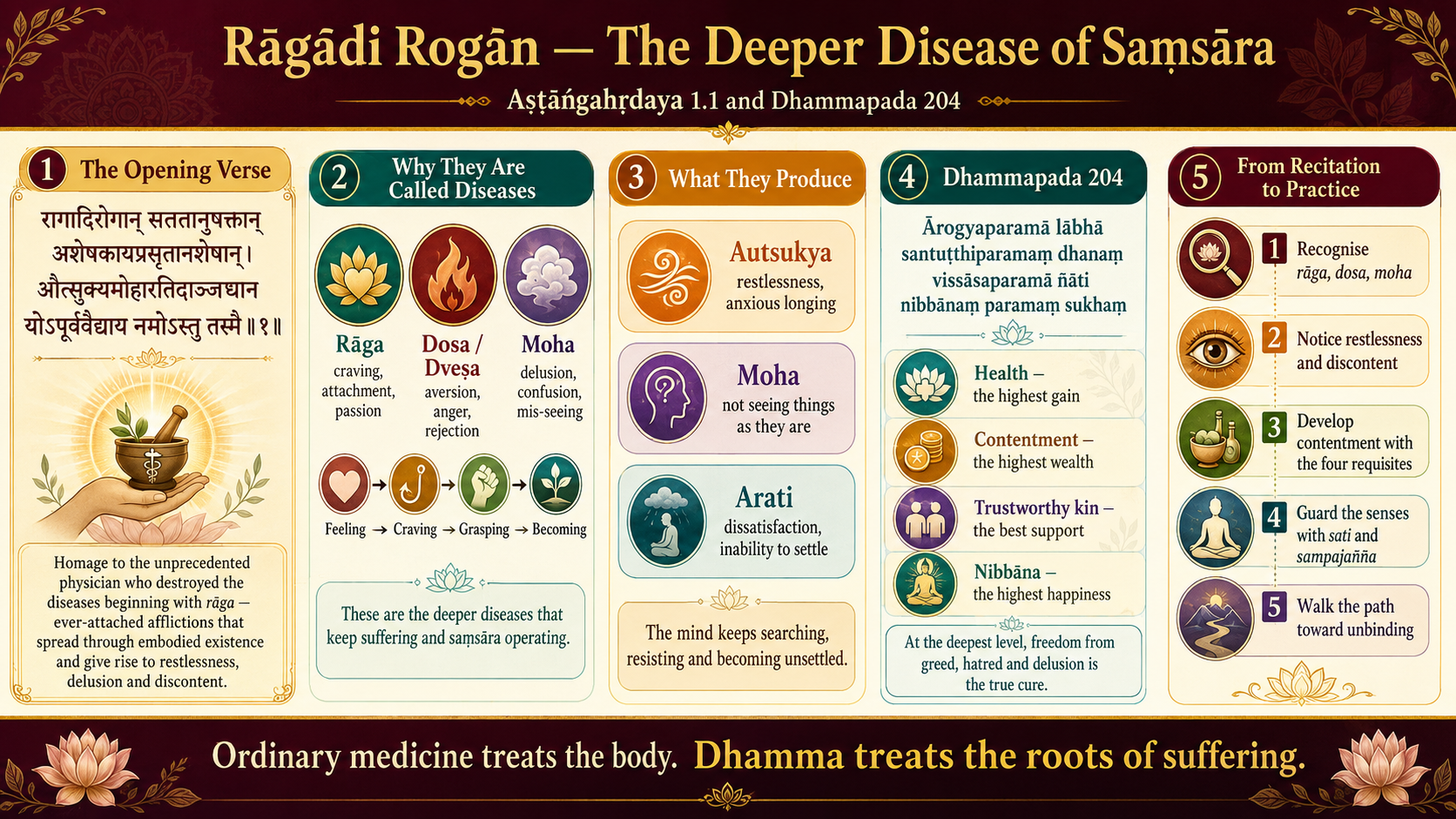 VISUAL SUMMARYSee this study in a pictureOpen the complete infographic for a visual overview before or after reading the full study.View infographic →
More Than a Maṅgalācaraṇa
Students of Ayurveda encounter the opening verse of Vāgbhaṭa’s Aṣṭāṅgahṛdaya almost immediately. It is traditionally recited as a maṅgalācaraṇa before the study or practice of medicine. Yet the depth of the verse can disappear behind the act of recitation itself.
The verse does not begin by praising a physician who cured fever, wounds or digestive disorders. Vāgbhaṭa bows to an apūrva vaidya — an extraordinary physician — who destroyed rāgādi rogā, the diseases beginning with rāga and associated mental afflictions.
This study does not claim that every physical disease is directly caused by rāga, dosa or moha. Physical illness arises through many bodily and environmental conditions. The deeper point is that rāga, dosa and moha are themselves diseases of the untrained mind and can turn bodily illness, ageing and loss into further grasping, resistance and suffering.
The Physician Behind the Aṣṭāṅgahṛdaya
Vāgbhaṭa is one of the most influential physicians of classical Ayurveda and is especially associated with the Aṣṭāṅgahṛdaya, the “Heart of the Eight Branches of Ayurveda.”
He is traditionally associated with a Buddhist intellectual and religious environment. Historical details about the different Vāgbhaṭas are debated, so the strongest evidence for the present study is the text itself: before discussing bodily treatment, Vāgbhaṭa bows to a physician who destroyed the deeper afflictions beginning with rāga.
That distinction is crucial. Ayurvedic medicine attends to the conditioned body. Buddha Dhamma investigates the deeper conditions by which attachment, becoming, birth, ageing and death continue.
The Extraordinary Physician
रागादिरोगान् सततानुषक्तान्
अशेषकायप्रसृतानशेषान्।
औत्सुक्यमोहारतिदाञ्जघान
योऽपूर्ववैद्याय नमोऽस्तु तस्मै॥१॥
Rāgādirogān satatānuṣaktān
aśeṣakāyaprasṛtānaśeṣān;
autsukyamohāratidāñ jaghāna
yo’pūrvavaidyāya namo’stu tasmai.
Natural meaning: Homage to that unprecedented physician who completely destroyed the diseases beginning with rāga — diseases that continually accompany beings and give rise to restless longing, delusion and dissatisfaction.
01Rāgādi — “Rāga and the Rest”
Rāgādi means “beginning with rāga.” Rāga colours experience through attraction and attachment; dosa or dveṣa pushes away what is disliked; moha prevents these movements from being seen clearly.
02Satatānuṣaktān — The Disease Keeps Accompanying Us
Fever comes and goes. A wound heals. Yet the pattern of wanting pleasant experience, resisting unpleasant experience and mis-seeing conditioned phenomena keeps recurring until its causes are removed.
03Jaghāna — Treatment Means Destruction of the Root
Jaghāna means destroyed or struck down. The extraordinary physician does not merely make symptoms temporarily disappear. The treatment reaches the underlying cause.
Deha, Śarīra and Kāya — A Body That Cannot Remain Still
Deha can be contemplated as that which is continually heated, consumed and transformed. Śarīra points to that which wears away and decays. Kāya is a collection or mass rather than one indivisible entity.
The body must be continually maintained with food, water, shelter, medicine and rest. Even perfect medical treatment cannot make it independent of conditions.
The deeper disease is therefore not the body itself, but ignorance and appropriation in relation to a conditioned body.
Why Rāga, Dosa and Moha Are Called Diseases
01Rāga — “I Must Have This”
Pleasant feeling arises and the mind moves from simple experience to possession: “I want this. I want more. I do not want this to end.” Because the object is conditioned, rāga carries the seed of fear, disappointment and renewed searching.
02Dosa / Dveṣa — “This Must Not Be”
When unpleasant experience arises, the mind can add resistance: “Why is this happening to me? This should not be happening.” Physical pain may require treatment, but mental aversion can create another layer of suffering around the first.
03Moha — Not Seeing What Is Actually Happening
Moha sees changing phenomena as if they could be secured, and conditioned processes as if they were “me” or “mine.” It quietly supports both attraction and rejection.
04Autsukya and Arati — Restlessness and Discontent
Autsukya is restless longing and anxious expectation. Arati is dissatisfaction and inability to settle. Together they keep the mind searching for another object, another condition, another becoming.
The progression can be seen clearly: contact → feeling → craving → grasping → becoming. Pleasant experience need not become rāga, unpleasant experience need not become dosa, and neutral experience need not remain covered by moha. But where ignorance remains, feeling readily becomes a launch point for craving.
Health, Contentment, Trust and Nibbāna
Ārogyaparamā lābhā,
santuṭṭhiparamaṃ dhanaṃ;
vissāsaparamā ñāti,
nibbānaṃ paramaṃ sukhaṃ.
Health is the highest gain.
Contentment is the highest wealth.
The trustworthy are the best kin.
Nibbāna is the highest happiness.
At the ordinary level, this is already profound. At the deeper level, the verse culminates in Nibbāna: not merely a better condition, but the ending of the fires and the conditions sustaining dukkha.
| Pāḷi | Direct Meaning | Practice Meaning |
|---|---|---|
| Ārogya | Health; freedom from illness | What would complete health of the mind mean? |
| Santuṭṭhi | Contentment | Freedom from the continual demand that conditions must provide something more. |
| Vissāsa | Trust, confidence | Relationship without fear, manipulation or constant defence. |
| Ñāti | Kinsman, relative | The verse says trustworthy companionship is the finest kinship. |
| Nibbānaṃ | Extinguishment; unbinding | The cessation of the fires and the conditions sustaining dukkha. |
What Does the Extraordinary Physician Actually Cure?
Ārogya literally means health or freedom from illness. The deeper Dhamma application is to ask what complete freedom from the mental afflictions would mean. It would not merely replace unpleasant thoughts with pleasant ones; it would mean greed, hatred and delusion no longer dictate one’s relationship with experience.
Santuṭṭhi becomes equally important. The practitioner uses food, clothing, lodging and medicine appropriately without making psychological completion dependent upon obtaining something superior.
Nibbāna is therefore not a better arrangement of the same disease. It is the ending of the conditions through which the disease continues.
| Medical Question | Dhamma | Meaning |
|---|---|---|
| What is the disease? | Dukkha | The pressure and unreliability of grasped conditioned existence. |
| What causes it? | Taṇhā supported by avijjā | Craving and ignorance keep appropriation and becoming operating. |
| Can it end? | Nirodha | The causes can cease. |
| What is the treatment? | Ariya Aṭṭhaṅgika Magga | The Noble Eightfold Path is undertaken and developed. |
| What is complete recovery? | Nibbāna | Not suppression of symptoms, but ending the underlying cause. |
Turning the Recitation Into Medicine
Recognise rāga — notice the movement from pleasant feeling to wanting, owning and repeating.
Recognise dosa — distinguish the actual unpleasant experience from the resistance constructed around it.
Recognise moha — notice when impermanent phenomena are treated as stable, controllable or as “me” and “mine”.
Develop santuṭṭhi — use the four requisites wisely without making completion depend upon them.
Establish sati and sampajañña — know what the mind is doing while walking, eating, speaking, working, resting and meditating.
SN 36.6 Sallasutta — The Second Arrow
The Buddha explains that when an uninstructed person is touched by painful bodily feeling, that person may then sorrow, grieve, lament, beat the breast and become distraught. It is as though the person has been struck by two arrows.
The first arrow is the bodily painful feeling itself. The second arrow is what the untrained mind adds through resistance, fear, grief, aversion and confusion.
The instructed noble disciple may still experience bodily painful feeling, but does not add the second mental arrow in the same way. This makes the Sallasutta a perfect companion to the present essay.
It also reveals the connection with rāga, dosa and moha: painful feeling can provoke aversion; in escaping pain the mind may seek sensual pleasure and thereby strengthen rāga; and when the nature of feeling is not understood, moha remains.
The body may be struck once; the untrained mind strikes itself again.