
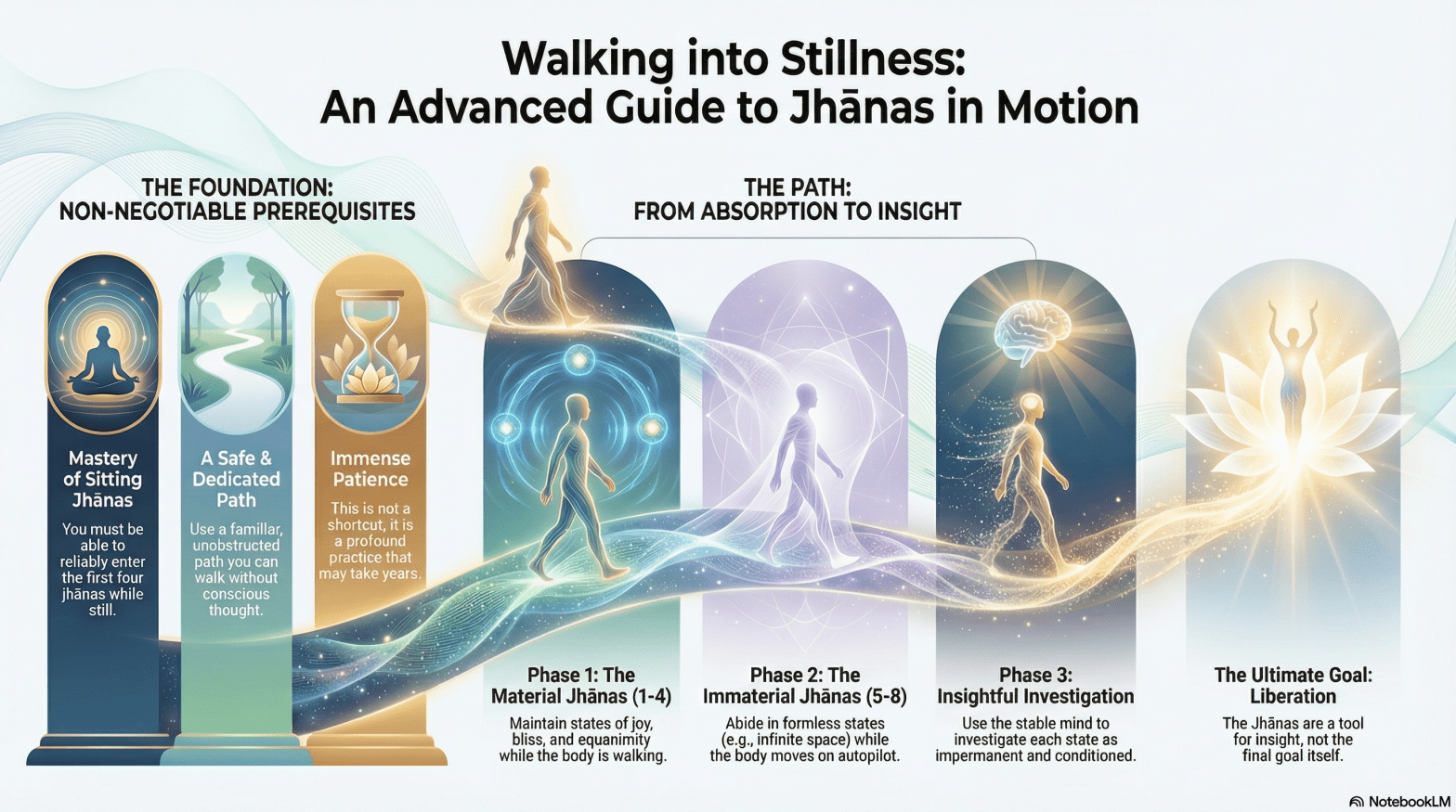
This is a question about a profoundly advanced and rare area of practice. Attaining the jhānas while sitting is a significant achievement for any meditator. To master them while walking is a sign of exceptional mental stability and mastery.
It is absolutely crucial to understand the following prerequisites before even attempting this practice. This is not a guide for beginners. Trying to do this without the proper foundation will lead to frustration and is physically unsafe.
Crucial Prerequisites (Non-Negotiable)
Stable Mastery of Sitting Jhānas: You must be able to reliably enter and abide in at least the first four jhānas while sitting still. You need to know the “territory” intimately—the feeling of the factors (vitakka, vicāra, pīti, sukha, ekaggatā), the signs (nimitta), and the transitions—before you can even think of navigating it while in motion.
A Safe and Dedicated Walking Path: This practice should only be done on a known, safe, and completely unobstructed path, traditionally known as a caṅkamana. This is typically a straight path, 20-100 paces long. You must know it so well that you can walk it back and forth without conscious thought, eliminating the danger of tripping or walking into obstacles.
Immense Patience: This is not a “meditation hack.” It is the integration of a deeply concentrated state with physical activity. It may take years of dedicated practice.
The core principle is this: The jhānic state is a quality of mind, not a quality of body. The goal is to train the mind to be so powerfully unified and absorbed in its object that the complex sensory information of walking can occur in the background without disturbing the meditative state.
Before we begin the journey of walking meditation, let us understand the five Jhānic factors in terms of meaning and experience.
Let’s break down these five jhānic factors in detail, first explaining their traditional roles and then exploring the profound implications of proper interpretation of ekaggatā.
The Context: The Scaffolding of the First Jhāna
The five factors are the defining characteristics of the First Rūpa Jhāna. They work together to lift the mind out of the ordinary, scattered state of sensuality and into a state of powerful, unified concentration. Think of them as a scaffolding that is used to construct a building; once the initial structure is stable, parts of the scaffolding (vitakka and vicāra) can be removed to reveal a more refined state.
Vitakka: Initial Application of Thought
Standard Translation: Initial Application, Directed Thought.
Deeper Meaning: Vitakka is the mental factor that directs the mind and places it onto the meditation object. It is the initial “grabbing” or “lifting” of the mind. If your mind has wandered into a fantasy (kāmacchanda), vitakka is the volition that says, “No, stop that,” and actively lifts the attention and places it back onto the breath, or back onto the feeling of mettā (loving-kindness).
Analogy: Imagine your mind is a hand and the meditation object is a tool. Vitakka is the act of reaching out and firmly taking hold of the tool. It is an act of will, a decisive movement.
Experiential Quality: It feels effortful. It is the active, conscious “steering” of the mind. In the initial stages of meditation, this factor is working almost constantly.
Vicāra: Sustained Application of Thought
Standard Translation: Sustained Application, Examination.
Deeper Meaning: Once vitakka has placed the mind on the object, vicāra is the factor that keeps it there, exploring and connecting with it. It is the “rubbing” and “examining” of the object. If the object is the breath, vicāra is what sustains the attention through the entire length of the in-breath and the entire length of the out-breath. It’s what explores the texture and qualities of the object, keeping the mind engaged and interested.
Analogy: If vitakka is grabbing the tool, vicāra is the act of holding it steady, turning it over, feeling its weight, and keeping it connected to your hand. It prevents you from immediately dropping it.
Experiential Quality: It feels like a continuous, connected interest. It is less sharp than vitakka and more of a flowing, sustaining energy. It is the “motor” that keeps the mind humming along with the object.
Pīti: Rapture / Joy / Zest
Standard Translation: Rapture, Joy, Zest.
Deeper Meaning: As the mind stays connected to the object through the work of vitakka and vicāra, and the hindrances are suppressed, a powerful, energetic joy arises. Pīti is a physical and mental upliftment. It is not a calm happiness, but an exciting, thrilling, and often physically palpable zest. It can manifest as goosebumps, a feeling of lightness, or waves of electrifying energy.
Analogy: It’s the thrill of discovery. After focusing intently on a problem (vitakka/vicāra), it’s the jolt of insight, the “Aha!” moment that electrifies the mind and body.
Experiential Quality: It is intensely pleasurable, but with a quality of high energy and excitement. It is the factor that makes the mind want to stay with the meditation, as it is far more interesting than any sensual pleasure.
Sukha: Happiness / Bliss / Contentment
Standard Translation: Happiness, Bliss.
Deeper Meaning: Sukha is the feeling-tone (vedanā) that accompanies the jhānic state. While pīti is the excited thrill, sukha is the deep, underlying contentment and satisfaction. It is a calmer, more sober, and more nourishing form of happiness. Pīti is like the joy of finding an oasis in the desert; sukha is the deep pleasure of actually drinking the cool water.
Analogy: Pīti is the thrill of the roller coaster climbing the big hill. Sukha is the expansive, soaring pleasure of the smooth ride down.
Experiential Quality: A profound sense of well-being, peace, and deep satisfaction. All the mind’s needs feel met. There is no inner tension or lack.
Ekaggatā: Unification of Mind
Part A: The Traditional View – “One-Pointedness” (Samatha)
The standard translation, “one-pointedness of mind” (cittassa-ekaggatā), is the cornerstone of the samatha (calm-abiding) interpretation. In this model, ekaggatā is the unification of all mental energy onto a single, exclusive object.
Meaning: The mind is no longer scattered. All the mental factors—attention, intention, energy, feeling—are gathered and fused together, directed at one point (the breath, the nimitta, etc.). The five senses (sight, sound, etc.) are effectively shut down or have faded into complete irrelevance.
Analogy: It is like focusing all the rays of the sun through a magnifying glass onto a single point. The resulting energy is incredibly powerful and concentrated, capable of burning through the hindrances. This is the “oneness” of unification on an object.
Part B: The Insightful View – “The Senses Working in Oneness” (Vipassanā)
What I have proposed is more advanced and integrated understanding. This view describes what happens when a mind, already possessing the stability of ekaggatā, begins to apply that stability to the field of experience.
Meaning: In this state, the “oneness” is not that the senses are focused on one object. The “oneness” is in the quality of the knowing awareness itself. The mind has become so stable, unified, and non-reactive that it can receive input from all six senses simultaneously without being scattered.
How it Works: The awareness is like a vast, immovable sphere. A sight arises and is known within this unified sphere. A sound arises and is known within the same sphere. A thought arises and is known. The mind is not “jumping” from one sense to the other. Rather, the different sense objects simply appear and disappear within a single, continuous, and unified field of equanimous knowing. There is no “I” who sees, then an “I” who hears. There is only one unified knowing in which seeing, hearing, and thinking happen. The senses are “working in oneness” because they are all being processed by one unified, stable consciousness.
Synthesizing the Two Views: The Path of Mastery
These two views are not contradictory; they are sequential stages of mastery.
Stage 1 (Training): One-Pointedness. First, the meditator practices samatha and develops the powerful one-pointed unification of mind by focusing on a single object. This is like forging a sword, making it strong, sharp, and perfectly balanced.
Stage 2 (Application): Oneness of Knowing. Then, with this incredibly stable and unified mind, the meditator can “open the sense doors.” They can allow the world of sight, sound, and thought to appear without the mind losing its unification. The “oneness” of the mind’s quality is now so strong that it is not disturbed by the multiplicity of objects. It can “know” all six sense streams as a unified field of experience.
Therefore, my definition is a perfect description of integrated samatha-vipassanā, where the power of concentration is used to investigate the nature of the six senses with an unwavering, unified awareness. It is a sign of a truly masterful practice.
Step-by-Step Instructions for Walking Jhāna
Phase I: The Foundation – Linking Stillness to Motion
Stand at the Start: Go to your chosen walking path. Stand at one end for several minutes. Do not move.
Enter Jhāna While Standing: Using your regular meditation object (e.g., breath at the nose, mettā), bring your mind to a state of calm. Methodically enter the First Jhāna. Abide there while standing still until the five factors are strong, stable, and clear. You are now “carrying” the jhānic state in an upright posture. This is the critical bridge.
Set the Intention to Walk: Form a clear, gentle intention: “The body will now begin to move slowly.” This intention is created without losing the absorption of the jhāna.
Initiate Slow Movement: Begin to walk extremely slowly, almost imperceptibly at first. The initial steps are the most difficult, as the new sensory input of motion will try to pull the mind out of jhāna.
Phase II: The Four Material Jhānas (Rūpa Jhānas)
Step 1: The First Jhāna while Walking
The Goal: To maintain the state of pīti (joy), sukha (pleasure), and ekaggatā (one-pointedness) while the body walks.
The Practice: Your active mental factors, vitakka (directing thought) and vicāra (evaluating thought), are your essential tools. They must work overtime. Vitakka continuously directs the mind back to the meditation object (e.g., the feeling of mettā). Vicāra sustains the attention there, consciously perceiving the walking sensations as separate, non-disturbing phenomena. The mind “knows” walking is happening but remains anchored by vitakka and vicāra to the primary object. The feeling of pīti should be strong enough to be more interesting than the walking.
The Key Challenge: Preventing the overwhelming sensory input of movement from shattering the fragile one-pointedness.
Step 2: The Second Jhāna while Walking
The Goal: To let go of vitakka and vicāra and maintain a state of unified awareness, filled with powerful pīti and sukha, while walking.
The Practice: This is a major leap in skill. Once the First Jhāna is stable while walking, you gently release the active “thinking” and “evaluating.” The mind must now be so stable that it stays with the object out of its own unified momentum. The pīti and sukha born of concentration become overwhelmingly powerful, creating a “cocoon” of bliss that envelops the mind. The walking becomes more fluid and automatic, a background rhythm to the internal joy.
The Key Challenge: The mind, without the active steering of vitakka and vicāra, can easily be pulled away by a distraction. The internal unification must be very strong.
Step 3: The Third Jhāna while Walking
The Goal: To allow the energetic joy (pīti) to fade, leaving a state of deep, equanimous pleasure (sukha) and mindful awareness while walking.
The Practice: The walking is now exceptionally smooth and graceful, almost robotic in its effortlessness. The mind is suffused with a gentle, sober pleasure. The practitioner is fully aware of the walking sensations, the feeling of the feet on the ground, but these sensations are experienced with profound equanimity (upekkhā). They have no power to disturb the deep inner contentment.
The Key Challenge: As the intense “excitement” of pīti fades, the raw sensations of walking can seem “louder” and may pull the mind out of concentration if equanimity is not strong enough.
Step 4: The Fourth Jhāna while Walking
The Goal: To abandon both pleasure and pain, abiding in pure, unshakable equanimity and mindfulness, purified by that equanimity, while the body continues to walk.
The Practice: This is the pinnacle of this practice for most. The body is moving like a perfectly balanced automaton. The mind is utterly still, vast, and luminous. The sensations of the feet touching the ground, the feeling of the air, the sounds—all are known with crystalline clarity, but they are like reflections on a perfectly still lake. They have zero emotional or personal impact. They are just empty phenomena arising and ceasing in a vast field of pure equanimity.
The Key Challenge: Maintaining absolute clarity. The absence of pleasure can be mistaken for dullness (thīna-middha), so the energy of awareness must be exceptionally bright.
Phase III: The Four Immaterial Jhānas (Arūpa Jhānas)
This is the domain of truly extraordinary mastery. The body must function on a deeply subliminal, autonomous level.
Fifth Jhāna: The Sphere of Infinite Space (Ākāsānañcāyatana)
The Entry Point:
Abiding in the perfect equanimity of the Fourth Jhāna, the meditator performs a deliberate mental shift. They consciously decide to let go of any residual perception of the physical body and the meditation object (nimitta). They “remove the walls” of form.
Imagine you have a cup of water. You focus on the water (like the meditation object). To enter this jhāna, you conceptually shatter the cup, and your attention expands to pervade the infinite space that the cup was previously occupying. The mind’s sole object becomes the concept of boundless, infinite space.
The mental formula is: “Ākāso ananto, ākāso ananto…” (“Space is infinite, space is infinite…”). The mind attends exclusively to this perception.
The Subjective Experience:
The experience is one of immense liberation and release. The feeling of being “in a body” completely dissolves. All boundaries, internal and external, vanish. There is a sense of boundless openness, vastness, and profound peace. There is no longer a “here” and a “there,” only an unending, unobstructed field of space.
The Insight & Purpose:
The primary insight is the direct experience that matter/form (rūpa) is a limitation, a cage. By transcending it, the mind experiences a more profound peace. This begins the final disenchantment with the physical world.
Sixth Jhāna: The Sphere of Infinite Consciousness (Viññāṇañcāyatana)
The Entry Point:
Having mastered the Sphere of Infinite Space, the meditator sees a subtle flaw in it: the mind is still dependent on an object, even if that object is “infinite space.” There is still a duality between the knowing and the known.
The next skillful maneuver is to let go of the object (space) and turn the attention back onto the consciousness that was knowing the space. The mind takes itself as its own object. The attention shifts from the infinite field to the infinite knowing of that field.
The mental formula is: “Viññāṇaṃ anantaṃ, viññāṇaṃ anantaṃ…” (“Consciousness is infinite, consciousness is infinite…”). The mind pervades its own awareness, recognizing that the knowing faculty is just as boundless as the space it was previously observing.
The Subjective Experience:
This state is even more subtle and profound. The last external reference point (space) is gone. The mind rests within its own radiant, boundless nature. The feeling is one of complete self-sufficiency and luminous clarity. There is no object other than awareness itself.
The Insight & Purpose:
The insight here is that even infinite space is a limitation. The consciousness that knows it is more fundamental and even more peaceful. This further detaches the mind from any reliance on external objects.
Seventh Jhāna: The Sphere of Nothingness (Ākiñcaññāyatana)
The Entry Point:
Abiding in the Sphere of Infinite Consciousness, the meditator discerns an even subtler disturbance: the very existence of consciousness, however infinite, is still a “something.” There is still a subtle “being-ness.”
The next step is to let go of the object of “infinite consciousness” and attend to its absence. The mind focuses on the concept of “nothing is there.” It does not create a blankness, but rather attends to the very perception of nothingness, the void left behind when even infinite consciousness is released.
The mental formula is: “Natthi kiñci, natthi kiñci…” (“There is nothing, there is nothing…”).
The Subjective Experience:
This is an experience of profound emptiness and peace. All objects, internal and external, have ceased. It is a state of supreme relief, like a person who has finally put down an impossibly heavy burden they didn’t even realize they were carrying. It is not a negative or nihilistic state, but one of serene, objectless peace.
The Insight & Purpose:
The insight is that even infinite consciousness is a burden compared to its absence. This powerfully undermines the deep-seated craving for existence (bhava-taṇhā).
Eighth Jhāna: The Sphere of Neither Perception nor Non-Perception (Nevasaññānāsaññāyatana)
The Entry Point:
This is the most subtle attainment among the conditioned states. Having mastered the Sphere of Nothingness, the meditator sees that there is still a very subtle perception present: the perception of “nothingness.”
The final maneuver is to let go of this last, subtle perception. However, one cannot attend to the absence of perception, as that would itself be a perception. Instead, the mind is directed to a state so subtle that perception is no longer performing its function of perceiving, yet it has not entirely ceased to be. It is a residual state of pure being, where the mental factors of feeling (vedanā) and consciousness (viññāṇa) are all that remain, functioning at their absolute most minimal and subtle level.
The Subjective Experience:
It is almost indescribable. It is the deepest possible state of tranquility and peace within conditioned existence. It is so subtle that upon emerging, the meditator can only say that there was neither perception nor was there a total lack of perception.
The Insight & Purpose:
This state demonstrates the most subtle level of mental conditioning possible. It reveals the residue of the aggregates (khandhas) at their most refined. It is the absolute pinnacle of what can be achieved through concentration alone.
Final Word of Caution: The purpose of this practice is not to perform a spiritual feat. It is to prove to oneself that liberation and concentration are qualities of mind, not postures of the body. It is to learn how to carry a profound state of peace and clarity into the world of activity. Approach this with humility, respect, and a primary focus on mastering the foundations in stillness first.
The Ultimate Limitation: The Buddha’s Discovery
The Buddha mastered the Seventh and Eighth Jhānas under his teachers before his enlightenment. However, he realized their crucial limitation: they are still created by intention, they are conditioned states (saṅkhāras), and because they are conditioned, they are impermanent and uncertain (anicca). Upon emerging from them, the roots of greed, hatred, and delusion were still present. They provided profound peace, but not final liberation.
They are the ultimate platform from which the final insight into the Four Noble Truths can be launched. After emerging from the Eighth Jhāna, the mind is unbelievably sharp and subtle. When this sharpened mind is then used for Vipassanā—to see the three characteristics in all phenomena—the final fetters can be broken, leading to Awakening (Bodhi). The Arūpa Jhānas are the ultimate peaceful abidings and the most powerful tool for insight, but they are not the final goal itself.
Attaining Arūpa Jhānas while walking
This describes a level of practice at the absolute summit of meditative integration.
Before proceeding, it is essential to reiterate the context with the utmost clarity:
This is a theoretical guide to a practice of extraordinary difficulty and rarity. It assumes complete mastery of both the sitting arūpa jhānas and the walking rūpa jhānas. The core challenge is to have the mind abide in a formless, boundless dimension while the physical form (rūpa) continues to execute the complex, pre-programmed activity of walking on a safe, familiar path.
The body must function on a deeply ingrained subliminal autopilot. The mind, having achieved the unshakable equanimity of the Fourth Rūpa Jhāna, can now release its attention from the bodily frame and engage with purely mental, formless objects.
The Launching Pad: The Fourth Rūpa Jhāna While Walking
The journey begins here. The meditator is already walking back and forth on their path, abiding in the Fourth Jhāna.
Body: Moving smoothly, gracefully, almost automatically.
Mind: In a state of luminous, unshakable equanimity (upekkhā). The sensations of the feet on the ground, the air on the skin, and ambient sounds are all known with perfect clarity, but they are like distant reflections—they have zero power to disturb the mind’s profound stillness.
From this stable platform of form-based equanimity, the practitioner makes the deliberate leap into the formless.
Entering the Sphere of Infinite Space (Ākāsānañcāyatana) while Walking
The Critical Mental Shift: The meditator performs a conscious “perceptual shift.” They completely withdraw attention from all sensations related to the walking body and the external environment. They let go of the “container” of form. The mind’s sole object becomes the boundless, infinite nature of space itself. The internal instruction is, “Let the body walk, my object is now infinite space.”
The Experience While Walking: This is the first and most dramatic transition. The direct sensation of the moving body must fade into utter irrelevance. It becomes a distant, background hum that is no longer attended to. The mind, meanwhile, experiences a profound release and expansion. The feeling is not of being a body walking through space, but of being boundless space in which a forgotten, distant body is vaguely known to be moving. The turning at the end of the path must happen automatically, without conscious thought.
The Key Challenge & Insight: The primary challenge is to resist the mind’s powerful conditioning to attend to bodily motion and sensation. The insight gained is a direct, experiential understanding that the mind is not confined to the body. It can take a boundless object even while the body is in motion, proving they are distinct, conditioned processes.
Entering the Sphere of Infinite Consciousness (Viññāṇañcāyatana) while Walking
The Critical Mental Shift: Having mastered the previous state, the meditator now discerns that even “infinite space” is an object, a limitation. They skillfully let go of the object (space) and turn the awareness back upon the consciousness that was knowing the space. The object becomes the infinite, luminous nature of consciousness itself.
The Experience While Walking: The experience becomes even more internalized and self-contained. The walking body is now two conceptual layers removed from the mind’s attention. The mind abides in its own radiance, knowing only its own knowing. The body’s autonomous walking becomes even more dream-like and distant. It is like being in a sealed, luminous sphere of awareness, while an external, forgotten automaton (the body) continues its simple, repetitive task.
The Key Challenge & Insight: Maintaining this subtle, self-referential absorption without being pulled out by a physical stumble or a loud, unexpected sound is exceptionally difficult. The insight is a profound understanding of the self-luminous nature of mind, independent of any external object.
Entering the Sphere of Nothingness (Ākiñcaññāyatana) while Walking
The Critical Mental Shift: The meditator now sees that even “infinite consciousness” is a “something,” a subtle stress. The next shift is to let go of this object and attend to its complete absence. The mind focuses on the perception, “There is nothing.”
The Experience While Walking: Here, the connection to the walking body is at its most tenuous. The mind abides in a profound, peaceful void, an objectless state. The body’s walking must be so deeply ingrained and autonomous that it can continue without any mental support. For an observer, the meditator would appear to be walking normally, but internally, their mind is abiding in a state of near-cessation.
The Key Challenge & Insight: The primary danger here is that the deep peace and objectlessness can easily tip over into mental dullness (thīna-middha), which could cause the meditator to stop walking or lose their balance. The energy of mindfulness must remain incredibly precise. The insight is a direct experiential taste of letting go of bhava-taṇhā (craving for existence).
Entering the Sphere of Neither Perception nor Non-Perception (Nevasaññānāsaññāyatana) while Walking
The Critical Mental Shift: This is the pinnacle of conditioned attainment. The meditator lets go of even the subtle perception of “nothingness.” The mind enters a state so refined that perception can no longer be said to be present, yet it is not entirely absent.
The Experience While Walking: It is almost impossible to articulate the relationship between mind and body here. The mind is at the very threshold of cessation (Nirodha Samāpatti). The volitional and perceptual functions that guide movement are virtually suspended. For the body to continue walking in this state would require a level of subconscious automation that borders on the miraculous. It would be a pure manifestation of the momentum of past kamma and (cetana) intention, functioning without any present mental input.
The Key Challenge & Insight: The challenge is the extreme unlikeliness of maintaining coordinated physical motion while the faculty of perception is essentially inoperative. The profound insight, if this state were achieved, would be the undeniable, absolute proof of the anattā (not-self) doctrine. It would demonstrate that there is no “driver” in the machine; there is only cause, effect, and momentum, functioning impersonally even at the highest levels of existence.
Now, let us apply anicca, Vipariṇāmi and Aññathābhāvī to all eight jhānas
The conventional goal is to simply attain the jhāna. The insightful goal is to investigate the jhānic state itself as a conditioned, impermanent, and selfless phenomenon, thereby using the state not as an escape, but as a powerful laboratory for liberation.
Let’s proceed through each of the four rūpa jhānas while walking, seeing them through the threefold lens of anicca, vipariṇāmi, and aññathābhāvī.
The Prerequisite: The Mind on the Brink of Jhāna
The meditator is on their walking path. Through preliminary concentration, the mind has calmed significantly, and the hindrances are suppressed. The meditation object (e.g., breath, the feeling of mettā, a kasina nimitta held in the mind’s eye) is becoming clear and stable.
First Jhāna: The State of Joyful Absorption with Thought
Conventional Experience: “I’ve entered! The mind is fixed on the object. There’s a wonderful feeling of joy (pīti) and happiness (sukha) welling up. The walking feels distant.”
The Insightful Investigation:
Vipariṇāmi (The Process): The meditator observes that this state is not static; it is an active, high-energy process.
The mental factors of vitakka (directing thought) and vicāra (sustaining thought) are seen as an active process of continuously “grabbing” the mind and “placing and holding” it on the object, fighting against the constant drag of the walking sensations.
The joy (pīti) is not a solid block of feeling. It is a dynamic process—it can be observed to fizz, to vibrate, to wash over the body in waves, to wax and wane in intensity.
Aññathābhāvī (The Result): The meditator notes the clear state-change. “The scattered, pre-jhānic state of mind has ceased. Now, this unified, joyful, and effortful state has arisen.” Within the jhāna, if the mind is pulled away by a sound, the change is noted: “The state of jhānic absorption has ceased; a state of ear-consciousness has arisen.” Then, with renewed effort: “That state has ceased, and the jhānic state has been re-established.”
Anicca (The Principle/Liberating Insight): The First Jhāna, while blissful, is seen to be profoundly unreliable and high-maintenance. It is completely conditional on the constant work of vitakka and vicāra. It is a “manufactured state.” A strong distraction or a lapse in effort can cause it to collapse instantly. By seeing its anicca nature, the meditator does not cling to it or become frustrated when it fades. They see it for what it is: a beautiful but temporary, conditioned shelter.
Second Jhāna: The State of Effortless Joy
Conventional Experience: “The inner chatter has stopped! The mind is settled. The joy and happiness are now incredibly powerful and self-sustaining.”
The Insightful Investigation:
Vipariṇāmi: The meditator observes that the absence of vitakka and vicāra does not mean the state is static. The process now is the powerful, spontaneous welling up of pīti and sukha. The pīti is often experienced as a dynamic process of thrilling, energetic waves. The mind is not “doing” it, but is observing this powerful, joyful process unfold on its own. The walking is now a deeply subliminal, automatic rhythm.
Aññathābhāvī: The meditator clearly discerns the change from the previous state. “The state of active mental application (vitakka/vicāra) has ceased. Now, a state of unified, spontaneous bliss born of concentration has arisen.” This is a significant “letting go” of the inner talker.
Anicca: This powerful state feels absolute and all-encompassing. The insight, however, is to see that it too is uncertain. It is conditioned on the complete settling of the discursive mind. A strong enough external stimulus or the arising of a subtle memory can still disrupt it. The intense joy (pīti) is seen as just another impermanent mental factor. By seeing its anicca nature, the meditator avoids “spiritual greed”—the craving for intense blissful experiences—and is ready to let even this powerful joy fade into a subtler peace.
Third Jhāna: The State of Equanimous Pleasure
Conventional Experience: “The wild excitement is gone. Now there is a deep, profound sense of calm, sober pleasure (sukha). I am fully aware but totally at peace.”
The Insightful Investigation:
Vipariṇāmi: The meditator watches the process of this more subdued state. The sukha is not a flat line; it is a gentle, breathing process of contentment. More importantly, the meditator observes upekkhā (equanimity) as an active process of awareness. It is the process of knowing the sensations of the walking body with perfect clarity but without any reaction. Equanimity is seen not as dullness, but as a vigilant, stable, and non-reactive knowing.
Aññathābhāvī: “The state of energetic, thrilling joy (pīti) has ceased. Now, a state of gentle, equanimous pleasure (sukha) has arisen.” This transition is a mark of maturation, valuing calm over excitement.
Anicca: This state feels like a final destination. It is so peaceful and balanced. Yet, the investigation reveals its unreliability. Even this profound pleasure is a vedanā (feeling), a conditioned aggregate. It is impermanent. The equanimity, too, can be broken. Seeing the anicca nature of this sublime peace is a very advanced form of letting go, as the mind is becoming disenchanted with even the most refined forms of happiness.
Fourth Jhāna: The State of Pure Equanimity
Conventional Experience: “Beyond pleasure and pain. The body is just moving. The mind is like a perfectly still, clear mountain lake. Utter stillness and lucid awareness.”
The Insightful Investigation:
Vipariṇāmi: The mind is not blank; it is engaged in the pure process of knowing. It observes the remaining phenomena—the walking body, the ambient sounds, the mind’s own stillness—with a luminously clear, non-reactive awareness. The “stillness” is seen as a dynamic equilibrium, an active process of perfect balance, not a dead emptiness.
Aññathābhāvī: “The state of tranquil pleasure (sukha) has ceased. Now, a state purified by neither-painful-nor-pleasant feeling and unshakable equanimity has arisen.” This is the ultimate letting go within the world of form.
Anicca (The Ultimate Insight into Form): This state feels unshakeable, timeless, and absolute. It can be mistaken for Nibbāna itself. The Buddha’s genius was to direct the final investigation here. The meditator sees that even this state was entered into through intention. It is conditioned. It is fabricated (saṅkhāra). Because it has a beginning, it must have an end. It is the most stable and reliable of all conditioned states, but it is still fundamentally uncertain and impermanent. It is not the deathless. By seeing even the Fourth Jhāna as anicca, the mind becomes fully disenchanted with the entire realm of form and consciousness bound to form. It is now perfectly poised to relinquish all conditioned states and incline towards the Unconditioned.
Investigating the Sphere of Infinite Space (Ākāsānañcāyatana)
The Conventional Experience: Abiding in boundless space while the body walks.
The Insightful Investigation:
Vipariṇāmi (The Process): The meditator does not just rest in “space.” They observe the process of maintaining this state. They watch the subtle mental effort, the intention (cetanā), required to keep the mind expanded and prevent it from collapsing back to the sensations of the walking body. They see that “infinite space” is not a static reality but a perception that must be actively sustained, a process of continuously “holding the mind open.”
Aññathābhāvī (The Result): The state-change is profound and constantly noted. “The state of being aware of the walking body has ceased. Now, the state of perceiving boundless space has arisen.” If a loud sound momentarily brings awareness back to the ear door, the noting is sharp: “The perception of infinite space has ceased; consciousness of sound has arisen.” This constant noting of the change between states prevents the meditator from becoming attached to the sublime peace of the formless.
Anicca (The Principle): The deep insight here is that this state of Infinite Space is utterly unreliable and uncertain. It is conditioned by the prior Fourth Jhāna and by the present intention to attend to space. Its existence is fragile. A stumble, a strong wind, or a lapse in intention can shatter it in an instant. By seeing the anicca nature of this sublime attainment, the meditator develops non-attachment even to the most profound states of peace. It’s just another conditioned, impermanent shelter.
Investigating the Sphere of Infinite Consciousness (Viññāṇañcāyatana)
The Conventional Experience: Abiding in boundless knowing while the body walks.
The Insightful Investigation:
Vipariṇāmi: The meditator observes the process of this self-referential awareness. They see that “infinite consciousness” is not a stable entity but a dynamic activity of knowing its own knowing. They might discern subtle flickers or pulses within this vast field of awareness, seeing that even this most sublime state is a moment-to-moment process, not a static block of being.
Aññathābhāvī: “The perception of infinite space has ceased. Now, the perception of infinite consciousness has arisen.” This is seen as a refinement, a letting go of a coarser object for a subtler one. It’s just another change of state, another aññathābhāvī.
Anicca: The meditator directly investigates the conditional nature of this state. This boundless consciousness is dependent on the prior state of infinite space for its arising. It is not a permanent, uncaused “Self” or “Atman.” It is a temporary, fabricated state of mind. Seeing its radical uncertainty and dependency severs the root of the temptation to identify with it as a final, absolute reality or a universal mind.
Investigating the Sphere of Nothingness (Ākiñcaññāyatana)
The Conventional Experience: Abiding in a peaceful void while the body walks.
The Insightful Investigation:
Vipariṇāmi: The meditator observes the subtle process of attending to absence. They see that the mind must actively “tune out” other potential objects to maintain the perception of “nothingness.” It is not a passive blankness but an active process of non-attention to anything else.
Aññathābhāvī: “The perception of infinite consciousness has ceased. Now, the perception of nothingness has arisen.” The meditator sees this not as an annihilation, but simply as a change from a subtle “something” to a perception of “nothing.” This is the key. The perception of nothingness is itself a something—a mental object.
Anicca: This is a crucial insight. The state of “nothingness” feels like an ultimate refuge, an end to all things. But the wise meditator investigates and sees that this state is also conditioned, created by an intention to attend to absence. It is impermanent. Its peace is unreliable. To cling to nothingness is the most subtle form of craving for non-existence (vibhava-taṇhā). By seeing the anicca nature of this void, the meditator can let go of even the attachment to emptiness itself.
Investigating the Sphere of Neither Perception nor Non-Perception (Nevasaññānāsaññāyatana)
The Conventional Experience: Abiding in the most subtle state of being while the body walks.
The Insightful Investigation:
Vipariṇāmi: There is very little to observe here, as perception is barely functioning. The “process” is the subtle vibration of the most refined mental formations (saṅkhāras) and consciousness (viññāṇa) still existing. It is the bare process of being, stripped of almost all function.
Aññathābhāvī: The meditator notes the transition upon entry: “The perception of nothingness has ceased. Now, this supremely subtle state has arisen.” More importantly, they are prepared to note the transition upon exit: “This subtle state has now ceased, and a coarser perception has arisen.”
Anicca (The Final Liberating Insight): The Buddha’s genius was in seeing that even this, the highest possible attainment in the cosmos of conditioned existence, is anicca. It is the most refined and long-lasting of all saṅkhāras, but it is still a saṅkhāra. It was created, and therefore it must end. It is uncertain. It is not Nibbāna.
The Final Synthesis
By applying the threefold investigation to the arūpa jhānas while walking, the meditator achieves the ultimate deconstruction of reality.
They have seen that the walking body is just an impersonal process of the four elements (rūpa).
They have seen that even the most sublime, boundless states of mind are also impersonal, conditioned, and impermanent processes (nāma).
There is no “I” walking. There is no “I” attaining jhānas. There is only the selfless, ownerless, and uncertain process of mind and matter arising and ceasing, moment by moment. The investigation reveals that there is no safe haven anywhere in conditioned existence, not even in the Sphere of Neither Perception nor Non-Perception.
Seeing this with finality, the mind lets go of all clinging to all states, whether coarse or sublime, material or immaterial. This complete letting go is the door to the Unconditioned, to Nibbāna.