
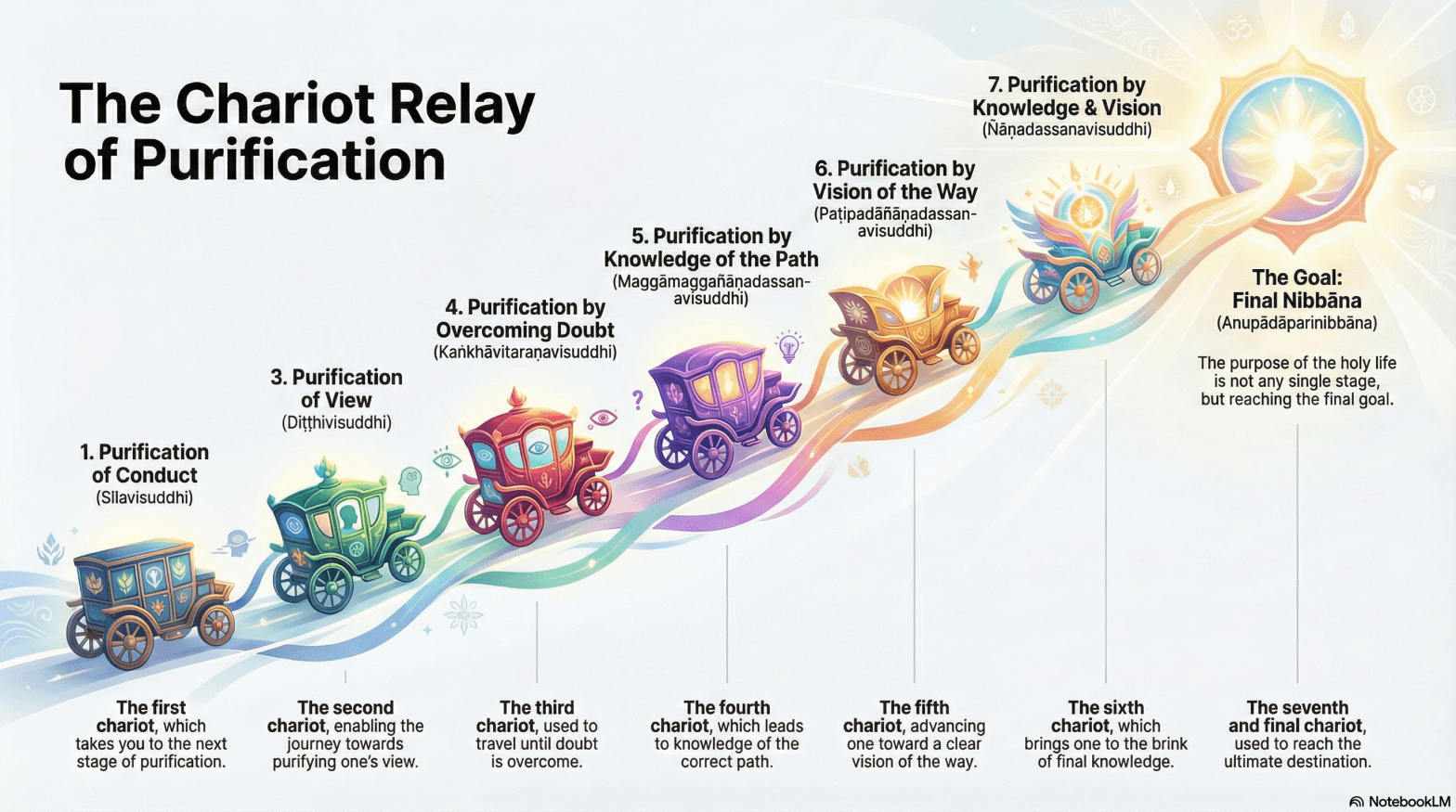
Let us go over Path to Purification and how the gradual training works in Buddha’s dispensation. The sutta which is most suitable for this purpose is Rathavinītasutta(MN24). This sutta, whose title translates to “The Relay Chariots,” features a profound dialogue between two of the Buddha’s most esteemed disciples: the Venerable Sāriputta and the Venerable Puṇṇa Mantāṇiputta. The conversation meticulously dissects the ultimate purpose of the holy life (brahmacariya) as taught by the Buddha.
Sīlavisuddhi: The Purification of Virtue
Sīlavisuddhi, or the “purification of virtue,” is the first of the seven stages of purification (satta visuddhi). It is the essential and indispensable foundation upon which the entire structure of the Buddhist path is built. In the analogy of the Rathavinīta Sutta, this is the very first relay chariot one must ride. Without successfully completing this stage, progress to the subsequent stages of mental purification and insight is impossible.
The Meaning and Purpose of Sīlavisuddhi
Sīla refers to morality, ethical conduct, and discipline. Visuddhi means purification. Therefore, sīlavisuddhi is the purification of one’s actions, specifically those of body, speech and mind
Eventhough, there is common belief in 5 or 8 precepts for lay and fourfold purification of virtue (Catupārisuddhi-sīla) for monks, it is removal of 10 immoral deeds that is the starting point of purifying the mind which gets into the next step.
The Ten Courses of Unwholesome Action (Dasa Akusala Kamma-patha)
These ten actions are considered “unwholesome” (akusala) because they are rooted in the mental defilements of greed (lobha), hatred (dosa), and delusion (moha), and they lead to suffering for both oneself and others. They are categorized by the “door” through which the action is committed: body, speech, or mind.
Sīlavisuddhi is the active, intentional process of purifying one’s conduct by abstaining from these ten actions.
Three Unwholesome Actions of the Body (Kāya-kamma)
1. Taking Life (Pāṇātipāta): The intentional killing of any living, breathing being. This is directly covered by the First Precept.
2. Taking What is Not Given (Adinnādāna): Stealing or taking possession of something that has not been freely given. This is directly covered by the Second Precept.
3. Sexual Misconduct (Kāmesumicchācāra): Engaging in sexual acts that cause harm, involve coercion, or break commitments (like adultery). This is directly covered by the Third Precept.
Four Unwholesome Actions of Speech (Vacī-kamma)
1. False Speech (Musāvāda): Intentionally speaking what is not true to deceive others. This is directly covered by the Fourth Precept.
2. Slanderous/Divisive Speech (Pisuṇā-vācā): Speaking with the intention of creating enmity and splitting people apart. This is a more specific aspect of Right Speech, which is the positive counterpart to the Fourth Precept.
3. Harsh Speech (Pharusā-vācā): Using abusive, scornful, angry, or hurtful language that wounds others’ feelings.
4. Idle Chatter (Samphappalāpa): Pointless, frivolous, and useless talk that wastes one’s own time and that of others. It lacks purpose and depth.
Three Unwholesome Actions of the Mind (Mano-kamma)
1. Covetousness (Abhijjhā): An intense, acquisitive desire for something that belongs to another, thinking, “Oh, may this be mine!” It is greed focused into a specific wish to possess.
2. Ill Will (Vyāpāda): Malice or the active wish for another being to suffer, be harmed, or be destroyed. It is the active form of hatred.
3. Wrong View (Micchā-diṭṭhi): This is considered the most serious of the ten because it is the root of the others. It is the deluded view that denies the fundamental laws of reality, such as:
Denying the efficacy of giving and generosity.
Denying the law of kamma (that wholesome and unwholesome actions have corresponding results).
Denying that there is a next life.
Denying the existence of enlightened beings who have realized the truth for themselves.
How this Relates to Sīlavisuddhi
Content vs. Practice: The Ten Unwholesome Actions are the content that makes conduct impure. Sīlavisuddhi is the practice of purifying oneself by abandoning this content.
Precepts as Training Rules: The Five Precepts are the practical, foundational training rules one undertakes to specifically guard against the most immediate and socially disruptive of these actions (the three bodily actions and the most direct verbal action of lying). By training with the Five Precepts, one is implicitly working against the first four of the ten unwholesome deeds.
Bridging to Mind Purification: You’ll notice the last three actions are purely mental. While the intention to avoid them is part of sīlavisuddhi, the actual purification of the mind from greed, hatred, and delusion is the primary work of the next stage, Cittavisuddhi (Purification of Mind), through meditation. However, the commitment to not acting on these mental states is where sīla holds the line. For example, you may feel ill will (a mental action), but sīla is what stops you from turning it into harsh speech or physical violence (verbal and bodily actions).
In summary, when we speak of Sīlavisuddhi, we are speaking precisely of the purification of the bodily and verbal “doors” of action, which means a direct abstention from the first seven of the ten unwholesome deeds. This creates the stability needed to then turn inward and purify the mind of the final three. They are two sides of the same coin: the Ten Unwholesome Actions are the problem, and Sīlavisuddhi is the solution.
The immediate purpose of virtue is not to “be good” in a conventional sense, but to create a mind free from the heat of remorse and guilt. The Buddha lays out a direct causal sequence in the Kimatthiya Sutta (AN 10.1):
“For one who is virtuous, O monks, for one who has perfected virtue, there is no need for an act of will, ‘May freedom from remorse arise in me.’ It is a natural law that freedom from remorse arises in a virtuous person.”
This freedom from remorse (avippaṭisāra) is the soil from which joy, tranquility, and concentration naturally grow. A mind agitated by guilt cannot become calm.
The Practice (from the Suttas)
The Suttas detail this practice as the “restraint of the Pātimokkha” for monastics and the observance of the Five or Eight Precepts for lay practitioners. Crucially, it extends beyond mere rules to include sense restraint (indriya saṃvara). As described in the Sāmaññaphala Sutta (DN 2), when a monk “sees a form with the eye, he does not grasp at its signs or features,” preventing the arising of craving and displeasure.
Practical Steps:
Undertake the Precepts: Formally commit to the relevant precepts (e.g., the five: abstaining from killing, stealing, sexual misconduct, lying, and intoxicants).
Guard the Sense Doors: Practice mindfulness at the point of contact between your senses and the world. When you see, hear, or feel something pleasant or unpleasant, notice the initial contact without immediately reacting with desire or aversion.
Cultivate Right Livelihood: Ensure your work does not harm others and aligns with your ethical principles, preventing inner conflict.
Regularly Review Your Conduct: Briefly reflect at the end of the day, not to cultivate guilt, but to reinforce your commitment and understand where heedfulness may have lapsed.
Cittavisuddhi (Purification of Mind)
Cittavisuddhi, or the “purification of mind,” is a crucial stage in the Buddha’s recommended path to liberation. It is the second of the seven stages of purification (satta visuddhi) and represents the sustained effort to cleanse the mind of defilements. This practice is not an end in itself but serves as the essential foundation for developing wisdom and insight. The achievement of cittavisuddhi is primarily accomplished through the practice of unification of mind meditation (samatha bhāvanā)
The Foundation for Purification of Mind
Before one can effectively purify the mind, a necessary prerequisite is the purification of virtue (sīlavisuddhi). This initial stage involves the dedicated observance of moral discipline, such as working out to remove ten immoral deeds and the more extensive Vinaya rules for monastics. By cultivating ethical conduct in speech and action, one creates an inner environment of stability and non-remorse, which is conducive to the deeper work of meditation.
The Practice of Concentration Meditation (Samatha Bhāvanā)
The core of cittavisuddhi is the development of profound states of mental calm and unification known as samādhi. This is achieved through samatha meditation, where the practitioner trains the mind to rest upon a single object, thereby suppressing the mental hindrances that agitate and obscure the mind.
The Five Hindrances (Pañca Nīvaraṇāni): The primary obstacles to be overcome in this practice are:
1. Sensual Desire (kāmacchanda): The longing for pleasant sights, sounds, smells, tastes, and bodily sensations.
2. Ill Will (vyāpāda): Feelings of anger, hostility, resentment, and aversion.
3. Sloth and Torpor (thīna-middha): Mental dullness, lethargy, and sleepiness.
4. Restlessness and Worry (uddhacca-kukkucca): An agitated mind and feelings of anxiety or regret.
5. Skeptical Doubt (vicikicchā): Uncertainty about the path, the teacher, or one’s own ability to practice.
Meditation Techniques:
To overcome these hindrances and cultivate concentration, a practitioner focuses on a chosen meditation object. There are forty classical meditation subjects (kammaṭṭhāna), with mindfulness of breathing (ānāpānasati) being one of the most common and universally applicable.
The practice of ānāpānasati involves:
1. Finding a suitable posture: Sitting in a quiet place with a straight back in a comfortable and stable position.
2. Focusing on the breath: Bringing gentle and sustained attention to the sensation of the breath entering and leaving the body, typically at the tip of the nostrils or the abdomen.
3. Observing without judgment: When the mind wanders, as it inevitably will, the instruction is to gently acknowledge the distraction without self-criticism and then skillfully guide the attention back to the breath.
The States of creating oneness in mind
As the practice of concentration deepens, the mind becomes progressively more serene and unified. This leads to two significant levels of achieving samādhi:
Access Concentration (upacāra-samādhi): At this stage, the five hindrances are temporarily suppressed, and the mind becomes clear, calm, and focused. This level of concentration is considered a sufficient foundation to begin the practice of insight meditation (vipassanā).
Absorption Concentration (appanā-samādhi): With continued practice, one can enter the jhānas, which are profound states of meditative absorption characterized by intense bliss, tranquility, and one-pointedness of mind. The attainment of the jhānas represents a very high degree of mental purification.
The Role of Cittavisuddhi in the Overall Path
As highlighted in the Rathavinīta Sutta, the purification of mind is not the final goal. Rather, cittavisuddhi is for the sake of the next stage, the purification of view (diṭṭhivisuddhi). A mind that is calm, clear, and free from the distortion of the hindrances is the necessary instrument for investigating the true nature of reality. With a purified mind, a practitioner can undertake insight meditation to see directly the three characteristics of all phenomena: impermanence (anicca), suffering (dukkha), and not-self (anattā).
In essence, cittavisuddhi is the pivotal transition from the outer discipline of morality to the inner cultivation of wisdom. It is the process of sharpening the mind into a tool capable of cutting through ignorance and achieving the ultimate goal of liberation.
Practical Steps:
1. Seek Seclusion: Find a quiet place conducive to meditation, as advised by the Buddha, “having gone to the forest, to the root of a tree, or to an empty hut.” which need not be literal, but objective is to empty the mind and focus on the breath.
2. Establish a Meditation Posture: Sit with the body erect and establish mindfulness “in front of you.”
3. Focus on a Meditation Object: Use the breath (ānāpānasati) as the anchor. Simply observe the natural process of breathing in and out without controlling it.
4. Work with the Hindrances: When a hindrance like desire or restlessness arises, recognize it by name. The Suttas recommend various strategies, such as contemplating the unattractive aspects of an object of desire or cultivating loving-kindness (mettā) to counteract ill will.
5. Cultivate Unification: As the hindrances subside, the mind naturally becomes joyful (pīti) and happy (sukha). Nurture these states, allowing the mind to unify on the breath, leading towards access concentration and, potentially, the absorptions of jhāna.
Diṭṭhivisuddhi (Purification of View)
Diṭṭhivisuddhi, or the “purification of view,” is the third of the seven stages of purification (satta visuddhi) and marks the beginning of true insight (vipassanā) on the Buddha’s path for liberation. It is a pivotal stage where the practitioner moves from conceptual understanding to the direct, experiential knowledge of the fundamental nature of existence.
The Purpose of Diṭṭhivisuddhi
The primary goal of diṭṭhivisuddhi is to overcome wrong views, specifically the “identity view” (sakkāya-diṭṭhi). This is the deeply ingrained, instinctual belief in a permanent, independent “self,” “soul,” or “I” that exists as the owner of the body and mind. Purification of view means replacing this illusion with the correct understanding of reality as it is.
This stage directly addresses the core ignorance (avijjā) that is the root cause of suffering. By seeing things as they truly are, the practitioner begins to dismantle the very foundation of craving and clinging.
The Prerequisites for Diṭṭhivisuddhi
As detailed in Rathavinīta Sutta and commentary of Visuddhimagga (The Path of Purification), diṭṭhivisuddhi is not an isolated practice. It depends entirely on the successful cultivation of the preceding two stages:
Sīlavisuddhi (Purification of Virtue): A foundation of ethical conduct is necessary to create a mind free from remorse, guilt, and agitation, making it suitable for deeper concentration.
Cittavisuddhi (Purification of Mind): Through concentration meditation (samatha), the mind is trained to be calm, focused, and free from the five hindrances. This purified, stable consciousness is the essential tool needed to perform the analytical work of insight. A scattered, agitated mind cannot see reality clearly.
The Practice of Diṭṭhivisuddhi: Analyzing Mind and Matter
Diṭṭhivisuddhi is accomplished through the analytical contemplation of one’s own existence in terms of mind-and-matter or name-and-form (nāma-rūpa). This involves methodically breaking down the conventional idea of a “person” into its ultimate, impersonal components.
Rūpa (Matter or Form): This refers to the physical dimension of existence. In meditation, the practitioner analyzes the body not as a solid entity but as a collection of the four primary elements (mahābhūta):
Earth element (paṭhavī-dhātu): The quality of hardness, softness, and solidity.
Water element (āpo-dhātu): The quality of cohesion and fluidity.
Fire element (tejo-dhātu): The quality of heat and cold.
Wind element (vāyo-dhātu): The quality of motion, pressure, and support.
By observing these elemental qualities directly, the concept of a “body” dissolves into a dynamic process of impersonal physical phenomena.
Nāma (Mind or Name): This refers to the mental dimension of existence, which is further broken down into its component parts, often categorized as the mental aggregates (khandhas):
Feeling (vedanā): Pleasant, painful, and neutral sensations.
Perception (saññā): The identification and labeling of objects.
Mental Formations (saṅkhārā): Volitional activities, thoughts, intentions, and emotions.
Consciousness (viññāṇa): The bare awareness of an object through the six sense doors (eye, ear, nose, tongue, body, and mind).
The meditator observes these mental and physical phenomena as they arise and pass away from moment to moment. They see that consciousness arises dependent on a sense object and a sense organ, that feelings arise from sense contact, and so on.
The Outcome of Diṭṭhivisuddhi
Through this sustained, analytical meditation, the practitioner comes to the direct and unshakeable realization that:
“There is only mind-and-matter, and there is no person, being, or self to be found apart from this combination of mind-and-matter.”
This is not a philosophical deduction but a direct, experiential seeing. Life is understood as an impersonal, conditioned process of mental and physical phenomena arising and ceasing.[5] The deeply-held belief “I am” is seen to be a conceptual error.
With this purified view, the meditator is ready to proceed to the next stage, Kaṅkhāvitaraṇavisuddhi (Purification by Overcoming Doubt), where they will investigate the causal relationships between these mental and physical phenomena. Diṭṭhivisuddhi lays the crucial groundwork by correctly identifying what exists, before the subsequent stages explore why it exists.
The Practice (from the Suttas)
The quintessential text is the Anattalakkhaṇa Sutta (SN 22.59). Here, the Buddha systematically dismantles the notion of self by guiding the five monks to investigate the Five Aggregates (khandhas): form, feeling, perception, mental formations, and consciousness. He asks them of each:
“Is it permanent or impermanent?”
“And is that which is impermanent, suffering, and subject to change fit to be regarded thus: ‘This is mine, this I am, this is my self’?”
Another powerful tool is the contemplation of the Six Sense Bases as described in the Ādittapariyāya Sutta (The Fire Sermon, SN 35.28), where all sense experiences are seen as “burning” and not-self.
The Pheṇapiṇḍūpama Sutta (SN 22.95) provides vivid similes: form is like a lump of foam, feeling like a bubble, perception like a mirage, formations like a banana tree trunk (with no core), and consciousness like a magic trick.
Practical Steps:
Stabilize the Mind: Attain the clear, calm state from Stage 2.
Deconstruct the “I”: Take up one of the five aggregates, for example, the body (form). Instead of seeing a solid “body,” investigate its elemental qualities: hardness (earth), cohesion (water), temperature (fire), and motion/pressure (wind). See that “body” is just a concept for these changing processes.
Investigate Mental Aggregates: Observe a feeling as it arises. See it simply as “feeling,” not “my feeling.” Note its pleasant, unpleasant, or neutral quality and watch it change and vanish. Do the same for thoughts, perceptions, and moments of awareness.
Apply the Three Questions: For each observed phenomenon, ask internally: Is this permanent? Is it truly satisfying? Is it me or mine? The answer, seen directly, will always be “no.” This insight is the purification of view.
Kaṅkhāvitaraṇavisuddhi: The Purification by Overcoming Doubt
Kaṅkhāvitaraṇavisuddhi is the fourth stage of purification (satta visuddhi) on the Buddha’s path to liberation. The name translates to “purification by crossing over or overcoming doubt.” Having established a correct view of reality as an impersonal process of mind-and-matter (nāma-rūpa), the practitioner now moves to understand why this process unfolds as it does. The goal is to eradicate all doubt about one’s existence across the three periods of time—past, present, and future.
The Foundation for Overcoming Doubt
This stage builds directly and inseparably upon the preceding ones:
Sīlavisuddhi (Purification of Virtue): Provides the moral stability.
Cittavisuddhi (Purification of Mind): Provides the clear, concentrated mind.
Diṭṭhivisuddhi (Purification of View): Provides the correct identification of the objects of investigation—mind and matter.
Without first seeing what exists (mind-and-matter), one cannot possibly understand why it exists (its causes and conditions). Diṭṭhivisuddhi answers the “what,” while Kaṅkhāvitaraṇavisuddhi answers the “why.”
The Practice: Discerning Conditions (Paccaya-Pariggaha-Ñāṇa) Ref: Visuddhimagga
The core of this practice is the development of the Knowledge by Discerning Conditions (Paccaya-pariggaha-ñāṇa). The meditator uses their purified mind to investigate and directly see the causal relationships that govern the arising of mind-and-matter. This is the experiential realization of the principle of Dependent Origination (Paṭiccasamuppāda).
The practitioner observes, moment by moment, how:
Mind causes Matter: The intention (nāma) to lift an arm causes the physical movement of the arm (rūpa).
Matter causes Mind: A sound (rūpa) makes contact with the ear organ (rūpa), giving rise to auditory consciousness (nāma).
Mind causes Mind: A sensory contact (nāma) gives rise to a feeling (nāma), which can give rise to a perception (nāma) and then craving (nāma).
Matter causes Matter: The physical body (rūpa) is sustained and conditioned by food (rūpa).
By repeatedly seeing these causal links in their own immediate experience, the meditator understands that nothing arises without a cause. Everything is part of a dynamic, interconnected web of conditions.
Overcoming the Sixteen Doubts
The successful practice of discerning conditions leads to the dispelling of what the classical texts call the “sixteen doubts.” These doubts revolve around the notion of a persistent “self” existing through time:
Doubts about the Past:
Did I exist in the past?
Did I not exist in the past?
What was I in the past?
How was I in the past?
Having been what, what did I become in the past?
Doubts about the Future:
Will I exist in the future?
Will I not exist in the future?
What will I be in the future?
How will I be in the future?
Having been what, what will I become in the future?
Doubts about the Present:
Am I?
Am I not?
What am I?
How am I?
Where has this being come from?
Where will it go?
By seeing that “I” am nothing more than a flow of conditioned mind-and-matter, these questions become obsolete. There was no static “I” in the past, only a process of causes and effects. There is no “I” now, only a present process conditioned by the past. And there will be no “I” in the future, only a continuing process conditioned by the present. The doubt is “crossed over” because its very premise—the existence of a self to be doubtful about—has been experientially deconstructed.
The Outcome and Significance
Upon the completion of Kaṅkhāvitaraṇavisuddhi, the practitioner’s understanding is firm.
They are free from all perplexity regarding their own nature.
They see that existence is simply a process of causes producing effects, and those effects becoming causes for new effects.
Their conviction in the law of kamma (intentional action and its results) becomes unshakeable, as they have seen it in operation.
This doubt-free understanding of reality as a conditioned flow prepares the meditator for the next crucial stage: Maggāmaggañāṇadassanavisuddhi (Purification by Knowledge and Vision of What is Path and Not-Path). It is from this clear and stable perspective that the universal characteristics of impermanence (anicca), suffering (dukkha), and not-self (anattā) will begin to reveal themselves with profound clarity.
The Practice (from the Suttas)
This is the experiential understanding of Dependent Origination (Paṭiccasamuppāda). The Vibhaṅga Sutta (SN 12.2) and many others lay out the formula: “With this as a condition, that arises. With the cessation of this, that ceases.” The practitioner applies this to their own stream of consciousness. They see directly how a sensory contact conditions a feeling, how that feeling conditions a craving, and how that craving conditions clinging, and so on.
Practical Steps:
Identify a Phenomenon: Observe a single mind-state, e.g., a moment of anger (a mental formation).
Trace its Origin: Investigate what conditioned its arising. You might see it was triggered by an unpleasant feeling, which was triggered by a harsh sound (contact), which arose because the ear sense base met a sound object.
Trace its Effect: Observe what this anger, in turn, conditions. It might lead to vengeful thoughts, bodily tension, or harsh speech.
Generalize the Principle: By repeatedly seeing these specific causal links, you develop an unshakeable, direct knowledge that all of existence is an impersonal, conditioned flow. The question “Who am I?” is replaced by “What conditions this?” All doubt about a “self” that exists or doesn’t exist is resolved.
Maggāmaggañāṇadassanavisuddhi: Purification by Knowledge and Vision of What Is Path and Not-Path
This is the fifth of the seven stages of purification (satta visuddhi). The name translates to “purification by knowledge and vision that correctly distinguishes between the path and what is not the path.” At this stage, the meditator’s insight becomes exceptionally sharp and powerful, giving rise to extraordinary mental phenomena. The crucial task is to avoid mistaking these impressive side-effects for the true path or for enlightenment itself.
The Foundation for This Stage
The practitioner enters this stage with a firm, experiential understanding from the previous purifications:
Sīlavisuddhi & Cittavisuddhi: A stable, pure, and concentrated mind.
Diṭṭhivisuddhi: Direct knowledge that existence is only mind-and-matter (nāma-rūpa).
Kaṅkhāvitaraṇavisuddhi: Direct knowledge that mind-and-matter arise from specific causes and conditions (Paṭiccasamuppāda).
Building on this foundation, the meditator now begins to contemplate the three universal characteristics (tilakkhaṇa) of all phenomena:
Impermanence (Anicca): Seeing the constant, moment-to-moment arising and passing away of all mental and physical states.
Suffering (Dukkha): Realizing that anything impermanent is ultimately unsatisfactory and cannot provide lasting happiness.
Not-Self (Anattā): Understanding that these transient, conditioned phenomena are devoid of any permanent, controlling self or soul.
This practice is known as Knowledge by Comprehending Formations (Sammāsana-ñāṇa).
The Arising of “What Is Not the Path”: The Ten Corruptions of Insight (Vipassanūpakkilesa)
As the meditator’s insight into the three characteristics deepens, their mind becomes exceptionally clear and powerful. This gives rise to ten brilliant, but potentially misleading, experiences known as the “corruptions of insight.” These are not “bad” in themselves; they are natural signs of progress. The corruption lies in becoming attached to them and wrongly concluding, “This is it! I have reached the goal.”
The ten corruptions are:
Illumination (Obhāsa): A brilliant light, sometimes like a flash of lightning or a radiant star, appears in the mind.
Knowledge (Ñāṇa): A sharp, clear, and very quick intellectual understanding arises.
Rapture (Pīti): Intense waves of bliss, joy, and delight wash over the body and mind.
Tranquility (Passaddhi): A profound sense of calm and serenity that pacifies both body and mind.
Happiness (Sukha): A subtle, deep, and pervading sense of contentment and well-being.
Resolution (Adhimokkha): An extremely strong faith and confidence in the practice and the teachings.
Exertion (Paggaha): Energy becomes perfectly balanced, neither too tense nor too lax, feeling effortless.
Assurance (Upaṭṭhāna): Mindfulness becomes exceptionally strong, clear, and established.
Equanimity (Upekkhā): A powerful state of mental balance and detachment towards all experiences.
Attachment (Nikanti): A subtle, refined delight or craving for these nine preceding experiences. This final corruption is the one that grasps onto the others.
Distinguishing the Path from the Not-Path
The meditator is now at a crossroads.
The Not-Path (Amagga): This is the road of attachment. The meditator thinks, “This light, this bliss, this equanimity is enlightenment.” They cling to the experience, develop craving for it, and their practice of observing the three characteristics stalls.
The Path (Magga): The wise meditator, perhaps with the guidance of a teacher, recognizes these experiences for what they are: mere signposts. They understand, “This light is not me, not mine. This bliss is impermanent. This equanimity is conditioned.” They then let go of any attachment and return their attention to the primary task: the bare, unwavering observation of the arising and passing of mind-and-matter.
The Outcome of This Purification
The successful completion of Maggāmaggañāṇadassanavisuddhi is a sign of great maturity in the practice. The meditator has developed the “knowledge of the arising and passing away of phenomena” (Udayabbaya-ñāṇa) to its mature phase. They are no longer fooled by spiritual fireworks. Their vision is now clear, and they are firmly established on the true path of insight.
This purification ensures that the journey is not derailed by the seductive allure of blissful states. The practitioner is now ready to progress to the next stage, Paṭipadāñāṇadassanavisuddhi (Purification by Knowledge and Vision of the Way), which constitutes the true, unwavering, and direct highway of insight leading towards final liberation.
The Practice (from the Suttas)
The practice is to apply the same principle of insight to these refined states. Even the most sublime bliss must be seen through the lens of the three characteristics. One must recognize that these experiences, however wonderful, are still conditioned, impermanent (anicca), and therefore ultimately unsatisfactory (dukkha) and not-self (anattā). The true path is the continued, detached observation of all phenomena, while the not-path is clinging to any experience along the way.
Practical Steps:
Recognize the Phenomenon: When a powerful experience like a brilliant inner light (obhāsa) or intense rapture (pīti) arises, mindfully acknowledge its presence without becoming excited or attached.
Apply the Three Characteristics: Immediately subject the experience to investigation. “This light… is it permanent? Can I keep it forever? Is it me? Is it mine?”
Discern Path from Not-Path: Conclude: “This is a conditioned phenomenon, a pleasant fruit of my practice, but it is not the goal. Clinging to it is the not-path. Letting it go and continuing to observe reality is the path.”
Return to the Primary Task: Gently release the attachment and bring your attention back to the bare observation of the arising and passing of mind-and-matter.
Paṭipadāñāṇadassanavisuddhi: Purification by Knowledge and Vision of the Way
This is the sixth of the seven stages of purification (satta visuddhi). The name translates to “purification by the knowledge and vision of the course of practice” or “the way.” This stage comprises the heart of insight meditation (vipassanā) itself. It is not a single moment but a progressive journey through a sequence of specific insights that directly lead to the threshold of enlightenment.
Having overcome the “ten corruptions of insight” in the previous stage, the meditator is now firmly established on the authentic path. Their practice is no longer sidetracked by blissful or extraordinary states. Their sole focus is the clear, unwavering observation of the three characteristics (tilakkhaṇa) of mind-and-matter.
The Practice: The Progression of Insight Knowledges (Vipassanā-Ñāṇa)
This purification consists of a series of nine distinct, sequential insight knowledges. The meditator experiences them in this fixed order as their understanding of reality deepens and becomes progressively more refined.
Knowledge of Arising and Passing Away (Udayabbaya-ñāṇa): This is the mature phase of the knowledge that began in the previous stage. The practitioner now clearly and continuously sees the momentary arising and ceasing of all mental and physical phenomena, free from any of the corruptions.
Knowledge of Dissolution (Bhaṅga-ñāṇa): The focus shifts almost exclusively to the passing away, the dissolution, the ceasing of phenomena. The mind sees everything as constantly breaking apart and vanishing. The experience is like watching bubbles pop or flashes of lightning disappear. The arising aspect becomes less prominent.
Knowledge of Fearfulness (Bhaya-ñāṇa): Seeing this universal, relentless dissolution of everything one identifies with—body, thoughts, feelings—gives rise to a profound sense of fear or terror. All conditioned existence appears as a perilous, unstable trap with no safe ground to stand on.
Knowledge of Danger (Ādīnava-ñāṇa): The initial terror matures into a clear perception of the inherent misery and danger in all formations. The practitioner sees all of conditioned existence—every world, every life—as fundamentally flawed, like a house on fire or a pit of glowing embers.
Knowledge of Disenchantment (Nibbidā-ñāṇa): This deep seeing of danger leads to a profound disenchantment or weariness. It is not emotional depression, but a wise turning away from the conditioned world, much like a swan prefers a clear lake to a dirty puddle. The allure of samsara fades completely.
Knowledge of the Desire for Deliverance (Muñcitukamyatā-ñāṇa): Arising from this disenchantment is an urgent and powerful aspiration to be free, to escape the cycle of conditioned phenomena. It is the mind’s deep yearning for the peace of the Unconditioned (Nibbāna).
Knowledge of Re-observation (Paṭisaṅkhā-ñāṇa): Spurred by this desire to escape, the practitioner re-examines the three characteristics with renewed vigor. They reflect again on the impermanent, suffering, and selfless nature of all things to find the exit. It is a final, decisive investigation.
Knowledge of Equanimity towards Formations (Saṅkhārupekkhā-ñāṇa): This is the climax of mundane insight. After the intense urgency and investigation, the mind settles into a state of profound, unshakable equanimity. It can observe the dance of arising and passing phenomena with perfect balance, free from both aversion and delight. The mind is like a person who has divorced their spouse and can now watch them without any emotional reaction. It is at this peak that the insight is fully mature, powerful, and ready for the final transition.
Knowledge in Conformity with Truth (Anuloma-ñāṇa): This is the final moment of insight on the mundane path. It is the “gateway” knowledge that adapts or conforms the mind to the supramundane truth of the Four Noble Truths that is about to be realized. It is the last “run-up” before the leap into Nibbāna.
The Outcome and Significance
The completion of Paṭipadāñāṇadassanavisuddhi places the practitioner at the very doorstep of enlightenment. They have traversed the entire landscape of insight and purified their vision of the path to the highest possible degree. Their mind is now perfectly poised, like a key turning in a lock, ready for the final stage.
This purification is the “path” in the truest sense of the word. It directly prepares the meditator for the next and final stage: Ñāṇadassanavisuddhi (Purification by Knowledge and Vision), which is the direct experience of the supramundane path and fruition, the moment of stream-entry (or a higher stage of awakening).
The Practice (from the Suttas)
This involves the relentless and deepening contemplation of the three characteristics across all experience. This is no longer a preliminary investigation but a powerful, continuous seeing of reality as a ceaseless, unsatisfactory, and selfless flux. The Girimananda Sutta (AN 10.60) lists key perceptions to be developed here, including the perception of impermanence, not-self, danger, and disenchantment with the whole world.
Practical Steps:
Deepen the Perception of Impermanence: Focus intently on the dissolution (bhaṅga) of phenomena. See everything as constantly vanishing, moment by moment.
See the Inherent Danger: As you see the ceaseless dissolution of everything you hold dear, a clear knowledge of the fearfulness and danger (ādīnava) of conditioned existence arises. Don’t shrink from this insight.
Cultivate Disenchantment: Allow the wisdom of disenchantment (nibbidā) to mature. This is not a state of depression, but a cool, clear turning away from that which is unstable and unreliable.
Develop Equanimity (Upekkhā): As disenchantment deepens, the mind settles into a state of profound balance. It can watch the entire drama of samsara unfold without being perturbed, like a man watching a play he knows is just a fiction. This powerful equanimity is the immediate gateway to awakening.
Ñāṇadassanavisuddhi: The Purification by Knowledge and Vision
This is the seventh and final purification (satta visuddhi). The name translates to “purification by means of knowledge and vision,” and it represents the direct, supramundane (lokuttara) experience of enlightenment itself. All the previous six purifications have been the meticulous preparation of the path; this stage is the arrival at the destination.
While the previous stages involved developing insight into the conditioned world (saṅkhāra-loka), Ñāṇadassanavisuddhi is the momentary transcending of that world to realize the Unconditioned—Nibbāna.
The Culmination of the Path
This purification arises as a direct result of the preceding stage. The Knowledge of Equanimity towards Formations (Saṅkhārupekkhā-ñāṇa) and the Knowledge in Conformity with Truth (Anuloma-ñāṇa) have matured the meditator’s insight to its peak. The mind is now perfectly poised and ready to leap from the mundane (lokiya) to the supramundane (lokuttara).
This purification itself consists of the supramundane path knowledge (magga-ñāṇa). It is not a prolonged state but a single, revolutionary moment of consciousness that irrevocially changes the practitioner. This moment, and its immediate results, unfolds in a fixed cognitive series:
Change-of-lineage Knowledge (Gotrabhū-ñāṇa): This is the transitional mind-moment that marks the boundary. For the very first time, the mind lets go of conditioned phenomena as its object and takes the Unconditioned, Nibbāna, as its object. In this instant, the practitioner ceases to be an ordinary person (puthujjana) and enters the lineage of the Noble Ones (ariya).
Path Knowledge (Magga-ñāṇa): Immediately following the change-of-lineage, the supramundane Path Knowledge arises. This is the actual “Knowledge and Vision” that defines this purification. With Nibbāna as its object, this powerful moment of consciousness simultaneously performs four functions:
It fully comprehends the truth of suffering (dukkha).
It abandons the truth of the origin of suffering (craving, samudaya).
It realizes the truth of the cessation of suffering (Nibbāna, nirodha).
It develops the truth of the path (magga).
At the level of a stream-enterer (Sotāpanna), this path moment eradicates the first three fetters (saṃyojana): identity view, doubt, and attachment to rites and rituals.
Fruition Knowledge (Phala-ñāṇa): Immediately after the path moment, two or three moments of Fruition Knowledge arise. This is the immediate result or “fruit” of the path. It also has Nibbāna as its object, but its function is simply to experience the peace and sublime relief of the liberation that was just attained.
Reviewing Knowledge (Paccavekkhaṇa-ñāṇa): After the supramundane process ends, the mind reverts to a mundane level and reflects upon the experience. The newly awakened Noble One reviews: the Path they walked, the Fruit they experienced, the Nibbāna they realized, the fetters they have destroyed, and the fetters that remain (if any).
The Outcome and Its Relation to the Final Goal
The completion of Ñāṇadassanavisuddhi constitutes awakening. The practitioner has become a Noble One (at least a Stream-enterer) and is no longer capable of falling back to the state of an ordinary person. Their final liberation within a limited number of future lives is now assured.
This process is repeated for the higher stages of awakening:
The path of the Once-returner (Sakadāgāmī) weakens the fetters of sensual desire and ill will.
The path of the Non-returner (Anāgāmī) fully eradicates these two fetters.
The path of the Arahant (Arahatta) eradicates the final five fetters, including conceit, restlessness, and ignorance.
It is crucial to connect this back to the Rathavinīta Sutta. The ultimate goal stated in the sutta is Anupādāparinibbāna—final Nibbāna without any clinging remaining. The Ñāṇadassanavisuddhi of an Arahant is the final relay chariot. It is the direct cause for attaining that final goal. Having reached Arahantship through this purification, the Arahant lives out the remainder of their life span. Upon the death of their body, since all causes for rebirth (clinging and kamma) have been destroyed, they attain anupādāparinibbāna.
Thus, the seven purifications are the complete and sufficient means, with each stage serving the next, all for the sake of the knowledge and vision of an Arahant, which in turn leads to the ultimate and final cessation of all suffering.
The Practice (from the Suttas)
This is not a “practice” in the conventional sense but the irrevocable result of the perfection of the previous stage. The mind, poised in perfect equanimity, lets go completely. At this moment, described in the Dhammacakkappavattana Sutta (SN 56.11), the “stainless, immaculate vision of the Dhamma” arises: “Whatever is subject to origination is all subject to cessation.”
The result is liberation, and the knowledge of that liberation. The newly awakened being declares, as countless Arahants do in the Suttas:
“Destroyed is birth, the holy life has been lived, what had to be done has been done, there is no more for this state of being.”
Practical Steps:
This stage is beyond volitional steps. It is the natural culmination of the path.
Perfection of Equanimity: The previous stage is brought to its absolute peak.
The Leap: The mind lets go of all conditioned things and, for a single moment, takes the Unconditioned (Nibbāna) as its object. This is the supramundane path moment (magga-ñāṇa).
The Fruit: This is immediately followed by moments of fruition (phala-ñāṇa), experiencing the peace of that attainment.
The Knowledge of Liberation: The practitioner knows that the fetters have been broken and that a fundamental transformation has occurred. This is the final purification, the chariot that has arrived at the ultimate destination.