

Let us first visit what sutta explains on nama & rupa: Definition from SN 12.2 (Paṭiccasamuppāda Vibhaṅga): “Katamañca, bhikkhave, nāmarūpaṁ?
Cattāro ca mahābhūtā, catunnañca mahābhūtānaṁ upādāya rūpaṁ— idaṁ vuccati rūpaṁ.
Vedanā, saññā, cetanā, phasso, manasikāro— idaṁ vuccati nāmaṁ.
Iti idaṁ nāmañca rūpañca—idaṁ vuccati nāmarūpaṁ.”
| Term | Meaning |
|---|---|
| Cattāro mahābhūtā | The four great elements: earth (pathavī), water (āpo), fire (tejo), air (vāyo) |
| Upādāya rūpaṁ | Rūpa derived from the four great elements (form, body, sense organs) |
| Rūpaṁ | Materiality (not consciousness) |
| Vedanā | Feeling (pleasant, painful, neutral) |
| Saññā | Perception (recognizing name, color, shape, etc.) |
| Cetanā | Volition (intending, choosing, will) |
| Phasso | Contact (meeting of sense, object, and consciousness) |
| Manasikāro | Attention (directing awareness) |
| Nāma | Mentality (these five together) |
🟨 Thus, nāma is a set of 5 mental factors; rūpa is physical form including the four elements and derivative forms.
Rūpa (As per SN 12.2) as per below
| Element | Sutta-based Description |
|---|---|
| Cakkhu (eye) | Sense base dependent on rūpa. |
| Rūpa (form) | Visible shape (the snake’s form). |
| Light and pathavī-tejo-vāyo-āpo | The four great elements and derived forms like skin, movement, shadow. |
| Upādāya rūpa | The conditioned physical form made from the elements. |
Nāma (As per SN 12.2)
| Nāma Factor | What happens in this experience |
|---|---|
| Phasso | Eye contacts form → contact arises. |
| Vedanā | Fearful or unpleasant feeling. |
| Saññā | “That’s a snake!” — perception labels. |
| Cetanā | Intention arises: “Run!” |
| Manasikāro | Mind turns fully to that object. |
🟩 These five together make up nāma — what knows, feels, intends, directs.
📌 Nāma gives conceptual structuring. Rūpa is known through that conceptual structuring.
The two are mutually dependent.
👉 Therefore “name-and-form” is itself a naming — a formal label for this mutually dependent cognitive field.
👉 Even the distinction between “name” and “form” is itself a convenient designation (paññatti).”Yena yena hi maññanti tato taṁ hoti aññathā” (MN 113)
→ “However they conceive it, thus it becomes otherwise.”
📌 Rūpa is not an independently existing thing
👉 The deep point is: What we call “form” (rūpa) is actually: Conceptually perceived
Dependent upon phassa → which itself depends on nāma–rūpa
Not “an object out there” existing independently 👉 Hence “rūpa is a nominal form”: It is a perceptual appearance. Constructed through ākāra, liṅga, nimitta, uddesa (DN 15). Labeled and known only via nāma.
Let’s take Mahatanhasankhayasutta(MN38) and see how it works:
‘Saḷāyatanaṃ cidaṃ, bhikkhave, kiṃnidānaṃ kiṃsamudayāṃ kiṃjātikāṃ kiṃpabhavṃ?
Saḷāyatanaṃ nāmarūpanidānaṃ nāmarūpasamudayāṃ nāmarūpajātikāṃ nāmarūpapabhavaṃ
| Pāli Term | Translation | Meaning |
|---|---|---|
| Saḷ-āyatanaṁ | The six sense bases | Eye, ear, nose, tongue, body, mind — with their respective objects |
| Kiṁ-nidānaṁ? | What is their root cause or origin? | What is the condition from which they arise as origin? |
| Kiṁ-samudayaṁ? | What causes their arising? | What leads to their arising? |
| Kiṁ-jātikaṁ? | Of what kind of birth? | What do they arise from, as a mode of generation? |
| Kiṁ-pabhavaṁ? | What is their coming into existence? | What do they emerge out of as a manifestation? |
| → Answer: | ||
| Nāmarūpa-nidānaṁ | They are rooted in nāma–rūpa | The six bases arise because nāma–rūpa exists |
| Nāmarūpa-samudayaṁ | Arise when nāma–rūpa arises | No nāma–rūpa, no saḷāyatana |
| Nāmarūpa-jātikaṁ | They are “born from” nāma–rūpa | They are generated as nāma–rūpa develops |
| Nāmarūpa-pabhavaṁ | They emerge as expression of nāma–rūpa | They manifest with it as condition |
🧠 Concrete Example: A Child Being Born and Learning to Perceive
Stage 1: Nāma–rūpa develops
In the womb or early infancy, there’s an evolving psycho-physical process.
Rūpa: The body forms (eye, ear, brain, heart, etc.).
Nāma: Primitive perception, contact, and rudimentary response to sensation (screaming when hungry, calm when held).
At this stage, there is nāma–rūpa: a flow of feeling, perception, contact, and body structure — no clear sense bases functioning fully yet.
Stage 2: Saḷāyatana arises
When nāma–rūpa matures, the six sense bases become functionally distinct.
Sense Base How it manifests from Nāma–Rūpa
Eye -> The child opens eyes, forms visible objects. The eye base functions with awareness.
Ear -> Sound is registered, and the child reacts. Auditory base emerges.
Nose, Tongue, Body Senses of smell, taste, and touch begin to operate.
Mind base -> Mental processing (of memory, emotion, etc.) begins to take shape from nāma evolution.
Thus, nāma–rūpa matures → sense bases arise — now there is an entire field of experience open for contact (phassa), feeling (vedanā), craving (taṇhā), and so on.
🔁 Mutual Dependency: Nāmarūpa ⇆ Viññāṇa → Saḷāyatana
Viññāṇa supports nāma–rūpa: Consciousness must be present for nāma–rūpa to continue.
Nāma–rūpa conditions saḷāyatana: The sense bases develop as the body–mind complex evolves.
When all six bases are established, phassa (contact) can occur, giving rise to experience.
📌 Summary Table:
| Term | Sutta Definition | Living Example |
|---|---|---|
| Nāma–rūpa | Feeling, perception, intention + body | Infant’s growing body and awareness |
| Saḷāyatana | Six sense bases (eye, ear, etc.) | The infant opening eyes, hearing sounds, etc. |
| Causal Link | Nāma–rūpa is the nidāna (source) for saḷāyatana | Once nāma–rūpa matures, the six bases function |
Let us proceed to understand nama-rupa taking DN15 – Mahānidānasutta especialy the section relating to nama-rupa
‘Nāmarūpapaccayā phasso’ti iti kho panetaṁ vuttaṁ, tadānanda, imināpetaṁ pariyāyena veditabbaṁ, yathā nāmarūpapaccayā phasso.
Yehi, ānanda, ākārehi, yehi liṅgehi, yehi nimittehi, yehi uddesehi nāmakāyassa paññatti hoti, tesu ākāresu, tesu liṅgesu, tesu nimitte tesu uddesesu asati, api nu kho rūpakāye adhivacanasamphasso paññāyetha?”
“No hetaṁ, bhante.”
“Yehi, ānanda, ākārehi, yehi liṅgehi, yehi nimittehi, yehi uddesehi rūpakāyassa paññatti hoti, tesu ākāresu, tesu liṅgesu, tesu nimitte tesu uddesesu asati, api nu kho nāmakāye paṭighasamphasso paññāyetha?”
“No hetaṁ, bhante.”
“Yehi, ānanda, ākārehi, yehi liṅgehi, yehi nimittehi, yehi uddesehi nāmakāyassa ca rūpakāyassa ca paññatti hoti, tesu ākāresu, tesu liṅgesu, tesu nimitte tesu uddesesu asati, api nu kho adhivacanasamphasso vā paṭighasamphasso vā paññāyetha?”
“No hetaṁ, bhante.”
“Yehi, ānanda, ākārehi, yehi liṅgehi, yehi nimittehi, yehi uddesehi nāmarūpassa paññatti hoti, tesu ākāresu, tesu liṅgesu, tesu nimitte tesu uddesesu asati, api nu kho phasso paññāyetha?”
“No hetaṁ, bhante.”
“Tasmātihānanda, eseva hetu, etaṁ nidānaṁ, esa samudayo, esa paccayo phassassa, yadidaṁ nāmarūpaṁ.”
“‘Conditioned by nāma–rūpa is contact (phassa),’ this, Ānanda, has been said.
Now, Ānanda, it should be understood in this way, how it is that contact arises dependent on nāma–rūpa.
Suppose, Ānanda, the shape (ākāra), features (liṅga), sign (nimitta), and verbal designations (uddesa) by which the concept of a nāma-kāya (the mental body) is established — if those forms, features, signs and designations were absent, could verbal-contact (adhivacana-samphassa) occur with regard to the rūpa-kāya (physical body)?”
“Certainly not, venerable sir.”
“Suppose, Ānanda, the forms, signs, features, and designations by which the concept of a rūpa-kāya (physical body) is established — if those were absent, could resistance-contact (paṭigha-samphassa) occur with regard to the nāma-kāya (mental body)?”
“Certainly not, venerable sir.”
“Suppose, Ānanda, the forms, signs, features, and designations by which both the nāma-kāya and rūpa-kāya are established — if those were absent, could either verbal-contact or resistance-contact occur?”
“Certainly not, venerable sir.”
“Suppose, Ānanda, the forms, signs, features, and designations by which nāma–rūpa itself is established — if those were absent, could any contact (phassa) occur?”
“Certainly not, venerable sir.”
“Therefore, Ānanda, this is the cause, the source, the arising, and the condition for contact (phassa) — that is to say, nāma–rūpa.”
Let us understand key terms:
ākāra literally means shape, form, mode of appearance — it can also mean manner or configuration.
liṅga in general Pāli can mean gender, mark, sign. In this context it means mark / distinguishing feature, not gender as “male/female” in literal sense, but due to Indian way of seeing it, can be considered as male/female/neutral depending upon type of rupa
nimitta means sign, mental image, appearance — often what perception picks up to identify an object.
uddesa literally means designation, reference, naming, sometimes also enumeration or description, and in this context it is designation or reference, not “purpose” eventhough udessa means purpose in literal sense.
| Pāli term | Literal meaning | Contextual meaning in DN 15 |
|---|---|---|
| ākāra | Shape, appearance, mode, configuration | The way in which something appears to be perceived as a “thing” |
| liṅga | Mark, distinguishing feature, gender | The identifying characteristic used to distinguish one thing from another |
| nimitta | Sign, image, appearance | The sign that the mind picks up, the basis for perception and recognition based upon conceptualization |
| uddesa | Purpose it serves | The verbal or conceptual designation under which the object is mentally classified which serves that purpose |
How should this whole list be understood in DN 15? It is not a random list of attributes. What the Buddha is pointing to is: 👉 These are the conditions by which a nāmakāya / rūpakāya comes to be conceptually established and recognized. In other words:
ākāra → the visual / sensorial mode of appearance
liṅga → the identifying mark that distinguishes it from other things
nimitta → the sign or image the mind seizes upon
uddesa → the designation, label or conceptual term assigned to it which then meets the purpose
If these are absent, phassa cannot occur because there is no recognizable object for contact to take place with.
Example from Daily Life – Seeing a “cup”:
| Component | Example in “cup” experience |
|---|---|
| ākāra | The round shape, the handle, the hollow cavity — the shape of a cup |
| liṅga | The mark or feature that tells you “this is a cup” and not a bowl — e.g. the handle, the size and also neither a human being or any animal etc., |
| nimitta | The sign or image your mind picks up — “ah! this is a cup!” (mental image of cupness) |
| uddesa | The word or designation: “cup” — whether in English, Hindi, Pāli or your internal conceptual language which meets the purpose for which it was conceptualized |
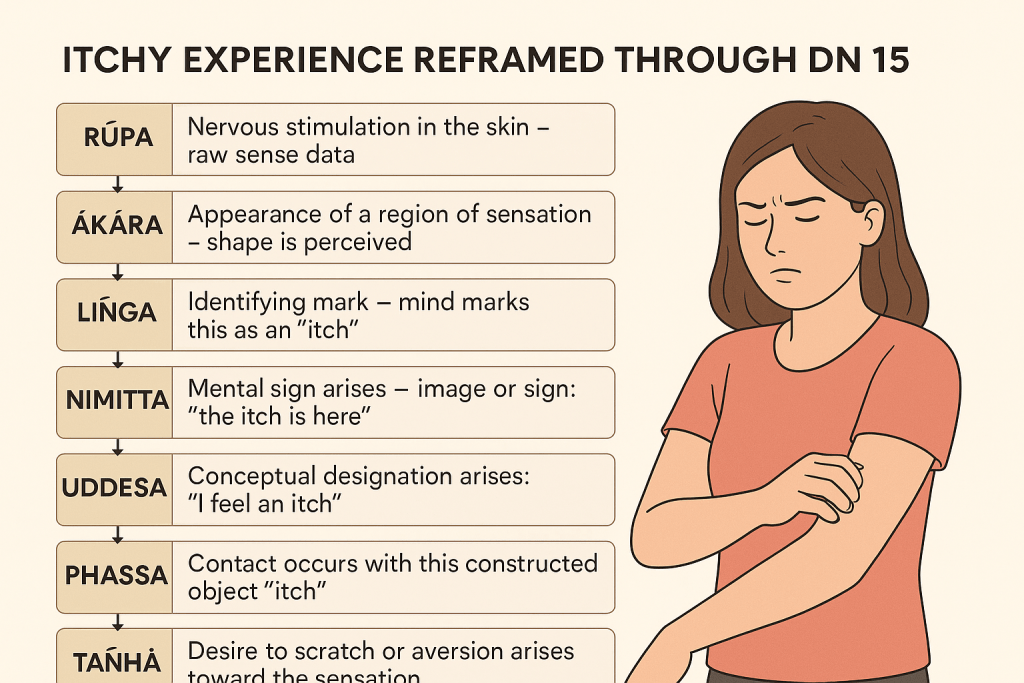
Let’s take another example as in itchy sensation in which there is a normal tendency to scratch it. Especially those who have done retreats in U Ba Khin/S.N Goenka method can reflect upon it.
To do that, below formula is most important by 👉 following DN 15:
Nāmarūpapaccayā phasso → phassa-paccayā vedanā and without ākāra, liṅga, nimitta, uddesa — no phassa arises.
1️⃣ Initial Physical Basis — Rūpa
At some point: Nerve endings in the skin get stimulated: Heat, dryness, minor irritation which can be due to a mosquito bite or for any other reason or some elemental fluctuation (tejo, vāyo, āpo). which is 👉 rūpa:
The physical base: 4 mahābhūta + upādāya rūpa. However, there is no “itch” present yet — only some nerve firing happening which triggers brain response.
2️⃣ Nāma–Rūpa field constructs the experience – Now, nāma–rūpa operates:
| DN 15 Component | What happens with the itch |
|---|---|
| Ākāra (appearance) | You perceive an area of sensation on your skin — shape, boundary arises in awareness. |
| Liṅga (identifying mark) | The mind marks this as not “neutral touch” or “pain,” but “itch.” The mind says: “This is itchiness.” |
| Nimitta (sign) | The mind generates an internal sign — an image or mental representation of “itch” at this spot. |
| Uddesa (designation) | Internally you name it: “I feel an itch.” The conceptual label is applied. |
👉 Now: the itch appears in experience — as a constructed object.
👉 Without ākāra, liṅga, nimitta, uddesa — there would be no experience of “itch.”
3️⃣ Phassa arises
Now: The sense base (body) + object (constructed itch) + consciousness → phassa happens.
👉 Kāya-phassa occurs on the conceptualized “itch.”
👉 It is not “pure body sensation being watched.”
👉 It is constructed phassa on a nāma–rūpa structured field.
4️⃣ Vedanā arises
Dependent on phassa → vedanā arises: In this case → unpleasant vedanā.
👉 This is the subjective felt tone of the itch.
👉 Without phassa → no vedanā would arise.
5️⃣ Taṇhā arises
If unmindful: The mind reacts with – “I want this to go away.” and “I should scratch this.” or “How long will this last?” 👉 Taṇhā → craving to remove the unpleasant vedanā.
6️⃣ Upādāna and Bhava
If you believe: “This is my itch,” and “I cannot sit because of this itch,”
👉 You are taking upādāna (clinging) to this “itch” and to “self-experience.”
👉 This creates bhava: The mode of being: “I am a person with an itch I must fix.” which then triggers or being born with itch.
Practice Implication
👉 In correct vipassanā:
✅ You do not merely “watch the itch sensation.”
✅ You investigate: How is the itch constructed?
What is the ākāra, liṅga, nimitta, uddesa?
How does phassa happen here?
How does vedanā arise?
How does taṇhā arise?
How to see through the constructed nature of the whole experience?
👉 This is how vipassanā leads to suññatā → seeing the empty, dependently arisen nature of experience → disenchantment → liberation.
let us use another real example as in:
A meditator gets knee pain while sitting in a posture for an hour or so. Let us go over the entire structure which Buddha explains relating to nama-rupa
👉 We will now trace this experience exactly in terms of the nāma–rūpa → phassa → vedanā → taṇhā chain, using the precise structure from DN 15:
🌿 1️⃣ The underlying structure of the body-mind in meditation (nāma–rūpa)
Rūpa: 4 Mahābhūtā (Earth, Water, Fire, Air elements) present in the physical body:
Earth (paṭhavī) → hardness in the knee joint
Water (āpo) → cohesion of tissues
Fire (tejo) → warmth, inflammation if pain develops
Air (vāyo) → tension, pressure, stiffness
👉 The physical basis for any sensation is the presence of these rūpa phenomena.
Nāma
Vedanā → feeling: the bodily sensation (pain/pressure)
Saññā → perception: recognition of “this is pain in my knee”
Cetanā → volition: intention may arise (“Should I move? Should I endure?”)
Phasso → contact: the meeting of sense base, object, and consciousness giving rise to the experience
Manasikāro → attention: awareness directed toward the knee sensation and decision maker
👉 These five mental processes co-arise with the physical form — this is nāma.
🌿 2️⃣ How the pain arises as an experience → Nāma–rūpa → Phassa
Now the Buddha’s analysis comes in: The experience of “pain in my knee” is not a given thing — it arises through the interplay of:
| Pāli term | Example in this meditation |
|---|---|
| Ākāra | The shape or mode of appearance of the pain: e.g., a sharp line, an area of burning, a point of stabbing |
| Liṅga | The distinguishing feature: this is not “numbness”, this is “sharp pain” |
| Nimitta | The mental sign: “this is knee pain” → an image of the painful spot arises in awareness |
| Uddesa | The designation: the thought “knee pain”, or “my knee hurts” arises |
👉 Without these four components, no structured experience of “pain” would appear.
👉 This is why the Buddha says: If those ākāra, liṅga, nimitta, uddesa are absent, no phassa would arise.
🌿 3️⃣ The actual arising of phassa
When eye, ear, nose, tongue, body, mind base are established (saḷāyatana), here:
Kāya-viññāṇa → bodily consciousness contacts rūpa (pressure in the knee). Nāma is already co-arising with rūpa.
At this point: → The conceptualized field of “knee” + “pain” is constructed:
I have contact with that constructed object:
adhivacana-samphassa → the labeling of this as “pain”, as “knee pain”
paṭigha-samphassa → the direct impingement of the physical sensation on bodily consciousness
👉 Now phassa is fully present: the meditator experiences the contact of mind with “knee pain.”
🌿 4️⃣ The rest of the chain proceeds:
| Link | Example in this meditation |
|---|---|
| Phassa | Contact of body with the touch through consciousness |
| Vedanā | The unpleasant feeling: dukkha-vedanā arises with a perception of the pain |
| Taṇhā | If unmindful, craving arises: “I want this to go away!” |
| Upādāna | Clinging: “It is my knee pain”, self-appropriation happens |
| Bhava | Continuation of identification and habitual reactions |
| Jāti | The repeated arising of “I am suffering” identity |
| Jarāmaraṇa | Sorrow, lamentation, distress result → suffering deepens |
🌿 5️⃣ How a wise meditator would observe this:
If the meditator has yoniso manasikāra and applies satipaṭṭhāna, they would see:
The pain is not “my” knee pain — it is a process of nāma–rūpa arising dependent on conditions.
The ākāra, liṅga, nimitta, uddesa that construct “knee pain” are mentally fabricated. Seeing this, attachment to the experience ceases. The pain may remain as sensation, but the mind does not personalize or react and the entire nāma–rūpa → phassa → vedanā → taṇhā loop is broken.
👉 Liberative insight arises through this exact observation — this is why the Buddha taught DN 15: to show that the entire world of experience is constructed and dependently arisen, not inherent.
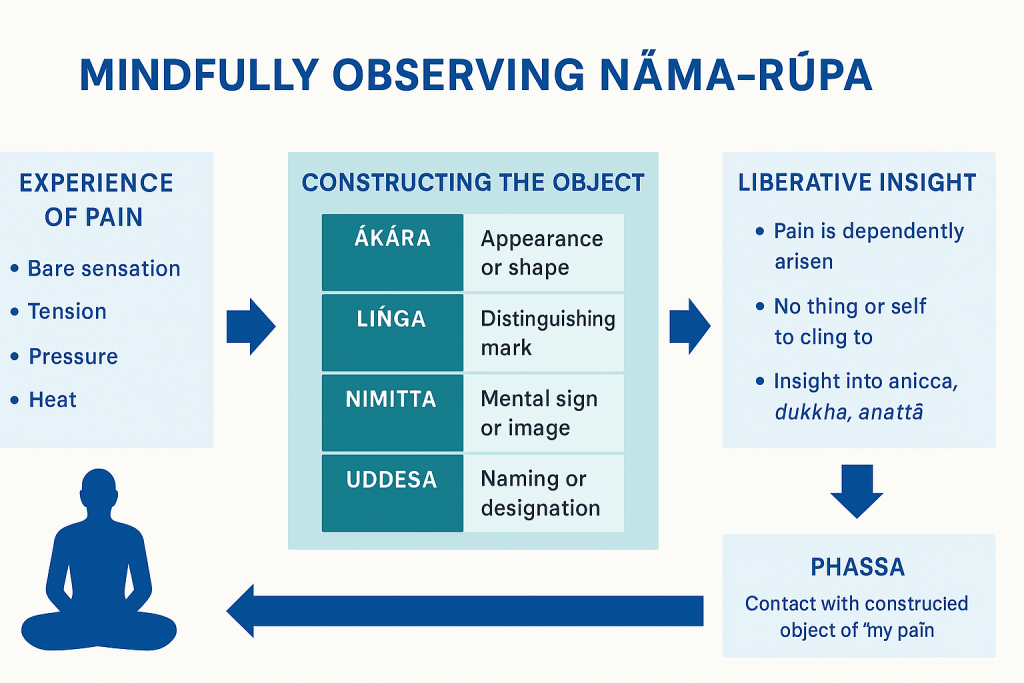
🌿 6️⃣ Summary Table of This Meditation Example
| Component | In this case |
|---|---|
| Rūpa | Physical tension, inflammation, air and heat in knee tissues |
| Nāma | Feeling, perception, volition, attention, contact |
| Ākāra | The way the pain appears in experience: shape or form |
| Liṅga | The mark that distinguishes this as pain, not numbness or tingling |
| Nimitta | The mental image “pain” |
| Uddesa | The conceptual designation: “knee pain” |
| Phassa | Contact with the constructed “knee pain” object |
| Vedanā | The unpleasant feeling |
| Taṇhā | Desire to end the pain |
| Upādāna | Identification with the pain |
| Bhava | Maintenance of the suffering identity |
| Jāti | Repeated arising of “I am suffering” story |
| Jarāmaraṇa | Full-blown distress and aversion |
🌿 Final insight: 👉 The Buddha is showing that pain itself is not given —
It is constructed, named, designated through nāma–rūpa processes.
👉 When you see this process in real time in meditation: This is the path to liberation from suffering. You no longer cling to “my pain”.
You understand: “Phassa itself is conditioned. If I cease the conceptual structuring (ākāra, liṅga, nimitta, uddesa), phassa does not occur in that way.”
Let us now go over in a meditative way for nama-rupa with sense fields:
🧘 Step-by-Step Meditative Instruction – 🪑 Preliminary preparation
Sit quietly, establish mindfulness.
Awareness is open: body, feelings, mind.
Suppose pain arises in the knee during the sitting.
1️⃣ First Level of Observation — Rūpa and Initial Phassa. First, observe bare sensation:
Hardness → paṭhavī, Movement, pressure → vāyo, Heat or burning → tejo, Cohesion of tissues → āpo. At this level: there is just physical impingement → paṭigha-samphassa.
You do not yet say “pain” — just observe these elements.
👉 This is observing rūpa at the initial level of phassa.
2️⃣ Next Level — Arising of Ākāra
Now you notice: “Ah, this is not just random sensation.” A certain shape or area is mentally noticed:
Is it spread out? Is it sharp? Is it diffuse? Is it a point? For example: “It feels like a burning circle in my right knee.”
👉 This is the arising of ākāra — appearance or shape in your awareness. Observe: “How is this ākāra being perceived? Is it changing? Moving?”
👉 Now you see anicca — this shape is not stable.
3️⃣ Next Level — Arising of Liṅga
Now the mind distinguishes: “This is not tingling, this is sharp pain.”
A mark or identifying feature arises: It is sharp, burning, stabbing, or throbbing.
👉 This is liṅga — the identifying mark that allows you to say: “pain”, not something else.
Observe: “Is this liṅga stable? Or changing?”
👉 Again: anicca, dukkha — the mind keeps re-creating the mark moment to moment.
4️⃣ Next Level — Arising of Nimitta
Now the mind forms a mental image or sign: “This is my knee pain.”
You may visualize the area, or a mental label “pain” appears.
The mind holds this nimitta and keeps referring back to it.
👉 This is nimitta — the mental sign that consolidates the perception.
Observe: “When I stop grasping this nimitta, does the experience change?”
👉 You see: the construction of “pain” depends on nimitta.
5️⃣ Next Level — Arising of Uddesa
Now the mind names it internally: “Knee pain.” and “This is bad.” “I cannot take this anymore.”
👉 This is uddesa — the verbal or conceptual designation which is serving the purpose of identifying. Observe: “Without this designation, what remains?”
👉 You begin to see that uddhacca (mental restlessness), aversion come strongly only when uddesa is strongly grasped.
6️⃣ Breaking the Chain
Now you see clearly: Rūpa → just elemental qualities and Phassa → arises because ākāra, liṅga, nimitta, uddesa construct an object and Vedanā → painful feeling arises leading to Taṇhā → only arises when uddhacca, aversion follows, “I want this to stop” arises due to uddhisa (designation).
👉 If you release uddesa, the “pain” is no longer “my pain”, just sensation.
👉 If you see nimitta dissolving, the constructed object weakens.
👉 If you see liṅga and ākāra changing, impermanence (anicca) is clear.
👉 As this deepens, phassa itself weakens, and sometimes you experience direct cessation of that phassa — momentary “disappearance” of the object.
🔍 Summary of Insight Path
| Step | What to observe | Insight that arises |
|---|---|---|
| Rūpa | Bare sensations | No inherent “pain” |
| Ākāra | Shape or appearance | Changing, not stable |
| Liṅga | Distinguishing feature | Momentarily created |
| Nimitta | Mental sign/image | Constructed, not essence |
| Uddesa | Naming, conceptual designation | Label imposed, can be dropped |
| Phassa | Contact with constructed object | Conditioned, not self |
| Vedanā | Feeling | To be observed without reaction |
| Taṇhā | Craving | Arises when objectification occurs |
🏆 Liberative Insight
When this is seen clearly: 👉 You understand that what you thought was “my knee pain” was a dependently arisen construction: Without ākāra, liṅga, nimitta, uddesa, the experience of “pain” as such cannot arise. This is exactly what the Buddha said to Ānanda in DN 15.
👉 Thus, “pain” is anicca, dukkha (when clung to), and anattā — not owned, not inherent, not self.
👉 With repeated practice, this insight generalizes to all experience:
You see that everything you experience is built in this way — there is no true “thing” there.
Example: Anger arises toward someone
👉 Suppose during meditation retreat or after, someone takes comment in a negative way — anger arises. Now let’s analyze it exactly like Buddha does in DN 15:
| Level | How it happens in anger |
|---|---|
| Rūpa | Slight bodily reactions: heat in chest, tension in stomach, tightening of face |
| Ākāra | Anger appears as a certain “shape” in experience: burning, constricted feeling |
| Liṅga | Distinguishing feature: this is not sadness or fear — it is anger. The “push” energy of wanting to harm, reject, or fight is recognized |
| Nimitta | Mental sign appears: a mental image of the person, an imagined face, a memory of what they said or did |
| Uddesa | Naming: “That person commented on me”, “I am angry”, “This is unjust” — conceptual narration begins which serves the purpose of identification |
👉 Now phassa arises strongly — contact with the constructed object of ‘that person’ + ‘anger’.
👉 Vedanā: Unpleasant feeling arises
👉 Taṇhā: Wanting to push away, retaliate, or mentally fight
What the meditator does:
Notice each level: How ākāra is shaped: where is this “anger”? How big is it? How solid is it?
How liṅga identifies it as “anger” and how nimitta holds the image of the person or event. How uddesa names it and builds the narrative.
👉 You will see: without nimitta and uddesa, the anger cannot sustain.
👉 As soon as you release uddesa (stop the mental story), and see nimitta as empty, the anger collapses.
👉 Thus the Buddha says: “Without ākāra, liṅga, nimitta, uddesa → no phassa can arise.”
Anger is not a real “thing” — it is a constructed process.
Example: A thought of “I am a failure” arises
👉 In meditation, a self-critical thought arises: “I always fail.” Again DN 15 structure can be implemented:
| Level | How it happens in thought |
|---|---|
| Rūpa | Very subtle bodily tension, contraction in the head or chest |
| Ākāra | The thought appears as a certain “shape”: words in the mind, or an image of oneself failing |
| Liṅga | Distinguishing feature: “This is self-judgment thought”, not planning or random thought |
| Nimitta | Mental sign: image of oneself in a failure situation; words like “failure”, “useless” |
| Uddesa | Naming: “I am a failure”, “I can’t do anything right” — the internal story |
👉 Phassa arises: contact with this constructed “self-failure” image.
👉 Vedanā: Unpleasant feeling
👉 Taṇhā: Wanting to escape, wanting to wallow, or wanting to compensate
Meditator’s insight: See that the entire thought is constructed from:
ākāra of thought (mental words, images)
liṅga identifying it as self-critical
nimitta sustaining the self-image
uddesa reinforcing the “I am” narrative
When you release uddesa, stop believing the words → the “thought” has no foundation.
When you see nimitta as empty → no fuel for the thought. The mind returns to natural awareness.
👉 Again: Thought is not “your thought” — it is a constructed process.
This is anattā in direct experience.
| Aspect | Wrong Seeing (Worldling) | Right Seeing (Noble Disciple / Meditator) |
|---|---|---|
| Ākāra | “This is a real shape or pain or emotion.” | “This is an appearance, constantly changing.” |
| Liṅga | “This is truly pain / anger / thought.” | “This mark is constructed — impermanent.” |
| Nimitta | “This is real — I must fight it / get rid of it.” | “This is a sign my mind is picking up — it’s empty.” |
| Uddesa | “This is my pain, my anger, my problem.” | “Naming is creating suffering — drop the naming.” |
| Phassa | Taken as a real “thing” happening to “me.” | Seen as a conditioned arising — not self. |
| Vedanā | Reacted to with craving, aversion. | Observed as conditioned feeling — not reacted to. |
| Taṇhā | Clinging arises automatically. | Craving weakens as insight deepens. |
Summary
👉 DN 15 teaches the deepest practical wisdom:
All contact (phassa) is conditioned → no inherent world or inherent self.
Experience of body, pain, emotion, thought is constructed from:
ākāra → mode of appearance, liṅga → identifying mark, nimitta → mental sign, uddesa → designation / label
👉 When you observe these layers in vipassanā, insight arises: There is no “real anger”, “real pain”, “real thought” — all are fabrications of mind. Seeing this clearly → liberation from suffering.
Summary for Meditator:
1️⃣ Observe bare experience first → what is really there?
2️⃣ Watch for arising of ākāra → how is this appearing?
3️⃣ Notice liṅga → how am I marking this as pain / anger / thought?
4️⃣ Watch nimitta → what image or concept am I holding?
5️⃣ Notice uddesa → what naming am I applying? “My pain”, “My anger”?
6️⃣ See that these are all constructed — drop the identification.
7️⃣ Stay with pure awareness — phassa without grasping → liberation.
📌 Nāma is primarily conceptual in its function:
In SN 12.2, nāma is defined as: vedanā — feeling, saññā — perception, cetanā — intention, phasso — contact and manasikāro — attention
👉 These are mental operations that organize experience.
👉 They operate through conceptual construction, not bare physical process.
Saññā itself is an explicit conceptual function:
“Perceiving blue, perceiving yellow…” — perception involves recognizing, categorizing, conceptually identifying as it applies a concept to an arising stimulus.
Cetanā is volitional — operates in the conceptual field of “I should do this”, “I should avoid this”.
Manasikāra directs the mind toward objects — again conceptually selecting what will be taken as object.
📌 Nāma works through Paññatti (conceptual designation):
This is why in DN 15, the Buddha says: “Without ākāra, liṅga, nimitta, uddesa → no phassa.”
👉 All of these are conceptual structures:
You don’t perceive a “woman” without: a shape being attended to (ākāra), a feature being identified (liṅga), a sign being seized (nimitta), and a name or label being applied (uddesa) to have the purpose filled up
👉 Nāma is what gives “form” to experience conceptually.
It is not that the visual process of light on retina creates “woman”; rather, nāma organizes the raw data into an experience of woman.
👉 Therefore, nāma = conceptual, linguistic, volitional structuring of experience.
It is not the object, but how experience is rendered as a knowable world.
📌 Rūpa in this same perspective:
Rūpa, as the four great elements and their derivatives, is the physical aspect.
But even rūpa as experienced is mediated by nāma:
Without saññā, you cannot say “hard”, “soft”, “hot”, “cold”.
Even rūpa is presented through conceptual perception — otherwise it is just bare elemental process, not an “object”.
👉 This is why the Buddha says:
Nāma–rūpa paccayā phasso. Contact itself depends on conceptual structuring of experience.Without nāma and its operation, you have no “object” to contact.
📌 Summary View:
| Aspect | Nature |
|---|---|
| Nāma | Conceptual reality — it organizes experience through mental operations and paññatti |
| Rūpa | Physical process — but experienced via conceptual overlay from nāma |
| Phassa | Arises when conceptualized nāma–rūpa is present; not a raw mechanical impact |
👉 In this sense, the entire experienced world is dependently arisen conceptual reality — not an absolute thing “out there”.
Practical Implication:
In vipassanā you learn to see:
How nāma constructs the experience.
How clinging arises to constructed objects.
How dropping the construction leads to seeing anicca, dukkha, anattā — liberation.
In conclusion:
👉 Nāma is a conceptual process — it is not “purely mental energy”, but a structuring, naming, constructing activity of mind.
👉 Rūpa, too, as experienced is shaped by nāma — otherwise, no “object” is known.
👉 Phassa depends on this conceptualized field — without it, no contact arises.
Let us take up Namasutta which is very important here:
📜 Question (Deva asks the Buddha):
Kiṁsu sabbaṁ addhabhavi,
kismā bhiyyo na vijjati;
Kissassu ekadhammassa,
sabbeva vasamanvagū”ti.
Answer (Buddha replies):
Nāmaṁ sabbaṁ addhabhavi,
nāmā bhiyyo na vijjati;
Nāmassa ekadhammassa,
sabbeva vasamanvagū”ti.
🗣️ Question:
“What has overcome all (things),
Beyond which nothing is found;
Under the sway of which single thing,
Have all beings gone under its power?”
Answer:
“It is nāma that has overcome all;
Beyond nāma nothing is found;
Under the sway of this single thing — nāma —
All have come under its power.”
✨ Explanation
👉 This verse points to a deep psychological and phenomenological truth:
All beings experience the world through nāma — through naming, conceptualizing, labeling, perceiving. Nāma is not just “names of things” in language — it is the mental process of giving structure to experience:
Saññā (perception) — recognizing and labeling;
Vedanā (feeling) — experienced as pleasant/unpleasant based on concept;
Cetanā (volition) — intending within the conceptual frame;
Manasikāra (attention) — directed toward conceptualized objects.
👉 All this is nāma.
🪞 Deeper Aspect of “Nāmaṁ sabbaṁ addhabhavi”
👉 Why does Buddha say “nāma has overcome all”?
Because: The world as known is structured entirely through nāma.
Without nāma, there is no knowable world.
The “tree”, “sky”, “pain”, “woman”, “enemy”, “my self” — all these are nāma constructions imposed on raw sensory data.
👉 This is why in DN 15 the Buddha says: Without ākāra, liṅga, nimitta, uddesa → no phassa arises.
That is exactly this verse:
Nāmaṁ sabbaṁ addhabhavi → The entire world of experience is under the power of nāma.
👉 “Beyond nāma, nothing is found” means:
In normal perception, whatever is experienced is mediated by nāma.
You never know raw reality — only nāma-constructed experience.
🏛 Philosophical Depth — Relation to Paṭiccasamuppāda
In Paṭiccasamuppāda: Viññāṇa paccayā nāmarūpaṁ → Consciousness gives rise to the whole nāma–rūpa field.
Nāma–rūpa paccayā saḷāyatanaṁ → The six sense bases operate within the nāma–rūpa field.
Phassa, vedanā, taṇhā, upādāna all follow → all operate within the conceptual framework built by nāma.
👉 Without the nāma construction, there is no sense-world as such.
🧘 Practical Insight for Meditation
👉 When practicing vipassanā, if you watch carefully: You will see that pain, pleasure, thoughts, emotions — all arise and are maintained through naming and conceptual structuring.
The raw sense data is neutral — it is nāma that makes it “my pain”, “my memory”, “my anger”, “this is a person”, “this is me”.
👉 If you deeply observe nāma constructing experience, and let go of identification with it:
Nāma loses its hold → experience becomes lighter. The illusion of “real world” and “real self” weakens → insight into anattā grows.
🗺 Summary:
| Line in Verse | Meaning |
|---|---|
| Nāmaṁ sabbaṁ addhabhavi | Nāma overcomes all because all experience is structured through naming and conceptualizing. |
| Nāmā bhiyyo na vijjati | Beyond nāma, no experience is found — you never experience “raw reality”, only conceptually mediated reality. |
| Nāmassa ekadhammassa sabbeva vasamanvagū | All beings are under the power of nāma — the entire saṁsāric mind operates in conceptual structuring. |
Closing Reflection:
👉 This tiny verse beautifully encapsulates why the Buddha focuses so deeply on nāma–rūpa → phassa in DN 15.
👉 If you see the process of nāma constructing your world, and release it, you are on the path to vimutti (freedom).
👉 The highest stages of vipassanā involve exactly this:
Disrupting and deconstructing the nāma–rūpa field → seeing the emptiness of phenomena → liberation.
📌 Implication for Insight Practice
👉 Why is this teaching vital?
Because saṅkhāra (fabrication) operates via nāma constructing rūpa.
When you see this directly, the illusion of the “solid world” collapses.
Attachment is to conceptual appearances, not to reality as such.
Seeing this, the mind inclines toward release → vimutti.
👉 Hence Vipassanā aims to:
See how ākāra, liṅga, nimitta, uddesa produce “things”.
See rūpa as just an appearance — not an inherent object.
See nāma as a process — not “my mind” or “my self”.
👉 Result → Profound disenchantment (nibbidā) → letting go → cessation (nirodha).
Let us take an example and see how it works in daily life:

| Process Level | Example |
|---|---|
| Rūpa | The body / appearance / wealth / achievements / behavior |
| Ākāra | The way it appears (body shape, possessions, behaviors) |
| Liṅga | Mark imposed: beautiful / ugly, rich / poor, smart / dumb |
| Nimitta | Mental image of self stored and reinforced |
| Uddesa | Naming: “I am beautiful”, “I am poor”, “I am dumb”, etc. |
| Phassa | Contact with constructed self-image |
| Vedanā | Pleasant / unpleasant feelings about this self-image |
| Taṇhā | Craving to maintain or change the image |
| Upādāna | Clinging to the self-image |
| Bhava | Living one’s life according to the self-image |
🚀 Practical Vipassanā Application
👉 In meditation, we need to observe:
“What ākāra is the mind picking up?”
“What liṅga is being imposed?”
“What nimitta is being held?”
“What uddesa is being spoken inside?”
“How does phassa happen on this image?”
“What vedanā is arising on it?”
“Where is taṇhā and upādāna happening?”
👉 This observation dissolves the false self.
👉 You see the constructive nature of the “I” → disenchantment → release.