Marā is an important aspect of Buddha Dhamma and it is a must to understand it properly. Let us go over this Padhānasutta
1️⃣ Taṁ maṁ padhānapahitattaṁ,
nadiṁ nerañjaraṁ pati;
Viparakkamma jhāyantaṁ,
yogakkhemassa pattiyā.
“At that time, I — with my mind directed toward energetic striving,
Sat by the river Nerañjarā;
Meditating counter to the worldly current,
For the sake of attaining the supreme security from bondage.”
Deeper meaning:
padhāna-pahitattā → This is not ordinary effort. This is exertion for arahattaphala.
The word pahitattā (directed mind) here is used in a sense similar to paṭipanna, but more intense: every single moment of volition is dedicated toward Nibbāna.
Viparakkamma jhāyantaṁ — against the current (viparakkamma) — Buddha was reversing dependent origination.
All beings float downstream: saḷāyatana → phassa → vedanā → taṇhā → upādāna → bhava → jāti → jarāmaraṇa. The Buddha was meditating in the opposite direction: phassa → without taṇhā → no upādāna → cessation.
Yogakkhema — term for Nibbāna in the Nikāyas.
The key is that this striving is not just for samādhi, not for jhāna itself, but for liberation.
Conclusion
This is a moment when the last layers of clinging (bhavataṇhā) are about to be broken.
The entire universe is pulling the Buddha toward one direction (existence), he is counter-current.
This is not heroic “striving” in an ordinary sense — it is the final operation of paññā cutting the latent tendencies (anusaya).
2️⃣ Namucī karuṇaṁ vācaṁ,
bhāsamāno upāgami;
‘Kiso tvamasi dubbaṇṇo,
santike maraṇaṁ tava.
“Then Namucī, speaking words of false compassion, approached me;
‘You are emaciated, your complexion is poor,
Death is near for you.'”
Deeper meaning:
Māra appears as well-wisher — deep psychological point.
Temptations do not appear as ugly forces, but as “caring” voices.
Kiso, dubbaṇṇo — Māra points to decay of the body.
santike maraṇaṁ — Māra evokes fear of death, which is one of the last fetters for a Bodhisatta: fear is rooted in sakkāya-diṭṭhi.
Conclusion: This is the voice of the saṅkhāra desire to survive.
At deep meditation stages, one sees aniccatā of all phenomena. When the mind approaches release, the bodily organism can send danger signals to the mind — this is how clinging to the body manifests. Māra here is embodiment of the survival instinct in a human organism.
3️⃣ Sahassabhāgo maraṇassa,
ekaṁso tava jīvitaṁ;
Jīva bho jīvitaṁ seyyo,
jīvaṁ puññāni kāhasi.
“A thousand shares belong to death;
Only a single share remains of life.
Live, good sir! Better to live —
And while living, do good deeds (puñña).”
Deeper meaning: Here Māra offers “wise counsel”: Live, accumulate merit, why strive so hard?
This is the subtlest temptation: giving up the ultimate goal, and instead settling for heavenly rebirth or meritorious life.
Conclusion: For one at the threshold of awakening, the pull of “being a good person” or doing puñña is a deep subtle obstacle. Puñña is still within saṁsāra: upapatti-bhava depends on puñña.
Buddha is cutting even good kamma attachment — because ultimate goal is not good rebirth, but end of rebirth.
4️⃣ Carato ca te brahmacariyaṁ,
Aggihuttañca jūhato;
Pahūtaṁ cīyate puññaṁ,
Kiṁ padhānena kāhasi.
“Living the holy life, performing fire sacrifices —
Much merit is thereby accumulated.
Why then do you strive so hard?”
Deeper meaning:
Māra compares external ritual (aggihutta) with Buddha’s deep inner striving.
This is a temptation for external religiosity. Even in Buddhist practice today, the same temptation exists: focus on ritual, dana, sīla, but not doing paññā-based practice.
Conclusion: Buddha’s rejection of ritual-based merit here is a fundamental point:
→ Ritual is still within kamma-niyama, not nirodha-niyama.
→ Striving (padhāna) here is to cross into nirodha-dhamma — the unconditioned.
5️⃣ Duggo maggo padhānāya,
dukkaro durabhisambhavo’”
“The path of striving is rough,
Hard to cross and difficult to accomplish.”
Deeper meaning:
Māra highlights dukkha of the path. This is the path of dukkhanirodha — it will shake the entire khandha-santāna. The deepest dukkha arises not in worldly life, but at the threshold of awakening, when latent tendencies are being uprooted.
Conclusion: At this stage, sankhāras resist their own extinction. The dukkha Māra mentions is precisely the dukkha of dissolving sakkāya.
The practitioner sees: Rūpa, Vedanā, Sañña, Saṅkhāra and Viññāṇa are unstable.
This is the terrifying seeing of anicca — and Māra plays on that terror.
👉 The same level of deep doctrinal unpacking can be done for each verse further:
6️⃣ Imā gāthā bhaṇaṁ māro,
aṭṭhā buddhassa santike. “Speaking these verses, Māra stood near the Buddha.”
Deeper meaning:
Now Māra has completed his first verbal assault — he has used:
Fear of death, Subtle praise of puñña-making, Temptation to abandon difficult practice, Social conformity (aggihutta), Discouragement (duggo maggo)
→ Psychologically, this is a perfect mirror of what arises in deep meditation when one approaches cessation — all of these voices can arise in one’s own mind.
Conclusion: Māra is not just an external being — he represents the conditioned side of viññāṇa that fears its own cessation. As dependent origination starts breaking down in deep vipassanā/jhāna, these forces personify into such temptations.
7️⃣ Taṁ tathāvādinaṁ māraṁ,
bhagavā etadabravi;
“Pamattabandhu pāpima,
yenatthena idhāgato.
“Then the Blessed One said to Māra, who had spoken thus:
‘O Evil One, whose companions are negligent —
For what purpose have you come here?”
Deeper meaning:
Buddha calls Māra pamattabandhu — friend of the negligent and in contrast: Buddha’s companions are appamatta (vigilant). Buddha directly addresses Māra — not with fear, not with hatred, but with clear knowing. Deep point here: mindfulness and wisdom address hindrances by knowing them clearly, not by suppression.
Conclusion: In one’s own practice, this corresponds to the moment when the yogi sees the hindrance as not-self — as just a conditioned appearance. The correct response is not aversion, but knowing it clearly, with equanimity.
8️⃣ Aṇumattopi puññena,
Attho mayhaṁ na vijjati;
Yesañca attho puññena,
Te māro vattumarahati.
“Even the smallest benefit from merit,
I have no interest in.
Those who seek merit —
Let Māra speak to them!”
Deeper meaning:
Now Buddha makes a key distinction:
→ The path he is now walking is not about merit, but liberation. In the gradual path, one moves:
From kusalāni → puññāni → paññāya bhāvanā → virāga → nirodha.
At this final stage, even puñña is not clung to.
Conclusion: Yogis sometimes get stuck at:
Clinging to samādhi bliss, to puñña ritual and to identity as “good person”
→ All these must be seen as not the goal — as Māra’s army.
In terms of dependent origination: Puññābhisaṅkhāra is also a saṅkhāra → subject to anicca.
9️⃣ Atthi saddhā tathā viriyaṁ,
paññā ca mama vijjati;
Evaṁ maṁ pahitattampi,
kiṁ jīvamanupucchasi.
“Faith is present, energy is present,
Wisdom too is present in me.
With my mind directed in this way —
Why do you ask me about life?”
Deeper meaning:
Buddha declares the 5 spiritual faculties (indriya):
Saddhā (faith), Viriya (energy), Sati (mindfulness — implicit here), Samādhi (coming later), Paññā (wisdom) → These are now fully ripened.
This verse is an arhat-like reply already — one sees that concern for life/death is irrelevant when paññā is functioning.
Conclusion:
In deep meditation, this is the stage where the yogi fully trusts the process — no longer concerned with survival or comfort. The fear of annihilation, which arises near cessation, is seen as another dhamma — not self.
10️⃣ Nadīnamapi sotāni,
ayaṁ vāto visosaye;
Kiñca me pahitattassa,
lohitaṁ nupasussaye.
“Even the streams of rivers
this wind can dry up —
Then why should not my blood
dry up as I strive?”
Deeper meaning:
Buddha uses the simile of the drying of rivers → illustrating impermanence.
The body is subject to change — no need to cling to its maintenance.
Lohitaṁ (blood) → symbol of life-force — Buddha is unafraid if even this fades.
Conclusion:
This is the deep insight into anicca of the entire pañcakkhandha. Body decaying? It is just rūpa. Vedanā changing? It is just vedanā. The yogi experiences this without self-reference — this is the direct breaking of sakkāyadiṭṭhi.
11️⃣ Lohite sussamānamhi,
Pittaṁ semhañca sussati;
Maṁsesu khīyamānesu,
Bhiyyo cittaṁ pasīdati.
“As blood dries up,
bile and phlegm too dry up;
As flesh wastes away,
all the more serene becomes my mind.”
Deeper meaning:
Here Buddha expresses the paradox of spiritual practice:
As the body declines → mind becomes clearer, more serene.
This is the moment when physical suffering no longer conditions mental suffering.
Conclusion: In deep vipassanā and jhāna, one sometimes experiences body pain, sickness, weakness — but the mind can be perfectly still and luminous. This is also where vedanā-nirodha is seen. The practitioner understands: this is not my body, not my pain — the citta is free.
12️⃣ Bhiyyo sati ca paññā ca,
Samādhi mama tiṭṭhati.
“All the more mindfulness and wisdom arise,
and my concentration remains steady.”
Deeper meaning:
Now the indriya of sati, paññā, samādhi are not disturbed by bodily processes.
This is unshakable samādhi — not fragile absorption, but liberation-oriented concentration.
Conclusion: Jhāna used for release, not enjoyment. The real test of samādhi is:
→ can it remain when the body is sick, when external world is painful?
Buddha shows arahatta-quality of citta — completely untouched.
13️⃣ Tassa mevaṁ viharato,
Pattassuttamavedanaṁ;
Kāmesu nāpekkhate cittaṁ,
Passa sattassa suddhataṁ.
“For one abiding thus,
having attained the supreme experience,
The mind no longer hankers after sense pleasures —
See the purity of this being!”
Deeper meaning:
uttama vedanā here refers not to ordinary sukha, but nirāmisa sukha:
Either jhānic equanimity Or Nibbānic experience and the kāma-chanda is now extinguished.
Conclusion: The key phrase: kāmesu nāpekkhate cittaṁ — this is the sign of one nearing or attaining arahatta. In deep practice, one must look: → Does even subtle expectation toward sensuality remain? If not, suddhataṁ — the mind is truly pure.
Thus:
The 10 armies of Māra are a complete map of the 5 nīvaraṇāni + defilements + ego traps.
The Buddha’s responses are statements of arahatta-ñāṇa perspective.
The analogy of unbaked pot is a profound teaching on empty nature of saṅkhāra.
The last verse — crow circling a rock — is the psychological image of how defilements operate near awakening: they circle and try to find some hook to cling to, but fail.
Summary so far: What you are seeing in these verses is:
| Phase | Inner process happening |
|---|---|
| First verses | Māra’s psychological temptations appear |
| Buddha’s reply | Right seeing through paññā → no clinging |
| Physical weakness | Mind remains luminous and equanimous |
| Ultimate stance | Not even the slightest kāma remains |
14️⃣
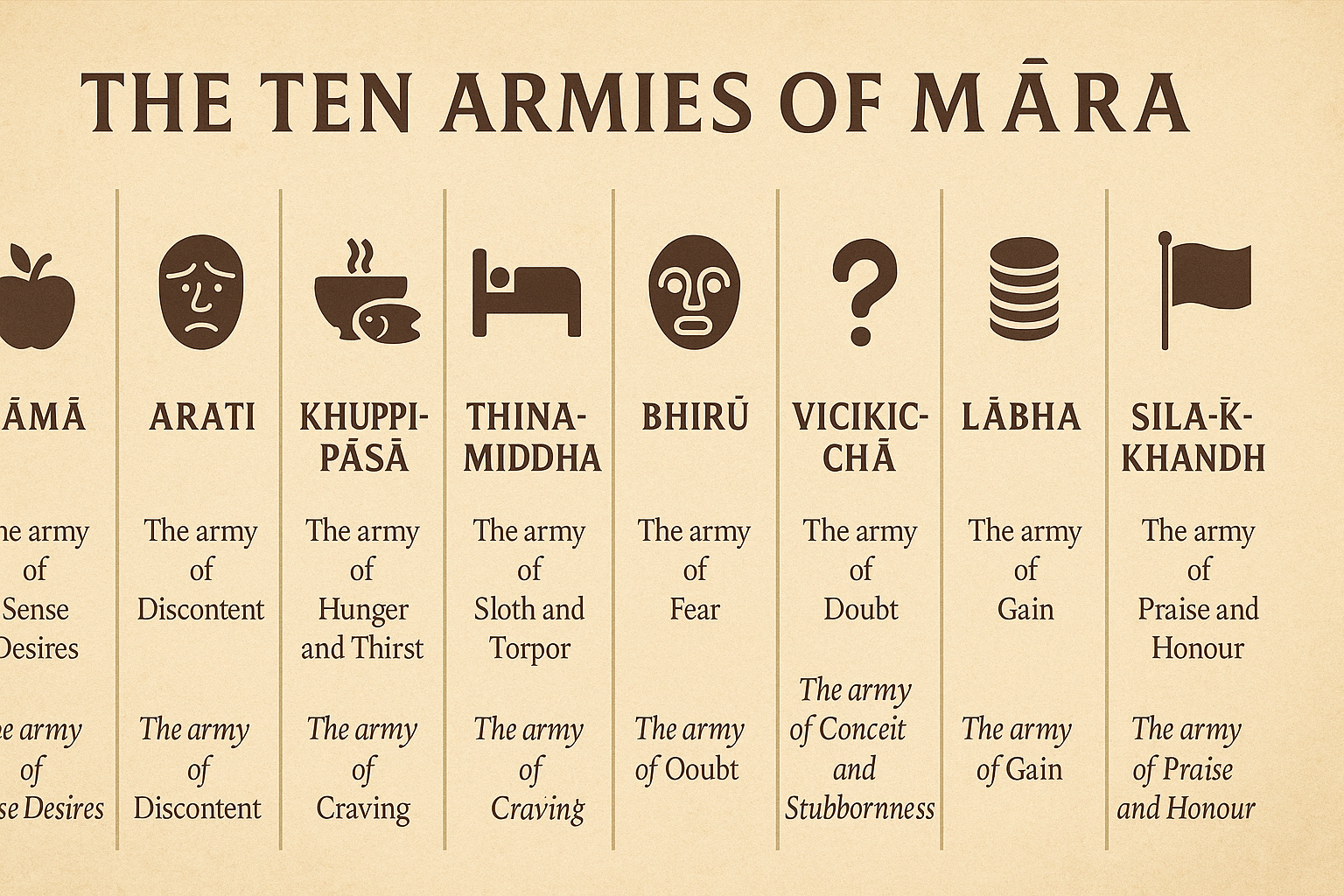
Kāmā te paṭhamā senā,
Dutiyā arati vuccati;
Tatiyā khuppipāsā te,
Catutthī taṇhā pavuccati.
“Your first army is Sense Pleasures;
The second is Discontent;
The third is Hunger and Thirst;
The fourth is Craving.”
Deeper meaning:
1️⃣ Kāmā — Sense Pleasures:
Kāmā here is not merely external objects — it refers to kāma-chanda, desire for the experience of pleasant contact in the six sense spheres. In jhāna practice and vipassanā, when one withdraws from sense input, this kāma arises strongly at first:
Memories of pleasant experiences. Desire to get up, do something pleasant.
Resentment at the “dryness” of pure practice.
In dependent origination: It is the core of taṇhā → upādāna → bhava loop.
2️⃣ Arati — Discontent:
This is the inability to stay with present experience.
In practice: even when there is no great kāma-desire, one feels boredom, dissatisfaction, restlessness. Arati is a great enemy of samādhi and vipassanā.
Deeper point: Arati is craving for becoming (bhavataṇhā) — it makes you feel that “something is wrong”, which drives more saṅkhāra.
3️⃣ Khuppipāsā — Hunger and Thirst:
Not just literal hunger, but all physical discomforts that arise strongly when trying to go deep. These are often used by the mind to justify: “Let’s stop meditation now” “We must take care of the body first” “A little comfort is necessary”
Deeper point: Hunger and thirst are linked to the body identification (rūpupādāna) — they feed sakkāyadiṭṭhi.
4️⃣ Taṇhā — Craving: A broad force — not just for sense pleasure, but for existence itself.
Subtle taṇhā: Craving for jhānic bliss., Craving for continuing existence as a meditator. and craving for identity as someone on the path. Ultimate taṇhā is what binds to viññāṇa → nāma-rūpa → saḷāyatana, keeping the wheel going.
Summary Table:
| Māra’s Army | Practical manifestation in practice |
|---|---|
| Kāmā | Sense desire / kāma-chanda |
| Arati | Restlessness / boredom / frustration |
| Khuppipāsā | Body discomforts disrupting practice |
| Taṇhā | Craving — for pleasure, identity, existence |
15️⃣ Pañcamaṁ thinamiddhaṁ te,
Chaṭṭhā bhīrū pavuccati;
Sattamī vicikicchā te,
Makkho thambho te aṭṭhamo.
“Your fifth army is Sloth and Torpor;
The sixth is Fear;
The seventh is Doubt;
The eighth is Conceit and Stubbornness.”
Deep Explanation:
5️⃣ Thinamiddha — Sloth and Torpor:
One of the 5 hindrances (nīvaraṇāni).
It attacks both: Body → heaviness, drowsiness.
Mind → dullness, lack of clarity In jhāna and vipassanā:
It is a great danger especially at intermediate stages.
Often arises when perception of anicca deepens and the mind wants to shut down rather than face it.6️⃣ Bhīru — Fear: Very subtle danger at deep stages.
When saṅkhāra starts dissolving, or when non-self perception arises strongly, fear can arise:
Fear of losing control. Fear of “disappearing”. Fear of nirodha.
In the suttas, even advanced meditators face bhayaññāṇa stage.
Conclusion:
Fear arises from the deep grasping at viññāṇa.
It signals the mind’s resistance to cessation.
7️⃣ Vicikicchā — Doubt:
Not mere intellectual doubt about Dhamma.
Deep existential doubt: “Is this the right path?” “Will this really work?” “Am I going mad?”
“Is cessation safe?”
Conclusion:Vicikicchā is craving for certainty — but the path requires letting go into anicca, anattā.
8️⃣ Makkha / Thambha — Conceit and Stubbornness:
Makkha — being unable to see good in others, or in the path.
Thambha — mental rigidity. In advanced stages: Arrogance about one’s progress.
Subtle sense of “I am special”. Resistance to fully letting go.
Deeper aspect: These correspond to mana, one of the final fetters to be broken by an arahant.
Summary Table
| Māra’s Army | Practical manifestation in practice |
|---|---|
| Thinamiddha | Dullness / sleepiness / heaviness |
| Bhīru | Fear of non-self, dissolution, death |
| Vicikicchā | Doubt about path, experience, mind |
| Makkha / Thambha | Conceit, stubbornness, “I know”, rigidity |
16️⃣ Lābho siloko sakkāro,
Micchāladdho ca yo yaso;
Yo cattānaṁ samukkaṁse,
Pare ca avajānati.
“Gain, fame, honor,
Wrongly acquired repute;
One who exalts oneself,
And belittles others.”
Deep Explanation:
This is one of the subtlest dangers: After some progress in samādhi or vipassanā, the yogi may: Receive respect, Be regarded as special. Develop subtle ego. Micchāladdho yaso — wrongly gained fame: Based on partial realization. Based on charisma. Based on community feedback.
Conclusion: The mind shifts from striving toward release → striving to preserve status. This is the final stronghold of mana (conceit).
17️⃣ Esā namuci te senā,
Kaṇhassābhippahārinī;
Na naṁ asūro jināti,
Jetvā ca labhate sukhaṁ.
“This is your army, Namucī —
Striking force of the black-hearted.
Not by ordinary hero is it conquered —
But whoever conquers it attains bliss.”
Deeper Explanation
Black-hearted (kaṇha) — this force sustains saṁsāra.
Asūro — not any ordinary strong-willed person can win this. Only through paññā and full letting go can this army be defeated. Deeper Aspect: The 10 armies = full map of saṁyojana + nīvaraṇāni:
Early ones (kāmā, arati) → early fetters and later ones (fear, conceit) → higher fetters.
To cross from anāgāmī → arahant stage, one must penetrate through all these.
18️⃣ Heroic resolve — muñja grass simile
Esa muñjaṁ parihare,
Dhiratthu mama jīvitaṁ;
Saṅgāme me mataṁ seyyo,
Yañce jīve parājito.
“Let this muñja grass be my banner!
Perish my life if need be;
Better to die in battle
than to live defeated.”
Deeper Explanation:
Muñja grass: Muñja grass is used to make strong ropes or banners.
But before being used, the outer layers are stripped off — only the strong core remains.
Thus, “let this muñja be my banner” = let my fully purified resolve stand here, stripped of all clinging.
Dhiratthu mama jīvitaṁ — “Let my life be damned!”
Buddha expresses utter fearlessness regarding survival.
Deeper Explanation: In vipassanā, when one approaches cessation, the deep fear of annihilation arises: “If I let go fully, will I die?” “Will my consciousness cease?”
Here, Buddha says: better death than spiritual defeat (than giving in to taṇhā and clinging).
This is the ultimate non-clinging to bhava-taṇhā.
👉 In practice: The yogi must reach a point where one is ready to lose everything — life, self-identity, experiences — in order to cross to nirodha.
👉 This is also letting go of clinging to life as part of āsava-khaya.
19️⃣ Critique of other samaṇas/brāhmaṇas
Pagāḷhettha na dissanti,
Eke samaṇabrāhmaṇā;
Tañca maggaṁ na jānanti,
Yena gacchanti subbatā.
“Here many ascetics and brāhmaṇas are seen playing about;
But they do not know the path
by which the truly well-conducted ones go.”
Deeper Explanation:
Buddha is referring to many religious practitioners — even those with sīla, meditation, austerities — but they do not know the noble path.
Pagāḷha — behaving foolishly, playfully.
In modern terms: attached to form of practice but not seeking actual liberation.
Conclusion: Many yogis get stuck at: Samādhi states., Heavenly rebirth aspirations.Attachment to being “good monk”, “good yogi”. Only the noble eightfold path with deep paññā can lead to true freedom. 👉 This is a warning even for us: Do we practice for peace and clarity, or for full cessation?
20️⃣ Facing Māra directly
Samantā dhajiniṁ disvā,
Yuttaṁ māraṁ savāhanaṁ;
Yuddhāya paccuggacchāmi,
Mā maṁ ṭhānā acāvayi.
“Seeing your army arrayed all around,
with vehicles and banners ready —
I advance to battle!
Do not move me from my seat.”
Deeper Explanation:
Dhajiniṁ — army with banners → symbolic of defilements showing themselves clearly.
In deep meditation, when one approaches breakthrough, the hindrances show their full force one last time — this is called: pariyuṭṭhāna kilesā — active, attacking defilements.
Buddha’s resolve: “I will face you directly” — with paññā, not suppression.
Mā ṭhānā acāvayi — “Don’t move me from this seat”:
The seat is symbolic of unwavering mindfulness and equanimity.
The practice at this stage is to stay completely unmoved even as the deepest instincts of survival, fear, taṇhā arise.
Conclusion:
In the final approach to cessation, the greatest challenge is:
The mind is tempted to create one last identification:
“I am the one who is aware”
“I am the one who will awaken” That too must be abandoned.
👉 This is why the Buddha sits utterly still, facing all armies of conditioned existence.
21️⃣ Breaking the army with paññā
Yaṁ te taṁ nappasahati,
Senaṁ loko sadevako;
Taṁ te paññāya bhecchāmi,
Āmaṁ pattaṁva asmanā.
“Your army — which the world together with the gods cannot overcome —
I will break it with wisdom,
as an unbaked pot is shattered by a stone.”
Deeper Explanation:
This is one of the most profound statements about the role of paññā.
No amount of willpower or ritual or samādhi can fully defeat Māra.
Only paññā, insight into anicca, dukkha, anattā, can completely shatter the illusion of self and craving.
Āmaṁ pattaṁ — an unbaked pot: Māra’s army looks strong, but in reality it is: Constructed. Impermanent. Dependent on taṇhā and avijjā. When seen with paññā, these armies are as fragile as an unbaked clay pot — they cannot withstand the stone of clear wisdom.
Conclusion: In practice: even at jhānic levels, Māra’s army still exists if one does not apply paññā.
The turning point is when the practitioner directly sees the emptiness of all dhammas — this is the real shattering.
22️⃣ The Buddha’s mission
Vasīkaritvā saṅkappaṁ,
Satiñca sūpatiṭṭhitaṁ;
Raṭṭhā raṭṭhaṁ vicarissaṁ,
Sāvake vinayaṁ puthū.
“Having mastered my resolve,
with mindfulness well-established,
I will wander from land to land,
training many disciples.”
Deeper Explanation:
Now the Buddha declares victory.
Vasīkaritvā saṅkappaṁ — not just “having a firm resolve”, but having a mastery of the path.
From here, the Buddha sees that he will bring others to the same liberation.
Conclusion: Once one truly breaks through avijjā and āsava-khaya, there is no more: Personal goal. Self-centered striving. What remains is compassionate activity — guiding others.
23️⃣ Description of true disciples
Te appamattā pahitattā,
Mama sāsanakārakā;
Akāmassa te gamissanti,
Yattha gantvā na socare.”
“They, being heedful and resolute,
will be doers of my teaching;
They will go where no desire leads them,
and having gone there, will not grieve.”
Deeper Explanation:
The ideal disciple: Appamatta — heedful. Pahitattā — directed mind, same word as earlier for Buddha himself. Akāmassa — going without desire: No taṇhā for existence or non-existence.
No craving for particular experiences. Moving purely by the flow of Dhamma, not by personal wish.
Yattha gantvā na socare — after entering Nibbāna, there is no sorrow.
Conclusion: This is the vision of a true arahant: Action without clinging. Presence without self-reference. Final freedom from grief and loss.
Summary of this section:
| Verse theme | Inner meaning |
|---|---|
| Muñja grass | Full readiness to abandon life itself for the Dhamma |
| Other samaṇas/brāhmaṇas | Most remain stuck in partial practice — need paññā |
| Facing Māra | Steadfast presence, mindfulness unmoved |
| Breaking Māra | Only paññā can truly shatter illusion of self and saṅkhāra |
| Buddha’s mission | Compassionate teaching after personal liberation |
| True disciples | Non-craving, heedful, sorrowless disciples |
24️⃣ Māra confesses defeat after years of shadowing
“Satta vassāni bhagavantaṁ,
Anubandhiṁ padāpadaṁ;
Otāraṁ nādhigacchissaṁ,
Sambuddhassa satīmato.
“For seven years I followed the Blessed One,
step by step.
But I could not find even the slightest opening
in the mindful, Fully Awakened One.”
Deeper Explanation:
Satta vassāni — a long period of constant surveillance — Māra follows closely, seeking a weak spot.
Otāraṁ nādhigacchissaṁ — could not find a single opening.
Otāra means a crack, an entry point, a mental vulnerability.
In practical terms: no latent tendency (anusaya) arose in the Buddha’s mind.
Sambuddhassa satīmato — the mindfulness (sati) of a Buddha is uninterrupted, luminous, and established in non-clinging.
Conclusion:
In deep vipassanā, one sees how defilements try to enter: Through contact (phassa),
Through feeling (vedanā), Through latent craving. Māra represents this subtle process.
But in arahatta: There is contact without grasping. There is feeling without taṇhā. There is consciousness without clinging. → Thus, there is no “otāra” — no foothold for Māra.
25️⃣ Crow and rock simile
Medavaṇṇaṁva pāsāṇaṁ,
Vāyaso anupariyagā;
Apettha muduṁ vindema,
Api assādanā siyā.
“Like a crow circling
a rock with the color of fat —
Hoping to find something soft,
Hoping there might be some delight.”
Deeper Explanation:
Medavaṇṇaṁ pāsāṇaṁ — a stone that looks like a lump of fat. Fat = soft, nourishing, flavorful.
Stone = hard, flavorless, inedible. Vāyaso = crow — symbol of restless defilement, always seeking something to feed on.
The crow mistakes the stone for something edible, and keeps circling, hoping to taste it.
In this simile: The rock = the Buddha’s citta — hard, pure, no grasping left.
The fat = defilements’ projection — looking for pleasure, weakness, identification.The crow = Māra, or the residual latent saṅkhāras trying to cling.
Conclusion:
This simile is absolutely central for insight practice: Defilements arise only when there is assāda — when some pleasure, some clinging is possible. In arahattaphala: There is no assāda in saṅkhāra.
No assāda in kāma and no assāda in existence. Even paññā and vimutti are not clung to. → Thus Māra, like the crow, searches, circles, looks for weakness, but finds no entry.
This is the death of saṅkhāra-based consciousness.
26️⃣ Māra departs
Aladdhā tattha assādaṁ,
Vāyasetto apakkami;
Kākova selamāsajja,
Nibbijjāpema gotamaṁ”.
“Finding no delight there,
the crow flew away;
Like a crow striking a rock,
we now leave Gotama, disenchanted.”
Deeper Explanation:
Aladdhā tattha assādaṁ — assāda is the enjoyment / flavor / gratification in any experience.
Apakkami — Māra leaves. Not defeated by force, but by absence of support.
Māra disappears because there is nothing left to cling to.
Kākova selamāsajja — like a crow that crashes into a rock:
Thought it would be soft. But it is unyielding.
The crow hurts itself and flies away, disillusioned. Nibbijjā — literally, “having become disgusted / dispassionate”.
Conclusion:
This is the final cutting of the root of saṁsāra. The yogi must reach the point where: One no longer finds assāda in any of the aggregates. Even subtle pleasure in thinking, knowing, meditating — seen as fuel for becoming. The mind abides in virāga → nirodha.
Māra’s departure = āsava-khaya ñāṇa. This is the moment of arahatta.
27️⃣ Māra’s lute falls — final symbol
Tassa sokaparetassa,
Vīṇā kacchā abhassatha;
Tato so dummano yakkho,
Tatthevantaradhāyatha.
“Overcome by grief,
his lute slipped from his armpit.
Then that miserable yakkha
vanished right there.”
Deeper Explanation:
Sokaparetassa — Māra is now consumed by sorrow. Not emotional sorrow — but defilements unable to survive in a mind that has no upādāna.
Vīṇā = lute or musical instrument — in Māra’s mythology, it symbolizes: Temptation, Pleasure.
The call of the senses. The lute falling means: End of Māra’s influence. No more “music” to play — the Buddha’s mind is unaffected. Tatthevantaradhāyatha — he vanished right there. This is symbolic of how defilements, when not grasped, simply cease. No dramatic struggle — just cessation due to non-feeding.
🪷 Summary: Final Movement of Liberation
| Verse | Deeper Insight |
|---|---|
| 24 — 7 years of pursuit | No “entry point” for defilements in a liberated mind |
| 25 — Crow circling rock | Māra seeks delight in the Buddha’s mind, finds none |
| 26 — Crow flies away | Assāda gone → no fuel for craving → Māra defeated |
| 27 — Lute falls, Māra disappears | Defilements vanish without support — not by force, but by wisdom |
🧘♂️ Practical Application for Yogis
See Māra’s temptations clearly — they begin as helpful suggestions.
Respond not with aversion, but with paññā — clear knowing.
Train to find zero assāda in all phenomena: This is not nihilism. It is seeing that there is no permanent refuge in saṅkhāras. Do not fear loss of self — it is the final gate to liberation. Victory is not in resisting Māra, but in not giving him ground — like a rock to a crow.
🗺️ Map of Māradhītu Sutta — Psychological Battle of the Buddha
| Phase of Sutta | Māra’s Attack | Buddha’s Response | Deeper Transformation |
|---|---|---|---|
| 1. Fear of Death | You are dying — stop striving | No fear — citta rooted in faith & paññā | Freedom from bhavataṇhā / survival instinct |
| 2. Temptation with Puñña | Just do good deeds — avoid this difficult path | I seek not puñña but release | Freedom from clinging to wholesome states |
| 3. Social Conformity | Ritual is enough (aggihutta) | Ritual is not path to release | Clear seeing of Dhamma vs external forms |
| 4. Discouragement | Path is too hard — give up | This is my path — I remain unmoved | Perfect courage and viriya |
| 5. 10 Armies of Māra | Arising of latent tendencies | Paññā sees them as anicca, dukkha, anattā | No assāda — no taste left in saṅkhāra |
| 6. Muñja Grass Vow | Pressure to cling to life | Better to die than live defeated | Full release from self-preservation instinct |
| 7. Seeing the World | Others are playing, not seeing the path | I will walk the Noble Path alone | Clarity of Dhamma-vinaya — inner independence |
| 8. Facing Māra Directly | Full deployment of kilesā | I remain unmoved, grounded in sati | Establishment of unshakable equanimity |
| 9. Breaking Māra | Kilesā seeks foothold | Paññā smashes them like unbaked pot | Complete āsava-khaya — uprooting taṇhā, avijjā |
| 10. Crow Simile | Kilesā tries to find assāda | Finds none — departs | Citta completely purified — arahattaphala reached |
Mapping the 10 Armies of Māra:
| Māra’s Army | Corresponding Hindrance/Fetter | Deep Meditative Meaning |
|---|---|---|
| Kāmā | Kāma-chanda (sense desire) | Craving for pleasurable contact |
| Arati | Restlessness / discontent | Non-acceptance of present experience |
| Khuppipāsā | Hunger, thirst, discomfort | Body identification — craving for comfort |
| Taṇhā | General craving for existence | Deep bhavataṇhā at root of saṁsāra |
| Thinamiddha | Sloth & torpor (nīvaraṇa) | Dullness & collapse of mindfulness |
| Bhīru | Fear | Fear of letting go of self — cessation fear |
| Vicikicchā | Doubt | Doubt about path, about experience |
| Makkha | Conceit | Subtle mana, resistance to seeing others’ good |
| Thambha | Stubbornness / rigidity | Non-yielding mind — resistance to anattā |
| Lābho-siloko-sakkāro | Subtle ego & social success | Clinging to identity, fame, “I am a yogi” |
Buddha’s Core Mind Qualities as Response:
| Quality | Description |
|---|---|
| Saddhā | Absolute faith in Dhamma & Nibbāna |
| Viriya | Unstoppable energy directed toward awakening |
| Sati | Unbroken mindfulness, moment-to-moment presence |
| Samādhi | Immovable concentration, not disturbed by anything |
| Paññā | Cutting insight — seeing anicca, dukkha, anattā in all phenomena |
Let us take up Mārasutta
1️⃣ Opening framing
Sāvatthinidānaṁ. “Thus have I heard. At Sāvatthī.”
➡️ Standard opening.
2️⃣ Question from Rādha
Ekamantaṁ nisinno kho āyasmā rādho bhagavantaṁ etadavoca:
“Then, when seated to one side, Venerable Rādha said to the Blessed One:”
➡️ Setting: direct personal question from Venerable Rādha.
“‘Māro, māro’ti, bhante, vuccati. Katamo nu kho, bhante, māro”ti?
“‘Māra, Māra’, Bhante, it is said. But who indeed, Bhante, is Māra?”
Commentary:
Rādha asks for a direct definition of Māra, not mythic or external, but in experiential terms.
This is a key sutta because the Buddha does not give a personification of Māra here — he gives the core of Māra.
Deeper aspect:
This question is about overcoming saṁsāra:
“If I am to overcome Māra, what exactly is it?”
3️⃣ Buddha’s direct answer
“Rūpaṁ kho, rādha, māro,
“Form, Rādha, is Māra.”
vedanā māro,
“Feeling is Māra.”
saññā māro,
“Perception is Māra.”
saṅkhārā māro,
“Formations (volitional activities) are Māra.”
viññāṇaṁ māro.
“Consciousness is Māra.”
What is Māra? → The five aggregates themselves.
| Aggregate | How it acts as Māra |
|---|---|
| Rūpa | Basis of body-identity, objectification |
| Vedanā | Basis of assāda — chasing pleasure, avoiding pain |
| Saññā | Basis of distorted perception, labeling — “I”, “mine”, “pleasant”, “unpleasant” |
| Saṅkhārā | Basis of volitional activity — perpetuating becoming (bhava) |
| Viññāṇa | Basis of rebirth — viññāṇa nidāna in Paṭiccasamuppāda |
Key point: Māra = any aggregate taken with clinging.
Māra = conditioned, unstable, dependently arisen processes.
Not an external being — the field of clinging is Māra.
Deeper aspect: In profound vipassanā, this realization becomes experiential:
→ “There is nothing outside these aggregates.
All grasping arises in these five.”
“Māra” = the force of continuity of saṁsāra — it works through the aggregates.
4️⃣ Seeing this — the task of the ariyasāvaka
Evaṁ passaṁ, rādha, sutavā ariyasāvako:
“Seeing thus, Rādha, the well-instructed noble disciple:”
➡️ The key is right seeing — passaṁ → seeing directly, not just knowing intellectually.
rūpasmimpi nibbindati,
“Becomes disenchanted with form;”
vedanāyapi nibbindati,
“Becomes disenchanted with feeling;”
saññāyapi nibbindati,
“Becomes disenchanted with perception;”
saṅkhāresupi nibbindati,
“Becomes disenchanted with formations;”
viññāṇasmimpi nibbindati.
“Becomes disenchanted with consciousness.”
Commentary:
Nibbindati — “becomes disenchanted”, from nibbidā: deep weariness, seeing the unsatisfactoriness,
seeing that all assāda is false. This is not “hatred” or aversion — it is the natural wisdom-based release.
Deeper aspect: Nibbidañāṇa is a major vipassanā-ñāṇa stage: after fully seeing anicca, dukkha, anattā, the mind naturally withdraws from grasping at aggregates.
The Buddha is giving the core liberative insight here: not about “killing Māra”, but about seeing the aggregates clearly → disenchantment → release.
5️⃣ From disenchantment to release : Nibbindaṁ virajjati;
“Being disenchanted, one becomes dispassionate (loses craving);”
virāgā vimuccati. “Through dispassion, one is liberated.”
Commentary:
Process flow:
1️⃣ Nibbindati — seeing no assāda, disenchantment
2️⃣ Virajjati — rāga (lust/craving) ceases
3️⃣ Vimuccati — liberation arises
This is the core sequence of liberation throughout the Nikāyas.
Deeper aspect: This is the only way to escape Māra:
→ Not by fighting it externally, but by no longer giving fuel to the aggregates.
6️⃣ Knowledge of liberation
Vimuttasmiṁ vimuttamiti ñāṇaṁ hoti.
“When liberated, there is the knowledge: ‘I am liberated’.”
Commentary: This is the path knowledge: Not speculative. The citta knows itself as freed.
Key point: This knowing is not an “I” knowing — it is the function of wisdom seeing cessation.
It is the arahattaphala ñāṇa.
7️⃣ Final realization: ‘Khīṇā jāti, vusitaṁ brahmacariyaṁ, kataṁ karaṇīyaṁ, nāparaṁ itthattāyā’ti pajānāti”ti. “He knows: ‘Birth is destroyed, the holy life has been lived, what had to be done has been done, there is no more of this state of existence (itthatta).’”
Commentary: Khīṇā jāti — no more rebirth → the complete overcoming of Māra.
Itthatta — “this-ness” — being this or that. No more identification with form, feeling, perception, formations, consciousness.