Preparation and Removal of the Five Hindrances
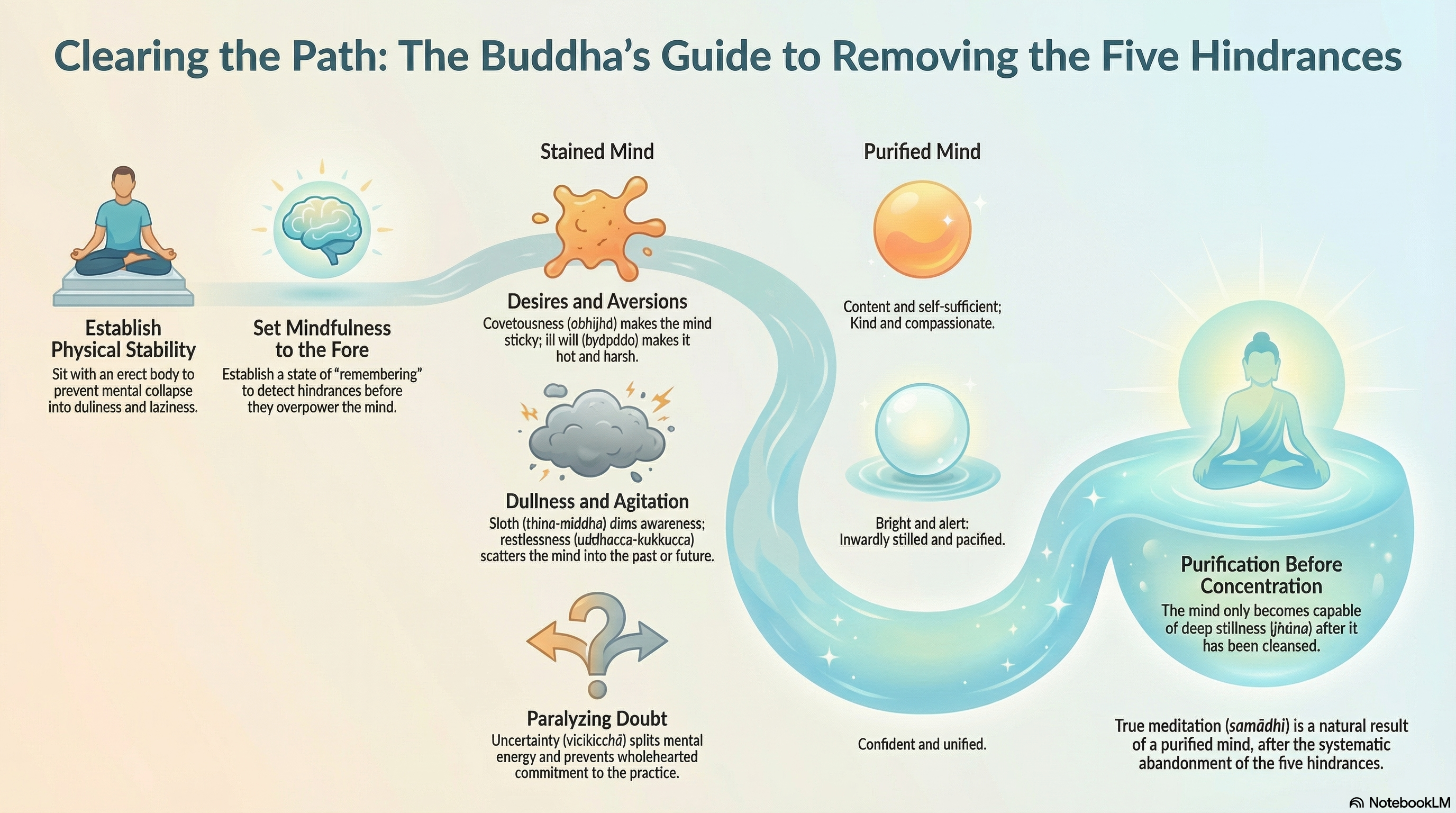 VISUAL SUMMARYSee this study in a pictureOpen the complete infographic for a visual overview before or after reading the full study.View infographic →
The Practical Movement of the Passage
Return from outward activity
Sit steadily
Establish sati to the fore
Identify the specific hindrance
Abandon it
Cittaṁ parisodheti
Mind becomes fit for samādhi
Jhāna can develop
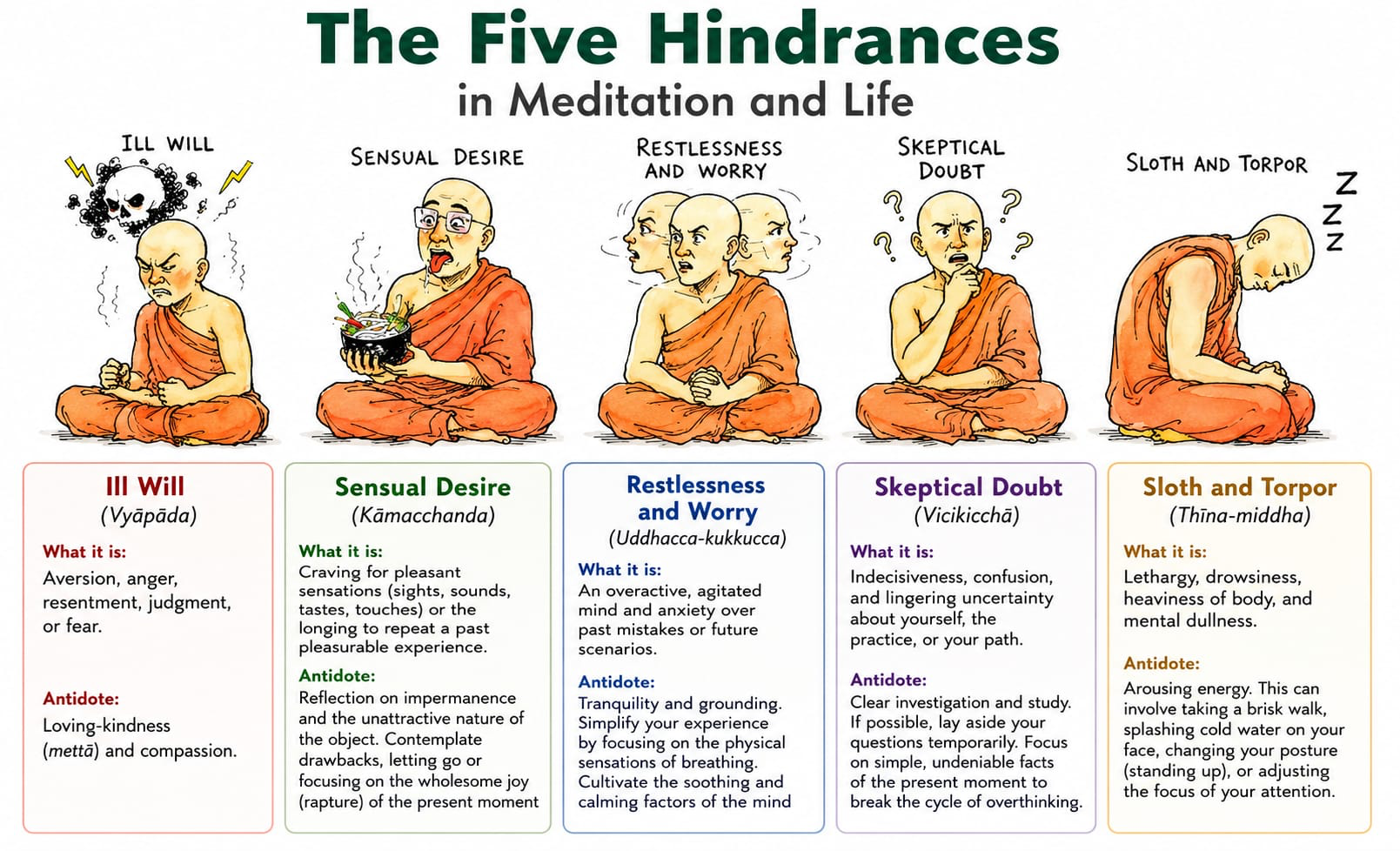
Five hindrances and purification before jhāna
Click infographic to enlarge ↗
Preparation and the Five Hindrances
01 Preparation for Hindrance Removal
So pacchābhattaṁ piṇḍapātapaṭikkanto nisīdati pallaṅkaṁ ābhujitvā, ujuṁ kāyaṁ paṇidhāya, parimukhaṁ satiṁ upaṭṭhapetvā.
1. Overall structure of the passage
The structure is: preparation → establishment of mindfulness → abandonment of hindrances → purification of mind
So the movement is not random. It is:
- 1. return from alms / after meal
- 2. sit down properly
- 3. establish mindfulness
- 4. remove the hindrances
- 5. purify the mind
- only then the mind becomes capable of samādhi and jhāna
This is why the repeated phrase is so important:
- cittaṁ parisodheti
- “he purifies the mind”
The Buddha is not describing a mere seated exercise. He is describing citta-visuddhi in action, at least at the level of hindrance-cleansing.
The opening phrase: bodily settling is not yet meditation proper
So pacchābhattaṁ piṇḍapātapaṭikkanto nisīdati pallaṅkaṁ ābhujitvā, ujuṁ kāyaṁ paṇidhāya, parimukhaṁ satiṁ upaṭṭhapetvā.
Let us break each part carefully.
So “he,” “that monk,” “such a one.”
This refers to the practitioner already described in a larger training context. Usually such passages come after sīla and often after sense restraint and clear comprehension. So this “he” is not any random person who has made no preparation. It is one who has been living rightly.
pacchābhattaṁ “after the meal.”
This tells us something practical and subtle. The monk has completed a necessary bodily duty. He is not sitting with agitation about food, nor chasing tastes, nor in the middle of worldly engagement. A sense of completion is there.
piṇḍapātapaṭikkanto “having returned from alms-round.”
This also matters. He has returned from moving in the world of sights, sounds, encounters, and possible distractions. Now comes withdrawal from outward involvement into inward settling.
So already there is a transition:
- from movement to stillness
- from social contact to seclusion
- from engagement to inward purification
nisīdati “he sits.”
This sounds simple, but in the suttas sitting is often the posture chosen for collected inward work because it is balanced: not too relaxed like lying down, not too active like walking.
pallaṅkaṁ ābhujitvā “having folded the legs crosswise.”
This is simply the standard meditative seat. The important point is stability. The body is put in a form that can remain steady without frequent adjustment.
ujuṁ kāyaṁ paṇidhāya “having set the body erect.” which is very rich.
ujuṁ = straight, upright
kāyaṁ = body
paṇidhāya = having placed, established, directed
This is not about stiffness. It is about non-collapse. The body is aligned so that dullness, laziness, and carelessness are less likely to overpower the mind.
A bent, slack body easily supports thīna-middha. An upright body supports wakefulness and presence.
So bodily erectness is already part of the battle against hindrances.
parimukhaṁ satiṁ upaṭṭhapetvā – This is one of the most important phrases in all meditation passages.
pari-mukhaṁ = “in front,” “before oneself,” “to the fore”
satiṁ = mindfulness
upaṭṭhapetvā = having established, set up, placed near
This does not necessarily mean merely “at the nostrils.” That later narrow interpretation is too small. The primary meaning is that mindfulness is brought to the forefront, made present, made ready, made operative.
So before dealing with hindrances, the practitioner does not drift vaguely. He first establishes a state of remembering, non-forgetfulness, present guarding, lucid attending.
This is crucial. Without sati, one cannot even detect hindrances properly.
Why the hindrances come here
After posture and mindfulness, the Buddha does not immediately say, “now enter first jhāna.” Instead he describes the abandoning of the five nīvaraṇas.
Why? Because the hindrances are precisely what make the mind:
- muddy
- divided
- weak
- unstable
- unfit for samādhi
- incapable of seeing clearly
A mind under hindrances may think it is meditating, but in reality it is either wanting, resisting, sinking, scattering, or doubting.
So the hindrance section is the practical answer to the question:
What prevents true samādhi? and also: what must be purified before insight becomes sharp?
Why the phrase “cittaṁ parisodheti” repeats after every hindrance
This repetition is deliberate and profound.
The hindrances are not external enemies; they are stains, obscurations, disturbances in the mind itself. Thus abandoning each one is an act of purification.
Each hindrance stains the mind differently:
- 1. abhijjhā makes it sticky and outward-leaning
- 2. byāpāda makes it hot and harsh
- 3. thīna-middha makes it dim and heavy
- 4. uddhacca-kukkucca makes it scattered and unsettled
- 5. vicikicchā makes it divided and hesitant
When these are removed, the mind becomes the opposite:
- 1. non-grasping
- 2. kind
- 3. bright
- 4. calm
- 5. confident
That purified mind is naturally much closer to samādhi and so samādhi is not produced mechanically. It grows in a purified field.
This is why jhāna cannot be reduced to “just focus on breath”
This passage shows that the Buddha’s path is psychologically precise.
One may put attention on breath for hours, but if the mind remains:
- desiring,
- irritated,
- sleepy,
- restless,
- doubtful,
then the ground for jhāna is not yet purified.
So the breath or other meditation object is not magic by itself. The object becomes effective when the hindrances are being abandoned.
This is why many people sit for years but remain mostly in conflict with hindrances. They mistake object-contact for meditation, whereas the Buddha emphasizes purification of mind.
Relation to samatha
This passage is one of the clearest demonstrations that samatha is not merely a technical device but a condition emerging from purification.
Samatha literally means calming, pacification, settling.
Where do we see that here?
desire calmed
ill will calmed
dullness cleared
restlessness settled
doubt crossed
Especially in:
- ajjhattaṁ vūpasantacitto
- inwardly calmed mind
So samatha is already being built here through abandonment of the hindrances.
In other words: abandoning the hindrances is not separate from samatha
it is the very making of the mind calm and fit
Relation to jhāna The first jhāna is commonly described as entered by one who is:
vivicceva kāmehi vivicca akusalehi dhammehi
secluded from sensual pleasures and secluded from unwholesome states
The hindrances are precisely central unwholesome states that obstruct jhāna. So this passage can be seen as the practical groundwork for that seclusion.
When the hindrances fade, the mind becomes:
- more unified
- lighter
- less conflicted
- more joyful
- more stable on the object
Then vitakka-vicāra can stay with the object in a wholesome way, and pīti-sukha can arise in a mind no longer under assault from the hindrances.
So this passage is almost a pre-jhāna cleansing formula.
Relation to daily life, not only formal sitting
Though the passage is presented in seated meditation form, these hindrances are not only sitting problems. They are life problems.
Throughout the day:
seeing desirable forms → abhijjhā
being annoyed by others → byāpāda
laziness and mental fog → thīna-middha
agitation and regret → uddhacca-kukkucca
wavering and uncertainty → vicikicchā
If they are not worked with during the day, sitting will simply reveal the accumulated force of what has been fed all day.
So proper practice means:
- guarding the senses
- not grasping signs and features
- living with moderation
- maintaining sati-sampajañña
- then formal sitting becomes the deepening of a training already underway
This is why you have rightly emphasized sīla, indriya-saṁvara, and sampajañña. Without them, this passage remains mostly theoretical.
A subtler reading: each hindrance blocks a specific excellence of mind
We can see a deeper mapping:
Abhijjhā blocks contentment and inward sufficiency.
Byāpāda blocks gentleness and non-harming.
Thīna-middha blocks luminosity and alert comprehension.
Uddhacca-kukkucca blocks collected inward stillness.
Vicikicchā blocks confidence and unification of direction.
So abandoning hindrances is not merely subtraction. It also reveals wholesome positive qualities.
The phrase “viharati” is important
In every case the Buddha says:
- vigatābhijjhena cetasā viharati
- abyāpannacitto viharati
- vigatathinamiddho viharati
- anuddhato viharati
- tiṇṇavicikiccho viharati
He dwells like this.
This means these are not momentary flashes only. The aim is a sustained mode of abiding. The mind takes up residence in freedom from the hindrance.
So practice is not merely knocking hindrances down for a second. It is learning to dwell in their absence.
This is an internal purification liturgy
The repetitive structure has a liturgical and pedagogical force:
- abandon X
- dwell free from X
- purify the mind of X
This teaches the meditator exactly what to look for.
Not: “I hope something mystical happens.”
But:
- “Is desire present or absent?”
- “Is ill will present or absent?”
- “Is dullness present or absent?”
- “Is agitation present or absent?”
- “Is doubt present or absent?”
This is concrete, observable, testable.
That is one of the great strengths of the Buddha’s teaching.
How this passage should shape actual practice
A practitioner can use this as a real diagnostic sequence:
After sitting upright and establishing mindfulness, check:
Is the mind leaning outward wanting something? That is abhijjhā.
Is the mind resisting, irritated, or harsh? That is byāpāda.
Is the mind sinking, dim, heavy, blurred? That is thīna-middha.
Is the mind scattered, hurried, replaying, regretting? That is uddhacca-kukkucca.
Is the mind wavering, second-guessing, unconvinced? That is vicikicchā.
Then the task is not to fight blindly, but to remove the specific hindrance with its appropriate opposite and with wise attention.
Summary in doctrinal language
This passage is a compact practical manual showing:
- the bodily basis for meditation,
- the establishment of mindfulness,
- the abandoning of the pañca nīvaraṇā,
- the purification of mind,
the necessary groundwork for samādhi and jhāna.
The key doctrinal point is:
jhāna does not arise in a mind still occupied by hindrances.
Therefore the primary meditative labor is purification.
A concise rendering of the whole passage in flowing English
After returning from alms-round and meal, he sits down with legs folded crosswise, sets the body erect, and establishes mindfulness to the fore. Having abandoned covetousness regarding the world, he dwells with a mind free from longing and purifies the mind of covetousness. Having abandoned ill will and aversion, he dwells with a mind free from hostility, compassionate for the welfare of all living beings, and purifies the mind of ill will. Having abandoned sloth and torpor, he dwells free from dullness, perceiving light, mindful and clearly comprehending, and purifies the mind of sloth and torpor. Having abandoned restlessness and remorse, he dwells unagitated, inwardly calmed in mind, and purifies the mind of restlessness and remorse. Having abandoned doubt, he dwells having crossed beyond doubt, without wavering regarding wholesome states, and purifies the mind of doubt.
The essence in one line This whole passage is the Buddha’s way of saying:
02 First Hindrance: Abhijjhā
So abhijjhaṁ loke pahāya vigatābhijjhena cetasā viharati, abhijjhāya cittaṁ parisodheti.
Let us go word by word.
abhijjhaṁ Covetousness, longing, grasping desire, especially wanting what is attractive.
This is more than simple desire. It is desire that leans toward taking, appropriating, relishing, and mentally feeding on objects.
loke “in the world.” This is profound.
Not merely desire in some abstract sense, but desire with respect to the world of experience: visible forms, sounds, smells, tastes, touches, ideas, memories, imaginings, attainments, identities.
So “world” here is not just society outside; it is the experienced field toward which the mind spreads.
pahāya “having abandoned.”
This is not “having indulged a little less.” It indicates a real putting aside, relinquishment, dropping.
vigatābhijjhena cetasā viharati “He dwells with a mind from which covetousness has gone.”
vigata = gone away, departed
cetasā = with mind
viharati = dwells, abides
This is beautiful. Meditation here is not merely doing something; it is dwelling in a changed inner condition.
abhijjhāya cittaṁ parisodheti – “He purifies the mind of covetousness.”
This is the heart. Desire dirties the mind because it makes it lean outward. It produces stickiness. The mind is no longer clear and reflective; it becomes adhesive.
Deep meaning: Why is sensual desire such a major obstacle?
Because desire does several things at once:
- It creates projection and mind no longer sees the object as it is, but as promising satisfaction.
- It creates lack as the mind feels incomplete and seeks completion externally.
- It destroys stillness as wanting is motion. Even if the body is still, the mind runs toward the desired thing.
- It strengthens “mine-making” as one wants to obtain, keep, repeat, own, become.
Thus abhijjhā is incompatible with collectedness.
In direct practice – When sitting, abhijjhā may appear as:
wanting pleasant sensations
wanting visions
wanting calm quickly
wanting jhāna
wanting the session to feel special
wanting to think about a person, food, conversation, success
So even “wanting meditation to go well” can become a subtle form of abhijjhā.
The antidote: In the suttas, this is worked against by:
- seeing danger in sensuality
- non-grasping at signs and features
- restraint of the senses
- contemplating unattractiveness where needed
- contentment
- returning to the present object without feeding desire
So this is not brute suppression. It is disempowering desire by wisdom and non-participation.
03 Second Hindrance: Byāpāda-Padosa
byāpādapadosaṁ pahāya abyāpannacitto viharati sabbapāṇabhūtahitānukampī, byāpādapadosā cittaṁ parisodheti.
byāpāda – Ill will, hostility, intention of harm.
padosa – Aversion, resentment, irritation, angry corruption of mind.
Together they point to a mind that pushes against what it dislikes.
pahāya – Having abandoned. Again, this is not “managing anger politely.” It is genuine relinquishment at that moment.
abyāpannacitto viharati “He dwells with a mind free from ill will.”
a-byāpanna = not harmed, not hostile, not injuring
citto = minded, mental state
The mind becomes non-violent internally.
sabbapāṇabhūtahitānukampī – “Compassionate for the welfare of all living beings.”
This is extremely important. The absence of ill will is not presented as blank neutrality only. It flowers into benevolence and compassion.
sabba = all
pāṇa-bhūta = breathing beings, living creatures
hita = welfare, benefit
anukampī = compassionate, trembling with sympathy, moved kindly
So the antidote is not simply “stop being angry.” It is replacement with a mind that wishes well.
byāpādapadosā cittaṁ parisodheti “He purifies the mind of ill will and aversion.”
Deep meaning
Ill will distorts perception just as desire does, but in the opposite direction.
With desire, the mind paints attractiveness.
With ill will, the mind paints offensiveness.
In both cases, the object is not seen clearly. It is altered by affective coloring.
Byāpāda also burns the mind. It makes samādhi impossible because the mind becomes rough, hot, contracted, oppositional.
A mind that wants to hurt, reject, condemn, or replay offense cannot settle deeply.
In direct practice – Byāpāda in meditation appears as:
- irritation at noises
- anger toward people
- resentment about past events
- harshness toward oneself
- frustration with the meditation object
- “why is this not working?”
- dislike of bodily pain
- subtle annoyance toward even small disturbances
This is very common. Many think only explicit anger counts. But even fine irritation is byāpāda in seed form.
Important subtle point – Self-hatred is also byāpāda.
A meditator who sits with inner aggression toward their own mind is still under the hindrance.
The antidote
The passage itself gives it: sabbapāṇabhūtahitānukampī
This points toward mettā-karuṇā orientation. as the mind softens, it no longer relates through aggression.
When ill will fades, the mind becomes inhabitable and can remain with the object without inner warfare.
04 Third Hindrance: Thīna-Middha
thinamiddhaṁ pahāya vigatathinamiddho viharati ālokasaññī sato sampajāno, thinamiddhā cittaṁ parisodheti.
This is not merely “sleepiness.” It is a composite hindrance.
thīna – Mental stiffness, inertia, shrinking, dull collapse of energy.
middha – Heaviness, drowsiness, torpor, sinking of alertness.
Together they mean the mind is not bright, nimble, or penetrative. It becomes foggy, weighed down, low-powered.
vigatathinamiddho viharati – “He dwells free from sloth and torpor.”
Again the emphasis is on an altered condition of abiding.
āloka-saññī “One perceiving light.”
This is often misunderstood if taken too narrowly. It can include deliberate brightening of the mind, attending to luminosity, openness, clarity, wakefulness. It does not need to mean mystical light alone. Primarily it opposes gloom, murk, dimness, mental darkness.
sato sampajāno “Mindful and clearly comprehending.”
This pair is crucial:
- sati keeps the object in view, prevents forgetfulness
- sampajañña knows clearly what is happening, what one is doing, the condition of the mind, suitability, purpose
So the antidote to thīna-middha is not just forcing the eyes open or moving a little. The deeper antidote is lucid presence.
thinamiddhā cittaṁ parisodheti “He purifies the mind of sloth and torpor.”
Deep meaning – Why is thīna-middha such a serious obstacle?
Because insight requires a live mind. A dull mind cannot penetrate arising and passing. A sleepy mind cannot sustain mindfulness. A heavy mind cannot gather energy into samādhi.
This hindrance is especially deceptive because it can mimic peace.
A meditator may think:
“I am becoming quiet.”
But actually the mind is sinking.
Or:
“There are fewer thoughts.”
But actually awareness has dimmed.
So one must distinguish:
- calm from collapse
- stillness from stupor
- quietude from dullness
In direct practice
Thīna-middha may appear as:
- mental blur
- sleep-like sinking
- head nodding
- inability to stay with the object
- blankness mistaken for meditation
- low interest in the object
- heaviness after overeating or poor posture
- fuzzy drifting with occasional remembrance
Why body posture matters here
Now we can see why ujuṁ kāyaṁ paṇidhāya was placed earlier. If the body collapses, this hindrance is invited.
The antidote
This passage gives three remedies in essence:
- āloka-saññī — brighten perception
- sato — establish mindfulness
- sampajāno — clear comprehension
Elsewhere in the suttas:
change posture
reflect on Dhamma
rub limbs
wash the face
attend to light
walk mindfully
do not cooperate with dullness
So this hindrance is fought through wise arousal of energy, not through irritation toward oneself.
05 Fourth Hindrance: Uddhacca-Kukkucca
uddhaccakukkuccaṁ pahāya anuddhato viharati ajjhattaṁ vūpasantacitto, uddhaccakukkuccā cittaṁ parisodheti.
This pair is very deep.
uddhacca Restlessness, agitation, inner scattering, inability to remain gathered where in the mind jumps, flutters, runs.
kukkucca – Remorse, worry, anxious regret, mental fussing over what was done or not done.
This is not wholesome conscience in the moment of learning from a mistake. It is unproductive mental churning.
anuddhato viharati – “He dwells unagitated.”
The mind is not thrown upward, not excited into dispersion.
ajjhattaṁ vūpasantacitto “With inwardly stilled mind.”
This is a magnificent phrase.
ajjhattaṁ = inwardly, internally
vūpasanta = calmed down, subsided, pacified
citto = minded, mental state
The mind is not merely quiet on the surface. It is inwardly pacified.
This is essential for samādhi. A person may sit motionless while inwardly rehearsing, regretting, anticipating, comparing, remembering, and planning. That is not inward peace.
uddhaccakukkuccā cittaṁ parisodheti “He purifies the mind of restlessness and remorse.”
Deep meaning
This hindrance pulls in two directions:
- restlessness runs toward what is next
- remorse runs back toward what was
Thus the mind is torn from present collectedness.
Restlessness is often linked with excitation, expectation, novelty-seeking.
Remorse is often linked with self-preoccupation, unfinished mental business, replaying past actions.
Together they destroy inward unification.
In direct practice This hindrance appears as:
planning future tasks
replaying conversations
regret over mistakes
anxiety about progress
checking whether meditation is “working”
urge to move, adjust, stop, restart
subtle excitement about attaining something
Important subtle point
Even spiritual ambition can become uddhacca.
The mind may think:
- “Will jhāna arise now?”
- “Am I improving?”
- “What should I teach tomorrow from this?”
This is not collectedness; it is agitation wearing a Dhamma mask.
The antidote
The sutta gives the essence:
- anuddhato — unagitated
- ajjhattaṁ vūpasantacitto — inwardly calmed
This implies:
- do not chase
- do not replay
- do not mentally poke experience
- let the mind settle into inward quiet
This requires trust, non-interference, and patient staying.
06 Fifth Hindrance: Vicikicchā
vicikicchaṁ pahāya tiṇṇavicikiccho viharati akathaṅkathī kusalesu dhammesu, vicikicchāya cittaṁ parisodheti.
vicikicchā – Doubt, perplexity, uncertainty that weakens practice.
This is not honest inquiry as such. The Buddha does not condemn careful investigation. This is paralyzing doubt, wavering indecision, inability to commit the mind.
tiṇṇavicikiccho “One who has crossed beyond doubt.”
tiṇṇa = crossed over
This is strong language. Doubt is like a flood or swamp; one must cross it.
akathaṅkathī kusalesu dhammesu “Without uncertainty regarding wholesome states.”
This is important. The meditator is not vacillating about the path of wholesome qualities. This does not mean omniscience. It means enough clarity and confidence not to be crippled by wavering.
vicikicchāya cittaṁ parisodheti “He purifies the mind of doubt.”
Deep meaning
Doubt splits energy.
A doubting mind cannot fully gather because part of it withholds commitment.
It asks endlessly:
Is this the right object?
Am I doing it right?
Is this worth it?
Maybe another method?
Maybe I should stop?
Maybe this teacher is wrong?
Maybe I can never do this?
Such doubt is not wisdom; it is dispersal.
In direct practice: Vicikicchā shows up as:
- jumping between methods
- not staying long enough with one training
- constant internal commentary about whether practice is correct
- doubt about one’s capacity
- doubt about the value of wholesome states
- doctrinal uncertainty that prevents wholehearted practice
The antidote
In the suttas, doubt is weakened by:
- hearing true Dhamma
- wise attention
- direct seeing
- confidence born of verification
- staying with the training long enough to know it from within
So again, the Buddha is not asking for blind faith. He is asking for non-wavering commitment grounded in understanding.
Summary of the Five Hindrances
| Hindrance Name (Pali) | English Translation | Mental Effect/Obstruction | Manifestation in Practice | Prescribed Antidote | Resulting Purified State |
|---|---|---|---|---|---|
| abhijjhā | Covetousness, longing, grasping desire | Makes the mind sticky, outward-leaning, and adhesive; creates projection and a sense of lack. | Wanting pleasant sensations, visions, or the session to feel special; wanting to think about food, success, or people; wanting jhāna or quick results. | Internal: Seeing danger in sensuality, contemplating unattractiveness, and contentment. External: Restraint of the senses and returning to the present object without feeding desire. | Non-grasping, contentment, and inward sufficiency. |
| byāpāda | Ill will, hostility, intention of harm | Makes the mind hot, harsh, rough, contracted, and oppositional; burns the mind and distorts perception toward offensiveness. | Irritation at noises, anger toward people, resentment about past events, harshness toward oneself (self-hatred), and frustration with the meditation object. | Internal: Mettā-karuṇā (loving-kindness and compassion) orientation. External: Developing a mind that wishes for the welfare of all living beings. | Kindness, gentleness, and non-harming. |
| thīna-middha | Sloth and torpor (mental stiffness and heaviness) | Makes the mind dim, heavy, foggy, and weighed down; creates a dull collapse of energy and murkiness. | Mental blur, sleep-like sinking, head nodding, inability to stay with the object, and fuzzy drifting. | Internal: Āloka-saññī (perceiving light/brightening perception), establishing sati (mindfulness) and sampajañña (clear comprehension). External: Changing posture, rubbing limbs, or washing the face. | Brightness, luminosity, and alert comprehension. |
| uddhacca-kukkucca | Restlessness and remorse | Makes the mind scattered, unsettled, and torn from the present; restlessness runs forward while remorse runs back. | Planning future tasks, replaying conversations, regret over mistakes, anxiety about progress, and the urge to move or stop. | Internal: Ajjhattaṁ vūpasantacitto (inwardly calming/stilling the mind) and trust. External: Non-interference and patient staying without chasing or replaying thoughts. | Calmness and collected inward stillness. |
| vicikicchā | Doubt, perplexity, uncertainty | Makes the mind divided, hesitant, and wavering; splits energy and prevents commitment to the path. | Jumping between methods, constant internal commentary on correctness, doubt about one’s capacity, and uncertainty about the value of the training. | Internal: Wise attention and direct seeing. External: Hearing true Dhamma and confidence born of verification through staying with the training. | Confidence, certainty, and unification of direction. |
The Essence
The Buddha does not present meditation as mere contact with an object. The primary meditative labour is purification: desire is relinquished, ill will is softened into benevolence, dullness is brightened, agitation is calmed, and doubt is crossed.