
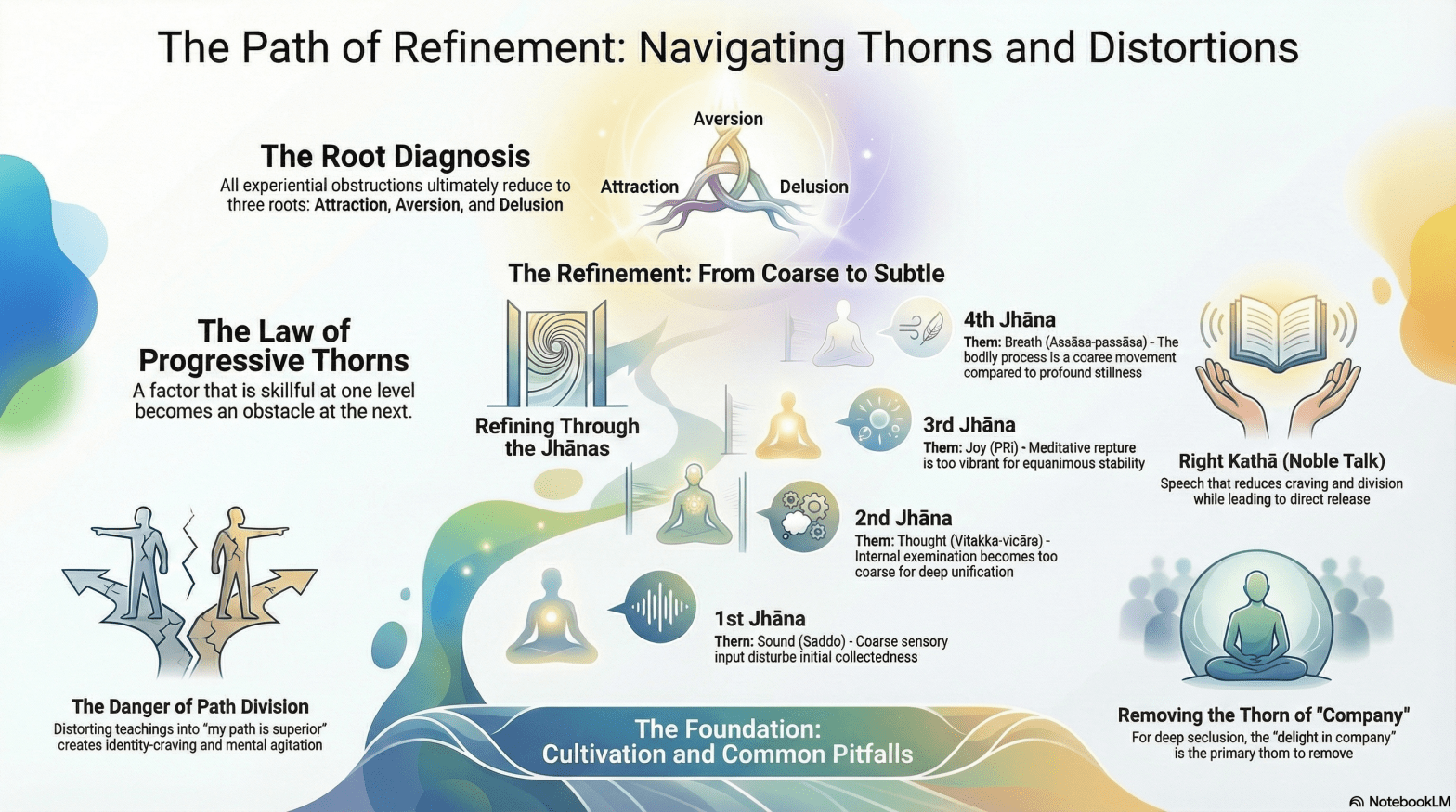
During my understanding of dhamma, found that there are two paths to perfection. One through saddha wherein one starts to do general meditation of any traditions and mainly watches the breath and another way is pañña or wisdom where you investigate into dhamma.
Actually, we would require both samathā and vipassanā to develop the mind in not getting lost in transition and reach the ultimate liberation from samsarā.
If I were to progress, following suttas from Anguttara Nikaya would be of great help:
1. Mulakasutta – AN10.58
2. Mahācundasutta – AN 6.46
3. Kaṇṭakasutta – AN10.72
4. Dasakathā – AN10.69
Let us tabulate Dasakathā with Mahācundasutta to see show things gets distorted and leads to debates and fights between two groups – Jhāyī bhikkhū and Dhammayogā bhikkhū
To begin with, let us understand AN10.69
Interactive Sutta Study
| # | Kathā | Etymology (Root Meaning) | Meaning (Deeper Sense) | Opposite (Contrary State) | Practical Check (In Practice) |
|---|---|---|---|---|---|
| 1 | Appicchakathā | Appa (little) + Icchā (desire) | Cultivating fewness of wishes; reducing craving even subtly | Mahicchatā (many desires), craving for gain, status, attainments | “What am I still wanting now — even in Dhamma?” |
| 2 | Santuṭṭhikathā | San (well) + Tuṭṭhi (contentment) | Contentment with present conditions; inner sufficiency | Asantuṭṭhi (discontent), restlessness, comparison | “Am I dissatisfied with what I have or where I am?” |
| 3 | Pavivekakathā | Vi (apart) + Viveka (separation/discrimination) | Seclusion through wise discrimination (what to engage / avoid) | Saṅgaṇikārāmatā (delight in company), over-engagement | “Is this engagement necessary or weakening my mind?” |
| 4 | Asaṁsaggakathā | A (not) + Saṁsagga (mixing, association) | Non-entanglement socially and mentally | Saṁsagga (entanglement), involvement, gossip, debate | “Am I getting mentally entangled with people or views?” |
| 5 | Vīriyārambhakathā | Vīriya (energy) + Ārambha (arising, initiating) | Arousing and sustaining effort toward abandoning unwholesome states | Thīna–middha (sloth, torpor), laziness, comfort-seeking | “Am I applying energy or slipping into dullness?” |
| 6 | Sīlakathā | Sīla (conduct, restraint) | Ethical discipline; purity of bodily and verbal actions | Duccarita (misconduct), carelessness, moral compromise | “Is my action/speech aligned with non-harming?” |
| 7 | Samādhikathā | Sam (together) + Ādhā (to place) | Collected, unified, non-scattered mind | Uddhacca–kukkucca (restlessness, agitation, remorse) | “Is my mind steady or scattered right now?” |
| 8 | Paññākathā | Pa (complete) + Ñā (to know) | Direct seeing of reality: anicca, dukkha, anattā | Moha (delusion), conceptual thinking without seeing | “Am I directly seeing arising–passing or just thinking?” |
| 9 | Vimuttikathā | Vi (free) + Mutti (release) | Letting go of clinging; experiential freedom | Upādāna (clinging), identification, holding | “Am I still holding onto this experience or identity?” |
| 10 | Vimuttiñāṇadassanakathā | Ñāṇa (knowledge) + Dassana (seeing) | Knowledge and vision of liberation; direct knowing of freedom | Avijjā (ignorance), doubt about liberation | “Is there clear knowing of release, or still uncertainty?” |
| Stage | Kathā |
|---|---|
| Renunciation foundation | Appiccha → Santuṭṭhi |
| Withdrawal | Paviveka → Asaṁsagga |
| Effort | Vīriya |
| Training | Sīla → Samādhi → Paññā |
| Result | Vimutti → Vimuttiñāṇadassana |
Now the comparison between AN10.69 and AN6.46
| # | Dasakathā AN 10.69) | Deeper Meaning | Distortion (AN 6.46 warning) | Correct Integration |
|---|---|---|---|---|
| 1 | Appicchakathā | Fewness of wants | “My path is superior” → subtle craving for identity | Simplicity in both learning & meditation |
| 2 | Santuṭṭhikathā | Contentment | Dissatisfaction with others’ approach | Accept diversity of faculties |
| 3 | Pavivekakathā | Discriminative withdrawal | Avoiding others wrongly OR clinging to group identity | Withdraw from defilements, not people |
| 4 | Asaṁsaggakathā | Non-entanglement | Getting entangled in debates | No mental involvement in “who is right” |
| 5 | Vīriyārambhakathā | Arousing effort | Effort wasted in argument | Direct effort to abandoning defilements |
| 6 | Sīlakathā | Right conduct | Harsh speech, criticism | Speech rooted in non-harming |
| 7 | Samādhikathā | Collected mind | Agitated mind due to comparison | Stability regardless of others |
| 8 | Paññākathā | Seeing reality | Conceptual debate mistaken as wisdom | Direct seeing over argument |
| 9 | Vimuttikathā | Letting go | Clinging to identity: “I am meditator / scholar” | Drop identity-view |
| 10 | Vimuttiñāṇadassanakathā | Knowing liberation | False claims / judging others’ attainment | Only direct knowledge counts |
Two dangerous deviations:
Dhammayoga distortion
Intellectualization of teachings
Criticizing practitioners
“They don’t truly understand”
Jhāyī distortion
Anti-intellectualism
Rejecting investigation
“Only meditation matters”
| Dimension | AN 10.69 | AN 6.46 |
|---|---|---|
| Content | What to speak | How speech goes wrong |
| Function | Build path | Prevent distortion |
| Danger | Missing steps | Division of path |
| Resolution | Balanced cultivation | Mutual respect |
There are two wings for awakening and liberation
Samatha (jhāyī) – Stabilization of mind
Vipassanā (dhammayogā) – Seeing depth of mind
When, they don’t meet then Samathā becomes “dry and stagnated” and Vipassanā leads to agitate and restless state of mind which is what AN6.46 is focussing upon.
🧘 FINAL ESSENCE
AN 10.69 says: “Speak only what leads to liberation”
AN 6.46 says: “Do not let even Dhamma become division”
🟢 Right Kathā = That which reduces craving, division, and identity — and leads to direct seeing and release
Interactive Sutta Study
Let us add Kaṇṭakasutta – AN10.72 to see how it works
# | Pāli term | Literal meaning | Deeper meaning | Thorn / Kaṇṭaka | What it means in practice |
|---|---|---|---|---|---|
| 1 | Appicchakathā | talk on fewness of wishes | reducing wanting | subhanimittānuyogo, rāga | the mind stops feeding on attractive signs and wanting more |
| 2 | Santuṭṭhikathā | talk on contentment | sufficiency, enoughness | dissatisfaction hidden in craving and comparison | contentment protects the mind from outward pull |
| 3 | Pavivekakathā | talk on seclusion/discrimination | choosing non-entanglement | saṅgaṇikārāmatā | if one delights in crowd, seclusion cannot deepen |
| 4 | Asaṁsaggakathā | talk on non-mingling | non-mixing with what disturbs | visūkadassanaṁ, social and sensory scattering | prevents fragmentation of attention |
| 5 | Vīriyārambhakathā | talk on arousing effort | energy rightly launched | giving in to distraction and softness | energy is needed to remove the thorn before settling |
| 6 | Sīlakathā | talk on virtue | restraint, non-remorse | mātugāmūpacāro, rāga-driven conduct | ethical restraint protects the field of practice |
| 7 | Samādhikathā | talk on collectedness | gathered, unified mind | saddo, vitakkavicārā, pīti, assāsapassāso | each stage requires abandoning a coarser movement |
| 8 | Paññākathā | talk on wisdom | seeing conditions clearly | mistaking the coarse for the subtle | wisdom knows what must now be relinquished |
| 9 | Vimuttikathā | talk on release | freedom from holding | saññā ca vedanā ca in nirodha context | even very subtle experience must cease for cessation |
| 10 | Vimuttiñāṇadassanakathā | talk on knowledge and vision of release | direct knowing of freedom | rāgo, doso, moho | final verification is by destruction of roots |
Let us go over AN10.72 in detail
Pavivekārāmassa saṅgaṇikārāmatā kaṇṭako
paviveka = seclusion, separation, discerned withdrawal
ārāma = delight, pleasure, abiding in
pavivekārāmassa = for one who delights in seclusion
saṅgaṇikā-ārāmatā = delight in company, delight in crowd, delight in sociality
kaṇṭako = thorn
For one who wants seclusion, delight in company is a thorn.
This is very deep. It does not merely say “company is bad.” It says: delight in company is the thorn
One may physically sit alone, but if the mind delights in conversation, audience, being seen, being needed, social warmth, group identity and emotional companionship due to which paviveka cannot mature.
Deeper significance -This directly links with AN 10.69 – pavivekakathā and asaṁsaggakathā
And with AN 6.46: dividing into camps, delighting in faction, identity, group-based selfhood
Important point
Seclusion is not hatred of people but is freedom from dependence on company for inner comfort.
Thorn removed – Not people themselves, but psychological leaning toward company, the comfort addiction of social presence
Asubhanimittānuyogaṁ anuyuttassa subhanimittānuyogo kaṇṭako
asubha = unattractive, foul, not beautiful, not alluring
nimitta = sign, mark, mental image, perceptual cue
anuyoga = cultivation, application, pursuit
anuyuttassa = for one engaged in
subha-nimitta-anuyogo = attention to attractive signs
For one engaged in the cultivation of the unattractive sign, attention to the attractive sign is a thorn.
This is extremely practical. If one is trying to cool lust by seeing impermanence, decay, unattractiveness and non-ownable body nature. This then turning toward beauty signs, pleasant bodily form, charm, desirability and aesthetic fascination and becomes a thorn.
Deeper point
The Buddha is showing a law of mind as the perception you feed becomes the world you inhabit. If one is cultivating asubha, then subhanimitta is not neutral. It is an obstruction.
Connection with AN 10.69: This connects especially with:
appicchakathā, sīlakathā and paññākathā
Because attractive-sign attention feeds to wanting, attachment, delusion of beauty as lasting and satisfying
Practice meaning
This does not mean creating disgust in a neurotic way. It means correcting delusion where the mind selectively exaggerates the attractive and ignores impermanence, vulnerability, decay and unsatisfactoriness
Indriyesu guttadvārassa visūkadassanaṁ kaṇṭako
indriyesu = in the sense faculties
gutta-dvāra = guarded at the doors
visūka-dassanaṁ = looking at distractions, variety-shows, crooked seeing, scattered spectacle
The exact force of visūkadassana points toward looking at distracting, variegated, captivating displays that pull the mind outward.
For one guarded at the sense doors, looking at distracting variety is a thorn.
Sense restraint is not just “do not see.” It is not grasping signs, not pursuing details and not letting perception proliferate. So visūkadassana is thorn because it breaks the continuity of guarding. It is the opposite of stable inward composure. In practical modern language it includes the mind’s fascination with spectacle, novelty, dramatic visual distraction, scanning, comparison, restless looking
Connection with AN 10.69 – asaṁsaggakathā, samādhikathā paññākathā
Because an unguarded eye quickly destroys collectedness.
Brahmacariyassa mātugāmūpacāro kaṇṭako
brahmacariyassa = for the holy life / celibate life / spiritual life
mātugāma = womenfolk, female presence; in broader practical sense, sensual object relevant to lust
upacāra = proximity, approach, familiar association
For the holy life, proximity to women is a thorn.
In the original monastic context, this is direct and plain. The point is not hatred or devaluation. The point is protection of celibate practice from sensual stimulation and emotional entanglement.
Deeper doctrinal meaning – The Buddha is identifying not abstract sexuality but proximity that activates sensuality.
For a brahmacārī, the thorn is not merely an act but nearness, familiarity, emotional softening toward sensual possibility and repeated exposure with unguarded mind.
Broader principle – For any practitioner, the thorn is: proximity to that which one is not yet free from.
Connection with AN 10.69 – appicchakathā, sīlakathā, pavivekakathā and asaṁsaggakathā
This is where lifestyle, perception, restraint, and seclusion all come together.
Jhāna leads to progressively subtler thorns and now the sutta becomes extraordinarily refined.
Paṭhamassa jhānassa saddo kaṇṭako – For the first jhāna, sound is a thorn.
First jhāna still has vitakka, vicāra, pīti, sukha and ekaggatā which are the factors, but has withdrawn from sensuality and unwholesome states. External sound becomes intrusive because the mind is now collected away from the sensory spread and sound becomes intense.
Important nuance
This does not mean the person becomes deaf. It means sound functions as disturbance relative to that collected state.
Deeper insight – What was ordinary at a coarse level becomes piercing at a subtler level and exactly why Buddha says thorn.
Dutiyassa jhānassa vitakkavicārā kaṇṭakā – For the second jhāna, vitakka and vicāra are thorns.
Why? In first jhāna, vitakka-vicāra are still present and functional. In second jhāna there is internal placing and examining of mind are now too coarse. The mind no longer needs applied and sustained movement toward the object. It settles in inner confidence, unification and pīti-sukha born of samādhi
So what was support in first jhāna becomes obstacle in second.
Very deep principle – A factor can be skillful at one level and obstructive at the next.
This is crucial far beyond jhāna. and even Dhamma reflection, useful earlier, can become overactivity later.
Connection with AN 6.46
This also mirrors how conceptual engagement has its place and beyond a point, it disturbs direct settling
So neither “thinking only” nor “anti-thinking” is right. Rather each factor has its proper place and proper relinquishment.
Tatiyassa jhānassa pīti kaṇṭako – For the third jhāna, pīti is a thorn.
Why? Pīti is energizing joy, thrill, uplift, rapture. It is still somewhat active and exciting. In third jhāna the mind moves toward deeper calm, equanimous happiness and quieter stability and so pīti is now too vibrant which seems like a thorn
Very important – Many practitioners mistake pīti for completion. But here Buddha explicitly shows it is still a thorn relative to a subtler peace.
Deeper lesson Pleasant meditative excitement is not the end and the path refines from exhilaration toward serenity.
Catutthassa jhānassa assāsapassāso kaṇṭako – For the fourth jhāna, inhalation and exhalation are a thorn.
Why? Fourth jhāna is characterized by purity of mindfulness due to equanimity, neither-painful-nor-pleasant feeling and profound stillness.
Relative to that, the bodily process of breathing is still coarse and so the sutta is not saying breathing is bad. Rather compared to the stillness of fourth jhāna, breathing is a coarse movement.
This is one of the strongest pieces of evidence against reducing all samādhi to “just keep watching breath forever.” Breath can be the basis for entry, but at greater refinement, even it is surpassed as coarse.
Saññāvedayitanirodhasamāpattiyā saññā ca vedanā ca kaṇṭako
For the attainment of cessation of perception and feeling, perception and feeling are thorns. If the attainment aimed at is nirodha-samāpatti, then saññā and vedanā must cease. Therefore, as long as they are present, they are obstacles relative to that attainment.
Deep doctrinal point
At this level, the thorn is not craving or coarse distraction alone, even the basic structures of experience themselves are thorn with respect to cessation and this shows the graded profundity of the sutta.
Final triad – Rāgo kaṇṭako, doso kaṇṭako, moho kaṇṭako
This is the summary key. All the previous thorns can be gathered into the three roots:
rāga = attraction, lust, pulling toward
dosa = aversion, irritation, push-back
moha = delusion, not seeing things correctly
So the Buddha ends by collapsing the whole map into the root diagnosis.
This means delight in company is rāga + moha, attractive sign is rāga and sensory spectacle is rāga + moha
harsh reaction, criticism, factionalism in AN 6.46 is dosa + māna + moha and inability to refine beyond coarse factors is moha regarding levels of subtlety
Interactive Sutta Study
Now let us integrate all three suttas deeply
AN 10.69 — the right orientation – These ten kathās tell you what kind of reflection, teaching, and speech support liberation.
AN 6.46 — the relational danger – Even practitioners can turn Dhamma into division by clinging to identities as in we are meditators, we are analysts and our way is superior and this itself is thorn.
AN 10.72 — the experiential obstruction – At each stage there is a specific coarser factor that must be recognized and relinquished
| Sutta | Focus | What it gives |
|---|---|---|
| AN 10.69 | Noble talks | what should orient the mind |
| AN 6.46 | Harmony of practitioners | how not to corrupt the path through division |
| AN 10.72 | Thorns | what specifically obstructs refinement |
Full Integration
| Stage | AN 10.69 (Kathā – Pāli) | What to Cultivate | AN 6.46 Distortion (Error) | AN 10.72 Kaṇṭaka (Thorn) | Deep Practice Insight |
|---|---|---|---|---|---|
| 1 | Appicchakathā | Fewness of wishes; reduce craving | Identity craving: “my method is superior” | Subhanimittānuyogo, Rāga | Attractive signs feed desire; reduce wanting to stabilize mind |
| 2 | Santuṭṭhikathā | Contentment; sufficiency | Dissatisfaction with practice/teacher | Craving-based dissatisfaction | Contentment stops outward seeking |
| 3 | Pavivekakathā | Seclusion (discrimination) | Group identity: “we vs they” | Saṅgaṇikārāmatā | Delight in company blocks inner withdrawal |
| 4 | Asaṁsaggakathā | Non-entanglement | Debate, argument, social involvement | Visūkadassanaṁ | Sensory scattering breaks mindfulness continuity |
| 5 | Vīriyārambhakathā | Arousing effort | Effort wasted in argument | Laziness supported by distraction | Energy must remove defilements, not defend views |
| 6 | Sīlakathā | Ethical restraint | Harsh speech, criticism | Mātugāmūpacāro, rāga/dosa/moha | Without sīla, mind cannot stabilize |
| 7 | Samādhikathā (1st level) | Initial collectedness | External disturbance sensitivity | Saddo (sound) | Coarse sensory input disturbs collected mind |
| 8 | Samādhikathā (2nd level) | Deeper unification | Overthinking | Vitakka-vicārā | Thinking becomes too coarse |
| 9 | Samādhikathā (3rd level) | Equanimous stability | Attachment to joy | Pīti | Joy becomes disturbance at subtler level |
| 10 | Samādhikathā (4th level) | Deep stillness | Clinging to bodily process | Assāsa-passāsa | Breath becomes coarse relative to stillness |
| 11 | Paññākathā | Direct seeing (anicca, dukkha, anattā) | Intellectualization | Misjudging subtle vs coarse | Wisdom = knowing what to abandon now |
| 12 | Vimuttikathā | Letting go of clinging | Identity: “I am meditator/knower” | Residual clinging | Release = dropping ownership |
| 13 | Vimuttiñāṇadassanakathā | Knowledge of liberation | Judging attainment | Saññā & vedanā (in nirodha context) | Even experience itself must cease |
| 14 | Root Layer | — | Division, comparison | Rāga, dosa, moha | All thorns reduce to these three |
HOW TO READ THIS TABLE (IMPORTANT)
🔁 Horizontal reading (row-wise) Each row = one stage of practice
👉 Example (Row 8):
Kathā → Samādhikathā
Error → Overthinking
Thorn → Vitakka-vicāra
Insight → Thought must now be dropped
🪜 Vertical reading (top to bottom)
This is full path progression:
Reduce desire
Become content
Withdraw
Cut entanglement
Apply effort
Establish sīla
7–10. Refine samādhi
11–13. Insight → liberation
🔥 MOST IMPORTANT INSIGHT (FROM AN 10.72) – What helps at one stage becomes a thorn at the next
| Earlier Stage | Later Stage |
|---|---|
| Thinking helps | Thinking obstructs |
| Joy helps | Joy obstructs |
| Breath helps | Breath becomes coarse |
| Perception helps | Perception obstructs |
🧘 PRACTICE FORMULA (VERY PRACTICAL)
At any moment need to apply:
1️⃣ AN 10.69 Dasakathā 👉 “What should I cultivate now?”
2️⃣ AN 6.46 Mahācundasutta 👉 “Am I creating division (inside or outside)?”
3️⃣ AN 10.72 Kaṇṭakasutta 👉 “What is the thorn right now?”
Let us integrate it with Mulakasutta from which we started.
| Mūlakasutta Step (AN 10.58) | Meaning | Dasakathā (AN 10.69) | Mahācunda (AN 6.46) – Distortion | Kaṇṭakasutta (AN 10.72) – Thorn | Practice Insight |
|---|---|---|---|---|---|
| Chanda (root) | Intention, desire, inclination | Appicchakathā | Desire to be right, superior | Rāga, subhanimitta | Reduce wanting → purify intention |
| Manasikāra (attention) | How mind attends | Santuṭṭhikathā | Comparing, dissatisfaction | Craving-driven restlessness | Attend with contentment |
| Phassa (contact) | Sense contact | Pavivekakathā | Social identity, group formation | Saṅgaṇikārāmatā | Withdraw from unnecessary contact |
| Vedanā (feeling) | Feeling tone | Asaṁsaggakathā | Emotional reactions in debate | Visūkadassanaṁ | Do not entangle with feeling |
| Samādhi (front) | Stabilization begins | Vīriyārambhakathā | Effort misdirected to argument | Laziness / distraction | Apply effort correctly |
| Satī (governing) | Mindfulness leads | Sīlakathā | Carelessness in conduct | Mātugāmūpacāro | Guard behavior → supports mindfulness |
| Paññā (highest) | Wisdom leads | Paññākathā | Intellectualization | Mis-seeing subtle vs coarse | See clearly what to abandon |
| Vimutti (essence) | Release is core | Vimuttikathā | Identity: “I am meditator/knower” | Clinging | Let go completely |
| Amata (immortal) | Deathless element | — | Doubt about path | Residual ignorance | Stability in deathless |
| Nibbāna (end) | Final goal | Vimuttiñāṇadassanakathā | Judging attainment | Saññā & vedanā (nirodha thorn) | Direct knowing of release |
Interactive Sutta Study
a 🔥 Now Add Jhāna Thorns Properly (AN 10.72) as these belong specifically under Samādhi refinement stage:
| Samādhi Level | Kaṇṭaka (Thorn) | Meaning |
|---|---|---|
| 1st Jhāna | Saddo | Sound disturbs collected mind |
| 2nd Jhāna | Vitakka–vicārā | Thought becomes coarse |
| 3rd Jhāna | Pīti | Joy becomes disturbance |
| 4th Jhāna | Assāsa–passāsa | Breath becomes coarse |
| Nirodha | Saññā & vedanā | Even experience must cease |
Questions to be asked at regular intervals
| Question | Sutta |
|---|---|
| What is arising from what root? | AN 10.58 |
| How should I orient the mind? | AN 10.69 |
| Am I distorting through identity/division? | AN 6.46 |
| What must now be removed? | AN 10.72 |
Conclusion:
All dhammas arise from intention → guided by attention → shaped by contact & feeling → stabilized by samādhi → governed by sati → led by paññā → fulfilled in vimutti → culminating in Nibbāna and at each stage, remove the corresponding thorn — without falling into division or identity
After knowing the above, let us apply samādhi on 10 sila which is key to success
Interactive Sutta Study
| Pāli word | Root / structure | Literal meaning | Deeper meaning |
|---|---|---|---|
| veramaṇī / veramaṇi | vi + rama / virati-sense | abstaining, refraining, turning away | not suppression alone, but deliberately not entering that field |
| sikkhāpadaṁ | sikkhā + pada | training-step | a practical step of cultivation, not mere commandment |
| samādiyāmi | sam + ā + dā | I undertake, I take up fully | I establish this intentionally in life, speech, body, and mind |
| No. | Pāli | Literal meaning | Deeper meaning | Main defilement weakened | How to work on it continuously |
|---|---|---|---|---|---|
| 1 | Pāṇātipātā | killing living beings | non-harming in body, speech, intention | aversion, cruelty | catch irritation early; cultivate mettā and care |
| 2 | Adinnādānā | taking what is not given | non-appropriation, non-entitlement | greed | check all subtle forms of taking and claiming |
| 3 | Abrahmacariyā | non-holy conduct | restraint from sensual intoxication | lust | guard the senses; stop fantasy at the beginning |
| 4 | Musāvādā | false speech | integrity and truth alignment | delusion, image-making | speak carefully; remove exaggeration and concealment |
| 5 | Surāmerayamajjapamādaṭṭhānā | intoxicants causing heedlessness | protection of clarity and appamāda | heedlessness | avoid substances and other forms of intoxication |
| 6 | Vikālabhojanā | untimely eating | restraint in craving through food | greed, dullness | eat for support, not indulgence |
| 7 | Naccagītavāditavisūkadassanā | dance, song, music, shows | restraint from sensory excitement | restlessness | reduce stimulation; learn silence |
| 8 | Mālāgandhavilepanadhāraṇamaṇḍanavibhūsanaṭṭhānā | adornment and beautification | dropping body-based self-display | conceit, vanity | simplify presentation; watch self-image |
| 9 | Uccāsayanamahāsayanā | high, luxurious beds | simplicity and wakefulness | indulgence, laziness | reduce comfort-seeking; train contentment |
| 10 | Jātarūparajatapaṭiggahaṇā | accepting gold and silver | non-reliance on wealth and possession | greed, clinging | observe money-mind, security-craving, ownership |