
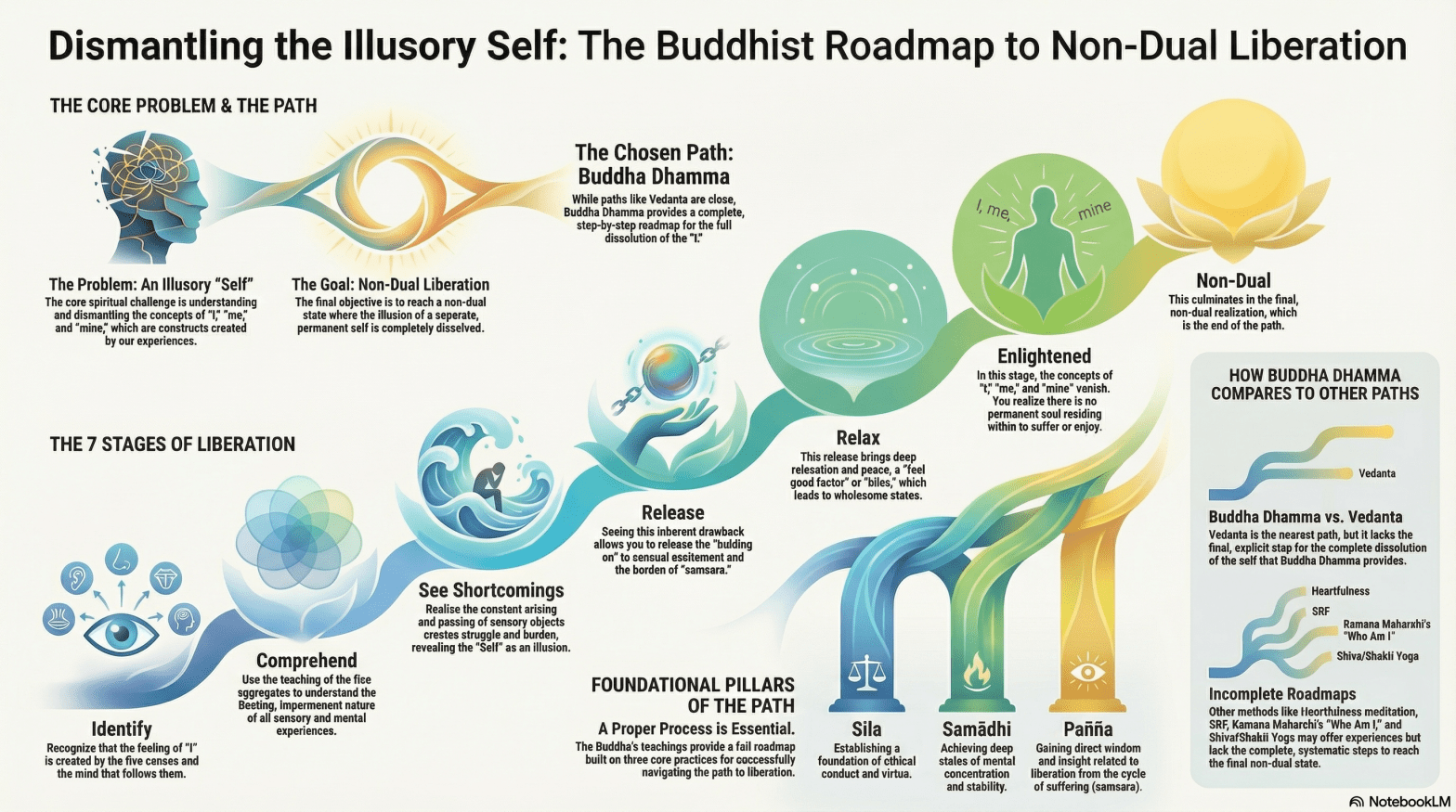
This essay outlines a systematic progression toward spiritual liberation by transitioning from a self-centered ego to a state of non-dual realization. The author argues that while various traditions like Vedanta or Yoga offer glimpses of enlightenment, Buddha Dhamma provides the most comprehensive, step-by-step roadmap for total dissolution of the “I.” This journey involves identifying and comprehending how the five senses and the mind create a false sense of self through fleeting experiences. By recognizing the inherent shortcomings and lack of lasting satisfaction in sensory objects, a practitioner can achieve a release from attachment and a profound sense of relaxation. Ultimately, the source concludes that following the structured path of morality, concentration, and wisdom is the most effective way to eliminate the illusion of a soul and reach final enlightenment.
Where and what do I start with?
If it is “me” who wants to know what “me” is in reality, it is like going from “I” to “No I”. And that is the journey we are taking here to understand steps on how to do it?
Problem statement: What is “I”, “me” and “mine”
Answer: To get into non-dual state when this is dissolved
For our topic, there are two ways of doing it:
Vedanta which teaches Non-Dual and Adi Shankara has perfected it, but has some missing steps for those who want to follow
Buddha dhamma which lays down all the steps till the dissolution of “I” is taken in full.
For me, Buddha dhamma has worked to understand “me” and then get go forever. Here is the short journey of it:
Identify- In this stage, identify the underlying factors that create the “I’, “me” and “mine” and when we carefully examine, it would just be 5 senses along with mind following it
Comprehend: In this stage, comprehend on these 5 senses along with mind to see where it point to. One can see the fleeting nature of it and that’s the time, Buddha’s teaching of 5 aggregates comes handy
See shortcomings: When the comprehension is good, one can see the shortcomings of all the six senses and their associated objects. There is no happiness even for a moment let alone for the whole day or whole life. One can see the arising & passing nature of objects along with consciousness of each of them, thereby seeing the danger of it and my struggle to keep it going which is a burden and then there is nothing anyone can do as they come and go away, which shows that the “Self” is an illusion created by the senses with conscious experiences
Release: At this stage, the “holding on” to the sensual excitement gets released since the “drawback” is seen for oneself. With this release, comes the peace of “getting rid of burden” which is “samsara” in its essence.
Relax: Relax the tension in the head and heart area. While I was engaged and holding-on to these sense experiences and trying hard to get rid of the pain and eventually bearing up with it and ignoring it, once the release happened, there was this relaxation which can be known as “bliss” or “feel good factor” which then leads to most wholesome states
Enlightened: In this stage, there is no “I”, “me” or “mine” and that is what the enlightenment would be. That there is no soul or someone residing to suffer or enjoy and all that was were preparations or volitions through conscious experiences of six senses.
Non Dual: This leads to non dual realization and that is the final end
To get into this, there are various ways such as:
1. Imagination of a light inside heart and having heartfulness meditation. This might not work for long time as there are no steps beyond making imaginative way of it
2. SRF or Self Realization Fellowship of Paramahamsa Yogananda – This looks really promising, but in the end have no steps to reach non-dual state
3. Contemplating on Who Am I – Just as Ramana Maharshi did it, one can do it and reach the higher stages. After that, one gets stuck on the last step of dissolution as there are no steps beyond that
4. Shiva/Shakti Yoga – There are various tantric techniques using different approaches that gives non-dual experience, but again has no proper steps
5. Vedanta – Vedanta of Adi Shankara is most nearest to Buddha dhamma except for the last step of dissolution
Conclusion: Better that one operate through proper process of:
Establishing Sila
Achieving Samādhi
Getting pañña or wisdom relating to liberation from samsara
These steps include a full roadmap in Buddha teachings and hence most appropriate
What does Buddha teach then step by step?
1. Understanding the true nature of things as it is – yathābhūtañāṇadassanaṁ
2. Knowing the characteristics of nature – anicca, dukkha,and anattā
anicca – Arising and passing away of everything
dukkha – burden of making things work to one’s satisfaction while it arises and passes away
anattā – No owner or controller to stop this from happening which is “no-self” or “no-personality”
How to verify attainment?
You can verify the attainment by contemplating as indicated in MN26 which has helped me considerably to verify again and again on the accomplishments. Basically, it will show out following:
1. Nibbidāya – to get disillusioned due to 1 & 2 above
2. virāgāya – Seeing the unsatisfactoriness in senses and sense objects, minds leans towards seclusion and hence dispassion sets in
3. nirodhāya – Due to disillusion and dispassion, cessation happens between the senses and sense objects
4. upasamāya – Always associating with sense objects create restlessness and now it is so peaceful, tranquil or still due to cessation happened in 3 above.
5. abhiññāya – With the above four happening, there is direct knowledge leading to wisdom on what actually is happening and that removes the labels that were making it seem different.
6. sambodhāya – Full awakening to the reality as it is without any distortion. This happens when the above five steps are completed
7. nibbānāya – Extinguishment of raga (colouring), dvesha (aversion/hatred) and moha (delusion)
Q&A Session
1. Why are systematic steps like Sila, Samadhi, and Panna essential for achieving enlightenment?
Systematic steps like Sila (ethical conduct), Samadhi (concentration), and Panna (wisdom) are essential because they provide a full roadmap for the complete dissolution of the “I,” “me,” and “mine”. While other spiritual traditions like Vedanta or the “Who Am I” contemplation of Ramana Maharshi reach high stages, they often lack the specific final steps necessary for the total dissolution of the self-illusion or the realization of a non-dual state.
These steps are necessary for the following reasons:
• Establishing a Foundation for Examination: The process begins with identifying the underlying factors that create the “I”—specifically the five senses and the mind. Without a systematic approach like Sila and Samadhi to steady the mind, it is difficult to accurately comprehend the fleeting nature of these senses.
• Developing Liberating Wisdom (Pañña): Pañña is specifically defined in the sources as wisdom relating to liberation from samsara. This wisdom allows one to see the shortcomings and danger of the six senses and their objects. It reveals that there is no lasting happiness in these experiences and that the “Self” is merely an illusion created by conscious experiences.
• Facilitating Release and Relaxation: Once the “drawback” of sensual excitement is clearly seen through wisdom, the practitioner can release their “holding on” to these experiences. This release leads to a state of relaxation or “bliss” that replaces the burden of samsara.
• Achieving the Final Goal: The systematic nature of these steps ensures one reaches the stage where there is no soul or resident entity left to suffer or enjoy. By following this “proper process,” a practitioner can move beyond mere imagination or incomplete techniques to reach the final end of non-dual realization.
(Note: While the essay categorize Sila, Samadhi, and Pañña as the “proper process”, I do not provide detailed definitions for Sila and Samadhi in this essay as it is covered in many of the essays on the website. In broader Buddhist context, Sila refers to ethical behavior and Samadhi to mental discipline and pañña is the wisdom that dawns on the person.
To understand this journey, imagine dismantling a complex machine that you previously thought was a living being; you must first stabilize your tools (Sila and Samadhi) to carefully examine each part, and only then do you gain the insight (Pañña) to see that there is no “driver” inside, just a collection of interacting components which was being considered as “I”
Identify the six stages of the roadmap to non-dual liberation?
The roadmap to non-dual liberation consists of progressive stages designed to dissolve the illusion of “I,” “me,” and “mine”. While the journey leads to a seventh final end of non-dual realization, the six stages comprising the roadmap are:
Identify: The practitioner first identifies the underlying factors that create the sense of self, which are the five senses and the mind.
Comprehend: In this stage, one examines these senses and the mind to see their fleeting nature, often using the Buddha’s teaching on the five aggregates as a guide.
See Shortcomings: The practitioner recognizes the “arising and passing nature” of objects and consciousness. This leads to the realization that the “Self” is an illusion created by the senses and that there is no lasting happiness in these experiences.
Release: Once the drawbacks and burdens of “samsara” (sensual excitement) are clearly seen, the practitioner releases their “holding on” to these experiences.
Relax: This release results in relaxing the tension in the head and heart areas. This stage is characterized by a “bliss” or “feel-good factor” as the burden of the self is lifted.
Enlightened: At this stage, the “I,” “me,” and “mine” are fully dissolved. One realizes there is no soul or resident entity remaining to suffer or enjoy; there are only the results of previous volitions and conscious experiences.
Following these six stages leads to the final end: Non-Dual realization. Anāgarika Vilas notes that while other traditions like Vedanta or the “Who Am I” contemplation may reach high levels, they often lack the specific steps found in the Buddha’s teachings—specifically Sila, Samādhi, and Pañña—to complete the final dissolution of the self.
To visualize this roadmap, consider it like peeling the layers of an onion; you first identify the layers (Identify), understand they are separate from the core (Comprehend), see that they provide no solid center (Shortcomings), and as you peel them away (Release and Relax), you eventually reach a point where the onion—or the “Self”—simply no longer exists (Enlightened).
Explain how the five aggregates aid the comprehension stage?
In the roadmap described above, the five aggregates serve as a critical analytical tool during the Comprehension stage to dismantle the illusion of a permanent self.
The five aggregates aid this stage in the following ways:
Revealing Impermanence: After identifying the five senses and the mind, a practitioner uses the five aggregates to observe their fleeting nature. Rather than seeing a solid, continuous “I,” the aggregates help the practitioner see that what we call “me” is actually a collection of changing parts.
Providing a Framework for Examination: The aggregates help the practitioner “see where [the senses] point to”. By breaking down experience into these categories, it becomes easier to track the arising and passing nature of objects and the consciousness associated with them.
Exposing the Illusion of Self: As the comprehension of these aggregates deepens, it becomes clear that the “Self” is merely an illusion created by the interaction of the senses and conscious experiences. One realizes there is no “resident” entity or soul, but rather a series of volitions and preparations.
Facilitating the Transition to Wisdom: Once the aggregates are used to achieve a “good” level of comprehension, the practitioner can move to the next stage of seeing the shortcomings and dangers of the senses.
This realization is essential for the eventual release of “holding on” to sensual excitement.
In essence, the five aggregates act like a prism that takes the single, solid beam of “I” and refracts it into its constituent parts; once you see the individual colors of the spectrum appearing and disappearing, you realize the solid beam you thought you saw was never a permanent, independent object to begin with.