Destroying Views at the Root
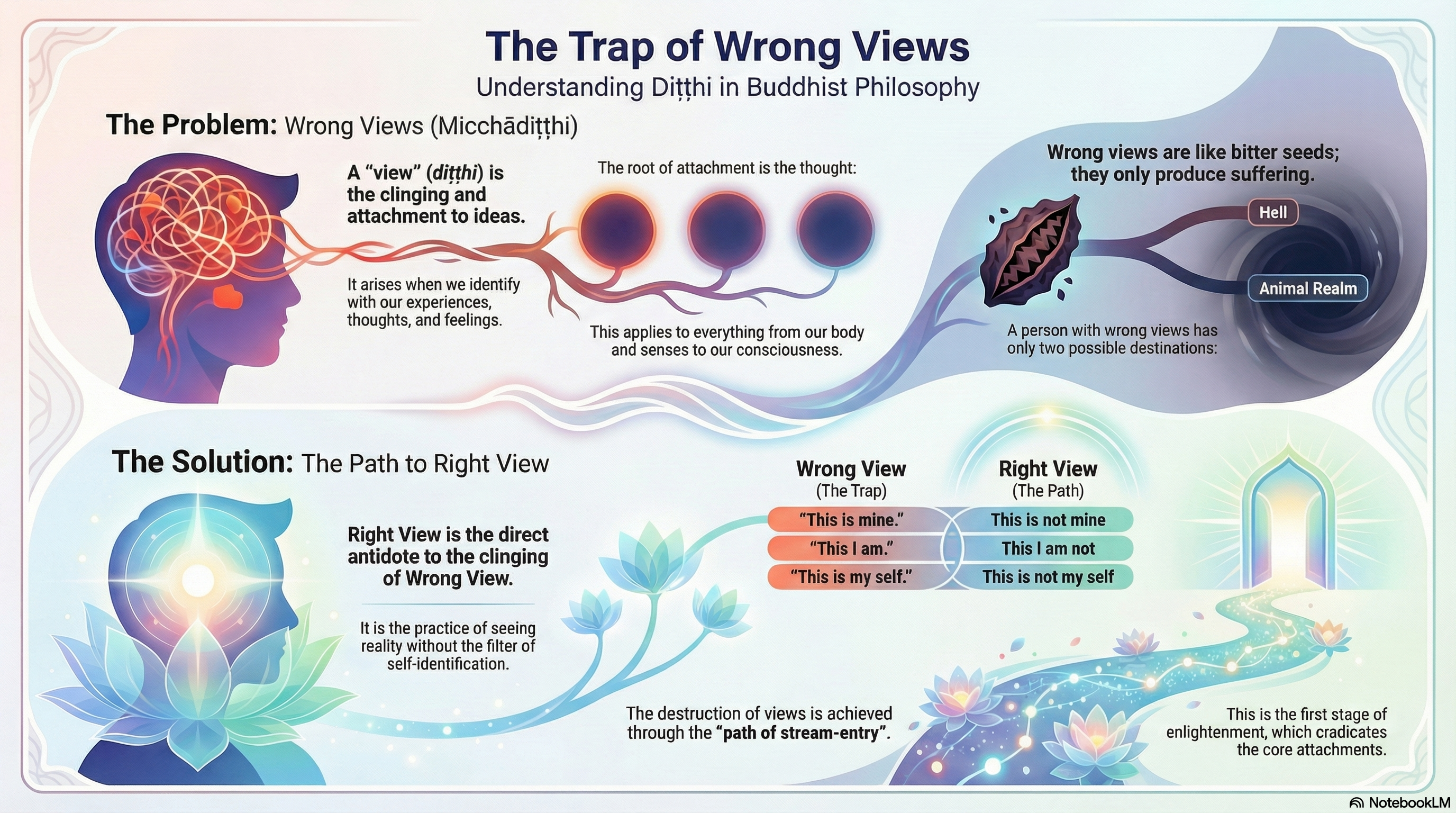 VISUAL SUMMARYSee this study in a pictureOpen the complete infographic for a visual overview before or after reading the full study.View infographic →
The Article Is About the Mechanism of Grasping, Not Merely a Catalogue of Doctrines
Views (diṭṭhi) are not merely opinions; they arise when the mind clings to an idea, experience, practice, identity, or doctrine and treats it as “mine,” “I am this,” or “this is my self.” Such attachment can extend across the five aggregates, six sense bases, feelings, perceptions, intentions, meditative attainments, realms of existence, and even one’s understanding of the Dhamma. The teaching therefore examines eight bases from which views arise, eighteen forms through which they obsess and bind the mind, sixteen principal kinds of views, and hundreds of ways in which attachment to them develops. The purpose of this study is not to replace one rigid belief with another, but to recognize the process of grasping itself. When form, feeling, perception, formations, or consciousness are no longer regarded as self, belonging to self, contained within self, or containing self, the foundation of identity-view begins to collapse. The path of stream-entry is therefore described as the destruction of the basis of views, opening the way to direct understanding and liberation.
Central diagnostic from the source: the pattern “This is mine, I am this, this is my self” can be imposed upon aggregates, sense bases, consciousness, contact, feeling, perception, intention, craving, thought, reflection, elements, faculties, realms, meditative attainments and dependent origination.
| Layer | Source count / status | Role in the article |
|---|---|---|
| Bases | 8 | Conditions from which views arise. |
| Obsession / entanglement | 18 | Ways views bind, agitate, confine and dominate the mind. |
| Kinds of views | 16 | The source’s principal classification of views. |
| Attachments to views | 300 (source also notes 330) | Distributed attachment-count scheme across the sixteen views. |
| Root destruction | Sotāpatti-magga | The source identifies stream-entry path as destruction of the basis of views. |
Eight Bases, Eighteen Obsessions, Sixteen Views and the Attachment Scheme
Eight bases of views
| Base | Pāli | Source explanation |
|---|---|---|
| Aggregates (khandhā) are a base of views. | ||
| Ignorance | avijjā | Ignorance gives rise to views because it serves as both a cause and condition for delusion. |
| Contact | phasso | Contact becomes a base of views by being both the cause and condition for perception. |
| Perception | saññā | Perception forms a base of views through its role in the interpretation of experiences. |
| Thought | vitakko | Thought serves as a base of views by initiating mental proliferation. |
| Unwise attention | ayoniso manasikāra | Unwise attention is a base of views, fostering erroneous thinking. |
| Bad friends (pāpamitta) are a base of views. | ||
| External speech or influence | paratoghoso | Hearing misleading words from others shapes incorrect views. |
Eighteen forms of obsession with views
| Form of obsession | Meaning in source |
|---|---|
| Diṭṭhi diṭṭhigataṁ | The view itself as a doctrine. |
| Diṭṭhigahanaṁ | The entanglement with views. |
| Diṭṭhikantāraṁ | The wilderness of views (confusion). |
| Diṭṭhivisūkaṁ | The crookedness or distortion of views. |
| Diṭṭhivipphanditaṁ | The agitation or restlessness caused by views. |
| Diṭṭhisaññojanaṁ | The fetter of views. |
| Diṭṭhisallaṁ | The thorn of views. |
| Diṭṭhisambādho | The confinement or limitation caused by views. |
| Diṭṭhipalibodho | The hindrance of views. |
| Diṭṭhibandhanaṁ | The bondage of views. |
| Diṭṭhipapāto | The downfall caused by views. |
| Diṭṭhānusayo | The latent tendency toward views. |
| Diṭṭhisantāpo | The distress caused by views. |
| Diṭṭhipariḷāho | The burning or fever of views. |
| Diṭṭhigantho | The knot of views. |
| Diṭṭhupādānaṁ | The clinging to views. |
| Diṭṭhābhiniveso | The obsession or attachment to views. |
| Diṭṭhiparāmāso | The grasping at views. |
Sixteen views and the source’s attachment counts
| View | Meaning | Attachment count in source |
|---|---|---|
| Assāda-diṭṭhi | The view of pleasure. | 35 forms of attachment. |
| Attānudiṭṭhi | The view of self (self-view). | 20 forms of attachment. |
| Micchā-diṭṭhi | Wrong view. | 10 forms of attachment. |
| Sakkāya-diṭṭhi | The view of identity (personality view). | 20 forms of attachment. |
| Sassatadiṭṭhi (based on sakkāya) | The eternalist view. | 15 forms of attachment. |
| Ucchedadiṭṭhi (based on sakkāya) | The annihilationist view. | 5 forms of attachment. |
| Antaggāhikā diṭṭhi | The view of ultimate ends (extreme views). | 50 forms of attachment. |
| Pubbantānudiṭṭhi | Speculation about the past. | 18 forms of attachment. |
| Aparantānudiṭṭhi | Speculation about the future. | 44 forms of attachment. |
| Saññojanikā diṭṭhi | The view leading to bondage. | 18 forms of attachment. |
| Ahanti mānavinibandhā diṭṭhi | The view tied to the conceit “I am.” | 18 forms of attachment. |
| Mamanti mānavinibandhā diṭṭhi | The view tied to the conceit “This is mine.” | 18 forms of attachment. |
| Attavādapaṭisaṁyuttā diṭṭhi | View related to the theory of self. | 20 forms of attachment. |
| Lokavādapaṭisaṁyuttā diṭṭhi | View related to the theory of the world. | 8 forms of attachment. |
| Bhavadiṭṭhi | The view of existence. | 1 or 19 forms of attachment (variant reading). |
| Vibhavadiṭṭhi | The view of non-existence. | 1 or 19 forms of attachment (variant reading). |
The source headline says 300 attachments and also notes a 330 variant. However, the sixteen itemized values as pasted total 301 if the lower Bhavadiṭṭhi/Vibhavadiṭṭhi readings are used, and 337 if the higher readings are used. The V3 version preserves the source values but flags this mismatch for later textual verification instead of silently forcing the numbers to agree.
What is a view (diṭṭhi)?
How many bases of views (diṭṭhiṭṭhānāni)?
– There are eight bases of views.
How many causes of obsession with views (diṭṭhipariyuṭṭhānāni)?
– There are eighteen causes of obsession with views.
How many types of views (diṭṭhiyo)?
– There are sixteen kinds of views.
How many attachments to views (diṭṭhābhinivesā)?
– There are three hundred attachments to views (some texts list it as 330).
What is the destruction of the basis of views (diṭṭhiṭṭhānasamugghāta)?
– The path of stream-entry (sotāpatti-magga) is the destruction of the basis of views.
What are the eight bases of views (aṭṭha diṭṭhiṭṭhānāni)?
Ignorance (avijjā) is a base of views.
Contact (phasso) is a base of views.
Perception (saññā) is a base of views.
Thought (vitakko) is a base of views.
Unwise attention (ayoniso manasikāra) is a base of views.
Bad friends (pāpamitta) are a base of views.
External speech or influence (paratoghoso) is a base of views.
Each of these factors serves as a condition for views to arise, either through attachment or emergence:
Aggregates: Aggregates become a base of views because they serve as both the cause and condition for clinging and attachment.
Ignorance: Ignorance gives rise to views because it serves as both a cause and condition for delusion.
Contact: Contact becomes a base of views by being both the cause and condition for perception.
Perception: Perception forms a base of views through its role in the interpretation of experiences.
Thought: Thought serves as a base of views by initiating mental proliferation.
Unwise attention: Unwise attention is a base of views, fostering erroneous thinking.
Bad friends: Associating with bad friends leads to wrong views through their influence.
External speech or influence: Hearing misleading words from others shapes incorrect views.
These are the eight bases of views (aṭṭha diṭṭhiṭṭhānāni).
What are the eighteen forms of obsession with views (aṭṭhārasa diṭṭhipariyuṭṭhānāni)?
Diṭṭhigahanaṁ: The entanglement with views.
Diṭṭhikantāraṁ: The wilderness of views (confusion).
Diṭṭhivisūkaṁ: The crookedness or distortion of views.
Diṭṭhivipphanditaṁ: The agitation or restlessness caused by views.
Diṭṭhisaññojanaṁ: The fetter of views.
Diṭṭhisallaṁ: The thorn of views.
Diṭṭhisambādho: The confinement or limitation caused by views.
Diṭṭhipalibodho: The hindrance of views.
Diṭṭhibandhanaṁ: The bondage of views.
Diṭṭhipapāto: The downfall caused by views.
Diṭṭhānusayo: The latent tendency toward views.
Diṭṭhisantāpo: The distress caused by views.
Diṭṭhipariḷāho: The burning or fever of views.
Diṭṭhigantho: The knot of views.
Diṭṭhupādānaṁ: The clinging to views.
Diṭṭhābhiniveso: The obsession or attachment to views.
Diṭṭhiparāmāso: The grasping at views.
These are the eighteen forms of obsession with views (aṭṭhārasa diṭṭhipariyuṭṭhānāni).
What are the sixteen views (soḷasa diṭṭhiyo)?
Assāda-diṭṭhi: The view of pleasure.
Attānudiṭṭhi: The view of self (self-view).
Micchā-diṭṭhi: Wrong view.
Sakkāya-diṭṭhi: The view of identity (personality view).
Sassatadiṭṭhi (based on sakkāya): The eternalist view.
Ucchedadiṭṭhi (based on sakkāya): The annihilationist view.
Antaggāhikā diṭṭhi: The view of ultimate ends (extreme views).
Pubbantānudiṭṭhi: Speculation about the past.
Aparantānudiṭṭhi: Speculation about the future.
Saññojanikā diṭṭhi: The view leading to bondage.
Ahanti mānavinibandhā diṭṭhi: The view tied to the conceit “I am.”
Mamanti mānavinibandhā diṭṭhi: The view tied to the conceit “This is mine.”
Attavādapaṭisaṁyuttā diṭṭhi: View related to the theory of self.
Lokavādapaṭisaṁyuttā diṭṭhi: View related to the theory of the world.
Bhavadiṭṭhi: The view of existence.
Vibhavadiṭṭhi: The view of non-existence.
What are the 300 attachments to views (tīṇi sataṁ diṭṭhābhinivesā)?
Assāda-diṭṭhi: 35 forms of attachment.
Attānudiṭṭhi: 20 forms of attachment.
Micchā-diṭṭhi: 10 forms of attachment.
Sakkāya-diṭṭhi: 20 forms of attachment.
Sassatadiṭṭhi (based on sakkāya): 15 forms of attachment.
Ucchedadiṭṭhi (based on sakkāya): 5 forms of attachment.
Antaggāhikā diṭṭhi: 50 forms of attachment.
Pubbantānudiṭṭhi: 18 forms of attachment.
Aparantānudiṭṭhi: 44 forms of attachment.
Saññojanikā diṭṭhi: 18 forms of attachment.
Ahanti mānavinibandhā diṭṭhi: 18 forms of attachment.
Mamanti mānavinibandhā diṭṭhi: 18 forms of attachment.
Attavādapaṭisaṁyuttā diṭṭhi: 20 forms of attachment.
Lokavādapaṭisaṁyuttā diṭṭhi: 8 forms of attachment.
Bhavadiṭṭhi: 1 or 19 forms of attachment (variant reading).
Vibhavadiṭṭhi: 1 or 19 forms of attachment (variant reading).
These categories show how different views, from speculations about self and existence to wrong doctrines, generate clinging and attachment in various ways.
The Same “Mine • I Am • My Self” Pattern Can Spread Across the Entire Field of Experience
| Domain | How the source applies the identity formula |
|---|---|
| Five aggregates | Form, feeling, perception, formations and consciousness can be appropriated as “mine, I am this, this is my self.” |
| Six faculties and six objects | Eye through mind, and forms through mental phenomena. |
| Consciousness, contact and feeling | The six classes of consciousness, their contacts and contact-born feeling. |
| Perception | Perceptions of form, sound, smell, taste, touch and mental phenomena. |
| Intention | Intentions toward the six classes of objects. |
| Craving | Craving directed toward the six classes of objects. |
| Thought | Thought about the six classes of objects. |
| Reflection | Reflection on the six classes of objects. |
| Elements | Earth, water, fire, air, space and consciousness elements. |
| Kasiṇas | Earth, water, fire, air, colors, space and consciousness kasiṇas. |
| Body parts | Hair, nails, teeth, skin and the extended body-parts inventory. |
| Sense bases and consciousness elements | The twelve bases and eighteen elements are also taken as self or belonging to self. |
| Faculties | Sensory, life, sex, feeling and spiritual faculties. |
| Realms, becoming and attainments | Sensual/form/formless realms, modes of existence, jhānas, brahmavihāras and formless attainments. |
| Dependent origination | Ignorance through aging-and-death can each be appropriated through the same identity formula. |
The article does not merely say that a person holds a philosophical opinion. It repeatedly shows appropriation moving through aggregates, senses, mental processes, meditation objects, faculties, realms, attainments and dependent origination.
How does attachment to views (abhinivesaparāmāsa) manifest?
– Similarly, attachment arises with regard to feelings (vedanā), perceptions (saññā), formations (saṅkhāra), and consciousness (viññāṇa) by thinking: “This is mine, I am this, this is my self.”
This pattern extends to:
Eye, ear, nose, tongue, body, and mind: Thinking “This is mine, I am this, this is my self.”
Objects such as forms, sounds, smells, tastes, tactile sensations, and mental phenomena are also clung to with the thought: “This is mine, I am this, this is my self.”
The same clinging extends further to:
Eye-consciousness, ear-consciousness, and so on for the senses, and their respective contacts (samphassa).
Feelings arising from sensory contact are also regarded as “mine, I am this, this is my self.”
Perceptions and Attachments as Views:
– Thinking, “This perception of form (rūpasaññā) is mine, I am this, this is my self,”
– Similarly with the perception of sound (saddasaññā), smell (gandhasaññā), taste (rasasaññā), touch (phoṭṭhabbasaññā), and mental phenomena (dhammasaññā), the same attachment to the perception as “mine” arises. This clinging to perception is called abhinivesaparāmāsa diṭṭhi (attachment as a view).
Intentions and Attachments as Views:
– Thinking, “This intention toward form (rūpasañcetana) is mine, I am this, this is my self,”
– Similarly with intentions toward sound, smell, taste, touch, and mental phenomena, one clings to them as “mine, I am this, this is my self.” This is attachment as a view.
Craving and Attachments as Views:
– Thinking, “This craving for form (rūpataṇhā) is mine, I am this, this is my self,”
– Similarly, craving for sound, smell, taste, touch, and mental phenomena is also viewed as “mine, I am this, this is my self.” This attachment to craving is called abhinivesaparāmāsa diṭṭhi.
Thoughts and Attachments as Views:
– Thinking, “This thought about form (rūpavitakka) is mine, I am this, this is my self,”
– Similarly with thoughts about sound, smell, taste, touch, and mental phenomena, the same clinging to thought occurs. This is abhinivesaparāmāsa diṭṭhi.
Reflections and Attachments as Views:
– Thinking, “This reflection on form (rūpavicāra) is mine, I am this, this is my self,”
– Similarly with reflections on sound, smell, taste, touch, and mental phenomena, one holds them as “mine, I am this, this is my self.” This is attachment to reflection as a view.
Elements and Attachments as Views:
– “This earth element (pathavīdhātu) is mine, I am this, this is my self,”
– Similarly with the water element (āpodhātu), fire element (tejodhātu), air element (vāyodhātu), space element (ākāsadhātu), and consciousness element (viññāṇadhātu), one clings to them as “mine, I am this, this is my self.” This attachment is called abhinivesaparāmāsa diṭṭhi (attachment to views).
Kasiṇas and Attachments as Views:
– “This earth kasiṇa (pathavīkasiṇa) is mine, I am this, this is my self,”
– Similarly with water kasiṇa, fire kasiṇa, air kasiṇa, blue kasiṇa, yellow kasiṇa, red kasiṇa, white kasiṇa, space kasiṇa, and consciousness kasiṇa, one holds them as “mine, I am this, this is my self.”
Body Parts and Attachments as Views:
– “This hair on the head (kesa) is mine, I am this, this is my self,”
– Similarly, one holds body parts like body hair (loma), nails (nakha), teeth (danta), skin (taca), flesh (maṁsa), tendons (nhāru), bones (aṭṭhi), bone marrow (aṭṭhimiñja), kidneys (vakka), heart (hadaya), liver (yakana), diaphragm (kilomaka), spleen (pihaka), lungs (papphāsa), intestines (anta), mesentery (antaguṇa), stomach (udariya), feces (karīsa), bile (pitta), phlegm (semha), pus (pubba), blood (lohita), sweat (seda), fat (meda), tears (assu), grease (vasa), saliva (kheḷa), mucus (siṅghāṇika), lymph (lasikā), urine (mutta), and brain (matthaluṅga) with attachment, thinking: “This is mine, I am this, this is my self.”
Sense Bases and Attachments as Views:
– “This eye base (cakkhāyatana) is mine, I am this, this is my self,”
– Similarly, one clings to the form base, ear base (sotāyatana), sound base, nose base (ghānāyatana), smell base, tongue base (jivhāyatana), taste base, body base (kāyāyatana), tactile base, mind base (manāyatana), and mental phenomena base (dhammāyatana) as “mine, I am this, this is my self.”
Elements of Consciousness and Attachments as Views:
– “This eye element (cakkhudhātu) is mine, I am this, this is my self,”
– Similarly, one clings to the form element, eye-consciousness element (cakkhuviññāṇadhātu), ear element (sotadhātu), sound element, ear-consciousness element (sotaviññāṇadhātu), nose element (ghānadhātu), smell element, nose-consciousness element (ghānaviññāṇadhātu), tongue element (jivhādhātu), taste element, tongue-consciousness element (jivhāviññāṇadhātu), body element (kāyadhātu), tactile element, body-consciousness element (kāyaviññāṇadhātu), mind element (manodhātu), mental phenomena element (dhammadhātu), and mind-consciousness element (manoviññāṇadhātu), thinking: “This is mine, I am this, this is my self.”
Faculties and Attachments as Views:
– “This faculty of sight (cakkhundriya) is mine, I am this, this is my self,”
– Similarly, attachment arises toward the faculties of hearing (sotindriya), smell (ghānindriya), taste (jivhindriya), touch (kāyindriya), and mind (manindriya).
– The same clinging extends to the life faculty (jīvitindriya), femininity (itthindriya), masculinity (purisindriya), pleasure (sukhindriya), pain (dukkhindriya), joy (somanassindriya), sorrow (domanassindriya), and equanimity (upekkhindriya).
– It also applies to spiritual faculties like faith (saddhindriya), energy (vīriyindriya), mindfulness (satindriya), concentration (samādhindriya), and wisdom (paññindriya), thinking: “This is mine, I am this, this is my self.”
Realms of Existence and Attachments as Views:
– “This realm of sensuality (kāmadhātu) is mine, I am this, this is my self,”
– Similarly, one clings to the form realm (rūpadhātu), formless realm (arūpadhātu), sensual existence (kāmabhava), form existence (rūpabhava), and formless existence (arūpabhava).
– Attachment extends to conscious existence (saññābhava), unconscious existence (asaññābhava), and neither-conscious-nor-unconscious existence (nevasaññānāsaññābhava).
– Furthermore, it applies to the single-element existence (ekavokārabhava), four-element existence (catuvokārabhava), and five-element existence (pañcavokārabhava).
– Even meditative absorptions (jhānas) are seen as “mine,” from the first jhāna to the fourth jhāna, as well as liberations of the mind through loving-kindness (mettaṁ cetovimutti), compassion (karuṇaṁ cetovimutti), sympathetic joy (muditaṁ cetovimutti), and equanimity (upekkhaṁ cetovimutti).
– Attainments such as the sphere of infinite space (ākāsānañcāyatanasamāpatti), infinite consciousness (viññāṇañcāyatanasamāpatti), nothingness (ākiñcaññāyatanasamāpatti), and neither-perception-nor-non-perception (nevasaññānāsaññāyatanasamāpatti) are also viewed as “mine, I am this, this is my self.”
Dependent Origination and Attachments as Views:
– “This ignorance (avijjā) is mine, I am this, this is my self,”
– Similarly, one clings to volitional formations (saṅkhāra), consciousness (viññāṇa), name-and-form (nāmarūpa), the six sense bases (saḷāyatana), contact (phassa), feelings (vedanā), craving (taṇhā), clinging (upādāna), becoming (bhava), birth (jāti), and aging-and-death (jarāmaraṇa).
– This is how clinging and attachment to views (abhinivesaparāmāsa diṭṭhi) manifest.
Pleasure, View and Craving Must Not Be Collapsed into One Thing
| Theme | What the source develops |
|---|---|
| Pleasure and view | The source repeatedly distinguishes pleasure (assāda) from view (diṭṭhi), then explains their conjunction as assāda-diṭṭhi. |
| Craving and view | Craving (rāga) and view are likewise treated as distinct, with their conjunction discussed as diṭṭhirāga. |
| Wrong-view consequences | The subsection repeats consequences attributed to micchādiṭṭhi and uses the bitter-seed simile. |
| Entanglement | The 18 forms of view-entanglement and the relation between fetters and views are repeated again inside the Assāda discussion. |
The old source repeats the wrong-view consequences, bitter-seed analogy, eighteen forms of entanglement and fetter discussion multiple times inside this one subsection. Rather than displaying those repetitions as a wall of text, V3 keeps the complete source wording inside one reference module.
Assāda-diṭṭhi (View of Pleasure)
This is one of the most repetitive parts of the source. The full wording is retained, but the main V3 page surfaces its doctrinal movement separately.
– When pleasure (sukha) and joy (somanassa) arise dependent on form (rūpa), this is called the pleasure of form (rūpassa assādo). This attachment to the enjoyment of form is considered a view (abhinivesaparāmāsa diṭṭhi).
– However, the view (diṭṭhi) is not the pleasure (assādo), and pleasure is not the view. They are distinct: one is a view, the other is pleasure. Yet, when these two—pleasure and view—are combined, it is called assādadiṭṭhi (the view of pleasure).
Assāda-diṭṭhi is a wrong view (micchādiṭṭhi), leading to failure in understanding correctly (diṭṭhivipatti).
– A person possessing this view is called a person with wrong view (diṭṭhivipanno).
– Such a person is not to be followed, associated with, or respected. Why? Because their view is corrupt (pāpikā).
Craving (rāga) is not the same as a view (diṭṭhi), and a view is not the same as craving.
– However, when both are present in a person—wrong view and craving—it is called diṭṭhirāga (attachment to view).
– A person dominated by attachment to views (diṭṭhirāgaratto) receives no great merit from offerings given to them. Why? Because their view is corrupt (pāpikā), and it is rooted in wrong views, such as assāda-diṭṭhi and micchādiṭṭhi.
The Consequences of Wrong View (Micchādiṭṭhi):
– A person with wrong view has only two possible destinations:
Hell (niraya)
The animal realm (tiracchānayoni).
Any physical action, speech, or thought performed in accordance with their wrong view, along with their intentions (cetanā), wishes (patthanā), aspirations (paṇidhi), and volitional formations (saṅkhārā), will result in undesirable, painful, and harmful outcomes. Why? Because their view is corrupt.
Illustration through the Example of Seeds:
– Just as bitter seeds (like those of the neem tree, bitter melon, or colocynth) grow into bitter fruit regardless of the nutrients absorbed from the earth and water, wrong views lead only to suffering.
– Why? Because the seed itself is bad (pāpikaṁ bījaṁ).
Similarly, a person with wrong views (micchādiṭṭhikassa purisapuggala), through their bodily actions, speech, thoughts, and aspirations, will accumulate negative outcomes—undesirable, unpleasant, harmful, and full of suffering. Why? Because their view is corrupt (pāpikā), rooted in assāda-diṭṭhi and micchādiṭṭhi.
Explanation of Assāda-diṭṭhi (View of Pleasure)
In what 35 ways does attachment to the view of pleasure (assādadiṭṭhi) occur?
– When pleasure (sukha) and joy (somanassa) arise dependent on form (rūpa), this is called the pleasure in form (rūpassa assādo). This pleasure and the clinging to it constitute a view called abhinivesaparāmāsa diṭṭhi (attachment as a view).
– However, view (diṭṭhi) is not pleasure (assādo), and pleasure is not view. They are distinct from one another: one is a view, and the other is pleasure.
– When these two—pleasure and view—combine, it is called assādadiṭṭhi (the view of pleasure).
Assādadiṭṭhi is considered a wrong view (micchādiṭṭhi), leading to failure in understanding (diṭṭhivipatti).
– A person with this wrong view is called diṭṭhivipanno (one who has fallen into wrong view).
– Such a person should not be followed, associated with, or respected.
Why? Because their view is corrupt (pāpikā).
Relationship Between View and Craving
Craving (rāga) is not the same as a view (diṭṭhi), and view is not the same as craving. They are distinct.
– When both craving and view are present in a person, it is called diṭṭhirāga (attachment to view).
– A person with diṭṭhirāgaratto (a mind filled with attachment to views) does not receive significant benefit from offerings given to them.
Why? Because their view is corrupt and rooted in assādadiṭṭhi and micchādiṭṭhi (wrong views).
Consequences of Wrong View (Micchādiṭṭhi)
A person with micchādiṭṭhi (wrong view) has only two possible destinations:
Hell (niraya)
The animal realm (tiracchānayoni)
Any bodily, verbal, or mental actions performed in accordance with their wrong view, along with their intentions (cetanā), wishes (patthanā), aspirations (paṇidhi), and volitional formations (saṅkhārā), lead to undesirable, unpleasant, harmful, and painful outcomes.
Why? Because their view is corrupt.
Illustration Using the Example of Bitter Seeds
Just as bitter seeds—such as neem seeds, colocynth seeds, or bitter gourd seeds—planted in moist soil absorb the nutrients from the earth and water, but still produce bitter, unpleasant fruits,
Why? Because the seeds themselves are bad (pāpikaṁ bījaṁ).
Similarly, a person with micchādiṭṭhi (wrong view), despite engaging in bodily actions, speech, thoughts, or aspirations, will inevitably experience negative and painful results.
Why? Because their view is corrupt—assādadiṭṭhi and micchādiṭṭhi.
Micchādiṭṭhi and the Eighteen Forms of Mental Entanglement with Views
Wrong view (micchādiṭṭhi) manifests in the following eighteen ways, leading to entanglement of the mind:
Diṭṭhigataṁ: Clinging to views as a doctrine.
Diṭṭhigahanaṁ: The entanglement with views.
Diṭṭhikantāraṁ: The wilderness of views (confusion).
Diṭṭhivisūkaṁ: The distortion or crookedness of views.
Diṭṭhivipphanditaṁ: The agitation or restlessness caused by views.
Diṭṭhisaññojanaṁ: The fetter of views.
Diṭṭhisallaṁ: The thorn of views (causing distress).
Diṭṭhisambādho: The narrowness or confinement of views.
Diṭṭhipalibodho: The obstruction caused by views.
Diṭṭhibandhanaṁ: The bondage or attachment to views.
Diṭṭhipapāto: The downfall caused by views.
Diṭṭhānusayo: The latent tendency toward views.
Diṭṭhisantāpo: The mental distress caused by views.
Diṭṭhipariḷāho: The burning or fever of views.
Diṭṭhigantho: The knot of views (difficult to unravel).
Diṭṭhupādānaṁ: The clinging to views.
Diṭṭhābhiniveso: The obsession with views.
Diṭṭhiparāmāso: The grasping at views.
These forms of wrong view (micchādiṭṭhi) lead to mental entanglement (pariyuṭṭhitacitta), binding the mind.
The Relationship Between Fetters and Views:
There are fetters (saññojana) that are also views and fetters that are not views.
Fetters that are also views:
Sakkāya-diṭṭhi: Identity view or personality belief (the belief in a permanent self).
Sīlabbata-parāmāsa: The clinging to rites and rituals.
These are both views and fetters.
Fetters that are not views:
Kāmarāga-saññojana: The fetter of sensual desire.
Paṭigha-saññojana: The fetter of ill-will.
Māna-saññojana: The fetter of conceit.
Vicikicchā-saññojana: The fetter of doubt.
Bhavarāga-saññojana: The fetter of attachment to existence.
Issā-saññojana: The fetter of jealousy.
Macchariya-saññojana: The fetter of stinginess.
Anunaya-saññojana: The fetter of complacency or indulgence.
Avijjā-saññojana: The fetter of ignorance.
These are fetters but not views.
Dependent Arising of Pleasure through Sensory Contact:
– When feelings (vedanā), perceptions (saññā), volitional formations (saṅkhāra), or consciousness (viññāṇa) arise based on various sensory faculties:
The eye (cakkhu), ear (sota), nose (ghāna), tongue (jivhā), body (kāya), and mind (mana).
Corresponding sensory objects: forms (rūpa), sounds (sadda), smells (gandha), tastes (rasa), tactile sensations (phoṭṭhabba), and mental phenomena (dhamma).
Consciousness through each sense: eye-consciousness (cakkhuviññāṇa), ear-consciousness (sotaviññāṇa), nose-consciousness (ghānaviññāṇa), tongue-consciousness (jivhāviññāṇa), body-consciousness (kāyaviññāṇa), and mind-consciousness (manoviññāṇa).
Sensory contact: eye-contact (cakkhusamphassa), ear-contact (sotasamphassa), nose-contact (ghānasamphassa), tongue-contact (jivhāsamphassa), body-contact (kāyasamphassa), and mental contact (manosamphassa).
Feelings through Sensory Contact (Samphassajā Vedanā):
– When feelings (vedanā) arise from sensory contact, such as:
Eye-contact-induced feelings (cakkhusamphassajā vedanā)
Ear-contact-induced feelings (sotasamphassajā vedanā)
Nose-contact-induced feelings (ghānasamphassajā vedanā)
Tongue-contact-induced feelings (jivhāsamphassajā vedanā)
Body-contact-induced feelings (kāyasamphassajā vedanā)
Mind-contact-induced feelings (manosamphassajā vedanā)
Pleasure through Mind Contact (Manosamphassajā Vedanā):
– When pleasure (sukha) or joy (somanassa) arises based on mental contact (manosamphassa), this is called the pleasure of mind-contact (manosamphassajā vedanā).
– Clinging to this pleasure becomes a view called abhinivesaparāmāsa diṭṭhi (attachment to pleasure as a view).
View and Pleasure are Different:
– View (diṭṭhi) is not the same as pleasure (assādo), and pleasure is not the same as view. They are distinct from each other.
– However, when both pleasure and view are combined, it is referred to as assādadiṭṭhi (the view of pleasure).
Assādadiṭṭhi (View of Pleasure) and Its Consequences
Assāda-diṭṭhi is a form of wrong view (micchādiṭṭhi) and represents a failure in understanding (diṭṭhivipatti).
– A person holding this wrong view is called diṭṭhivipanno (one with wrong view).
– Such a person should not be followed, associated with, or respected.
Why? Because their view is corrupt (pāpikā).
Relationship Between View and Craving
Craving (rāga) is not the same as view (diṭṭhi), and view is not the same as craving. They are distinct phenomena.
– However, when both craving and wrong view are present in a person, it is called diṭṭhirāga (attachment to views).
– A person dominated by attachment to views (diṭṭhirāgaratto) does not receive significant benefit or merit from any offerings given to them.
Why? Because their view is corrupt, based on assādadiṭṭhi and micchādiṭṭhi (the view of pleasure and wrong view).
Destinations of a Person with Wrong View
A person holding wrong views (micchādiṭṭhi) has only two possible destinations:
Hell (niraya)
The animal realm (tiracchānayoni)
Consequences of Actions Based on Wrong View
All actions—whether bodily, verbal, or mental—performed according to wrong view, along with the person’s intentions (cetanā), desires (patthanā), aspirations (paṇidhi), and volitional formations (saṅkhārā), lead to outcomes that are undesirable, unpleasant, harmful, and painful.
Why? Because their view is corrupt (pāpikā).
Illustration with the Example of Bitter Seeds
Just as bitter seeds—such as neem seeds, colocynth seeds, or bitter melon seeds—absorb nutrients from the earth and water but still produce bitter, unpleasant fruits,
Why? Because the seed itself is bad (pāpikaṁ bījaṁ).
Conclusion: Harmful Effects of Wrong Views
Similarly, a person holding wrong views (micchādiṭṭhi)—regardless of their bodily, verbal, or mental actions—along with their intentions, wishes, and volitional formations, will experience undesirable, unpleasant, harmful, and painful consequences.
Why? Because their view is corrupt—rooted in assādadiṭṭhi (the view of pleasure) and micchādiṭṭhi (wrong view).
Micchādiṭṭhi (Wrong View) and the Eighteen Forms of Mental Entanglement
Micchādiṭṭhi (wrong view) manifests through the following eighteen forms, leading to mental entanglement (pariyuṭṭhitacitta):
Diṭṭhigataṁ – Holding onto views as doctrines.
Diṭṭhigahanaṁ – Entanglement with views.
Diṭṭhikantāraṁ – Confusion or wilderness of views.
Diṭṭhivisūkaṁ – Crookedness or distortion of views.
Diṭṭhivipphanditaṁ – Restlessness caused by views.
Diṭṭhisaññojanaṁ – The fetter of views.
Diṭṭhisallaṁ – The thorn of views (causing distress).
Diṭṭhisambādho – Confinement due to views.
Diṭṭhipalibodho – Obstruction caused by views.
Diṭṭhibandhanaṁ – Bondage due to views.
Diṭṭhipapāto – The downfall caused by views.
Diṭṭhānusayo – The latent tendency toward views.
Diṭṭhisantāpo – Mental suffering caused by views.
Diṭṭhipariḷāho – Burning or fever caused by views.
Diṭṭhigantho – The knot of views.
Diṭṭhupādānaṁ – Clinging to views.
Diṭṭhābhiniveso – Obsession with views.
Diṭṭhiparāmāso – Grasping at views.
These eighteen forms bind the mind in attachment to views.
The Relationship Between Fetters (Saññojanāni) and Views (Diṭṭhiyo)
Some fetters are also views, while some are not.
Fetters that are also views:
Sakkāyadiṭṭhi – Identity view (the belief in a permanent self).
Sīlabbataparāmāso – Clinging to rules and rituals.
Fetters that are not views:
Kāmarāgasaññojana – The fetter of sensual desire.
Paṭighasaññojana – The fetter of ill-will.
Mānasaññojana – The fetter of conceit.
Vicikicchāsaññojana – The fetter of doubt.
Bhavarāgasaññojana – The fetter of desire for existence.
Issāsaññojana – The fetter of jealousy.
Macchariyasaññojana – The fetter of stinginess.
Anunayasaññojana – The fetter of indulgence or compliance.
Avijjāsaññojana – The fetter of ignorance.
The 35 Ways in which Assāda-diṭṭhi (View of Pleasure) Manifests:
Assāda-diṭṭhi (the view of pleasure) gives rise to attachment in 35 ways through various types of clinging to pleasurable experiences and their corresponding views.
Five Aggregates × Four Identity Relations = Twenty Ways of Constructing Self
| Aggregate | Pattern 1 | Pattern 2 | Pattern 3 | Pattern 4 |
|---|---|---|---|---|
| Rūpa | Form as self | Self possessing form | Form within self | Self within form |
| Vedanā | Feeling as self | Self possessing feeling | Feeling within self | Self within / dependent on feeling |
| Saññā | Perception as self | Self possessing perception | Perception within self | Self within / dependent on perception |
| Saṅkhārā | Formations as self | Self possessing formations | Formations within self | Self within / dependent on formations |
| Viññāṇa | Consciousness as self | Self possessing consciousness | Consciousness within self | Self within consciousness |
Attānudiṭṭhi, Sakkāyadiṭṭhi and Attavāda overlap heavily in the source because each revisits the same five aggregates and the same four self-relations. V3 therefore shows the matrix once, while preserving every original explanation below.
Attānudiṭṭhi (View of Self)
– There are 20 ways in which one can cling to the view of self.
The Uninstructed Ordinary Person:
– An uninstructed, ordinary person (assutavā puthujjano) who has not seen the noble ones (ariyā), who is unfamiliar with the teachings of the noble ones (ariyadhamma), and who is untrained in the path of the noble ones, holds the following wrong views:
They see form (rūpa) as self or the self as possessing form.
They see self within form or form within self.
Similarly, they see feelings (vedanā), perceptions (saññā), mental formations (saṅkhārā), or consciousness (viññāṇa) as self, or the self as possessing them.
They see the self within these elements or these elements within the self.
How One Sees Form (Rūpa) as Self
– A person may contemplate the earth kasiṇa (pathavīkasiṇa) and wrongly think:
“This earth kasiṇa is myself. I am the earth kasiṇa.”
They perceive no distinction between the self and the earth kasiṇa.
This is similar to seeing the flame of an oil lamp and thinking:
“The flame is its color, and the color is the flame.”
Just as there is no distinction between the flame and its color, they perceive no distinction between self and the earth kasiṇa:
“What is the earth kasiṇa is myself, and what is myself is the earth kasiṇa.”
This is attachment to a view (abhinivesaparāmāsa diṭṭhi).
Distinguishing Between Views and Objects:
A view (diṭṭhi) is not the same as the object (vatthu), and the object is not the same as the view.
They are distinct from one another.
However, when both view and object are combined, it becomes the first form-based view of self (paṭhamā rūpavatthukā attānudiṭṭhi).
Attānudiṭṭhi is a wrong view (micchādiṭṭhi) and constitutes failure in understanding (diṭṭhivipatti).
Consequences of Holding the View of Self (Attānudiṭṭhi):
A person with attānudiṭṭhi (view of self) is also one with micchādiṭṭhi (wrong view).
Such a person faces only two possible destinies:
Hell (niraya)
The animal realm (tiracchānayoni)
Fetters that are not Views:
There are fetters (saññojana) that are not views.
These include:
Kāmarāga-saññojana – Fetter of sensual desire.
Paṭigha-saññojana – Fetter of ill-will.
Māna-saññojana – Fetter of conceit.
Vicikicchā-saññojana – Fetter of doubt.
Bhavarāga-saññojana – Fetter of attachment to existence.
Issā-saññojana – Fetter of jealousy.
Macchariya-saññojana – Fetter of stinginess.
Anunaya-saññojana – Fetter of indulgence.
Avijjā-saññojana – Fetter of ignorance.
Further Explanation of the View of Self (Attānudiṭṭhi)
How one mistakenly identifies various kasiṇas as the self:
– A person perceives various kasiṇas (concentration objects), such as:
Water kasiṇa (āpokasiṇa)
Fire kasiṇa (tejokasiṇa)
Air kasiṇa (vāyokasiṇa)
Blue kasiṇa (nīlakasiṇa)
Yellow kasiṇa (pītakasiṇa)
Red kasiṇa (lohitakasiṇa)
White kasiṇa (odātakasiṇa)
– This person believes: “This white kasiṇa (odātakasiṇa) is myself. I am the white kasiṇa.”
– They perceive no distinction between the self and the white kasiṇa.
Example Using a Lamp’s Flame and Color:
Just as the flame and the color of an oil lamp are perceived as inseparable:
“The flame is the color, and the color is the flame.”
In the same way, the person sees no difference between the self and the kasiṇa:
“What is the white kasiṇa is myself, and what is myself is the white kasiṇa.”
This is attachment to a view (abhinivesaparāmāsa diṭṭhi).
– View (diṭṭhi) is not the object (vatthu), and the object is not the view.
– They are distinct, but when wrongly combined, it becomes the first form-based view of self (paṭhamā rūpavatthukā attānudiṭṭhi).
How One Sees a Self Possessing Form:
A person may also wrongly see other mental factors (such as feeling, perception, mental formations, or consciousness) as possessing form:
“This is my self. This self has this form.”
Example Using a Tree and Its Shadow:
– Just as a tree with shade can be seen as:
“This is the tree, and this is the shade. The tree is distinct from the shade, yet the tree possesses the shade.”
– Similarly, the person believes:
“This is my self, and this self possesses form.”
Clinging to Views of Self:
This is another form of attachment to a view (abhinivesaparāmāsa diṭṭhi).
– View is not the object, and the object is not the view.
– But when the view and object are mistakenly combined, it becomes the second form-based view of self (dutiyā rūpavatthukā attānudiṭṭhi).
This view of self is a form of wrong view (micchādiṭṭhi) and leads to failure in understanding (diṭṭhivipatti).
– A person holding this view falls into the same fetters and suffering associated with wrong views and self-identity.
How One Sees Form within the Self (Attani Rūpaṁ Samanupassati):
Misidentification of Mental Factors as Self:
– A person may perceive feeling (vedanā), perception (saññā), mental formations (saṅkhāra), or consciousness (viññāṇa) as being part of the self.
– The thought arises:
“This is indeed my self (attā). And within this self, there is this form (rūpa).”
– Thus, the person perceives form (rūpa) within the self (attani rūpaṁ samanupassati).
Example Using a Flower and Its Fragrance:
Consider a flower that has fragrance.
– Someone might say:
“This is the flower, and this is the fragrance. The flower is one thing, and the fragrance is another. But this fragrance belongs to the flower.”
– In the same way, the person sees the self as containing form.
How this View Leads to Attachment to Self:
Similarly, someone might perceive feeling, perception, mental formations, or consciousness as part of the self:
“This is indeed my self. And within this self, there is this form.”
– Thus, the person wrongly believes that form exists within the self (attani rūpaṁ samanupassati).
This is attachment to a view (abhinivesaparāmāsa diṭṭhi).
– View (diṭṭhi) is not the same as the object (vatthu), and the object is not the same as the view.
– They are distinct, but when combined, this becomes the third form-based view of self (tatiyā rūpavatthukā attānudiṭṭhi).
Consequences of the View of Self (Attānudiṭṭhi):
This view of self (attānudiṭṭhi) is a wrong view (micchādiṭṭhi), leading to failure in understanding (diṭṭhivipatti).
– The person holding this view is trapped in fetters (saññojanāni), which lead to suffering.
– However, these fetters are not views themselves (na ca diṭṭhiyo).
How One Sees the Self within Form (Rūpasmiṁ Attānaṁ Samanupassati):
Misidentification of the Self within Form:
– A person may perceive feeling (vedanā), perception (saññā), mental formations (saṅkhāra), or consciousness (viññāṇa) as belonging to or existing within form (rūpa).
– They think:
“This is indeed my self. And this self exists within this form.”
– Thus, they wrongly believe that the self resides within form (rūpasmiṁ attānaṁ samanupassati).
Example Using a Jewel in a Casket:
Consider a jewel placed inside a casket.
– Someone might say:
“This is the jewel, and this is the casket. The jewel is one thing, and the casket is another. But this jewel is within the casket.”
– In the same way, the person mistakenly believes that the self exists within form.
How this View Develops into Attachment to the Self:
Similarly, the person perceives feeling, perception, mental formations, or consciousness as existing within form:
“This is my self. And this self resides within this form.”
– Thus, the person wrongly believes in the self’s existence within form (rūpasmiṁ attānaṁ samanupassati).
This is attachment to a view (abhinivesaparāmāsa diṭṭhi).
– View (diṭṭhi) is not the same as the object (vatthu), and the object is not the same as the view.
– They are distinct, but when combined, it becomes the fourth form-based view of self (catutthā rūpavatthukā attānudiṭṭhi).
Consequences of the View of Self (Attānudiṭṭhi):
Attānudiṭṭhi (the view of self) is a wrong view (micchādiṭṭhi), which leads to failure in understanding (diṭṭhivipatti).
– A person holding this view becomes entangled in fetters (saññojanāni) that lead to suffering.
– These fetters are not themselves views (na ca diṭṭhiyo).
How One Sees Feeling as Self (Vedanaṁ Attato Samanupassati)
– A person may perceive various sensory-contact-induced feelings (samphassajā vedanā) as part of the self, such as:
Feeling through eye-contact (cakkhu-samphassajā vedanā)
Feeling through ear-contact (sota-samphassajā vedanā)
Feeling through nose-contact (ghāna-samphassajā vedanā)
Feeling through tongue-contact (jivhā-samphassajā vedanā)
Feeling through body-contact (kāya-samphassajā vedanā)
Feeling through mental contact (mano-samphassajā vedanā)
– The person wrongly believes:
“This mental-contact-induced feeling is myself. I am this mental-contact-induced feeling.”
– They perceive no distinction between the self and the feeling:
“What is this feeling is myself, and what is myself is this feeling.”
Example Using a Lamp’s Flame and Color:
Just as one may see the flame and color of an oil lamp as inseparable:
“The flame is its color, and the color is the flame.”
In the same way, the person wrongly believes:
“This mental-contact-induced feeling is myself, and myself is this feeling.”
This is attachment to a view (abhinivesaparāmāsa diṭṭhi).
– View (diṭṭhi) is not the same as the object (vatthu), and the object is not the same as the view.
– They are distinct, but when they are wrongly combined, it becomes the first feeling-based view of self (paṭhamā vedanāvatthukā attānudiṭṭhi).
How One Sees the Self as Possessing Feeling (Vedanāvantaṁ Attānaṁ Samanupassati):
Misidentification of the Self as Having Feeling:
– A person may also wrongly perceive perception (saññā), mental formations (saṅkhāra), consciousness (viññāṇa), or form (rūpa) as possessing feeling:
“This is my self, and this self possesses this feeling.”
Example Using a Tree and Its Shade:
Consider a tree with shade.
– Someone might say:
“This is the tree, and this is its shade. The tree is one thing, and the shade is another. But this tree possesses the shade.”
– In the same way, the person wrongly believes:
“This is my self, and this self possesses this feeling.”
How this View Develops into Attachment to Self:
Similarly, the person may perceive perception, mental formations, consciousness, or form as possessing feeling:
“This is my self, and this self has this feeling.”
– Thus, they perceive the self as possessing feeling (vedanāvantaṁ attānaṁ samanupassati).
This is another form of attachment to a view (abhinivesaparāmāsa diṭṭhi).
– View is not the same as the object, and the object is not the same as the view.
– When these are wrongly combined, it becomes the second feeling-based view of self (dutiyā vedanāvatthukā attānudiṭṭhi).
Consequences of the View of Self (Attānudiṭṭhi):
Attānudiṭṭhi (the view of self) is a wrong view (micchādiṭṭhi), leading to failure in understanding (diṭṭhivipatti).
– A person holding this view becomes entangled in fetters (saññojanāni) that lead to suffering.
– These fetters are not views themselves (na ca diṭṭhiyo).
How One Sees Feeling within the Self (Attani Vedanaṁ Samanupassati):
Misidentification of Feeling as Part of the Self:
– A person may perceive perception (saññā), mental formations (saṅkhāra), consciousness (viññāṇa), or form (rūpa) as part of the self and think:
“This is indeed my self, and within this self resides this feeling.”
– In this way, the person sees feeling within the self (attani vedanaṁ samanupassati).
Example Using a Flower and Its Fragrance:
Consider a flower that has fragrance.
– Someone might say:
“This is the flower, and this is the fragrance. The flower is one thing, and the fragrance is another. But the fragrance exists within the flower.”
– Similarly, the person sees feeling residing within the self.
Attachment to a View (Abhinivesaparāmāsa Diṭṭhi):
This is attachment to a view (abhinivesaparāmāsa diṭṭhi).
– View (diṭṭhi) is not the object (vatthu), and the object is not the view.
– However, when these are wrongly combined, it becomes the third feeling-based view of self (tatiyā vedanāvatthukā attānudiṭṭhi).
How One Sees the Self Possessed by Feeling (Vedanāya Attānaṁ Samanupassati):
Misidentification of the Self as Possessed by Feeling:
– A person may also perceive perception (saññā), mental formations (saṅkhāra), consciousness (viññāṇa), or form (rūpa) as part of the self and think:
“This is indeed my self, and this self is possessed by this feeling.”
– Thus, they see the self as being controlled by or dependent on feeling (vedanāya attānaṁ samanupassati).
Example Using a Jewel in a Casket:
Consider a jewel placed inside a casket.
– Someone might say:
“This is the jewel, and this is the casket. The jewel is one thing, and the casket is another. But the jewel is inside the casket.”
– Similarly, the person believes:
“This is my self, and this self is possessed by or dependent on this feeling.”
Attachment to a View (Abhinivesaparāmāsa Diṭṭhi):
This is another form of attachment to a view (abhinivesaparāmāsa diṭṭhi).
– View is not the same as the object, and the object is not the view.
– When these are wrongly combined, it becomes the fourth feeling-based view of self (catutthā vedanāvatthukā attānudiṭṭhi).
Consequences of the View of Self (Attānudiṭṭhi):
Attānudiṭṭhi (the view of self) is a wrong view (micchādiṭṭhi), which leads to failure in understanding (diṭṭhivipatti).
– A person holding this view becomes entangled in fetters (saññojanāni) that lead to suffering.
– These fetters are not views themselves (na ca diṭṭhiyo).
How One Sees Perception as Self (Saññaṁ Attato Samanupassati)
– A person may perceive various perceptions (saññā) that arise from sensory contact as being part of the self, such as:
Perception through eye-contact (cakkhu-samphassajā saññā)
Perception through ear-contact (sota-samphassajā saññā)
Perception through nose-contact (ghāna-samphassajā saññā)
Perception through tongue-contact (jivhā-samphassajā saññā)
Perception through body-contact (kāya-samphassajā saññā)
Perception through mental contact (mano-samphassajā saññā)
– The person wrongly believes:
“This mental-contact-induced perception is myself. I am this perception.”
– They perceive no distinction between the perception and the self:
“What is this perception is myself, and what is myself is this perception.”
Example Using a Lamp’s Flame and Color:
Consider the flame of an oil lamp.
– Just as one might say:
“The flame is its color, and the color is the flame.”
– Similarly, the person wrongly believes:
“This mental-contact-induced perception is myself, and I am this perception.”
This is attachment to a view (abhinivesaparāmāsa diṭṭhi).
– View (diṭṭhi) is not the same as the object (vatthu), and the object is not the same as the view.
– When these are wrongly combined, it becomes the first perception-based view of self (paṭhamā saññāvatthukā attānudiṭṭhi).
Attachment to the View of Perception as Self:
This view of perception as self leads to attachment and delusion.
– Attānudiṭṭhi (the view of self) is a wrong view (micchādiṭṭhi), which causes failure in understanding (diṭṭhivipatti).
– A person holding this view becomes trapped in fetters (saññojanāni) that lead to suffering.
– However, these fetters are not views themselves (na ca diṭṭhiyo).
How One Sees the Self as Possessing Perception (Saññāvantaṁ Attānaṁ Samanupassati):
Misidentification of the Self as Possessing Perception:
– A person may perceive mental formations (saṅkhārā), consciousness (viññāṇa), form (rūpa), or feeling (vedanā) as part of the self and think:
“This is indeed my self, and this self is possessed of this perception (saññā).”
– Thus, the person sees the self as possessing perception (saññāvantaṁ attānaṁ samanupassati).
Example Using a Tree and Its Shade:
Consider a tree with shade.
– Someone might say:
“This is the tree, and this is the shade. The tree and the shade are distinct, but this tree possesses the shade.”
– Similarly, the person believes:
“This is my self, and this self is possessed of this perception.”
Attachment to a View (Abhinivesaparāmāsa Diṭṭhi):
This is attachment to a view (abhinivesaparāmāsa diṭṭhi).
– View (diṭṭhi) is not the same as the object (vatthu), and the object is not the same as the view.
– When these are wrongly combined, it becomes the second perception-based view of self (dutiyā saññāvatthukā attānudiṭṭhi).
How One Sees Perception within the Self (Attani Saññaṁ Samanupassati):
Misidentification of Perception within the Self:
– A person may perceive mental formations (saṅkhārā), consciousness (viññāṇa), form (rūpa), or feeling (vedanā) as part of the self and think:
“This is indeed my self, and within this self resides perception.”
Example Using a Flower and Its Fragrance:
Consider a flower with fragrance.
– Someone might say:
“This is the flower, and this is the fragrance. The flower and the fragrance are distinct, but the fragrance resides within the flower.”
– Similarly, the person believes:
“This is my self, and within this self resides perception.”
Attachment to a View (Abhinivesaparāmāsa Diṭṭhi):
This is another form of attachment to a view (abhinivesaparāmāsa diṭṭhi).
– View is not the object, and the object is not the view.
– When these are wrongly combined, it becomes the third perception-based view of self (tatiyā saññāvatthukā attānudiṭṭhi).
Consequences of the View of Self (Attānudiṭṭhi):
Attānudiṭṭhi (the view of self) is a wrong view (micchādiṭṭhi), leading to failure in understanding (diṭṭhivipatti).
– A person holding this view becomes entangled in fetters (saññojanāni) that lead to suffering.
– These fetters are not views themselves (na ca diṭṭhiyo).
How One Sees the Self as Dependent on Perception (Saññāya Attānaṁ Samanupassati):
Misidentification of the Self as Dependent on Perception:
– A person may perceive mental formations (saṅkhāra), consciousness (viññāṇa), form (rūpa), or feeling (vedanā) as part of the self and think:
“This is indeed my self, and this self is dependent on this perception (saññā).”
– Thus, they see the self as being possessed by perception (saññāya attānaṁ samanupassati).
Example Using a Jewel in a Casket:
Consider a jewel placed inside a casket.
– Someone might say:
“This is the jewel, and this is the casket. The jewel is one thing, and the casket is another. But the jewel resides within the casket.”
– Similarly, the person believes:
“This is my self, and this self is dependent on this perception.”
This is attachment to a view (abhinivesaparāmāsa diṭṭhi).
– View (diṭṭhi) is not the same as the object (vatthu), and the object is not the same as the view.
– When these are wrongly combined, it becomes the fourth perception-based view of self (catutthā saññāvatthukā attānudiṭṭhi).
How One Sees Mental Formations as Self (Saṅkhāre Attato Samanupassati)
– A person may perceive various intentions (cetana) arising from sensory contact as being part of the self:
Intention through eye-contact (cakkhu-samphassajā cetanā)
Intention through ear-contact (sota-samphassajā cetanā)
Intention through nose-contact (ghāna-samphassajā cetanā)
Intention through tongue-contact (jivhā-samphassajā cetanā)
Intention through body-contact (kāya-samphassajā cetanā)
Intention through mental contact (mano-samphassajā cetanā)
– The person believes:
“This mental-contact-induced intention is myself. I am this intention.”
– They see no distinction between the intention and the self:
“What is this intention is myself, and what is myself is this intention.”
Example Using a Lamp’s Flame and Color:
Consider the flame of an oil lamp.
– Someone might say:
“The flame is its color, and the color is the flame.”
– In the same way, the person believes:
“This mental-contact-induced intention is myself, and I am this intention.”
This is attachment to a view (abhinivesaparāmāsa diṭṭhi).
– View (diṭṭhi) is not the same as the object (vatthu), and the object is not the same as the view.
– When these are wrongly combined, it becomes the first mental-formation-based view of self (paṭhamā saṅkhāravatthukā attānudiṭṭhi).
Consequences of These Views of Self (Attānudiṭṭhi):
Attānudiṭṭhi (the view of self) is a wrong view (micchādiṭṭhi), leading to failure in understanding (diṭṭhivipatti).
– A person holding this view becomes entangled in fetters (saññojanāni) that lead to suffering.
– These fetters are not views themselves (na ca diṭṭhiyo).
How One Sees the Self as Possessing Mental Formations (Saṅkhāravantaṁ Attānaṁ Samanupassati):
Misidentification of the Self as Possessing Mental Formations:
– A person may perceive consciousness (viññāṇa), form (rūpa), feeling (vedanā), or perception (saññā) as part of the self and think:
“This is indeed my self, and this self possesses these mental formations (saṅkhārā).”
– Thus, the person sees the self as possessing mental formations (saṅkhāravantaṁ attānaṁ samanupassati).
Example Using a Tree and Its Shade:
Consider a tree with shade.
– Someone might say:
“This is the tree, and this is its shade. The tree and the shade are distinct, but the tree possesses the shade.”
– Similarly, the person believes:
“This is my self, and my self possesses these mental formations.”
This is attachment to a view (abhinivesaparāmāsa diṭṭhi).
– View (diṭṭhi) is not the object (vatthu), and the object is not the view.
– When these are wrongly combined, it becomes the second mental-formation-based view of self (dutiyā saṅkhāravatthukā attānudiṭṭhi).
How One Sees Mental Formations within the Self (Attani Saṅkhāre Samanupassati):
Misidentification of Mental Formations within the Self:
– A person may perceive consciousness (viññāṇa), form (rūpa), feeling (vedanā), or perception (saññā) as part of the self and think:
“This is indeed my self, and within this self are these mental formations.”
Example Using a Flower and Its Fragrance:
Consider a flower with fragrance.
– Someone might say:
“This is the flower, and this is the fragrance. The flower and the fragrance are distinct, but the fragrance resides within the flower.”
– Similarly, the person believes:
“This is my self, and within this self are these mental formations.”
This is attachment to a view (abhinivesaparāmāsa diṭṭhi).
– View (diṭṭhi) is not the object (vatthu), and the object is not the view.
– When these are wrongly combined, it becomes the third mental-formation-based view of self (tatiyā saṅkhāravatthukā attānudiṭṭhi).
How One Sees the Self Within Mental Formations (Saṅkhāresu Attānaṁ Samanupassati):
Misidentification of the Self as Residing Within Mental Formations:
– A person may perceive consciousness, form, feeling, or perception as part of the self and think:
“This is indeed my self, and this self resides within these mental formations.”
Example Using a Jewel in a Casket:
Consider a jewel placed inside a casket.
– Someone might say:
“This is the jewel, and this is the casket. The jewel and the casket are distinct, but the jewel resides within the casket.”
– Similarly, the person believes:
“This is my self, and my self resides within these mental formations.”
This is attachment to a view (abhinivesaparāmāsa diṭṭhi).
– View (diṭṭhi) is not the object (vatthu), and the object is not the view.
– When these are wrongly combined, it becomes the fourth mental-formation-based view of self (catutthā saṅkhāravatthukā attānudiṭṭhi).
Consequences of These Views of Self (Attānudiṭṭhi):
Attānudiṭṭhi (the view of self) is a wrong view (micchādiṭṭhi), which leads to failure in understanding (diṭṭhivipatti).
– A person holding this view becomes entangled in fetters (saññojanāni) that lead to suffering.
– These fetters are not views themselves (na ca diṭṭhiyo).
How One Sees Consciousness as Self (Viññāṇaṁ Attato Samanupassati)
– A person may perceive the different types of consciousness as being part of the self, such as:
Eye-consciousness (cakkhuviññāṇa)
Ear-consciousness (sotaviññāṇa)
Nose-consciousness (ghānaviññāṇa)
Tongue-consciousness (jivhāviññāṇa)
Body-consciousness (kāyaviññāṇa)
Mind-consciousness (manoviññāṇa)
– The person wrongly believes:
“This mind-consciousness is myself, and I am this mind-consciousness.”
– They perceive no distinction between consciousness and the self:
“What is this consciousness is myself, and what is myself is this consciousness.”
Example Using a Lamp’s Flame and Color:
Consider the flame of an oil lamp.
– One might say:
“The flame is its color, and the color is the flame.”
– Similarly, the person wrongly believes:
“This mind-consciousness is myself, and I am this mind-consciousness.”
This is attachment to a view (abhinivesaparāmāsa diṭṭhi).
– View (diṭṭhi) is not the same as the object (vatthu), and the object is not the same as the view.
– When these are wrongly combined, it becomes the first consciousness-based view of self (paṭhamā viññāṇavatthukā attānudiṭṭhi).
How One Sees the Self as Possessing Consciousness (Viññāṇavantaṁ Attānaṁ Samanupassati):
Misidentification of the Self as Possessing Consciousness:
– A person may perceive form (rūpa), feeling (vedanā), perception (saññā), or mental formations (saṅkhārā) as part of the self and think:
“This is indeed my self, and this self possesses consciousness (viññāṇa).”
Example Using a Tree and Its Shade:
Consider a tree with shade.
– Someone might say:
“This is the tree, and this is its shade. The tree and the shade are distinct, but the tree possesses the shade.”
– Similarly, the person believes:
“This is my self, and my self possesses consciousness.”
This is another form of attachment to a view (abhinivesaparāmāsa diṭṭhi).
– View is not the same as the object, and the object is not the same as the view.
– When these are wrongly combined, it becomes the second consciousness-based view of self (dutiyā viññāṇavatthukā attānudiṭṭhi).
Consequences of These Views of Self (Attānudiṭṭhi):
Attānudiṭṭhi (the view of self) is a wrong view (micchādiṭṭhi), leading to failure in understanding (diṭṭhivipatti).
– A person holding this view becomes entangled in fetters (saññojanāni) that lead to suffering.
– These fetters are not views themselves (na ca diṭṭhiyo).
How One Sees Consciousness within the Self (Attani Viññāṇaṁ Samanupassati):
Misidentification of Consciousness as Residing within the Self:
– A person may perceive form (rūpa), feeling (vedanā), perception (saññā), or mental formations (saṅkhārā) as part of the self and think:
“This is indeed my self, and within this self resides this consciousness (viññāṇa).”
– In this way, the person sees consciousness within the self (attani viññāṇaṁ samanupassati).
Example Using a Flower and Its Fragrance:
Consider a flower with fragrance.
– Someone might say:
“This is the flower, and this is the fragrance. The flower and the fragrance are distinct, but the fragrance resides within the flower.”
– Similarly, the person believes:
“This is my self, and within this self resides this consciousness.”
Attachment to a View (Abhinivesaparāmāsa Diṭṭhi):
This is attachment to a view (abhinivesaparāmāsa diṭṭhi).
– View (diṭṭhi) is not the same as the object (vatthu), and the object is not the view.
– When these are wrongly combined, it becomes the third consciousness-based view of self (tatiyā viññāṇavatthukā attānudiṭṭhi).
How One Sees the Self Within Consciousness (Viññāṇasmiṁ Attānaṁ Samanupassati):
Misidentification of the Self as Residing within Consciousness:
– A person may perceive form, feeling, perception, or mental formations as part of the self and think:
“This is indeed my self, and this self resides within this consciousness.”
Example Using a Jewel in a Casket:
Consider a jewel placed inside a casket.
– Someone might say:
“This is the jewel, and this is the casket. The jewel and the casket are distinct, but the jewel resides within the casket.”
– Similarly, the person believes:
“This is my self, and my self resides within this consciousness.”
Attachment to a View (Abhinivesaparāmāsa Diṭṭhi):
This is another form of attachment to a view (abhinivesaparāmāsa diṭṭhi).
– View is not the same as the object, and the object is not the view.
– When these are wrongly combined, it becomes the fourth consciousness-based view of self (catutthā viññāṇavatthukā attānudiṭṭhi).
Consequences of These Views of Self (Attānudiṭṭhi):
Attānudiṭṭhi (the view of self) is a wrong view (micchādiṭṭhi), which leads to failure in understanding (diṭṭhivipatti).
– A person holding this view becomes entangled in fetters (saññojanāni) that lead to suffering.
– These fetters are not views themselves (na ca diṭṭhiyo).
Micchādiṭṭhi Niddesa – The Explanation of Wrong Views (Micchādiṭṭhi): How Does Wrong View (Micchādiṭṭhi) Arise in Ten Forms?
– This is a belief that denies the value or existence of generosity.
– Holding such a belief is called micchābhinivesaparāmāso diṭṭhi (wrongly clinging to a false view).
– View (diṭṭhi) is not the same as the object (vatthu), and the object is not the view.
– When wrongly combined, it becomes the first wrong view based on an object (paṭhamā micchāvatthukā micchādiṭṭhi).
“There is no sacrifice” (Natthi yiṭṭhan).
“There is no offering” (Natthi hutan).
“There is no result or effect from good or bad actions” (Natthi sukatadukkaṭānaṁ kammānaṁ phalaṁ vipāko).
This world does not exist” (Natthi ayaṁ loko).
“The next world does not exist” (Natthi paro loko)
“There is no mother” (Natthi mātā).
“There is no father” (Natthi pitā).
“There are no spontaneously born beings” (Natthi sattā opapātikā).
“There are no monks and brahmins who are rightly practicing, who have realized and taught both this world and the next through their own higher knowledge” (Natthi loke samaṇabrāhmaṇā sammaggatā sammāpaṭipannā, ye imañca lokaṁ, parañca lokaṁ sayaṁ abhiññā sacchikatvā pavedenti).
The Nature of Wrong View (Micchādiṭṭhi):
Wrong view (diṭṭhi) is not the same as the object (vatthu), and the object is not the view.
There is a distinction between view and the object it refers to:
“This is the view (diṭṭhi), and that is the object (vatthu).”
– When these are wrongly combined, it becomes the tenth wrong view based on an object (dasamā micchāvatthukā micchādiṭṭhi).
The Consequences of Holding Wrong Views:
Micchādiṭṭhi leads to failure in understanding (diṭṭhivipatti).
– A person holding such a view becomes trapped in fetters (saññojanāni) that lead to suffering.
– These fetters are not views themselves (na ca diṭṭhiyo).
– There are only two destinies for someone holding such views:
Hell (niraya)
The realm of animals (tiracchānayoni).
Wrong view arises through these ten forms.
Sakkāyadiṭṭhi — Identity View
Identity View (Sakkāyadiṭṭhi) arises when a person who is uninstructed, ignorant, and untrained in the teachings of the Noble Ones (ariyā) and the virtuous (sappurisā) misperceives the aggregates of existence.
– This person wrongly identifies the self with one or more of the following aggregates:
Form (rūpa)
Feeling (vedanā)
Perception (saññā)
Mental formations (saṅkhārā)
Consciousness (viññāṇa)
How Does One Misidentify Form (Rūpa) with the Self?
A person may misperceive form in several ways, thinking:
“This form is myself.”
“I am this form.”
“This form exists within myself.”
“I exist within this form.”
Example Using Kasina Meditations:
A person may meditate on the “white kasina” (odātakasiṇa) and think:
“This white kasina is myself, and I am this white kasina.”
“What is the white kasina is myself, and what is myself is the white kasina.”
The person views the kasina and the self as non-dual (advayaṁ).
– This is similar to seeing a lamp’s flame and its color as inseparable.
“The flame is its color, and the color is the flame.”
This type of view is called sakkāyadiṭṭhi, the identity view related to form (rūpavatthukā sakkāyadiṭṭhi).
– Sakkāyadiṭṭhi is a form of wrong view (micchādiṭṭhi) that results in misunderstanding and leads to attachment (abhinivesaparāmāso diṭṭhi).
Misidentifying Other Aggregates with the Self:
A person applies the same erroneous view to other aggregates:
Feeling (vedanā): “This feeling is myself.” “I exist within this feeling.”
Perception (saññā): “This perception is myself, and I am this perception.”
Mental formations (saṅkhārā): “These mental formations belong to me.”
Consciousness (viññāṇa): “This consciousness is my self, and I exist within this consciousness.”
Attachment to Views (Abhinivesaparāmāso Diṭṭhi):
Sakkāyadiṭṭhi (identity view) involves clinging to views (abhinivesa).
– View (diṭṭhi) is not the same as the object (vatthu), and the object is not the view.
– When these are incorrectly perceived as one, it results in the first identity-based wrong view (paṭhamā rūpavatthukā sakkāyadiṭṭhi).
Consequences of Identity View (Sakkāyadiṭṭhi):
Sakkāyadiṭṭhi is a form of wrong view (micchādiṭṭhi) that leads to misunderstanding (diṭṭhivipatti).
– Those holding identity view become trapped in fetters (saññojanāni) that bind them to suffering.
– These fetters are not views themselves (na ca diṭṭhiyo).
Identity view arises through these twenty ways by misidentifying the self with form, feeling, perception, mental formations, and consciousness.
Attavāda — Theories of Self
Such a person lacks insight into the teachings of the noble ones (ariyā) and has not mastered the noble dhamma. They are untrained in the ways of the wise ones (sappurisā) and ignorant of the truths taught by the noble and wise.
Consequently, this person views various phenomena (such as forms, sensations, and consciousness) as self or belonging to self through four modes of identification:
Seeing self in the form (rūpa).
Seeing the form as belonging to self (attani vā rūpaṁ).
Seeing self within the form (rūpasmiṁ vā attānaṁ).
Seeing the form itself as self (rūpavantaṁ vā attānaṁ).
The same identification is extended to:
Feelings (vedanā), Perceptions (saññā), Mental formations (saṅkhārā), Consciousness (viññāṇa)
How Does One Mistake a Form (Rūpa) as Self? For example, an individual contemplates the earth kasina (pathavīkasiṇa) or other meditation objects like the white kasina (odātakasiṇa) and concludes:
“This white kasina is me; I am this white kasina.” The individual sees the kasina and self as inseparable (advaya)—as identical.
An example: Just as a lamp’s flame and its light are indistinguishable, this person sees no distinction between self and the form they are contemplating. They believe the form and self are one and the same.
This View as Attavādapaṭisaṁyuttā Diṭṭhi: This is called attavādapaṭisaṁyuttā diṭṭhi—the view tied to the notion of self. This mistaken belief creates attachment to the body, feelings, perceptions, mental formations, and consciousness as “me” or “mine.”
Diṭṭhi na vatthu, vatthu na diṭṭhi: The view is not the object, nor is the object the view.
However, in ignorance, one mistakenly identifies objects as self (attā).
The Harm of Such Views:
The belief that “I am” or “This is mine” becomes a source of attachment and suffering, creating misidentification and delusion (micchādiṭṭhi). This leads to false views that perpetuate ignorance and entrapment in the cycle of suffering (saṁsāra).
Conclusion: This mistaken view of self (attavādapaṭisaṁyuttā diṭṭhi) arises in 20 ways through misidentification with various aggregates (rūpa, vedanā, saññā, saṅkhāra, viññāṇa). It becomes a barrier to enlightenment by reinforcing attachment and ego-centered thinking.
“This Is Mine” • “I Am This” • “This Is My Self”
| Formula | Identity movement |
|---|---|
| Etaṁ mama | “This is mine” — appropriation as ownership. |
| Esohamasmi | “This I am” — appropriation as identity. |
| Eso me attā | “This is my self” — appropriation as self-doctrine. |
The source separately develops the eighteen “I am” forms, eighteen “mine” forms, and the eighteen ways in which views become binding. Those discussions belong together because they show how ownership, identity and doctrinal fixation reinforce each other.
Saññojanikā Diṭṭhi — Views That Bind
Diṭṭhi diṭṭhigataṁ: This refers to being attached to views related to views themselves, where one becomes entangled in the very act of having a view.
Diṭṭhigahanaṁ: The entanglement or deep immersion in views, causing one to become mentally fixated.
Diṭṭhābhiniveso: Strong attachment to specific views, leading to obsession.
Diṭṭhiparāmāso:
Clinging to views as ultimate truth, refusing to let go even when they lead to suffering or delusion.
Through these 18 forms of attachment, the binding view emerges, where individuals become so ensnared in their beliefs that they cannot see beyond them. This view leads to the suffering caused by rigid attachment, preventing individuals from gaining a correct understanding of reality.
These views are considered micchādiṭṭhi (wrong views) because they act as fetters (saññojana), trapping individuals in ignorance and delusion. The attachment to such views causes mental bondage, making it difficult to achieve liberation and a clear comprehension of the path to freedom.
“I Am” — Ahaṁ and View
Cakkhu (Eye): “The eye is me”—a sense of self linked to the faculty of sight.
This results in abhinivesaparāmāso, or clinging to the idea of “I.”
Sota (Ear): “The ear is me”—a sense of self connected to hearing.
Ghāna (Nose): “The nose is me”—self-identification with the sense of smell.
Jivhā (Tongue): “The tongue is me”—attachment to the sense of taste.
Kāyo (Body): “The body is me”—identifying oneself with physical sensations.
Mano (Mind): “The mind is me”—self-concept tied to thoughts and mental processes.
Rūpā (Forms):”Forms are me”—attaching to visual appearances as part of one’s identity.
Dhammā (Mental Objects): “Mental objects are me”—identifying with thoughts, emotions, or concepts.
Cakkhuviññāṇa (Visual Consciousness): “The consciousness of sight is me”—linking self to seeing awareness.
Manoviññāṇa (Mental Consciousness): “The consciousness of the mind is me”—attachment to mental awareness.
These 18 forms of attachment result in the false belief of “I am” (Ahan)—a delusional identification with body, senses, and consciousness. This view is referred to as mānavinibandhā diṭṭhi, a self-view (micchādiṭṭhi) that binds one to ignorance and suffering.
Key Insight into this View: “Diṭṭhi is not the object, and the object is not the diṭṭhi.”
This means that the view (diṭṭhi) and the object (vatthu) are distinct. However, the deluded mind mistakes the two—attaching views of self to sensory faculties and experiences.
Consequences of Mānavinibandhā Diṭṭhi:
This mistaken view leads to attachment to the sense of “I” and “mine,” which generates suffering. The obsession with self creates an illusion of permanence, making it difficult to see reality as it truly is.
“Mine” — Mama and View
Cakkhu (Eye): “The eye is mine”—attaching ownership to the sense of sight.
Sota (Ear): “The ear is mine”—claiming possession over hearing.
Ghāna (Nose): “The nose is mine”—attaching to the sense of smell.
Jivhā (Tongue): “The tongue is mine”—clinging to the sense of taste.
Kāyo (Body): “The body is mine”—identifying the physical body as personal property.
Mano (Mind): “The mind is mine”—possessing thoughts and emotions as part of self.
Rūpā (Forms): “Forms are mine”—clinging to visual appearances as personal.
Dhammā (Mental Objects): “Mental objects are mine”—claiming ownership over thoughts, emotions, and concepts.
Cakkhuviññāṇa (Visual Consciousness): “Visual consciousness is mine”—attaching to seeing awareness as personal. Manoviññāṇa (Mental Consciousness): “Mental consciousness is mine”—claiming ownership of mental awareness.
Explanation of Mānavinibandhā Diṭṭhi (Self-Identified Attachment):
This view of “mine” (maman) results in the abhinivesaparāmāso—a deep attachment and clinging to personal ownership over faculties, senses, and consciousness. The deluded view of ownership binds one to suffering, reinforcing a false sense of identity and self.
Diṭṭhi na vatthu, vatthu na diṭṭhi:The view (diṭṭhi) is not the object (vatthu), and the object is not the view. However, in delusion, one mistakenly identifies objects as “mine.”
Aññā diṭṭhi, aññaṁ vatthu: The view and the object are separate, but in ignorance, they are wrongly conflated. This leads to the mistaken belief of ownership and self-centered identification.
Impact of This View: This mistaken view of “mine” causes attachment, suffering, and ignorance, making it difficult to let go of the ego and achieve liberation. It perpetuates micchādiṭṭhi (wrong view), reinforcing suffering by chaining one to the cycle of craving and identity.
Extreme and Speculative Views About World, Self and the Tathāgata
| Extreme proposition | Pāli wording in source |
|---|---|
| The world is eternal | Sassato loko |
| The world is not eternal | Asassato loko |
| The world is finite | Antavā loko |
| The world is infinite | Anantavā loko |
| The self and the body are the same | Taṁ jīvaṁ taṁ sarīraṁ |
| The self and the body are different | Aññaṁ jīvaṁ aññaṁ sarīraṁ |
| The Tathāgata (enlightened one) exists after death | Hoti tathāgato paraṁ maraṇā |
| The Tathāgata does not exist after death | Na hoti tathāgato paraṁ maraṇā |
| The Tathāgata both exists and does not exist after death | Hoti ca na ca hoti tathāgato paraṁ maraṇā |
| The Tathāgata neither exists nor does not exist after death | Neva hoti na na hoti tathāgato paraṁ maraṇā |
The old “Finite World” section is actually the overview of the ten extreme propositions. Later sections expand only selected propositions. The old “Eternal World” title also conflicts with its body, which begins with “the world is not eternal.” V3 keeps the original source blocks but places them under one coherent thematic section.
Lokavāda — Doctrines About the World I and Lokavāda — Doctrines About the World II contain identical normalized text. Both source blocks are retained below for archival fidelity, with the duplicate clearly labelled.
Ucchedadiṭṭhi — Annihilationist View
Ucchedadiṭṭhi (Annihilationist View) arises in a person who is uninstructed, ignorant, and untrained in the teachings of the Noble Ones (ariyā) and the virtuous (sappurisā).
– Such a person wrongly identifies the aggregates (khandhas)—form (rūpa), feeling (vedanā), perception (saññā), mental formations (saṅkhārā), and consciousness (viññāṇa)—with the self.
– This person holds the erroneous view that these aggregates constitute the self, but upon death, the self will cease to exist entirely, leading to complete annihilation.
– The view that “I am identical with these aggregates, and nothing exists beyond them” is called ucchedadiṭṭhi (annihilationist view).
How Does One Misperceive Form (Rūpa) as the Self?
A person misidentifies form and thinks:
“This form is myself.”, “I am this form.” Similarly, the person wrongly identifies:
Feeling (vedanā): “This feeling is myself.”, Perception (saññā): “This perception is myself.”,
Mental formations (saṅkhārā):, “These mental formations are myself.”
Consciousness (viññāṇa):, “This consciousness is myself.”
Example Using Kasina Meditations:
Consider a person meditating on a white kasina (odātakasiṇa).
– They think:
“This white kasina is myself, and I am this white kasina.”
– They see no distinction between the kasina and the self (advayaṁ).
“What is the white kasina is myself, and what is myself is the white kasina.”
This misidentification leads to the first type of annihilationist view (paṭhamā sakkāyavatthukā ucchedadiṭṭhi)—the belief that when the aggregates cease, the self ceases entirely.
The Nature of Annihilationist View (Ucchedadiṭṭhi):
Ucchedadiṭṭhi is micchādiṭṭhi (wrong view) because it denies any continuation of existence beyond death.
– This view leads to attachment (abhinivesa) to the aggregates as the only reality of the self.
– View (diṭṭhi) is not the same as the object (vatthu), and the object is not the view.
– When these are wrongly combined, it leads to misunderstanding and suffering (diṭṭhivipatti).
Consequences of the Annihilationist View:
Ucchedadiṭṭhi leads to entanglement in fetters (saññojanāni) that bind the individual to suffering.
– These fetters are not views themselves (na ca diṭṭhiyo).
– Holding this view leads to a failure to understand the true nature of reality and causes suffering.
The annihilationist view arises through these five ways by misidentifying the five aggregates as the self and believing that the self ceases when the aggregates cease.
Antaggāhikā Diṭṭhi — Extreme Views: Finite World
Although the old section title says “Finite World,” the body is actually an overview of the wider Antaggāhikā system and lists ten extreme propositions.
Antaggāhikā diṭṭhi refers to views that are extreme and rigid, such as believing that the world or self is either eternal or non-existent, finite or infinite. These views reflect an inability to see the reality beyond these polar opposites.
– Fifty types of attachment to these views can arise by clinging to such absolute beliefs.
Examples of Extreme Views (Antaggāhikā Diṭṭhi):
“The world is eternal” (Sassato loko).
“The world is not eternal” (Asassato loko).
“The world is finite” (Antavā loko).
“The world is infinite” (Anantavā loko).
“The self and the body are the same” (Taṁ jīvaṁ taṁ sarīraṁ).
“The self and the body are different” (Aññaṁ jīvaṁ aññaṁ sarīraṁ).
“The Tathāgata (enlightened one) exists after death” (Hoti tathāgato paraṁ maraṇā).
“The Tathāgata does not exist after death” (Na hoti tathāgato paraṁ maraṇā).
“The Tathāgata both exists and does not exist after death” (Hoti ca na ca hoti tathāgato paraṁ maraṇā).
“The Tathāgata neither exists nor does not exist after death” (Neva hoti na na hoti tathāgato paraṁ maraṇā).
How Does One Cling to the View “The World is Eternal” (Sassato Loko)?
A person may attach to the belief that the world is eternal through five ways:
Form (rūpa):
“The world consists of form, and this form is eternal.”
Feeling (vedanā):
“The world is feeling, and this feeling is eternal.”
Perception (saññā):
“The world is perception, and this perception is eternal.”
Mental formations (saṅkhārā):
“The world is mental formations, and they are eternal.”
Consciousness (viññāṇa):
“The world is consciousness, and this consciousness is eternal.”
Attachment to Views (Abhinivesaparāmāso Diṭṭhi):
Extreme views (antaggāhikā diṭṭhi) involve clinging (abhinivesa) to rigid beliefs about the nature of the self or the world.
– View (diṭṭhi) is not the same as the object (vatthu), and the object is not the view.
– When these are wrongly combined, it leads to confusion and suffering.
– For example:
“The form is eternal, and I am the form.”
“This perception is my self, and it is eternal.”
Extreme Views as Wrong Views (Micchādiṭṭhi):
Antaggāhikā diṭṭhi is a form of micchādiṭṭhi (wrong view) because it clings to one extreme or another, denying the middle path.
– These extreme views lead to misunderstanding (diṭṭhivipatti) and entanglement in fetters (saññojanāni) that cause suffering.
– Fetters are not views themselves (na ca diṭṭhiyo).
Summary of the Five Extreme Attachments to “The World is Eternal”:
The world is form, and form is eternal.
The world is feeling, and feeling is eternal.
The world is perception, and perception is eternal.
The world is mental formations, and they are eternal.
The world is consciousness, and consciousness is eternal.
Consequences of Extreme Views:
These extreme views trap individuals in delusion and prevent them from understanding reality as it is.
Antaggāhikā diṭṭhi can arise through fifty different ways by attaching rigid beliefs to the aggregates of form, feeling, perception, mental formations, and consciousness.
Antaggāhikā Diṭṭhi — Extreme Views: Eternal World
The old section title says “Eternal World,” but the body opens by explaining “the world is not eternal.” This internal title/body mismatch is preserved and flagged rather than silently corrected.
The belief that “the world is not eternal” (asassato loko) arises when a person identifies the world or self with one of the five aggregates (khandhas) and believes that these aggregates will cease to exist, along with the world.
The person holds the view that “form (rūpa) is the world, and the world is not eternal.”
– This clinging to views leads to abhinivesaparāmāso diṭṭhi (wrong attachment to views), a form of antaggāhikā diṭṭhi (extreme view).
The same attachment can arise for the other aggregates:
Feeling (vedanā):
“Feeling is the world, and the world is not eternal.”
Perception (saññā):
“Perception is the world, and the world is not eternal.”
Mental formations (saṅkhārā):
“Mental formations are the world, and the world is not eternal.”
Consciousness (viññāṇa):
“Consciousness is the world, and the world is not eternal.”
These views reflect the extreme attachment to the belief that when the aggregates end, the self or world ceases entirely.
How Does the View “The World is Finite” (Antavā Loko) Arise in Five Ways?
A person may hold the belief that “the world is finite” (antavā loko) by misidentifying the world or self with the space they perceive or the colors they experience during meditation.
– For example, the person meditates and perceives a limited space (parittaṁ okāsaṁ) filled with a particular color (blue, yellow, red, white, or light).
The meditator thinks:
“This space is the world, and the world is finite and limited.”
The object (vatthu) and world (loka) are identified with the self through this experience.
Example of the View “The World is Finite” (Antavā Loko):
A person meditates and perceives blue space (nīlakato pharati) and concludes:
“This limited space is the world, and the world is finite.”
Similarly, they may experience yellow (pītaka), red (lohita), white (odāta), or radiant light (obhāsaka) and believe:
“This limited space is the world, and it is finite.”
Attachment to Views (Abhinivesaparāmāso Diṭṭhi):
The extreme view (antaggāhikā diṭṭhi) leads to attachment (abhinivesa) to specific beliefs about the nature of the world and the self.
– View (diṭṭhi) is not the same as the object (vatthu), and the object is not the view.
– Mistaking the object and view causes confusion and suffering.
For example:
“The form is finite, and I am that form.”
“The consciousness is limited, and I am that consciousness.”
This attachment results in wrong views (micchādiṭṭhi) that bind the individual to ignorance and suffering.
Summary:
Extreme views such as “the world is not eternal” (asassato loko) or “the world is finite” (antavā loko) arise through five ways of clinging to the aggregates of form, feeling, perception, mental formations, and consciousness.
These views are forms of micchādiṭṭhi (wrong view) that prevent understanding of reality and lead to suffering through entanglement in fetters (saññojanāni).
Antaggāhikā Diṭṭhi — The World Is Infinite
The view that “the world is infinite” (anantavā loko) arises when a person experiences vast space or perceives endless colors during meditation.
– The meditator believes:
“This world is infinite, without end (apariyanto).”
– The meditator becomes anantasaññī—one who holds the perception of infinity.
How Does One Develop the Belief that the World is Infinite?
A person experiences a vast expanse of blue color (nīlakato pharati) and thinks:
“This space is vast and boundless; therefore, the world is infinite.”
The meditator identifies the object (vatthu) and the world (loka) with the self and concludes that this world is infinite.
This mistaken attachment is called abhinivesaparāmāso diṭṭhi—the wrong attachment to views.
Example with Colors and Light:
Similarly, the meditator experiences other vast spaces:
Yellow (pītakato pharati)
Red (lohitakato pharati)
White (odātakato pharati)
Light or Radiance (obhāsakato pharati)
In each case, the person concludes:
“The world is infinite and boundless.”
The object and the world are identified with the self, leading to the attachment to infinity.
The Nature of Attachment to Views (Abhinivesa):
The view (diṭṭhi) is not the same as the object (vatthu), and the object is not the view.
– Mistaking the two leads to antaggāhikā diṭṭhi—a rigid and extreme view.
The person believes:
“What I perceive is the world and the self.”
“This boundless space or color is the world, and I am identical to it.”
Consequences of the View “The World is Infinite”:
Anantavā loko (the belief in an infinite world) is a form of micchādiṭṭhi (wrong view).
– It leads to misunderstanding (diṭṭhivipatti) and traps the person in attachments (saññojanāni) that cause suffering.
These views are not the same as the fetters (saññojanāni), but they contribute to binding the person to delusion and ignorance.
Summary:
The belief that “the world is infinite” arises through five types of clinging:
Blue space (nīlakato)
Yellow space (pītakato)
Red space (lohitakato)
White space (odātakato)
Radiance or light (obhāsakato)
In each case, the meditator identifies the world and self with the space or color perceived, leading to wrong views and attachments.
This attachment to the belief in an infinite world binds the person to suffering and delusion, preventing liberation.
The Self and the Body Are the Same
A person holds the view:
“The self (jīva) and the body (sarīra) are identical.”
“What is the self is also the body, and what is the body is also the self.”
This attachment is called abhinivesaparāmāso diṭṭhi—wrong attachment to views.
Because of this belief, the person becomes attached to both the self and the body as the same entity.
This is an extreme view (antaggāhikā diṭṭhi):
The person confuses the view and the object (diṭṭhi and vatthu) and identifies them wrongly.
View (diṭṭhi) is not the same as the object (vatthu), and treating them as identical causes delusion.
Examples of Clinging to This View:
The belief arises with different aggregates (khandhas):
Form (rūpa): “Form is both the self and the body.”
Feeling (vedanā): “Feeling is both the self and the body.”
Perception (saññā): “Perception is both the self and the body.”
Mental Formations (saṅkhārā): “Mental formations are both the self and the body.”
Consciousness (viññāṇa): “Consciousness is both the self and the body.”
The person believes:
“The form, feeling, perception, or consciousness that I experience is identical to my self.”
How Does the View “The Self and the Body Are Different” (Aññaṁ Jīvaṁ Aññaṁ Sarīran) Arise in Five Ways?
Alternatively, a person may believe:
“The self and the body are separate entities.”
“The body is not the self, and the self is not the body.”
This is the opposite extreme—separating the self from the body completely.
Examples of Clinging to This Opposite View:
The belief arises with the aggregates as follows:
Form (rūpa): “The body is form, but not the self.”
Feeling (vedanā): “Feeling is the body, but not the self.”
Perception (saññā): “Perception is the body, but not the self.”
Mental Formations (saṅkhārā): “Mental formations are the body, but not the self.”
Consciousness (viññāṇa): “Consciousness is the body, but not the self.”
The person becomes attached to the idea that the self and body are distinct, which also leads to wrong attachment (abhinivesa).
The Nature of Extreme Views (Antaggāhikā Diṭṭhi):
The view (diṭṭhi) is not the same as the object (vatthu), and the object is not the view.
Confusing these two results in misconceptions and delusion.
What is the self? What is the body?—Such questions cannot be resolved with rigid views.
Both the view that “the self and body are the same” and “the self and body are different” are forms of antaggāhikā diṭṭhi—extreme views that trap the individual in ignorance and suffering.
Consequences of Clinging to Extreme Views:
These views are forms of wrong view (micchādiṭṭhi) that prevent a person from understanding reality clearly.
They cause misunderstanding (diṭṭhivipatti) and entrap the individual in fetters (saññojanāni) that obstruct liberation.
Fetters are not views themselves (na ca diṭṭhiyo), but wrong views reinforce them.
Summary:
“The Self and Body Are the Same” (Taṁ Jīvaṁ Taṁ Sarīran):
Belief that the self is identical to the body and cannot be separated from it.
“The Self and Body Are Different” (Aññaṁ Jīvaṁ Aññaṁ Sarīran):
Belief that the self and the body are distinct entities.
Both views are wrong (micchādiṭṭhi) and cause the individual to cling to delusion and suffering.
These extreme views prevent the understanding of reality and lead to ignorance and bondage.
The Tathāgata Exists After Death
“The Tathāgata continues to exist after death.”
They believe that even after the body breaks apart (kāyassa bhedā), the Tathāgata can continue to exist, stand, arise, or be reborn (tiṭṭhatipi uppajjatipi nibbattatipi).
This clinging to the belief is called abhinivesaparāmāso diṭṭhi—a wrong attachment to views.
The person wrongly concludes: “The form (rūpa) is mortal, but the Tathāgata continues beyond the breaking of the body.”
How the Five Aggregates (Khandhas) Are Misinterpreted with This View:
Form (Rūpa):
“Form is subject to death here and now, but the Tathāgata continues beyond the body.”
Feeling (Vedanā):
“Feeling perishes here, but the Tathāgata continues to exist.”
Perception (Saññā):
“Perception is impermanent, but the Tathāgata persists.”
Mental Formations (Saṅkhārā):
“Mental formations dissolve, but the Tathāgata endures.”
Consciousness (Viññāṇa):
“Even though consciousness changes, the Tathāgata continues to exist after death.”
This extreme view (antaggāhikā diṭṭhi) results from confusing the aggregates with the idea of a permanent self or eternal Tathāgata.
The view is not the same as the object (diṭṭhi ≠ vatthu), but the person mistakenly equates them, creating delusion.
How Does the View “The Tathāgata Does Not Exist After Death” (Na Hoti Tathāgato Paraṁ Maraṇā) Arise in Five Ways?
Conversely, a person may believe:
“The Tathāgata ceases to exist after death.”
They hold that after the body breaks apart (kāyassa bhedā), the Tathāgata is destroyed and ceases to exist entirely (ucchijjati vinassati).
Misinterpretation of the Aggregates in This View:
Form (Rūpa):
“Form is subject to death, and the Tathāgata ceases to exist when the body perishes.”
Feeling (Vedanā):
“Feeling dies with the body, and the Tathāgata no longer exists.”
Perception (Saññā):
“Perception ends, and with it, the Tathāgata ceases to exist.”
Mental Formations (Saṅkhārā):
“Mental formations dissolve, and the Tathāgata vanishes.”
Consciousness (Viññāṇa):
“When consciousness ends, the Tathāgata ceases entirely.”
This belief reflects the opposite extreme: the view that existence is entirely extinguished at death.
Attachment to These Views (Abhinivesaparāmāso Diṭṭhi):
In both cases—whether the Tathāgata is believed to exist after death or cease to exist—the person becomes entangled in extreme views (antaggāhikā diṭṭhi).
The view (diṭṭhi) is wrongly equated with the object (vatthu).
“The view is not the object, and the object is not the view.”
Both views are forms of wrong view (micchādiṭṭhi) that lead to ignorance and suffering by preventing an accurate understanding of reality.
Summary:
“The Tathāgata Exists After Death” (Hoti Tathāgato Paraṁ Maraṇā):
The belief that the Tathāgata continues to exist after the body’s dissolution.
Arises from misidentifying the aggregates with a permanent self or eternal existence.
“The Tathāgata Does Not Exist After Death” (Na Hoti Tathāgato Paraṁ Maraṇā):
The belief that the Tathāgata is entirely extinguished at death.
Arises from the mistaken idea that the aggregates define existence, and their dissolution means the end of the self.
Both views are wrong (micchādiṭṭhi) and bind the individual to delusion and suffering by clinging to extreme notions of existence or non-existence.
The Tathāgata Both Exists and Does Not Exist After Death
A person holds the belief:
“After the body breaks apart (kāyassa bhedā), the Tathāgata both exists and does not exist.”
This view is born out of the inability to resolve the nature of existence and non-existence.
It leads to abhinivesaparāmāso diṭṭhi—an extreme attachment to contradictory views.
This is an example of antaggāhikā diṭṭhi—a delusional, extreme view:
It confuses the view (diṭṭhi) with the object (vatthu).
“The view is not the object, and the object is not the view.”
Holding onto such confusion causes delusion and entrapment in ignorance.
How the Five Aggregates (Khandhas) Are Misinterpreted in This View:
Form (Rūpa):
“The body is mortal, but the Tathāgata both exists and does not exist after death.”
Feeling (Vedanā):
“Feeling ceases, but the Tathāgata both exists and does not exist.”
Perception (Saññā):
“Perception dissolves, yet the Tathāgata both exists and does not exist.”
Mental Formations (Saṅkhārā):
“Mental formations are impermanent, but the Tathāgata both exists and does not exist.”
Consciousness (Viññāṇa):
“Consciousness arises and ceases, yet the Tathāgata both exists and does not exist.”
This view creates confusion and delusion, leading the person to become attached to incompatible beliefs about life and death.
How Does the View “The Tathāgata Neither Exists Nor Does Not Exist After Death” (Neva hoti na na hoti tathāgato paraṁ maraṇā) Arise in Five Ways?
A person may hold the belief:
“After the body dissolves (kāyassa bhedā), the Tathāgata neither exists nor does not exist.”
This is an expression of skepticism and uncertainty, where the individual cannot decide whether existence applies to the Tathāgata beyond death or not.
This view also represents antaggāhikā diṭṭhi—an extreme view leading to confusion.
The view is not the same as the object (diṭṭhi ≠ vatthu), yet the person confuses the two, creating delusion.
How the Five Aggregates (Khandhas) Are Misinterpreted in This View:
Form (Rūpa):
“Form perishes, and the Tathāgata neither exists nor does not exist beyond death.”
Feeling (Vedanā):
“Feeling dissolves, yet the Tathāgata neither exists nor does not exist.”
Perception (Saññā):
“Perception ceases, yet the Tathāgata neither exists nor does not exist.”
Mental Formations (Saṅkhārā):
“Mental formations end, and the Tathāgata neither exists nor does not exist.”
Consciousness (Viññāṇa):
“When consciousness ends, the Tathāgata neither exists nor does not exist.”
The Nature of These Extreme Views (Antaggāhikā Diṭṭhi):
“The Tathāgata Both Exists and Does Not Exist” (Hoti ca na ca hoti) and “The Tathāgata Neither Exists Nor Does Not Exist” (Neva hoti na na hoti) are forms of extreme, wrong views (micchādiṭṭhi).
These views arise from confusion about the aggregates and the nature of existence beyond death.
Such views trap individuals in ignorance by confusing what is a view (diṭṭhi) with the object (vatthu).
Holding onto these views causes delusion and suffering (dukkha), making it impossible to achieve true understanding and liberation.
Summary:
“The Tathāgata Both Exists and Does Not Exist After Death”:
A belief arising from contradictory thinking—that the Tathāgata somehow continues and does not continue after death.
“The Tathāgata Neither Exists Nor Does Not Exist After Death”:
A skeptical view, where the person cannot decide whether existence or non-existence applies to the Tathāgata beyond death.
Both views are forms of wrong view (micchādiṭṭhi), causing ignorance and delusion by preventing a clear understanding of reality.
Lokavāda — Doctrines About the World I
The following Lokavāda block is duplicated verbatim in the next source section.
Sassato attā ca loko cāti (The self and the world are eternal):
The belief that both the self and the world are eternal is an attachment to worldly doctrines (lokavādapaṭisaṁyuttā diṭṭhi).
Asassato attā ca loko cāti (The self and the world are non-eternal):
The view that both the self and the world are non-eternal is also part of lokavādapaṭisaṁyuttā diṭṭhi.
Sassato ca asassato ca attā ca loko cāti (The self and the world are both eternal and non-eternal):
This dual belief, where the self and the world are seen as both eternal and non-eternal, is a false attachment to worldly doctrines.
Neva sassato nāsassato attā ca loko cāti (The self and the world are neither eternal nor non-eternal):
The view that the self and the world are neither eternal nor non-eternal is an attachment that also leads to wrong views.
Antavā attā ca loko cāti (The self and the world are finite):
The belief that the self and the world are finite, having an end, falls under this form of worldly view.
Anantavā attā ca loko cāti (The self and the world are infinite):
The view that both self and world are infinite, without boundaries, is a form of misidentification with worldly doctrines.
Antavā ca anantavā ca attā ca loko cāti (The self and the world are both finite and infinite):
The belief that the self and the world are both finite and infinite simultaneously leads to confusion and wrong views.
Neva antavā na anantavā attā ca loko cāti (The self and the world are neither finite nor infinite):
The view that neither the self nor the world is finite or infinite represents another worldly doctrine leading to false beliefs.
Understanding Lokavādapaṭisaṁyuttā Diṭṭhi:
The attachment to these doctrines (lokavādapaṭisaṁyuttā diṭṭhi) is based on misidentification with the world and self, causing confusion and suffering. The belief that the self and the world are either eternal, non-eternal, finite, or infinite reflects delusion (micchādiṭṭhi).
Diṭṭhi na vatthu, vatthu na diṭṭhi: The view (diṭṭhi) is not the object (vatthu), nor is the object the view. Yet, people wrongly identify their views with the nature of reality, leading to attachment.
Aññā diṭṭhi, aññaṁ vatthu: The view and the object are distinct, but through delusion, they are conflated, causing the person to hold onto false views about the self and the world.
Impact of These Worldly Doctrines: These worldly views (lokavādapaṭisaṁyuttā diṭṭhi) create attachment and delusion, perpetuating ignorance and suffering. By misidentifying the nature of existence, one remains trapped in wrong views (micchādiṭṭhi) and is unable to break free from the cycle of saṁsāra (suffering and rebirth).
Conclusion:
The view associated with worldly doctrines arises in 8 ways through false identification with the nature of the self and the world, leading to attachment and the continuation of suffering.
Lokavāda — Doctrines About the World II
This source block is textually identical to the preceding Lokavāda section. It is retained for source fidelity but should normally be removed from the published article after editorial approval.
Sassato attā ca loko cāti (The self and the world are eternal):
The belief that both the self and the world are eternal is an attachment to worldly doctrines (lokavādapaṭisaṁyuttā diṭṭhi).
Asassato attā ca loko cāti (The self and the world are non-eternal):
The view that both the self and the world are non-eternal is also part of lokavādapaṭisaṁyuttā diṭṭhi.
Sassato ca asassato ca attā ca loko cāti (The self and the world are both eternal and non-eternal):
This dual belief, where the self and the world are seen as both eternal and non-eternal, is a false attachment to worldly doctrines.
Neva sassato nāsassato attā ca loko cāti (The self and the world are neither eternal nor non-eternal):
The view that the self and the world are neither eternal nor non-eternal is an attachment that also leads to wrong views.
Antavā attā ca loko cāti (The self and the world are finite):
The belief that the self and the world are finite, having an end, falls under this form of worldly view.
Anantavā attā ca loko cāti (The self and the world are infinite): The view that both self and world are infinite, without boundaries, is a form of misidentification with worldly doctrines.
Antavā ca anantavā ca attā ca loko cāti (The self and the world are both finite and infinite):
The belief that the self and the world are both finite and infinite simultaneously leads to confusion and wrong views.
Neva antavā na anantavā attā ca loko cāti (The self and the world are neither finite nor infinite):
The view that neither the self nor the world is finite or infinite represents another worldly doctrine leading to false beliefs.
Understanding Lokavādapaṭisaṁyuttā Diṭṭhi:
The attachment to these doctrines (lokavādapaṭisaṁyuttā diṭṭhi) is based on misidentification with the world and self, causing confusion and suffering. The belief that the self and the world are either eternal, non-eternal, finite, or infinite reflects delusion (micchādiṭṭhi).
Diṭṭhi na vatthu, vatthu na diṭṭhi: The view (diṭṭhi) is not the object (vatthu), nor is the object the view. Yet, people wrongly identify their views with the nature of reality, leading to attachment.
Aññā diṭṭhi, aññaṁ vatthu: The view and the object are distinct, but through delusion, they are conflated, causing the person to hold onto false views about the self and the world.
Impact of These Worldly Doctrines:
These worldly views (lokavādapaṭisaṁyuttā diṭṭhi) create attachment and delusion, perpetuating ignorance and suffering. By misidentifying the nature of existence, one remains trapped in wrong views (micchādiṭṭhi) and is unable to break free from the cycle of saṁsāra (suffering and rebirth).
Conclusion:
The view associated with worldly doctrines arises in 8 ways through false identification with the nature of the self and the world, leading to attachment and the continuation of suffering.
Eighteen Views About the Past and Forty-Four About the Future
Pubbantānudiṭṭhi — 18 past-oriented views
| Count | Past-oriented group | Pāli |
|---|---|---|
| 4 | Eternalist views | Cattāro Sassatavādā |
| 4 | Partial-eternalist views | Cattāro Ekaccasassatikā |
| 4 | Finite–infinite views | Cattāro Antānantikā |
| 4 | Evasive views | Cattāro Amarāvikkhepikā |
| 2 | Spontaneous-arising views | Dve Adhiccasamuppannikā |
Aparantānudiṭṭhi — 44 future-oriented views
| Count | Future-oriented group | Pāli |
|---|---|---|
| 16 | Views of perception | Soḷasa Saññīvādā |
| 8 | Views of non-perception | Aṭṭha Asaññīvādā |
| 8 | Neither-perception-nor-non-perception views | Aṭṭha Nevasaññīnāsaññīvādā |
| 7 | Annihilationist views | Satta Ucchedavādā |
| 5 | Views of Nibbāna in this life | Pañca Diṭṭhadhammanibbānavādā |
Pubbantānudiṭṭhi — Views About the Past
Four Eternalist Views (Cattāro Sassatavādā):
These views assert that the world or certain aspects of existence are eternal and unchanging.
Four Partial-Eternalist Views (Cattāro Ekaccasassatikā):
These views propose that some phenomena are eternal, while others are impermanent.
Four Finite-Infinite Views (Cattāro Antānantikā):
These views maintain that the universe is both finite and infinite, depending on context or perspective.
Four Evasive Views (Cattāro Amarāvikkhepikā):
These views avoid definite statements about the nature of existence by resorting to ambiguity or avoidance.
Two Views of Spontaneous Arising (Dve Adhiccasamuppannikā):
These views hold that things arise spontaneously or without cause.
Through these 18 distinct perspectives regarding the past, a person becomes attached to pubbantānudiṭṭhi—a wrong view focused on the origins and permanence of existence.
These beliefs represent micchādiṭṭhi (wrong views) that entrap individuals in ignorance and prevent the realization of true understanding. They reflect mistaken interpretations of the nature of existence, causality, and the past, leading to delusion and suffering.
Aparantānudiṭṭhi — Views About the Future
Sixteen Views of Perception (Soḷasa Saññīvādā):
These views propose that future existence will involve various states of conscious perception or awareness.
Eight Views of Non-Perception (Aṭṭha Asaññīvādā):
These beliefs suggest that future states will involve no conscious perception or awareness.
Eight Views of Neither-Perception-Nor-Non-Perception (Aṭṭha Nevasaññīnāsaññīvādā):
These views claim that future existence involves states that are neither characterized by perception nor by non-perception—a subtle and indeterminate state.
Seven Annihilationist Views (Satta Ucchedavādā):
These views maintain that existence ends entirely with death, suggesting complete annihilation.
Five Views of Nibbāna in This Life (Pañca Diṭṭhadhammanibbānavādā):
These beliefs propose that nibbāna or liberation can be fully achieved in this present life through specific experiences or realizations.
These 44 distinct forms of belief constitute aparantānudiṭṭhi, or the mistaken views about future existence. Each of these views represents an attachment to speculative ideas about the nature of existence after death or what might occur in future lives.
These views are forms of micchādiṭṭhi (wrong views) that cause individuals to become entangled in ignorance, delusion, and suffering. By focusing on speculative ideas about the future, one loses the opportunity to cultivate a correct understanding of the present reality and achieve liberation.
How the Same Speculations Resolve into Bhavadiṭṭhi and Vibhavadiṭṭhi
The source next gathers world, self, past, future, “I am,” “mine,” Attavāda and Lokavāda material into the polarity of existence and non-existence. This is a synthesis layer rather than another unrelated catalogue.
Bhavadiṭṭhi and Vibhavadiṭṭhi
“The world is not eternal” (Asassato loko): The attachment formed through this view with five modes leads to Vibhava-diṭṭhi (views of non-existence).
“The world has an end” (Antavā loko):
This view, with five modes, can result in both Bhava-diṭṭhi (existence views) and Vibhava-diṭṭhi (non-existence views).
“The world has no end” (Anantavā loko): This view, with five modes, can also result in both Bhava and Vibhava views.
“The soul and the body are the same” (Taṁ jīvaṁ taṁ sarīran): This view, through five modes, results entirely in Vibhava-diṭṭhi (non-existence views).
“The soul and the body are different” (Aññaṁ jīvaṁ aññaṁ sarīran): This view, with five modes, results in Bhava-diṭṭhi (existence views).
“The Tathāgata exists after death” (Hoti tathāgato paraṁ maraṇā): This belief, expressed with five modes, leads entirely to Bhava-diṭṭhi (existence views).
“The Tathāgata does not exist after death” (Na hoti tathāgato paraṁ maraṇā): This belief, expressed through five modes, results entirely in Vibhava-diṭṭhi (non-existence views).
“The Tathāgata both exists and does not exist after death” (Hoti ca na ca hoti tathāgato paraṁ maraṇā): This view, with five modes, can result in both Bhava and Vibhava views.
“The Tathāgata neither exists nor does not exist after death” (Neva hoti na na hoti tathāgato paraṁ maraṇā): This belief, with five modes, can also result in both Bhava and Vibhava views.
Further Analysis of Existence (Bhava) and Non-Existence (Vibhava) Views:
Views about the past (Pubbantānudiṭṭhi) through 18 forms:
These views can result in both Bhava and Vibhava views.
Views about the future (Aparantānudiṭṭhi) through 44 forms:
These views can result in both Bhava and Vibhava views.
Binding views (Saññojanikā diṭṭhi) through 18 forms:
These can result in both Bhava and Vibhava views.
The “I am” belief (Ahanti—mānavinibandhā diṭṭhi) through 18 forms:
These result in Vibhava-diṭṭhi (non-existence views).
The “It is mine” belief (Mamanti—mānavinibandhā diṭṭhi) through 18 forms:
These result in Bhava-diṭṭhi (existence views).
Self-related views (Attavādapaṭisaṁyutta diṭṭhi) through 20 forms:
These result in 15 Bhava views and 5 Vibhava views.
World-related views (Lokavādapaṭisaṁyutta diṭṭhi) through 8 forms:
These can result in both Bhava and Vibhava views.
How the Mind Leans Toward Existence
Assādadiṭṭhi (View of Gratification)
Attānudiṭṭhi (Self-View)
Micchādiṭṭhi (Wrong View)
Sakkāyadiṭṭhi (Identity View)
Antaggāhikā diṭṭhi (Extremist View)
Saññojanikā diṭṭhi (Binding View)
Attavādapaṭisaṁyutta diṭṭhi (Self-related View)
On Views of Existence and Non-Existence:
“The view of existence (bhava) and the view of non-existence (vibhava)—this duality entraps thinkers. Those caught in these views cannot comprehend cessation, where the world is seen as it truly is, beyond delusion.”
Explanation of Clinging to Existence and Non-Existence:
The Buddha said:
“There are two types of views that trap gods and humans: some lean towards clinging (olīyana), while others overreach (atidhāvana). However, the wise ones see clearly.”
“Devotees of existence, whether gods or humans, delight in being, revel in it, and find joy in existence. When a teaching about the cessation of existence is presented, their minds do not incline, do not settle, do not trust, and do not accept it.”
“Thus, some lean towards existence.”
How do some lean towards non-existence (atidhāvanti)?
“Others, distressed by existence, repelled by it, and disgusted with it, take refuge in the view of non-existence (vibhava). They say, ‘When the self is annihilated with the breakup of the body after death, nothing remains; this is peace, this is sublime, this is reality.’”
“Thus, some overreach towards non-existence.”
The Exit Is Not a Better Identity—It Is the Reversal of Appropriation
| Wrong appropriation | Right-view reversal |
|---|---|
| Etaṁ mamāti — This is mine | Netaṁ mamāti — This is not mine |
| Esohamasmīti — This I am | Nesohamasmīti — This I am not |
| Eso me attāti — This is my self | Na meso attāti — This is not my self |
The old final source section is titled only “Views Associated with ‘This Is Mine’,” but it actually covers “mine,” “I am,” “my self,” right-view outcomes and stream-entry. It is therefore placed here with the “How the Wise See” material instead of being left as an isolated final appendix.
How the Wise See
Verses on Insight:
“Whoever sees things as they are (bhūtaṁ bhūtato), and surpasses attachment to those things;
Whoever gains insight into reality and extinguishes the craving for existence;
That one, fully understanding things, is free from craving for becoming and non-becoming.
With full knowledge of things, the monk no longer returns to rebirth.”
The Three Types of People with Wrong Views and Right Views:
Who are the three people with wrong views?
The one who follows heretical doctrines (titthiyo).
A disciple of a heretic (titthiyasāvako).
The one who holds wrong views (micchādiṭṭhiko).
These are the three people with wrong views.
Who are the three people with right views?
The Tathāgata (the Buddha).
A disciple of the Tathāgata (tathāgatasāvako).
The one who holds right views (sammādiṭṭhiko).
These are the three people with right views.
Verses on Wrong Views and Right Views:
“The one who is angry, holds grudges, deceives, and criticizes others,
One with wrong views and false pretenses—know that person as a wretched one.”
“The one free from anger, free from resentment, pure and upright,
One with right views, wise and insightful—know that person as noble.”
The Three Kinds of Wrong and Right Views:
What are the three kinds of wrong views?
“This is mine” (Etaṁ mamāti)—this is a wrong view.
“This I am” (Esohamasmīti)—this is a wrong view.
“This is my self” (Eso me attāti)—this is a wrong view.
These are the three kinds of wrong views.
What are the three kinds of right views?
“This is not mine” (Netaṁ mamāti)—this is a right view.
“This I am not” (Nesohamasmīti)—this is a right view.
“This is not my self” (Na meso attāti)—this is a right view.
These are the three kinds of right views.
Views Associated with “This Is Mine”
Despite the old title referring only to “This Is Mine,” this section also covers “This I am,” “This is my self,” right-view outcomes, and stream-entry.
There are eighteen views under this category.
These views are categorized as connected with the past (Pubbantānuggahitā).
What are the views associated with “This I am” (Esohamasmīti)?
This is classified as Aparantānudiṭṭhi (views about the future).
There are forty-four views under this category.
These views are categorized as connected with the future (Aparantānuggahitā).
What are the views associated with “This is my self” (Eso me attāti)?
This belongs to Attānudiṭṭhi (self-views) and involves twenty forms of self-related views.
It also overlaps with Sakkāyadiṭṭhi (the view of individuality).
These form a total of sixty-two speculative views (diṭṭhigatā) focused on the concept of self and individuality, including both past and future dimensions (Pubbantāparantānuggahitā).
Further Teachings on Right and Wrong Views
“Monks, whoever has reached finality in me, all of them have attained right view.
For those with right view, there are five outcomes achieved here and five outcomes beyond.”
What are the five outcomes achieved here?
Sattakkhattuparama: One who will be reborn seven times at most.
Kolaṅkola: One reborn in noble families until enlightenment.
Ekabījī: One with only one more birth to achieve enlightenment.
Sakadāgāmi: A once-returner who will return to this world only once more.
Arahat: One who has attained enlightenment in this very life.
What are the five outcomes beyond?
Antarāparinibbāyī: One who attains final liberation in the intermediate state.
Upahaccaparinibbāyī: One who attains final liberation upon rebirth in a higher realm.
Asaṅkhāraparinibbāyī: One who attains liberation without effort.
Sasaṅkhāraparinibbāyī: One who attains liberation through effort.
Uddhaṁsota and Akaniṭṭhagāmī: One who ascends to the highest heavens and attains final liberation there.
“All those who are fully convinced in me, monks, have attained right view.
They have either the five outcomes here or the five outcomes beyond.
Those who are deeply confident in me are all stream-enterers (sotāpannā).
For stream-enterers, there are five outcomes here and five outcomes beyond.”