 VISUAL SUMMARYSee this study in a pictureOpen the complete infographic for a visual overview before or after reading the full study.View infographic →
Here you will find a collection of recorded audio sessions from various retreats, each focused on a specific and important aspect of the Dhamma practice. These recordings capture key teachings, guided meditations, and reflective instructions offered during the retreats, making them a valuable resource for deepening your understanding and practice.
- INSTRUCTIONS
- ENGLISH
- HINDI
Note and Disclaimer
This practice is intended for direct experiential engagement—not merely for listening or passive reflection. It involves advanced techniques aimed at deconstructing the deep-rooted “self-view” (sakkāyadiṭṭhi), and should be undertaken only with the right preparation and mindset.
This exercise is typically taught in structured meditation retreats under the close guidance of a qualified teacher. If at any point you feel mentally disturbed, emotionally unsettled, or unable to follow the practice, please stop immediately. It is not advisable to proceed without first consulting a teacher on how to approach and integrate this method appropriately.
Important Instructions
Clarity of Mind is Essential: Please ensure your mind is free from the five hindrances—sensual desire, ill will, sloth and torpor, restlessness and remorse, and doubt—before engaging in this meditation. Proceeding without mental clarity can result in confusion or psychological strain.
Do Not Skip the Final Step: After completing the dissection and observation of bodily components, it is important to mentally reassemble the body as an intact whole. This symbolic act serves to restore balance and should not be neglected.
Always Practice Safely: These contemplations can stir deep psychological and existential insights. They are not recommended for casual exploration or for individuals undergoing emotional or mental distress.
13th August, 2025 – How to understand Buddha Dhamma
This morning, we had an enriching discussion on how to begin practicing the Buddha’s Dhamma and ultimately attain all eight jhānas, while maintaining full mastery over breath awareness. Remarkably, this state of clarity and stillness is not confined to formal meditation alone—it can be sustained amidst everyday life, whether in family settings, professional work, or daily activities. In essence, this seamless integration is the true meaning of samādhi. We hope you enjoy this brief yet insightful reflection.
14th August, 2025 – Embarking on the Path: Foundations in Sīla and Indriya Saṁvara
This morning, we formally commenced our journey into the Buddha’s Dhamma by focusing on the foundational training in sīla (morality) and indriya saṁvara (guarding of the sense faculties). These form the ethical and mindful basis for deeper meditative development.
A critical support for this practice is sustained mindfulness of breathing, and it is recommended that one spends at least 18 hours or more in conscious breath observation to stabilize the mind and lay the groundwork for refined awareness. This degree of continuity serves as a prerequisite for genuine restraint at the sense doors and the purification of conduct.
Over the next six months, we will be engaging in a structured cultivation process, aligning our practice along a two-quarter workflow, inspired by the discipline outlined in the Uposatha Sutta (AN 3.70).
All HINDI sessions
Date: 7th August, 2025: How to practice Vipassana as soon as you start meditation (morning session)
Date: 7th August, 2025: How to practice yoniso manasikara with 5 aggregates by removing the identity (evening session)
Before embarking on this stage of practice, it is highly recommended that you develop a solid foundation in breath observation, dedicating at least 8 to 10 hours to simply watching the natural flow of the breath. This steady attention to respiration cultivates the concentration and stability needed for deeper insight work.
Following this, a basic understanding of Vipassana is important, as the practice now involves methodically examining the body in terms of its constituent parts and observing the space or emptiness within them. This internal observation is not analytical in the intellectual sense, but experiential—grounded in direct awareness.
Once this bodily insight is established, the practice expands to observe the more subtle dimensions of experience: feeling (vedanā), perception (saññā), mental formations or volitional activities (saṅkhāra), and consciousness (viññāṇa). Each of these aggregates is examined in turn with mindful awareness, not for conceptual understanding, but to penetrate their impermanent, conditioned, and non-self nature.

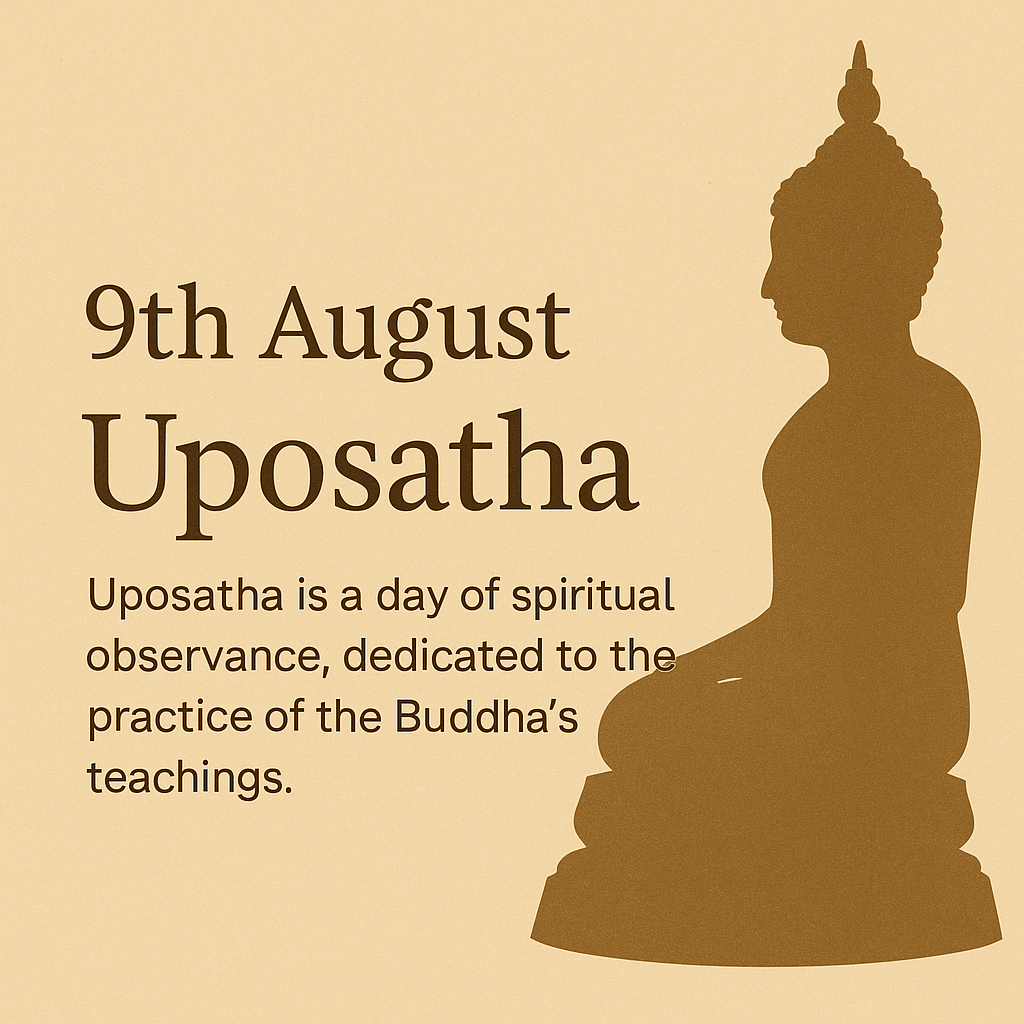
How to practice samatha and vipassana Uposatha – 9th August, 2025 (in Hindi)
Uposatha is an ideal occasion to cultivate both serenity (samatha) and insight (vipassanā) by grounding oneself in the Brahmavihāras and reflecting deeply on the five aggregates, the six sense bases, and the six elements that constitute experience leading to tranquility for the entire day for next 15 days
Practice of Brahma Vihara – 13th August, 2025
Now is the time to cultivate and establish the Four Brahmavihāras—loving-kindness (mettā), compassion (karuṇā), empathetic joy (muditā), and equanimity (upekkhā)—using the breath as a stable anchor.
Begin by settling the mind through mindfulness of breathing, and gradually remove the five hindrances: sensual desire, ill will, sloth and torpor, restlessness and remorse, and doubt. As the mind becomes purified and tranquil, gently incline it toward one of the Brahmavihāras.
With repeated and sustained attention, allow the mind to immerse fully in that wholesome mental state, nurturing and expanding it until it becomes the dominant and abiding tone of the heart. The mind can then remain in that sublime dwelling—steadily, joyfully, and at will—for as long as desired.
Once fully established, this mental dwelling becomes second nature, allowing the practitioner to abide in these divine abodes at any time, both in formal meditation and daily life.
