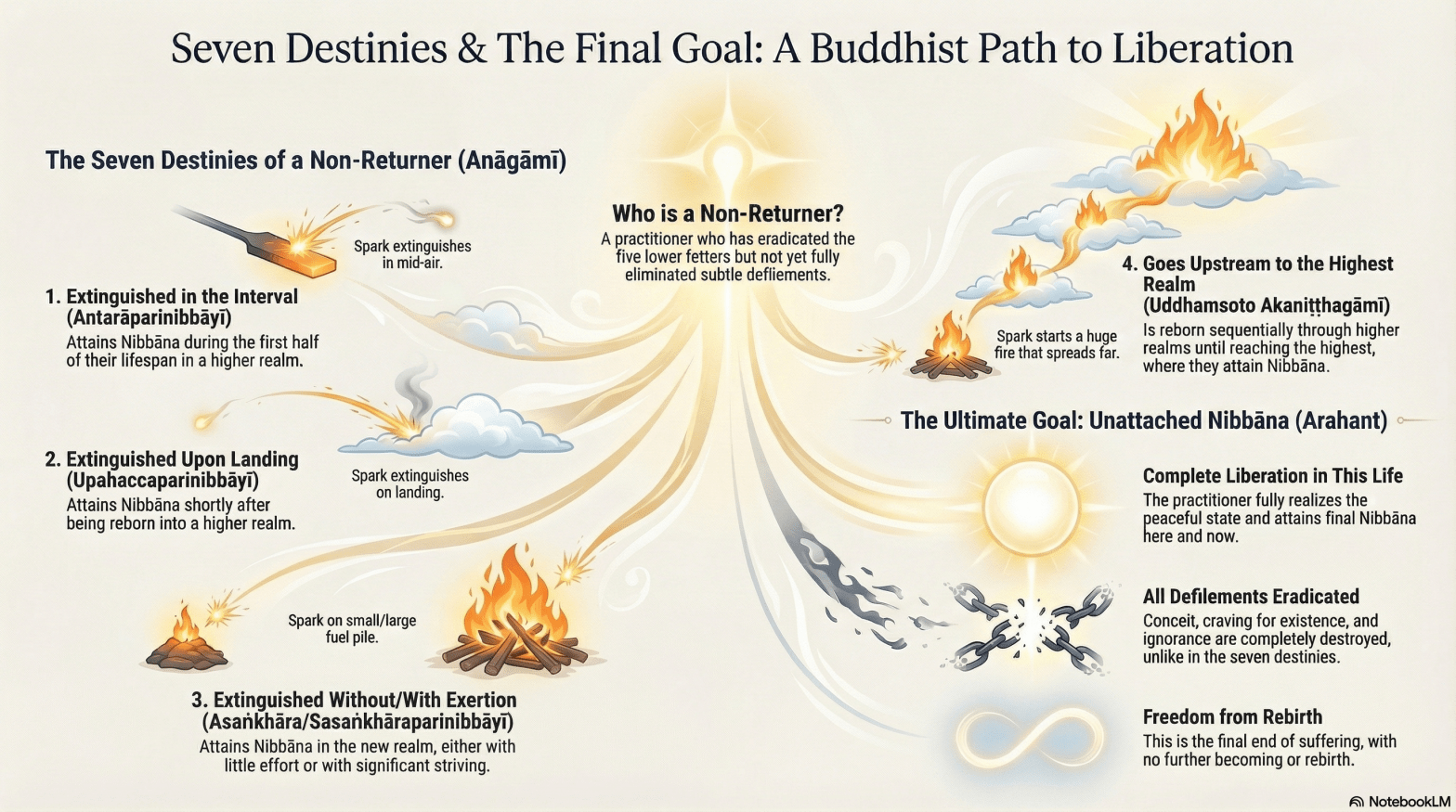
We are now taking up AN7.55 Purisagatisutta, seven destinies of beings (satta purisagatiyo) as found in the Aṅguttara Nikāya (AN 7.55). It explains one of the types of individuals who have progressed on the path but have not yet completely eradicated all defilements.
This particular passage focuses on the Antarāparinibbāyī—one who attains final pari-Nibbāna in-between (before their next rebirth is fully established)
The Buddha describes a monk who practices with the following understanding:
“No cassa no ca me siyā, na bhavissati na me bhavissati, yadatthi yaṁ bhūtaṁ taṁ pajahāmī”
This expresses detachment from existence and non-existence.
The monk does not crave for continued existence (bhava) nor for annihilation (vibhava).
He sees that what exists (bhūtaṁ, conditioned phenomena) should be abandoned.
“Upekkhaṁ paṭilabhati”
Through wisdom, he attains equanimity (upekkhā), seeing reality as it is.
He does not cling to becoming (bhava) nor to its causes (sambhava).
He perceives the higher, peaceful state (santaṁ padaṁ)—Nibbāna.
“Tañca khvassa padaṁ na sabbena sabbaṁ sacchikataṁ hoti”
However, he has not yet fully realized this peaceful state.
Some underlying tendencies (anusaya) still remain:
Conceit (māna) is not fully abandoned.
Craving for existence (bhavarāga) is not fully abandoned.
Ignorance (avijjā) is not fully abandoned.
“Pañcannaṁ orambhāgiyānaṁ saṁyojanānaṁ parikkhayā antarāparinibbāyī hoti”
But he has completely eliminated the five lower fetters (orambhāgiya saṁyojana):
Self-view (sakkāyadiṭṭhi) – Belief in a permanent self.
Doubt (vicikicchā) – Skepticism about the path.
Attachment to rites and rituals (sīlabbataparāmāsa) – Thinking moral and rituals alone lead to liberation.
Sensual desire (kāmarāga) – Craving for sensual pleasures.
Ill-will (byāpāda) – Hatred and anger.
Because these are destroyed, he will not be reborn in the lower realms.
However, since subtle clinging still remains, he is classified as an Antarāparinibbāyī—one who will attain final Nibbāna before their next rebirth is fully established.
The Seven Destinies of Beings (AN 7.55)
In the same sutta, the Buddha lists seven types of individuals based on their progress:
Antarāparinibbāyī – One who attains Nibbāna in-between lives, as described in this passage.
Upahaccaparinibbāyī – One who attains Nibbāna immediately upon rebirth in a higher realm.
Asaṅkhāraparinibbāyī – One who attains Nibbāna with little effort.
Sasaṅkhāraparinibbāyī – One who attains Nibbāna with much effort.
Each of these individuals has overcome the five lower fetters, ensuring that they will not be reborn in sensual realms (kāmaloka).
| Type of Non-Returner | Attainment of Nibbāna | Fire Simile |
|---|---|---|
| Antarāparinibbāyī | Attains Nibbāna before fully entering a new rebirth. | The spark goes out before touching the ground. |
| Upahaccaparinibbāyī | Attains Nibbāna immediately after rebirth. | The spark goes out the moment it touches the ground. |
Key Takeaways:
Sattakkhattuparama, Kolaṅkolo, and Ekabījī – These types of puggala will still take rebirths (bhava) before attaining extinguishment.
Antarāparinibbāyī & Upahaccaparinibbāyī – These two attain Nibbāna very quickly:
Antarāparinibbāyī: Before rebirth fully takes place.
Upahaccaparinibbāyī: Immediately after being reborn in a Brahma realm.
Asaṅkhāraparinibbāyī & Sasaṅkhāraparinibbāyī – These attain Nibbāna gradually in a higher realm:
Asaṅkhāraparinibbāyī: With little effort.
Sasaṅkhāraparinibbāyī: With more effort over a longer period.
What is Anupādāparinibbāna?
Katamañca, bhikkhave, anupādāparinibbānaṁ?
“And what, monks, is Anupādāparinibbāna?” The Buddha is about to explain the ultimate goal of the path: final liberation without any remainder of attachment (anupādā-parinibbāna).
This refers to the complete extinguishing of all defilements and cessation of rebirth.
Unlike Non-Returners (Anāgāmīs), who attain Nibbāna after rebirth in a higher realm, this directly refers to Arahantship—the complete ending of suffering in this very life.
| Stage | Characteristics | Clinging Left? | Time of Nibbāna |
|---|---|---|---|
| Antarāparinibbāyī | Attains Nibbāna before rebirth fully establishes. | Some subtle tendencies remain. | Before rebirth takes place. |
| Upahaccaparinibbāyī | Attains Nibbāna immediately after rebirth. | Some subtle tendencies remain. | Just after rebirth in a Brahma realm. |
| Asaṅkhāraparinibbāyī | Attains Nibbāna with little effort. | Some subtle tendencies remain. | After a short time in a Brahma realm. |
| Sasaṅkhāraparinibbāyī | Attains Nibbāna with much effort. | Some subtle tendencies remain. | After an extended period in a Brahma realm. |
| Uddhaṁsoto Akaniṭṭhagāmī | Reaches the highest Brahma realm, then attains Nibbāna. | Some subtle tendencies remain. | After extensive effort in Akaniṭṭha. |
| Anupādāparinibbāna (Arahantship) | Complete liberation, no rebirth. | No clinging remains. | In this very life. |