

Let us get into detail of AN 5.57 — Abhiṇhapaccavekkhitabbaṭhānasutta which is very important for recollection all the time and practice. This helps in establishing aniccā, dukkha and anatta or aniccā, vipariṇāmī, and aññathābhāvī. For understanding these three important terms, please go through this post
With this small introduction, let us begin the journey.
1️⃣ Introductory Statement
“Pañcimāni, bhikkhave, ṭhānāni abhiṇhaṁ paccavekkhitabbāni itthiyā vā purisena vā gahaṭṭhena vā pabbajitena vā. Katamāni pañca?”
“Bhikkhus, there are these five things that should be frequently reflected upon — whether by a woman or by a man, by a householder or by one gone forth (monk/nun).” Which five?”
Explanation: This practice is universal — for both genders, for both laypeople and monastics. It is a foundational reflection on Dhamma reality — to guard against complacency and attachment.
2️⃣ First Reflection — Aging
‘Jarādhammomhi, jaraṁ anatīto’ti abhiṇhaṁ paccavekkhitabbaṁ itthiyā vā purisena vā gahaṭṭhena vā pabbajitena vā.
“I am subject to aging; I am not beyond aging.”
This should be frequently reflected upon by a woman or by a man, by a householder or by one gone forth.”
Explanation: “Jarā-dhammo’mhi” = I am of the nature to age and “Jarāṁ anatīto” = I am not beyond aging.
👉 Deep meaning: We live as if youth will last — this reflection cuts through that delusion. Youth intoxication (yobbanamāda) is to be overcome.
3️⃣ Second Reflection — Illness
‘Byādhidhammomhi, byādhiṁ anatīto’ti abhiṇhaṁ paccavekkhitabbaṁ itthiyā vā purisena vā gahaṭṭhena vā pabbajitena vā. “I am subject to illness; I am not beyond illness and should be frequently reflected upon by all.”
“Byādhi-dhammo’mhi” = I am of the nature to fall ill. “Byādhiṁ anatīto” = I am not beyond illness.
👉 Deep meaning: Good health is impermanent. This reflection is an antidote to health intoxication (ārogya-māda).
4️⃣ Third Reflection — Death
‘Maraṇadhammomhi, maraṇaṁ anatīto’ti abhiṇhaṁ paccavekkhitabbaṁ itthiyā vā purisena vā gahaṭṭhena vā pabbajitena vā. “I am subject to death; I am not beyond death.” and This should be frequently reflected upon by all.”
“Maraṇa-dhammo’mhi” = I am of the nature to die and “Maraṇaṁ anatīto” = I am not beyond death.
👉 Deep meaning: Without death reflection, we live heedlessly (jīvitamāda — intoxication with life). Death reflection fosters urgency (saṁvega).
5️⃣ Fourth Reflection — Separation
‘Sabbehi me piyehi manāpehi nānābhāvo vinābhāvo’ti abhiṇhaṁ paccavekkhitabbaṁ itthiyā vā purisena vā gahaṭṭhena vā pabbajitena vā. “I will be parted and separated from all that is dear and pleasing to me.”
This should be frequently reflected upon by all.”
“Piyehi manāpehi nānābhāvo vinābhāvo” = separation from loved ones is inevitable.
👉 Deep meaning: Clinging to relationships or possessions leads to grief. This reflection develops non-attachment.
6️⃣ Fifth Reflection — Kamma
‘Kammassakomhi, kammadāyādo kammayoni kammabandhu kammapaṭisaraṇo.
Yaṁ kammaṁ karissāmi—kalyāṇaṁ vā pāpakaṁ vā— tassa dāyādo bhavissāmī’ti abhiṇhaṁ paccavekkhitabbaṁ…
“I am the owner of my actions; heir to my actions; born of my actions; related to my actions; and supported by my actions. Whatever action I do — good or bad — of that I will be the heir.”
👉 Reflecting on kamma cultivates moral responsibility and vigilance. One stops blaming others and takes ownership.
| Term | Meaning | Why it matters |
|---|---|---|
| abhiṇhaṁ | Frequently, habitually, again and again | Only through constant reflection does deep insight arise → leads to abandoning fetters |
| nānābhāvo | Becoming different → change of condition | Helps loosen clinging to present state of relationships and possessions |
| vinābhāvo | Separation, parting, going apart | Prepares mind for inevitable loss → develops equanimity and wise love |
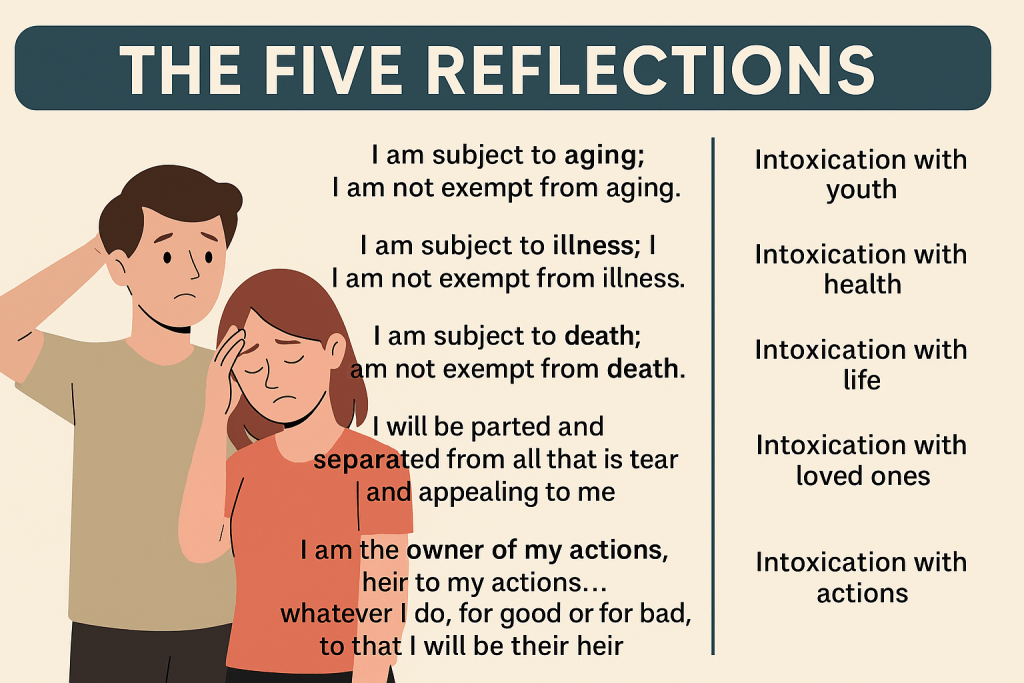
| Reflection | Purpose | What arises |
|---|---|---|
| Aging | Overcome youth intoxication | Path develops, fetters weaken |
| Illness | Overcome health intoxication | Path develops, fetters weaken |
| Death | Overcome life intoxication | Path develops, fetters weaken |
| Separation | Overcome craving for loved ones | Path develops, fetters weaken |
| Kamma | Strengthen moral responsibility | Path develops, fetters weaken |
Now comes the atthavasa (purpose) — for each reflection.
1️⃣ Jarāta: Aging
Kiñca, bhikkhave, atthavasaṁ paṭicca ‘jarādhammomhi, jaraṁ anatīto’ti abhiṇhaṁ paccavekkhitabbaṁ itthiyā vā purisena vā gahaṭṭhena vā pabbajitena vā?
“And what, bhikkhus, is the purpose and benefit (atthavasaṁ) of frequently reflecting:
‘I am of the nature to age; I have not gone beyond aging’ — whether by a woman or by a man, by a householder or by one gone forth?”
Atthi, bhikkhave, sattānaṁ yobbane yobbanamado, yena madena mattā kāyena duccaritaṁ caranti, vācāya duccaritaṁ caranti, manasā duccaritaṁ caranti.
“There are, bhikkhus, beings who — when in youth — become intoxicated with youth (yobbanamado); and, being maddened (intoxicated) by that intoxication, they engage in misconduct by body, engage in misconduct by speech, engage in misconduct by mind.”
yobbane yobbanamado = the intoxication (mada) of youth, arising in youth.
madena mattā = maddened, intoxicated, heedless because of this pride and intoxication.
kāyena duccaritaṁ caranti = do bodily misconduct — i.e., physical actions rooted in craving, arrogance, or heedlessness.
vācāya duccaritaṁ caranti = do verbal misconduct — false speech, harsh speech, divisive speech, idle chatter.
manasā duccaritaṁ caranti = do mental misconduct — covetousness, ill will, wrong view.
Tassa taṁ ṭhānaṁ abhiṇhaṁ paccavekkhato yo yobbane yobbanamado so sabbaso vā pahīyati tanu vā pana hoti.
“For one who frequently reflects on this very point (ṭhānaṁ),
that intoxication with youth, if present, is either completely abandoned or at least weakened.”
ṭhānaṁ = this very basis/topic of reflection.
abhiṇhaṁ paccavekkhato = for one who frequently reflects.
yo yobbane yobbanamado = that intoxication/pride in youth.
sabbaso vā pahīyati = is completely removed.
tanu vā pana hoti = or becomes weakened/thinned.
Idaṁ kho, bhikkhave, atthavasaṁ paṭicca ‘jarādhammomhi, jaraṁ anatīto’ti abhiṇhaṁ paccavekkhitabbaṁ itthiyā vā purisena vā gahaṭṭhena vā pabbajitena vā.
“This, bhikkhus, is the purpose and benefit of frequently reflecting:
‘I am of the nature to age; I have not gone beyond aging’ — whether by a woman or by a man, by a householder or by one gone forth.”
Detailed Explanation and Practical Instruction:
The Problem: Yobbanamado (intoxication with youth) is a great source of heedlessness.
Youth brings: strength, energy, beauty, charm, sexual attraction, power.
People tend to think: “I am invincible, death is far away, I will always be strong and attractive.”
This false view leads to:
→ carelessness of virtue,
→ arrogance,
→ indulgence in sense pleasures,
→ violations of ethical conduct.
The Solution: When one frequently reflects: “I am of the nature to age. I am not beyond aging.”
Then the intoxication/pride is weakened or destroyed. and the mind becomes more humble, realistic, and oriented toward the Dhamma.
Practical Steps:
1️⃣ Each day, repeat: “This body is aging even now. I am not beyond aging.”
2️⃣ Observe aging signs in oneself and others — not with aversion, but with wisdom.
3️⃣ Understand: youth is temporary, fragile.
4️⃣ As the reflection deepens: urgency for Dhamma practice increases.
Summary in Short:
| Term | Meaning | Practical Impact |
|---|---|---|
| Yobbane yobbanamado | Intoxication with youth | Causes heedlessness and misconduct |
| Abhiṇhaṁ paccavekkhato | Frequent reflection | Weakens or removes intoxication |
| Result | Sobriety, humility, urgency | Progress on the Path |
2️⃣ byādhidhamma – Illness Reflection
Kiñca, bhikkhave, atthavasaṁ paṭicca ‘byādhidhammomhi, byādhiṁ anatīto’ti abhiṇhaṁ paccavekkhitabbaṁ itthiyā vā purisena vā gahaṭṭhena vā pabbajitena vā?
“And what, bhikkhus, is the purpose and benefit (atthavasaṁ) of frequently reflecting:
‘I am of the nature to become ill; I have not gone beyond illness’ — whether by a woman or by a man, by a householder or by one gone forth?”
Atthi, bhikkhave, sattānaṁ ārogye ārogyamado, yena madena mattā kāyena duccaritaṁ caranti, vācāya duccaritaṁ caranti, manasā duccaritaṁ caranti.
“There are, bhikkhus, beings who — when in good health — become intoxicated with health (ārogyamado); and, being maddened (intoxicated) by that intoxication, they engage in misconduct by body, misconduct by speech, and misconduct by mind.”
ārogye ārogyamado = intoxication with health; the arrogance or heedlessness that arises when one feels strong, healthy.
madena mattā = maddened or heedless because of this intoxication.
kāyena duccaritaṁ caranti = perform bodily misconduct.
vācāya duccaritaṁ caranti = perform verbal misconduct.
manasā duccaritaṁ caranti = perform mental misconduct.
Tassa taṁ ṭhānaṁ abhiṇhaṁ paccavekkhato yo ārogye ārogyamado so sabbaso vā pahīyati tanu vā pana hoti.
“For one who frequently reflects on this very point (ṭhānaṁ), that intoxication with health, if present, is either completely abandoned or at least weakened.”
ṭhānaṁ = this basis of reflection.
abhiṇhaṁ paccavekkhato = for one who frequently reflects.
yo ārogye ārogyamado = that intoxication/pride in health.
sabbaso vā pahīyati = is completely abandoned.
tanu vā pana hoti = or becomes weakened.
Idaṁ kho, bhikkhave, atthavasaṁ paṭicca ‘byādhidhammomhi, byādhiṁ anatīto’ti abhiṇhaṁ paccavekkhitabbaṁ itthiyā vā purisena vā gahaṭṭhena vā pabbajitena vā.
“This, bhikkhus, is the purpose and benefit of frequently reflecting:
‘I am of the nature to become ill; I have not gone beyond illness’ — whether by a woman or by a man, by a householder or by one gone forth.”
Deep Explanation & Practical Instruction:
The Problem:
Ārogyamado (intoxication with health) is a great source of heedlessness. When one feels: “I am healthy, strong, no danger”, the mind tends to become careless.
One thinks: “I can indulge now, I can enjoy sense pleasures, I am in control.”
This leads to:
→ Ignoring Dhamma practice.
→ Chasing pleasures.
→ Ethical decline.
The Solution:
Frequent reflection: “This health is fragile and temporary. I am subject to illness. I am not beyond illness.” When this is deeply understood:
One uses health wisely, not wastefully.
One prepares the mind to face illness without fear or resentment.
One has compassion toward the sick, not disgust or aversion.
Practical Steps:
1️⃣ Reflect daily: “This good health may vanish at any moment.”
2️⃣ Observe: when you see someone ill, reflect: “That could be me — this is natural.”
3️⃣ Reduce pride and complacency.
4️⃣ Practice Dhamma while healthy, knowing health is uncertain.
5️⃣ Cultivate karuṇā (compassion) toward those who are ill.
Summary of Illness Reflection:
| Term | Meaning | Practical Impact |
|---|---|---|
| Ārogye ārogyamado | Intoxication with health | Causes heedlessness and misconduct |
| Abhiṇhaṁ paccavekkhato | Frequent reflection | Weakens or removes this intoxication |
| Result | Sobriety, mindful use of health | Progress on the Path |
3️⃣ Death Reflection — Ariyasāvako
Kiñca, bhikkhave, atthavasaṁ paṭicca ‘maraṇadhammomhi, maraṇaṁ anatīto’ti abhiṇhaṁ paccavekkhitabbaṁ itthiyā vā purisena vā gahaṭṭhena vā pabbajitena vā?
“And what, bhikkhus, is the purpose and benefit (atthavasaṁ) of frequently reflecting:
‘I am of the nature to die; I have not gone beyond death’ — whether by a woman or by a man, by a householder or by one gone forth?”
Atthi, bhikkhave, sattānaṁ jīvite jīvitamado, yena madena mattā kāyena duccaritaṁ caranti, vācāya duccaritaṁ caranti, manasā duccaritaṁ caranti.
“There are, bhikkhus, beings who — when in life (jīvite) — become intoxicated with life (jīvitamado);
and, being maddened (intoxicated) by that intoxication, they engage in bodily misconduct, verbal misconduct, and mental misconduct.”
jīvite jīvitamado = intoxication with life; sense of permanence, invulnerability, and craving for continuous existence.
madena mattā = maddened, heedless, drunk on life itself.
kāyena duccaritaṁ caranti = perform bodily misconduct.
vācāya duccaritaṁ caranti = perform verbal misconduct.
manasā duccaritaṁ caranti = perform mental misconduct.
Tassa taṁ ṭhānaṁ abhiṇhaṁ paccavekkhato yo jīvite jīvitamado so sabbaso vā pahīyati tanu vā pana hoti.
“For one who frequently reflects on this very point (ṭhānaṁ), that intoxication with life, if present, is either completely abandoned or at least weakened.”
ṭhānaṁ = this basis, topic of reflection.
abhiṇhaṁ paccavekkhato = for one who frequently reflects.
yo jīvite jīvitamado = that intoxication/pride in life.
sabbaso vā pahīyati = is completely abandoned.
tanu vā pana hoti = or becomes weakened.
Idaṁ kho, bhikkhave, atthavasaṁ paṭicca ‘maraṇadhammomhi, maraṇaṁ anatīto’ti abhiṇhaṁ paccavekkhitabbaṁ itthiyā vā purisena vā gahaṭṭhena vā pabbajitena vā.
“This, bhikkhus, is the purpose and benefit of frequently reflecting:
‘I am of the nature to die; I have not gone beyond death’ — whether by a woman or by a man, by a householder or by one gone forth.”
Deep Explanation & Practical Instruction:
The Problem:
Jīvitamado = intoxication with life itself. This is perhaps the deepest and subtlest mada.
People act as if life will go on forever: “I have time — no need to practice Dhamma now.”
“I can enjoy life for a while longer.” “Death is for others, not me — not now.”
This fundamental delusion leads to: Procrastination in Dhamma practice, greed for sense pleasures, fear and denial of death and arrogance and carelessness.
The Solution:
Frequent reflection: “I am of the nature to die. I have not gone beyond death.”
This develops saṁvega (sense of urgency).
One begins to live each day as precious, not wasting time. and thought “I can practice later.”
Practical Steps:
1️⃣ Morning reflection: “Today may be my last day.”
2️⃣ Observe impermanence in life around you — plants, animals, people — not with fear, but with wisdom.
3️⃣ When a loved one dies, reflect: “This is natural. I too will die.”
4️⃣ Reduce over-involvement in worldliness — cultivate spiritual urgency.
5️⃣ Practice letting go — both of clinging to life and fear of death.Result:
👉 Intoxication with life weakens.
👉 Fear of death lessens.
👉 Urgency for Dhamma increases.
👉 Fetters such as sakkāya-diṭṭhi and craving for existence (bhavataṇhā) are undermined.
Summary of Death Reflection:
| Term | Meaning | Practical Impact |
|---|---|---|
| Jīvite jīvitamado | Intoxication with life | Causes heedlessness and procrastination |
| Abhiṇhaṁ paccavekkhato | Frequent reflection | Weakens or removes intoxication |
| Result | Urgency (saṁvega), wisdom | Progress on the Path |
4️⃣ Separation Reflection — Ariyasāvako
Kiñca, bhikkhave, atthavasaṁ paṭicca ‘sabbehi me piyehi manāpehi nānābhāvo vinābhāvo’ti abhiṇhaṁ paccavekkhitabbaṁ itthiyā vā purisena vā gahaṭṭhena vā pabbajitena vā?
“And what, bhikkhus, is the purpose and benefit (atthavasaṁ) of frequently reflecting:
‘I will be separated and parted from all that is dear and pleasing to me’ — whether by a woman or by a man, by a householder or by one gone forth?”
Atthi, bhikkhave, sattānaṁ piyesu manāpesu yo chandarāgo yena rāgena rattā kāyena duccaritaṁ caranti, vācāya duccaritaṁ caranti, manasā duccaritaṁ caranti.
“There are, bhikkhus, beings who — toward what is dear and pleasing (piyesu manāpesu) — develop desire and attachment (chandarāgo);
and, being infatuated (rattā) by that attachment, they engage in bodily misconduct, verbal misconduct, and mental misconduct.”
piyesu manāpesu = toward those who are loved and pleasing — family members, friends, lovers, possessions.
chandarāgo = passionate desire, lustful attachment.
yena rāgena rattā = infatuated by that passion/craving (rāga).
kāyena duccaritaṁ caranti = bodily misconduct — fighting, harming, stealing, in pursuit of or protecting attachments.
vācāya duccaritaṁ caranti = verbal misconduct — lying, harsh speech, etc. to secure or defend attachments.
manasā duccaritaṁ caranti = mental misconduct — obsession, jealousy, hatred arising from clinging to what is dear.
Tassa taṁ ṭhānaṁ abhiṇhaṁ paccavekkhato yo piyesu manāpesu chandarāgo so sabbaso vā pahīyati tanu vā pana hoti.
“For one who frequently reflects on this very point (ṭhānaṁ), that desire and attachment (chandarāgo) toward what is dear and pleasing, if present, is either completely abandoned or at least weakened.”
ṭhānaṁ = this basis of reflection.
abhiṇhaṁ paccavekkhato = for one who frequently reflects.
yo piyesu manāpesu chandarāgo = that desire and clinging toward what is dear.
sabbaso vā pahīyati = is completely abandoned.
tanu vā pana hoti = or becomes weakened.
Idaṁ kho, bhikkhave, atthavasaṁ paṭicca ‘sabbehi me piyehi manāpehi nānābhāvo vinābhāvo’ti abhiṇhaṁ paccavekkhitabbaṁ itthiyā vā purisena vā gahaṭṭhena vā pabbajitena vā.
“This, bhikkhus, is the purpose and benefit of frequently reflecting:
‘I will be separated and parted from all that is dear and pleasing to me’ — whether by a woman or by a man, by a householder or by one gone forth.”
Deep Explanation & Practical Instruction:
The Problem:
Chandarāgo = passionate clinging and craving for people, things, situations.
We act as if our relationships and possessions will be permanent or belong to us.
This fuels: Jealousy, fear of loss. possessiveness, anger when things go wrong leading to mourning and despair at loss which is inevitable.
Misconduct arises: Lying, manipulating, harming others to maintain or acquire attachments leading to mental agitation and restlessness.
The Solution: Frequent reflection: “Whatever is dear and pleasing to me — I will one day be separated from it.” This is not pessimism — it is wisdom.
When deeply understood: Love becomes pure — free of clinging.
Relationships are lived with gratitude, not possessiveness.
One prepares the mind to face inevitable loss with equanimity.
Practical Steps:
1️⃣ Daily reflection: “No one and nothing is mine to keep forever.”
2️⃣ When enjoying relationships, remain aware of their impermanence.
3️⃣ When loss comes (death, separation), see it as natural — this reflection helps prevent overwhelming grief.
4️⃣ Cultivate mettā — unconditional love without attachment.
5️⃣ Practice letting go even while living among loved ones.
Result:
👉 Attachment toward people and possessions weakens.
👉 Relationships become healthier and freer.
👉 Capacity to endure change and loss increases.
👉 Inner peace and equanimity develop.
Summary of Separation Reflection:
| Term | Meaning | Practical Impact |
|---|---|---|
| Piyesu manāpesu chandarāgo | Craving and clinging toward what is dear and pleasing | Causes possessiveness and suffering |
| Abhiṇhaṁ paccavekkhato | Frequent reflection | Weakens or removes this clinging |
| Result | Pure love, equanimity, non-attachment | Progress on the Path |
5️⃣ Kamma Reflection
Kiñca, bhikkhave, atthavasaṁ paṭicca ‘kammassakomhi, kammadāyādo kammayoni kammabandhu kammapaṭisaraṇo, yaṁ kammaṁ karissāmi—kalyāṇaṁ vā pāpakaṁ vā—tassa dāyādo bhavissāmī’ti abhiṇhaṁ paccavekkhitabbaṁ itthiyā vā purisena vā gahaṭṭhena vā pabbajitena vā?
“And what, bhikkhus, is the purpose and benefit (atthavasaṁ) of frequently reflecting:
‘I am the owner of my actions; heir to my actions; born of my actions; related to my actions; supported by my actions.
Whatever action I do — good or bad — of that I will be the heir’ — whether by a woman or by a man, by a householder or by one gone forth?”
kammassakomhi = I am the owner of my kamma (actions).
kammadāyādo = I am the heir of my actions — I will experience their results.
kammayoni = I am born of my kamma — it is the origin of my experience.
kammabandhu = I am related to my kamma — it is my true companion.
kammapaṭisaraṇo = I have kamma as my refuge — when all else falls away, kamma follows me.
yaṁ kammaṁ karissāmi—kalyāṇaṁ vā pāpakaṁ vā—tassa dāyādo bhavissāmi = whatever I do — good or bad — I will inherit it.
Atthi, bhikkhave, sattānaṁ kāyaduccaritaṁ vacīduccaritaṁ manoduccaritaṁ.
“There are, bhikkhus, beings who engage in bodily misconduct, verbal misconduct, and mental misconduct.”
kāyaduccaritaṁ = unwholesome bodily actions — killing, stealing, sexual misconduct.
vacīduccaritaṁ = unwholesome verbal actions — lying, harsh speech, divisive speech, idle chatter.
manoduccaritaṁ = unwholesome mental actions — covetousness, ill will, wrong view.
Tassa taṁ ṭhānaṁ abhiṇhaṁ paccavekkhato sabbaso vā duccaritaṁ pahīyati tanu vā pana hoti.
“For one who frequently reflects on this very point (ṭhānaṁ),
all misconduct — bodily, verbal, and mental — is either completely abandoned or at least weakened.”
ṭhānaṁ = this basis of reflection.
abhiṇhaṁ paccavekkhato = for one who frequently reflects.
sabbaso vā duccaritaṁ pahīyati = misconduct is completely abandoned.
tanu vā pana hoti = or becomes weakened.
Idaṁ kho, bhikkhave, atthavasaṁ paṭicca ‘kammassakomhi, kammadāyādo kammayoni kammabandhu kammapaṭisaraṇo, yaṁ kammaṁ karissāmi— kalyāṇaṁ vā pāpakaṁ vā— tassa dāyādo bhavissāmī’ti abhiṇhaṁ paccavekkhitabbaṁ itthiyā vā purisena vā gahaṭṭhena vā pabbajitena vā.
“This, bhikkhus, is the purpose and benefit of frequently reflecting:
‘I am the owner of my actions; heir to my actions; born of my actions; related to my actions; supported by my actions. Whatever action I do — good or bad — of that I will be the heir’ — whether by a woman or by a man, by a householder or by one gone forth.”
Deep Explanation & Practical Instruction:
The Problem:
People often live as if: Actions have no consequences, blame is to be placed outside — on others, on society, on circumstances and think that they can somehow escape the results of what they do.
👉 This delusion leads to unwholesome actions: Bodily, verbal, and mental misconduct leading to carelessness and heedlessness.
The Solution:
Frequent reflection: “I alone am the owner of my actions. Whatever I do — good or bad — I will inherit.” This builds ethical responsibility and helps restrain impulsive behavior with cultivation of integrity.
Practical Steps:
1️⃣ Daily reflection: “Whatever I do today will shape my experience tomorrow — and in future lives.”
2️⃣ Before acting: “Will I be glad to inherit the results of this action?”
3️⃣ After action: review — “What seed did I just plant?”
4️⃣ Recognize that external blame is useless — my kamma is my true legacy.
5️⃣ Develop sīla (virtue), samādhi, and paññā — because they lead to wholesome kamma and liberation.
Result:
👉 Mindfulness and restraint improve.
👉 Ethical clarity deepens.
👉 Impulsiveness diminishes.
👉 One becomes self-governed and accountable.
👉 Progress on the Noble Eightfold Path accelerates.
Summary of Kamma Reflection:
| Term | Meaning | Practical Impact |
|---|---|---|
| Kammassakomhi | I am the owner of my actions | Deep sense of personal responsibility |
| Kammadāyādo | I will inherit my actions | Motivation for ethical conduct |
| Kammayoni, kammabandhu, kammapaṭisaraṇo | My actions shape my birth, my true companions, and my refuge | Continuous ethical mindfulness |
| Abhiṇhaṁ paccavekkhato | Frequent reflection | Weakens or removes misconduct |
| Result | Integrity, self-accountability, wholesome kamma | Progress on the Path toward liberation |
Conclusion — Final Verse (Gāthā)
Byādhidhammā jarādhammā, atho maraṇadhammino;
Yathā dhammā tathā sattā, jigucchanti puthujjanā.
“Beings are of the nature to become ill, of the nature to age, and of the nature to die.
Yet ordinary worldlings (puthujjanā) are repelled by this — though this is their true nature.”
byādhidhammā = of the nature to become ill.
jarādhammā = of the nature to age.
maraṇadhammino = of the nature to die.
yathā dhammā = as is their true nature.
jigucchanti = they feel revulsion, disgust, rejection.
puthujjanā = worldlings — those not trained in Dhamma.
👉 The ignorant mind is disturbed by truths of illness, aging, and death — it does not want to face them.
Ahañce taṁ jiguccheyyaṁ, evaṁ dhammesu pāṇisu;
Na metaṁ patirūpassa, mama evaṁ vihārino.
“If I too were to feel revulsion toward these natural processes in living beings,
that would not be fitting for me — for one dwelling thus (in wisdom).”
ahañce taṁ jiguccheyyaṁ = if I were to feel revulsion toward this.
evaṁ dhammesu pāṇisu = toward such Dhammas (natural phenomena) in living beings.
na metaṁ patirūpassa = this would not be proper, fitting, appropriate.
mama evaṁ vihārino = for one who dwells thus — one who dwells in insight and wisdom.
👉 The noble disciple sees these realities with wisdom, not with rejection or emotional aversion.
Sohaṁ evaṁ viharanto, ñatvā dhammaṁ nirūpadhiṁ;
Ārogye yobbanasmiñca, jīvitasmiñca ye madā.
“Thus dwelling, knowing the Dhamma that is without substratum (nirūpadhiṁ = without basis for attachment), I have overcome the intoxications connected with health, with youth, and with life.”
evaṁ viharanto = dwelling in this way (with these reflections).
ñatvā dhammaṁ nirūpadhiṁ = knowing the Dhamma that is without substratum — referring to Nibbāna, and to wisdom seeing the empty nature of conditioned phenomena.
ārogye yobbanasmiñca jīvitasmiñca ye madā = the intoxications that arise with health, youth, and life.
👉 The noble disciple abandons the madā (intoxications) that cause heedlessness.
Sabbe made abhibhosmi, nekkhammaṁ daṭṭhu khemato;
Tassa me ahu ussāho, nibbānaṁ abhipassato.
“I have overcome all intoxications; seeing the security in renunciation,
there has arisen in me great energy (ussāho) for the direct seeing of Nibbāna.”
sabbe made abhibhosmi = I have overcome all intoxications (youth, health, life, sensuality, etc.).
nekkhammaṁ daṭṭhu khemato = seeing the safety/security in renunciation (nekkhamma = going forth, letting go).
ussāho = energy, enthusiasm, diligent effort.
nibbānaṁ abhipassato = for seeing Nibbāna directly.
👉 Renunciation here is both external (simplicity of life) and internal (letting go of craving).
Nāhaṁ bhabbo etarahi, kāmāni paṭisevituṁ;
Anivatti bhavissāmi, brahmacariyaparāyaṇo’ti.
“Now I am no longer capable of indulging in sensual pleasures.
I will not turn back; I am fully dedicated to the spiritual life (brahmacariya).”
nāhaṁ bhabbo = I am not capable, not fit.
etarahi kāmāni paṭisevituṁ = to indulge in sensual pleasures anymore.
anivatti bhavissāmi = I will not turn back (to lay life, to heedlessness).
brahmacariyaparāyaṇo = devoted to the brahmacariya — the holy life of renunciation and practice toward Nibbāna.
Deep Explanation & Practical Instruction:
👉 The verse is the Buddha’s praise of the noble disciple’s journey:
1️⃣ The worldling reacts to aging, illness, and death with fear and aversion → causing suffering.
2️⃣ The noble disciple learns to see them with clear, wise equanimity → no fear, no clinging.
3️⃣ By deep reflection, the disciple overcomes the intoxications that cause heedlessness:
Youth intoxication → arrogance.
Health intoxication → complacency.
Life intoxication → clinging to existence.
4️⃣ Seeing the safety in renunciation → the disciple gains energy for the path.
5️⃣ One becomes incapable of returning to indulgence → fully committed to liberation.
How to Accomplish this Practically:
✅ Daily reflection — as part of daily contemplation, after morning or evening meditation.
✅ During challenges — when facing health issues, loss, or temptation, recall these reflections.
✅ Develop mindfulness — yoniso manasikāra transforms these reflections into direct wisdom.
✅ Remember universality — “It is not just I…” → promotes compassion and equanimity.
Ariyasāvaka Reflection — 1️⃣ Aging
Sa kho so, bhikkhave, ariyasāvako iti paṭisañcikkhati:
‘Na kho ahaññeveko jarādhammo jaraṁ anatīto, atha kho yāvatā sattānaṁ āgati gati cuti upapatti sabbe sattā jarādhammā jaraṁ anatītā’ti. Tassa taṁ ṭhānaṁ abhiṇhaṁ paccavekkhato maggo sañjāyati. So taṁ maggaṁ āsevati bhāveti bahulīkaroti. Tassa taṁ maggaṁ āsevato bhāvayato bahulīkaroto saṁyojanāni sabbaso pahīyanti anusayā byantīhonti.
Sa kho so, bhikkhave, ariyasāvako iti paṭisañcikkhati:
“That noble disciple, bhikkhus, reflects thus:”
‘Na kho ahaññeveko jarādhammo jaraṁ anatīto, atha kho yāvatā sattānaṁ āgati gati cuti upapatti sabbe sattā jarādhammā jaraṁ anatītā’ti.
“It is not only I alone who am of the nature to age, who have not gone beyond aging.
Rather, insofar as there are beings who come and go, pass away and re-arise, all beings are of the nature to age; none have gone beyond aging.”
āgati gati cuti upapatti = coming (rebirth), going (death), passing away, reappearing (rebirth again) → cyclic existence (saṁsāra).
sabbe sattā jarādhammā = all beings are of the nature to age.
Tassa taṁ ṭhānaṁ abhiṇhaṁ paccavekkhato maggo sañjāyati.
“For one who frequently reflects on this very point, a path arises.”
maggo sañjāyati = the Noble Eightfold Path arises — wisdom and dispassion grow.
So taṁ maggaṁ āsevati bhāveti bahulīkaroti. “He cultivates that path, develops it, and makes it abundant.”
āsevati = frequently attends to it. bhāveti = develops it in practice. bahulīkaroti = brings it to fullness, abundance.
Tassa taṁ maggaṁ āsevato bhāvayato bahulīkaroto saṁyojanāni sabbaso pahīyanti anusayā byantīhonti.
“For one who cultivates and develops that path, makes it abundant, the fetters are completely abandoned, and the latent tendencies are destroyed.”
saṁyojanāni = fetters — mental bonds that tie one to saṁsāra:
1. identity view (sakkāya-diṭṭhi),
2. doubt (vicikicchā)
3. attachment to rites/rituals (sīlabbataparāmāsa),
4. sensual desire (kāmacchanda),
5. ill will (vyāpāda),
6. craving for existence (bhavataṇhā),
7. conceit (māna),
8. restlessness (uddhacca),
9. ignorance (avijjā).
anusayā = latent tendencies — deep-rooted inclinations (greed, hatred, delusion) stored at the root of the mind.
sabbaso pahīyanti = completely abandoned.
byantīhonti = utterly destroyed.
Deep Explanation & Practical Instruction:
👉 This is the transition from reflection to insight:
Initially: personal reflection → “I will age.”
Now: universal insight → “All beings are subject to aging. This is saṁsāra.”
👉 This universal reflection triggers:
Dispassion (virāga).
Non-identification (anatta).
Empathy and compassion — “all beings suffer the same fate.”
Deep acceptance of impermanence — “nothing is worth clinging to.”
👉 As this deepens → Path factors arise:
Proper view. Proper intention. Proper mindfulness and Proper concentration → leading to release.
👉 Eventually → fetters fall away, latent tendencies destroyed → liberation.
How to Practice:
1️⃣ Daily reflect on one’s own aging.
2️⃣ Reflect: “All beings age. No one escapes.”
3️⃣ Observe aging in others — with compassion, not fear.
4️⃣ Let this insight fuel urgency, gentleness, and detachment.
5️⃣ Gradually: fetters fall away.
Ariyasāvaka Reflection — 2️⃣ Illness
‘Na kho ahaññeveko byādhidhammo byādhiṁ anatīto,
“It is not only I alone who am of the nature to become ill, who have not gone beyond illness,”
atha kho yāvatā sattānaṁ āgati gati cuti upapatti sabbe sattā byādhidhammā byādhiṁ anatītā’ti.
“rather, insofar as there are beings who come and go, pass away and reappear — all beings are of the nature to become ill; none have gone beyond illness.”
āgati gati cuti upapatti = coming, going, passing away, reappearance → cyclic existence of beings.
byādhidhammā = of the nature to become ill.
Tassa taṁ ṭhānaṁ abhiṇhaṁ paccavekkhato maggo sañjāyati.
“For one who frequently reflects on this very point (ṭhānaṁ), a path arises.”
maggo sañjāyati = the Noble Eightfold Path arises.
So taṁ maggaṁ āsevati bhāveti bahulīkaroti.
“He cultivates that path, develops it, and makes it abundant.”
āsevati bhāveti bahulīkaroti = attends to it, develops it, brings it to fullness.
Tassa taṁ maggaṁ āsevato bhāvayato bahulīkaroto saṁyojanāni sabbaso pahīyanti, anusayā byantīhonti.
“For one who cultivates and develops that path and makes it abundant, the fetters are completely abandoned, and the latent tendencies are destroyed.”
Deep Explanation & Practical Instruction:
👉 This is the transition from personal reflection to universal insight on illness.
Initially: I will become ill. I have not gone beyond illness.
Now: All beings, in all realms, are subject to illness. This is the nature of existence.
What arises through this reflection?
👉 Compassion: We stop being angry at the sick and do not fear illness in ourselves.
We recognize illness as natural Dhamma, not personal misfortune.
👉 Equanimity: We stop fighting reality and abandon resentment toward sickness. Also, stop thinking: “Why me?” → because all beings are in the same boat.
👉 Letting go of identity view (sakkāya-diṭṭhi): The body is not me, not mine — it is a changing, vulnerable process. Illness shows this clearly.
👉 The Path arises: We become more gentle and abandon harshness and pride, to cultivate the Four Brahmavihāras: Mettā → loving-kindness. Karuṇā → compassion. Muditā → rejoicing in others’ well-being. Upekkhā → equanimity.
👉 Fetters fall away: Identity view fades and sensual craving diminishes — because the body is seen clearly as fragile. With this, restlessness fades — because the mind is reconciled to the Dhamma of the body.
How to Practice:
1️⃣ Reflect: “Illness is natural to all beings — not just to me.”
2️⃣ When seeing illness in others, cultivate compassion — not disgust, not pity.
3️⃣ When ill oneself, reflect: “This is nature at work — not an injustice, not a punishment.”
4️⃣ See: youth, beauty, health — all are transient and fragile.
5️⃣ Abandon pride in health; cultivate gentle mindfulness of the body.
| Term | Meaning | Practical Impact |
|---|---|---|
| Na kho ahaṁ eko byādhidhammo | Not only I alone am subject to illness | Universalizes the reflection — compassion arises |
| All beings are byādhidhammā | All beings are subject to illness | Humility, equanimity develop |
| Maggo sañjāyati | The Path arises | Right view deepens, compassion and wisdom grow |
| Saṁyojanāni pahīyanti | Fetters fall away | Clinging to health, self-identity weaken |
| Anusayā byantīhonti | Latent tendencies are destroyed | Progress toward liberation occurs |
Ariyasāvaka Reflection — 3️⃣ Death
‘Na kho ahaññeveko maraṇadhammo maraṇaṁ anatīto,
“It is not only I alone who am of the nature to die, who have not gone beyond death,”
atha kho yāvatā sattānaṁ āgati gati cuti upapatti sabbe sattā maraṇadhammā maraṇaṁ anatītā’ti.
“Rather, insofar as there are beings who come and go, pass away and reappear — all beings are of the nature to die; none have gone beyond death.”
āgati gati cuti upapatti = cyclic existence → rebirth and death.
maraṇadhammā = of the nature to die.
Tassa taṁ ṭhānaṁ abhiṇhaṁ paccavekkhato maggo sañjāyati. “For one who frequently reflects on this very point (ṭhānaṁ), a path arises.”
maggo sañjāyati = the Noble Eightfold Path arises → wisdom grows.
So taṁ maggaṁ āsevati bhāveti bahulīkaroti. “He cultivates that path, develops it, and makes it abundant.”
Tassa taṁ maggaṁ āsevato bhāvayato bahulīkaroto saṁyojanāni sabbaso pahīyanti, anusayā byantīhonti.
“For one who cultivates and develops that path and makes it abundant, the fetters are completely abandoned, and the latent tendencies are destroyed.”
Deep Explanation & Practical Instruction:
👉 This is the deepest stage of universal reflection on death.
Initially:
“I will die. I have not gone beyond death.”
Now: “All beings are subject to death. This is the universal law of saṁsāra.”
What arises through this reflection? 👉 Fearlessness: One who fully sees that all beings must die loses the irrational fear of death and the mind becomes steady and courageous.
👉 Dispassion: When we see the universality of death, clinging to life weakens and abandon the desperate grasping at existence.
👉 Insight into Anatta: Death reveals the non-self nature of body and mind — no permanent “I” continues.
👉 The Path arises: The mind moves toward release.
Samādhi deepens → because fear and craving diminish.
Wisdom sharpens → seeing the Dhamma of birth and death clearly.
👉 Fetters fall away: Identity view fades and craving for existence weakens.
Restlessness lessens — no longer agitated about controlling life.
How to Practice:
1️⃣ Reflect: “Death is certain for all beings — none escape.”
2️⃣ Observe death in nature, in news, in life — with equanimity.
3️⃣ Reflect on one’s own mortality — not morbidly, but with wisdom and clarity.
4️⃣ When death of others occurs, reflect: “This is nature — for them, for me, for all beings.”
5️⃣ Abandon useless fears, live with urgency and freedom.
| Term | Meaning | Practical Impact |
|---|---|---|
| Na kho ahaṁ eko maraṇadhammo | Not only I alone am subject to death | Universalizes the reflection — fearlessness arises |
| All beings are maraṇadhammā | All beings are subject to death | Equanimity develops, clinging weakens |
| Maggo sañjāyati | The Path arises | Right view and courage grow |
| Saṁyojanāni pahīyanti | Fetters fall away | Clinging to life fades, wisdom arises |
| Anusayā byantīhonti | Latent tendencies are destroyed | Progress toward liberation occurs |
Ariyasāvaka Reflection — 4️⃣ Separation
‘Na kho mayhevekassa sabbehi piyehi manāpehi nānābhāvo vinābhāvo,
“It is not only I alone who will be separated and parted from all that is dear and pleasing,”
mayhaṁ eva ekassa = not only I alone.
sabbehi piyehi manāpehi = from all that is dear and pleasing to me.
nānābhāvo vinābhāvo = separation and parting.
atha kho yāvatā sattānaṁ āgati gati cuti upapatti sabbesaṁ sattānaṁ piyehi manāpehi nānābhāvo vinābhāvo’ti.
“Rather, insofar as there are beings who come and go, pass away and reappear — all beings are subject to separation and parting from what is dear and pleasing to them.”
āgati gati cuti upapatti = cyclic existence — rebirth and death.
sabbesaṁ sattānaṁ piyehi manāpehi nānābhāvo vinābhāvo = all beings are subject to separation from the dear and pleasing.
Tassa taṁ ṭhānaṁ abhiṇhaṁ paccavekkhato maggo sañjāyati. “For one who frequently reflects on this very point (ṭhānaṁ), a path arises.”
maggo sañjāyati = the Noble Eightfold Path arises.
So taṁ maggaṁ āsevati bhāveti bahulīkaroti.
“He cultivates that path, develops it, and makes it abundant.”
Tassa taṁ maggaṁ āsevato bhāvayato bahulīkaroto saṁyojanāni sabbaso pahīyanti, anusayā byantīhonti.
“For one who cultivates and develops that path and makes it abundant, the fetters are completely abandoned, and the latent tendencies are destroyed.”
Deep Explanation & Practical Instruction:
👉 Now the reflection on separation is expanded from personal to universal.
Initially: “I will be separated from what is dear and pleasing to me.”
Now: “All beings, without exception, are subject to separation from what is dear and pleasing.”
What arises through this reflection?
👉 Non-clinging love: We begin to love others with wisdom — knowing that all relationships are impermanent. and love is not grasping or possessive.
👉 Compassion: We understand that all beings suffer this pain of separation which leads to kindness and empathy for others.
👉 Freedom from grief:
When separation occurs, the mind is prepared and balanced — not devastated by loss.
👉 Letting go of craving: Seeing the universal nature of separation helps one release craving for permanence in relationships or possessions.
👉 The Path arises:
Proper view — understanding impermanence and non-ownership.
Proper intention — cultivating love without attachment.
Proper mindfulness — observing the arising and passing of relationships.
Proper effort — abandoning clinging and cultivating equanimity.
👉 Fetters fall away:
Sensual craving weakens — knowing that pleasures and relationships must pass.
Clinging to identity and possessions weakens.
Restlessness diminishes — as the mind stops seeking lasting security in transient things.
How to Practice:
1️⃣ Reflect: “No one and nothing belongs to me permanently — separation is certain.”
2️⃣ Observe the changing nature of relationships — not with fear, but with wisdom.
3️⃣ Cultivate mettā (loving-kindness) without expectation of ownership or permanence.
4️⃣ Prepare the mind for inevitable loss — so that when it comes, one responds with equanimity and understanding.
5️⃣ Let love be a gift, not a chain.
| Term | Meaning | Practical Impact |
|---|---|---|
| Na kho mayhaṁ eko sabbehi piyehi manāpehi nānābhāvo vinābhāvo | Not only I alone will be separated — all beings are subject to this | Universalizes the reflection — compassion and non-clinging arise |
| Maggo sañjāyati | The Path arises | Right view, equanimity, non-possessive love develop |
| Saṁyojanāni pahīyanti | Fetters fall away | Sensual craving and attachment weaken |
| Anusayā byantīhonti | Latent tendencies are destroyed | Freedom from grief, peace of mind arise |
Ariyasāvaka Reflection — 5️⃣ Kamma Reflection
‘Na kho ahaññeveko kammassako kammadāyādo kammayoni kammabandhu kammapaṭisaraṇo, yaṁ kammaṁ karissāmi—kalyāṇaṁ vā pāpakaṁ vā—tassa dāyādo bhavissāmi;
“It is not only I alone who am the owner of my actions, heir to my actions, born of my actions, related to my actions, supported by my actions;
and whatever action I do — good or bad — of that I will be the heir;”
kammassako = owner of kamma → no one else can bear the result of my actions.
kammadāyādo = heir to kamma → what I inherit is the fruit of my actions.
kammayoni = born from kamma → my very existence arises conditioned by kamma.
kammabandhu = companion is kamma → kamma is my true companion, not external relationships.
kammapaṭisaraṇo = refuge is kamma → when all else fails, kamma follows me.
yaṁ kammaṁ karissāmi—kalyāṇaṁ vā pāpakaṁ vā—tassa dāyādo bhavissāmi = whatever I do, good or bad, I will inherit it.
atha kho yāvatā sattānaṁ āgati gati cuti upapatti sabbe sattā kammassakā kammadāyādā kammayoni kammabandhu kammapaṭisaraṇā, yaṁ kammaṁ karissanti—kalyāṇaṁ vā pāpakaṁ vā—tassa dāyādā bhavissantī’ti.
“Rather, insofar as there are beings who come and go, pass away and reappear — all beings are owners of their actions, heirs to their actions, born of their actions, related to their actions, supported by their actions; and whatever actions they do — good or bad — of that they will be the heirs.”
This is the universalization of the reflection — all beings are governed by the law of kamma, not just oneself.
Tassa taṁ ṭhānaṁ abhiṇhaṁ paccavekkhato maggo sañjāyati. “For one who frequently reflects on this very point (ṭhānaṁ), a path arises.”
So taṁ maggaṁ āsevati bhāveti bahulīkaroti. “He cultivates that path, develops it, and makes it abundant.”
Tassa taṁ maggaṁ āsevato bhāvayato bahulīkaroto saṁyojanāni sabbaso pahīyanti, anusayā byantīhonti.
“For one who cultivates and develops that path and makes it abundant, the fetters are completely abandoned, and the latent tendencies are destroyed.”
Deep Explanation & Practical Instruction:
👉 Now the noble disciple reflects not just: “I am the owner of my actions.”
But: “ALL beings are the owners of their actions.”
What arises through this reflection? 👉 Personal responsibility:
One stops blaming others and imagining that external forces are responsible for one’s suffering.
👉 Equanimity toward others: One understands: “Everyone is undergoing the results of their own kamma.”
When others act unwholesomely → “They too are planting seeds they will harvest.” One cultivates forgiveness, patience, non-reactivity.
👉 Non-envy: Seeing others’ success → “Result of past good kamma.”
Seeing others’ suffering → “Result of their own kamma — may they be free.”
👉 Ethical vigilance: Knowing that one cannot escape one’s own kamma → one becomes careful and mindful in thought, speech, and action.
👉 The Path arises: Proper view — law of kamma deeply understood.
Proper effort — constant ethical vigilance.
Proper mindfulness — awareness of one’s volitions.
Proper concentration — deeper samādhi supported by purity of conduct.
👉 Fetters fall away:
Identity view weakens — seeing that existence is kamma-constructed.
Craving weakens — no need to grab experiences; they arise and pass due to kamma.
Restlessness weakens — no need to manipulate reality; law of kamma unfolds.
How to Practice:
1️⃣ Reflect daily: “I am planting seeds in every moment — I alone will inherit the fruits.”
2️⃣ Reflect on others: “Everyone is doing the same — I need not judge or interfere.”
3️⃣ When harmed: “They are acting from their kamma — I will respond with wisdom.”
4️⃣ When tempted to act unwholesomely → STOP → “I will inherit this — do I want that?”
5️⃣ Cultivate ethical integrity — the basis of samādhi and wisdom.
| Term | Meaning | Practical Impact |
|---|---|---|
| Na kho ahaṁ eko kammassako… | Not only I alone — all beings are owners of kamma | Universalizes the reflection — deepens wisdom and equanimity |
| Maggo sañjāyati | The Path arises | Right view, ethical vigilance, equanimity grow |
| Saṁyojanāni pahīyanti | Fetters fall away | Identity view, craving, restlessness weaken |
| Anusayā byantīhonti | Latent tendencies are destroyed | Deep purification of mind — progress toward liberation |
Apart from the above, one can also include reflection of four requisites as indicated in MN2, Sabbasavasuta and in this under: 3. Paṭisevanāpahātabbaāsava. These two help in cutting craving for sensuality, existence and non existence (kama, bhava and vibhava) and stops the rebirth process altogether.