
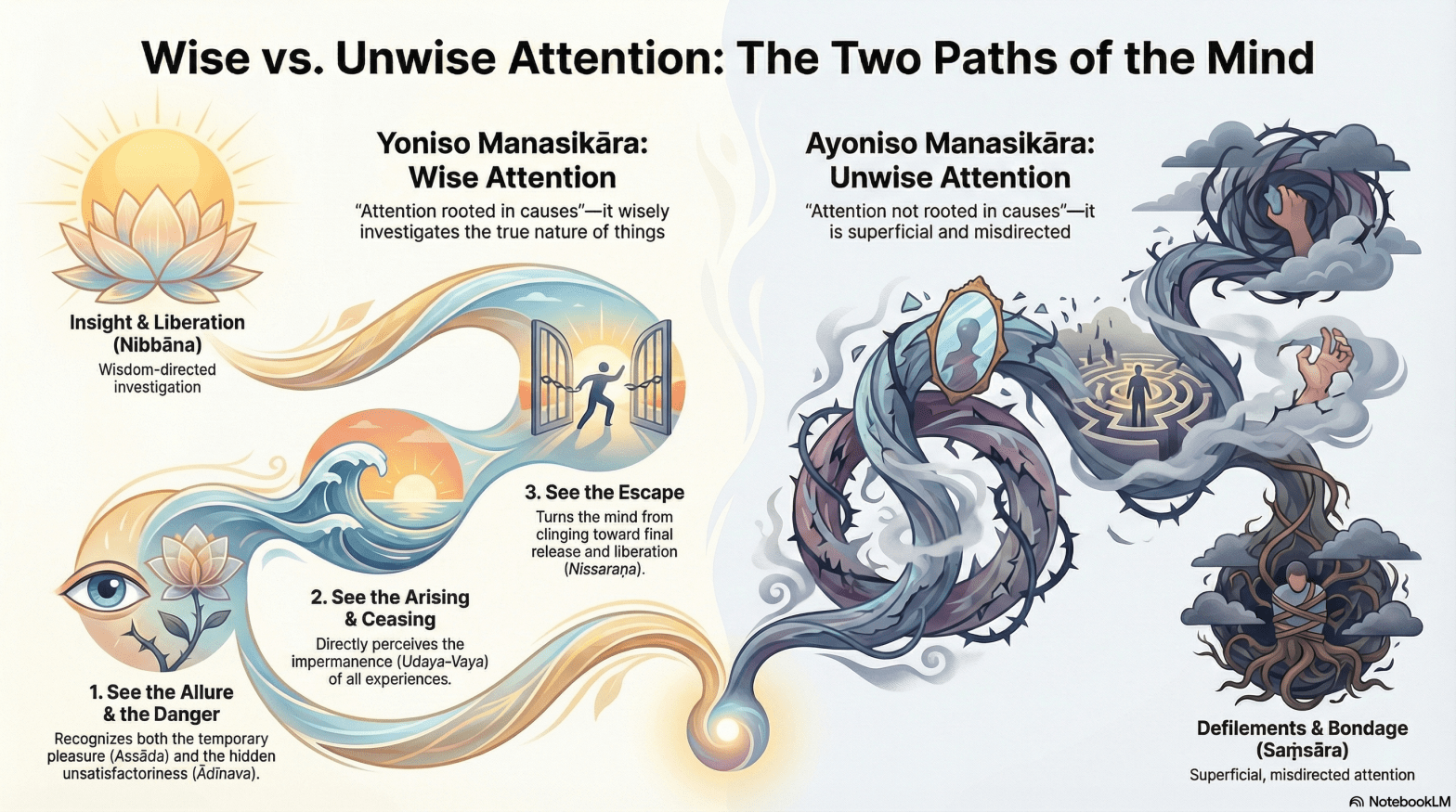
Let us get to understand on what is manasikara or making up the mind. We are going to start with the Etymology of it.
Before that, what do you think of the cover photo? Did you make up the mind on how it is?
Manasikāra (मनसिकार) 🔹 Etymology:
manasi = locative of mana = mind and kāra = doing, making, action
manasi + kāra → “bringing into the mind,” or “making up the mind”
Thus, manasikāra literally means: “The act of making up the mind” or “mental attention / advertence / bringing to mind.” This refers to the initial mental turning toward an object — the process of attending to, not yet evaluating or conceptualizing. It is pre-reflective in its basic form.
🔹 Canonical Role:
In the Paṭiccasamuppāda (Dependent Origination), manasikāra plays a decisive role in cognition.
“Phassapaccayā vedanā, vedanāpaccayā taṇhā” — but before phassa, there is manasikāra.
In the Abhidhammic (but early canonical) analysis, manasikāra is one of the 7 universal mental factors (sabbacittasādhāraṇa cetasika) — always present in any cognitive event. It’s what orients the mind toward the object.
Yoniso Manasikāra (योनिसो मनसिकार)
🔹 Etymology:
yoni = origin, womb, source, matrix, or cause/root. and so = suffix, making it an adjective (yoniso = according to the origin/source) and manasikāra = attention / mental turning / making up the mind
Thus, yoniso manasikāra = “attention that is rooted in causes,” or “thorough, wise, reasoned attention”
But literally: “Attention according to origin” – i.e., tracing things back to their root cause or nature
This aligns closely with paṭiccasamuppāda-vipassanā (insight into dependent arising), and hence, yoniso manasikāra becomes the cornerstone of right investigation (yoniso manasikāra = yoniso vīmaṁsā in some contexts).
🔹 Function in Sutta:
In MN 2 Sabbāsava Sutta, the Buddha says:
“Yonisomanasikāra-sampannassa asavā parikkhīyanti”
“For one endowed with yoniso manasikāra, the āsavas (taints) are destroyed” as it is a a direct antidote to defilement. Through it, the mind sees the arising and cessation, leading to nibbāna.
🔹 Examples in Sutta Use:
Contemplating the body as body → seeing it as not-self, impermanent, and dependently arisen
Asking questions such as:
“What is the cause of this?” ; “What is the origin of suffering?” ; “What is the escape from it?”
This kind of attention leads to wisdom (paññā) because it penetrates the Dhamma-nature of phenomena.
Ayoniso Manasikāra (अयोनिसो मनसिकार)
🔹 Etymology: a- = negation; yoniso = according to the source/cause; manasikāra = attention / making up the mind and so, ayoniso manasikāra = “non-causal attention” or “unwise, unthorough attention” Literally: “Attention not in accordance with origin” — i.e., superficial or misdirected attention
This type of attention is what gives rise to delusion, attachment, and aversion, because it treats things at face value or through wrong views, rather than tracing them to their underlying conditions.
🔹 Function in Sutta:
In the same MN 2 Sabbāsava Sutta, the Buddha warns:
“Ayoniso manasikāra-sampannassa asavā pavaḍḍhanti”
“For one endowed with unwise attention, the āsavas grow.”
Examples include: Attending to identity in the aggregates (“Is this self?”)
Asking metaphysical or speculative questions that lead to ditthi (views), rather than insight
Key Sutta Summary: MN 2 – Sabbāsava Sutta – This sutta contrasts yoniso and ayoniso manasikāra repeatedly: “An uninstructed worldling attends unwisely…thus ignorance and taints increase. But the instructed noble disciple attends wisely… thus the taints are abandoned.”
Relation to the Path
Yoniso manasikāra → leads to yonisomanasikārasampanno ariyasāvako → sammādiṭṭhi → Nibbāna
Ayoniso manasikāra → leads to micchādiṭṭhi, strengthens āsava, causes saṁsāra to perpetuate
In AN 1.16–1.20 and elsewhere, the Buddha says:
“All wholesome qualities are rooted in yoniso manasikāra. All unwholesome ones are rooted in ayoniso manasikāra.”
In Patisambhidāmagga Analysis (Ps I.46ff) – This text explains yoniso manasikāra as: paṭiccasamuppādanudassana — attention that sees conditional arising
Connected with sammādiṭṭhi (right view) It sees: Arising, Ceasing, Danger, Escape
Whereas ayoniso manasikāra: Clings to signs and misperceives which produces delusion
In summary
| Term | Literal Meaning | Function | Leads To |
|---|---|---|---|
| Manasikāra | Making up the mind | Initial attention to object | Neutral cognitive operation |
| Yoniso Manasikāra | Attention rooted in the source | Wisdom-directed investigation | Insight, Liberation (nibbāna) |
| Ayoniso Manasikāra | Attention not rooted in origin | Superficial, misdirected attention | Defilements, Samsaric bondage |
Let us now explore yoniso manasikāra in its most profound function — the penetrative attention that investigates phenomena in terms of:
udayabbaya / udaya-vaya (arising and cessation)
attha-gama (ending)
assāda (gratification / pleasure)
ādīnava (danger / disadvantage)
nissaraṇa (escape / release)
These five aspects form the essential framework of wisdom (paññā) in early Buddhism. The Buddha repeatedly emphasized that yoniso manasikāra is the mental operation that discerns these five aspects in any conditioned thing, especially in relation to the five aggregates, sense experience, and craving.
🔶 1. Udaya–Vaya (Udayabbaya) – Arising and Ceasing
➤ Meaning: Udaya = arising, coming into being
Vaya / vayo = fading, ceasing, dissolution
Together: The perception of both the arising and passing away of phenomena.
➤ Applied with Yoniso Manasikāra:
When the mind attends wisely (yoniso), it discerns: The arising of a sensation, perception, or thought
Its momentary nature and its cessation. This is most seen in meditative contexts such as:
“So satova assasati, satova passasati… pajānāti”
– He knows as it is: “This is long breathing…” (MN 118, Ānāpānasati Sutta)
And in Vipassanā: “Aniccaṁ, aniccaṁ” — The rising and passing of rūpa, vedanā, saññā, saṅkhāra, viññāṇa is observed directly.
This is yoniso manasikāra seeing the anicca-lakkhaṇa (impermanence) directly.
🔶 2. Atthagāma – Complete Ending
➤ Meaning: Attha = ending / setting ; gāma = going toward
This refers to the cessation or disappearance of what has arisen — not just its passing, but its non-return. In practice, yoniso manasikāra turns the mind not only toward impermanence, but also to nirōdha, the cessation of suffering:
“Yo imesu pañc’upādānakkhandhesu chandarāgavinayo… so dukkhanirodho.” (MN 28)
Seeing the end of dependent arising:
“Evam etassa kevalassa dukkhakkhandhassa nirodho hoti” (SN 12.1)
Yoniso manasikāra allows the mind to penetrate to the ending (attha) of conditioned phenomena.
🔶 3. Assāda – Gratification / Allure
➤ Meaning: Assāda = taste, satisfaction, pleasure, gratification which is the pleasant aspect of phenomena that gives rise to craving. In SN 22.26 (Assāda Sutta), the Buddha says:
“Yā tattha rāgasammissā somanassasaññā uppajjati, ayaṁ tattha assādo”
“That perception of pleasure mixed with lust — that is the gratification.”
Yoniso manasikāra examines: “What is the allure in this experience?” “What is the satisfaction that keeps the mind clinging to it?” This is critical — because most beings get stuck here, not moving further.
🔶 4. Ādīnava – Danger / Drawback
➤ Meaning: ādīnava = defect, harm, peril, danger This is the unsatisfactoriness or hidden trap in things that seem pleasurable. In the same SN 22.26: “Yattha ādīnavaṁ paññāya disvā… nibbindati, virajjati…” – “Having seen the danger, he becomes disenchanted, dispassionate…”
With yoniso manasikāra, one sees: The pain of change (vipariṇāma-dukkha) and the stress of maintaining pleasure The hidden cost: birth, aging, death This converts the mind’s delight to nibbidā — disenchantment.
🔶 5. Nissaraṇa – Escape / Exit / Release
➤ Meaning: nissaraṇa = going out, exit, escape This is renunciation, freedom, and non-clinging.
“Etam santaṁ, etam paṇītaṁ – yadidaṁ, sabbasaṅkhārasamatho, sabbūpadhipaṭinissaggo…” (MN 64)
This is the function of yoniso manasikāra at its highest — it turns the mind not toward the gratification, but toward release.
🔷 Summary Table
| Aspect | Literal Meaning | Insight through Yoniso Manasikāra | Result |
|---|---|---|---|
| Udaya–Vaya | Arising and ceasing | Perception of impermanence (anicca) | Disruption of delusion |
| Atthagāma | Final disappearance | Directing mind toward cessation (nirodha) | Turning toward nibbāna |
| Assāda | Gratification | Seeing the pleasure in phenomena | Awareness of craving’s root |
| Ādīnava | Danger | Seeing the unsatisfactoriness and trap | Disenchantment (nibbidā) |
| Nissaraṇa | Escape | Turning away from clinging and toward liberation | Dispassion → Nibbāna |
📜 Assāda Sutta (SN 22.26) – “Allure”
Setting: Near Sāvatthī. – Buddha’s Reflection:
“Monks, before my self-awakening, when I was still just an unawakened bodhisatta, the thought occurred to me: ‘What is the allure of form? What is its drawback? What is its escape?
What is the allure of feeling? What is its drawback? What is its escape? What is the allure of perception? What is its drawback? What is its escape? What is the allure of fabrications / preparations / choices / volutions? What is their drawback? What is their escape? What is the allure of consciousness? What is its drawback? What is its escape?’”
Buddha’s Insight: “Then the thought occurred to me: ‘Whatever pleasure and joy arises dependent on form: That is the allure of form. The fact that form is inconstant, stressful due to changing, subject to ceasation That is the drawback of form. The subduing of desire and passion, the abandoning of desire and passion for form: That is the escape from form.’” This analysis applies similarly to feeling, perception, preparations and consciousness.
🧠 Interpretation and Significance
The Assāda Sutta presents a framework for understanding the nature of the five aggregates through three lenses:
Assāda (Gratification): The immediate pleasure or satisfaction derived from engaging with the aggregates.
Ādīnava (Danger): The inherent unsatisfactoriness, impermanence, and potential for suffering within the aggregates.
Nissaraṇa (Escape): The liberation achieved by relinquishing attachment and desire for the aggregates. By contemplating these aspects, the Buddha realized that while the aggregates may offer temporary gratification, they are ultimately impermanent and a source of suffering. True liberation lies in understanding their nature and letting go of attachment.