During January 2013, the company I was working with had been taken over by a Venture Capitalist company and from their way of managing, I was not that keen to continue. One day while pondering over what I should be doing, I got an awakening moment with 4 C’s
1. Comparison
2. Compulsion
3. Competetion
4. Compromise
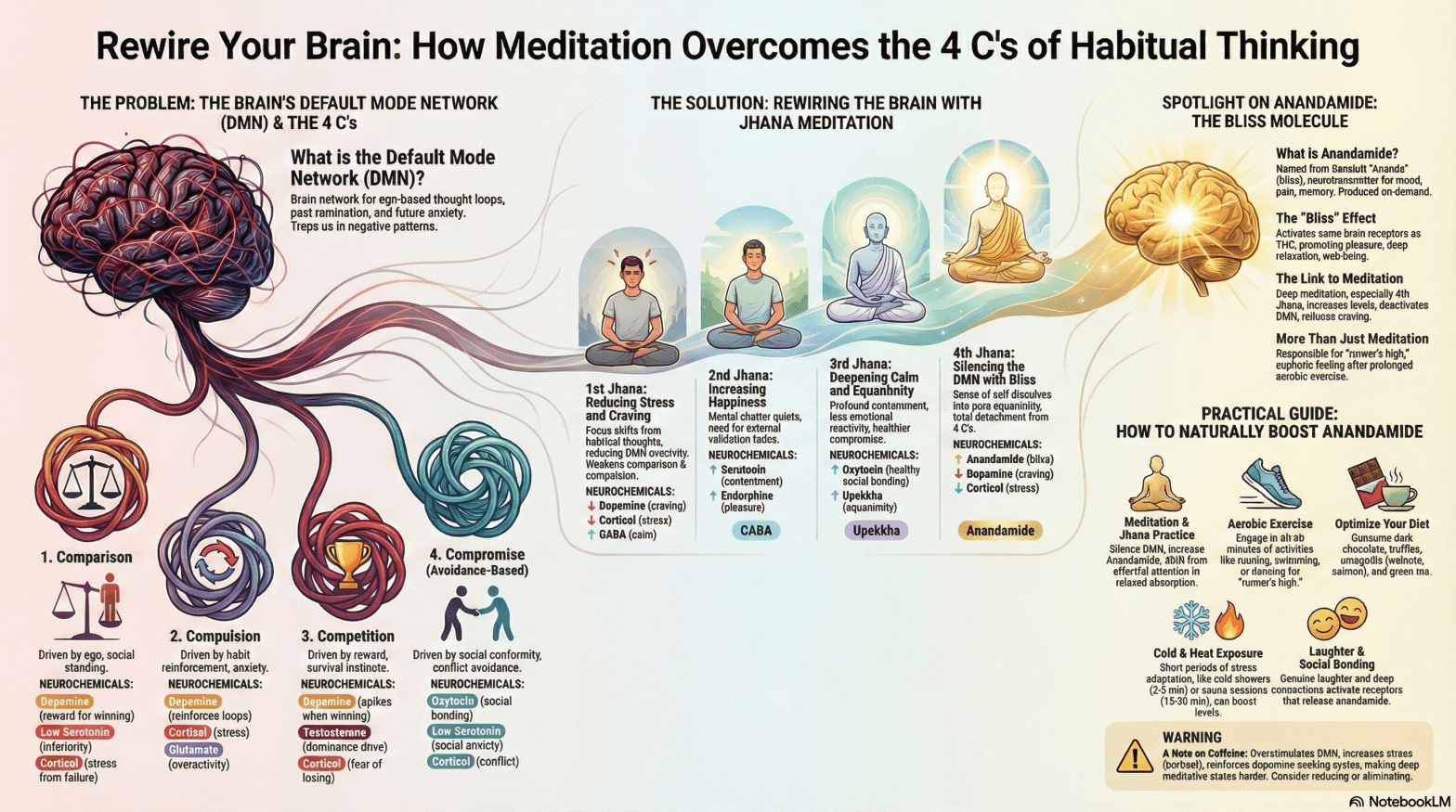
I felt the deep urge to drop all these four of them and this helped me to progress in my meditation. Recently, have been doing research on Neuro sciences and found that there is correlation between Default Mode Network (DMN) with these 4 C’s and would like to give a brief information on the same.
I. How the DMN Reinforces the 4 C’s Through Neurochemicals
The DMN’s activation is associated with habitual and ego-based thought loops. These loops are reinforced by dopamine, serotonin, cortisol, oxytocin, and endorphins in different ways.
Comparison (Driven by Ego & Social Hierarchy)
Brain regions involved: Medial prefrontal cortex (mPFC), posterior cingulate cortex (PCC), temporoparietal junction (TPJ)
Neurochemicals:
Dopamine (Reward Seeking) → When you compare yourself to someone and “win,” dopamine gives you a reward (reinforcing comparison).
Serotonin (Social Status Regulation) → Low serotonin can make a person feel inferior, increasing the tendency to compare.
Cortisol (Stress Hormone) → If comparison leads to perceived failure, stress increases.
🔹 DMN Effect: When the DMN is overactive, it ruminates on social standing, reinforcing comparison as a survival-based evaluation mechanism.
Compulsive Attitude (Driven by Habitual Reinforcement)
Brain regions involved: Anterior cingulate cortex (ACC), striatum, orbitofrontal cortex (OFC)
Neurochemicals:
Dopamine (Habit Formation) → Reinforces compulsions, especially in addiction-like behaviors.
Cortisol (Anxiety & Stress Response) → A compulsive attitude often emerges as a coping mechanism for stress.
Glutamate (Excitatory Neurotransmitter) → Overactivity in compulsive thought loops.
🔹 DMN Effect: The DMN fuels compulsive behaviors by continuously reactivating past patterns, making it harder to break free from habitual tendencies.
Competition (Driven by Reward & Survival Instinct)
Brain regions involved: mPFC, ACC, amygdala, striatum
Neurochemicals:
Dopamine (Achievement & Motivation) → Competition gives dopamine spikes when winning, reinforcing the behavior.
Testosterone (Dominance & Aggression) → Increases competitiveness, especially in status-driven contexts.
Cortisol (Stress in Losing Situations) → Fear of losing activates the stress response.
🔹 DMN Effect: The DMN fosters internal narratives about superiority/inferiority, which strengthens competition-driven mind loops.
Compromise (Driven by Social Conformity & Avoidance)
Brain regions involved: Anterior insula, mPFC, ACC
Neurochemicals:
Oxytocin (Social Bonding & Conformity) → Encourages compromise to maintain social harmony.
Serotonin (Happiness & Stability) → Low serotonin levels can push people into excessive compromise due to social anxiety.
Cortisol (Stress Response in Conflict Situations) → People may compromise to avoid conflict-related stress.
🔹 DMN Effect: When the DMN is overactive, it can lead to overcompromising as a way to avoid social rejection or maintain relationships.
II. How Jhanas Reduce the DMN Activity & Balance Neurochemicals
Through deep meditation states (Jhana), the DMN activity is downregulated, shifting the brain from habitual reactivity to conscious awareness.
1st Jhana: Dopamine Reset & Cortisol Reduction
Shifts focus away from habitual thought loops, reducing DMN overactivity.
Neurochemical effect:
↓ Dopamine (Craving-based loops reduce)
↓ Cortisol (Reduced stress from comparison & competition)
↑ GABA (Calming neurotransmitter, reducing compulsions)
🔹 Impact on 4 C’s: Less engagement in comparison and compulsive habits. Overcoming Initial Agitation (Vitakka & Vicara)
How it Helps: The 1st Jhana is characterized by directed thought (Vitakka) and evaluation (Vicara), along with joy (Pīti) and pleasure (Sukha). It stabilizes attention away from external distractions, weakening habitual reactions.
Application:
Comparison & Competition: These arise due to excessive engagement with self-identity. By continuously sustaining focus on a single object (e.g., breath), self-referential thinking starts to fade.
Compulsive Attitude: The act of staying with the breath counters compulsive mental habits by replacing them with deliberate focus.
Compromise (as avoidance): The joy (pīti) in this state helps shift the mind away from external conflict toward internal stability.
2nd Jhana: Serotonin & Endorphins Increase
As thinking quiets, serotonin (happiness) and endorphins (pleasure) increase.
Neurochemical effect:
↑ Serotonin (Reduces the need for competition & social comparison)
↑ Endorphins (Euphoria, reducing stress-driven compulsions)
🔹 Impact on 4 C’s: Less need to compare, more contentment.
Silencing Mental Chatter
How it Helps: Vitakka and Vicara fall away, leaving pure joy (pīti) and happiness (sukha). Mental chatter, which fuels habitual comparison and compulsions, dissolves.
Application:
Comparison & Competition: With the silencing of mental movement, the tendency to compare oneself with others naturally diminishes.
Compulsive Attitude: Joy replaces restlessness, making the mind content without external validation.
Compromise (as avoidance): As the mind enters a deeper state of unification, external negotiations lose their hold.
3rd Jhana: Oxytocin Regulation & Deep Calm
Profound contentment emerges.
Neurochemical effect:
↑ Oxytocin (Social attachment stabilizes, making compromise healthier)
↑ Upekkha (Equanimity reduces reward-seeking behavior)
🔹 Impact on 4 C’s: Competition weakens as dominance-seeking reduces.
Dissolving Emotional Reactivity
How it Helps: Pīti fades, leaving behind deep peace (sukha) and equanimity (upekkhā). Emotional attachment to compulsive thoughts weakens.
Application:
Comparison & Competition: Since these emotions are rooted in craving (tanhā), the diminishing of pīti reduces their pull.
Compulsive Attitude: Sukha’s stability brings ease, preventing mindless pursuits.
Compromise (as avoidance): Deep contentment removes the need for unnecessary negotiations.
Complete DMN Shutdown & Equanimity
The sense of self dissolves, leading to pure equanimity.
Neurochemical effect:
↑ Anandamide (Bliss & complete relaxation)
↓ Dopamine (Craving-based loops disappear completely)
↓ Cortisol (No stress, full detachment from habitual patterns)
🔹 Impact on 4 C’s: No mental engagement with comparison, compulsions, competition, or compromise.
4th Jhana: Pure Equanimity & Full Detachment
How it Helps: Even pleasure (sukha) disappears, leaving pure equanimity (upekkhā). The mind is now fully detached from habitual inclinations.
Application:
Comparison & Competition: Full detachment eliminates the sense of self-importance behind these tendencies.
Compulsive Attitude: No urge remains to act impulsively.
Compromise (as avoidance): True equanimity allows clear discernment rather than avoidance.
Anandamide: The Neurochemical of Bliss
Function: Anandamide plays a role in mood regulation, pain relief, memory, appetite, and neurogenesis.
Origin of Name: Derived from the Sanskrit word “Ananda”, meaning bliss or joy.
System: It interacts with the endocannabinoid system (ECS), particularly CB1 and CB2 receptors, much like THC (the active compound in cannabis).
Synthesis: Anandamide is produced on demand in the brain (not stored like other neurotransmitters).
Enzyme Breakdown: It is broken down by the enzyme fatty acid amide hydrolase (FAAH), which limits its effects.
Neurochemical Effects of Anandamide
Promotes Bliss & Well-being
Activates CB1 receptors in the brain, enhancing pleasure, relaxation, and reduced stress.
Reduces Anxiety & Depression
Modulates serotonin and dopamine levels.
Enhances Focus & Creativity
Improves cognitive flexibility and neurogenesis in the hippocampus.
Pain Relief & Anti-Inflammatory
Activates pain-reducing pathways in the central nervous system.
Exercise-Induced Euphoria (“Runner’s High”)
Anandamide, rather than just endorphins, contributes to the euphoric feeling after prolonged exercise.
Relation to Jhana & Meditation
Deep meditation has been found to increase anandamide levels, leading to a state of blissful absorption.
It deactivates the DMN, reducing habitual thought patterns.
4th Jhana-like states correlate with increased anandamide and reduced dopamine craving, leading to pure equanimity.
Summary of How Jhana Breaks DMN-Driven 4 C’s
| Jhana | DMN Effect | Neurochemical Effect | Impact on 4 C’s |
|---|---|---|---|
| 1st Jhana | Reduces ruminative thinking | ↓ Dopamine, ↓ Cortisol, ↑ GABA* | Weakens compulsive thought patterns |
| 2nd Jhana | Reduces mind-wandering | ↑ Serotonin, ↑ Endorphins | Reduces comparison & competition |
| 3rd Jhana | Enhances equanimity | ↑ Oxytocin, ↑ Upekkha | Less emotional reactivity, healthier compromise |
| 4th Jhana | Completely silences DMN | ↑ Anandamide, ↓ Cortisol, ↓ Dopamine | Total detachment from conditioned patterns |
GABA stands for gamma-aminobutyric acid. It is the brain’s main inhibitory neurotransmitter, meaning it reduces the likelihood that neurons will fire excessively. In simple words, it acts like a braking system in the nervous system.
When a neuron is too active, GABA can make the receiving neuron less excitable. It does this mainly by binding to GABA receptors, especially GABA-A and GABA-B receptors, which alter ion movement and make the neuron less likely to generate another signal.
So, where glutamate is the major excitatory neurotransmitter — like an accelerator — GABA is the major inhibitory one — like a brake. In fact, GABA is synthesized from glutamate. Healthy brain function depends on a balance between excitation and inhibition.
This is why many medicines for anxiety, insomnia, seizures, and muscle relaxation work partly by enhancing GABA-related activity, especially at GABA receptors.
But one important point: GABA is not simply a “peace chemical.” It is part of a larger regulatory system. Too little GABA activity may contribute to over-arousal, anxiety, insomnia, irritability, or seizures; too much inhibition can cause dullness, sedation, poor alertness, and slowed functioning.
Also, taking GABA supplements is not the same as increasing brain GABA in a precise way. Evidence is still limited on how much oral GABA meaningfully affects the brain, and more research is needed.
From a bhāvanā perspective, you can think of GABA as one biological mechanism that supports cooling, quieting, and reducing over-excitation in the nervous system. But Dhamma practice is not merely increasing GABA; it is the cultivation of sīla, indriyasaṁvara, sati-sampajañña, samādhi, and paññā, which gradually transforms the whole pattern of reactivity.
GABA is involved in regulating:
| Function | Role of GABA |
|---|---|
| Sleep | Helps reduce neural overactivity and supports sleep regulation |
| Anxiety / calmness | Helps quiet excessive nervous-system arousal |
| Seizure control | Prevents runaway electrical activity in the brain |
| Muscle tone | Helps regulate motor control |
| Attention and stability | Prevents the nervous system from becoming overstimulated |
How to Naturally Boost Anandamide & Bypass the Default Mode Network (DMN)
To bypass the DMN, we need to reduce its habitual activity and enhance states of presence, equanimity, and mental absorption. Anandamide, the “bliss molecule,” plays a crucial role in achieving this state by promoting joy, relaxation, and non-attachment. Below are strategies to increase Anandamide naturally and reduce DMN overactivity.
I. Natural Ways to Boost Anandamide
Meditation & Jhana Practice
✅ Effect: Increases Anandamide, reduces DMN, induces bliss states.
Deep meditation silences the DMN and increases Anandamide production.
Studies show that long-term meditators have higher endocannabinoid activity.
Jhana States (especially 2nd & 4th) create a self-sustaining bliss without external stimulation.
🔥 Best Approach:
1st Jhana: Focus on the breath to stabilize attention.
2nd Jhana: Shift from effortful focus to relaxed absorption (activates Anandamide).
4th Jhana: Deepest equanimity, correlating with Anandamide’s role in non-attachment.
Aerobic Exercise (“Runner’s High”)
✅ Effect: Triggers Anandamide release, reduces DMN-driven stress.
Endurance activities (running, cycling, swimming) stimulate Anandamide & Endorphins, causing a natural euphoric high.
Unlike Dopamine-driven rewards (which create cravings), Anandamide promotes a self-sufficient bliss.
🔥 Best Approach:
40–60 min of moderate aerobic exercise (Zone 2 training)
Activities like trail running, dancing, or swimming maximize flow states.
Fasting & Diet Optimization
✅ Effect: Fasting increases Anandamide and reduces overactive DMN.
Intermittent fasting (16:8 or longer) boosts Anandamide levels.
Fasting activates autophagy, which resets the brain’s neurochemical balance.
🔥 Best Foods for Anandamide Boosting:
Dark Chocolate 🍫 – Contains theobromine, which prevents Anandamide breakdown.
Truffles 🍄 – Have naturally occurring Anandamide.
Omega-3 Fatty Acids (walnuts, flaxseeds, salmon) – Improve endocannabinoid function.
Green Tea (EGCG) 🍵 – Prevents FAAH enzyme from breaking down Anandamide.
Cold Exposure & Sauna
✅ Effect: Stress adaptation (cold/hot exposure) raises Anandamide levels.
Cold Showers or Ice Baths ❄️ → Increase dopamine & Anandamide levels.
Sauna Therapy 🔥 → Heat stress boosts Anandamide and endorphins.
🔥 Best Approach:
Cold Shower → 2-5 min daily.
Sauna (Infrared or Traditional) → 15-30 min session.
Psychedelic States & Flow Activities
✅ Effect: Psychedelics (like psilocybin) & Flow States shut down DMN & increase Anandamide.
Psychedelics like Psilocybin, LSD, and DMT reduce DMN overactivity, similar to deep meditation.
Flow States (deep creative work, music, surfing, martial arts) naturally reduce DMN and enhance Anandamide.
🔥 Best Approach:
Engage in activities that require full absorption → playing an instrument, rock climbing, deep conversation.
Laughter & Social Bonding
✅ Effect: Anandamide increases during deep social bonding & laughter.
Laughing with friends activates CB1 receptors, boosting Anandamide.
Oxytocin & Anandamide work together in deep, authentic social connections.
🔥 Best Approach: Watch comedy, spend time with positive people, engage in playful activities.
Summary: Anandamide Boosting & DMN Suppression Techniques
| Method | Effect on Anandamide | Effect on DMN |
|---|---|---|
| Meditation & Jhana | 🚀 Increases Bliss, Reduces FAAH Breakdown | 🔥 Silences DMN |
| Exercise (Runner’s High) | 🚀 Increases Anandamide & Endorphins | 💤 Lowers DMN |
| Fasting & Dark Chocolate | 🚀 Boosts Anandamide | 💤 Resets Brain Patterns |
| Cold Exposure & Sauna | 🚀 Increases Anandamide & Dopamine | 💤 Resets Stress Response |
| Psychedelics & Flow States | 🚀 Anandamide Release & Ego Dissolution | 🔥 Strongest DMN Shutdown |
| Laughter & Social Bonding | 🚀 Anandamide + Oxytocin | 🔥 Reduces Negative Self-Talk |
🔹 Why Quit Tea & Coffee for DMN Suppression?
Caffeine Overstimulates the Prefrontal Cortex (PFC) & DMN
Caffeine increases dopamine and norepinephrine, making the mind more active rather than silent.
This strengthens self-referential thought loops instead of dissolving them.
Makes deep Jhana states harder to enter because focus remains effortful rather than absorbed.
Caffeine Keeps You in a Dopamine-Seeking Cycle
Caffeine spikes dopamine, reinforcing the craving-reward loop.
This contradicts Jhana absorption, which requires detachment from craving.
Bypassing the DMN means reducing habitual thought loops, including those reinforced by caffeine.
Increases Cortisol & Stress Response
Caffeine raises cortisol, which can keep the DMN active by promoting alertness.
Higher cortisol = more comparison, competition, compulsions, and anxiety.
Quitting caffeine lowers baseline stress and helps stabilize Anandamide & Serotonin.
Caffeine Blocks Adenosine (Deep Relaxation)
Adenosine is a neurotransmitter that builds deep relaxation and sleep pressure.
Caffeine blocks adenosine, keeping the mind engaged and active.
To reach 3rd & 4th Jhana, the mind must fully relax, so caffeine can make this harder.
🔹 When Can You Still Use Tea & Coffee?
If quitting completely feels extreme, here’s how you can use it strategically:
✅ Use Tea Instead of Coffee
Green tea has L-Theanine, which promotes calm focus without overstimulating.
Matcha tea has lower caffeine but still offers a slight mental boost.
Herbal teas like Tulsi, Chamomile, or Rooibos support relaxation & Anandamide production.
✅ Drink Caffeine in the Morning Only
Keep it before 10 AM to avoid affecting sleep, deep meditation, and Anandamide cycles.
✅ Microdose Caffeine (Low Doses Only)
If you must drink coffee, reduce intake to ½ cup instead of multiple cups per day.
✅ Use Caffeine for Flow States, Not Meditation
If you want to do deep work, creative activities, or physical training, caffeine can help.
But for Jhana meditation, fasting, and DMN suppression, avoid it.
🔹 Best Alternative Drinks for DMN Suppression
If you want to quit caffeine, here are the best replacements:
Herbal Nootropics (Boost Focus Without DMN Activation)
✅ Lion’s Mane Mushroom Tea → Boosts neurogenesis without overstimulating.
✅ Ashwagandha Tea or Capsules → Reduces cortisol, improves calm alertness.
Anandamide-Boosting Teas (Caffeine-Free)
✅ Tulsi (Holy Basil) Tea → Lowers cortisol, increases Anandamide.
✅ Chamomile Tea → Increases GABA (calm brainwaves).
✅ Valerian Root Tea → Deepens sleep & relaxation.
✅ Rooibos Tea → Reduces inflammation, good for fasting.
Fasting-Friendly Drinks (Non-Stimulant)
✅ Lemon Water → Detoxifies & hydrates.
✅ Salt & Electrolyte Water → Prevents energy crashes in fasting.
✅ Apple Cider Vinegar (ACV) in Water → Stabilizes blood sugar & mental clarity.