
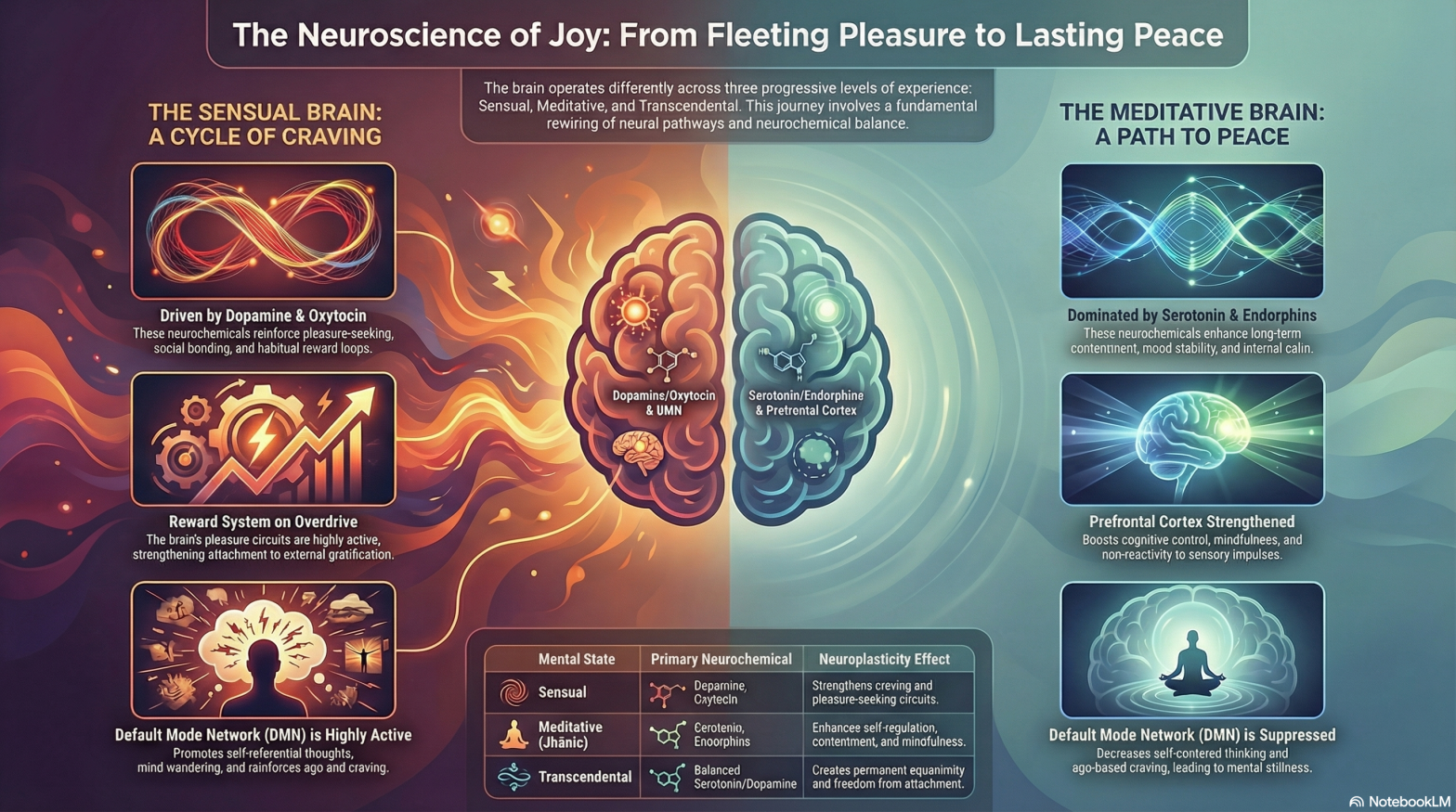
Let us now look into neuro transmitter and neural pathways that happens when one is moving from default mode network and its transformation into meditative states
Introduction: The Brain’s Transformation from Sensual to Meditative to Transcendental States
The Nirāmisasutta describes three progressive levels of mental experiences—Sensual (Sāmisa), Meditative (Jhānic/Nirāmisa), and Transcendental (Nirāmisatarā)—each influencing the brain, neurochemistry, and neural wiring differently.
Understanding how dopamine, serotonin, oxytocin, and endorphins function in these states can help explain why one feels attachment to sensual pleasures, how deep meditation rewires the brain, and how enlightenment results in a permanent shift in perception.
Comparison of Neurochemicals Across Sensual, Jhānic, and Transcendental States
| Mental State | Neurochemical Dominance | Neural Activity | Effect on Neuroplasticity |
|---|---|---|---|
| Sensual (Sāmisa Pīti, Sukha, Upekkhā, Vimokkha) | Dopamine, Oxytocin, Some Serotonin | Reward System (VTA-Nucleus Accumbens), Limbic System (Amygdala, Hypothalamus) | Strengthens habitual reward loops (craving cycles) |
| Jhānic (Nirāmisa Pīti, Sukha, Upekkhā, Vimokkha) | Serotonin, Endorphins, Some Dopamine | Prefrontal Cortex, Default Mode Network (DMN Suppression) | Increases neural stability and deep calm (meditative rewiring) |
| Beyond Jhāna (Nirāmisatarā Pīti, Sukha, Upekkhā, Vimokkha) | Balanced Serotonin, Dopamine Regulation, Endocannabinoid Activation | Frontal Cortex, Insula, Decreased Amygdala Reactivity | Rewires perception of self, dissolves ego, permanent mental equanimity |
Sensual Pleasure and Its Neural Effects (Sāmisa Pīti, Sukha, Upekkhā, Vimokkha)
(Sensory-Induced Joy, Happiness, Equanimity, and Temporary Liberation through Pleasures of Sight, Sound, Smell, Taste, and Touch)
Neurochemicals: Dopamine and Oxytocin Drive Sensory Joy and Attachment
Dopamine: Released in response to pleasurable stimuli (food, sex, music, touch, wealth), reinforcing habit loops and craving.
Oxytocin: Strengthens social bonding and emotional pleasure (romantic love, maternal attachment, group affiliation).
Serotonin (briefly elevated): Provides a momentary sense of well-being but drops when pleasure fades, leading to withdrawal or craving more stimulation.
Neural Networks and Plasticity in Sensual States
Sensory pleasures activate the mesolimbic dopamine system (Ventral Tegmental Area → Nucleus Accumbens → Prefrontal Cortex).
Amygdala engagement: Creates emotional imprinting, reinforcing pleasure-seeking habits.
High craving sensitivity: The brain strengthens reward-seeking pathways, increasing attachment to external gratification.
Over time, hedonic adaptation reduces the brain’s sensitivity, requiring stronger stimuli to achieve the same pleasure level (addiction cycle).
Jhānic Meditation and Its Effects on the Brain (Nirāmisa Pīti, Sukha, Upekkhā, Vimokkha)
(Joy, Happiness, Equanimity, and Liberation through Absorption States – Jhāna 1 to 4)
Neurochemicals: Serotonin and Endorphins Shift Focus from External to Internal Joy
Serotonin Dominance: Enhances long-term contentment and mood stability, reduces impulsivity and craving.
Endorphins Activation: Deep meditation increases natural opioids, inducing pleasurable calm and pain relief.
Reduced Dopamine Dependence: Joy now arises from internal stability rather than external stimulation.
Neural Networks and Plasticity in Jhāna
Prefrontal Cortex activation: Strengthens cognitive control, mindfulness, and non-reactivity to sensory impulses.
Default Mode Network (DMN) Suppression: Decreases self-referential thinking, reducing ego-based craving.
Increased Insula Activation: Enhances body awareness, emotional regulation, and deep relaxation.
Reduced Amygdala Reactivity: Lessens fear, anger, and emotional instability, leading to inner calm.
Diminished Striatum Influence: Weakens craving circuits that drive habitual sensual desire.
Through consistent practice, meditative states begin to rewire the brain away from short-term pleasure-seeking toward long-term stability and inner joy.
Transcendental Liberation and Its Impact on the Brain (Nirāmisatarā Pīti, Sukha, Upekkhā, Vimokkha)
(The Ultimate Joy, Happiness, Equanimity, and Liberation from Complete Cessation of Craving and Self-Identification – Arahantship)
Neurochemicals: Balanced Dopamine, Serotonin, and Endocannabinoids
Dopamine Regulation: No longer driven by craving, now released in measured balance, allowing joy without addiction.
Serotonin Optimization: Provides stable, lasting well-being without fluctuations.
Endocannabinoid Activation: Leads to effortless relaxation, body-mind synchronization, and deep peace.
Neural Networks and Plasticity in Full Liberation
Anterior Cingulate Cortex (ACC) Strengthening: Regulates attention, emotional balance, and cognitive flexibility.
Hyper-Connectivity Between Prefrontal Cortex and Insula: Leads to unshakable equanimity and effortless mindfulness.
Significant Amygdala Shrinkage: Eliminates fear, attachment, and aversion responses.
Decreased Activity in Medial Prefrontal Cortex (Self-Referencing Region): Weakens ego-centered processing, resulting in the experience of non-self (anattā).
Once this transformation occurs, the brain no longer seeks external sources of happiness or security, having found an unconditioned state of peace (Nibbāna).
Progressive Rewiring of the Brain in the Transition from Sensual to Transcendental
| Stage | Primary Neurochemical | Brain Area Activation | Neuroplasticity Effect |
|---|---|---|---|
| Sensual Joy/Happiness (Pīti, Sukha) | Dopamine, Oxytocin | Reward System (Nucleus Accumbens, Amygdala) | Strengthens craving and pleasure-seeking circuits |
| Jhānic Joy/Happiness (Pīti, Sukha) | Serotonin, Endorphins | Prefrontal Cortex, Insula, Default Mode Network Suppression | Enhances self-regulation, contentment, and mindfulness |
| Transcendental Joy/Happiness (Pīti, Sukha) | Balanced Dopamine, Serotonin, Endocannabinoids | Prefrontal Cortex-Insula Synchronization, Amygdala Shrinkage | Creates permanent equanimity and freedom from attachment |
This neuroscientific model of pīti, sukha, upekkhā, and vimokkha explains why sensual pleasures feel rewarding but unstable, why meditation produces deeper joy, and why enlightenment results in a fundamentally different brain state—one free from craving, suffering, and self-referential attachment.
Conclusion
Key Insights from Neuroscience & the Nirāmisasutta
The shift from sensual joy to transcendental liberation is not just philosophical—it is a physical rewiring of the brain.
Dopamine-driven pleasure loops keep people trapped in craving, while serotonin- and endorphin-driven states lead to inner stability.
Jhāna rewires the brain to function independently of external rewards, preparing for the final step—transcendental liberation.
Liberation (Arahantship) corresponds to a complete restructuring of neural networks, leading to an effortless, natural state of peace.
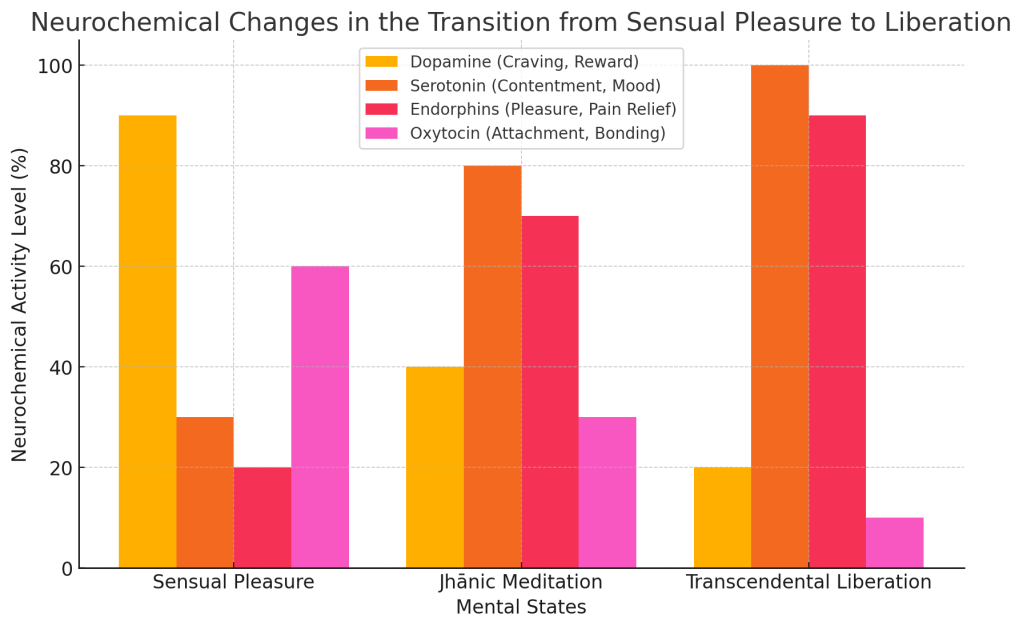
Here is a graphical representation of the neurochemical shifts as one transitions from sensual pleasure to transcendental liberation.
Oxytocin (Attachment, Social Bonding) is high in sensual pleasure (due to relationships and sensory experiences) but significantly decreases as attachment dissolves in enlightenment.
Dopamine (Craving, Reward System) decreases as one moves from sensual pleasures to meditation and finally stabilizes in transcendental liberation.
Serotonin (Contentment, Mood Stability) increases significantly in meditation and is fully optimized in the liberated mind.
Endorphins (Pleasure, Pain Relief) rise in deep meditation, contributing to a sense of well-being and detachment.
Deep Exploration of the Default Mode Network (DMN) and Its Preconditioning from Past Lives and Habits
We will now examine:
What is the Default Mode Network (DMN)?
How is the DMN wired by past habits and previous births?
How meditation and mindfulness alter the DMN, leading to liberation?
What is the Default Mode Network (DMN)?
The Default Mode Network (DMN) is a large-scale brain network primarily involved in self-referential thinking, mind-wandering, autobiographical memory, and internal dialogue.
It consists of three major brain regions:
Medial Prefrontal Cortex (mPFC) – Generates self-referential thoughts, personal identity, and ego-based processing.
Posterior Cingulate Cortex (PCC) & Precuneus – Involved in reflection, rumination, and emotional evaluation of memories.
Inferior Parietal Lobule (IPL) – Handles internal narratives, projections into the past and future, and attachment to identity.
Key Functions of the DMN:
Self-Identity Construction – Creates a continuous sense of ‘I’ and ‘mine’.
Autobiographical Memory Recall – Maintains habitual thought patterns based on past experiences.
Future Planning & Simulation – Projects past conditioning into predictions about the future.
Mind-Wandering & Daydreaming – Often responsible for distraction, craving, and repetitive thought loops.
How the DMN Reinforces Samsaric Patterns
In Buddhist terms, the DMN aligns with sakkāya-diṭṭhi (personality-view) and bhava-taṇhā (craving for existence).
It creates a persistent illusion of self and maintains habitual mental tendencies from past lives and karmic imprints.
Overactive DMN activity keeps beings bound to samsāra by reinforcing ego, attachment, and habitual thought patterns.
How the DMN is Wired by Past Habits and Previous Births
The DMN is deeply shaped by karmic tendencies (saṅkhāra) and past conditioning.
A. Habit Formation and Neuroplasticity
Every repeated thought, emotional reaction, and behavioral pattern strengthens neural pathways in the DMN.
This creates automatic mental loops, making certain reactions habitual (e.g., fear, anger, craving).
Past habits from previous lifetimes carry forward, influencing personality traits, preferences, and subconscious tendencies.
B. Scientific Explanation of Karmic Conditioning in the Brain
Neuroscience confirms that habitual thought patterns are encoded in synaptic connections.
The more a neural pathway is activated, the stronger it becomes (Hebbian Learning: “Neurons that fire together, wire together”).
Buddhist teachings describe this as bhavaṅga citta (latent mental continuum), where past karmic tendencies resurface in thought patterns.
C. DMN’s Role in Reincarnation and Memory Retention
During death, the DMN activity reduces as consciousness transitions, but karmic imprints (vāsanā) remain stored in the subconscious (bhavaṅga citta).
These imprints resurface in the next life, shaping the new personality, tendencies, and inclinations.
Individuals may have intuitive skills, fears, or attractions without apparent reasons—these are likely carryovers from previous lives.
D. Meditation and Past-Life Recall
Advanced meditation (Jhāna and Vipassanā) can weaken DMN activity, allowing access to latent memories from past lives.
Many Buddhist meditators report detailed past-life recollections when their sense of self weakens and subconscious imprints emerge.
This aligns with Buddhist texts (e.g., Buddha’s recollection of past lives during enlightenment).
How Meditation and Mindfulness Alter the DMN, Leading to Liberation
Neuroscientific studies show that meditative practices significantly reduce DMN activity, leading to:
Reduced Self-Referential Thinking (Anattā Realization)
Ego-centric thoughts diminish, aligning with the Buddhist insight of non-self (anattā).
The practitioner experiences a “selfless awareness”, where perception is no longer rooted in personal identity.
Less Craving and Attachment (Taṇhā Reduction)
The weakened DMN stops reinforcing craving patterns linked to dopamine-driven pleasures.
This aligns with Buddhist insight into reducing craving (taṇhā nirodha).
Enhanced Present-Moment Awareness
Meditation strengthens the Task-Positive Network (TPN), which helps in concentration, mindfulness, and present-moment focus.
This suppresses DMN activity, reducing rumination and suffering.
Unshakable Peace and Liberation
With continued practice, the DMN’s attachment to self dissolves, leading to unshakable equanimity (upekkhā).
The Arahant’s brain shows little to no DMN activation, meaning they no longer generate mental suffering.
Graphical Representation of DMN Reduction in Meditation –
Here is the graph that shows DMN activity decreases with meditation, leading to permanent rewiring of the brain in enlightenment.
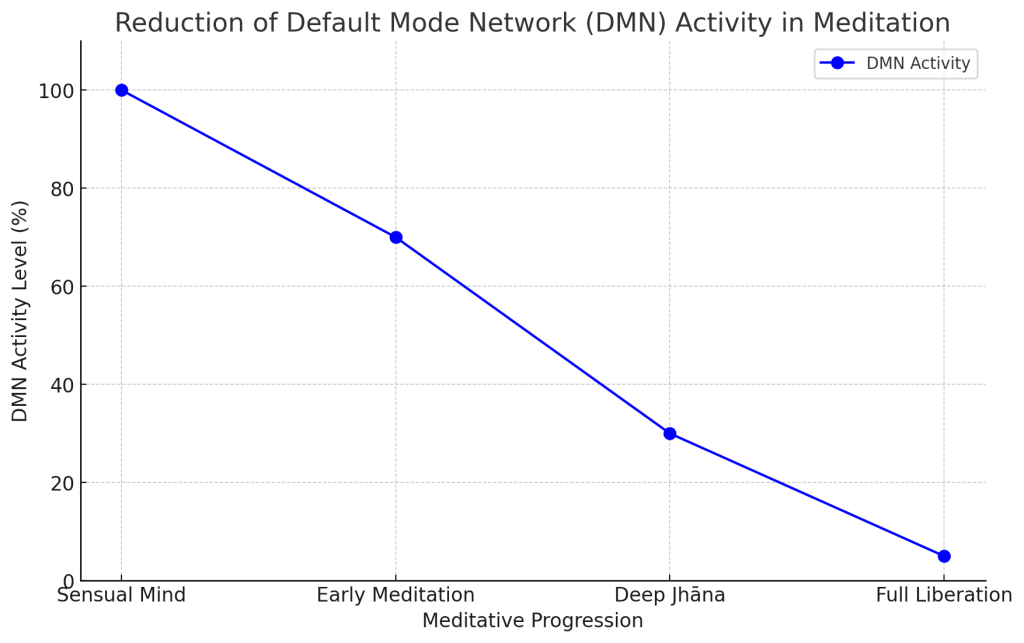
Sensual Mind (100%): The DMN is highly active, reinforcing self-referential thoughts, craving, and attachment to past and future.
Early Meditation (70%): Mindfulness begins reducing DMN overactivity, leading to more focus and present-moment awareness.
Deep Jhāna (30%): The DMN is largely suppressed, resulting in deep absorption and mental stillness.
Full Liberation (5%): An Arahant has near-zero DMN activation, meaning there is no self-referential thought, craving, or attachment.
Key Insights on the DMN’s Role in Samsara and Liberation
1. DMN Creates the Illusion of a Continuous ‘Self’
2. The DMN maintains personal identity, attachment, and the illusion of permanence.
3. This aligns with the Buddhist concept of Sakkāya-diṭṭhi (Personality-View).
4. DMN Drives Karmic Habit Loops
5. Past actions strengthen mental tendencies (saṅkhāra), which continue across lifetimes.
6. These tendencies resurface in self-referential thought patterns, shaping future experiences.
7. Meditation Rewires the Brain Toward Liberation
8. Mindfulness and deep concentration reduce DMN activity, breaking habitual ego-based thinking.
9. This rewiring allows the mind to experience pīti, sukha, upekkhā, and final vimokkho (liberation).
How Karmic Tendencies Shape the Default Mode Network (DMN) Across Lifetimes
In Buddhist and neuroscientific terms, our thought patterns, emotions, and behaviors are shaped by past karma and neural conditioning. The DMN serves as the primary system that maintains this continuity across lifetimes.
The Role of Karmic Imprints (Vāsanā) and the DMN
According to Buddhism, karmic tendencies (vāsanā) are habitual patterns formed through repeated experiences in past lives.
These tendencies reside in the subconscious mind (bhavaṅga citta) and influence the DMN’s structure in the next life.
Every lifetime, the DMN reconstructs the sense of self based on past karmic tendencies, which dictate thought patterns, cravings, fears, and desires.
Karmic habits create deep neural pathways, reinforcing the illusion of a stable, unchanging self (sakkāya-diṭṭhi).
2. How DMN and Karma Interact Across Lifetimes
| Karmic Habit (Saṅkhāra) | Brain’s Default Mode Network (DMN) Effect | Resulting Samsaric Effect |
|---|---|---|
| Craving (Taṇhā) | Strengthens reward circuits in the brain (dopamine-based pleasure loops) | Leads to addiction to pleasure and rebirth in desire realms |
| Aversion (Dosa) | Increases amygdala hyperactivity (fear, anger, stress response) | Leads to aggressive, fear-based rebirths (e.g., in lower realms) |
| Delusion (Moha) | Reinforces DMN self-referencing and ego-clinging | Causes ignorance, mental fog, and repeated rebirth |
| Meditative Absorption (Jhāna) | Weakens DMN’s hold over thought loops and self-referencing | Leads to rebirth in Brahma realms or eventual enlightenment |
| Wisdom (Paññā) | Restructures the brain toward present-moment awareness and equanimity | Weakens karmic bondage and leads to final liberation |
DMN as the Carrier of Karmic Habits Across Lifetimes
Neuroscientifically, every thought pattern we engage in strengthens specific neural pathways.
In death, the DMN slows down, but its karmic tendencies are stored in the subconscious mind (bhavaṅga citta).
In the next life, the DMN reforms based on previous karmic energy, continuing patterns of craving, anger, or delusion.
Example:
A person addicted to sensory pleasure (taṇhā) strengthens dopaminergic craving pathways in the brain.
If they die with strong sensual craving, their next life will reconstruct similar DMN wiring, reinforcing attachment to sense pleasures.
A meditator who develops wisdom (paññā) rewires the DMN to function with equanimity and reduced self-referential thinking.
If they die in this state, their next life will inherit a more detached and stable DMN, leading to higher rebirths or enlightenment.
How Different Buddhist Meditation Techniques Affect Neuroplasticity and the DMN
Vipassanā (Insight Meditation) and Its Effects
Vipassanā meditation focuses on observing sensations, thoughts, and impermanence (anicca), leading to: Decreased DMN activity – Weakens habitual self-referential thoughts.
Strengthened Anterior Cingulate Cortex (ACC) – Enhances mindfulness and emotional regulation.
Reduced Amygdala Reactivity – Lessens fear, anger, and suffering responses.
Jhāna (Absorption Meditation) and Its Effects
Deep concentration (samādhi) rewires the DMN by:
Suppressing default mode network activity – Inducing states of selflessness and deep peace.
Enhancing prefrontal cortex control – Strengthening cognitive clarity and stable attention.
Releasing natural endorphins and serotonin – Leading to sustained joy and happiness.
Mettā (Loving-Kindness Meditation) and Its Effects
Mettā meditation generates positive emotional states, affecting the DMN by:
Strengthening neural pathways of compassion – Reducing self-centered mental activity.
Increasing oxytocin and serotonin – Leading to increased happiness and reduced anxiety.
Shrinking the amygdala – Decreasing anger and fear responses.
Mindfulness of Death (Maraṇānussati) and Its Effects
Contemplating death rewires the DMN toward dispassion by:
Decreasing attachment to self – Weakening egoic identification with bodily existence.
Increasing equanimity circuits – Leading to greater acceptance of impermanence.
Reducing fear-based amygdala activation – Leading to fearlessness and peace.
Graphical Representation of How Different Meditations Alter the DMN – I will now create a comparative graph showing how different meditation techniques impact DMN activity, emotional reactivity, and craving tendencies over time.
Here is a graphical representation showing how different meditation techniques impact DMN activity, emotional reactivity, and craving tendencies:
Vipassanā (Insight Meditation) significantly reduces DMN activity and emotional reactivity, while also lowering craving tendencies.
Jhāna (Absorption Meditation) suppresses the DMN the most, leading to deep calm with minimal emotional fluctuation or craving.
Mettā (Loving-Kindness Meditation) increases positive emotions but maintains some DMN activity for emotional warmth and connection.
Maraṇānussati (Mindfulness of Death) reduces both craving and DMN activity, leading to deep equanimity and fearlessness.
Key Takeaways:
Deep Jhāna suppresses self-referential thinking most effectively.
Vipassanā gradually rewires the DMN, breaking karmic thought loops.
Mettā increases positive emotions but does not eliminate DMN activity.
Maraṇānussati weakens attachment to self and future craving.
How Past Karmic Tendencies Shape the Default Mode Network (DMN) in Early Childhood
(A Deep Neuroscientific and Buddhist Exploration)
The Default Mode Network (DMN), which governs self-referential thinking, emotional responses, and habitual thought patterns, is not built from scratch in each lifetime. Instead, it inherits karmic imprints (vāsanā) from previous births, shaping a child’s personality, inclinations, and subconscious reactions from infancy.
This section explores:
How Karmic Imprints (Vāsanā) Transfer Through Rebirth
DMN Formation in Early Childhood and Karmic Influences
Why Some Children Are Naturally Inclined Toward Sensuality, Meditation, or Wisdom
Scientific Correlations Between Past-Life Memory, DMN Development, and Neural Plasticity
Practical Applications for Understanding and Changing Karmic Conditioning
DMN Formation in Early Childhood and Karmic Influences
A. Early Brain Development and Karmic Rewiring
The DMN starts forming in infancy (0-2 years) and becomes fully active by age 5.
This period is critical, as the brain rapidly strengthens habitual thought patterns.
A child’s emotional regulation and self-identity are already influenced by past-life habits stored in the DMN.
How Karmic Imprints (Vāsanā) Transfer Through Rebirth
A. The Concept of Vāsanā (Latent Karmic Tendencies)
Vāsanā refers to deep-seated habits, tendencies, and inclinations carried over from previous lives.
These imprints are stored in the subconscious mind (bhavaṅga citta) and influence perceptions, reactions, and choices in the new birth.
B. How These Imprints Influence the DMN
At birth, the brain is not a blank slate—it is already wired with predispositions that arise from past karmic conditioning.
The DMN self-referential system builds on these latent impressions, shaping a child’s automatic emotional responses, preferences, and fears.
C. Connection Between Past Karmic Energy and Neural Pathways
Every habitual thought strengthens specific neural circuits.
If a person develops deep craving in one life, their DMN will be predisposed to craving in the next.
If someone cultivates meditative calm, their DMN will be less reactive and more equanimous in their next birth.
B. Key Signs of Karmic Influence in Early Personality
| Early Childhood Trait | Likely Karmic Cause | DMN Activation Pattern |
|---|---|---|
| Strong Sensual Craving | Past-life indulgence in sensual pleasures | Hyperactive reward system, high dopamine dependency |
| Frequent Anger and Aggression | Past-life dominance or unresolved conflicts | Overactive amygdala, strong self-referential DMN loops |
| Deep Fear Without Known Cause | Past-life trauma or violent death | Hyper-reactive limbic system, high stress-response DMN patterns |
| Natural Compassion and Kindness | Past-life cultivation of Mettā | High oxytocin, increased anterior cingulate cortex activation |
| Early Interest in Meditation and Inquiry | Past-life spiritual practice | Reduced DMN activity, high prefrontal cortex engagement |
These traits show how past-life conditioning carries over, shaping the initial DMN neural structure of a newborn.
Why Some Children Are Naturally Inclined Toward Sensuality, Meditation, or Wisdom
Not all children are born with the same psychological and emotional tendencies—some are naturally more impulsive, others introspective, some wise beyond their years.
A. Sensual Craving and DMN Hyperactivity
Cause: Past-life indulgence in sensory pleasures.
Effect: Child is highly dopamine-dependent, seeking pleasure from food, music, physical sensations.
Neural Pattern: Hyperactive mesolimbic reward system → DMN reinforces attachment to pleasure.
B. Anger, Hatred, and the Aggressive DMN
Cause: Past-life unresolved anger or power struggles.
Effect: Child reacts aggressively or with strong opinions and resistance.
Neural Pattern: Overactive amygdala → DMN reinforces ego-based identity and hostility.
C. Fear, Anxiety, and Trauma-Carrying DMN
Cause: Past-life experiences of sudden death, war, or suffering.
Effect: Child experiences irrational fears, nightmares, or anxiety without a clear cause.
Neural Pattern: Overactive stress-response circuits → DMN creates self-protection loops.
D. Deep Wisdom and Meditative Inclinations
Cause: Past-life dedication to meditation or philosophical inquiry.
Effect: Child naturally inclines toward contemplation, solitude, and deep thought.
Neural Pattern: Weaker DMN self-referential loops, strong prefrontal cortex activity → Mindfulness is naturally easier.
Scientific Correlations Between Past-Life Memory, DMN Development, and Neural Plasticity
Scientific research into past-life memory in young children suggests that the DMN preserves deep subconscious memories from previous lives.
A. Cases of Past-Life Memory and DMN Overlap
Studies by Dr. Ian Stevenson (University of Virginia) documented thousands of cases where children accurately recalled past lives.
In these cases, children showed persistent emotional and cognitive patterns matching their past lives, reinforcing the idea that DMN preserves long-term karmic habits.
B. The Role of Neural Plasticity in Karmic Carryover
Neural plasticity means the brain constantly rewires itself based on experiences.
This plasticity allows deep karmic imprints (vāsanā) to be carried forward through birth.
Strong past-life habits lead to strong neural pathways in the next life—just as repeated behaviors strengthen neural connections in one lifetime.
Practical Applications for Understanding and Changing Karmic Conditioning
A. Recognizing Karmic Tendencies in Oneself
Observe which thought patterns dominate your mind.
Identify whether you naturally incline toward sensuality, anger, fear, or meditation.
This will reveal how your DMN has been shaped by past karma.
B. Meditation as a Tool to Rewire the DMN
Vipassanā helps dissolve habitual DMN loops by breaking self-referential thinking.
Jhāna suppresses DMN hyperactivity, leading to deeper peace.
Mettā rewires anger-based DMN loops into compassion-based networks.
C. Breaking Negative Karmic Cycles
Conscious awareness of habitual reactions allows rewiring of DMN loops.
Cultivating mindful responses instead of impulsive reactions helps soften deep karmic patterns.
Every time a craving or aversion arises, choosing mindfulness over reactivity weakens its neural dominance.
Final Thoughts: Understanding the DMN is Key to Liberation
The DMN functions as a karmic continuity carrier, keeping beings bound to past habits.
By understanding how the DMN conditions thought patterns, one can actively rewire it through meditation and mindfulness.
The goal is to weaken the DMN’s self-referential hold, leading to final liberation (Nibbāna) where craving and attachment fully cease.
Final Thoughts: Understanding the DMN is Key to Liberation
The DMN functions as a karmic continuity carrier, keeping beings bound to past habits.
By understanding how the DMN conditions thought patterns, one can actively rewire it through meditation and mindfulness.
The goal is to weaken the DMN’s self-referential hold, leading to final liberation (Nibbāna) where craving and attachment fully cease.
Karmic Imprints & Default Mode Network (DMN) Influence Across Lifetimes
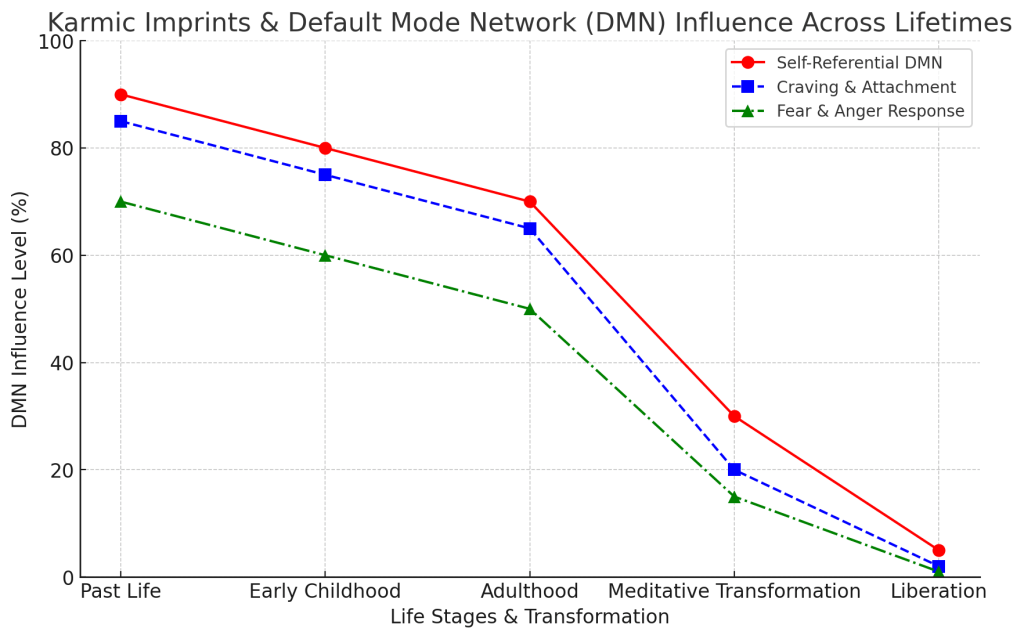
Here is a graphical model showing how karmic imprints shape the Default Mode Network (DMN) across lifetimes:
Key Observations:
Past Life Influence (90%)
The DMN retains past-life tendencies (craving, anger, self-identity patterns).
Self-referential DMN loops are strong, reinforcing ego and attachment.
Early Childhood (80%)
The DMN reconstructs personality based on previous karmic conditioning.
Craving, attachment, and emotional reactivity are still dominant.
Fear-based imprints (e.g., past-life trauma) may still be actively influencing the subconscious.
Adulthood (70%)
DMN patterns continue shaping habitual behaviors.
Sensual craving, ego-based self-referencing, and emotional reactivity remain strong unless challenged.
Some individuals develop awareness and seek transformation.
Meditative Transformation (30%)
Mindfulness and deep concentration (Jhāna/Vipassanā) weaken DMN’s self-referential control.
Craving and emotional responses drop significantly.
The brain starts rewiring itself toward equanimity and detachment.
Liberation (5%)
The DMN is no longer dominant, meaning no more self-referential attachment.
Craving and fear responses are fully dissolved.
The Arahant’s brain operates in a fundamentally different state, free from conditioned thought loops.
Final Summary: Breaking the Karmic DMN Cycle
Final liberation (Nibbāna) occurs when the DMN no longer generates self-based thought loops, dissolving suffering at its root.
Karmic habits (vāsanā) from past lives shape the Default Mode Network in new lifetimes.
Early childhood tendencies (craving, aversion, fear) arise from past-life conditioning stored in the DMN.
Without mindfulness, the DMN maintains samsaric patterns, reinforcing ego, attachment, and suffering.
Meditation (especially Jhāna and Vipassanā) actively reduces DMN self-referential activity, weakening karmic loops.
Let us now go over the psychedelic drugs and jhānas which have impact over DMN
The DMN, Psychedelics, and Meditation: A Common Pathway
A. The Default Mode Network (DMN) and the Ego
The DMN is responsible for self-referential thinking, rumination, and the sense of a continuous self (ego).
It acts as the brain’s control center for identity, time perception, and habitual thought patterns.
A hyperactive DMN reinforces self-attachment, cravings, suffering, and repetitive mental loops.
B. Psychedelics and DMN Suppression
Psychedelics like psilocybin (magic mushrooms), LSD, and DMT significantly reduce DMN activity.
This loosens ego-boundaries, allowing experiences of oneness, timelessness, and expanded awareness.
Users often report a loss of self (anattā-like experience), a deep connection to everything, and profound joy.
Neuroscientific studies confirm that psychedelic-induced DMN suppression mimics deep meditative states.
C. Meditation as a Natural Psychedelic
Advanced meditation (especially deep Jhāna and Vipassanā) also suppresses the DMN.
Meditators experience:
Ego dissolution (self-identity weakens, leading to vastness or non-self).
Timeless awareness (the sense of past and future fades).
Profound bliss (jhānic joy), often beyond any sensory pleasure.
Oneness or emptiness experiences similar to psychedelic trips.
Scientific Evidence: How Meditation and Psychedelics Alter the Brain
A. Brain Imaging Studies: Meditation vs. Psychedelics
Studies using fMRI and EEG scans show that both:
1. Meditation and psychedelics cause reduced connectivity in the DMN.
2. The prefrontal cortex (higher cognitive control) also quiets, leading to a raw, unfiltered perception of reality.
3. The thalamus (sensory gatekeeper) shifts activity, altering how one perceives self and the world.
4. Johns Hopkins University studies on psilocybin reveal that high-dose experiences produce brain activity patterns almost identical to deep meditation.
Key Neurochemical Changes in Both Psychedelics and Meditation
| Process | Psychedelics | Meditation |
|---|---|---|
| DMN Suppression | Yes | Yes |
| Ego Dissolution | Yes | Yes |
| Serotonin Activation | Yes (5-HT2A receptor stimulation) | Yes (natural serotonin increase) |
| Increased Neural Plasticity | Yes (synaptogenesis, neurogenesis) | Yes (long-term rewiring of thought patterns) |
| Heightened Sensory Awareness | Yes | Yes |
| Profound Bliss | Yes | Yes (especially in Jhāna states) |
| Reduced Fear Response (Amygdala Activity) | Yes | Yes |
Meditation’s Long-Term Effects: The “Permanent Trip”
While psychedelics induce temporary states, meditation creates lasting neurological changes.
Long-term meditators permanently weaken DMN dominance, leading to:
A natural state of contentment, reduced self-focus, and deep peace.
No need for external substances to achieve profound bliss.
Jhanic absorption states that are often described as “more powerful than any drug.”
Can Psychedelics Be a Gateway to Meditation?
Some Buddhist teachers (like Ajahn Brahm, Shinzen Young) acknowledge that psychedelics can temporarily show people what is possible through meditation.
Many who have profound trips later seek meditation to reach these states naturally.
However, true insight requires cultivation of wisdom (paññā), not just peak experiences.
Psychedelics vs. Meditation in Buddhist Perspective
A. Why Psychedelics Are Considered Inferior to Meditation
Buddhism acknowledges altered states, but warns against external reliance.
Psychedelics can induce mystical experiences, but:
They are temporary—they do not guarantee permanent wisdom.
They do not fully eliminate craving and ignorance.
They lack control and repeatability (a meditator can enter deep states at will).
They may lead to attachment to the experience rather than insight.
B. Meditation Produces Stable and Controllable States
In deep Jhāna, meditators experience indescribable bliss, vastness, and non-duality, but with full awareness.
Unlike psychedelics, there is no loss of cognitive function—only deepened clarity.
Advanced meditators can enter states deeper than any psychedelic trip at will.
The Key Difference:
| Aspect | Psychedelics | Meditation |
|---|---|---|
| Control Over Experience | No | Yes |
| Repeatability | No | Yes |
| Stability of Insight | Temporary | Permanent |
| Mindfulness During Experience | Reduced | Fully Awake |
| Effect on Long-Term Suffering | Temporary Relief | Full Liberation Possible |
Brain Changes Induced by Psychedelics vs. Jhāna States
Both psychedelic substances and deep meditation (Jhāna) lead to profound changes in the brain, particularly by suppressing the Default Mode Network (DMN) and altering perception, self-awareness, and neural connectivity.
In this exploration, we will analyze brain regions, neurochemicals, and long-term plasticity changes caused by:
Psychedelic-Induced States (Psilocybin, LSD, DMT, etc.)
Jhānic States (Deep Samādhi and Absorption States in Meditation)
Key Brain Regions Affected by Psychedelics and Jhāna
| Brain Region | Effect of Psychedelics | Effect of Jhāna Meditation |
|---|---|---|
| Default Mode Network (DMN) | Strong suppression, leading to ego dissolution and altered self-perception. | Gradual suppression, leading to self-transcendence and deep awareness. |
| Prefrontal Cortex (PFC) | Reduced control over experience (disinhibition). | Strengthened executive function and concentration. |
| Thalamus (Sensory Gatekeeper) | More sensory input allowed, causing hallucinations and altered perception. | Sensory filtering enhanced, leading to inner absorption. |
| Amygdala (Fear/Emotion Center) | Reduced fear response, emotional openness. | Deep tranquility, elimination of fear over time. |
| Hippocampus (Memory Formation) | Enhanced autobiographical memory recall, revisiting subconscious. | Diminished memory involvement, focus on present-moment absorption. |
| Neuroplasticity (New Neural Pathways) | Short-term enhancement in plasticity, helping in behavioral change. | Long-term rewiring of thought patterns, reducing suffering permanently. |
Key Difference: Jhāna not only dissolves ego but also restructures the brain into a stable, blissful, and awakened state.
Psychedelics “dissolve” ego boundaries but do not create deep stability.
Neurochemical Differences in Psychedelic vs. Jhānic States
| Neurochemical | Psychedelic Effect | Jhānic Meditation Effect |
|---|---|---|
| Serotonin (5-HT2A Activation) | Overstimulation leading to altered perception, unity experiences. | Steady increase, leading to deep happiness and equanimity. |
| Dopamine (Pleasure & Motivation) | Increased temporarily, causing euphoria. | Naturally regulated, producing lasting inner contentment. |
| Endorphins (Natural Opioids) | Mild release contributing to relaxation. | Strong release, leading to profound pain relief and bliss. |
| Glutamate (Neurotransmitter for Excitation) | Increased connectivity, creating novel insights. | Reduced overactivity, leading to deep stillness. |
| Cortisol (Stress Hormone) | Decreased during the trip but may increase afterward (integration stress). | Consistently lowered over time, leading to permanent relaxation. |
Key Difference:
Psychedelics cause intense spikes in serotonin and glutamate, leading to unpredictable insights.
Jhāna produces gradual, long-lasting serotonin stabilization, leading to profound contentment.
Long-Term Brain Changes in Psychedelic vs. Jhānic Practitioners
| Long-Term Effect | Psychedelic States | Jhāna Meditation |
|---|---|---|
| Neuroplasticity & Cognitive Flexibility | Increased during the experience, potential for long-term rewiring. | Deep, stable rewiring over years, leading to emotional regulation. |
| Ego Dissolution & Self-Identity Change | Temporary (during the trip), self may re-integrate afterward. | Gradual and lasting, leading to fundamental identity shifts. |
| Anxiety & Depression Reduction | Can help with PTSD, addiction, and mental health disorders. | Long-term mental stability and emotional control. |
| Conscious Control Over State | No control over hallucinations or experience. | Full control over entry and exit from Jhānic states. |
| Stability of Insight | Temporary insights; requires integration work. | Stable wisdom that is reinforced by continuous meditation. |
Key Takeaways:
Psychedelics open the mind but lack control and integration, often requiring guidance.
Jhāna meditation systematically rewires the brain into a permanently blissful and equanimous state.
Why Jhāna Meditation is Superior for Long-Term Transformation
Jhāna States Are Repeatable and Controllable
A skilled meditator can enter Jhāna at will, unlike a psychedelic trip which is unpredictable
No External Substances Required
Psychedelics need external ingestion, while Jhāna is a natural internal process
Jhāna Produces a Deeper Bliss Than Any Psychedelic Experience
Experienced meditators (e.g., Ajahn Brahm) report Jhānic bliss surpassing any worldly pleasure.
No Risk of Side Effects or Mental Disruption
Psychedelics can cause bad trips, anxiety, or emotional disturbances.
Jhāna produces only increasing peace and clarity.
Graphical Comparison: Psychedelics vs. Jhāna Brain Changes
Let us generate a graph comparing brain activity in Psychedelic states vs. Jhāna states, highlighting DMN suppression, serotonin levels, emotional stability, and long-term rewiring effects.
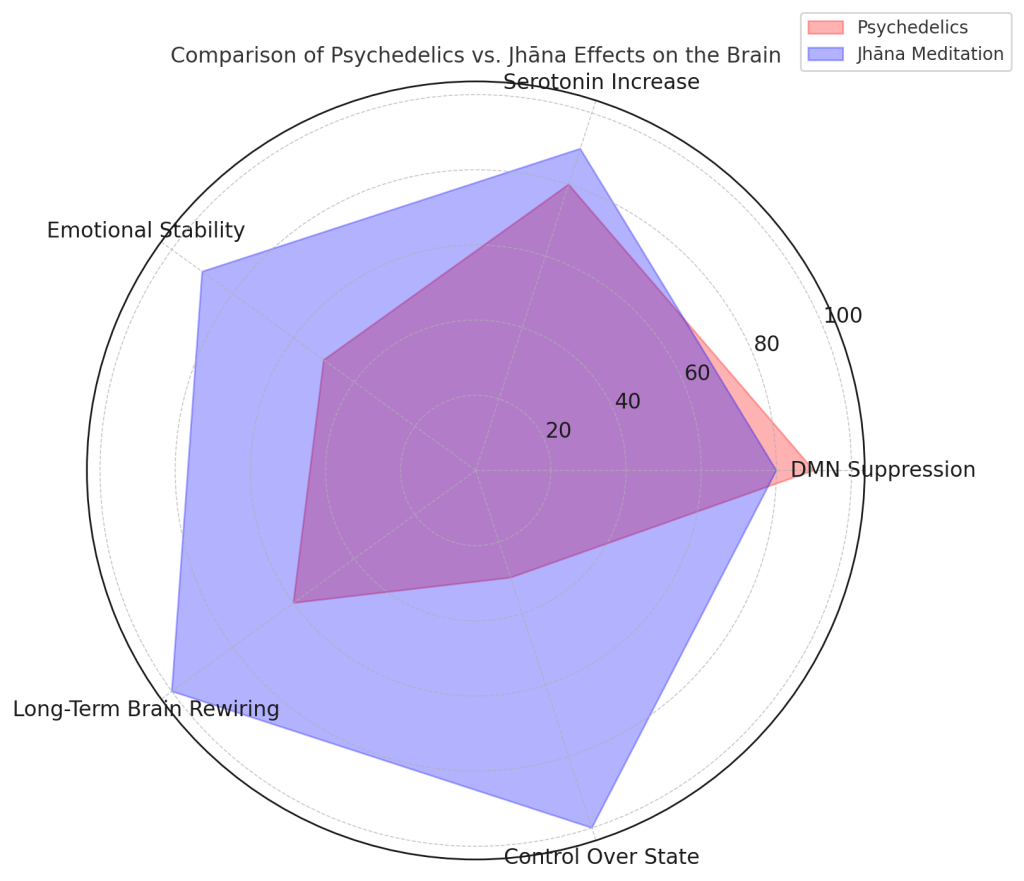
Key Insights from the Chart:
DMN Suppression:
Psychedelics (90%) cause strong temporary suppression leading to ego dissolution.
Jhāna (80%) also weakens the DMN but does so gradually and sustainably.
Serotonin Increase:
Psychedelics (80%) create a serotonin surge, leading to euphoria but often followed by a return to baseline.
Jhāna (90%) stabilizes serotonin long-term, resulting in sustained contentment.
Emotional Stability:
Psychedelics (50%) may cause emotional breakthroughs but can also be unpredictable.
Jhāna (90%) leads to unshakable inner peace and emotional resilience.
Long-Term Brain Rewiring:
Psychedelics (60%) show temporary increases in neuroplasticity, requiring integration to make lasting changes.
Jhāna (100%) permanently rewires the brain toward equanimity, bliss, and detachment from suffering.
Control Over the State:
Psychedelics (30%) are unpredictable—you cannot choose the experience’s direction.
Jhāna (100%) offers full control, allowing meditators to enter and exit at will.
Conclusion: Jhāna is a Superior Path to Deep, Stable Bliss
Psychedelics can open doors but are unpredictable and temporary.
Jhāna naturally induces ego dissolution, bliss, and insight with full awareness and long-term stability.
For true liberation (Nibbāna), meditation is the path—not external substances.
Comparing Jhāna, Psychedelics, and Other Altered States (Mantra Recitation, Hypnosis, Deep Prayer, and Flow States)
Different altered states of consciousness have unique effects on the brain, Default Mode Network (DMN), neurochemistry, and self-perception. Let’s compare:
Jhāna (Deep Meditative Absorption)
Psychedelics (Psilocybin, LSD, DMT, etc.)
Mantra Recitation (Chanting and Repetition)
Hypnosis (Trance-Induced States)
Deep Prayer (Christian, Sufi, and Bhakti Traditions)
Flow States (Peak Performance and Creative Absorption)
Key Brain Changes Across These Altered States
| State | DMN Suppression | Serotonin/Dopamine Change | Self-Perception Change | Emotional Stability | Repeatability |
|---|---|---|---|---|---|
| Jhāna (Deep Meditation) | High | Long-term serotonin stabilization | Ego dissolution | Extreme inner peace | Fully controllable |
| Psychedelics (DMT, LSD, Psilocybin) | Extreme | Serotonin spike, glutamate increase | Ego dissolution | Unstable, varies | Unpredictable |
| Mantra Recitation | Moderate | Dopamine and serotonin boost | Self-expansion, calmness | Moderate stability | Easily repeatable |
| Hypnosis (Trance States) | Low | Variable | Identity softening | Temporary relaxation | Requires guidance |
| Deep Prayer (Mystical and Devotional) | Moderate | Serotonin, oxytocin increase | Ego surrender | Deep peace, devotion | Repeatable, but dependent on faith |
| Flow States (Creative Absorption, Sports, Music, Work) | Low to moderate | Dopamine surge | Self-forgetfulness | Emotional elevation | Happens in peak performance moments |
How These States Affect the Brain
| Brain Region | Jhāna | Psychedelics | Mantra Recitation | Hypnosis | Deep Prayer | Flow States |
|---|---|---|---|---|---|---|
| Default Mode Network (DMN) | Strong suppression | Extreme suppression | Mild suppression | Mild suppression | Partial suppression | Moderate suppression |
| Prefrontal Cortex (Control & Awareness) | Strengthened | Weakened | Strengthened | Altered | Strengthened | Active |
| Amygdala (Fear Response) | Reduced | Reduced (but may cause anxiety) | Reduced | Neutral | Reduced | Low |
| Hippocampus (Memory & Narrative Self) | Reduced involvement | Memory distortions possible | Strengthened | Variable | Strengthened | Active |
| Thalamus (Sensory Processing) | Reduced external input | Sensory flooding | Normalized | Normal | Normal | Heightened sensory absorption |
| Neuroplasticity (Brain Rewiring) | High | High (temporary) | Moderate | Low | Moderate | High |
How Do These States Change Self-Perception?
| State | How the ‘Self’ is Experienced | Effect on the Sense of Identity |
|---|---|---|
| Jhāna | Self dissolves into infinite stillness, awareness remains. | Ego is dissolved but clarity is high. |
| Psychedelics | Self dissolves into unity with the cosmos. | Ego dissolves temporarily, may return. |
| Mantra Recitation | Self expands with rhythmic focus. | Creates a strong spiritual self-identity. |
| Hypnosis | Self softens, becomes suggestible. | Temporary identity shifts possible. |
| Deep Prayer | Self surrenders to divine presence. | Ego softens, replaced by devotion. |
| Flow State | Self merges into action. | Identity dissolves into the activity. |
Comparing the Depth and Sustainability of Bliss
| State | How Deep is the Bliss? | Is it Sustainable? |
|---|---|---|
| Jhāna | Extreme, beyond any sensory pleasure. | Yes, can be trained and repeated. |
| Psychedelics | Intense, may cause euphoria or fear. | No, temporary experience. |
| Mantra Recitation | Mild-to-strong, deep absorption possible. | Moderate, dependent on practice. |
| Hypnosis | Mild, trance-like relaxation. | Temporary, depends on suggestibility. |
| Deep Prayer | Deep emotional and devotional bliss. | Moderate, depends on faith. |
| Flow State | High engagement and pleasure. | Happens unpredictably. |
The Key Superiority of Jhāna Over Other States
Unlike psychedelics, Jhāna is fully under control and can be repeated.
Unlike hypnosis, Jhāna creates lasting changes in awareness.
Unlike mantra recitation and deep prayer, Jhāna is purely experiential, not belief-dependent.
Unlike flow states, Jhāna can be sustained indefinitely.
In Short:
Jhāna rewires the brain permanently, creating extreme bliss and stability.
Psychedelics provide a temporary window into altered perception but do not rewire habits deeply.
Mantra recitation, hypnosis, and prayer offer emotional stability but not deep absorption.
Flow states happen in peak performance but cannot be sustained.
Comparing Buddha’s Jhāna and Babaji’s Kriya Yoga: Neuroscientific and Spiritual Perspectives
Both Buddha’s Jhāna (Absorption Meditation) and Kriya Yoga (as taught by Mahavatar Babaji and Paramahansa Yogananda) claim to offer deep states of inner transformation, bliss, and liberation.
However, when analyzed through neuroscientific and spiritual frameworks, Buddha’s Jhāna is far superior for achieving both permanent neurological rewiring and complete spiritual awakening (Nibbāna).
This comparison explores:
Neuroscientific Impact of Jhāna vs. Kriya Yoga
Differences in Spiritual Goal and Depth of Awakening
Impact on Default Mode Network (DMN), Neuroplasticity, and Ego Dissolution
Why Buddha’s Jhāna Leads to Permanent Liberation (Nibbāna), While Kriya Yoga Remains Limited
Core Differences Between Jhāna and Kriya Yoga
| Aspect | Buddha’s Jhāna (Absorption Meditation) | Kriya Yoga (Babaji, Yogananda Tradition) |
|---|---|---|
| Primary Focus | Pure concentration (samādhi), leading to wisdom (paññā). | Breath and energy control (pranayama), activating subtle energy. |
| Method | Deep, effortless absorption in objectless awareness. | Rhythmic breathwork to activate pranic energy channels. |
| Neural Impact | Suppresses DMN, strengthens prefrontal cortex, rewires brain permanently. | Activates autonomic nervous system, strengthens energy circulation, but does not suppress DMN fully. |
| Ego Dissolution | Complete (non-dual experience, beyond identity). | Partial (higher states of awareness, but identity remains). |
| Long-Term Stability | Fully self-sustaining bliss, independent of effort. | Requires continued practice to maintain elevated states. |
| Ultimate Goal | Nibbāna (final liberation from rebirth and suffering). | Higher spiritual states but does not fully eliminate rebirth. |
Key Difference:
Jhāna leads to absolute liberation (Nibbāna), while Kriya Yoga results in prolonged bliss but remains within conditioned existence.
Buddha’s Jhāna rewires the brain permanently, while Kriya Yoga relies on temporary energy activation.
Neuroscientific Impact: Jhāna vs. Kriya Yoga
| Brain Region | Effect of Jhāna | Effect of Kriya Yoga |
|---|---|---|
| Default Mode Network (DMN) | Completely suppressed, leading to ego dissolution. | Partially suppressed, leading to heightened awareness but identity remains. |
| Prefrontal Cortex (Executive Function) | Hyperactive in deep Jhāna, leading to unshakable concentration. | Engaged but fluctuates, as focus shifts between breath and energy. |
| Limbic System (Emotional Regulation) | No reactivity—perfect equanimity. | Emotional bliss activated but not neutralized. |
| Hippocampus (Memory & Identity Processing) | Minimal involvement—experience of “self” fades. | Active, as one maintains awareness of body-breath connection. |
| Thalamus (Sensory Gatekeeper) | Reduced external sensory processing. | Enhanced energy perception but sensory experience still present. |
Neural Superiority of Jhāna
Jhāna rewires the brain into a state of permanent contentment—no external input required.
Kriya Yoga boosts energy temporarily, but requires continued practice to sustain bliss.
DMN suppression in Jhāna is total, while in Kriya Yoga, the sense of identity remains active.
Key Difference:
Buddha’s method leads to an effortless, self-sustaining peace.
Kriya Yoga is effort-dependent and tied to physiological control.
Ego Dissolution: Jhāna vs. Kriya Yoga
| State of Self-Identity | Jhāna (Buddha) | Kriya Yoga (Babaji, Yogananda) |
|---|---|---|
| Sense of ‘I’ | Dissolves completely (anattā, non-self). | Expanded, but still present. |
| Awareness of Body | Body awareness disappears in deep Jhāna. | Breath and pranic energy remain central. |
| Depth of Bliss | Beyond bliss into complete peace. | Euphoric bliss, but still within body awareness. |
Why Jhāna is Superior for Ego Dissolution
In deep Jhāna, the sense of ‘I’ disappears—there is pure, objectless awareness.
In Kriya Yoga, the sense of self expands but remains tied to the body-energy connection.
Jhāna leads to complete detachment from identity, while Kriya Yoga reinforces higher identity states.
Key Difference:
Jhāna leads to full enlightenment (Arahantship), Kriya Yoga leads to “divine experiences” but not liberation.
Ultimate Goal: Why Jhāna Leads to Permanent Liberation
| Path | Final Result | Why It’s Superior |
|---|---|---|
| Jhāna → Nibbāna | Permanent liberation (end of rebirth and suffering). | No craving, no self, no attachment—pure peace. |
| Kriya Yoga → Higher Realms | Rebirth in higher worlds (devas, cosmic consciousness). | Still within samsāra, requires return to practice. |
Why Jhāna is the Supreme Path
Buddha’s Jhāna completely transcends birth, death, and suffering.
Kriya Yoga can elevate consciousness, but does not permanently free one from existence.
The Buddha rejected mere bliss states—he sought and achieved the ultimate cessation of suffering.
Key Difference: Kriya Yoga enhances existence, Jhāna ends it completely.
Why Buddha’s Path is the Most Powerful: Neuroscientific and Spiritual Perspective
| Factor | Why Buddha’s Jhāna is Superior |
|---|---|
| Permanence of Bliss | Jhāna bliss is self-sustaining, Kriya Yoga requires continued practice. |
| Ego Dissolution | Jhāna leads to full ego extinction, Kriya Yoga keeps a subtle sense of self. |
| DMN Suppression | Jhāna completely suppresses the DMN, leading to true non-duality. |
| Neuroplasticity | Jhāna rewires the brain into permanent equanimity. |
| Liberation | Jhāna leads to Nibbāna, Kriya Yoga leads to higher rebirth. |
Final Conclusion
Buddha’s Jhāna is the most direct, repeatable, and effective method for total liberation.
Kriya Yoga offers extraordinary bliss and elevated consciousness but remains within conditioned existence.
From both neuroscience and spiritual analysis, Buddha’s Jhāna is the ultimate method for enlightenment.
Core Differences: SOHAM/HAMSA Kriya Yoga vs. Buddha’s Jhāna
| Aspect | SOHAM/HAMSA Kriya Yoga | Buddha’s Jhāna (Absorption Meditation) |
|---|---|---|
| Primary Focus | Synchronizing breath with mantra (“So” inhale, “Ham” exhale) to feel unity with the Divine. | Completely stilling the mind into deep absorption beyond thoughts and breath. |
| Method | Breath-focused, often visualizing prana movement. | No breath control—awareness becomes still, detached from bodily processes. |
| Neural Impact | Activates autonomic nervous system, increases energy flow. | Suppresses Default Mode Network (DMN), leading to ego dissolution. |
| Ego Dissolution | Expands ego into cosmic identity (“I am That” realization). | Completely dissolves ego into emptiness and non-self (anattā). |
| Bliss Experience | Strong bliss from pranic energy activation. | Beyond bliss into absolute peace (passaddhi). |
| Dependence on Breath | Yes, requires continuous breath awareness. | No, in deep Jhāna, breath stops automatically. |
| Long-Term Stability | Must be maintained with regular breath synchronization. | Self-sustaining, effortless peace. |
| Final Goal | Expansion into cosmic awareness and higher consciousness. | Complete cessation of suffering (Nibbāna). |
Neuroscientific Impact: SOHAM vs. Buddha’s Jhāna
| Brain Region | Effect of SOHAM Kriya Yoga | Effect of Jhāna Meditation |
|---|---|---|
| Default Mode Network (DMN) | Partially suppressed—ego expands but remains. | Fully suppressed—ego disappears entirely. |
| Prefrontal Cortex (Executive Function) | Active—awareness of breath and mantra remains. | Fully absorbed, total detachment from body-mind. |
| Amygdala (Fear/Emotion Center) | Calms the nervous system but does not eliminate attachment. | Completely neutralizes emotional reactivity. |
| Hippocampus (Memory & Identity Processing) | Maintains personal and cosmic identity. | Identity disappears—experience of pure awareness. |
| Neuroplasticity (Long-Term Brain Changes) | Strengthens habitual focus on mantra and breath. | Rewires the brain for effortless equanimity. |
Spiritual and Liberation Differences
| Path | Final Result | Why It’s Different |
|---|---|---|
| SOHAM (Kriya Yoga) | Expanded cosmic self, realization of divine identity. | Still within conditioned existence (samsāra). |
| Jhāna (Buddha) | Full cessation of “I”—awakening into emptiness. | Final liberation, no rebirth (Nibbāna). |
Why Jhāna is the Supreme Path to Liberation
Buddha rejected “union with the divine” because it keeps one in samsāra.
Jhāna goes beyond bliss to permanent freedom from suffering.
In SOHAM, one remains “one with the universe”—but this is still a conditioned state.
Only Jhāna completely ends rebirth and all conditions.
Key Difference: SOHAM leads to divine bliss, but Jhāna leads to liberation from all existence.
Why Buddha’s Jhāna is the Ultimate Practice
| Factor | Why Buddha’s Jhāna is Superior |
|---|---|
| Permanence of Bliss | Jhāna bliss is self-sustaining, independent of breath or mantra. |
| Ego Dissolution | Jhāna leads to full extinction of identity (anattā), while SOHAM keeps a cosmic identity. |
| DMN Suppression | Jhāna completely eliminates DMN activity, leading to true non-duality. |
| Neuroplasticity | Jhāna rewires the brain permanently for equanimity and wisdom. |
| Liberation | Jhāna leads to Nibbāna, the highest possible realization. |