
Understanding HRV (Heart Rate Variability)
🔹 HRV is the variation in time between heartbeats—it reflects the dynamic balance between the sympathetic (fight/flight) and parasympathetic (rest/digest) nervous systems.
🔹 Higher HRV indicates greater adaptability, relaxation, and a well-regulated autonomic nervous system.
🔹 Lower HRV is linked to stress, anxiety, and cardiovascular risks.
🌿 Slow breathing is one of the most effective ways to increase HRV naturally.
The Science of HRV and Slow Breathing
A) HRV and Respiratory Sinus Arrhythmia (RSA)
🔹 HRV is directly influenced by breathing patterns.
🔹 During inhalation, the heart rate increases (sympathetic activation).
🔹 During exhalation, the heart rate decreases (parasympathetic activation).
🔹 This natural oscillation is called Respiratory Sinus Arrhythmia (RSA).
🌿 The slower and deeper the breath, the stronger this oscillation, leading to increased HRV.
B) The “Coherence Breathing” Effect (HRV Optimization)
🔹 Studies show that breathing at 5-6 breaths per minute optimizes HRV, known as coherence breathing.
🔹 However, at 1 breath per minute, the effect becomes even more pronounced, leading to:
✅ Maximum parasympathetic activation (deep relaxation, vagus nerve dominance).
✅ A highly synchronized heart and breath rhythm (coherent HRV waves).
✅ Extended exhalation pauses, increasing relaxation response.
HRV Benefits of 1 Breath Per Minute
A) Deep Autonomic Nervous System Regulation
✔ Activates the vagus nerve → promoting deep relaxation and stress reduction.
✔ Balances the heart and lungs → creating a steady, synchronized HRV rhythm.
✔ Reduces sympathetic overdrive → minimizing anxiety, fear, and hyper-reactivity.
B) Increased Baroreflex Sensitivity (Blood Pressure Regulation)
✔ Baroreceptors (blood pressure sensors) adapt to slow breathing, stabilizing cardiovascular function.
✔ Prevents blood pressure spikes → keeping circulation steady.
✔ Enhances oxygenation efficiency → supporting deep meditative states.
C) Strengthened HRV Patterns for Emotional Stability
✔ High HRV correlates with greater emotional resilience and reduced stress reactivity.
✔ Ultra-slow breathing strengthens HRV coherence, allowing the nervous system to remain stable even in stressful situations.
🌿 At 1 breath per minute, HRV becomes highly structured, leading to profound calmness and stability.
HRV, Jhāna, or Meditation
How does this apply to deep meditation and Jhāna practice?
A) Breath & HRV in Deep Concentration
✔ When breath slows to 1/min, HRV becomes maximally coherent.
✔ The heart, breath, and nervous system synchronize, reducing mental agitation.
✔ Since HRV affects emotional stability, deep calmness arises naturally.
B) Natural Transition to Deep Absorption (Jhāna)
✔ With high HRV coherence, mental distractions decrease.
✔ Since breathing is ultra-efficient, bodily perception fades, allowing Jhāna absorption.
✔ The nervous system reaches its deepest parasympathetic state → effortless, sustained stillness.
🌿 This is why breathing slows naturally in deep Jhāna—it aligns the nervous system for pure stillness.
Practical Steps to Use 1 Breath Per Minute for HRV & Meditation
If you want to train HRV while preparing for Jhāna, follow this sequence:
A) Step-by-Step HRV Training (Pre-Jhāna)
1️⃣ Sit comfortably with an upright spine.
2️⃣ Begin diaphragmatic breathing (deep, slow, and effortless).
3️⃣ Extend the exhalation slightly longer than inhalation.
4️⃣ Slow down the breath to 4-5 breaths per minute first.
5️⃣ Progressively extend each cycle until you reach 1 breath per minute.
6️⃣ Focus on the pause after exhale—let stillness take over naturally.
B) Entering Jhāna from HRV Coherence
✔ Once breathing stabilizes at 1/min, shift attention from breath to pure stillness.
✔ Allow the breath to fade into deep silence—effortlessly.
✔ If HRV is fully coherent, body perception disappears, and Jhāna emerges naturally.
🌿 At this stage, the heart, breath, and mind are in perfect sync, leading to effortless absorption.
Understanding HRV Numbers : HRV varies by age, fitness, and stress levels, but here’s a general interpretation:
| HRV (ms) | General Meaning |
|---|---|
| 80+ ms | Excellent nervous system balance, deep relaxation, high adaptability. |
| 50-80 ms | Strong HRV, good recovery, well-balanced stress response. |
| 30-50 ms | Normal, but potential room for improvement. |
| Below 30 ms | Possible chronic stress, fatigue, or autonomic imbalance. |
HRV During Sitting Meditation
✔ If HRV Increases After Meditation:
Your practice is successfully activating the parasympathetic system.
A steady HRV increase shows deeper relaxation (good for Jhāna preparation).
✔ If HRV Remains the Same or Drops After Meditation:
Your nervous system may not be fully letting go into deep absorption.
Consider longer exhalation breathing (e.g., inhale 4 sec, exhale 8 sec) to increase vagal response.
HRV During Walking or Movement
✔ If HRV Rises During Walking:
This is a good sign of resilience & adaptability as indicated in AN5.29_Cankamasutta
Suggests that light movement helps regulate your nervous system.
✔ If HRV Drops During Walking:
This may indicate mild autonomic dysregulation or hidden stress.
Try mindful walking or nasal breathing while moving to stabilize HRV.
How to Improve HRV Using Meditation & Breathwork
If you want higher HRV for deep meditation and Jhāna entry, try these:
A) HRV-Boosting Breathwork Before Meditation
6-4-10 Breathing: Inhale 6 sec → Hold 4 sec → Exhale 10 sec.
Coherence Breathing (6 BPM): Slow breaths at 6 breaths per minute maximize HRV.
Ultra-Slow Breathing (1 BPM): Extending exhalations trains deep nervous system stability.
B) Measuring HRV Before & After Meditation
Check HRV before & after your session in Apple Health.
If HRV rises after meditation → You are moving into deeper states.
If HRV stays the same → Adjust breath focus & relaxation methods.
🗓️ 7-Day HRV Training Plan
📌 Day 1: Establish Baseline HRV
🔹 Morning:
✔ Open Apple Health → Heart Rate Variability → Check HRV (Morning Reading).
✔ Do 6-4-10 Breathing (Inhale 6 sec, Hold 4 sec, Exhale 10 sec) for 5 minutes.
✔ Re-check HRV after breathwork → Expect a slight increase.
🔹 Midday:
✔ Mindful walking for 10 minutes, breathing naturally.
✔ Check HRV during walking—should remain stable or rise.
🔹 Evening:
✔ HRV-Boosting Breathwork Before Sleep:
Inhale 4 sec, Hold 6 sec, Exhale 8 sec (Activates deep vagal relaxation).
✔ HRV Sleep Measurement: Observe how HRV trends overnight.
📌 Day 2-3: Coherence Breathing & HRV Meditation
🔹 Morning:
✔ HRV Morning Check → Compare with Day 1.
✔ Coherence Breathing (6 breaths per minute) for 10 minutes.
🔹 Midday:
✔ Walking Meditation with Breath Awareness (Nasal Breathing, No Distractions).
✔ Observe HRV during walking in Apple Health.
🔹 Evening:
✔ HRV-Tracking Meditation (20 Minutes):
1️⃣ Check HRV before meditation.
2️⃣ Sit in stillness, focus on breath & relaxation response.
3️⃣ Check HRV after meditation—it should rise significantly.
🌿 Key Insight: If HRV doesn’t increase, your breath rate might still be too fast. Adjust exhalation to be longer.
📌 Day 4-5: Training for Ultra-Slow Breathing (1 Breath Per Minute)
🔹 Morning:
✔ HRV Check → Goal: See if morning HRV is naturally improving.
✔ Slow Breath Training (1 Breath Per Minute):
Inhale for 10 sec, Hold for 10 sec, Exhale for 40 sec.
Repeat for 5-10 minutes.
🔹 Midday:
✔ Use HRV Monitor During Work Tasks → Observe stress triggers.
✔ Adjust breathing pattern if HRV drops due to stress.
🔹 Evening:
✔ HRV-Tracking Deep Meditation (Jhāna Entry Prep):
Slow breathing into full stillness.
Observe when HRV peaks → That’s the ideal breath rate for you.
Goal: HRV should increase naturally before entering deep stillness.
🌿 Insight: If breath disappears in meditation, HRV will stabilize at a high level.
📌 Day 6-7: Sustained High HRV & Refining Stillness
🔹 Morning:
✔ HRV Check → Compare with Day 1.
✔ Test if you can wake up with high HRV without breath training.
🔹 Midday:
✔ Spontaneous HRV Optimization → Whenever you feel tension, observe HRV & adjust breath.
🔹 Evening:
✔ Measure HRV before & after deep absorption meditation.
✔ Goal: HRV should remain high post-meditation.
🌿 Key Realization: High HRV = Mind is deeply calm before Jhāna.
📊 Understanding HRV in Each Jhāna State
HRV Changes as You Move Through the Jhānas
| Jhāna Level | HRV Pattern | Nervous System State | Breathing & Heart Rate Behavior |
|---|---|---|---|
| First Jhāna | High HRV (Fluctuations) | Parasympathetic Dominance | Breath slows but is still noticeable |
| Second Jhāna | HRV Stabilizes (Less Variability) | Deep Parasympathetic Relaxation | Breath becomes very light |
| Third Jhāna | HRV Becomes Rhythmic | Near-perfect balance | Breath is extremely subtle |
| Fourth Jhāna | HRV Almost Flatlined | Full Nervous System Equanimity | Breath stops being perceived |
🌿 By tracking HRV, we can determine when the body and mind are ready to enter deeper Jhāna states.
📌 Phase 1: Pre-Jhāna HRV Preparation (Building the Foundation)
✅ Goal: Bring HRV into a high-coherence state (50+ ms) before entering Jhāna.
✅ How? Use coherence breathing and HRV tracking before meditation.
🔹 HRV Breathing Exercise (5-10 min) ✔ Inhale 6 sec, Hold 4 sec, Exhale 10 sec (Long exhale increases HRV).
✔ Maintain 6 breaths per minute (BPM) for 5 minutes before meditation.
✔ Check Apple Watch HRV before and after—it should increase.
🌿 Once HRV is stable and high, begin Jhāna absorption.
📌 Phase 2: Entering First Jhāna (Pīti-Sukha Activation)
✅ Goal: Shift from “normal relaxation” to deep joyful absorption (pīti).
✅ HRV Pattern: High variability at first, then stabilizing.
🔹 How to Induce First Jhāna Using HRV
1️⃣ Start with slow breathing (6 BPM) until HRV rises.
2️⃣ Shift focus from breath to the joyful energy (pīti) that arises.
3️⃣ If HRV drops suddenly, you are forcing too much—relax.
4️⃣ If pīti becomes overwhelming, extend exhalation to calm the energy.
🌿 HRV Signature of First Jhāna: High HRV with subtle fluctuations.
📌 Phase 3: Entering Second Jhāna (Pīti Fades, Deep Relaxation)
✅ Goal: Move from “excited joy” (pīti) to stable inner happiness (sukha).
✅ HRV Pattern: HRV fluctuations decrease, becoming smoother.
🔹 How to Induce Second Jhāna Using HRV
1️⃣ Allow excitement (pīti) to naturally fade—don’t hold onto it.
2️⃣ Shift focus to stable happiness (sukha) and deep relaxation.
3️⃣ HRV should stabilize into a rhythmic, steady pattern.
4️⃣ The breath naturally slows further—do not force it.
🌿 HRV Signature of Second Jhāna: Smooth, steady HRV with reduced fluctuations.
📌 Phase 4: Entering Third Jhāna (Upekkhā Begins, Breath Almost Gone)
✅ Goal: Transition from subtle happiness to equanimity (upekkhā).
✅ HRV Pattern: HRV becomes very stable and rhythmic.
🔹 How to Induce Third Jhāna Using HRV
1️⃣ Shift attention away from pleasant sensations toward neutrality.
2️⃣ Allow HRV to stabilize at a constant, rhythmic pattern.
3️⃣ Breath becomes barely perceptible—almost gone.
4️⃣ If breath is still noticeable, extend the natural pause between exhales.
🌿 HRV Signature of Third Jhāna: Highly rhythmic, stable pattern with almost no fluctuations.
📌 Phase 5: Entering Fourth Jhāna (Perfect Equanimity, No Breath Perception)
✅ Goal: Attain full absorption, where breath & effort disappear.
✅ HRV Pattern: HRV becomes almost flatlined (perfect stillness).
🔹 How to Induce Fourth Jhāna Using HRV
1️⃣ Completely let go of all effort—just rest in stillness.
2️⃣ HRV should now be in a perfectly coherent, steady pattern.
3️⃣ Breath ceases to be felt—there’s only awareness.
4️⃣ If HRV remains slightly irregular, relax further—allow all sense of self to dissolve.
🌿 HRV Signature of Fourth Jhāna: Flat, ultra-stable HRV—indicating deep nervous system balance.
📌 How to Use HRV Tracking for Jhāna Training
If you are using an Apple Watch or HRV monitoring app, follow this process:
✅ Check HRV before meditation.
If HRV is low (<40 ms) → Do HRV breathing (6-4-10) first. If HRV is moderate (40-50 ms) → Enter Jhāna naturally. If HRV is high (>50 ms) → You are primed for deep states.
✅ Check HRV after meditation.
If HRV dropped, you may have forced concentration too much.
If HRV increased, you entered a deep relaxation response.
🌿 Over time, track HRV trends to see how meditation affects your nervous system.
How to Improve Sleep HRV?
Since ideal sleep HRV should be higher than walking HRV, we can adjust breathing, relaxation, and sleep hygiene:
A) Optimize Pre-Sleep Parasympathetic Activation
✅ Breathwork Before Sleep:
Practice slow breathing (5-6 breaths/minute) for 5-10 minutes before bed.
Try extended exhalation breathing (inhale 4 sec, exhale 8 sec) to enhance vagus nerve activation.
✅ Reduce Pre-Sleep Stressors:
No screens (blue light suppresses melatonin, affecting HRV).
Avoid heavy mental activity before bed.
Consider a light mindfulness or metta meditation to settle the mind.
✅ Optimize Sleep Environment:
Ensure room is cool (18-20°C), dark, and quiet.
Try sleeping with a slight elevation (pillow support) to ease breathing.
B) HRV Training for Better Sleep Recovery
🌿 To naturally boost sleep HRV:
Spend 5-10 minutes before sleep doing ultra-slow breathing (1 breath per minute).
If breath slows sufficiently, HRV will rise during deep sleep cycles.
✅ Experiment:
Try breathing at 1 breath per minute before bed for a span of 20 minutes and check your HRV difference the next day.
HRV and Anāpanasati sutta (MN118)
passambhayaṁ kāyasaṅkhāraṁ assasissāmī’tisikkhati, ‘passambhayaṁ kāyasaṅkhāraṁpassasissāmī’ti sikkhati.
“Training oneself: ‘I will breathe in calming the bodily formations’; training oneself: ‘I will breathe out calming the bodily formations.’”
Explanation:
“Kāyasaṅkhāra” (bodily formation) refers to the physical aspect of breathing (the breath itself, muscle tension, heart rate, etc.).
The practice involves consciously relaxing the breath and body while inhaling and exhaling, reducing physical stress and tension.
How to achieve: Focus on slow, deep, and natural breathing. Progressive relaxation techniques help.
‘Pītipaṭisaṁvedī assasissāmī’ti sikkhati,‘pītipaṭisaṁvedī passasissāmī’ti sikkhati;
“Training oneself: ‘I will breathe in experiencing joy’; training oneself: ‘I will breathe out experiencing joy.’”
Explanation:
“Pīti” is a deep, uplifting joy (not mere happiness but rapture, often felt as lightness or tingling).
When the body and breath are relaxed, a feeling of lightness and bliss can arise naturally.
How to achieve: Develop a deep, appreciative awareness of the breath. Let go of worries, and immerse fully in the present moment.
‘sukhapaṭisaṁvedī assasissāmī’ti sikkhati,‘sukhapaṭisaṁvedī passasissāmī’ti sikkhati
“Training oneself: ‘I will breathe in experiencing happiness (ease, comfort)’; training oneself: ‘I will breathe out experiencing happiness.’”
Explanation:
“Sukha” is deeper tranquility and ease (a stable, peaceful happiness).
Unlike “pīti” (rapture), “sukha” is more serene and enduring.
How to achieve: Once joy is established, allow the mind to settle into a more peaceful contentment with the breath.
Can This Be Measured Using HRV?
Yes, HRV (Heart Rate Variability) can provide insights into some of these meditative states:
Calming Bodily Formations (passambhayaṁ kāyasaṅkhāraṁ)
HRV increases as the body relaxes. A higher HRV indicates a shift toward parasympathetic activation (rest-and-digest mode).
Measurement: Look for an increase in HRV during deep breathing.
Experiencing Joy (pītipaṭisaṁvedī)
Joy and rapture activate dopaminergic and parasympathetic pathways.
HRV may slightly increase, but respiratory sinus arrhythmia (RSA) (the natural HR fluctuations with breath cycles) is a more reliable measure.
Experiencing Happiness/Ease (sukhapaṭisaṁvedī)
A stable and high HRV reflects sustained relaxation and well-being.
cittasaṅkhārapaṭisaṁvedī assasissāmī’ti sikkhati, cittasaṅkhārapaṭisaṁvedī passasissāmī’ti sikkhati.
✅ Translation:
“One trains oneself: ‘I will breathe in experiencing the mental formations (cittasaṅkhāra).’
One trains oneself: ‘I will breathe out experiencing the mental formations (cittasaṅkhāra).’”
✅ Explanation:
Here, “cittasaṅkhārapaṭisaṁvedī” means becoming aware of the mental formations (feeling and perception).
In meditation, as one breathes in and out, one observes vedanā (sensations) and saññā (perceptions) without reacting. This stage is about fully knowing the conditioned nature of feeling and perception.
passambhayaṁ cittasaṅkhāraṁ assasissāmī’ti sikkhati, passambhayaṁ cittasaṅkhāraṁ passasissāmī’ti sikkhati.
✅ Translation:
“One trains oneself: ‘I will breathe in calming the mental formations (cittasaṅkhāra).’
One trains oneself: ‘I will breathe out calming the mental formations (cittasaṅkhāra).’”
✅ Explanation:
After becoming aware of feeling and perception, the next step is to calm them.
As breathing becomes more refined and subtle, feelings (pleasant, unpleasant, neutral) and perceptions also become more peaceful.
This leads toward equanimity (upekkhā) and deeper stillness.
cittapaṭisaṁvedī assasissāmī’ti sikkhati, cittapaṭisaṁvedī passasissāmī’ti sikkhati.
✅ Translation:
“One trains oneself: ‘I will breathe in experiencing the mind (citta).’
One trains oneself: ‘I will breathe out experiencing the mind (citta).’”
✅ Explanation:
This stage moves beyond cittasaṅkhāra and shifts focus to the entire mind itself.
It is about knowing the nature of the mind in real-time—whether it is restless, calm, focused, scattered, or absorbed in deep meditation.
This awareness sets the foundation for mental unification (samādhi).
How to Achieve and Measure This in Practice?
Observe how sensations and perceptions shift during breathing. Track how feelings change from gross to subtle. Note if perception becomes clearer or more refined. Use HRV (Heart Rate Variability) as a physiological marker.
As mental formations calm down, HRV may temporarily drop (indicating deep relaxation).
If the mind becomes too dull, HRV may remain low for too long—suggesting the need for more mindful alertness.
Check if breathing becomes naturally subtler.
A clear sign of cittasaṅkhāra calming is when breathing feels almost effortless.
If you notice long, natural pauses between breaths, you are moving toward deeper states of samādhi.
Expected HRV Patterns During Meditation Stages
Based on the Ānāpānasati process, here’s how HRV might behave at each stage:
| Stage | Meditation Focus | HRV Response | Interpretation |
|---|---|---|---|
| Before Meditation | Normal daily state | Baseline HRV | HRV varies based on stress, fatigue, hydration. |
| Awareness of Cittasaṅkhāra (Feelings & Perception) | Observing sensations & mental activity | HRV may slightly fluctuate | Mind is adjusting, autonomic system is balancing. |
| Calming Cittasaṅkhāra | Feelings & perception settle | HRV stabilizes or drops slightly | Deep relaxation begins, nervous system slows. |
| Experiencing the Mind (Citta) | Mind becomes still | HRV can drop further, breathing slows | Similar to deep sleep but with awareness. |
| Post-Meditation Recovery | Return to normal awareness | HRV may rise again | Nervous system rebalances after deep rest. |
Tracking HRV Response to Cittasaṅkhāra Meditation
A. Set Up a Simple HRV Experiment
1️⃣ Before Meditation: Measure HRV & BPM (baseline).
2️⃣ During Meditation:
Observe HRV at 2-minute intervals (or continuous tracking if available).
Track how HRV changes as cittasaṅkhāra (feeling/perception) settles.
3️⃣ After Meditation: Measure HRV recovery 5-10 minutes later.
🔹 What to Look For?
✔ If HRV drops moderately (10-20 points) but you feel deeply calm, this is a good sign of deep relaxation.
✔ If HRV drops too much (below 30) and you feel sluggish, the nervous system might be over-relaxing.
✔ If HRV rises after meditation, it shows healthy autonomic recovery.
Optimizing Cittasaṅkhāra Meditation for HRV Balance
✅ If HRV drops too low and you feel dull:
Try slightly more active breathing (6 breaths/min).
Use open awareness instead of absorption to stay alert.
✅ If HRV stays stable but mind remains restless:
Extend the calming phase by staying with the breath longer.
Use a longer exhale to promote relaxation.
✅ If HRV drops but recovers quickly post-meditation:
This is a sign of good adaptation—your body is efficiently shifting states.
7-Day HRV & Cittasaṅkhāra Meditation Tracking Plan
We’ll track your HRV responses during cittasaṅkhāra meditation for 7 days, analyzing trends to optimize your practice.
Tracking Plan Structure
📍 Daily Tracking (Before, During, After Meditation)
| Time | What to Track? | Why It Matters? |
|---|---|---|
| Before Meditation (Baseline) | HRV, BPM | Establishes starting point. |
| During Meditation (Every 2 min if possible) | HRV shifts, breath depth | Tracks how cittasaṅkhāra calming affects HRV. |
| After Meditation (5-10 min later) | HRV recovery | Checks how quickly the nervous system rebalances. |
Meditation Focus for Each Day – Each day will slightly adjust the meditation technique to compare its effect on HRV.
| Day | Focus | Expected HRV Response |
|---|---|---|
| Day 1 | Normal cittasaṅkhāra awareness | Initial baseline changes. |
| Day 2 | Calming cittasaṅkhāra (longer exhale) | HRV may drop slightly but stabilize. |
| Day 3 | Experiencing the mind (citta) deeply | HRV may drop further, breathing slows. |
| Day 4 | Faster breathing (6 breaths/min) | HRV may increase slightly, more alertness. |
| Day 5 | No active control, just observation | HRV response will show natural tendencies. |
| Day 6 | Longer meditation (10+ min) | Checking if HRV drops too much or stabilizes. |
| Day 7 | Post-meditation walking + tracking | Tests HRV recovery speed after movement. |
How to Record Your HRV & Meditation Experience – Use a simple log to track your HRV trends + subjective experience:
| Day | HRV Before | HRV During | HRV After | BPM | Meditation Feeling (Calm, Alert, Dull?) |
|---|---|---|---|---|---|
| 1 | |||||
| 2 | |||||
| 3 | |||||
| 4 | |||||
| 5 | |||||
| 6 | |||||
| 7 |
How We’ll Analyze the Data
Compare HRV patterns for each technique.
Identify if a particular meditation style keeps HRV more stable.
See if HRV recovery after meditation is fast or slow.
Understand if deep relaxation always lowers HRV or if certain techniques maintain it better.
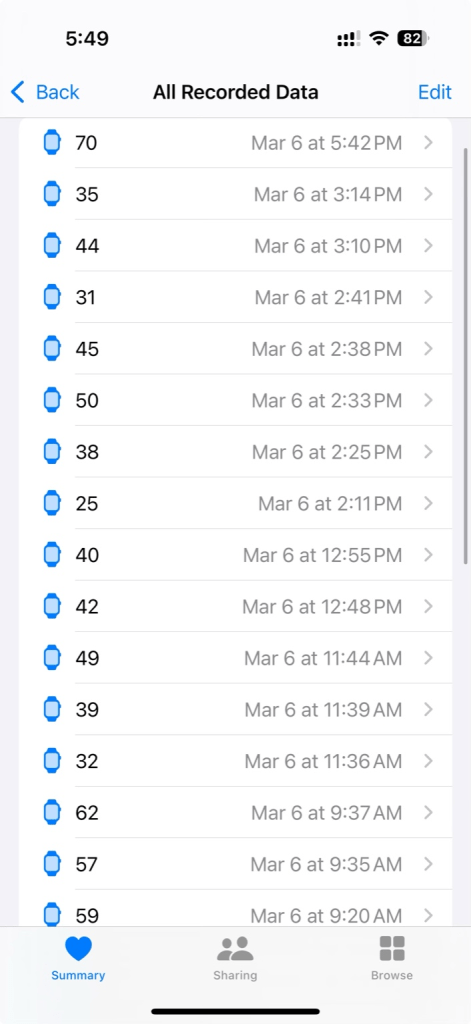
Key Observations: Here is my custom HRV diagram based on above recorded data from March 6. The blue line represents the fluctuations in HRV over time, showing periods of stability, drops, and recoveries.

Early Fluctuations (Morning – Noon)
HRV starts relatively higher (~59-62 ms) in the morning.
Drops significantly around 11:30 AM – 12:55 PM (32 → 25 ms), possibly indicating deep relaxation or fatigue.
Afternoon Variability
Some recovery seen between 2:25 PM – 2:38 PM (38 → 50 ms), suggesting autonomic rebound.
Brief dips (~31-35 ms) followed by a sharp increase to 70 ms at 5:42 PM.
Evening HRV Peak
HRV reaching 70 ms by evening suggests full recovery or a different physiological state (activity, stress reduction, etc.).
Key HRV Fluctuations & Possible Meditation Effects
| Time | HRV (ms) | Possible Cause (Meditation, Breathing, Other Factors) |
|---|---|---|
| 9:20 AM – 9:37 AM | 59 → 62 | Normal HRV stability, possibly light breathing. |
| 11:36 AM – 12:55 PM | 32 → 25 | Significant drop—likely deep relaxation, slow breathing, or passive observation. |
| 2:11 PM – 2:38 PM | 25 → 50 | Recovery—may indicate HRV rebound after meditation session. |
| 3:10 PM – 3:14 PM | 44 → 35 | In metro train and observing the breath created over-relaxation |
| 5:42 PM | 70 | Highest HRV—suggests full recovery, activity, or breathing adaptation. |
What These HRV Trends Reveal
✔ Morning Meditation (Before 12 PM):
HRV dropped significantly (62 → 25 ms).
Due to passive breath observation, it may have over-activated the vagus nerve, causing a deep relaxation response which is good sign.
A sharp drop below 30 ms could indicate the need for a slightly more engaged breathing pattern else sleep would ensure.
✔ Midday HRV Recovery (Post-12:55 PM):
HRV rose from 25 → 50 ms, showing my nervous system rebounded.
When I ended meditation and moved a bit, this suggested healthy adaptation.
✔ Afternoon Drop & Evening Peak:
Another small dip at 3:10 PM indicate that I was in the metro train and relaxing the breath.
HRV peaked at 70 ms in the evening, which means my body fully recovered, possibly due to more active natural deep breathing – observing the two stops in the breath
How to Optimize Meditation & Breathing for HRV Stability?
✅ If HRV drops too much in meditation (> 30% decrease):
Need to try a slightly more active breath cycle (6 breaths/min) instead of passive observation.
Ensure the breath is not becoming too shallow which then creates dreams and sleep
✅ If HRV takes too long to recover:
Introduce gentle movement after deep meditation (walking, stretching and standing).
To measure HRV 10 min post-ses