We saw six contemporaries of Buddha in the earlier post and now let us proceed further towards comparing each one of them in their philosophies, methods and how would one accomplish the task alongside with Buddha teachings. If you have still not visited it, 
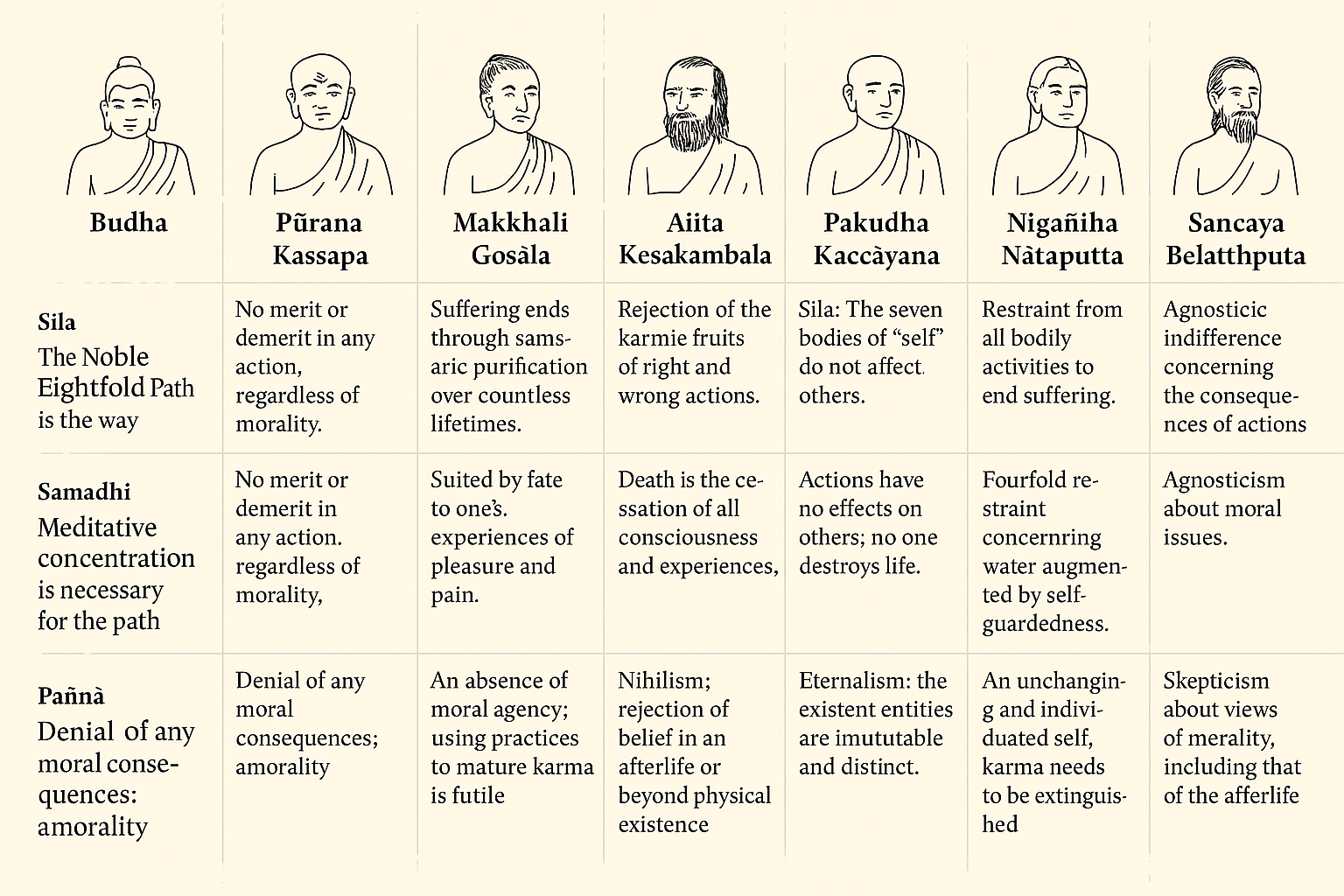
🧭 Comparative Chart: Śramaṇa Teachers & Buddha on Sīla, Samādhi, Paññā
| Teacher | Sīla (Virtue) | Samādhi (Concentration) | Paññā (Wisdom/Right View) |
|---|---|---|---|
| Pūraṇa Kassapa | ❌ Denied moral efficacy of actions | ❌ No emphasis on mental development | ❌ Akiriyāvāda: “No action is truly good or bad.” No karma, no responsibility |
| Makkhali Gosāla | ❌ No self-effort in morality | ❌ Deterministic fatalism, no inner cultivation | ❌ Niyativāda: Destiny controls everything. No karma, no free will |
| Ajita Kesakambala | ❌ Rejected all morality, soul, rebirth | ❌ Materialist; denied mental cultivation | ❌ Ucchedavāda: Annihilationism. Body dies, that’s the end. No afterlife, no liberation |
| Pakudha Kaccāyana | ❌ Denied moral consequence | ❌ Atomistic immovable substances | ❌ Eternalist & atomist. Soul & matter are fixed; actions don’t affect outcomes |
| Nigaṇṭha Nātaputta | ✅ Extreme moral discipline (restraint) | ❌ No cultivation of mind, only bodily restraint | ❌ Belief in cleansing past karma by austerity alone (no insight or wisdom path) |
| Sañjaya Belaṭṭhaputta | ❌ No ethical guidance | ❌ No teaching of meditation | ❌ Vikkhepavāda: Agnostic, evasive. Refused to affirm or deny anything |
| Buddha | ✅ Five/Eight Precepts; Noble Conduct | ✅ Jhāna-based training in right mindfulness | ✅ Dependent origination, Four Noble Truths, Anattā. Karma & rebirth properly integrated |
🔍 Deep Analysis by Training Categories
1️⃣ Sīla – Morality / Ethical Conduct
| View | Summary |
|---|---|
| Buddha | Emphasized intention-based ethical conduct (right speech, action, livelihood). |
| Nigaṇṭha Nātaputta (Jain) | Extreme ascetic morality (e.g. restraining all movement to avoid harming beings). |
| Others | Rejected ethical causality (Pūraṇa), denied free will (Makkhali), or had no view (Sañjaya). |
🔸 Insight: Only the Buddha offers a balanced, intention-driven ethical system that leads to harmony and progress.
2️⃣ Samādhi – Mental Discipline
| View | Summary |
|---|---|
| Buddha | Strong emphasis on Jhānas, mindfulness (satipaṭṭhāna), and development of concentration. |
| Others | None had a clear method of meditation. Nigaṇṭhas had restraint of body, speech and mind, not meditation in the sense of what Buddha commits to 4 jhanas |
🔸 Insight: Samādhi is absent in all others except the Buddha, who offers a direct inner path.
3️⃣ Paññā – Wisdom / Insight
Pūraṇa: No right/wrong — no wisdom needed.
Makkhali: All fate — no learning possible.
Ajita: Nihilistic materialism — no spiritual wisdom.
Pakudha: Eternalism — fixed elements as in seven kaya
Sañjaya: Avoided knowledge altogether as it is not graspable no matter what is tried
Nigaṇṭha: By restraining and following Right view, Right knowledge and Right character one can get liberated which is termed as “tri-ratna”
Buddha: Emphasized insight into impermanence, suffering, not-self (anicca, dukkha, anattā).
🔸 Insight: Buddha’s path alone integrates clear insight into dependent origination and liberation.
🎯 Summary of Differences
| Aspect | Buddha | Other Teachers (Common Patterns) |
|---|---|---|
| Sīla | Balanced, intention-led | Either denied or extreme & unbalanced (Jainism) |
| Samādhi | Positive training in mind | Largely absent, no formal meditative development |
| Paññā | Right view, Dep. Orig, 4Noble Truth | Fatalism, Materialism, Eternalism, Nihilism, Agnosticism |
🌼 Final Insight:
The Buddha’s teaching is the only system among the six that: Integrates morality, meditation, and wisdom into a progressive path (ariyo aṭṭhaṅgiko maggo). Balances personal responsibility (against fatalism), introspection (against mere austerity), and insight (against dogma).
Next, let us do a comparative study with Adi Śaṅkara, Nigaṇṭha Nāṭaputta (Mahāvīra) and Buddha through a structured lens and, examine them across the following key areas:
Metaphysics – View of self, reality, and liberation
Karma & Rebirth – Cause-effect and rebirth mechanics
Ethics & Austerity (Sīla) – Path of restraint and morality
Meditation & Mind Training (Samādhi)
Liberation (Paññā or Mokṣa) – The goal and how to attain it
Doctrine of the Soul / Non-soul
🧭 Comparative Table: Śaṅkara, Nigaṇṭha Nāṭaputta, Buddha
| Category | Adi Śaṅkara (Advaita Vedānta) | Nigaṇṭha Nāṭaputta (Jainism) | Buddha (Theravāda/Sutta-based) |
|---|---|---|---|
| View of Self (Ātman) | Believes in eternal, unchanging ātman; identical with Brahman (non-dualism). | Believes in jīva (soul), eternal but bound by karma. | Denies ātman altogether; teaches anattā (non-self) since in the end anything that is created is destroyed completely and Brahman is a mental creation |
| View of Reality | Brahman is ultimate reality; world is māyā (illusion). | Dualism: jīva and ajīva (soul and matter) are real. | Dependent origination: all phenomena are conditionally arisen. |
| Cause of Suffering | Ignorance (avidyā) of one’s true Self. | Karma particles bind to jīva, causing rebirth. | Craving (taṇhā), ignorance of anicca/anattā. |
| Karma & Rebirth | Karma binds due to ignorance. Mokṣa ends cycle. | Karma is a physical substance; burned via asceticism. | Karma is volitional action. Rebirth stops with cessation of craving. |
| Austerity (Tapas) | Optional; jñāna (knowledge) is supreme path. | Mandatory: extreme physical restraint to purify karma. | Middle path: neither indulgence nor torment. Ethical living + mindfulness. |
| Meditation / Yoga | Jñāna Yoga: Self-inquiry (“Who am I?”) to realize Brahman. | Little emphasis on mind-training; more on bodily control. | Jhānas and Satipaṭṭhāna (mindfulness) central. |
| Liberation (Mokṣa/Nibbāna) | Realization that ātman = Brahman (self = all). Liberation is from ignorance. | Liberation is freeing soul from karmic matter through austerity. | Nibbāna is cessation of greed, hatred, delusion; unconditioned state. |
| Doctrine on Soul | Eternal Self (ātman) exists. | Eternal individual soul (jīva) exists. | No soul (anattā); five aggregates are not-self and Nibbana is unconditioned whereas Brahman once conceived is a creation and hence conditioned |
🔍 Key Observations 🔸 1. Self vs. Non-Self
Śaṅkara: Absolute monism. Self = Brahman. Everything else is illusion (māyā). Liberation is re-identification with the Self.
Mahāvīra: Real dualism. Self exists independently but is entangled in karma.
Buddha: No self. Clinging to “I” and “mine” is the root of dukkha.
🔸 2. Ethics and Path
Śaṅkara: Ethical conduct is preparation; jñāna yoga (intellectual realization) is main path.
Jainism: Ethics is rigorous—non-violence to microscopic degree; physical purity is primary.
Buddhism: Ethics (sīla) integrated with mental purification (samādhi) and wisdom (paññā).
🔸 3. Liberation
Śaṅkara: Mokṣa = knowledge of self = Brahman.
Jainism: Mokṣa = purified soul rises to Siddha-loka after burning off all karmas.
Buddha: Nibbāna = extinguishing all craving, ending rebirth.
🕉️ Anekāntavāda vs Advaita vs Anattā
Jain Anekāntavāda: Reality has many aspects; truth is multi-perspectival (syādvāda).
Śaṅkara: Non-dualism (only Brahman is ultimately real; everything else is illusory).
Buddha: Middle way: dependent origination explains experience without eternalism or nihilism.
🌱 Conclusion
| Criterion | Buddha | Mahāvīra (Nigaṇṭha) | Śaṅkara |
|---|---|---|---|
| Doctrinal Middle Way? | ✅ Yes – avoids extremes | ❌ No – extreme austerity | ❌ No – non-dual absolutism |
| Soul belief? | ❌ No soul | ✅ Soul exists | ✅ Universal Self exists |
| Rebirth View | ✅ Yes – conditional | ✅ Yes – based on karma matter | ✅ Yes – but maya-based |
| Final Goal | ✅ Nibbāna – extinction of craving | ✅ Siddhahood – karma-free soul | ✅ Mokṣa – Self-realization |
Was Adi Śaṅkara a liberated being who ended rebirth?
🔹 1. Traditional Advaita Vedānta Claim
According to Advaita Vedānta itself:
A person who has realized that ātman is Brahman and completely transcended ignorance (avidyā) is considered a jīvanmukta – liberated while alive. Śaṅkara is considered such a being by the entire Advaita tradition because:
He wrote profound commentaries on the Upaniṣads, Brahma Sūtras, and the Bhagavad Gītā that expound non-dual realization.
He lived a renunciate life from a young age, engaged in debates with other schools (e.g., Mīmāṁsā, Sāṅkhya, Buddhists), and is believed to have defeated them in philosophical reasoning.
Hagiographies claim he performed miracles (e.g., reviving a dead king’s son, entering another’s body) — these are often cited as signs of spiritual powers.
🔹 2. Textual Self-Testimony
In his works, Śaṅkara often speaks from the standpoint of the liberated self (paramārtha dṛṣṭi), for example:
“I am neither the mind, nor the intellect, nor the ego… I am pure consciousness – bliss – Śivam.”
— Nirvāṇa Ṣaṭkam (often attributed to him). Such declarations are interpreted by Advaitins as evidence of self-realization.
🔹 3. External Validation?
Unlike in the Buddhist tradition, where liberation is confirmed by a teacher (e.g., Buddha recognizing arahant disciples) and the suttas record these recognitions, Advaita Vedānta lacks:
A clear lineage of formal verification.
A sangha system to “test” realization (no precepts, no vinaya).
Any record of someone else attesting Śaṅkara’s liberation based on defined criteria (like cessation of taṇhā, attainment of sa-upādisesa nibbāna, etc.).
🔹 4. Contrasts with Early Buddhist Liberation
| Point | Adi Śaṅkara | Buddhist Arahant |
|---|---|---|
| View of liberation | Realization of identity with Brahman | Extinction of taṇhā, avijjā, saṅkhāra |
| Testimony | Self-claimed, accepted by tradition | Validated by Buddha or Vinaya procedures |
| Post-liberation behavior | May still act in the world (lokasaṅgraha) | Non-craving, equanimous, restrained |
| Scriptural evidence | Hagiographies (later) | Early Sutta references (e.g., Theragāthā) |
🧘♂️ Was Mahāvīra a Liberated Being?
✅ According to Jainism: Yes
Mahāvīra is regarded as a kevalī (one who has attained kevala-jñāna, or omniscience) and ultimately a siddha (a perfected soul free from all karmic bondage).
🔹 Jain Textual Basis:
According to Jain Āgamas like the Ācārāṅga Sūtra, Uttarādhyayana Sūtra, and Kalpasūtra:
Mahāvīra conquered the senses and passions (which is what “Jina” means).
He burned off all karmic matter through extreme austerity and non-violence.
After attaining kevala-jñāna under a śāl tree at the age of 42, he taught for 30 years.
At death (nirvāṇa at Pāvā or Pāwāpurī), he became a siddha – a pure soul residing in Siddhaśilā (the highest realm).
🛤 Path to Liberation in Jainism
| Stage | Description |
|---|---|
| Saṁyama (Restraint) | Begins the path with vows of non-violence, truth, celibacy, etc. |
| Tapa (Austerities) | Internal and external austerities to shed karma. |
| Kevala-jñāna | Omniscient knowledge, achieved once all ghātiyā karmas are removed. |
| Nirvāṇa | Final release from cycle of rebirth; soul ascends to Siddha-loka. |
🔄 Contrast with Buddha’s Liberation
| Feature | Mahāvīra (Jainism) | Buddha (Theravāda) |
|---|---|---|
| Liberation term | Kevala-jñāna → Siddha | Nibbāna → Arahant / Buddha |
| Self-view | Eternal soul (jīva), liberated through karma-shedding | No-self (anattā), cessation of craving |
| Path | Austerities, vows, karma-shedding | Middle Way: sīla, samādhi, paññā |
| Omniscience | Literal and total omniscience | Functional omniscience (in context) |
| Recognition of state | Assumed upon kevala-jñāna | Confirmed by other arahants or Buddha |
| Post-death | Soul goes to Siddhaśilā | No rebirth; aggregates cease |
Out of the 3 ways of doing immoral, Mahāvīra always made physical the most karmic debt than mind since it can be stopped by speech and physical. Let us look at this in more detail.
🔶 Jain View on Kamma and Misconduct Hierarchy
Karma is seen as a material substance (pudgala) that binds to the soul (jīva) due to the activities of mind, speech, and body.
All actions (yoga) of mind (mano), speech (vāg), and body (kāya) are causes for karmic bondage, but there is a hierarchy in terms of severity and directness of action.
🔷 Physical Action as Heaviest Karmic Bondage
According to texts like the Tattvārtha Sūtra (5th century CE) and Sthānāṅga Sūtra:
Physical actions (kāya-yoga) bind karma most strongly because they manifest intention into concrete form.
Verbal actions (vāg-yoga) are considered less intense than physical actions.
Mental actions (mano-yoga) still bind karma, but with the least intensity if not acted upon.
📘 Tattvārtha Sūtra 6.2: “Yoga is the activity of the body, speech, and mind. It is the cause of the inflow of karma.”
📘 Sthānāṅga Sūtra 3.3.1 (Śvetāmbara canon): It differentiates between intentional (saṅkalpa) and unintentional (asaṅkalpa) acts, and places intentional bodily acts as the gravest.
🧭 Why Physical Misconduct is Heavier in Jainism: Jains assert:
Mental and verbal actions generate karma primarily due to internal vibrations (leśyās).
Physical action is the full crystallization of intention—thus it leads to the grossest karmic binding.
For example: merely thinking about killing is bad, but actually killing is exponentially worse, because it actively harms other souls and creates direct viōlence (himsā).
Thus, for Jains: Real harm = physical enactment of intention, and this is where the weight of pāpa (sinful karma) accrues most.
🔶 Comparison with Buddhist View
The Buddhist view (especially Theravāda) sharply differs: For the Buddha: “Cetanāhaṁ, bhikkhave, kammaṁ vadāmi” (“Volition, monks, I declare, is karma.”) — AN 6.63. So for Buddhism, mental intention alone—even if not acted upon—is sufficient to generate karma. The mind (mano) is the foremost root of both good and evil. This is why in the Upāli Sutta (MN 56), the Buddha challenges the Jain assertion that bodily action is more blameworthy, using logical and experiential similes.
🧾 Comparison of Karma Doctrine: Jainism vs Buddhism
| Aspect | Jainism | Buddhism (Theravāda) |
|---|---|---|
| Definition of Karma | A material substance (pudgala) that binds to the soul (jīva) | Volition (cetanā) — mental intention is karma (AN 6.63) |
| Source of Karma | Activities (yoga) of body, speech, and mind | Mental volition is primary; body/speech are secondary expressions |
| Weight of Misconduct | 1. Body > Speech > Mind Physical acts create heaviest karma | 1. Mind > Speech > Body Unwholesome intention alone creates strong karma |
| Unintentional Acts | Cause karma, but less blameworthy (asaṅkalpaja); intention adds severity | No karmic result without intention (cetanā) — purely mechanical acts are neutral |
| Violence (Hiṁsā) | Defined as injuring living beings physically (jīva-ghāta); external act is the main factor | Defined as intention to harm, regardless of physical result (SN 35.145) |
| Mental Wrath (Manopadosa) | Recognized, but binds lighter karma unless acted upon | Central — even a moment of hatred (e.g. manopadosa) binds strong karma |
| Example of Greatest Sin | Killing a living being intentionally — e.g., a monk stepping on insects is sinful if careless | Deliberate mental hatred, cruelty, or wrong view — even if not enacted |
| Liberation Path Focus | Focus on external restraint (ahiṁsā, vows, fasting, nudity) to stop new karmic influx | Focus on internal purification — uprooting greed, hate, delusion |
| Role of Intention | Important but not central — karma sticks through vibrations regardless of motive | Central — cetanā is what initiates, defines, and ends karma |
| Final Liberation (Mokṣa/Nibbāna) | Achieved by shedding all karmic matter through penance and non-action | Achieved by ending craving and ignorance, not by physical suppression alone |