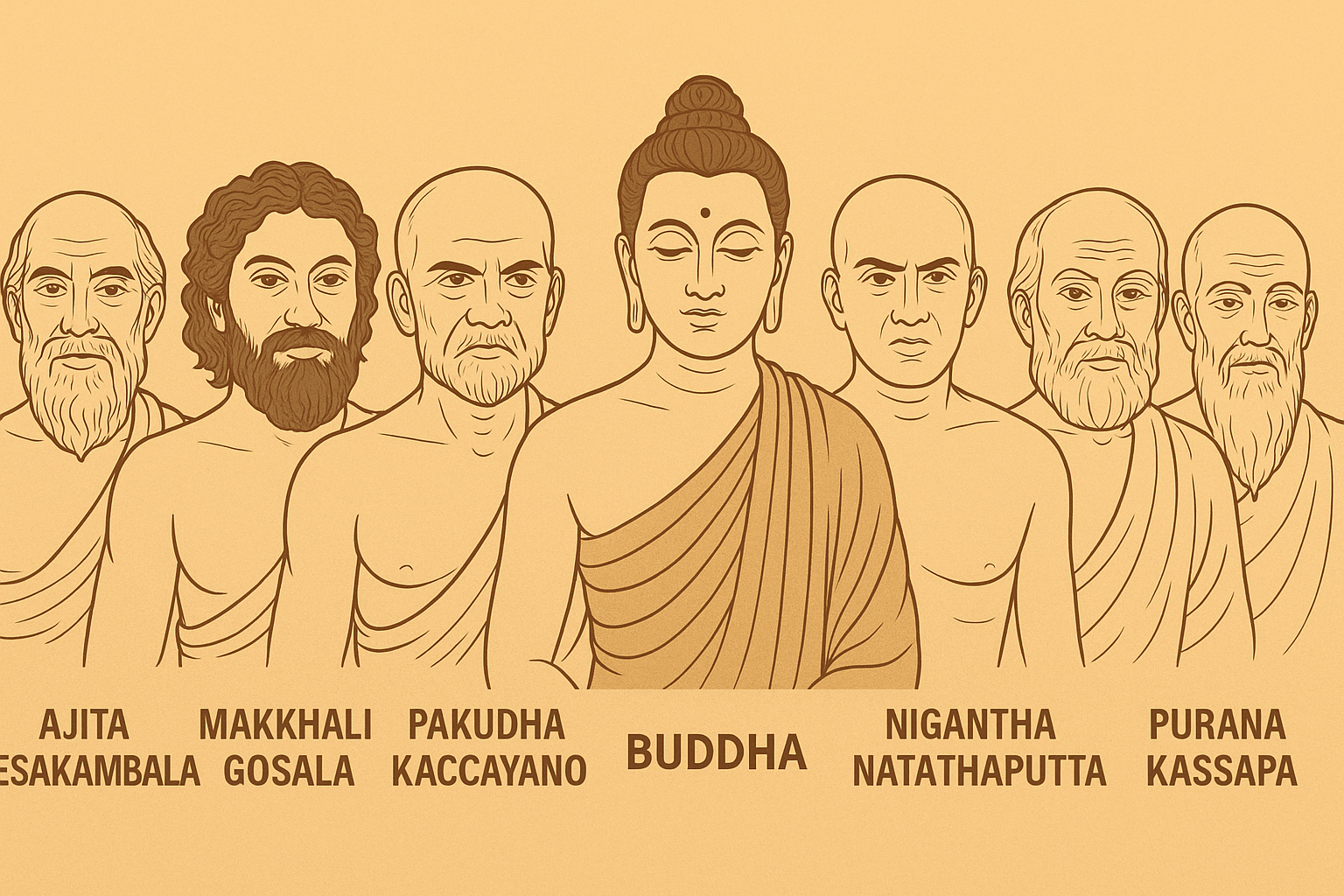
Its time to understand six contemporaries of Buddha who had a different philosophy which made good sense far away from Vedic misunderstandings and differences which created a new school of thought as “samana” or “shramana” which means “one’s own effort” rather than divine intervention and sacrifices which were too much during that time. Also, the society had been divided based upon birth rather than the profession and this created a even much bigger problem.
Let us now start with Pūraṇa Kassapa’s philosophy
1. Pūraṇa Kassapa – Akiriyāvāda
Evaṁ vutte, bhante, pūraṇo kassapo maṁ etadavoca:
‘karoto kho, mahārāja, kārayato, chindato chedāpayato, pacato pācāpayato socayato, socāpayato, kilamato kilamāpayato, phandato phandāpayato, pāṇamatipātāpayato, adinnaṁ ādiyato, sandhiṁ chindato, nillopaṁ harato, ekāgārikaṁ karoto, paripanthe tiṭṭhato, paradāraṁ gacchato, musā bhaṇato, karoto na karīyati pāpaṁ.
When this was said, venerable sir, Pūraṇa Kassapa said to me thus:
“Whatever one does, great king—whether one acts oneself, causes others to act, cuts, causes to be cut, cooks, causes to be cooked, grieves, causes others to grieve, tires oneself, tires others, trembles, causes others to tremble, kills living beings, takes what is not given, breaks into houses, plunders, commits burglary, robs in the streets, commits adultery, tells lies—none of these deeds are evil. No evil is done by doing any of these.
Khurapariyantena cepi cakkena yo imissā pathaviyā pāṇe ekaṁ maṁsakhalaṁ ekaṁ maṁsapuñjaṁ kareyya, natthi tatonidānaṁ pāpaṁ, natthi pāpassa āgamo.
Even if someone, with a razor-edged wheel, were to turn a living being on this earth into one lump of flesh, one heap of meat, there would be no evil arising from that; there is no coming of evil as a result.
Dakkhiṇañcepi gaṅgāya tīraṁ gaccheyya hananto ghātento chindanto chedāpento pacanto pācāpento, natthi tatonidānaṁ pāpaṁ, natthi pāpassa āgamo.
If one were to go along the southern bank of the Ganges killing, slaughtering, cutting, causing to be cut, cooking, causing to be cooked—there would be no evil as a result, no evil would come from that.
Uttarañcepi gaṅgāya tīraṁ gaccheyya dadanto dāpento yajanto yajāpento, natthi tatonidānaṁ puññaṁ, natthi puññassa āgamo.
If one were to go along the northern bank of the Ganges giving gifts, causing gifts to be given, performing sacrifices, causing sacrifices to be performed—there would be no merit as a result, no merit would come from that.
Dānena damena saṁyamena saccavajjena natthi puññaṁ, natthi puññassa āgamo’ti.
By giving, by self-restraint, by self-control, by speaking truth—there is no merit; no result of merit comes from that.”
Itthaṁ kho me, bhante, pūraṇo kassapo sandiṭṭhikaṁ sāmaññaphalaṁ puṭṭho samāno akiriyaṁ byākāsi.
Thus, venerable sir, when I questioned Pūraṇa Kassapa about the visible fruit of the contemplative life, he declared the doctrine of non-action (akiriya).
Seyyathāpi, bhante, ambaṁ vā puṭṭho labujaṁ byākareyya, labujaṁ vā puṭṭho ambaṁ byākareyya; evameva kho me, bhante, pūraṇo kassapo sandiṭṭhikaṁ sāmaññaphalaṁ puṭṭho samāno akiriyaṁ byākāsi.
It was as if, venerable sir, when asked about a mango, one were to explain a breadfruit, or when asked about a breadfruit, one were to explain a mango. Just so, when I asked Pūraṇa Kassapa about the immediate fruit of the contemplative life, he declared the doctrine of non-action.
Tassa mayhaṁ, bhante, etadahosi: ‘kathañhi nāma mādiso samaṇaṁ vā brāhmaṇaṁ vā vijite vasantaṁ apasādetabbaṁ maññeyyā’ti.
Then, venerable sir, it occurred to me: “How can someone like me think of criticizing a samaṇa or brāhmaṇa who lives in my realm?”
So kho ahaṁ, bhante, pūraṇassa kassapassa bhāsitaṁ neva abhinandiṁ nappaṭikkosiṁ. Anabhinanditvā appaṭikkositvā anattamano, anattamanavācaṁ anicchāretvā, tameva vācaṁ anuggaṇhanto anikkujjanto uṭṭhāyāsanā pakkamiṁ.
So, venerable sir, I neither approved nor rejected what Pūraṇa Kassapa said. Without expressing either approval or disapproval, displeased, without uttering a pleased word, I rose from my seat and left, holding on to that very statement, turning it over in my mind.
🧠 Epistemological Analysis of Pūraṇa Kassapa’s View (A-Kiriyāvāda)
Central Tenet: Akiriyāvāda – the Doctrine of Non-action
Pūraṇa Kassapa is one of the six heterodox teachers during the Buddha’s time. His doctrine is moral nihilism—the idea that there is no intrinsic moral consequence (puñña or pāpa) to any action. He espouses that actions such as killing, stealing, lying, or even generosity and truthfulness have no ethical value or consequence. This includes a complete denial of karma (kamma) and vipāka (result).
Denial of Moral Causality
Actions (kamma) do not produce consequences (vipāka).
Good and bad are socially constructed, not ultimately real.
Even the most violent or most virtuous actions are causally void of moral outcomes.Epistemologically, he denies dependent origination (paṭiccasamuppāda) and any experiential or inferable moral law.
Epistemological Foundation:
The view is a form of empiricist materialism or fatalism—what exists is only material reality; morality is subjective.
The statement “na karīyati pāpaṁ” (no evil is done) implies a rejection of agency and moral intention (cetanā).
Pūraṇa’s teaching undermines any basis for spiritual effort, renunciation, or liberation through ethical purification
Consequences of Such a View:
If no action has moral consequence, there is no motivation for ethical restraint or spiritual progress. It would lead to moral indifference or license. The doctrine contradicts direct experiential knowledge of suffering (dukkha), cause (samudaya), cessation (nirodha), and the path (magga), which is central to the Buddha’s epistemology.
📌 Conclusion: King Ajātasattu’s disappointment is clear: he expected a profound insight into the visible fruits of the contemplative life, but was instead given a denial of moral causality. This makes Pūraṇa’s answer comparable to answering a question about mangoes by talking about jackfruit — totally misaligned.
2. Makkhali Gosāla – Niyativāda
Evaṁ vutte, bhante, makkhali gosālo maṁ etadavoca:
‘natthi, mahārāja, hetu natthi paccayo sattānaṁ saṅkilesāya, ahetū apaccayā sattā saṅkilissanti.
Natthi hetu, natthi paccayo sattānaṁ visuddhiyā, ahetū apaccayā sattā visujjhanti.
When this was said, venerable sir, Makkhali Gosāla said to me thus:
“There is no cause, great king, no condition for beings’ defilement; without cause and without condition, beings become defiled.
There is no cause, no condition for beings’ purification; without cause and without condition, beings become purified.
Natthi attakāre, natthi parakāre, natthi purisakāre, natthi balaṁ, natthi vīriyaṁ, natthi purisathāmo, natthi purisaparakkamo.
There is no self-doing, no other-doing, no human effort, no strength, no energy, no human might, no human exertion.
Sabbe sattā sabbe pāṇā sabbe bhūtā sabbe jīvā avasā abalā avīriyā niyatisaṅgatibhāvapariṇatā chasvevābhijātīsu sukhadukkhaṁ paṭisaṁvedenti.
All beings, all living creatures, all existences, all lives—are helpless, powerless, without energy; they are shaped by fate, circumstance, and nature. They experience pleasure and pain in the six classes of rebirths according to these forces.
Cuddasa kho panimāni yonipamukhasatasahassāni… (long list follows)
There are, indeed, fourteen hundred thousand primary womb-entries (types of birth), along with:
660 intermediate categories,
500 actions,
5 minor actions,
3 further actions,
actions-and-half-actions,
62 ways of conduct,
62 intermediate aeons,
6 types of birth,
8 stages of human development,
49 life-views of Ājīvikas,
49 of wandering ascetics,
49 snake-abode realms,
20 faculties,
30 hells,
36 types of dust nature (material categories),
7 wombs with perception,
7 wombs without perception,
7 for naked ascetics,
7 for gods,
7 for humans,
7 for ghosts,
7 for beings with voices,
7 for beings without voices,
700 mute beings,
7 abysses,
700 abyss-beings,
7 dreams,
700 dream-beings,
and 84 great aeons.
All these are the round of rebirths through which the foolish and the wise alike must wander, revolve, and transmigrate until they come to the end of suffering.
Tattha natthi “imināhaṁ sīlena vā vatena vā tapena vā brahmacariyena vā aparipakkaṁ vā kammaṁ paripācessāmi, paripakkaṁ vā kammaṁ phussa phussa byantiṁ karissāmī”ti hevaṁ natthi.
In this system, there is no such idea as:
“By this virtue, this vow, this austerity, this holy life, I will ripen unripe kamma, or eliminate ripened kamma little by little.” Such a thought does not exist.
Doṇamite sukhadukkhe pariyantakate saṁsāre, natthi hāyanavaḍḍhane, natthi ukkaṁsāvakaṁse.
In this round of rebirths, measured by fixed doses of pleasure and pain, there is no falling away, no rising, no better or worse.
Seyyathāpi nāma suttaguḷe khitte nibbeṭhiyamānameva paleti; evameva bāle ca paṇḍite ca sandhāvitvā saṁsaritvā dukkhassantaṁ karissantī’ti.
Just as a ball of thread when thrown runs on as it unwinds, in the same way, the foolish and the wise alike wander and transmigrate until they make an end of suffering.
Itthaṁ kho me, bhante, makkhali gosālo sandiṭṭhikaṁ sāmaññaphalaṁ puṭṭho samāno saṁsārasuddhiṁ byākāsi.
Thus, venerable sir, when I asked Makkhali Gosāla about the immediate fruit of the contemplative life, he declared purification through transmigration (saṁsārasuddhiṁ).
Seyyathāpi, bhante, ambaṁ vā puṭṭho labujaṁ byākareyya, labujaṁ vā puṭṭho ambaṁ byākareyya…
It was as if, venerable sir, when asked about a mango, one were to explain a breadfruit, or when asked about a breadfruit, one were to explain a mango…
So kho ahaṁ, bhante, makkhalissa gosālassa bhāsitaṁ neva abhinandiṁ nappaṭikkosiṁ…
So, venerable sir, I neither approved nor rejected what Makkhali Gosāla said. Without expressing approval or disapproval, silently dissatisfied, I rose from my seat and departed, turning his statement over in my mind.
🔍 Epistemological Analysis of Makkhali Gosāla’s View
🔸 1. Central Doctrine: Niyativāda (Theory of Fate/Determinism)
Makkhali Gosāla’s philosophy is grounded in complete determinism (niyata), where everything is governed by fate (niyati), natural laws, and inherent nature (bhāva). He denies all forms of causation in moral or spiritual progress.
🔸 2. Denial of Cause and Effect in Ethics (ahetuvāda)
No action (kamma), whether wholesome or unwholesome, has any causal power to purify or defile.
Beings undergo suffering or happiness not because of volition or action, but due to predetermined cosmic laws.
No free will (natthi purisakāro), no self-effort (attakāra), or other-effort (parakāra).
This is a direct epistemological challenge to paṭiccasamuppāda, the Buddha’s teaching of dependent origination based on volitional formations (saṅkhārā) and intentional action.
🔸 3. Mechanism of Liberation: Saṁsārasuddhi (Purification through Saṁsāra)
Liberation is achieved not through any effort, but by exhausting a fixed quantum of experiences (fixed units of pain and pleasure).
Life is like a pre-programmed reel unwinding—much like the simile of the ball of thread.
Thus, progress or decline is nonexistent; ethical effort is meaningless.
🔸 4. Consequences of the View
Moral equanimity collapses—no difference between a good or bad person.
No motivation for practice: virtue, restraint, and mindfulness are futile.
Philosophically, this reduces humans to mechanistic puppets, stripped of moral agency.
Makkhali Gosāla represents the fatalistic śramaṇa path that denies moral agency, volition, and spiritual causality. His epistemology holds that all beings are swept along by fate, like a ball of thread unwinding. There is no karma, no value in meditation or effort.
Gosāla was the founder of the Ājīvika sect, a strict deterministic school distinct from both Jainism and Buddhism, though sharing ascetic practices.
Historical Records & Influence
▸ Gosāla’s Story in Jain Texts: According to Jain sources (e.g., Bhagavatī Sūtra), Gosāla was once a disciple of Mahāvīra. He later split off, claiming divine inspiration and formulating his own path. Described as having clairvoyant powers (e.g., predicting deaths, cosmic cycles).
Jains portray Gosāla as proud, having misunderstood karma, and descending into false asceticism.
Epistemological Label: Fatalist Nihilism
Gosāla’s doctrine represents: A determinist ontology: Niyati as ultimate.. A nihilistic soteriology: No use of ethics, meditation, or knowledge. A rejection of karma-theory shared by almost all other Indian systems.
▸ Core Beliefs:
| Doctrine | Belief |
|---|---|
| Niyati (Fate) | Only force governing existence |
| No Karma | Kamma has no causal efficacy |
| No Free Will | All acts predetermined |
| Deterministic Rebirth | Fixed cycle of births and experiences |
| Rejection of Tapas | Ascetic effort doesn’t purify |
| Final Liberation | Attained only when fate allows, not through effort |
3. Ajita Kesakambali – ucchedavāda
Evaṁ vutte, bhante, ajito kesakambalo maṁ etadavoca:
‘natthi, mahārāja, dinnaṁ, natthi yiṭṭhaṁ, natthi hutaṁ, natthi sukatadukkaṭānaṁ kammānaṁ phalaṁ vipāko, natthi ayaṁ loko, natthi paro loko, natthi mātā, natthi pitā, natthi sattā opapātikā, natthi loke samaṇabrāhmaṇā sammaggatā sammāpaṭipannā, ye imañca lokaṁ parañca lokaṁ sayaṁ abhiññā sacchikatvā pavedenti.
When this was said, venerable sir, Ajita Kesakambala said to me thus:
“There is no giving, great king; no sacrifice, no offering; there is no fruit or result of good or bad actions.
There is no this world, no other world; no mother, no father; no spontaneously arisen beings.
There are in the world no true ascetics or brahmins who have gone rightly, who have followed the right path, and who, by their own direct knowledge, realize and declare this world and the next.”
Cātumahābhūtiko ayaṁ puriso, yadā kālaṁ karoti, pathavī pathavikāyaṁ anupeti anupagacchati, āpo āpokāyaṁ anupeti anupagacchati, tejo tejokāyaṁ anupeti anupagacchati, vāyo vāyokāyaṁ anupeti anupagacchati, ākāsaṁ indriyāni saṅkamanti.
This person is made up of the four great elements.
When one dies, the earth element returns to the earth element, the water to water, the fire to fire, the air to air.
The faculties dissolve into space.
Āsandipañcamā purisā mataṁ ādāya gacchanti. Yāvāḷāhanā padāni paññāyanti. Kāpotakāni aṭṭhīni bhavanti, bhassantā āhutiyo.
The corpse is carried by four men and a fifth leads them. The footprints are visible until the cremation ground.
The bones become like pigeon-colored pebbles. The offerings (funeral oblations) burn and crackle.
Dattupaññattaṁ yadidaṁ dānaṁ. Tesaṁ tucchaṁ musā vilāpo ye keci atthikavādaṁ vadanti.
Giving is merely a social convention.
The talk of those who speak of an existent being (atthikavādins) is empty, false nonsense.
Bāle ca paṇḍite ca kāyassa bhedā ucchijjanti vinassanti, na honti paraṁ maraṇā’ti.
Fools and wise alike, at the breakup of the body, are completely annihilated and destroyed.
They do not exist after death.
Itthaṁ kho me, bhante, ajito kesakambalo sandiṭṭhikaṁ sāmaññaphalaṁ puṭṭho samāno ucchedaṁ byākāsi.
Thus, venerable sir, when I asked Ajita Kesakambala about the visible fruit of the contemplative life, he declared a doctrine of annihilation (ucchedavāda).
Seyyathāpi, bhante, ambaṁ vā puṭṭho labujaṁ byākareyya…
It was as if, venerable sir, when asked about a mango, one were to describe a breadfruit, or vice versa.
Just so, when I asked Ajita Kesakambala about the immediate fruit of the contemplative life, he gave an answer on annihilation.
So kho ahaṁ, bhante, ajitassa kesakambalassa bhāsitaṁ neva abhinandiṁ nappaṭikkosiṁ…
So, venerable sir, I neither approved nor rejected what Ajita Kesakambala said. Without approval or disapproval, dissatisfied, and without expressing agreement, I rose from my seat and left, still contemplating that statement.
🔍 Epistemological Analysis of Ajita Kesakambala’s View
🔸 1. Core Doctrine: Ucchedavāda – Materialist Annihilationism
Ajita Kesakambala’s worldview is a radical materialism and nihilism, known in the suttas as ucchedavāda, or the doctrine of annihilation.
His ontology and epistemology can be broken down as follows:
🔸 2. Rejection of Ethical and Metaphysical Causation
No kamma-vipāka: “natthi sukatadukkaṭānaṁ kammānaṁ phalaṁ vipāko” – Actions, good or bad, have no consequence.
No moral accountability, hence, no basis for restraint or discipline.
This contradicts the Buddha’s experiential epistemology rooted in kamma and its result as observable across time and through insight (abhiññā).
🔸 3. Denial of Other Worlds, Afterlife, and Spiritual Knowledge
Denial of this world and next: “natthi ayaṁ loko, natthi paro loko”
Denial of spiritual beings or spontaneously born beings (opapātikā)
Denial of valid spiritual knowledge: “natthi…samaṇabrāhmaṇā…sayaṁ abhiññā sacchikatvā pavedenti” – There are no realized ascetics who directly know both worlds.
He undermines the epistemic credibility of the entire śramaṇa tradition, including the Buddha, claiming such insights are delusional or fabricated.
🔸 4. Human as a Biological Machine
Human being is merely a compound of four great elements (cātumahābhūtiko).
Upon death, the elements return to their source, and all faculties dissolve.
This implies: no rebirth, no surviving consciousness, no karma-carrying continuum.
It is an early Indian parallel to scientific materialism, seeing life as reducible to matter, without soul, spirit, or continuity.
🔸 5. Funeral Rituals are Meaningless
Dāna (charity) is social convention (dattupaññattaṁ), not meritorious.
Funeral rites are symbolic gestures with no metaphysical significance.
The burning of bones, crackling of offerings—this is the end of the person.
🔸 6. No Survival after Death
“Bāle ca paṇḍite ca kāyassa bhedā ucchijjanti vinassanti, na honti paraṁ maraṇā”
“Fools and wise alike are cut off, annihilated, cease to be after death.”
He posits absolute cessation—death is final. This is epistemologically opposite to the Buddha’s teaching of renewed becoming (bhava) due to clinging.
🧠 Epistemological Label
Ajita’s view is a form of epistemological eliminativism:
Eliminates subjective experience as valid knowledge
Rejects consciousness beyond body
Invalidates ethical inference and moral causality
This leads to existential nihilism and destroys the ground for ethical striving, self-transformation, or liberation.
📚 Summary
Ajita Kesakambali’s doctrine is the most radical of all six heretical views in the Samaṇamaggā list. It’s an ancient Indian materialist rejection of kamma, rebirth, ethics, and liberation. He asserts that we are nothing but elemental aggregates, and after death, there is nothing.
Like King Ajātasattu, the discerning listener realizes that such a view is not a visible fruit of the contemplative life, but a bleak philosophical dead-end.
Ajita Kesakambala and the Cārvāka Philosophy
🔸 1. Doctrinal Roots: The Link
The Dīgha Nikāya describes Ajita as denying: karma and its result,
the afterlife, rebirth,, spiritual knowledge, and the efficacy of offerings, sacrifices, and moral conduct.
This anticipates many of the key tenets of the later Cārvāka/Lokāyata school, which flourished around 600 BCE to 1000 CE and was so influential that even orthodox schools had to refute it repeatedly.
🔸 2. Core Tenets of Cārvāka Philosophy
Here’s a reconstruction based on both Buddhist, Jain, and Brahmanical critiques (since no original Cārvāka texts survive):
a. Materialism (Bhūtavāda)
Cātumahābhūtiko ayaṁ puriso – “The human is made of the four great elements.”
Everything is composed of earth, water, fire, and air. Consciousness arises from the combination of material elements, just like the intoxication arises from fermenting molasses.
They denied the existence of anything non-material — such as soul (ātman), God (Īśvara), heaven (svarga), or rebirth (punarjanma).
b. Perception is the Only Valid Knowledge (Pratyakṣa-pramāṇa)
Cārvākas accepted only direct perception (pratyakṣa) as a valid source of knowledge.
They rejected inference (anumāna) as uncertain and error-prone.
Scripture (śabda) was dismissed as the product of self-interested priests and fabricated.
This is a hard empiricism: only what is observable with the senses is accepted.
c. Rejection of Dharma, Karma, and Mokṣa
Natthi sukatadukkaṭānaṁ kammānaṁ phalaṁ vipāko – “There is no fruit of good or evil deeds.”
The Cārvākas denied moral causality across lifetimes. According to them, the ideas of karmic result and rebirth are constructs to exploit the naive.
They mocked austerities, sacrifices, and celibacy as foolish attempts to secure a non-existent future world.
d. Hedonism – “Pleasure is the only good”
Famous verse from a lost Cārvāka text:
“Yāvajjīvet sukhaṁ jīvet, ṛṇaṁ kṛtvā ghṛtaṁ pibet;
bhasmībhūtasya dehasya punarāgamanaṁ kutaḥ?”
“As long as you live, live happily.
Borrow money if you must, but drink ghee.
When the body is burned to ashes, how can it return again?”
This is ethical hedonism, but not reckless indulgence — they advocated pleasure in moderation, within the limits of health and society.
e. Critique of Religion
Cārvākas accused the brahmins of crafting fictions — heaven, hell, gods, rituals — to monopolize social power and wealth. They saw religion as a business of fear, sustained by mythology and authority.
🔸 3. Cārvāka as a Philosophical Challenge
Despite being labeled nāstika (non-believers), the Cārvākas had a rigorous rationalist spirit and played a critical role in sharpening Indian philosophical discourse. All orthodox schools (Vedānta, Nyāya, Mīmāṁsā) were compelled to refine their arguments in response to Cārvāka criticisms.
Even the Buddha, while not explicitly naming them, confronts similar views:
Ucchedavāda (annihilationism)
Ahetuvāda (denial of causality)
Akiriyavāda (denial of moral action)
🔸 4. Legacy and Extinction
Unfortunately, no full Cārvāka texts survive. What we know comes from:
Refutations in works by Vedāntins (like Madhava’s Sarvadarśanasaṅgraha),
Jain and Buddhist polemical literature,
A few quoted verses that have survived in anthologies.
They eventually disappeared as Bhakti movements and Islamic invasions shifted philosophical inquiry away from rationalist debate.
🔸 5. Modern Relevance
The Cārvāka school is now being re-evaluated positively by scholars for:
its rationalism, early scientific worldview, ethical skepticism, and refusal to submit to dogma or tradition. They are sometimes seen as the first Indian humanists or proto-atheists.
📌 Summary
| Feature | Cārvāka (Ajita Kesakambali) |
|---|---|
| Metaphysics | Only matter exists – no soul, no afterlife |
| Ethics | Pleasure is the goal; morality is social |
| Epistemology | Only perception is valid (no inference, no scripture) |
| Religion | Brahminical rituals are false and exploitative |
| Liberation | No rebirth, no liberation – enjoy life now |
Ambedkar’s Early Attraction to Ajita Kesakambali
In his early writings, especially “The Buddha and His Dhamma” and scattered essays, Ambedkar shows appreciation for radical rationalism, empiricism, and rejection of brahminical metaphysics, all of which align with Ajita’s materialist ethos.
Ambedkar saw in Ajita:
A proto-scientific, egalitarian worldview,
A critique of ritualism and caste ideology,
A moral atheism that was liberating for the oppressed.
Ambedkar even listed Ajita Kesakambalī among the thinkers who challenged Vedic orthodoxy.
🔷 II. Transition from Materialism to Buddhism
🔸 Why Did Ambedkar Not Adopt Cārvāka or Ajita’s Path Fully?
Despite admiration, Ambedkar did not stop with materialism because:
Cārvāka lacked a structured ethical or social program. It was too individualistic, insufficient to organize a moral community. Ajita’s rejection of karma meant no intrinsic moral framework — incompatible with social justice or a moral order. There was no sangha, no training system, no ethical vows — crucial for Ambedkar’s socio-political vision.
🔸 Why Buddhism Appealed
Ambedkar turned to the Buddha because:
| Feature | Reason for Adoption |
|---|---|
| Dhamma = righteousness + social order | Buddhism offers a framework of moral action (kamma) based on intention rather than caste |
| Egalitarian Sangha | Open to all, unlike Hindu varṇa |
| Social ethics (sīla), wisdom (paññā), and compassion (karuṇā) | Provided a way to transform society through individual growth |
| Rejects ātman, yet affirms ethical rebirth | A balance between moral responsibility and non-theism |
| Middle Path | Avoids extremes of nihilism (ucchedavāda) and eternalism (sassatavāda) |
🔷 III. Navayāna – The New Vehicle
🔸 What Is Navayāna?
“Navayāna” = “New Vehicle” — Ambedkar’s reinterpretation of Buddhism for modern, democratic, and anti-caste India.
🔸 Key Features:
Rejects supernaturalism – Focuses on man in society.
Reframes the Four Noble Truths – Root of suffering is social injustice, not just personal craving.
Emphasizes social liberation – Dhamma as a revolutionary ethic.
Views Buddha as a social reformer, not a mystic.
Morality without metaphysics – no rebirth or kamma as metaphysical law, but as ethical cause-effect.
Sangha = activist community – not just monks, but lay people working for justice.
🔷 IV. Continuity with Ajita Kesakambalī
While Navayāna rejects Ajita’s nihilism, it retains certain foundational themes:
| Theme | Ajita Kesakambalī | Navayāna Buddhism |
|---|---|---|
| Atheism | Yes | Yes |
| Rejection of Vedas and Caste | Yes | Yes |
| Focus on This-World | Strong | Strong |
| Rationalist Method | Yes | Yes |
| Social Program | No | Yes (via Dhamma) |
| Ethics & Sangha | Absent | Present, redefined |
| Karma & Rebirth | Denied | Interpreted ethically, not cosmologically |
V. Ambedkar’s Strategy
Ambedkar was deeply strategic:
Admired Ajita for his intellectual courage, But found in the Buddha a balanced system that could:
Inspire masses,
Organize a moral community,
Uplift the downtrodden, and reshape Indian society.
His version of Buddhism was deeply rooted in ancient revolt (like Ajita’s) but reconstructed for modern, constitutional justice.
4. Pakudha Kaccāyana – sattakāya
Evaṁ vutte, bhante, pakudho kaccāyano maṁ etadavoca:
‘sattime, mahārāja, kāyā akaṭā akaṭavidhā animmitā animmātā vañjhā kūṭaṭṭhā esikaṭṭhāyiṭṭhitā.
When this was said, venerable sir, Pakudha Kaccāyana said to me:
“These seven, great king, are bodies that are unmade, not to be made, uncreated, not created by anyone, barren, stable as peaks, and stand firm like pillars.
Te na iñjanti, na vipariṇamanti, na aññamaññaṁ byābādhenti, nālaṁ aññamaññassa sukhāya vā dukkhāya vā sukhadukkhāya vā.
They do not tremble, they do not change, they do not interfere with one another, and they are not capable of causing pleasure, pain, or both to one another.
Katame satta? Pathavikāyo, āpokāyo, tejokāyo, vāyokāyo, sukhe, dukkhe, jīve sattame—
And what are the seven?
The body of earth, the body of water, the body of fire, the body of air, pleasure, pain, and the soul (jīva)—these are the seven.
ime satta kāyā akaṭā akaṭavidhā animmitā animmātā vañjhā kūṭaṭṭhā esikaṭṭhāyiṭṭhitā.
Te na iñjanti, na vipariṇamanti, na aññamaññaṁ byābādhenti, nālaṁ aññamaññassa sukhāya vā dukkhāya vā sukhadukkhāya vā.
These seven bodies are unmade, not to be made, uncreated, not created by anyone, barren, fixed like mountain peaks, and stand firm like pillars.
They neither move nor change, nor cause one another pleasure or pain.
Tattha natthi hantā vā ghātetā vā, sotā vā sāvetā vā, viññātā vā viññāpetā vā.
In that system, there is no killer, no one who causes to kill, no listener, no one who makes heard, no knower, no one who makes known.
Yopi tiṇhena satthena sīsaṁ chindati, na koci kiñci jīvitā voropeti;
sattannaṁ tveva kāyānamantarena satthaṁ vivaramanupatatī’ti.
Even if someone slices off a head with a sharp sword, no one takes the life of another.
The sword simply passes between the seven bodies.
Seyyathāpi, bhante, ambaṁ vā puṭṭho labujaṁ byākareyya…
It was like being asked about a mango and replying about a breadfruit, or vice versa.
Just so, Pakudha Kaccāyana, when asked about the visible fruit of the contemplative life, gave a completely unrelated reply.
Itthaṁ kho me, bhante, pakudho kaccāyano sandiṭṭhikaṁ sāmaññaphalaṁ puṭṭho samāno aññena aññaṁ byākāsi.
Thus, venerable sir, when I asked Pakudha Kaccāyana about the visible fruit of the contemplative life, he replied with something entirely unrelated.
So kho ahaṁ, bhante, pakudhassa kaccāyanassa bhāsitaṁ neva abhinandiṁ nappaṭikkosiṁ…
So, venerable sir, I neither approved nor rejected what Pakudha Kaccāyana said.
Without showing approval or disapproval, silently dissatisfied, I rose from my seat and departed, turning that statement over in my mind.
🔍 Metaphysical and Epistemological Analysis of aPakudha Kaccāyana’s View
🔸 1. Core Doctrine: Atomistic Eternalism
Pakudha Kaccāyana propounds a doctrine resembling early atomism. His worldview posits that all reality consists of seven eternal, unchanging substances (sattakāya):
| Element | Description |
|---|---|
| Pathavīkāya | Earth element (solidity) |
| Āpokāya | Water element (cohesion) |
| Tejokāya | Fire element (heat) |
| Vāyokāya | Air element (motion) |
| Sukha | Pleasure |
| Dukkha | Pain |
| Jīva | Life-force or soul |
🔸 2. Key Attributes of the Seven Substances
Each is: Akaṭa / Animmita: Unmade, uncreated
Vañjhā / Kūṭaṭṭhā: Barren (not producing anything new), permanent
Esikaṭṭhāyī: Standing fixed like a pillar
They:
Do not move (na iñjanti)
Do not change (na vipariṇamanti)
Do not affect one another (na aññamaññaṁ byābādhenti)
Cannot cause pleasure or pain to one another
Thus, existence is a set of disconnected, eternal entities.
🔸 3. Denial of Moral Agency
There is no real agent (kartā) behind actions. Even killing is not a volitional act:
“Yopi tiṇhena satthena sīsaṁ chindati… na koci jīvitā voropeti”
“Even if a head is cut off, no one actually kills.”
The sword simply passes between the eternal substances — the illusion of action is a misunderstanding of fundamental reality.
🔸 4. Epistemology: Rationalist Eternalism
Pakudha’s doctrine implies:
Reality is comprised of eternal atoms or categories.
No change happens in essence, only in configuration.
Perceived change (like death, suffering) is a misinterpretation of rearrangement.
He thus denies dependent origination (paṭiccasamuppāda) and moral causation (kamma-vipāka). Knowledge is not experiential transformation (as in Buddhism), but understanding of indestructible substances.
🔸 5. Implications and Consequences
No moral responsibility: Actions are not real, agency is illusory.
No real cause-effect between events: all change is apparent.
No value in asceticism or ethical transformation: contemplative life doesn’t yield visible fruits.
This renders his teaching unrelated to spiritual liberation, which is why King Ajātasattu says:
“Asked about mango, he spoke of breadfruit.”
🔸 6. Philosophical Parallels
Pakudha’s view is historically significant as one of the earliest forms of Indian atomism, anticipating:
Vaiśeṣika school of classical Hindu philosophy (which also posits eternal atoms).
Greek atomists like Democritus and Leucippus, who viewed reality as unchangeable atoms in a void.
However, unlike later Hindu atomism, Pakudha includes pleasure, pain, and soul as independent substances, not emergent from material atoms.
🧠 Epistemological Label: Substance Eternalism (Sassatavāda)
His doctrine is:
Ontologically: pluralistic substance eternalism
Ethically: non-volitional and non-responsible
Epistemologically: rationalist essentialism (grasp the eternal truths, not impermanent experiences)
📌 Summary Table
| Feature | Pakudha Kaccāyana |
|---|---|
| Ontology | 7 eternal, unchanging substances |
| Ethics | No moral agency; action is illusory |
| Free Will | Denied |
| Cause and Effect | Denied (no interference among substances) |
| Liberation | Not meaningful in this system |
| Practice | No role for meditation, morality, or insight |
| Simile | Like pillars: unmoving, unaffecting, eternal |
🪔 Conclusion
Pakudha Kaccāyana represents the philosophy of metaphysical absolutism. His doctrine, though intellectually refined, offers no spiritual path, no moral imperative, and no transformation. It is a philosophy of ontological stasis, not dynamic liberation.
5. Nigaṇṭha Nātaputta – cātuyāmasaṁvaraṁ
Nigaṇṭha = “free from bonds” (referring to asceticism),
Nātaputta = “son of Nāta” (his clan name).
Evaṁ vutte, bhante, nigaṇṭho nāṭaputto maṁ etadavoca:
‘idha, mahārāja, nigaṇṭho cātuyāmasaṁvarasaṁvuto hoti.
When this was said, venerable sir, Nigaṇṭha Nātaputta said to me:
“Here, great king, the Nigaṇṭha is restrained by the fourfold restraint (cātuyāmasaṁvara).”
Kathañca, mahārāja, nigaṇṭho cātuyāmasaṁvarasaṁvuto hoti?
Idha, mahārāja, nigaṇṭho sabbavārivārito ca hoti, sabbavāriyutto ca, sabbavāridhuto ca, sabbavāriphuṭo ca.
And how, great king, is the Nigaṇṭha restrained by the fourfold restraint?
Here, great king, the Nigaṇṭha is:
sabbavārivārito – restrained from all evil
sabbavāriyutto – attached to all restraint
sabbavāridhuto – cleansed by all restraint
sabbavāriphuṭo – immersed in all restraint
Evaṁ kho, mahārāja, nigaṇṭho cātuyāmasaṁvarasaṁvuto hoti.
Yato kho, mahārāja, nigaṇṭho evaṁ cātuyāmasaṁvarasaṁvuto hoti; ayaṁ vuccati, mahārāja, nigaṇṭho gatatto ca yatatto ca ṭhitatto cā’ti.
Thus, great king, the Nigaṇṭha is one restrained by the fourfold restraint.
When he is so restrained, he is said to be, great king:
“Gone to his goal (gatatto),
in control (yatatto),
firmly established (ṭhitatto).”
Itthaṁ kho me, bhante, nigaṇṭho nāṭaputto sandiṭṭhikaṁ sāmaññaphalaṁ puṭṭho samāno cātuyāmasaṁvaraṁ byākāsi.
Thus, venerable sir, when I asked Nigaṇṭha Nātaputta about the visible fruit of the contemplative life, he spoke to me about the fourfold restraint.
Seyyathāpi, bhante, ambaṁ vā puṭṭho labujaṁ byākareyya…
It was like asking about a mango and receiving an answer about a breadfruit, or vice versa.
Just so, Nigaṇṭha Nātaputta, when asked about the visible fruit of the contemplative life, gave an unrelated reply.
So kho ahaṁ, bhante, nigaṇṭhassa nāṭaputtassa bhāsitaṁ neva abhinandiṁ nappaṭikkosiṁ…
So, venerable sir, I neither approved nor rejected what Nigaṇṭha Nātaputta said. Without showing either approval or disapproval, dissatisfied and without expressing a word, I rose from my seat and left, reflecting on what he had said.
🔍 Doctrinal and Epistemological Analysis of Nigaṇṭha Nātaputta’s View
🔸 1. Historical Identity: Nigaṇṭha Nātaputta = Mahāvīra
In Buddhist texts, Mahāvīra is referred to as Nigaṇṭha Nātaputta, meaning “the unclothed son of Nata.” He was the 24th tīrthaṅkara of the Jain tradition.
He was a contemporary of the Buddha and taught a rigorous path of asceticism and self-purification.
🔸 2. Core Tenet: Cātuyāmasaṁvara – Fourfold Restraint
This is a summary representation of Jain ethics and asceticism, reflecting the pañca-mahāvrata (five great vows) and rigorous control over bodily, verbal, and mental actions. While the Pāli text does not explicitly list the four restraints, the tradition aligns them conceptually with:
| Restraint | Description |
|---|---|
| Restraint from all sin (vārivārita) | Total abstinence from harming any being |
| Engagement in restraint (vāriyutta) | Commitment to rigorous control |
| Purification by restraint (vāridhuta) | Asceticism purifies karma |
| Immersion in restraint (vāriphuṭa) | Entire being is saturated in restraint |
This expresses the Jain idea of karma as a physical substance: every act, especially harm, binds karmic particles to the soul (jīva), and only through extreme restraint can one burn them off.
🔸 3. Metaphysics: Karma as Material, and Soul as Immutable
Jain View Contrasted with Buddhist View:
| Concept | Jainism (Mahāvīra) | Buddhism (Buddha) |
|---|---|---|
| Soul (Jīva) | Eternal, conscious, bound by karma | No soul (Anattā) |
| Karma | Subtle material particles | Volitional action (cetanā) |
| Liberation | Separation of soul from karma | Cessation of craving and ignorance |
| Method | Severe asceticism and non-violence | Middle Path – ethics, meditation, wisdom |
🔸 4. Soteriology: Burning Off Karma Through Tapas
Jains believe:
Karma accumulates with every action, even unknowingly.
Liberation (kevala-jñāna) occurs only by exhausting all karma through:
Non-injury (ahiṁsā) to an extreme,
Fasting,
Endurance of pain (tapas),
Silence and stillness.
Hence, Mahāvīra’s “visible fruit” of the contemplative life is the mastery of restraint, leading to purification.
🔸 5. Epistemological Focus: Control, Restraint, and Purity
For Mahāvīra, knowledge arises through purification of the soul as karmic matter is burned away.
Hence, when he says the restrained one is:
Gatatto (reached his goal),
Yatatto (in control),
Ṭhitatto (firmly established),…he is describing the culmination of restraint as a spiritual state, not through jhāna or wisdom but through self-denial and mortification.
🔸 6. Why the King Was Disappointed
King Ajātasattu was expecting: A visible, here-and-now fruit of the contemplative life,
Something transformative, experiential, or liberating.
Instead, Mahāvīra presented an abstract doctrine of restraint as virtue, without explaining:
How that directly manifests as inner peace and how it leads to freedom from suffering in this very life.
Hence the metaphor: “Asked about a mango, he spoke of a breadfruit.”
🧠 Epistemological Label: Ascetic Ritualistic Purism
Ontology: Dualism of eternal jīva and karmic matter
Epistemology: Liberation = purification by austerity
Ethics: Non-violence + total abstention + ritual purity
Practice: Severe physical control, celibacy, fasting, silence
📌 Summary Table
| Feature | Nigaṇṭha Nātaputta (Mahāvīra) |
|---|---|
| Soul | Eternal, inherently pure |
| Karma | Material, binds to soul through action |
| Liberation | Via austerity and restraint |
| Method | Cātuyāmasaṁvara (Fourfold Restraint) |
| Epistemology | Self-control purifies soul, enables omniscience |
| Path | Severe asceticism |
| Simile | Like burning off dirt by friction and fire |
🪔 Conclusion
Nigaṇṭha Nātaputta (Mahāvīra) taught a system centered on rigid ethical purity, seeing life as a cosmic moral physics where every act binds or burns karma.
Key Jain Doctrines Attributed to Mahāvīra
Anekāntavāda – Doctrine of Many-Sided Reality
Definition: Reality is complex and cannot be captured by a single viewpoint or expression. Truth has multiple aspects (anekānta = “non-one-sided”). Every entity possesses infinite characteristics (ananta dharmas) and statements are always partial reflections of reality from a particular perspective (naya).
Example: A pot is:
From the standpoint of substance: eternal,
From the standpoint of form: non-eternal,
From the standpoint of utility: useful.
Thus, both permanence and impermanence can be valid under different angles.
Philosophical implication: Anekāntavāda critiques absolutism (ekānta) in metaphysics, such as “everything is permanent” (Vedānta) or “everything is impermanent” (Buddhism) and it anticipates dialectical logic, later echoed in Nāgārjuna’s Madhyamakakarika.
Syādvāda – Conditional Predication / Sevenfold Logic (Saptabhaṅgī)
Definition: Every statement about reality is to be made with the qualifier syāt (“from a certain perspective”), acknowledging its conditional validity and the Sevenfold Predication (Saptabhaṅgī) is as follows:
| No. | Sanskrit | English Meaning |
|---|---|---|
| 1 | syād-asti | “In some respect, it exists” |
| 2 | syān-nāsti | “In some respect, it does not exist” |
| 3 | syād-asti ca nāsti ca | “In some respect, it exists and does not exist” |
| 4 | syād-avyaktavyaḥ | “In some respect, it is indescribable” |
| 5 | syād-asti ca avyaktavyaḥ | “In some respect, it exists and is indescribable” |
| 6 | syān-nāsti ca avyaktavyaḥ | “In some respect, it does not exist and is indescribable” |
| 7 | syād-asti nāsti ca avyaktavyaḥ | “In some respect, it exists, does not exist, and is indescribable” |
Doctrines found in the Āgamas:
Ahiṁsā paramo dharmaḥ – Non-violence is the supreme religion
Mahāvīra equates harm in thought, word, and deed with karmic bondage.
Jīva-Ajīva Tattva – Duality of Conscious and Non-conscious – Jīva (soul): eternal, infinite, conscious
Ajīva (matter): includes pudgala (atoms), dharma (motion), adharma (rest), ākāśa (space), kāla (time)
Karma Theory – Karma as physical substance
Karma is matter (pudgala) that adheres to the soul due to passions (kaṣāyas) and actions and liberation is achieved by burning off karmic particles through austerity (tapas) and restraint.
Kevala-jñāna – Omniscience through purification
The soul naturally possesses infinite knowledge and Kevala-jñāna is the unobstructed, direct perception of all reality, attained when all karma is removed.
Practice Framework
| Aspect | Jain Practice |
|---|---|
| Five Great Vows (Mahāvratas) | Non-violence, truth, non-stealing, celibacy, non-possession |
| Three Guptis | Control of mind, speech, body |
| Samvara | Stopping the influx of karmic matter |
| Nirjarā | Burning existing karma through austerities |
| Tapas (austerity) | Fasting, silence, mortification |
| Sallekhanā | Voluntary death through fasting when nearing liberation |
🔸 Types of Nayavāda:
Naigama-naya – Common sense or functional view
Saṅgraha-naya – Generic or universal perspective
Vyavahāra-naya – Practical or empirical standpoint
Ṛjusūtra-naya – Momentary or linear standpoint
Śabda-naya – Verbal/linguistic interpretation
Samabhirūḍha-naya – Etymological specificity
Evambhūta-naya – Essential nature based view
Each naya offers a slice of the truth. Only when synthesized through anekāntavāda, the complete picture emerges.
When these three interrelate, they offer a pluralistic realism and non-violent intellectual method.
| Anekāntavāda | Syādvāda | Nayavāda |
|---|---|---|
| Metaphysical foundation | Logical expression | Epistemic method |
| All truths are partial | All statements are conditional | All knowledge is standpoint-based |
| Reality is multifaceted | Language must reflect multiplicity | Inquiry must be contextual |
Applications in Jain Logic and Ethics
Encourages tolerance and multi-perspective dialogue. and in ethics, supports the principle of ahiṁsā in thought and speech and in debate, avoids binary oppositions and fosters inclusive reasoning.
“To assert one view as the only truth is to commit intellectual violence.”

🔷 Elements of the Jain Emblem and Their Significance
The Outline (Triratna)
The overall trapezoidal outline symbolizes the Universe (Lokākāśa) as per Jain cosmology:
The broad bottom: lower worlds (Naraka – hells),
The middle: Madhya-loka (human and animal worlds),
The narrow top: Urdhva-loka (heavenly realms),
The crescent + dot at the top: Siddha-śilā – the realm of liberated souls.
The Swastika (ॐ + 卐)
Four arms of the swastika represent the four possible destinies (gatis):
Heaven (Deva), Human (Manuṣya), Animal/Plant (Tiryanca), Hell (Naraka).
It reminds one to remain vigilant in conduct, since rebirth can occur in any of these based on karma.
Three Dots Above the Swastika
They represent the Three Jewels (Ratnatraya) of Jainism:
Samyak Darśana – Right Faith
Samyak Jñāna – Right Knowledge
Samyak Cāritra – Right Conduct
These are the path to liberation (mokṣa).
The Hand with a Wheel (Ahimsā Mudrā)
The raised hand symbolizes “stop” – a reminder to halt and reflect before acting, in line with non-violence (ahiṁsā).
The wheel (Dharmacakra) in the palm represents the resolve for righteous conduct and self-restraint.
Inside the wheel is the word “ahiṁsā”, indicating that non-violence is the supreme dharma (ahiṁsā paramo dharmaḥ).
The Curve + Dot (Siddha-śilā)
Located at the top of the universe outline, it symbolizes Siddha-loka – the realm beyond rebirth where liberated souls reside in perfect bliss, knowledge, and freedom and the dot stands for the liberated soul (Siddha).
Sanskrit Motto at the Bottom “परस्परोपग्रहहो जीवानाम्” (Parasparopagraho Jīvānām)
“All souls are interdependent and support each other.” This is from the Tattvārtha Sūtra (5.21) by Ācārya Umāsvāti. It emphasizes:
Universal interdependence, ecological and ethical harmony and the non-egoistic interconnectedness of all beings.
Summary Table
| Symbol | Meaning |
|---|---|
| Hand with wheel | Ahiṁsā and Dharma |
| Swastika | Four gatis (states of existence) |
| Three dots | Right faith, knowledge, conduct |
| Crescent with dot | Siddha-loka (liberated souls) |
| Outline shape | Structure of the Universe |
| Motto | Interdependence of all souls |
🪔 Philosophical Integration
This symbol visually encodes Jain metaphysics and ethics, uniting:
Anekāntavāda (pluralistic realism)
Ahiṁsā (non-violence)
Ratnatraya (path to liberation)
Lokavāda (cosmology)
Syādvāda (qualified speech
6. Sañjaya Belaṭṭhaputta – Vikkhepavāda
Evaṁ vutte, bhante, sañcayo belaṭṭhaputto maṁ etadavoca:
‘atthi paro lokoti iti ce maṁ pucchasi, atthi paro lokoti iti ce me assa, atthi paro lokoti iti te naṁ byākareyyaṁ.
When this was said, venerable sir, Sañjaya Belaṭṭhaputta said to me:
“If you ask me, ‘Is there another world?’ and if I thought that there is another world, I would declare it to you as such.”
Evantipi me no, tathātipi me no, aññathātipi me no, notipi me no, no notipi me no.
But I do not hold that:
it is so,
or that it is not so,
or that it is otherwise,
or that it is not otherwise,
or that it is not not so. (He neither affirms nor denies, nor takes any position at all.)
Natthi paro loko …pe… atthi ca natthi ca paro loko …pe… nevatthi na natthi paro loko…
Similarly: “There is no other world.”, “There both is and is not another world”, “There neither is nor is not another world.” All of these he refuses to affirm or deny, using the same fivefold evasion.
Atthi sattā opapātikā … natthi sattā opapātikā … atthi ca natthi ca sattā opapātikā … nevatthi na natthi sattā opapātikā …
“There are spontaneously arisen beings (opapātikā)”, “There are not…” “Both are and are not…”“Neither are nor are not…” Again, he declines to take a stance.
Atthi sukatadukkaṭānaṁ kammānaṁ phalaṁ vipāko …pe… nevatthi na natthi sukatadukkaṭānaṁ kammānaṁ phalaṁ vipāko …He remains noncommittal on all sides.
Hoti tathāgato paraṁ maraṇā …pe… neva hoti na na hoti tathāgato paraṁ maraṇāti …
He says: “I do not affirm this, nor that, nor otherwise, nor the negation, nor the negation of the negation.”
Itthaṁ kho me, bhante, sañcayo belaṭṭhaputto sandiṭṭhikaṁ sāmaññaphalaṁ puṭṭho samāno vikkhepaṁ byākāsi.
Thus, venerable sir, when I asked Sañjaya Belaṭṭhaputta about the visible fruit of the contemplative life, he gave an answer that was evasive and confused (vikkhepaṁ).
Seyyathāpi, bhante, ambaṁ vā puṭṭho labujaṁ byākareyya…
It was as though, venerable sir, one asked about a mango and got a reply about a breadfruit.
Just so, when I asked Sañjaya about the fruit of the contemplative life, he answered with evasion.
Ayan ca imesaṁ samaṇabrāhmaṇānaṁ sabbabālo sabbamūḷho…
And I thought:
“This one among the samaṇas and brāhmaṇas is the most foolish, the most deluded.
How could someone asked about the visible fruit of renunciation respond with mere evasion?”
So kho ahaṁ, bhante, sañcayassa belaṭṭhaputtassa bhāsitaṁ neva abhinandiṁ nappaṭikkosiṁ…
So, venerable sir, I neither approved nor rejected what Sañjaya said.
Without expressing approval or disapproval, dissatisfied and silent, I rose from my seat and departed, reflecting on what he had said.
🔍 Epistemological Analysis of Sañjaya Belaṭṭhaputta’s View
🔸 1. Doctrine of Radical Agnosticism (Vikkhepavāda)
Sañjaya Belaṭṭhaputta is the exemplar of vikkhepavāda – the doctrine of evasive equivocation, sometimes called:
Indecisionism, Non-committal skepticism, Radical agnosticism
He refuses to answer metaphysical questions not because he denies them, but because he does not accept the possibility of any certain knowledge.
🔸 2. The Fivefold Evasion (pañcavidhavivajjana-vāda)
In response to any question about reality, karma, afterlife, or truth, he answers with fivefold negation:
Evantipi me no – “It is not that it is so”
Tathātipi me no – “It is not that it is just so”
Aññathātipi me no – “It is not that it is otherwise”
Notipi me no – “It is not that it is not so”
No notipi me no – “It is not that it is not not so”
This is more than “I don’t know” — it is rejection of all propositional positions.
🔸 3. What Sañjaya Denies:
He doesn’t deny truth per se, but he denies:
The possibility of knowing metaphysical truth
The value of committing to speculative views
The utility of metaphysical assertions for spiritual practice
His is an epistemological suspension, not simply doubt.
🔸 4. Practical Implication: No Path, No Fruit
Unlike other teachers, Sañjaya:
Offers no doctrine, no ethics, no soteriology.
Does not affirm karma, nor reject it.
Cannot speak to the fruit of practice, since he rejects knowability.
Hence, his teaching is fruitless—there is no transformation, no liberation, no path.
📌 Summary Table
| Feature | Sañjaya Belaṭṭhaputta |
|---|---|
| Doctrine | Radical Agnosticism (Vikkhepavāda) |
| Method | Pañcavidhavivajjana – 5-fold evasion |
| Ethics | No clear moral stance |
| Rebirth, karma, afterlife | Neither affirmed nor denied |
| Fruit of renunciation | Not defined |
| Practice | None proposed |
| Simile | Mango question answered with a breadfruit |
🪔 Conclusion
Sañjaya Belaṭṭhaputta embodies epistemological paralysis. Unlike other samaṇas who propose some metaphysical or ethical position, he proposes nothing at all. His method is withholding judgment to the extreme, resulting in no transformation, no fruit, no direction. To King Ajātasattu, this is worse than being wrong — it is being empty.