
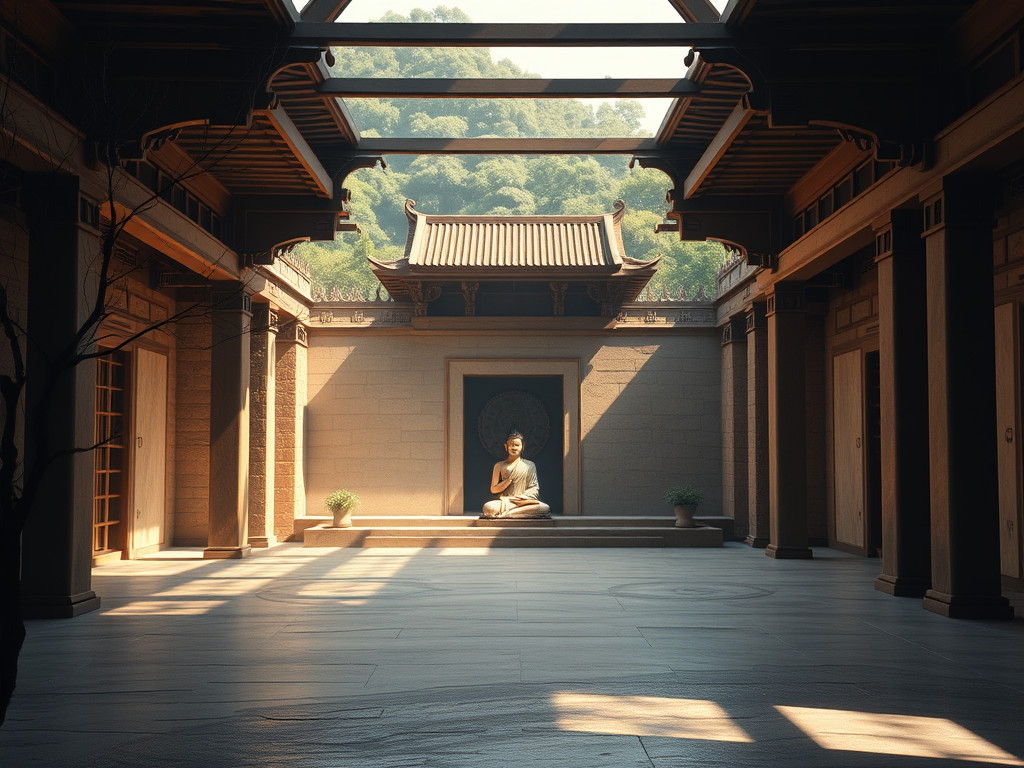
Let us take up Cūḷasuññatasutta in detailed exposition in order to practice and experience it.
Opening Affirmation by the Buddha
“Taggha te etaṁ, ānanda, sussutaṁ suggahitaṁ sumanasikataṁ sūpadhāritaṁ.
Pubbepāhaṁ, ānanda, etarahipi suññatāvihārena bahulaṁ viharāmi.”
“Indeed, Ānanda, this has been well heard, well grasped, well attended to, and well remembered by you. For formerly and even now, Ānanda, I dwell frequently in the abode of emptiness.”
Explanation:
Buddha praises Ānanda for his faithful recollection of his teachings and reiterates that suññatāvihāra is not a new or incidental practice but central to his own meditative abiding — both in the past (pubbe) and present (etarahi).
The Simile of the Empty Palace
Seyyathāpi, ānanda, ayaṁ migāramātupāsādo suñño hatthigavassavaḷavena, suñño jātarūparajatena, suñño itthipurisasannipātena atthi cevidaṁ asuññataṁ yadidaṁ— bhikkhusaṅghaṁ paṭicca ekattaṁ;
Just as, Ānanda, this Migāramātu’s Palace is empty of elephants, cattle, and mares; empty of gold and silver; empty of the gathering of men and women, yet there is this non-emptiness: namely, the unity dependent on the community of monks —
Explanation:
This simile illustrates how a place can be empty of certain things, yet not totally void. What remains (asuññataṁ) is not a “thing” in a material sense, but a relational presence — the ekatta (oneness or unity) of the monastic community gathered there. This introduces the subtlety of suññatāvihāra: not nihilistic absence, but a clearing of certain perceptions while acknowledging what remains.
✅ First Segment: Araññasaññā (Perception of Forest/Wilderness)
Evameva kho, ānanda, bhikkhu amanasikaritvā gāmasaññaṁ, amanasikaritvā manussasaññaṁ, araññasaññaṁ paṭicca manasi karoti ekattaṁ. Tassa araññasaññāya cittaṁ pakkhandati pasīdati santiṭṭhati adhimuccati. So evaṁ pajānāti: ‘ye assu darathā gāmasaññaṁ paṭicca tedha na santi, ye assu darathā manussasaññaṁ paṭicca tedha na santi, atthi cevāyaṁ darathamattā yadidaṁ— araññasaññaṁ paṭicca ekattan’ti. So ‘suññamidaṁ saññāgataṁ gāmasaññāyā’ti pajānāti, ‘suññamidaṁ saññāgataṁ manussasaññāyā’ti pajānāti, ‘atthi cevidaṁ asuññataṁ yadidaṁ— araññasaññaṁ paṭicca ekattan’ti. Iti yañhi kho tattha na hoti tena taṁ suññaṁ samanupassati, yaṁ pana tattha avasiṭṭhaṁ hoti taṁ ‘santamidaṁ atthī’ti pajānāti. Evampissa esā, ānanda, yathābhuccā avipallatthā parisuddhā suññatāvakkanti bhavati.
Just so, Ānanda, a monk, having not given attention to the perception of a village (gāmasaññaṁ), and not given attention to the perception of human beings (manussasaññaṁ), attends to the perception of wilderness (araññasaññaṁ) based on which he directs his mind toward oneness (ekattaṁ).
His mind enters into that perception of wilderness, gains confidence in it, settles on it, and becomes firmly resolved on it.
He understands thus: “Whatever disturbances (darathā) would arise based on the perception of village — those are not present here. Whatever disturbances would arise based on the perception of humans — those are also not present here. But there is this trace of disturbance, namely, the perception of wilderness accompanied by oneness.”
He discerns: “This is empty of the perception of village. This is empty of the perception of humans. Yet there is this non-emptiness, namely, the perception of wilderness attended with oneness.”
Thus, whatever is absent there, he perceives as empty because of that; and what remains there, he understands as: “This is present.”
In this way, Ānanda, this is a true, undistorted, and pure entry into emptiness (suññatāvakkanti).
Amanasikaritvā means “not giving attention to” — deliberate ignoring of the habitual perceptions of social constructs like “village” and “humans”.
Araññasaññaṁ paṭicca manasikaroti ekattaṁ means “he attends to wilderness-perception as a basis for mental unification.” This is not the formless but a deeply tranquil saññā grounded in solitude.
Cittaṁ pakkhandati pasīdati santiṭṭhati adhimuccati describes a fourfold engagement of mind:
Pakkhandati — leaps forth into the object, Pasīdati — becomes clear or confident, Santiṭṭhati — becomes established or settled, Adhimuccati — becomes resolutely fixed or determined. Darathā: Mental disturbances, restlessness, or feverishness (citta-daratha). The monk clearly sees:
This field of perception is empty of the earlier ones (gāmasaññā, manussasaññā), Yet there is a subtle trace of constructed perception — araññasaññā + ekatta.
This is a refined entry into emptiness — not annihilation of awareness, but careful discrimination of what is present and what is absent, forming the heart of yathābhūta ñāṇadassana (seeing things as they are).
✅ Second Segment: Pathavīsaññā (Perception of Earth Element)
Puna caparaṁ, ānanda, bhikkhu amanasikaritvā manussasaññaṁ, amanasikaritvā araññasaññaṁ, pathavīsaññaṁ paṭicca manasi karoti ekattaṁ. Tassa pathavīsaññāya cittaṁ pakkhandati pasīdati santiṭṭhati adhimuccati. Seyyathāpi, ānanda, āsabhacammaṁ saṅkusatena suvihataṁ vigatavalikaṁ; evameva kho, ānanda, bhikkhu yaṁ imissā pathaviyā ukkūlavikkūlaṁ nadīviduggaṁ khāṇukaṇṭakaṭṭhānaṁ pabbatavisamaṁ taṁ sabbaṁ amanasikaritvā pathavīsaññaṁ paṭicca manasi karoti ekattaṁ. Tassa pathavīsaññāya cittaṁ pakkhandati pasīdati santiṭṭhati adhimuccati. So evaṁ pajānāti: ‘ye assu darathā manussasaññaṁ paṭicca tedha na santi, ye assu darathā araññasaññaṁ paṭicca tedha na santi, atthi cevāyaṁ darathamattā yadidaṁ— pathavīsaññaṁ paṭicca ekattan’ti. So ‘suññamidaṁ saññāgataṁ manussasaññāyā’ti pajānāti, ‘suññamidaṁ saññāgataṁ araññasaññāyā’ti pajānāti, ‘atthi cevidaṁ asuññataṁ yadidaṁ— pathavīsaññaṁ paṭicca ekattan’ti. Iti yañhi kho tattha na hoti tena taṁ suññaṁ samanupassati, yaṁ pana tattha avasiṭṭhaṁ hoti taṁ ‘santamidaṁ atthī’ti pajānāti. Evampissa esā, ānanda, yathābhuccā avipallatthā parisuddhā suññatāvakkanti bhavati.
Again, Ānanda, a monk, having not attended to the perception of humans, and having not attended to the perception of wilderness, attends to the perception of earth (pathavīsaññaṁ) based on which he directs his mind toward oneness.
His mind enters into that perception of earth, becomes pleased with it, settles upon it, and becomes firmly committed to it.
Just as, Ānanda, a bull’s hide, well cleaned with a shaving tool, free of patches — even so, Ānanda, a monk, without attending to this earth’s unevenness, roughness, river inlets, stumps and thorns, and mountain irregularities, attends instead to the perception of earth in unification.
His mind enters, becomes pleased, settles, and commits to that perception.
He understands: “Whatever disturbances would arise due to perception of humans — they are not here. Whatever disturbances would arise due to perception of wilderness — they are not here. But there is a trace of disturbance — that is, this perception of earth together with oneness.”
He understands: “This is empty of perception of humans. This is empty of perception of wilderness. But there is non-emptiness, namely, perception of earth together with oneness.”
Thus, what is absent he sees as empty; what remains he knows as: “This is present.”
In this way too, Ānanda, this is the true, undistorted, and purified entry into emptiness. Explanation:
Moving subtler: from arañña to pathavī. Earth perception (pathavīsaññā) is a base for tranquility meditation (samatha), such as kasiṇa or spatial steadiness — seeing the earth as uniform, unmoving, vast. The simile (bull hide shaved smooth) signifies removing surface irregularities — just as one ignores geographical features and focuses only on the uniformity of the perception. Once again, the monk applies suññatāvakkanti: discerning what has been abandoned and what subtle perception remains. Even though disturbances from human or wilderness perception are gone, a trace remains — that is pathavīsaññā itself.
✅ Third Segment: Ākāsānañcāyatanasaññā (Perception of the Sphere of Infinite Space)
Puna caparaṁ, ānanda, bhikkhu amanasikaritvā araññasaññaṁ, amanasikaritvā pathavīsaññaṁ, ākāsānañcāyatanasaññaṁ paṭicca manasi karoti ekattaṁ. Tassa ākāsānañcāyatanasaññāya cittaṁ pakkhandati pasīdati santiṭṭhati adhimuccati. So evaṁ pajānāti: ‘ye assu darathā araññasaññaṁ paṭicca tedha na santi, ye assu darathā pathavīsaññaṁ paṭicca tedha na santi, atthi cevāyaṁ darathamattā yadidaṁ— ākāsānañcāyatanasaññaṁ paṭicca ekattan’ti. So ‘suññamidaṁ saññāgataṁ araññasaññāyā’ti pajānāti, ‘suññamidaṁ saññāgataṁ pathavīsaññāyā’ti pajānāti, ‘atthi cevidaṁ asuññataṁ yadidaṁ— ākāsānañcāyatanasaññaṁ paṭicca ekattan’ti. Iti yañhi kho tattha na hoti tena taṁ suññaṁ samanupassati, yaṁ pana tattha avasiṭṭhaṁ hoti taṁ ‘santamidaṁ atthī’ti pajānāti. Evampissa esā, ānanda, yathābhuccā avipallatthā parisuddhā suññatāvakkanti bhavati.
Again, Ānanda, a monk, having not attended to the perception of wilderness (araññasaññaṁ), and having not attended to the perception of earth (pathavīsaññaṁ), attends to the perception of the sphere of infinite space (ākāsānañcāyatanasaññaṁ) and based on that directs his mind toward oneness (ekattaṁ).
His mind enters into that perception of infinite space, becomes pleased with it, settles upon it, and becomes firmly resolved on it.
He understands: “Whatever disturbances (darathā) would arise from the perception of wilderness — those are not present here. Whatever disturbances would arise from the perception of earth — those are not present here. But there is this trace of disturbance: namely, that which arises from the perception of the sphere of infinite space with oneness.”
He understands: “This is empty of the perception of wilderness. This is empty of the perception of earth. But there is this non-emptiness: namely, perception of infinite space with oneness.”
Thus, whatever is not present there, he sees as empty; and whatever remains, he knows: “This is present.”
In this way too, Ānanda, this is a true, undistorted, and purified entry into emptiness. Explanation:
Transition: The meditator now transcends perceptions grounded in physical terrain and solidity — moving into formless perception (arūpasaññā).
Ākāsānañcāyatanasaññā: “Perception of the base of infinite space” — the first formless attainment. The meditator focuses on the vast, boundless, infinite aspect of space as a mental field. This perception is not grounded in form but is fabricated from the preceding jhānic state and requires abandoning all sense of “things” (earth, place, forest). Again, darathā — agitation, disturbance — is noted as absent in former perceptions, but there is still a trace due to the presence of a subtle perception.
Ekatta: Oneness remains central. Even in formless states, ekatta is the stabilizing factor that makes these states meditative rather than just conceptual.
✅ Fourth Segment: Viññāṇañcāyatanasaññā (Perception of the Sphere of Infinite Consciousness)
Puna caparaṁ, ānanda, bhikkhu amanasikaritvā pathavīsaññaṁ, amanasikaritvā ākāsānañcāyatanasaññaṁ, viññāṇañcāyatanasaññaṁ paṭicca manasi karoti ekattaṁ. Tassa viññāṇañcāyatanasaññāya cittaṁ pakkhandati pasīdati santiṭṭhati adhimuccati. So evaṁ pajānāti: ‘ye assu darathā pathavīsaññaṁ paṭicca tedha na santi, ye assu darathā ākāsānañcāyatanasaññaṁ paṭicca tedha na santi, atthi cevāyaṁ darathamattā yadidaṁ— viññāṇañcāyatanasaññaṁ paṭicca ekattan’ti. So ‘suññamidaṁ saññāgataṁ pathavīsaññāyā’ti pajānāti, ‘suññamidaṁ saññāgataṁ ākāsānañcāyatanasaññāyā’ti pajānāti, ‘atthi cevidaṁ asuññataṁ yadidaṁ— viññāṇañcāyatanasaññaṁ paṭicca ekattan’ti. Iti yañhi kho tattha na hoti tena taṁ suññaṁ samanupassati, yaṁ pana tattha avasiṭṭhaṁ hoti taṁ ‘santamidaṁ atthī’ti pajānāti. Evampissa esā, ānanda, yathābhuccā avipallatthā parisuddhā suññatāvakkanti bhavati.
Again, Ānanda, a monk, having not attended to the perception of earth (pathavīsaññaṁ), and not attended to the perception of the sphere of infinite space (ākāsānañcāyatanasaññaṁ), attends to the perception of the sphere of infinite consciousness (viññāṇañcāyatanasaññaṁ) and based on that directs his mind toward oneness (ekattaṁ).
His mind enters into that perception of infinite consciousness, becomes pleased with it, settles upon it, and becomes firmly committed to it.
He understands: “Whatever disturbances would arise from perception of earth — those are not present here. Whatever disturbances would arise from perception of infinite space — those are not present here. But there is a trace of disturbance: namely, that which arises from perception of infinite consciousness along with oneness.”
He understands: “This is empty of the perception of earth. This is empty of the perception of infinite space. But there is non-emptiness: namely, perception of infinite consciousness with oneness.”
Thus, whatever is not there, he regards as empty; and whatever is present, he discerns as: “This is existing.” In this way too, Ānanda, this is a true, undistorted, and purified entry into emptiness.
Explanation:
Viññāṇañcāyatanasaññā: This is the second formless attainment — “the base of infinite consciousness.” The meditator shifts from perceiving the boundlessness of external space to perceiving the boundlessness of awareness itself. One lets go even of spatiality (ākāsā), and the field of meditation becomes consciousness without bound or object. Still, this perception is also a construct — a formation — and thus has a daratha, however subtle. The pattern of emptiness remains: What is abandoned is seen as suñña (empty), What remains is known precisely — as the asuññata (non-emptiness), This precise discernment constitutes yathābhūta ñāṇa, not mere philosophical emptiness.
🔷 1. What is Viññāṇañcāyatanasaññā?
Viññāṇañcāyatana = Viññāṇa (consciousness) + Āyatana (dimension/base/sphere)
This refers to the sphere of infinite consciousness — a meditative absorption (samāpatti) in which: There is no form perception. One directly perceives consciousness as infinite, boundless, unlocalized. There is still perception, attention, concentration, and existence of subtle will (though very refined).
🔷 2. Sutta Sources for Viññāṇañcāyatana
Though technical descriptions are sparse, the Pāli Canon offers crucial hints:
MN 121 – Suññatāsutta (you’re already studying):
The meditator lets go of ākāsānañcāyatanasaññā (perception of infinite space).
Then attends to viññāṇañcāyatanasaññā, experiences unification (ekatta), and remains with confidence and clarity.
MN 111 – Anupadāsutta: Sāriputta is said to attain ākāsānañcāyatanaṁ, then viññāṇañcāyatanaṁ, then ākiñcaññāyatanaṁ… He discerns what is present, its origin, cessation, and the gratification/danger/escape.
DN 15 – Mahānidāna Sutta: Consciousness (viññāṇa) is said to be established (patiṭṭhaṃ) only when there is name-and-form (nāma-rūpa). Thus, to perceive consciousness in its boundless mode, one must withdraw from all form and naming.
🔷 3. Prerequisites Before Attempting
Before Viññāṇañcāyatanasaññā, the meditator must:
Requirement Description
Full mastery of the Fourth Jhāna Absolute equanimity, purity of mindfulness, no vitakka/vicāra
Mastery of Ākāsānañcāyatana Letting go of perception of form; infinite space perception established
Strong mindfulness and non-identification No craving or delight (nandi-rāga) in perception itself. Without detachment from the prior, the next cannot be entered. These are mutually exclusive saññā.
🔷 4. Step-by-Step Entry into Viññāṇañcāyatana
➤ Step 1: Abandoning Ākāsānañcāyatana
You reflect: “This infinite space is known — therefore it is not ultimate. There is something subtler.” This recognition is the seed of transcendence.
You observe that: There is awareness of space — which implies consciousness is present and more fundamental. You let go of ākāsānañcāyatana as the object. Then shift attention: “This awareness itself — this knowing — what if this becomes the meditation object?”
➤ Step 2: Attending to Infinite Consciousness
You withdraw from attending to spatiality and turn the attention inward. The mind ceases to hold onto the perception of spatial field, and instead rests in the knowing quality itself. You now sustain: “Infinite is this awareness.” Not a thought, but a direct experiential perception of the boundlessness of viññāṇa. This may feel like: A luminous, transparent field, With no location or form, just a sense of unbroken, limitless knowing.
🔷 5. Characteristics of Viññāṇañcāyatanasaññā
| Aspect | Description |
|---|---|
| Object | Infinite consciousness (viññāṇaṃ anantaṃ) |
| Mental Factors Present | Equanimity (upekkhā), one-pointedness (ekaggatā), mindfulness (sati) |
| Absent | Perception of form, spatial direction, bodily sense |
| Perception Type | Non-conceptual, non-dual; perception of boundless awareness itself |
| Vedana (Feeling) | Subtle neutral feeling (adukkhamasukha) |
This is not awareness of specific objects or thoughts, but the bare field of consciousness in its infinitude.
🔷 6. How to Verify This Attainment?
Verification is experiential, but guided by sutta-based discernment:
| Criterion | How to Observe |
|---|---|
| Absence of Form (rūpa) | No perception of body, space, or boundaries |
| No spatial perception | There is no “inside” or “outside,” no above/below |
| Single unified knowing | Consciousness not divided by object-subject split |
| Subtle disturbance remains | As noted in MN 121, there is still subtle daratha due to the constructed perception of “infinite consciousness” |
| Emergence from state | Upon emerging, one reflects: “There was that perception of infinite consciousness” |
| Insight discernment | As per MN 111, one contemplates its arising, ceasing, its gratification (assāda), danger (ādīnava), and escape (nissaraṇa) |
If these are confirmed, then one has verified viññāṇañcāyatanasaññā.
From MN 121: So ‘suññamidaṁ saññāgataṁ pathavīsaññāyā’ti pajānāti, ‘suññamidaṁ saññāgataṁ ākāsānañcāyatanasaññāyā’ti pajānāti, ‘atthi cevidaṁ asuññataṁ yadidaṁ— viññāṇañcāyatanasaññaṁ paṭicca ekattan’ti.
“He discerns: ‘This is empty of the perception of earth, empty of the perception of infinite space; but there is a non-emptiness — namely, the perception of infinite consciousness together with unification.’” This tells the meditator exactly what has been left behind and what subtle construct still remains — this clear seeing is the verification.
✅ Ākiñcaññāyatanasaññā (Perception of the Base of Nothingness)
Puna caparaṁ, ānanda, bhikkhu amanasikaritvā ākāsānañcāyatanasaññaṁ, amanasikaritvā viññāṇañcāyatanasaññaṁ, ākiñcaññāyatanasaññaṁ paṭicca manasi karoti ekattaṁ. Tassa ākiñcaññāyatanasaññāya cittaṁ pakkhandati pasīdati santiṭṭhati adhimuccati. So evaṁ pajānāti: ‘ye assu darathā ākāsānañcāyatanasaññaṁ paṭicca tedha na santi, ye assu darathā viññāṇañcāyatanasaññaṁ paṭicca tedha na santi, atthi cevāyaṁ darathamattā yadidaṁ— ākiñcaññāyatanasaññaṁ paṭicca ekattan’ti. So ‘suññamidaṁ saññāgataṁ ākāsānañcāyatanasaññāyā’ti pajānāti, ‘suññamidaṁ saññāgataṁ viññāṇañcāyatanasaññāyā’ti pajānāti, ‘atthi cevidaṁ asuññataṁ yadidaṁ— ākiñcaññāyatanasaññaṁ paṭicca ekattan’ti. Iti yañhi kho tattha na hoti tena taṁ suññaṁ samanupassati, yaṁ pana tattha avasiṭṭhaṁ hoti taṁ ‘santamidaṁ atthī’ti pajānāti. Evampissa esā, ānanda, yathābhuccā avipallatthā parisuddhā suññatāvakkanti bhavati.
Again, Ānanda, a monk, not giving attention to the perception of the base of infinite space (ākāsānañcāyatanasaññaṁ), not giving attention to the perception of the base of infinite consciousness (viññāṇañcāyatanasaññaṁ), attends to the perception of the base of nothingness (ākiñcaññāyatanasaññaṁ) and, based on that, directs his mind toward unification (ekattaṁ).
His mind leaps toward that perception, gains clarity, becomes stable, and firmly resolves on it.
He understands: “Whatever disturbances (darathā) might arise from the perception of infinite space — they are not here; whatever disturbances might arise from the perception of infinite consciousness — they are not here. But there is still this subtle trace of disturbance — namely, the perception of nothingness along with oneness.”
He understands: “This is empty of the perception of infinite space. This is empty of the perception of infinite consciousness. But there is this non-emptiness — namely, the perception of the base of nothingness with unification.”
Thus, whatever is not present there, he discerns as empty; and whatever is still present, he discerns: “This exists.”
In this way too, Ānanda, this is a genuine, undistorted, purified entry into emptiness (suññatāvakkanti).
✅ Explanation (In-Depth):
🔹 Stepwise Summary of What Happens:
The monk has already gone beyond: ākāsānañcāyatana: boundless space, viññāṇañcāyatana: boundless consciousness. Now he shifts into: ākiñcaññāyatana: “the base of nothingness” or “non-existence.”
🔹 What is Ākiñcaññāyatanasaññā?
“Ākiñcañña” = a- (not) + kiñca (something, anything) → “nothingness.”
The mind no longer attends to any perceived object (not even consciousness). Instead, it reflects: “There is nothing.” That reflection itself becomes the object of concentration. This is not annihilation, but the perception of nothing — nothing to grasp, nothing to define. It is deeper than perception of consciousness; now one sees even consciousness as “too much.”
🔹 Key Terms:
| Pāli Term | Explanation |
|---|---|
| Amanasikaritvā | Not attending to; deliberate non-attention |
| Ekattaṁ manasi karoti | Makes unification the object of his mental focus |
| Cittaṁ pakkhandati | The mind leaps into that perception |
| Pasīdati | Gains clarity and serenity |
| Santiṭṭhati | Becomes stable |
| Adhimuccati | Becomes fully committed or resolute |
🔹 Understanding the Daratha (Disturbance):
The monk clearly discerns: No more daratha from the prior stages (space, consciousness). However, a subtle trace remains due to attending to “nothingness” — it is still a constructed perception (abhisaṅkhata saññā). He sees: Even this experience is not ultimate. But he does not suppress it — he just knows it clearly.
🔹 Application of Suññatāvakkanti (Entry into Emptiness):
The principle continues: seeing what is absent as suñña (empty), and what still remains as santa atthi (“this is present”). He understands:
“This is empty of boundless space.”
“This is empty of boundless consciousness.”
“This still contains the perception of nothingness.”
This is a pure insight into how perception constructs experience, and how subtle mental activity sustains even the finest meditative attainments.
✅ Summary of This Stage:
| Aspect | Description |
|---|---|
| Stage | Third arūpa-jhāna: ākiñcaññāyatana |
| Object | The perception that “there is nothing” (natthi kiñcī’ti) |
| What is Let Go | Spatial and conscious field of perception |
| Mental State | Unified, subtle, disengaged from form and self-reference |
| Insight | Even this is conditioned, contains subtle disturbance (daratha) |
✅ NEVASAÑÑĀNĀSAÑÑĀYATANA (Base of Neither-Perception-Nor-Non-Perception)
Puna caparaṁ, ānanda, bhikkhu amanasikaritvā viññāṇañcāyatanasaññaṁ, amanasikaritvā ākiñcaññāyatanasaññaṁ, nevasaññānāsaññāyatanasaññaṁ paṭicca manasi karoti ekattaṁ. Tassa nevasaññānāsaññāyatanasaññāya cittaṁ pakkhandati pasīdati santiṭṭhati adhimuccati. So evaṁ pajānāti: ‘ye assu darathā viññāṇañcāyatanasaññaṁ paṭicca tedha na santi, ye assu darathā ākiñcaññāyatanasaññaṁ paṭicca tedha na santi, atthi cevāyaṁ darathamattā yadidaṁ— nevasaññānāsaññāyatanasaññaṁ paṭicca ekattan’ti. So ‘suññamidaṁ saññāgataṁ viññāṇañcāyatanasaññāyā’ti pajānāti, ‘suññamidaṁ saññāgataṁ ākiñcaññāyatanasaññāyā’ti pajānāti, ‘atthi cevidaṁ asuññataṁ yadidaṁ— nevasaññānāsaññāyatanasaññaṁ paṭicca ekattan’ti. Iti yañhi kho tattha na hoti tena taṁ suññaṁ samanupassati, yaṁ pana tattha avasiṭṭhaṁ hoti taṁ ‘santamidaṁ atthī’ti pajānāti. Evampissa esā, ānanda, yathābhuccā avipallatthā parisuddhā suññatāvakkanti bhavati.
Again, Ānanda, a monk, not attending to the perception of the base of infinite consciousness, not attending to the perception of the base of nothingness (ākiñcaññāyatana), attends to the perception of the base of neither-perception-nor-non-perception (nevasaññānāsaññāyatanasaññā) and based on that, he directs his mind toward oneness (ekattaṁ).
His mind enters into that perception, becomes pleased with it, settles upon it, and becomes fully committed to it.
He understands: “Whatever disturbances (darathā) would arise from the perception of the base of infinite consciousness — they are not here; whatever disturbances would arise from the perception of the base of nothingness — they are not here. But there is this trace of disturbance — namely, that arising due to the perception of the base of neither-perception-nor-non-perception with oneness.”
He understands: “This is empty of the perception of infinite consciousness; this is empty of the perception of the base of nothingness; but there is this non-emptiness — namely, perception of the base of neither-perception-nor-non-perception with oneness.”
Thus, what is not present he sees as empty; what remains he knows as: “This is present.”
In this way too, Ānanda, this is a genuine, undistorted, purified entry into emptiness.
Explanation:
This is the subtlest stage of perception, where perception is so faint that it cannot be identified clearly as either “existing” or “non-existing.” Neither-perception-nor-non-perception: a perception that does not engage in mental labeling, but is not completely unconscious. The mind remains unified, but perception is barely traceable, not coarse enough to be grasped. Even here, there is still some residual disturbance (daratha) due to the presence of a subtle construction — thus it too is seen as conditioned and not ultimate.
✅ ANIMITTA CETOSAMĀDHI (Signless Concentration of Mind)
Puna caparaṁ, ānanda, bhikkhu amanasikaritvā ākiñcaññāyatanasaññaṁ, amanasikaritvā nevasaññānāsaññāyatanasaññaṁ, animittaṁ cetosamādhiṁ paṭicca manasi karoti ekattaṁ. Tassa animitte cetosamādhimhi cittaṁ pakkhandati pasīdati santiṭṭhati adhimuccati. So evaṁ pajānāti: ‘ye assu darathā ākiñcaññāyatanasaññaṁ paṭicca tedha na santi, ye assu darathā nevasaññānāsaññāyatanasaññaṁ paṭicca tedha na santi, atthi cevāyaṁ darathamattā yadidaṁ— imameva kāyaṁ paṭicca saḷāyatanikaṁ jīvitapaccayā’ti. So ‘suññamidaṁ saññāgataṁ ākiñcaññāyatanasaññāyā’ti pajānāti, ‘suññamidaṁ saññāgataṁ nevasaññānāsaññāyatanasaññāyā’ti pajānāti, ‘atthi cevidaṁ asuññataṁ yadidaṁ— imameva kāyaṁ paṭicca saḷāyatanikaṁ jīvitapaccayā’ti. Iti yañhi kho tattha na hoti tena taṁ suññaṁ samanupassati, yaṁ pana tattha avasiṭṭhaṁ hoti taṁ ‘santamidaṁ atthī’ti pajānāti. Evampissa esā, ānanda, yathābhuccā avipallatthā parisuddhā suññatāvakkanti bhavati.
Again, Ānanda, a monk, not attending to the perception of the base of nothingness, not attending to the perception of the base of neither-perception-nor-non-perception, attends to signless concentration of mind (animittaṁ cetosamādhiṁ) and based on that, directs his mind toward oneness.
His mind enters into that signless concentration, becomes pleased with it, settles upon it, and becomes fully committed to it.
He understands: “Whatever disturbances would arise from the perception of the base of nothingness — they are not here; whatever disturbances would arise from the perception of neither-perception-nor-non-perception — they are not here. But there is this trace of disturbance — namely, that which arises dependent on this very body endowed with the six sense bases, sustained by life.”
He understands: “This is empty of perception of the base of nothingness; this is empty of the perception of neither-perception-nor-non-perception; but there is non-emptiness — namely, this very body with its six sense bases, sustained by life.”
Thus, what is absent he sees as empty; what remains he knows as: “This is present.”
In this way too, Ānanda, this is a genuine, undistorted, purified entry into emptiness. Explanation:
Animitta cetosamādhi: The signless concentration refers to a mind freed from all mental signs (nimitta) — no form, no perception, no grasping. It is an absorptive state bordering nibbāna. The last remaining disturbance (daratha) is not due to perception, but due to the fact of being embodied, with six sense bases and breath (jīvitapaccaya). Even when all mental signs have ceased, life remains — until cessation is attained.
✅ Realization and Liberation
Puna caparaṁ, ānanda, bhikkhu amanasikaritvā ākiñcaññāyatanasaññaṁ, amanasikaritvā nevasaññānāsaññāyatanasaññaṁ, animittaṁ cetosamādhiṁ paṭicca manasi karoti ekattaṁ. Tassa animitte cetosamādhimhi cittaṁ pakkhandati pasīdati santiṭṭhati adhimuccati. So evaṁ pajānāti: ‘ayampi kho animitto cetosamādhi abhisaṅkhato abhisañcetayito’. ‘Yaṁ kho pana kiñci abhisaṅkhataṁ abhisañcetayitaṁ tadaniccaṁ nirodhadhamman’ti pajānāti. Tassa evaṁ jānato evaṁ passato kāmāsavāpi cittaṁ vimuccati, bhavāsavāpi cittaṁ vimuccati, avijjāsavāpi cittaṁ vimuccati. Vimuttasmiṁ vimuttamiti ñāṇaṁ hoti. ‘Khīṇā jāti, vusitaṁ brahmacariyaṁ, kataṁ karaṇīyaṁ, nāparaṁ itthattāyā’ti pajānāti.
Again, Ānanda, a monk, not attending to the perception of the base of nothingness, not attending to the perception of neither-perception-nor-non-perception, attends to signless concentration of mind, and based on that, directs his mind toward oneness.
His mind enters into that signless concentration, becomes pleased with it, settles upon it, and becomes fully committed to it.
He understands: “Even this signless concentration is constructed, willed.”
And he understands: “Whatever is constructed and willed is impermanent, subject to cessation.”
Knowing and seeing thus, his mind is liberated from the taint of sensuality (kāmāsava), from the taint of becoming (bhavāsava), and from the taint of ignorance (avijjāsava).
When liberated, there is the knowledge: “It is liberated.”
He understands: “Birth is ended, the holy life is fulfilled, the task is done, there is no further becoming.”
Explanation:
The meditator realizes that even the most refined concentration, animitta cetosamādhi, is still fabricated (abhisaṅkhato), thus impermanent. This insight causes the final cessation of clinging, and the āsavas are destroyed:
Kāmāsava: craving for sensuality,
Bhavāsava: craving for existence or non-existence,
Avijjāsava: fundamental ignorance.
Liberation arises, with clear knowledge that the mind is freed and nothing more needs to be done.
✅ Final Suññatāvakkanti: The Ultimate Entry into Emptiness
So evaṁ pajānāti: ‘ye assu darathā kāmāsavaṁ paṭicca tedha na santi, ye assu darathā bhavāsavaṁ paṭicca tedha na santi, ye assu darathā avijjāsavaṁ paṭicca tedha na santi, atthi cevāyaṁ darathamattā yadidaṁ— imameva kāyaṁ paṭicca saḷāyatanikaṁ jīvitapaccayā’ti. So ‘suññamidaṁ saññāgataṁ kāmāsavenā’ti pajānāti, ‘suññamidaṁ saññāgataṁ bhavāsavenā’ti pajānāti, ‘suññamidaṁ saññāgataṁ avijjāsavenā’ti pajānāti, ‘atthi cevidaṁ asuññataṁ yadidaṁ— imameva kāyaṁ paṭicca saḷāyatanikaṁ jīvitapaccayā’ti. Iti yañhi kho tattha na hoti tena taṁ suññaṁ samanupassati, yaṁ pana tattha avasiṭṭhaṁ hoti taṁ ‘santamidaṁ atthī’ti pajānāti. Evampissa esā, ānanda, yathābhuccā avipallatthā parisuddhā paramānuttarā suññatāvakkanti bhavati.
He understands: “Whatever disturbances would arise from sensual taints — they are no longer present; from becoming taints — they are not present; from ignorance taints — they are not present. But there is still this trace of disturbance — namely, this very body, dependent on the six sense bases, sustained by life.”
He understands: “This is empty of the taint of sensuality, this is empty of the taint of becoming, this is empty of the taint of ignorance; but there is this non-emptiness — namely, this body dependent on the six sense bases, sustained by life.”
Thus, what is not present he sees as empty; what remains he knows as: “This is present.”
In this way, Ānanda, this is the true, undistorted, purified, and supreme entry into emptiness.
🗺️ The Eight Stages of Suññatāvakkanti (Entry into Emptiness)
| Stage | Pāli Perception Adopted | Perceptions Abandoned | Perception Present (Asuññata) | Type of Suññatāvakkanti |
|---|---|---|---|---|
| 1 | Araññasaññā | Gāmasaññā, Manussasaññā | Araññasaññā + ekatta | Initial |
| 2 | Pathavīsaññā | Manussasaññā, Araññasaññā | Pathavīsaññā + ekatta | Refined (based on kasiṇa) |
| 3 | Ākāsānañcāyatanasaññā | Araññasaññā, Pathavīsaññā | Ākāsānañcāyatanasaññā + ekatta | Formless Entry 1 |
| 4 | Viññāṇañcāyatanasaññā | Pathavīsaññā, Ākāsānañcāyatanasaññā | Viññāṇañcāyatanasaññā + ekatta | Formless Entry 2 |
| 5 | Ākiñcaññāyatanasaññā | Ākāsānañcāyatanasaññā, Viññāṇañcāyatanasaññā | Ākiñcaññāyatanasaññā + ekatta | Formless Entry 3 |
| 6 | Nevasaññānāsaññāyatanasaññā | Viññāṇañcāyatanasaññā, Ākiñcaññāyatanasaññā | Nevasaññānāsaññāyatanasaññā + ekatta | Formless Entry 4 (subtlest perception) |
| 7 | Animitta cetosamādhi | Ākiñcaññāyatanasaññā, Nevasaññānāsaññāyatanasaññā | Trace: imameva kāyaṁ + saḷāyatanikaṁ + jīvitapaccaya | Supramundane threshold |
| 8 | Animitta cetosamādhi + realization | All saññā + all saṅkhata abandoned | Only life-support remains; āsavas destroyed | Paramānuttarā (supreme and final) |