
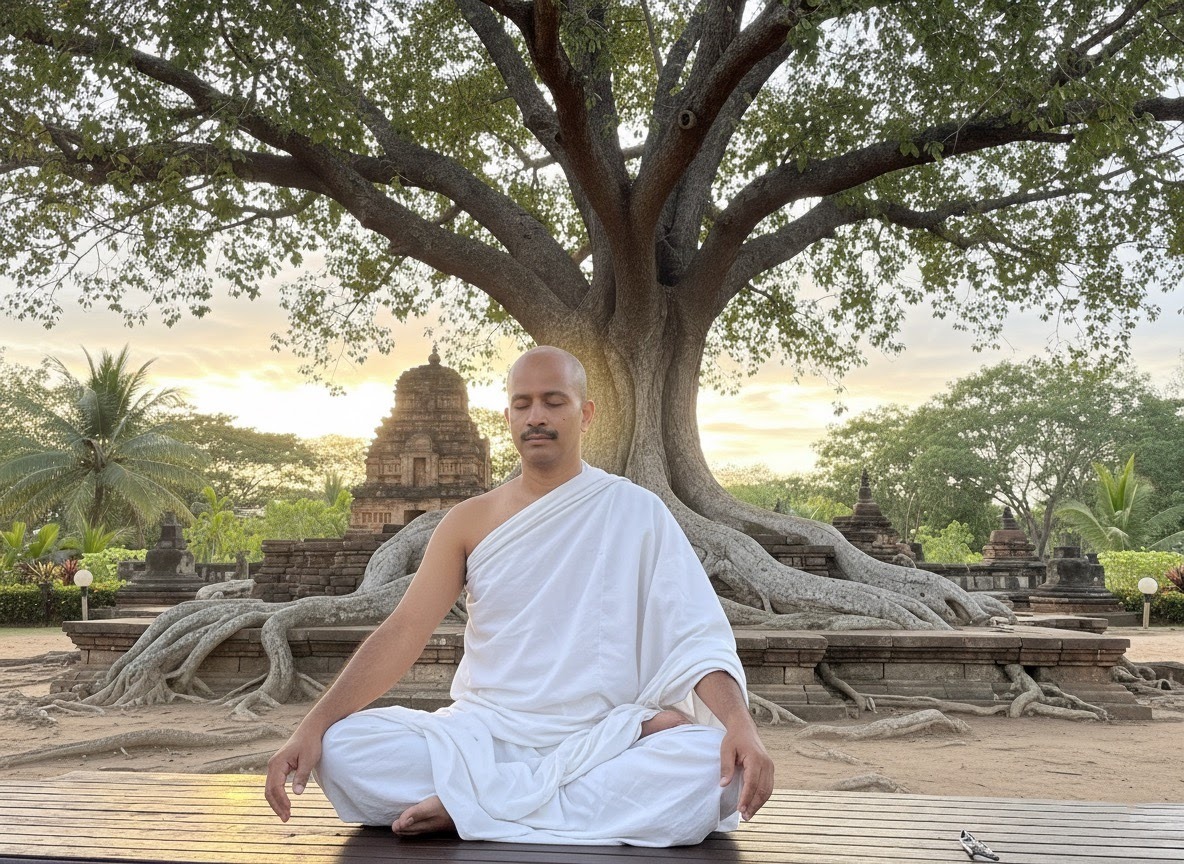
Let us get deeper into jhānas on how to attain them, how would one know that they have entered, how they have stayed there and how they have exited.
Also, there are preliminary things that need to be there before the jhānas are possible as in being secluded from sensual pleasures and all immoral deeds. Culmination of nirodhasamapatti shows that he is an anāgami and not otherwise.
Etymology of Jhāna
Derived from the root:√jhā (Sanskrit: √dhyai) – “to meditate”, “to contemplate”, “to burn (with focus)”.
The word jhāna (Pāli) is equivalent to dhyāna in Sanskrit. It has two connected roots that are often emphasized in traditional and commentarial interpretations:
From √dhyai – to contemplate or meditate
This is the primary derivation accepted in the Suttas and by classical grammarians.
Jhāna refers to the deep meditative absorption characterized by focused attention on a single object.
It is the process of sustaining the mind on a wholesome object, such as the breath, a kasina, or a quality like loving-kindness.
From √jhā – to burn
This interpretation is often highlighted by the commentarial tradition (e.g., Visuddhimagga).
Jhāna is that which “burns up” the hindrances (pañca nīvaraṇāni), like sensual desire, ill-will, sloth, restlessness, and doubt.
Here, jhāna functions like a flame that consumes impurities.
So:Jhāna = meditative absorption that either “burns defilements” or arises through “deep contemplation.”
Without much ado, let’s deep dive into it.
Sutta references: MN119, AN9.36, SN36.19, MN111, DN2, MN8, MN121, MN140
✅ Summary from above Suttas
| Jhāna | Source of Joy | Factors Present | Key Transition |
|---|---|---|---|
| 1st | Seclusion | Vitakka, Vicāra, Pīti, Sukha | Withdrawal from sensual of sight, sound, taste, touch and smell with removal of unwholesome deeds (10 immoral deeds to be precise |
| 2nd | Focus and attention | Pīti, Sukha, Ajjhatta Sampasādana | Letting go of thought |
| 3rd | Detachment | Sukha, Upekkhā, Sati | Fading of pīti |
| 4th | Equanimity | Upekkhā-sati-pārisuddhi | Letting go of sukha |
| 5th | Space | Perception of Infinite Space | Transcending form |
| 6th | Consciousness | Perception of Infinite Viññāṇa | Transcending space |
| 7th | Nothingness | Perception of “There is nothing” | Transcending consciousness |
| 8th | Ultra-subtle | Neither-perception-nor-non-perception | Transcending perception |
First Jhāna (Paṭhama Jhāna) – Simile (MN 119):
A bathman kneads soap powder with water until it becomes a lather that moistens the entire body.
Meaning: The mind pervades and saturates the body with joy and bliss from seclusion.
How to Enter:
Withdraw from sensual pleasures as in 5 senses x 6 gunas and unwholesome mental states as in 10 immoral deeds
Focus on breath which then brings in the attention towards that object. Keep this focus/attention for long period of time without a break.
Direct the mind again and again (vitakka), and sustain it (vicāra) towards this object as in breath
Knowing It’s Arisen:
Strong sense of rapture (pīti) and pleasure (sukha) starts to occur
Thought is still present, but stable as the main focus & attention is on the breath
Mind and body starts to feel joyful, energized, and unified.
Second Jhāna (Dutiya Jhāna) – Simile (MN 119):
A deep lake fed by underground springs, still and clear, filled from within.
Meaning: The bliss is no longer “applied” — it wells up from inner unification and can be felt all over
How to Enter:
Let go of mental effort (vitakka–vicāra).
Allow joy and plesaure to deepen naturally in every pores of the body from head to toe.
Knowing It’s Arisen:
No more internal verbalization or applied thought is required to get into the flow.
Seems like “free flow” and those who are well versed with S.N Goneka/ U Ba Khin / Burmese technique can know this better when it happens. There would be no part of the body which has no “free flow” and it would seem an endless bath on the head to toe making one to feel relaxed and comfortable.
Unshakable rapture and pleasure born of concentration.
Deep internal confidence (ajjhatta-sampasādana) and one-ness (ekaggatā).
Third Jhāna (Tatiya Jhāna) – Simile (MN 119):
A lotus fully immersed in water — cool, saturated from all directions.
Meaning: Bliss spreads throughout the body without movement or disturbance.
How to Enter:
Let the excitement of joy (pīti) fade.
Stay with peaceful bodily pleasure (sukha) and equanimity.
Knowing It’s Arisen:
Joy fades; equanimity (upekkhā) increases.
Pleasure remains, but it is serene and non-exciting.
Clear mindfulness (sati) and full awareness (sampajañña).
Fourth Jhāna (Catuttha Jhāna) – Simile (MN 119):
A person wrapped completely in a clean white cloth — even, neutral, untouched.
Meaning: Total balance, peace, and detachment. Sometimes, you get a pure bright white light which grows into a big way all across. However, this is not a requirement as such to get a bright light
How to Enter:
Let go of both pleasure and pain.
Rest in perfect equanimity and in awareness
Knowing It’s Arisen:
No pleasure or pain — only peace.
Strong equanimity (upekkhā) and mindfulness (sati-pārisuddhi).
Still, unmoving, silent mind.
Base of Infinite Space (Ākāsānañcāyatana) – Simile (AN 9.36):
Space is perceived as infinite — stretching beyond all boundaries as indicated in MN121
How to Enter:
Transcend all perception of form (rūpa) and body by following steps mentioned in MN121
Focus on the perception: “space is infinite” and attention follows there
Knowing It’s Arisen:
Body completely dropped from awareness and you would know it. Sometimes, it seems just like vibrations everywhere and no solid objects being felt at all. and only boundless space is perceived.
A formless, open expanse — no edges or location that can be pointed out to and it keeps on expanding and one knows that he is floating in “air”
Base of Infinite Consciousness (Viññāṇañcāyatana)
Simile: Awareness expands and fills the boundless space — infinite knowing.
✅ Step 1: Recognize the Field of Consciousness in Infinite Space
In the 5th jhāna, the mind is absorbed in the perception of infinite space — but that perception is known by something.
Ask yourself subtly: “What is knowing this infinite space?”
This introduces the seed for shifting the object:
From space as object – To the awareness of space as object
✅ Step 2: Drop the Perception of Space
This is a key turning point.
Let go of the perception of “boundless space.”
Not by resisting, but by releasing the frame of spatial extension.
Instead, incline the mind toward:
“That which knows — this consciousness — is also infinite.”
Now the object becomes consciousness itself, experienced as a boundless knowing field.
✅ Step 3: Attend to the Nature of Consciousness
Here, consciousness is not: Eye-consciousness (cakkhu-viññāṇa), Ear-consciousness, etc. nor is bound to any of the six sense doors. Rather, it is a purified knowing — not knower, not known, just pure viññāṇa.
The mind rests in the perception:“Viññāṇa anantaṁ” — “Consciousness is infinite”
There is no observer. There is only knowing — expansive, contentless awareness
It is that which knows all knowing — stripped of content. It’s like a mirror reflecting nothing — yet capable of reflecting anything.
So:
It includes the potential for any sense-consciousness
But in this state, none are active
There is only non-dual knowing, infinite and unsupported as though in deep sleep state
You know you’re in viññāṇañcāyatana when:
There’s no sense of body, no form
No perception of space
Yet there’s awareness — non-local, expansive, self-sustaining
No subject–object duality
Just pure luminous knowing
There may be a perception like:
“This knowing is infinite, without edge.”
But even this is not verbalized — it is known non-conceptually.
7th Jhāna – Ākiñcaññāyatana
✅ Step-by-Step Entry Process
Step 1: Let go of Infinite Consciousness
In the 6th jhāna, consciousness appears infinite — luminous, open, expansive.
Now: The mind begins to see even this infinite knowing as “something.”
A subtle insight arises: “Even this is too much — there is still something being known.”
You turn away from presence toward absence.
Step 2: Incline to the Perception: “There is Nothing”
Pāli: “Natthi kiñcī” — “There is nothing whatsoever.”
Not that you are nothing, nor that the world is nothing —
Rather, the object becomes absence itself.
You are attending to “nothingness” as a perceptual theme — not philosophical void.
Step 3: Mind Settles into Absence
As space was abandoned for consciousness, now:
Consciousness as object is abandoned.
The mind becomes absorbed into the perception of absence.
This is not annihilation — it is absence of thingness, absence of presence, absence of form, sound, even awareness-as-object.
🔹 What It Feels Like
No sensory input remains.
Even the sense of being a knower fades.
There’s no mental activity, yet knowing continues in a field of absence.
“Nothing” becomes the meditative object.
You might later describe it as:
“There was nothing, no object, no thing, no presence — just absence.”
But during the state, no self-reflection occurs.
🔹 Knowing It’s Arisen (from Review)
Entry is calm, silent, non-dual.
There is a distinct absence of any “thing” being experienced.
The mind is content resting in nothingness as object — not as philosophical concept.
8th Jhāna – Nevasaññānāsaññāyatana
✅ Step-by-Step Entry Process
Step 1: Let Go of the Perception of “Nothing”
In the 7th jhāna, there is still a subtle perception — “there is nothing.”
Now: Even that subtle designation is seen as “too much”.
The mind begins to abandon the perceptual act itself.
This is the doorway to non-perception.
Step 2: Awareness Becomes Ultra-Subtle
Now: Perception doesn’t disappear, but becomes so refined it’s barely accessible.
There is neither clear knowing, nor total unconsciousness.
You are not perceiving, yet not not-perceiving.
This is why it is called: “Nevasaññā nāsaññā” — neither perception nor non-perception.
🔹 What It Feels Like
You can’t track anything.
Time dissolves.
There’s no sense of body, no memory being laid down.
It’s like the mind floats without object, without edge.
You may later describe it like:
“I don’t know where I was. There was no thought, no perception, but I wasn’t unconscious either.”
🔹 Knowing It’s Arisen (Retrospective Review)
As per MN 111, Ven. Sāriputta reviewed the factors afterward.
You know:
Perception was present, but too subtle to name.
Entry and exit were clean, without disturbance.
The mind is laser-refined, empty, ultra-peaceful.
✴️ Key Differences Between 7th and 8th Jhānas
| Factor | 7th Jhāna (Nothingness) | 8th Jhāna (Neither-Perception-Nor-Non-Perception) |
|---|---|---|
| Perception | Present: “There is nothing” | So subtle it’s unnameable |
| Object | Absence (nothingness) | No clear object |
| Awareness | Non-dual with absence | Too refined to designate |
| Entry | Letting go of consciousness | Letting go of perception |
| Review | Clear memory of absence | Faint memory or no mental mark |
| Speech | Can’t describe during | Can’t describe even after, only allude |
Let us understand the rebirth process for a normal worldling and a Ariya savaka who can enter into the first four jhānas. (AN4.123)
1. Rebirth in the Brahmakāyika Realm through the First Jhāna
“Idha, bhikkhave, ekacco puggalo vivicceva kāmehi vivicca akusalehi dhammehi savitakkaṁ savicāraṁ vivekajaṁ pītisukhaṁ paṭhamaṁ jhānaṁ upasampajja viharati. So tadassādeti, taṁ nikāmeti, tena ca vittiṁ āpajjati. Tattha ṭhito tadadhimutto tabbahulavihārī aparihīno kālaṁ kurumāno brahmakāyikānaṁ devānaṁ sahabyataṁ upapajjati. Brahmakāyikānaṁ, bhikkhave, devānaṁ kappo āyuppamāṇaṁ.
Tattha puthujjano yāvatāyukaṁ ṭhatvā yāvatakaṁ tesaṁ devānaṁ āyuppamāṇaṁ taṁ sabbaṁ khepetvā nirayampi gacchati tiracchānayonimpi gacchati pettivisayampi gacchati. Bhagavato pana sāvako tattha yāvatāyukaṁ ṭhatvā yāvatakaṁ tesaṁ devānaṁ āyuppamāṇaṁ taṁ sabbaṁ khepetvā tasmiṁyeva bhave parinibbāyati.
Ayaṁ kho, bhikkhave, viseso ayaṁ adhippayāso idaṁ nānākaraṇaṁ sutavato ariyasāvakassa assutavatā puthujjanena, yadidaṁ gatiyā upapattiyā sati.”
Meditative Attainment:
A person attains the first jhāna, characterized by applied and sustained thought (savitakka-savicāra), joy (pīti), and happiness (sukha) born of seclusion.
Rebirth: Such a person is reborn among the Brahmakāyika devas (gods of the Brahma world), whose lifespan is one kappa (aeon).
Outcomes: Worldlings (puthujjana): After exhausting their lifespan in the Brahmakāyika realm, they may fall to lower realms such as hell, the animal womb, or the realm of hungry shades.
Noble Disciples (ariyasāvaka): They achieve Nibbāna within that existence.
2. Rebirth in the Ābhassara Realm through the Second Jhāna
“Puna caparaṁ, bhikkhave, idhekacco puggalo vitakkavicārānaṁ vūpasamā ajjhattaṁ sampasādanaṁ cetaso ekodibhāvaṁ avitakkaṁ avicāraṁ samādhijaṁ pītisukhaṁ dutiyaṁ jhānaṁ upasampajja viharati. So tadassādeti, taṁ nikāmeti, tena ca vittiṁ āpajjati. Tattha ṭhito tadadhimutto tabbahulavihārī aparihīno kālaṁ kurumāno ābhassarānaṁ devānaṁ sahabyataṁ upapajjati. Ābhassarānaṁ, bhikkhave, devānaṁ dve kappā āyuppamāṇaṁ.
Tattha puthujjano yāvatāyukaṁ ṭhatvā yāvatakaṁ tesaṁ devānaṁ āyuppamāṇaṁ taṁ sabbaṁ khepetvā nirayampi gacchati tiracchānayonimpi gacchati pettivisayampi gacchati. Bhagavato pana sāvako tattha yāvatāyukaṁ ṭhatvā yāvatakaṁ tesaṁ devānaṁ āyuppamāṇaṁ taṁ sabbaṁ khepetvā tasmiṁyeva bhave parinibbāyati.
Ayaṁ kho, bhikkhave, viseso ayaṁ adhippayāso idaṁ nānākaraṇaṁ sutavato ariyasāvakassa assutavatā puthujjanena, yadidaṁ gatiyā upapattiyā sati.”
Meditative Attainment:
The second jhāna, free from applied and sustained thought (avitakka-avicāra), and filled with joy and happiness born of concentration (samādhijaṁ pītisukhaṁ).
Rebirth: Rebirth occurs among the Ābhassara devas, whose lifespan is two kappas.
Outcomes:
Worldlings: After their lifespan ends, they may fall into lower realms.
Noble Disciples: They attain Nibbāna in this realm.
3. Rebirth in the Subhakiṇha Realm through the Third Jhāna
“Puna caparaṁ, bhikkhave, idhekacco puggalo pītiyā ca virāgā upekkhako ca viharati sato ca sampajāno sukhañca kāyena paṭisaṁvedeti yaṁ taṁ ariyā ācikkhanti: ‘upekkhako satimā sukhavihārī’ti tatiyaṁ jhānaṁ upasampajja viharati. So tadassādeti, taṁ nikāmeti, tena ca vittiṁ āpajjati. Tattha ṭhito tadadhimutto tabbahulavihārī aparihīno kālaṁ kurumāno subhakiṇhānaṁ devānaṁ sahabyataṁ upapajjati. Subhakiṇhānaṁ, bhikkhave, devānaṁ cattāro kappā āyuppamāṇaṁ. Tattha puthujjano yāvatāyukaṁ ṭhatvā yāvatakaṁ tesaṁ devānaṁ āyuppamāṇaṁ taṁ sabbaṁ khepetvā nirayampi gacchati tiracchānayonimpi gacchati pettivisayampi gacchati. Bhagavato pana sāvako tattha yāvatāyukaṁ ṭhatvā yāvatakaṁ tesaṁ devānaṁ āyuppamāṇaṁ taṁ sabbaṁ khepetvā tasmiṁyeva bhave parinibbāyati. Ayaṁ kho, bhikkhave, viseso ayaṁ adhippayāso idaṁ nānākaraṇaṁ sutavato ariyasāvakassa assutavatā puthujjanena, yadidaṁ gatiyā upapattiyā sati.”
Meditative Attainment
The third jhāna, characterized by equanimity (upekkhā), mindfulness, and happiness experienced with the body.
Rebirth: Rebirth occurs among the Subhakiṇha devas, whose lifespan is four kappas.
Outcomes:
Worldlings: After their lifespan ends, they may fall into lower realms.
Noble Disciples: They achieve Nibbāna.
4. Rebirth in the Vehapphala Realm through the Fourth Jhāna
Puna caparaṁ, bhikkhave, idhekacco puggalo sukhassa ca pahānā dukkhassa ca pahānā pubbeva somanassadomanassānaṁ atthaṅgamā adukkhamasukhaṁ upekkhāsatipārisuddhiṁ catutthaṁ jhānaṁ upasampajja viharati. So tadassādeti, taṁ nikāmeti, tena ca vittiṁ āpajjati. Tattha ṭhito tadadhimutto tabbahulavihārī aparihīno kālaṁ kurumāno vehapphalānaṁ devānaṁ sahabyataṁ upapajjati. Vehapphalānaṁ, bhikkhave, devānaṁ pañca kappasatāni āyuppamāṇaṁ…”
Meditative Attainment:
The fourth jhāna, marked by the cessation of pleasure and pain, and purified equanimity and mindfulness
Rebirth: Rebirth occurs among the Vehapphala devas, whose lifespan is 500 kappas.
Outcomes:
Worldlings: After their lifespan ends, they fall to lower realms.
Noble Disciples: Attain Nibbāna.
Let us also understand on kappa
Metaphors for the Length of a Kappa
Mountain and Silk Cloth:
Imagine a mountain 16 miles (or 7 yojanas) high, wide, and deep.
A person brushes it once every 100 years with a silk cloth.
The time it would take for the mountain to erode completely is shorter than one kappa.
Mustard Seed Metaphor:
Suppose a giant cube is filled with mustard seeds, with each side measuring one yojana (approximately 7 miles).
Removing one seed every 100 years, the time it takes to empty the cube is still shorter than one kappa.
Are Kalpa and Aeon Perfect Equivalents?
Similarities:
Both refer to immense periods of time.
Both are used symbolically to highlight the impermanence and vastness of cosmic processes.
Differences:
In Western usage, “aeon” can sometimes imply a more abstract or unspecified long duration, while kalpa specifically denotes a cosmological cycle within Indian traditions.
In non-Buddhist contexts (e.g., Greek philosophy), “aeon” might also have metaphysical or spiritual connotations.
Conclusion
While aeon and kalpa are not identical in all nuances, they are equivalent in the context of describing vast cosmic time periods in Buddhist cosmology. Using “aeon” for “kalpa” in English translations is widely accepted and captures the essence of the concept when translating from Pali.
| Jhāna Level | Realm of Rebirth | Lifespan | Worldling Outcome | Noble Disciple Outcome |
|---|---|---|---|---|
| First Jhāna | Brahmakāyika Realm | 1 aeon | Fall to lower realms after lifespan ends. | Attain Nibbāna in that life. |
| Second Jhāna | Ābhassara Realm | 2 aeons | Fall to lower realms after lifespan ends. | Attain Nibbāna in that life. |
| Third Jhāna | Subhakiṇha Realm | 4 aeons | Fall to lower realms after lifespan ends. | Attain Nibbāna in that life. |
| Fourth Jhāna | Vehapphala Realm | 500 aeons | Fall to lower realms after lifespan ends. | Attain Nibbāna in that life. |
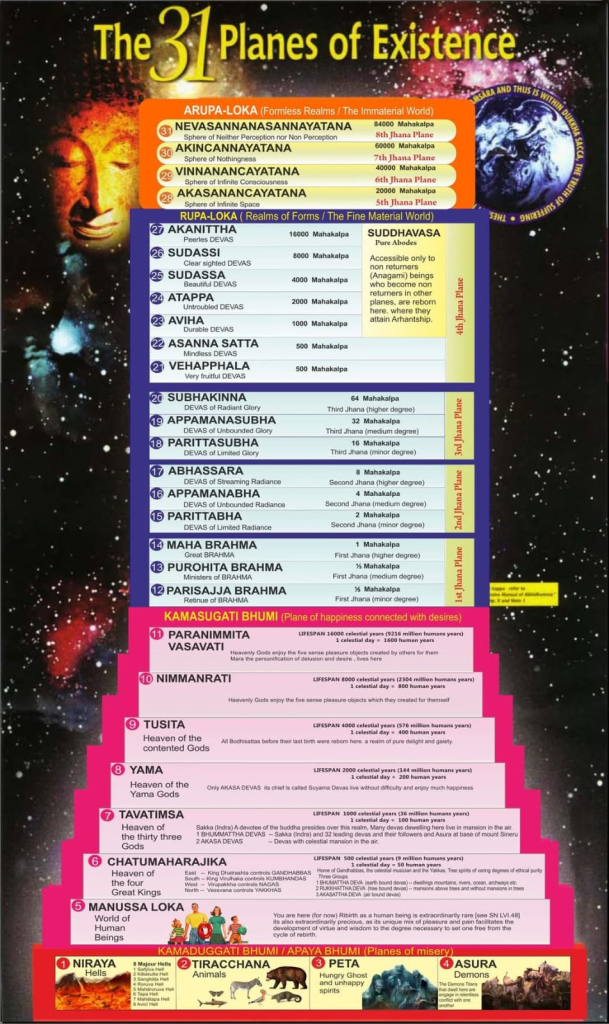
Purpose of the Pure Abodes
The Pure Abodes highlight the refinement and transcendence of mental states. They illustrate the Buddhist concept that spiritual progress is gradual and supported by ideal conditions, leading ultimately to the cessation of samsara (Nibbāna).
These realms emphasize the gradual perfection of equanimity, mindfulness, and wisdom until the final attainment of enlightenment.
The five Pure Abodes (Suddhāvāsa) are specific realms within the Rūpadhātu (Form Realm) and are only accessible to Anāgāmis (non-returners)—those who have reached the third stage of enlightenment. These beings have completely eradicated sensual desire (kāma-taṇhā) and will attain full enlightenment (Arahantship) within these realms without being reborn elsewhere.
Here is a detailed explanation of each Pure Abode:
Aviha (Non-Declining Realm)
Meaning: “Non-declining” refers to the unwavering stability of beings’ spiritual progress in this realm.
Characteristics: Beings here are steadfast in their journey to enlightenment.
The environment is serene and conducive to meditation and the refinement of insight.
Lifespan: Approximately 1,000 aeons (kalpas)
Significance: This is the lowest of the Pure Abodes, but beings here have transcended all sensual desires and are firmly established in their spiritual attainments.
Atappa (Without Affliction Realm)
Meaning: “Without affliction” signifies a realm free from mental and physical suffering.
Characteristics: A realm of pure bliss and complete detachment from worldly concerns.
Beings exist in a state of profound inner peace and mental clarity.
Lifespan: Approximately 2,000 aeons (kalpas).
Significance: Beings here refine their equanimity and insight, progressing further toward enlightenment.
Sudassa (Beautiful Realm)
Meaning: “Beautiful realm” emphasizes its sublime and radiant nature, reflecting the inner purity of its inhabitants.
Characteristics:
This realm is described as aesthetically perfect, symbolizing the refined mental states of its inhabitants.
The beings here radiate contentment and serenity.
Lifespan: Approximately 4,000 aeons (kalpas).
Significance: Beings here cultivate the beauty of their meditative absorption and profound insight, steadily approaching the end of the cycle of birth and death.
Sudassi (Clear-Sighted Realm)
Meaning: “Clear-sighted” indicates the clarity of vision and insight possessed by the beings here.
Characteristics: The clarity of mind and understanding in this realm surpasses the previous levels.
Beings here have near-complete understanding of the Dhamma and their own spiritual path.
Lifespan: Approximately 8,000 aeons (kalpas).
Significance: This realm is very close to the final liberation of Nibbāna. Beings here are profoundly wise and equanimous.
Akanittha (Highest Realm)
Meaning: “Peerless” or “supreme” realm, indicating its position as the highest of the Pure Abodes.
Characteristics:
This is the pinnacle of existence within the Form Realm, where beings are in their final birth before achieving enlightenment.. The environment is perfectly suited for meditation, free from any distractions or hindrances.
Lifespan: Approximately 16,000 aeons (kalpas).
Significance: Beings in this realm are on the verge of attaining Arahantship and full liberation.
This realm represents the culmination of spiritual practice in samsara, as no further rebirth occurs after enlightenment is achieved here.
Let us get deeper into Akanittha
Etymology of Akanittha
“A-” A prefix in Pāli and Sanskrit meaning “not” or “without”.
“Kanittha” Derived from the root kanistha, meaning “inferior,” “lower,” or “younger.”
Thus, Akanittha translates literally as “not inferior” or “peerless.”
Interpretation
Supremacy: Akanittha is understood as the “supreme” or “highest” realm within the Suddhāvāsa (Pure Abodes), signifying its unparalleled status
Spiritual Context: This realm is the pinnacle of existence in the Rūpadhātu (Form Realm), where beings are in their final existence before achieving full enlightenment (Arahantship).
The name underscores the idea that this realm is beyond all others in purity, tranquility, and suitability for spiritual attainment.