The Tree-and-Saw Method: Immobile Awareness at the Breath-Contact Point
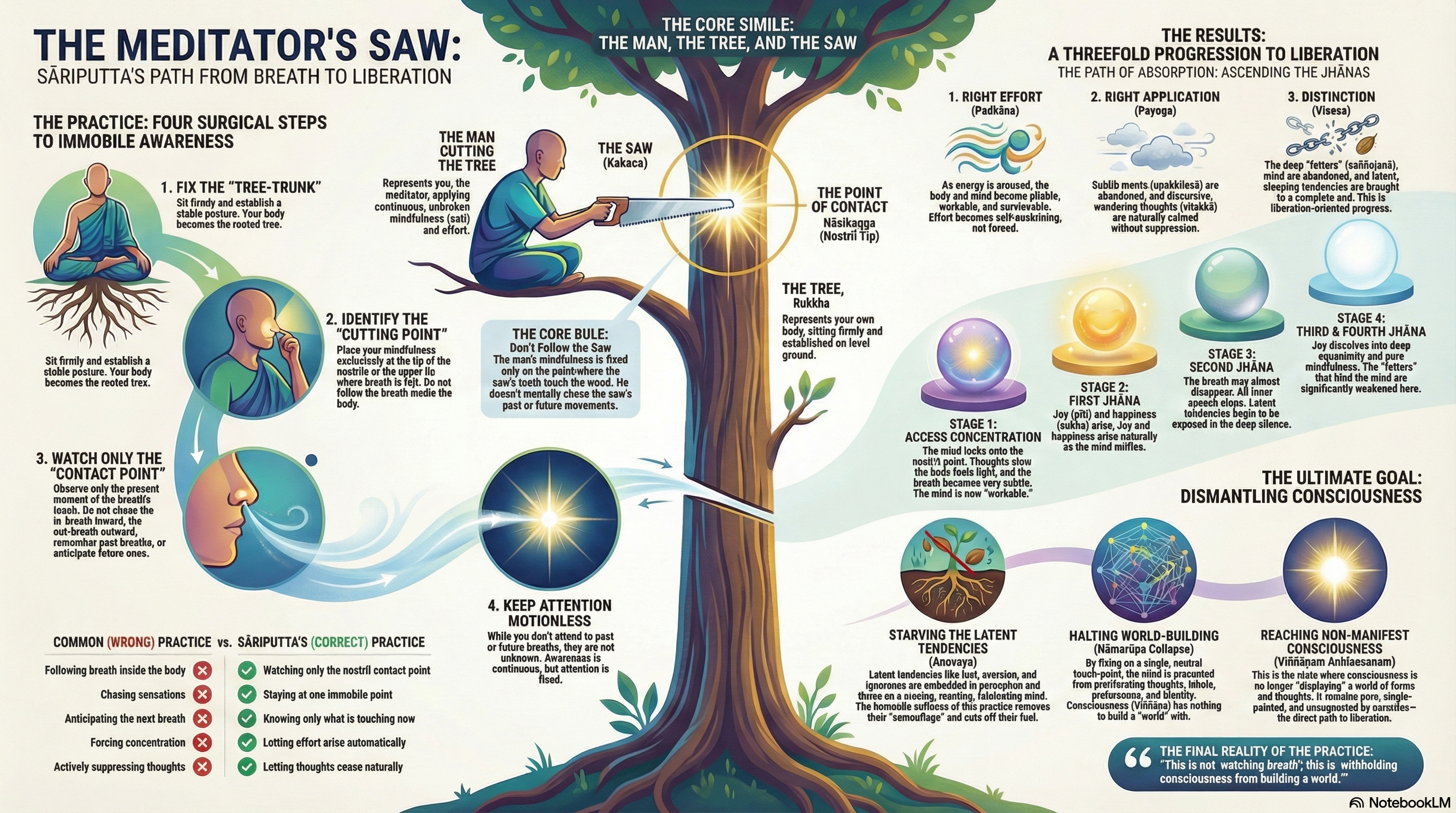 VISUAL SUMMARYSee this study in a pictureOpen the complete infographic for a visual overview before or after reading the full study.View infographic →
Separate the Tree-and-Saw Instruction from Later Interpretations
The Tree-and-Saw Method: Immobile Awareness at the Breath-Contact Point
A detailed study of Sāriputta’s instruction to establish mindfulness where the breath touches, without chasing past or future breaths—together with padhāna, payoga, visesa, jhāna development, latent tendencies, the sixteen steps of Ānāpānasati, and the later analysis of viññāṇa. The essay preserves the central simile: just as a woodcutter attends to the exact place where the saw teeth touch the tree, the practitioner establishes mindfulness at the nostril-tip or upper-lip contact point without following the breath inward or outward.
Editorial frame: the tree-and-saw passage gives a clear practice image: mindfulness is established at the relevant contact point, past and future breaths are not followed, yet the breathing process is not unknown. The source then builds several much larger doctrinal conclusions on top of that instruction. V3 keeps those later arguments, but no longer presents them as though they were all stated directly by the passage.
Tree → Saw → Contact Point → Steady Cutting
Tree — The firmly established body and posture.
Saw — The continuous sequence of in-breaths and out-breaths.
Contact Point — The nostril-tip or upper-lip point where breath is directly known.
Cutting — Unbroken mindfulness and effort that weaken fetters and latent tendencies.
Mindfulness is established where the relevant “saw teeth” meet the “tree”; what has passed and what is yet to come is not made the object of attention, while it is not thereby unknown. The passage then speaks of padhāna, payoga and visesa.
01The Tree-and-Saw Instruction
But according to the precise technical instructions of Venerable Sāriputta, true liberation requires a different approach. It requires immobility. The section that we are going to take is from anāpanāsatikatha in Patisambhiddhamagga pali. If you would like to know more about it, please follow it here
In a profound teaching known as the “Simile of the Tree and the Saw,” Sāriputta reveals a method of non-moving awareness that doesn’t just calm the mind—it surgically dismantles the structural foundation of suffering. By treating the body like a tree and the breath like a saw, this technique stops the “world-building” activity of consciousness, leading directly to the destruction of deep-seated latent tendencies (anusayā)
The Woodcutter’s Secret
Sāriputta explains that a meditator should act exactly like a woodcutter sawing down a tree. When a woodcutter cuts a tree, he does not watch the saw blade moving back and forth; he does not track the teeth that have passed or the teeth yet to come.
Instead, he establishes his mindfulness on the single point where the teeth touch the wood.
The instruction for the meditator is identical:
“Just as mindfulness is established on the point where the saw touches the tree, so too the bhikkhu, having established mindfulness at the nostril-tip or the upper lip… does not attend to breaths that are gone or to breaths yet to come”.
Why “Following” the Breath Fails
Why is this distinction so critical? When you follow the breath in and out, you are engaging with movement. By tracking the “in-breath” and “out-breath” as a journey, you activate memory (the past breath) and anticipation (the future breath),. This movement feeds the narrative mind, keeping the cycle of saṁsāra spinning.
Sāriputta’s method is a technique of consciousness isolation. By fixing awareness solely on the tactile “contact point” (phassa) at the nostril—and refusing to move from that spot—you starve the mind of the fuel it needs to build a story,.
The Three Automatic Results
This is not merely a relaxation exercise; it is a mechanical process of liberation. Sāriputta promises that when this “saw-tooth” focus is maintained, three things happen automatically without force:Distinction (Visesa): This is the breakthrough. Fetters are abandoned and latent tendencies (anusayā) are finally brought to an end.
In this post, we will explore the mechanics of this “Tree and Saw” technique, mapping how this single point of focus collapses the illusion of the ego and leads to the “non-manifesting consciousness” (viññāṇa anidassana) described by the Buddha,.
Right Effort (Padhāna): The body and mind become pliable and workable on their own.
Right Application (Payoga): Wandering thoughts go silent because they are starved of attention.
02Pāli Passage and Direct Application
Kathaṁ ime tayo dhammā ekacittassa ārammaṇā na honti, na cime tayo dhammā aviditā honti, na ca cittaṁ vikkhepaṁ gacchati, padhānañca paññāyati, payogañca sādheti, visesamadhigacchati?
“How is it that these three states are not taken as separate objects by one single mind, yet these three states are not unknown, the mind does not go into distraction, right effort becomes evident, right application is accomplished, and distinction (liberative progress) is attained?”
(Simile of the Tree):
Seyyathāpi rukkho same bhūmibhāge nikkhitto. Tamenaṁ puriso kakacena chindeyya. Rukkhe phuṭṭhakakacadantānaṁ vasena purisassa sati upaṭṭhitā hoti; na āgate vā gate vā kakacadante manasi karoti. Na āgatā vā gatā vā kakacadantā aviditā honti, padhānañca paññāyati, payogañca sādheti.
“Just as a tree is firmly planted on level ground. A man cuts it with a saw. The man’s mindfulness is established based on the teeth of the saw that are touching the tree. He does not attend to the teeth of the saw that have already passed, nor to those yet to come. Yet the past and future teeth are not unknown to him. Right effort is evident and right application is accomplished.”
Application to Breath:
Yathā kakacadantā, evaṁ assāsapassāsā.
Yathā rukkhe phuṭṭhakakacadantānaṁ vasena purisassa sati upaṭṭhitā hoti…
Evamevaṁ bhikkhu nāsikagge vā mukhanimitte vā satiṁ upaṭṭhapetvā nisinno hoti…
Visesamadhigacchati padhānañca.
“Just as the teeth of the saw, so are the in-breaths and out-breaths.
Just as mindfulness is established on the point where the saw touches the tree, so too the bhikkhu, having established mindfulness at the nostril-tip or the mouth-sign, sits. He does not attend to breaths that are gone or to breaths yet to come. Yet they are not unknown to him. Right effort becomes evident, right application is accomplished, and distinction is attained.”
Three speciality(Viseso) given by Sāriputta
Katamo viseso?
Āraddhavīriyassa saññojanā pahīyanti, anusayā byantīhonti— ayaṁ viseso.
✅ “What is distinction or speciality?
For one whose energy is aroused, fetters are abandoned and latent tendencies are brought to an end—this is distinction.”
Conclusion (Repetition of Key Point):
Evaṁ ime tayo dhammā ekacittassa ārammaṇā na honti… visesamadhigacchati.
✅ “Thus these three states do not become separate objects for one mind; they are not unknown; the mind does not scatter; right effort is evident; right application is accomplished; and distinction is attained.”
🔹 PRACTICAL STEP-BY-STEP METHOD FOR WATCHING THE BREATH AT THE NOSTRIL
(Exactly as taught here — NOT following the breath inside the body) which is pure, surgical mindfulness:
✅ STEP 1 — Fix the “tree-trunk”
Sit firmly and establish the posture. Your body is the tree rooted on level ground.
✅ STEP 2 — Identify the “cutting point”
Place mindfulness only at: nāsikagga → tip of the nostrils OR mukhanimitta → touch-point at the upper lip
⚠️ You do NOT follow the breath into the chest.
⚠️ You do NOT trace its path inside the body.
✅ STEP 3 — Watch only the “contact point”
Just as the man watches only the point where the saw teeth touch the tree, you watch only the moment of breath-touch at the nostril. You do NOT chase the in-breath inward or chase the out-breath outward or think about past breaths or anticipate future breaths
✅ STEP 4 — Mind is fixed, not moving
“Na āgate vā gate vā assāsapassāse manasi karoti”
He does not attend to breaths gone or yet to come. BUT
“na āgatā vā gatā vā assāsapassāsā aviditā honti” Yet they are not unknown.
🔑 This means:
Awareness is continuous while attention is motionless which helps in getting knowledge in background and focus is razor-sharp at one point
🔹WHAT THIS PRACTICE AUTOMATICALLY PRODUCES
✅ (1) Padhāna — Right effort arises naturally
“kāyopi cittampi kammaniyaṁ hoti” – Body and mind become workable, pliable, serviceable. and you do not force effort — it becomes self-sustaining.
✅ (2) Payoga — Right application happens automatically
“upakkilesā pahīyanti, vitakkā vūpasammanti” – Subtle defilements drop while wandering thoughts fall silent and discursive thinking fades without suppression
✅ (3) Visesa — Liberating distinction emerges
“saññojanā pahīyanti, anusayā byantīhonti”
This is direct dismantling of fetters (saṁyojana) and latent tendencies (anusaya)
👉 This is no longer just calm — it is liberation-oriented samādhi.
🔹 4. CORE INSIGHT FROM THIS SIMILE
| Wrong Practice | Correct Sāriputta Practice |
|---|---|
| Following breath inside | Watching only nostril contact |
| Chasing sensations | Staying at one immobile point |
| Anticipating next breath | Only knowing what is touching now |
| Forcing concentration | Effort auto-arises |
| Suppressing thoughts | Thoughts naturally cease |
03The Tree-and-Saw Simile Summarized
Just as a man cuts a tree by watching only the exact point where the saw touches the wood—so the meditator cuts through defilements by watching only the exact touch of the breath at the nostril, without chasing past or future breaths.
Katamaṁ padhānaṁ? Āraddhavīriyassa kāyopi cittampi kammaniyaṁ hoti— idaṁ padhānaṁ.
“What is foremost? For one whose energy is aroused, both body and mind become workable—this is foremost”
Katamo payogo? Āraddhavīriyassa upakkilesā pahīyanti, vitakkā vūpasammanti— ayaṁ payogo.
“What is right application or use? For one whose energy is aroused, defilements are abandoned and discursive thoughts are calmed—this is right use.”
Let’s go over this steps again to understand deep meaning
TREE (Rukkha) → Your Body
SAW (Kakaca) → In-breath & Out-breath
SAW TEETH (Dantā) → Individual moments of breath contact
POINT OF CONTACT → Nostril Tip / Upper Lip (Nāsikagga / Mukhanimitta)
MAN CUTTING TREE → Meditator with mindfulness & effort
STEADY CUTTING ACTION → Continuous unbroken sati at one point
TREE FALLING DOWN → Falling of fetters & anusayas
Core Rule from the Simile
You do NOT follow the saw backward or forward.
You ONLY watch the exact point where the saw touches the tree.
Likewise:
You do NOT follow the breath inside the body.
You ONLY watch the exact touch-point at the nostril.
Sāriputta is describing true ekaggatā, not casual breath watching.
Three Layers of Breath Awareness
| Level | What People Do | Why It Fails |
|---|---|---|
| Gross | Follow breath in chest | Mind moves too much |
| Medium | Follow breath in nose passage | Still movement |
| Ultimate (Sāriputta) | Watch only touch-point | Mind becomes immobile |
Four Practical Steps from the Source
Fix the “tree-trunk” — Sit firmly and establish the posture. Your body is the tree rooted on level ground.
Identify the “cutting point” — Place mindfulness only at: nāsikagga → tip of the nostrils OR mukhanimitta → touch-point at the upper lip You do NOT follow the breath into the chest. You do NOT trace its path inside the body.
Watch only the “contact point” — Just as the man watches only the point where the saw teeth touch the tree, you watch only the moment of breath-touch at the nostril. You do NOT chase the in-breath inward or chase the out-breath outward or think about past breaths or anticipate future breaths
Mind is fixed, not moving — “Na āgate vā gate vā assāsapassāse manasi karoti” He does not attend to breaths gone or yet to come. BUT “na āgatā vā gatā vā assāsapassāsā aviditā honti”
“Do not follow” should not be turned into a rigid metaphysical claim that awareness has literally become motionless or that all other experience must disappear. The practical instruction is simpler: do not chase the breath as a travelling object; keep mindfulness established where the breathing is directly known.
Padhāna → Payoga → Visesa
Padhāna — Energy is aroused; body and mind become workable and serviceable.
Payoga — Defilements are abandoned and discursive thoughts are calmed.
Visesa — The passage describes distinction in terms of fetters being abandoned and latent tendencies brought to an end.
The source repeatedly translates these terms as “right effort,” “right application,” and “liberative distinction.” Those renderings can be useful pedagogically, but the precise force of the terms should be read from the Paṭisambhidāmagga context rather than automatically equated with separate factors of the Noble Eightfold Path.
Jhāna, Fetters and Latent Tendencies
The Paṭisambhidāmagga passage does speak of fetters being abandoned and latent tendencies being brought to an end in its explanation of visesa. The source goes further by constructing a detailed automatic ladder from nostril contact → access concentration → four jhānas → weakening of particular fetters and anusayas. That detailed ladder is an interpretation supplied by the essay, not a sequence stated in the quoted tree-and-saw passage itself.
01Why Immobility Matters
If attention moves with breath → thought re-enters
If attention does not move → vitakka & vicāra die naturally
When movement stops → Jhāna factors emerge
✅ Anusayas get exposed
✅ Saṁyojanas weaken
3. HOW THIS METHOD LEADS TO JHĀNA (STEP-BY-STEP)
This method directly follows the natural jhāna gradient:
🧘♂️ STAGE 1 — FIXED CONTACT AWARENESS (ACCESS CONCENTRATION)
What happens: Mind locks to one microscopic point and thoughts slow down automatically
Body becomes light and breath becomes very subtle
This corresponds to:“kāyopi cittampi kammaniyaṁ hoti”
Body & mind become pliable → Threshold of jhāna
🧘♂️ STAGE 2 — FIRST JHĀNA ENTRY
Now: Vitakka & vicāra stabilize on nostril-point
Pīti arises naturally and sukha spreads
Mind is unified and this corresponds to: “vitakkā vūpasammanti” which helps in subsiding gross thinking
🧘♂️ STAGE 3 — SECOND JHĀNA
Breath almost disappears and thought stops completely
Only one-pointed awareness + joy + happiness and no inner speech and anusaya surfacing begins
🧘♂️ STAGE 4 — THIRD & FOURTH JHĀNA
Pīti dissolves and only sukha → then only upekkhā + pure mindfulness
Breath becomes almost imperceptible and body feels like transparent space which helps in getting rid of saṁyojana or weakening of it
4. HOW THIS METHOD DESTROYS ANUSAYAS (LATENT TENDENCIES)
Sāriputta clearly says: “Saññojanā pahīyanti, anusayā byantīhonti”
Let us understand how this happens:
🔹 What is an Anusaya?
Anusaya = sleeping tendency embedded in perception itself, e.g.
Rāgānusaya → latent lust
Paṭighānusaya → latent aversion
Avijjānusaya → latent ignorance
Mānānusaya → latent conceit
Diṭṭhānusaya → latent identity view
🔹 Why Normal Mind Cannot See Anusaya
Because the mind: Is always moving, reacting and fabricating which makes anusaya hide behind movement
🔹 Why Still Mind Exposes Anusaya
In this nostril-point method: No movement of attention, conceptual processing and narrative thinking leading to just contact-awareness
✅ When movement stops → latent tendencies lose camouflage
✅ When breath becomes extremely fine → craving loses fuel
✅ When perception stabilizes → identity loses traction
Thus: anusayas do not get “suppressed” — they get “starved.”
5. WHY SĀRIPUTTA EMPHASIZES “NOT TRACKING PAST & FUTURE BREATHS”
This is extremely deep: “Na āgate vā gate vā assāsapassāse manasi karoti”
This is not merely meditation advice — it is dependent origination control.
| If you track | You activate |
|---|---|
| Past breath | Memory → self-story |
| Future breath | Anticipation → craving |
| Movement | Saṅkhāra |
| Saṅkhāra | Viññāṇa expansion |
| Expansion | Saṁsāra continues |
02Contact-Point Awareness and Liberation
No memory loop, no anticipation and narrative leading to unadulterated awareness cutting off Paṭiccasamuppāda mid-stream
6. WHY THIS IS NOT “WATCHING BREATH” BUT “WATCHING CONTACT”
This is the biggest misunderstanding in modern meditation. Sāriputta is not teaching breath-watching.
He is teaching:
✅ phassa-sati (contact-based mindfulness)
✅ Not vāyo-kasiṇa
✅ Not body-scanning
✅ Not breathing visualization
Only: Touch, Presence, Stillness and Continuity
7. FINAL INTEGRATED SUMMARY (IN ONE FLOW)
Here is the entire meaning in a single continuous understanding:
Just as a man cuts a tree by fixing his attention only at the exact point where the saw touches the wood — without following the saw backward or forward — so the bhikkhu fixes mindfulness only at the nostril-point, without following the breath inward or outward. Because of this immobile attention, effort becomes effortless, application becomes automatic, thoughts naturally fall silent, the body-mind becomes pliable, deep jhāna arises, fetters begin to weaken, and latent tendencies are finally uprooted.
8. WHAT THIS METHOD LEADS TO IN STAGES OF LIBERATION
| Practice Matures Into | What Weakens |
|---|---|
| Access concentration | Gross craving |
| First jhāna | Kāmacchanda |
| Second jhāna | Vitakka & vicāra |
| Third/Fourth jhāna | Rāga & Paṭigha |
| Deep equanimity | Māna |
| Insight after stillness | Diṭṭhi |
| Final exhaustion | Avijjā |
Padhāna → Right Effort establishes
Payoga → Right Application fulfilled
Visesa → Liberative Distinction attained
The Sixteen Steps Need a Canonical Check Before Mapping
The source’s mapping mislabels part of the third and fourth tetrads. In the standard sixteen-step formula, steps 10–12 are abhippamodayaṁ cittaṁ, samādahaṁ cittaṁ, and vimocayaṁ cittaṁ; step 13 is aniccānupassī. The source instead repeats pīti/sukha/cittasaṅkhāra language under steps 10–12 and labels step 13 “Anicca-saññā.” The original source module is retained below, but the canonical sequence is shown first so the reader does not learn the wrong step labels.
Canonical sixteen-step reference
Dīghaṁ assasissāmī / passasissāmī — Long breathing
Rassaṁ assasissāmī / passasissāmī — Short breathing
Sabbakāyapaṭisaṁvedī — Experiencing the whole body
Passambhayaṁ kāyasaṅkhāraṁ — Calming the bodily formation
Pītipaṭisaṁvedī — Experiencing rapture
Sukhapaṭisaṁvedī — Experiencing pleasure
Cittasaṅkhārapaṭisaṁvedī — Experiencing the mental formation
Passambhayaṁ cittasaṅkhāraṁ — Calming the mental formation
Cittapaṭisaṁvedī — Experiencing the mind
Abhippamodayaṁ cittaṁ — Gladdening the mind
Samādahaṁ cittaṁ — Steadying / composing the mind
Vimocayaṁ cittaṁ — Releasing the mind
Aniccānupassī — Contemplating impermanence
Virāgānupassī — Contemplating fading / dispassion
Nirodhānupassī — Contemplating cessation
Paṭinissaggānupassī — Contemplating relinquishment
Even after correcting the sixteen labels, the claim that the tree-and-saw contact-point method maps “perfectly” and automatically onto all sixteen steps is an interpretive thesis that requires argument; it is not established merely by the tree-and-saw simile.
01Mapping to the Sixteen Steps of Ānāpānasati
🔹 Kāyānupassanā (Steps 1–4)
| Ānāpāna Step | What Sāriputta’s Method Does |
|---|---|
| 1. Dīghaṁ assasissāmī | You do not follow length — only touch |
| 2. Rassaṁ assasissāmī | You do not measure shortness |
| 3. Sabbakāyapaṭisaṁvedī | Here “sabbakāya” = whole breath-body at the nostril, not literal full physical body |
| 4. Passambhayaṁ kāyasaṅkhāraṁ | Because attention is immobile, breath automatically calms |
“na āgate vā gate vā assāsapassāse manasi karoti” – He does not chase past/future breath.
🔹 Vedanānupassanā
| Step | Pāli | What Sāriputta’s Method Does |
|---|---|---|
| 5 | Pītipaṭisaṁvedī | Joy arises because mind is no longer scattered |
| 6 | Sukhapaṭisaṁvedī | Comfort & ease arise because there is no friction |
| 7 | Cittasaṅkhāra-paṭisaṁvedī | Feeling reveals itself as a conditioned mental force |
| 8 | Passambhayaṁ cittasaṅkhāra | Even feeling itself settles into equanimity |
vitakkā vūpasammanti – Thought subsides because feeling has been pacified at the root.
✅ Structural Insight: Vedanā is not “something you add later” — it emerges automatically when breath + mind are immobile.
🔹 Cittānupassanā Once the breath becomes subtle:
| Step | Structural Effect |
|---|---|
| 9. Citta-paṭisaṁvedī | You begin to directly feel the state of consciousness itself |
| 10. Pītipaṭisaṁvedī | Joy arises due to non-fragmented viññāṇa |
| 11. Sukha-paṭisaṁvedī | Ease due to absence of conflict |
| 12. Cittasaṅkhāra-passaddhi | Mental fabrication quiets because object-multiplicity has collapsed |
🔹 Dhammānupassanā
This begins when Sāriputta says: “saññojanā pahīyanti, anusayā byantīhonti”
| Step | What Happens |
|---|---|
| 13. Anicca-saññā | You see impermanence of even stable awareness |
| 14. Virāga | Passion fades because viññāṇa has no fuel |
| 15. Nirodha | Phassa-vedanā loops weaken |
| 16. Paṭinissagga | You release even the watching |
Viññāṇa, Nāmarūpa and “Object Collapse”
The source’s language of “viññāṇa isolation,” “locking consciousness in one channel,” “nāmarūpa collapse,” “saṅkhāra starvation,” and cutting dependent origination at the viññāṇa–nāmarūpa junction is not stated in the quoted tree-and-saw passage. It should be read as the author’s later explanatory model, not as a direct teaching of that passage.
The source also connects single-point nostril awareness with viññāṇa anidassana. That is a substantial doctrinal interpretation. The phrase should not be reduced to “consciousness staying at phassa only,” nor should focused tactile awareness itself be presented as evidence that non-manifesting consciousness has been realized.
01Viññāṇa Isolation through Nostril-Point Awareness
This is where Sāriputta’s nostril-point method directly cuts Paṭiccasamuppāda at the viññāṇa–nāmarūpa junction.
① WHY THIS PRACTICE IS ACTUALLY A VIÑÑĀṆA CONTROL METHOD
Most people think: “I am watching breath.”
Sāriputta is actually doing: “I am stabilizing consciousness itself at a single sensory contact.”
“ekacittassa ārammaṇā na honti” ; “These three do not become multiple objects for one mind.”
This is not breath control — this is OBJECT COLLAPSE into a single phassa (contact).
That means: No nāma proliferation; No rūpa tracking; No saṅkhāra expansion and No viññāṇa branching
Only: Pure, single-pointed viññāṇa fixed on one tactile event. leading to viññāṇa-nirodha preparation.
② HOW VIÑÑĀṆA NORMALLY MULTIPLIES (AND WHY YOU SUFFER)
By Paṭiccasamuppāda: Phassa → Vedanā → Taṇhā → Upādāna → Bhava → Jāti → Dukkha
But deeper still: Saṅkhāra → Viññāṇa → Nāmarūpa → Saḷāyatana → Phassa → …
In ordinary life: Viññāṇa keeps shifting: Eye → Ear → Body → Thought → Memory → Emotion
Every shift recreates: Nāmarūpa; Identity; Becoming which is saṁsāra in real-time.
③ HOW NOSTRIL-POINT AWARENESS LOCKS VIÑÑĀṆA IN ONE CHANNEL
Taking passage “nāgate vā gate vā assāsapassāse manasi karoti”
He does not attend to past or future breaths which means:
| What is stopped | What collapses |
|---|---|
| Memory tracking | Past nāmarūpa |
| Anticipation | Future nāmarūpa |
| Breath-following | Body-proliferation |
| Internal verbalization | Saṅkhāra |
This is called in the suttas:
“viññāṇaṁ anidassanaṁ” (non-manifest consciousness)
“viññāṇaṁ appatiṭṭhitaṁ” (non-established consciousness)
“viññāṇa-nirodhasāmīpa” (proximal to cessation)
④ WHY THIS PRACTICE DOES NOT PRODUCE NĀMARŪPA PROLIFERATION
Nāmarūpa needs:
✅ Identification
✅ Labeling
✅ Preference
✅ Resistance
✅ Ownership
But in this method:
| Nāma component | What happens |
|---|---|
| Vedanā | Neutralized into upekkhā |
| Saññā | Reduced to “touch only” |
| Cetanā | No emotional intention |
| Phassa | Single repeated raw contact |
| Manasikāra | Fixed, not roaming |
This is exactly what MN 28, SN 12.67, SN 35.95 all describe.
⑤ THIS IS WHY SĀRIPUTTA SAYS ANUSAYAS GET DESTROYED HERE
“saññojanā pahīyanti, anusayā byantīhonti”
Let us be very exact:
| Anusaya | Why it collapses here |
|---|---|
| Rāgānusaya | No attractive object gets built |
| Paṭighānusaya | No resisted object gets built |
| Diṭṭhānusaya | No identity reference remains |
| Mānanusaya | No comparison structure survives |
| Avijjānusaya | Dependent origination becomes visible |
⑥ HOW THIS DIRECTLY LEADS TO VIÑÑĀṆA-NIRODHA
This practice does not yet equal nirodha — but it prepares the engine for it.
Sequence:
1. Single-point viññāṇa
2. No nāmarūpa proliferation
3. No saḷāyatana expansion
4. No phassa diversification
5. No taṇhā recharge
6. No bhava production
7. Viññāṇa becomes unsupported
8. Natural fading begins
This is what the Buddha means by:
“viññāṇaṁ anupādāya āsavehi parimuccati” – Consciousness is freed through non-clinging.
⑦ WHY THIS METHOD PRODUCES CETOVIMUTTI AND PAÑÑĀVIMUTTI TOGETHER
Because:
Cetovimutti happens when: Saṅkhāra & defilements fall silent
Paññāvimutti happens when: Structure of dependent origination becomes directly visible
This nostril-point method does both simultaneously because it: Stops emotional fuel (ceto release)
Stops structural fabrication (paññā release) and this is why Sāriputta does not call it “calm only”.
He calls it: ✅ padhāna → payoga → visesa which already belongs to the liberation sequence, not just jhāna.
⑧ CRUCIAL DISTINCTION:
WHAT THIS METHOD IS NOT
❌Not breath visualization
❌Not body scanning
❌Not vāyo-kasiṇa
❌Not relaxation exercise
❌Not nervous-system calming
❌Not mindfulness-based stress reduction
WHAT IT IS
✅ Viññāṇa stabilization
✅ Phassa-only awareness
✅ Nāmarūpa collapse training
✅ Saṅkhāra starvation
✅ Anusaya exposure chamber
✅ Liberation mechanics
FINAL REALITY OF THIS PRACTICE
This is not “watching breath”; this is “withholding consciousness from building a world.”
Suññatā, Formless Attainments and Non-Manifesting Consciousness
The source proposes a progression from faint contact to ākiñcaññāyatana, then to nevasaññānāsaññāyatana, and finally links this with viññāṇa anidassana. These are not automatic consequences that can be inferred simply because the breath or contact becomes subtle. They are distinct doctrinal and meditative subjects and should be verified independently rather than treated as the mechanical continuation of nostril-point practice.
01Suññatā, Formless Attainments, and Non-Manifesting Consciousness
In our day-to-day life, this is what happens:
Memory →“This is happening to me”
Anticipation → “What will happen next?”
Story → “Why is this happening?”
Ownership → “I am breathing”
Past → no memory-self
Future → no becoming-self
Movement → no action-self
Thought → no narrator-self
What remains is: Pure contact without ownership = Suññatā vihāra
You are not “in emptiness” as an idea — emptiness is the only thing left standing.
Let us proceed to examine ĀKIÑCAÑÑĀYATANA & NEVASAÑÑĀ by considering MN 106 and how it fits in Sariputta explanation
🔹 A. From Contact-Point → Ākiñcaññāyatana (Nothingness)
As awareness becomes subtler:
Breath → barely perceptible
Contact → extremely faint
Object → almost absent
This creates: “There is nothing to hold”
Which is exactly ākiñcaññāyatana
Not as imagination — but as objective starvation of sensory data.
🔹 B. From Nothingness → Neva-saññā-nāsaññā
When: Even the idea “nothing is present” fades → Perception becomes: Too subtle to grasp and too present to disappear
That gives rise to: nevasññānasaññāyatana – Neither-perception-nor-non-perception
This is not philosophical — it is what happens when: Viññāṇa has almost no nāma-fuel left to operate with.
Let us now look at VIÑÑĀṆA ANIDASSANA (non-manifestative consciousness) which is the deepest doctrinal point by referring to DN 11, SN 12.64:
Viññāṇaṁ anidassanaṁ, anantaṁ, sabbatopabhaṁ
This does not mean some cosmic consciousness. It means:
Consciousness that is NOT displaying nāmarūpa
| Normally | Here |
|---|---|
| Viññāṇa projects form | Viññāṇa stays at phassa only |
| Viññāṇa multiplies objects | Viññāṇa has one neutral contact |
| Viññāṇa builds a world | Viññāṇa builds nothing |
✅ Consciousness becomes non-displaying
✅ Not personal
✅ Not narrative
✅ Not world-producing
This is why the Buddha says: “Here name-and-form completely cease” and that is the end of suffering
Audio Teaching, PDF and Related Study
Remain with what is actually being known at the breathing contact. Do not turn a useful attentional simile into more than it directly establishes. Let the practice itself show what becomes calm, workable, clear and relinquished.