
Mahāvīra, the 24th Tīrthaṅkara of Jainism, offers a detailed explanation of karma and its burning (nirjarā) in the Jain canon. Unlike the Buddhist notion of kamma as volitional action (cetanā), in Jainism, karma is seen as a subtle material substance (pudgala) that binds to the soul due to passionate actions (kaṣāya).
Let’s break down Mahāvīra’s explanation of burning of karma according to Jain texts like the Āgamas, especially the Uttarādhyayana Sūtra, Tattvārthasūtra (by Umāsvāti), and Sūtrakṛtāṅga:
🔥 What Is “Burning” of Karma?
Nirjarā (निर्जरा) literally means wearing away or shedding. It refers to the process of dissociating karma from the soul, which leads to liberation (mokṣa). This process is considered the spiritual burning of karma, analogous to burning off impurities. There are two types of Nirjarā as explained by Mahāvīra:
Savipāka Nirjarā (Passive burning through experience)
Karma matures and brings its result (pleasure/pain) and then falls off naturally.
For example: if someone suffers due to past actions, the pain is the fruition (vipāka), and once endured without further attachment or aversion, that karma is shed. This process is not sufficient for liberation because it can take countless lifetimes.
Avipāka Nirjarā (Active burning through austerities)
This is the deliberate removal of karmic particles through ascetic practices (tapas):
Mahāvīra taught 12 kinds of tapas (austerities) which actively burn karma:
A. External Austerities (Bāhya Tapas):
Anashana – Fasting
Avamaudarya – Eating less than needed
Vritti-sankshepa – Limiting food sources
Rasa-parityāga – Avoiding taste/pleasure in food
Kāyakleśa – Enduring physical hardship
Sanlinatā – Solitude and silence
B. Internal Austerities (Abhyantara Tapas):
Prāyaścitta – Repentance
Vinaya – Humility and reverence
Vaiyāvṛttya – Selfless service to ascetics
Svādhyāya – Study of scriptures
Dhāraṇā – Meditation
Vyutsarga – Giving up attachments
➡️ These are the tools Mahāvīra emphasized for actively destroying karmic matter and speeding up liberation.
🧭 Key Principles in Mahāvīra’s Explanation:
Karma is material (dravya karma) – made of minute particles that stick to the soul due to:
Kaṣāya (passions like anger, pride, deceit, greed)
Yoga (activities of body, speech, mind)
Āsrava (influx) + Bandha (binding)
Shedding karma requires both stopping the influx (saṁvara) and burning the existing karma (nirjarā).
Right View, Right Knowledge, and Right Conduct are necessary for effective Nirjarā.
Mahāvīra emphasized equanimity (samatā) – enduring pain or pleasure without attachment or aversion is itself a fire that burns karma.
Mahāvīra says:
“The soul is like a mirror, covered in dust (karma). You cannot just wait for the dust to fall off — you must clean it actively through austerity, mindfulness, detachment, and meditation. This cleaning is nirjarā, and when done completely, the soul becomes free, pure, and omniscient.”
Right View (Samyag-Darśana – सम्यग्दर्शन)
🌟 Definition:
Right View is the intuitive faith in the truth as taught by the Tīrthaṅkaras. It is the correct perception of reality and an unwavering conviction in the nature of the soul, karma, and liberation.
📚 Tattvārthasūtra 1.2:
“Samyagdarśanajñānacāritrāṇi mokṣamārgaḥ”
“Right View, Right Knowledge, and Right Conduct are the path to liberation.”
🧠 Key Aspects:
Belief in the seven tattvas (truths):
Jīva – soul
Ajīva – non-soul (matter, space, etc.)
Āsrava – inflow of karma
Bandha – bondage of karma
Saṁvara – stoppage of new karma
Nirjarā – shedding of karma
Mokṣa – liberation
Reverence for:
Jina (Omniscient teachers)
Śruta (Scriptures)
Sādhus (Ascetics who follow the path)
🔥 Relevance to Nirjarā:
Right view purifies intentions. Without it, even good actions accumulate karma. Faith in the true nature of the soul is the start of spiritual awakening, leading to restraint and austerity that burns karma.
Right Knowledge (Samyag-Jñāna – सम्यग्ज्ञान)
🧠 Definition:
Right Knowledge is the accurate and undistorted understanding of reality, in accordance with the teachings of the Tīrthaṅkaras.
🔍 Types of Knowledge (5 Jñānas):
Mati-jñāna – Sensory knowledge
Śruta-jñāna – Scriptural knowledge
Avadhi-jñāna – Clairvoyance
Manaḥparyāya-jñāna – Telepathy
Kevala-jñāna – Omniscience (perfect knowledge)
✅ Characteristics:
Free from doubt, error, vagueness.
Must arise after Right View.
Helps discern wholesome vs unwholesome actions.
🔥 Relevance to Nirjarā:
Without right knowledge, one cannot apply the path. For example: Misunderstanding asceticism can lead to pride or self-harm.
Right Knowledge shows how to balance austerity and compassion, thus efficiently burning karma.
Right Conduct (Samyag-Cāritra – सम्यग्चरित्र)
🚶 Definition:
Right Conduct is the actual practice of non-violence, self-restraint, detachment, and ethical living. It is living according to Right View and Right Knowledge.
🔑 For Monastics:
Follows the Five Great Vows (Mahāvratas):
Ahimsā – Non-violence in thought, speech, and action
Satya – Truthfulness
Asteya – Non-stealing
Brahmacarya – Celibacy
Aparigraha – Non-attachment
🧎 For Laypeople:
Follows the Five Minor Vows (Anuvratas) + supplementary vows:
E.g., limited possession, periodic fasting, etc.
☸️ Additional Disciplines:
Guarding the senses (indriya-nirodha)
Equanimity (samatā)
Meditation (dhyāna)
Confession (pratikramaṇa)
🔥 Relevance to Nirjarā:
Right Conduct is where active karma-burning (avipāka nirjarā) happens. Fasting, meditating, enduring pain without aversion, and renouncing desires are all fires that destroy karma.
🔗 Interdependence of the Three:
Mahāvīra emphasized that none of the three can function in isolation:
Without Right View, knowledge is false and conduct becomes misguided.
Without Right Knowledge, faith becomes blind and conduct becomes ritualistic.
Without Right Conduct, view and knowledge remain theoretical and cannot transform the soul.
🔁 All three must be practiced together to seal the karmic inflow, burn past karma, and free the soul.
🏁 Final Goal: Kevalajñāna and Mokṣa
When all karma is burned off through the combined application of these three jewels, the soul becomes:
Infinite in knowledge (ananta-jñāna)
Infinite in perception (ananta-darśana)
Infinite in bliss (ananta-sukha)
Infinite in energy (ananta-vīrya)
And rises to Siddhaloka, never to be reborn.
🕊️ The Five Anuvratas:
🔹 1. Ahiṁsā Anuvrata (Non-Violence Vow)
Lay version: Avoid intentional harm to any living being through thought, word, or deed, within one’s limits.
Avoid occupations that cause violence (e.g., slaughter, war).
Includes abstaining from butchery, hunting, careless driving, etc.
🕯️ Intentional harm (sankalpa-hiṁsā) is central; accidental harm is excused with remorse and caution.
🔹 2. Satya Anuvrata (Truthfulness Vow)
Speak only what is true, beneficial, and not harmful.
Avoid lies, exaggeration, flattery, betrayal, or false accusations.
Avoid speech that incites violence or creates division.
🗣️ Truth must be spoken with restraint, compassion, and clarity.
🔹 3. Asteya Anuvrata (Non-Stealing Vow)
Do not take anything not given willingly.
Includes avoiding fraud, cheating, tax evasion, or unfair trade practices.
Also prohibits the desire to steal or benefit from stolen goods.
🔐 Ethical livelihood is part of this vow — no exploitation.
🔹 4. Brahmacarya Anuvrata (Chastity Vow)
For laypeople, this means faithfulness to one’s spouse.
Avoid adultery, excessive sensual indulgence, pornography, or lewd behavior.
Avoid mental fantasies and provocative conduct.
🌱 While monks/nuns observe complete celibacy, laypeople are expected to practice sexual responsibility and purity.
🔹 5. Aparigraha Anuvrata (Non-Possession / Non-Attachment Vow)
Limit accumulation of wealth, property, comforts, and desires.
Let go of possessiveness toward people, places, and objects.
Includes mental detachment, not just physical restraint.
🪶 This vow addresses greed (lobha) — root of karmic bondage and violence.
🌱 Practical Purpose of Anuvratas
Prepare the practitioner for further vows (guṇa-vratas and śikṣā-vratas) and possibly renunciation.
Serve as the ethical foundation for spiritual progress.
Laypeople reduce karmic influx (āsrava) and support the monastic saṅgha.
| No. | Sanskrit Name | Prakrit | Meaning |
|---|---|---|---|
| 1. | Ahiṁsā Anuvrata | Aṁtivāya Anuvaya | Non-violence vow |
| 2. | Satya Anuvrata | Saccāṇuvaya | Truthfulness vow |
| 3. | Asteya Anuvrata | Adattādānāṇuvaya | Non-stealing vow |
| 4. | Brahmacarya Anuvrata | Brahmaṇacariyāṇuvaya | Chastity / sexual restraint vow |
| 5. | Aparigraha Anuvrata | Apariggahāṇuvaya | Non-possession / non-attachment vow |
🔬 Pudgala: Material Substance (Canonical Definition)
In Jainism, pudgala is completely material and one of the six eternal substances (dravya).
Tattvārthasūtra 5.19:
“Pudgalaḥ rūparasagandhasparśavān saṅghāto vikārī ca.”
“Pudgala is that which has form, taste, smell, touch, and is subject to aggregation and disintegration.”
🧱 Includes: Karma (as a type of pudgala), Body, Speech-sounds, Material world
🧘 Jīva (Soul) 🔹 Key Tenets:
Jīva is eternal, conscious, formless, and capable of knowledge, bliss, and energy.
Jīva and Ajīva (non-soul) are two fundamental ontological categories.
Karmic pudgala (matter) adheres to jīva due to passion (kaṣāya), forming bondage (bandha).
Liberation (mokṣa) is the pure, bodiless state of the jīva in Siddhaśilā.
📚 Canonical Source: Tattvārthasūtra 2.5: “Jīvaḥ caitanyalakṣaṇaḥ nityo.”
“The soul is characterized by consciousness and is eternal.”
🪨 1. JAINISM: PUDGALA: Core Points:
One of the six eternal dravya (substances).
The only dravya with form, taste, touch, smell, and aggregation.
Karma is a type of pudgala — actual matter that adheres to the soul.
Pudgala enters bondage through passions (kaṣāya) and activities (yoga).
Liberation (mokṣa) is complete dissociation of jīva from pudgala.
Scriptural Base:
Tattvārthasūtra 5.19: “Pudgala is that which undergoes fusion and fission and possesses color, taste, smell, and touch.”
🌀 2. BUDDHISM: RŪPA: Core Points:
One of the Five Aggregates (pañcakkhandha): rūpa, vedanā, saññā, saṅkhārā, viññāṇa.
Rūpa is the material form — includes both internal body and external sense objects.
It is not substance, but processual and conditioned.
Composed of four mahābhūtas: pathavī (earth), āpo (water), tejo (fire), vāyo (wind).
No permanent matter; all arises due to dependent origination.
Liberation View:
Insight into the non-self (anattā) and impermanence (anicca) of rūpa leads to cessation of clinging.
There is no duality of soul and matter — just momentary aggregates.
Scriptural Base:
“Rūpaṁ anattā – Form is not self.” – Mahāhatthipadopamasutta (MN 28):
🌱 3. VEDĀNTA / SĀṄKHYA: PRAKṚTI : Core Points:
Unconscious, eternal principle of nature.
Composed of three guṇas: sattva (light), rajas (activity), tamas (inertia).
Evolves into mahat (intellect), ahaṅkāra (ego), manas (mind), and five great elements (pañca-mahābhūta). Puruṣa (consciousness) is separate, passive witness.
Goal of Liberation:
Kaivalya (isolation) of puruṣa from prakṛti.
Realization that prakṛti is not the Self, leads to mokṣa.
Prakṛti is not evil or binding — it functions for puruṣa’s experience until viveka (discrimination) arises.
Scriptural Base: Sāṅkhyakārikā 3:
“Prakṛti creates the world for the experience and liberation of puruṣa.” Bhagavad Gītā 13.19:
“Prakṛti and puruṣa are both without beginning.”
🔁 INTERRELATIONS AND CONTRASTS
🧩 COMPARATIVE TABLE OVERVIEW on PUDGALA, RUPA & PRAKARTI
| Aspect | Jainism – Pudgala | Buddhism – Rūpa | Vedānta/Sāṅkhya – Prakṛti |
|---|---|---|---|
| Definition | Material substance that binds to soul | Form/matter, one of five aggregates | Primordial matter; the root of creation |
| Ontology | Real, eternal, and atomic | Impermanent, conditioned process | Eternal, unconscious, subtle substance |
| Structure | Composed of paramāṇu (atoms) | Derived from four mahābhūtas (elements) | Composed of 3 guṇas (sattva, rajas, tamas) |
| Interaction with Consciousness | Binds with jīva due to passions | Rūpa arises dependent on conditions (paṭicca-samuppāda) | Evolves into the mind and body under puruṣa’s presence |
| Liberation Goal | Total separation of pudgala from jīva | Insight into non-self of rūpa (anattā) | Discrimination between puruṣa and prakṛti |
| Temporal Nature | Eternal (paramāṇu), but skandhas change | Impermanent (anicca), arises and ceases | Eternal but ever-changing (vikṛti) |
| Ethical Role | Karma is pudgala; binds based on ethical conduct | Kamma affects rūpa but doesn’t physically bind | Prakṛti is morally neutral; guṇas can be purified |
| Topic | Jainism (Pudgala) | Buddhism (Rūpa) | Vedānta (Prakṛti) |
|---|---|---|---|
| Is matter real? | Yes, eternal and real | Yes, but impermanent and empty | Yes, real but unconscious |
| Does it bind? | Yes, literally binds the soul | No, but craving toward it causes rebirth | No, only ignorance causes identification |
| Goal of spiritual path | Separation of pudgala from jīva | Cessation of attachment to rūpa (nirodha) | Discernment between puruṣa and prakṛti |
| Is there a Self/soul? | Yes, jīva is distinct from pudgala | No, only dependently arisen processes | Yes, puruṣa is the witnessing Self |
🧘 Implications for Practice
In Jainism: You purify the soul by stopping new pudgala (saṁvara) and burning off old karmic pudgala (nirjarā). Moral actions affect what kind of pudgala is attracted.
In Buddhism: Insight into the emptiness of rūpa leads to non-attachment. No material or soul essence is clung to as “mine.”
In Vedānta: Through viveka (discrimination) and vairāgya (detachment), one realizes that all prakṛti and its evolutes are not-Self.
🏁 Conclusion
Vedānta/Sāṅkhya sees matter (prakṛti) as a subtle, creative force — to be transcended by realizing its distinction from the eternal Self (puruṣa).
Jainism sees matter (pudgala) as real, atomic, and karmically sticky — to be burned away through asceticism and equanimity.
Buddhism treats matter (rūpa) as impermanent, devoid of self, and empty — to be seen clearly with wisdom.
🕊️ 1. Definition of Siddhaśilā
Siddhaśilā (also called Siddhaloka) is the topmost region of the universe (loka), where Siddhas — the perfected, liberated souls — reside permanently after shedding all karmas.
📜 Tattvārthasūtra 10.1: – “Muktasya siddhilokaḥ.”
“For the liberated, the Siddhaloka is the abode.”
“Siddha” = one who has accomplished the goal (mokṣa) “Śilā” = a zone, platform, or plane
🌌 2. Location in Jain Universe (Loka)
According to Jain cosmography, the universe (loka) is:
Shape: Like a standing human figure or cosmic man (puruṣa) or an hourglass — called loka-puruṣa.
Divided into:
Urdhva-loka – upper world (heavens)
Madhya-loka – middle world (humans, animals, plants)
Adho-loka – lower world (hells)
📍 Siddhaśilā is at the apex of Urdhva-loka, just above all heavens, at the very topmost edge of the finite universe.
Not infinite
Not within time or change
Fixed and eternal location
🔺 Jain Cosmology: Major Divisions of the Universe (Loka)
Jain universe is divided into three vertical regions:
Urdhva Loka (Upper World) — Heavens
Madhya Loka (Middle World) — Human and subhuman realms
Adho Loka (Lower World) — Hells
Urdhva Loka (Upper World – 16 Heavens)
These are celestial realms, inhabited by devas (gods), who enjoy long life but are not liberated. They are bound by karma and eventually die and get reborn.
Levels of Heavens:
Devaloka (First 12 Heavens) — like Saudharma, Īśāna, Sanatkumāra, etc.
Anuttara Vimāna (5 higher heavens) — superior heavenly abodes, inhabited by deities who are inclined toward liberation.
Sarvārthasiddhi Vimāna — highest celestial abode for those nearing liberation.
Madhya Loka (Middle World)
This is the realm of:
Humans (manuṣya)
Animals and plants (tiryañcha)
Inferior celestial beings (vyantara devas and bhavanavāsī devas)
It is only in this realm that liberation (mokṣa) is possible. Hence, being born as a human is highly valued.
Adho Loka (Lower World – 7 Hells)
These are nārakas or hell realms where souls suffer intensely due to heavy karma.
Levels of Hells:
Ratnaprabha
Sharkaraprabha
Valukaprabha
Pankaprabha
Dhumaprabha
Tamahprabha
Mahātamahprabha
Each lower hell is more painful than the one above, with denser matter and longer lifespans.
Siddhaśilā (Liberated Realm)
Located above the highest heaven.
Here reside the Siddhas — the liberated souls free from all karmic bondage.
No action, no rebirth, eternal existence in perfect bliss, knowledge, and freedom.
This is similar in role to Nibbāna in Buddhism, though conceptually different (Jains believe the liberated soul exists eternally as an individual).
🛕 Four Main Categories of Devas (Celestial Beings)
According to the Tattvārthasūtra (TS 4.1–4.11), devas are divided into four main classes, each with sub-divisions:
Main Class Description
Bhavanavāsī Devas Residential gods; live in palaces under the earth; closely associated with earthly realms
Vyantara Devas Peripatetic/intermediate gods; roam through space; includes Yakṣas, Rākṣasas, Piśācas etc.
Jyotiṣka Devas Stellar gods; control celestial bodies like the sun, moon, planets, and stars
Vaimānika Devas Heavenly gods; live in aerial abodes or Vimānas in Urdhva Loka (Upper World)
🌌 Vaimānika Devas – The 16 Heavens (Proper Devalokas)
These are the true heavens, situated in the Urdhva Loka. The beings here are known as Ārūpī Vaimānika Devas (form-devas with subtle bodies). The realms are hierarchical — higher levels indicate purer karma and more detachment from sensual pleasure.
➤ 12 Ordinary Heavens (Kalpa Devalokas)
These are the first 12 heavens, each successively more refined:
Saudharma – capital of Devaloka, presided by Indra (chief deity)
Īśāna
Sanatkumāra
Mahendra
Brahma
Brahmotara
Lāntava
Kāpiṣṭha
Śukra
Mahāśukra
Satāra
Sahasrāra
Each of these heavens has:
An Indra (king of devas)
Kalpavṛkṣa (wish-fulfilling trees)
Vast palaces called vimānas
Beings with pleasure bodies and subtle forms
These devas enjoy sensual pleasures, and some may listen to Jain dharma, but they are not spiritually advanced enough to attain liberation directly.
➤ 9 Anuttara Vimānas (Higher Celestial Realms)
Above the 12 heavens are 9 ultra-pure realms inhabited by Anuttara Devas, who:
Are devoid of sensual craving
Have achieved high spiritual progress in past human lives
Are reborn here after a life of deep meditation, austerity, and detachment
Are expected to attain liberation in their next human birth
These 9 heavens are:
Prāṇata
Āraṇa
Ācala
Vijaya
Jayanta
Aparājita
Sarayu
Suprabha
Sarvārthasiddhi
Sarvārthasiddhi is the highest possible birth in saṁsāra, just below the Siddhaśilā (realm of liberated souls).
🕰️ Lifespans of Devas
Lower Kalpa devas: Lifespans range in crores of years (e.g., 10⁶–10¹⁰ years).
Anuttara devas: Even longer; their experience of time is incomprehensible to humans.
Despite such vast lives, they remain within saṁsāra and are not free from karma.
🛑 Important Note: No Liberation in Devaloka
Unlike highest Buddhist Brahmā realms, in Jainism, mokṣa is only possible from a human birth — specifically, from the Madhyaloka (middle world). Even the highest Anuttara devas must be reborn as humans to attain mokṣa.
🧭 3. Nature of Siddhaśilā
| Attribute | Description |
|---|---|
| Formless | No physical body; pure consciousness |
| Unchangeable | No birth, death, movement, or decay |
| No time or space divisions | Beyond cycles of time (kālacakra) |
| Silent, blissful, omniscient | Infinite knowledge, perception, energy, and bliss |
| No social or physical differentiation | All Siddhas are equal, without hierarchy or gender |
| No interaction with world | Siddhas do not interfere with the universe (no creationism) |
🕉️ 4. Entry into Siddhaśilā
A jīva becomes a Siddha when it fulfills the following:
Destroys all 8 types of karmas.
The soul (jīva) is bound by eight fundamental types of karma (अष्टकर्म, aṣṭakarma). These karmas are not metaphorical but are seen as subtle matter particles (pudgala) that physically bind to the soul due to passionate actions (kaṣāya) and vibrations caused by activity (yoga). The ultimate goal of the Jain path is mokṣa—complete liberation—by destroying all eight types of karma, through saṁvara (stopping inflow) and nirjarā (burning accumulated karma). Let us now cover type of karma.
🕉️ The Eight Kinds of Karma (Aṣṭakarma)
They are divided into two broad categories:
A. Ghātiyā Karmas (Destructive karmas)
→ These obscure the soul’s essential qualities like knowledge, perception, energy, and conduct.
B. Aghātiyā Karmas (Non-destructive karmas)
→ These affect the external experience (body, environment, life conditions) but not the soul’s inherent nature.
🧩 A. Four Ghātiyā Karmas (Destructive to soul’s attributes)
🧠 Summary: These karmas veil the true nature of the soul, preventing it from realizing its infinite knowledge, perception, bliss, and energy.
| No. | Name | Sanskrit | Function |
|---|---|---|---|
| 1. | Jñānāvaraṇīya karma | ज्ञानावरणीय | Obstructs right knowledge (jñāna) |
| 2. | Darśanāvaraṇīya karma | दर्शनावरणीय | Obstructs perception or intuition (darśana) |
| 3. | Mohanīya karma | मोहनीय | Deludes the soul (attachment/aversion; right/wrong belief) |
| 4. | Antarāya karma | अन्तराय | Obstructs energy, effort, or capacity to act |
🪐 B. Four Aghātiyā Karmas (Do not destroy soul’s qualities)
| No. | Name | Sanskrit | Function |
|---|---|---|---|
| 5. | Nāma karma | नाम | Determines the body type, physical features, status (e.g., human, animal, god) |
| 6. | Gotra karma | गोत्र | Determines family, social class, and status |
| 7. | Vedanīya karma | वेदनीय | Causes experiences of pleasure and pain |
| 8. | Āyu karma | आयु | Determines lifespan in a particular birth |
🧘♂️ Interdependence of Karma Types
| Karma Type | Obstructs or Produces |
|---|---|
| Jñānāvaraṇīya | Infinite Knowledge |
| Darśanāvaraṇīya | Infinite Perception |
| Mohanīya | Right View and Conduct |
| Antarāya | Energy and Achievement |
| Vedanīya | Emotional Reactions (sukha–dukkha) |
| Nāma | Bodily and psychological traits |
| Gotra | Prestige and social identity |
| Āyu | Continuity in saṁsāra |
🔥 How They Are Destroyed
| Stage | Karma Action |
|---|---|
| Saṁvara | Stops new karma from entering (via right conduct) |
| Nirjarā | Destroys bound karma through austerity, equanimity, and insight |
| Kevalajñāna | Final stage where ghātiyā karmas are fully destroyed |
| Death of body | Aghātiyā karmas fall away, jīva becomes Siddha |
Breaks all saṁyojanas (bonding causes)
Attains kevalajñāna (omniscience), and upon death of the body, the pure soul ascends to Siddhaśilā.
📜 Tiloyapaṇṇatti (Jain cosmological text) gives exact calculations:
It says trillions of Siddhas reside on a narrow crescent-shaped plane at the topmost loka.
🧬 5. Siddha’s Characteristics (Ananta Catuṣṭaya)
Each Siddha possesses four infinite attributes:
| Attribute | Meaning |
|---|---|
| Ananta-jñāna | Infinite knowledge |
| Ananta-darśana | Infinite perception |
| Ananta-sukha | Infinite bliss |
| Ananta-vīrya | Infinite energy |
They are also free from:
Attachment and aversion
Body and senses
Birth and death
Delusion and ignorance
🧘♂️ 6. Philosophical Significance
Siddhaśilā symbolizes the end of transmigration (saṁsāra).
It is the purest spiritual state — a silent, non-intervening liberation.
Unlike other traditions, Jain Siddhas do not return, do not create, and do not function as gods.
The focus is on self-effort (puruṣārtha) and non-theism.
✨ Siddhaśilā is not “heaven” in a theistic sense. It is a state and place of total liberation and stillness.
🔁 How Namokkāra Mantra Relates to Ratnatraya and Nirjarā:
| Salutation | Associated Jewel | Role in Nirjarā |
|---|---|---|
| Arihantāṇaṁ | All Three | Exemplifies fully integrated path |
| Siddhāṇaṁ | Fruit of All | Goal of nirjarā |
| Āyariyāṇaṁ | Conduct | Disciplinary path that wears karma |
| Uvajjhāyāṇaṁ | Knowledge | Teaching the Dhamma; clears delusion |
| Savvasāhūṇaṁ | All | Practicing purification daily |
𑁍 Namo Arihantāṇaṁ – “I bow to the Arihants”
(Arihant: conqueror of inner enemies)
🧘♂️ Definition (from Prakrit root “ari” + “hant”):
Ari = enemies (karmic passions: anger, pride, deceit, greed) Hanta = destroyer
Arihant is one who has destroyed all internal enemies but still exists in the embodied form (samsāri śarīra), teaching others.
📚 Canonical Reference: – Uttarajjhayaṇa Sutta 22.41:
“Arihantāṇaṁ bhagavantāṇaṁ vandanā karomi.”
“I offer reverence to the Blessed Arihants.”
🔥 Significance:
Embodiment of Right View + Right Knowledge + Right Conduct – Source of Dhamma and spiritual guidance
Their teachings are a key tool for Nirjarā (burning karma)
𑁍 Namo Siddhāṇaṁ – “I bow to the Siddhas”
(Siddha: liberated beings, disembodied and perfect)
🔝 Definition:
Siddhas have attained Mokṣa. Shed all types of karmas, and now reside in Siddha-śilā, the highest realm, beyond rebirth.
🕊️ Characteristics:
Ananta-jñāna (infinite knowledge)
Ananta-darśana (infinite perception)
Ananta-sukha (infinite bliss)
Ananta-vīrya (infinite energy)
🔥 Significance:
The goal of all Jain practice
Siddhas represent the complete fruit of the Three Jewels
They are not teachers anymore, unlike Arihants
𑁍 Namo Āyariyāṇaṁ – “I bow to the Ācāryas”
(Heads of the fourfold Jain Saṅgha)
🎓 Definition:
Ācāryas are monastic leaders and spiritual guides who maintain the lineage and discipline of the Dhamma.
📚 From the Daśavaikālika Sūtra:
“Āyariyaṁ dhammaṁ deseti, sāvakaṁ ṇayati, sīlaṁ niveseti.”
“The Ācārya teaches the doctrine, guides disciples, and establishes discipline.”
🔥 Significance:
Preservers of Right Conduct
Models for lay and monastic communities
Live lives of strict non-possession, non-violence, and self-restraint
𑁍 Namo Uvajjhāyāṇaṁ – “I bow to the Upādhyāyas”
(Spiritual teachers and preceptors)
📖 Definition:
Upādhyāyas specialize in teaching scriptures and helping monks study and internalize the teachings.
📚 Canonical Source:
Niryukti (Prakrit commentary) on Āvassaya describes them as:
“Jo nāṇaṁ deseti, so uvajjhāyo”
“One who imparts knowledge is Upādhyāya.”
🔥 Significance:
Embodiment of Right Knowledge and bridges scriptural understanding and practical application
𑁍 Namo Loe Savvasāhūṇaṁ – “I bow to all Sādhus (monks and nuns) in the world”
🧘♂️ Definition:
Sādhus live in accordance with Ratnatraya: Right View, Knowledge, and Conduct
They observe strict vows, practice austerity, and guide others by example.
🔥 Significance:
Represent ongoing living examples of the Jain path. Through tapas and samādhi, actively engage in burning karma (nirjarā)
🕉️ The Pañca Namaskāra Concluding Gāthā:
📜 Verse in Prakrit:
Eso pañcaṇamokkāro, savvapāvappaṇāsano
Maṅgalāṇaṁ ca savvesiṁ, paḍhamaṁ havai maṅgalaṁ
📖 Translation:
“This five-fold salutation destroys all sins (pāpa).
Among all auspicious things, this is the foremost auspiciousness.”
🔥 Philosophical Meaning:
Not a prayer for favors but a deep bowing to qualities that liberate.
Reciting this with awareness cultivates right view, leads to mental purification, and helps prevent new karmic bondage.
Why should one become Digambara?
The term Digambara (literally “sky-clad”) refers to one of the two main sects of Jainism, the other being Śvetāmbara (“white-clad”). The belief in being Digambara—practicing complete nudity—is deeply rooted in Jain metaphysics, ascetic ideals, and the goal of total non-attachment (aparigraha). Here’s a detailed explanation of why the Digambaras practice nudity and what it signifies:
🔷 1. Spiritual Symbol of Total Renunciation (Aparigraha)
Nudity symbolizes complete detachment from all possessions, including clothes.
In Jain philosophy, possessions are seen as binding and as causes of karma. The Digambaras believe that even the slightest possession, like clothes, indicates attachment, which hinders liberation.
For a monk (muni) striving for mokṣa (liberation), total renunciation is essential—not just of wealth or family, but even of physical coverings.
🔷 2. Historical Reference to Mahāvīra’s Practice
According to Digambara tradition, Lord Mahāvīra, the 24th Tīrthaṅkara, gave up even his loincloth and lived in complete nudity for the rest of his life.
In contrast, the Śvetāmbaras believe he wore a single piece of white cloth for most of his ascetic life.
Digambaras view Mahāvīra’s nudity as the ideal model of an ascetic who has transcended all social norms and bodily shame, which arise from ego and delusion.
🔷 3. Metaphysical View: The Perfect Monk Must Be Without Possession
According to Digambara doctrine, a true muni must not possess anything, including clothing, begging bowls, or scriptures. This is because: Possession leads to attachment (upādāna).
Attachment leads to bondage of karma (karma-bandha).
Only a completely non-attached soul can attain kevala-jñāna (omniscience).
Hence, nudity is not just symbolic—it’s considered an actual precondition for the final stages of spiritual development.
🔷 4. Ethical Discipline: Control of Passions and Senses
Living without clothes also tests and reinforces the ascetic’s control over:
Desire for comfort
Shame or pride (māna)
Sensual distraction: A naked monk must remain in equanimity regardless of heat, cold, ridicule, or reverence, thereby cultivating perfect indifference (upekṣā) and self-restraint (saṁyama).
🔷 5. Scriptural Justification in Jain Āgamas and Digambara Texts
Though Digambaras reject the authenticity of the existing Śvetāmbara Āgamas (which they believe were lost), they rely on texts like: Ṣaṭkhaṅḍāgama ,Kārikās of Kundakunda (e.g., Samayasāra, Pravacanasāra). These texts advocate total non-possession and argue that even subtle forms of ownership (like wearing clothes) can be karmically binding.
🔷 6. Gender and Liberation: Digambara View
Digambaras believe that women cannot attain liberation in the present bodily form because:
They cannot practice nudity in the social order.
They are considered to have more bodily attachments.
Thus, according to Digambaras, a woman must be reborn as a man to attain mokṣa. This is a major doctrinal difference from Śvetāmbaras, who believe women can attain liberation directly.
🔷 7. Practical Application in Monastic Life
In daily practice: Digambara monks never wear clothes nor they clean their private parts nor take bath
They do not use utensils, often eating food from their hands.
They practice constant wandering, unless in rainy season (cāturmāsa).
They live in extreme austerity and silence (mauna).
🔚 Summary: Why Digambara = Sky-Clad?
Being Digambara is not merely about nudity. It represents:
Total renunciation of attachment.
Absolute commitment to self-discipline and non-possession.
Emulation of Mahāvīra’s model of perfect asceticism.
A doctrinal requirement for reaching the highest spiritual realization—kevala-jñāna and ultimately mokṣa.
🧾 Table: Digambara vs. Śvetāmbara Comparison
| Aspect | Digambara (दिगम्बर) | Śvetāmbara (श्वेताम्बर) |
|---|---|---|
| Name Meaning | Dig = direction; Ambara = clothes → “Sky-clad” (i.e., without clothes) | Śveta = white; Ambara = clothes → “White-robed” (wears white garments) |
| Ascetic Dress | Monks are nude, symbolizing complete non-possession | Monks and nuns wear white robes |
| Possession Allowed for Monks | No possessions at all—not even clothes or alms bowls | Minimal possessions allowed (e.g., alms bowl, scriptures, clothes) |
| View on Mahāvīra’s Attire | Mahāvīra was nude for the full 12 years of his asceticism | Mahāvīra wore a single cloth, which he lost later by accident |
| Kevala-jñāna (Omniscience) Requirement | Only possible after total renunciation, including nudity | Can be attained while wearing simple robes |
| Can Women Attain Liberation? | ❌ No – must be reborn as men first | ✅ Yes – women can directly attain mokṣa |
| Nuns (female ascetics) | No fully initiated Digambara nuns (only āryikās with limited vows) | Full-fledged nuns are common and institutionalized |
| Canonical Texts Accepted | Do not accept Śvetāmbara Āgamas; rely on older texts like Ṣaṭkhaṅḍāgama, Samayasāra | Accept 11 Āgamas as canonical (plus commentaries like the Niryukti and Bhāṣya) |
| Karma and Nudity | Wearing clothes creates attachment, hence bondage of karma persists | Minimal clothing doesn’t create karmic bondage if intention is pure |
| Spiritual Ideal | The nude ascetic, ideally without even asking for food | The robe-clad ascetic practicing ethical restraint |
| Alms Collection Practice | Food is taken directly into cupped hands; cannot request or accept stored food | Allowed to use bowls and accept food respectfully offered by laypeople |
| Prominent Texts in Prakrit or Sanskrit | Samayasāra, Pravacanasāra, Ṣaṭkhaṅḍāgama, Kārikās of Ācārya Kundakunda | Ācārāṅga Sutta, Sūtrakṛtāṅga, Upāsakadaśāh, Daśavaikālika |
| Scriptural Language Emphasis | Prakrit/Sanskrit texts in Digambara śāstra-paramparā | Canonical texts preserved in Jain Prākrit (Ardhamāgadhī) |
🧾 Do Digambaras Pluck Their Hair?
| Reason | Explanation |
|---|---|
| Vanity Renunciation | Rejects identification with beauty, appearance, and ego |
| Spiritual Austerity (Tapas) | Deliberate endurance of pain cultivates detachment and equanimity |
| Aparigraha | Hair seen as subtle possession; tools not allowed |
| Non-violence (ahiṁsā) | Avoids razor-related harm to micro-life |
| Imitation of Mahāvīra | Mahāvīra himself plucked his hair upon renunciation |
| Inner Purification | Overcoming bodily concern supports karmic shedding and clarity of mind |
🕊️ 2. Nibbāna vs Mokṣa: Liberation Compared
| Feature | Buddhism: Nibbāna | Jainism: Mokṣa |
|---|---|---|
| Definition | Cessation of craving, ignorance, and rebirth | State where soul is freed from all karma |
| Ontological Nature | Unconditioned, unborn, beyond description | Eternal soul in its pure state at Siddhaśilā |
| Is there a liberated being? | No being, only cessation of aggregates | Yes — purified jīva becomes Siddha |
| Is it self or not-self? | Beyond self; not “I” or “mine” | Affirmed self (jīva) that is freed |
| What ends? | All clinging, becoming, and suffering | Karma and rebirth; jīva remains |
| Where is the liberated? | Not locatable in terms of space/time | Exists eternally in top of loka (Siddhaśilā) |
| Means | Insight into anattā and paṭiccasamuppāda | Samyag-darśana, jñāna, cāritra + tapas |
| Ethical Basis | Sīla, samādhi, paññā (Eightfold Path) | Vrata, gupti, samiti, and austerities |
🧘 Practical Summary
| Practice Aspect | Jainism | Buddhism |
|---|---|---|
| View | Eternal self (jīva) bound by karma | No-self (anattā); bundles of processes |
| Goal | Purify and liberate the soul | End delusion of self; attain cessation |
| Path | Ratnatraya + Tapas + Samyama | Eightfold Path: Sīla, Samādhi, Paññā |
| Final State | Siddha: pure, eternal jīva | Nibbāna: cessation of all formations |
| Philosophy | Ethical realism and dualism | Ethical empiricism and process metaphysics |
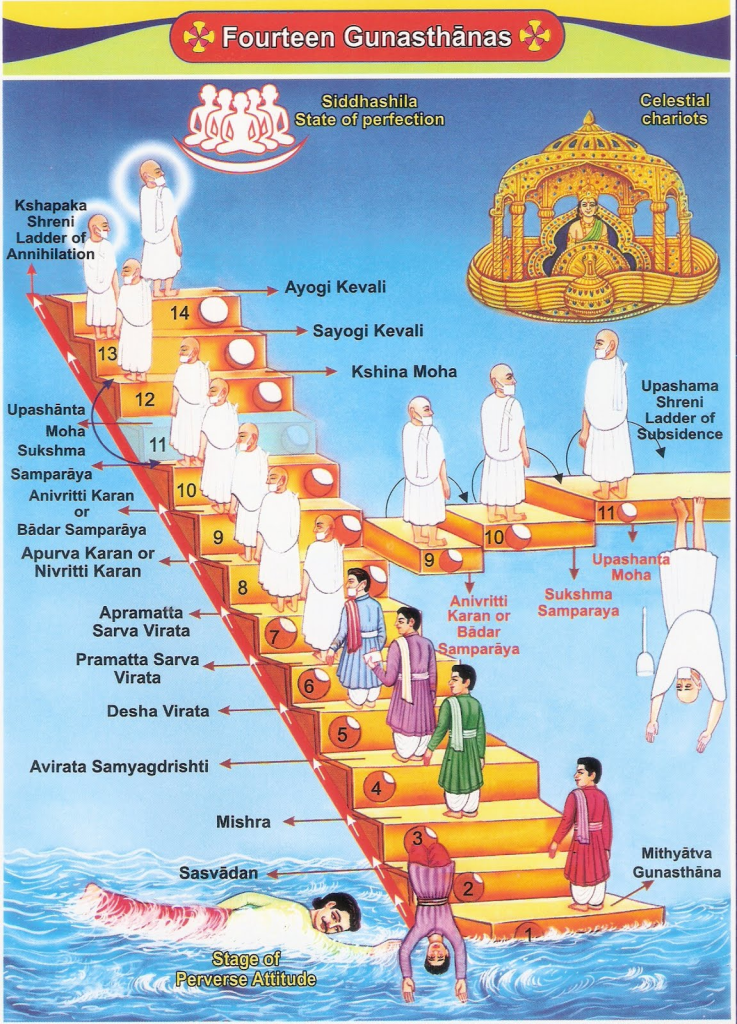
Fourteen Gunasthanas
🟤 1. Mithyādṛṣṭi Guṇasthāna – Deluded View
The soul holds false beliefs about reality.
Denies karma, liberation, or self-effort.
Dominated by Mohanīya karma (deluding karma).
Entry point for all bound souls in saṁsāra.
⚠️ 2. Sasādana Guṇasthāna – Spiritual Downfall
A person who had a glimpse of right view falls back into delusion.
“Sādana” = slipping from a higher to lower stage.
⚪ 3. Mishra Guṇasthāna – Mixed View
The soul is conflicted: partially believes in the truth, partially in delusion.
Vacillates between śraddhā (faith) and doubt.
🔍 4. Avirata-Samyagdṛṣṭi – Right View without Restraint
Firm right faith (Samyag-darśana) is established.
Still indulges in sensual life; has not adopted vows.
This stage marks entry into spiritual ascent. From here, the soul can progress upward.
🕊️ 5. Deśavirata Guṇasthāna – Partial Restraint
Begins lay vows (anuvratas) and restraint in limited areas.
First real ethical commitment.
🧘 6. Pramatta-Saṁyata – Full Restraint with Laxity
Becomes a monk or nun, taking all mahāvratas.
Practices complete restraint, but still slips occasionally due to negligence.
🕯️ 7. Apramatta-Saṁyata – Vigilant Restraint
Now perfectly careful — no negligence (apramāda).
Very rare — the ideal monk or nun.
Begins destroying ghātiyā karmas (knowledge-obscuring, delusion, etc.)
🔥 8. Apūrvakaraṇa – New Karmic Shedding Activity
Deep internal transformation begins.
Extraordinary purification not seen before.
Soul accelerates toward omniscience.
⚡ 9. Anivṛttikaraṇa – Irreversible Progress
Karmic destruction is non-reversible.
Delusion is nearly overcome.
Movement is only upward now.
💠 10. Sūkṣmasāmparāya – Subtle Passion Stage
All gross passions (kaṣāya) are gone.
Only extremely subtle greed remains (sūkṣma-lobha).
Deepest level of introspective purification.
🌫️ 11. Upaśānta-Moha – Delusion Suppressed
All deluding karma is temporarily suppressed, not yet destroyed.
Can fall back due to residual tendencies.
🌄 12. Kṣīṇa-Moha – Delusion Destroyed
Deluding karma is completely destroyed.
Can never fall back into saṁsāra.
Soul is arihant in waiting.
🌟 13. Sayogī-Kevalī – Omniscient with Activity
Kevalajñāna (omniscience) attained.
Still minor physiological activity (speech, breathing).
Final instructions to disciples may be given here.
✨ 14. Ayogī-Kevalī – Omniscient without Activity
Final stage before liberation.
All activity ceases.
At death, soul rises to Siddhaśilā — the topmost loka, never to return.
Ayogī-Kevalī ← Motionless, about to become Siddha
Sayogī-Kevalī ← Omniscient, still active
Kṣīṇa-Moha ← Delusion destroyed
Upaśānta-Moha ← Delusion suppressed
Sūkṣma-Sāmparāya ← Only subtle greed remains
Anivṛttikaraṇa ← Irreversible progress
Apūrvakaraṇa ← Extraordinary karmic destruction
Apramatta-Saṁyata ← Vigilant monastic conduct
Pramatta-Saṁyata ← Monastic conduct with lapses
Deśavirata ← Partial restraint (lay vows)
Avirata-Samyagdrṣṭi← Right view, no vows yet
Mishra ← Mixed belief
Sasādana ← Downfall
Mithyādṛṣṭi ← Total delusion
🔁 Relationship to Karma and Liberation
| Stage Range | Karma State | Notes |
|---|---|---|
| 1–3 | Dominated by Mohaniya karma | No spiritual discipline |
| 4–7 | Begins saṁvara (inflow stoppage) | Ethical restraint begins |
| 8–12 | Nirjarā (destruction of karma) | Rapid spiritual progress |
| 13–14 | Ghātiyā karmas fully destroyed | Omniscience and mokṣa |
| No. | Guṇasthāna (Sanskrit) | English Name | Key Feature |
|---|---|---|---|
| 1. | Mithyādṛṣṭi | Wrong belief | Deluded view; no spiritual pursuit |
| 2. | Sasādana | Downfall | Flicker of right belief, quickly lost |
| 3. | Mishra | Mixed belief | Vacillation between right and wrong view |
| 4. | Avirata-samyagdṛṣṭi | Right belief without conduct | Firm right view, but no restraint |
| 5. | Deśavirata | Partial self-restraint | Begins minor vows (anuvratas) |
| 6. | Pramattasaṁyata | Self-restraint with negligence | Full vows, but with lax mindfulness |
| 7. | Apramattasaṁyata | Perfect self-restraint | Careful observance of monastic vows |
| 8. | Apūrvakaraṇa | New thought-activity | Begins deep inner transformation |
| 9. | Anivṛttikaraṇa | Advanced thought-activity | Deep internal renunciation; karmic destruction intensifies |
| 10. | Sūkṣmasāmparāya | Subtle passions remain | Only subtle greed (lobha) left |
| 11. | Upaśānta-moha | Delusion suppressed | Delusion temporarily suppressed (not destroyed) |
| 12. | Kṣīṇa-moha | Delusion destroyed | Permanent destruction of delusion |
| 13. | Sayogī-kevalī | Omniscient with activity | Kevalajñāna attained; slight activity remains |
| 14. | Ayogī-kevalī | Omniscient without activity | Activity ceases; soul is about to attain liberation |