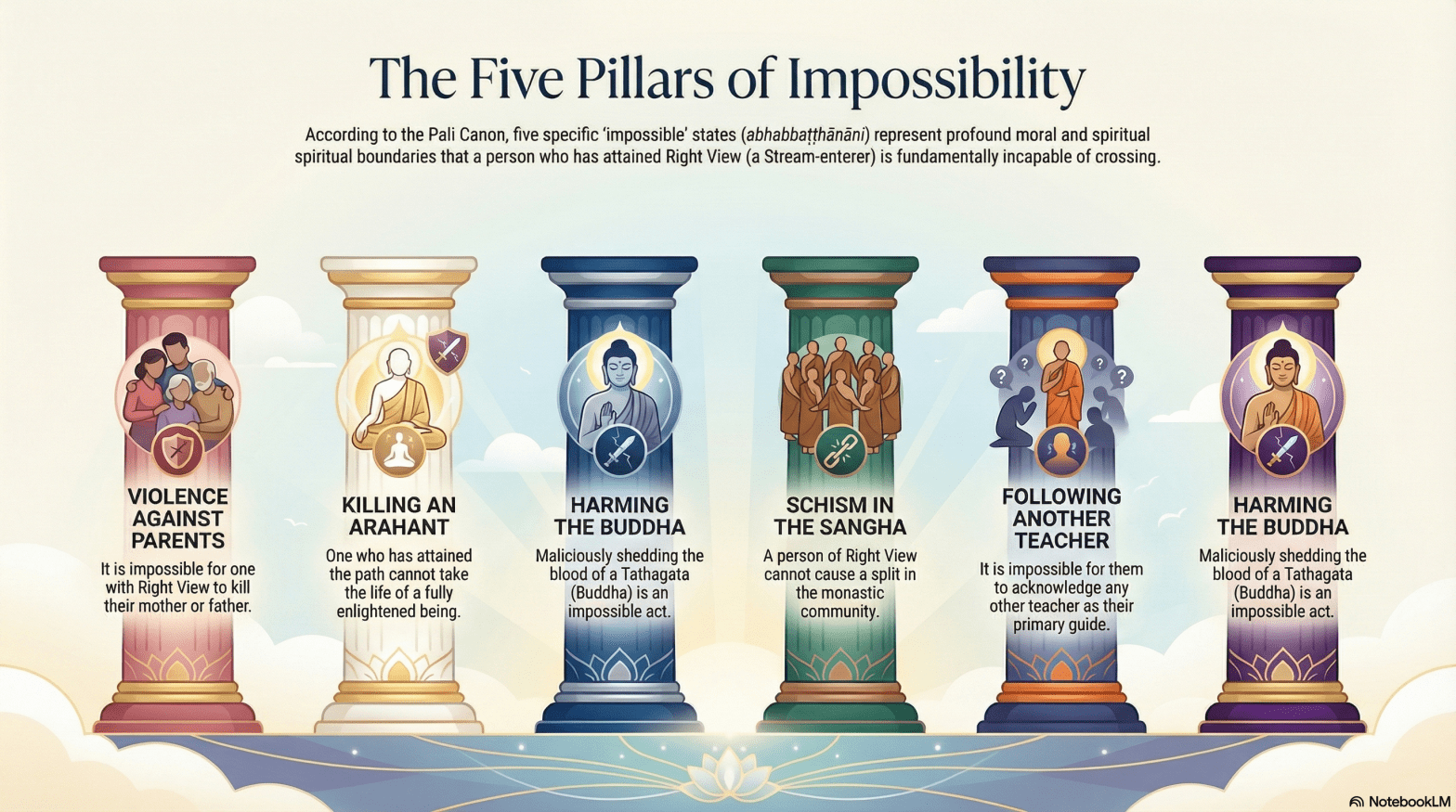
Based on this sutta, a person with ‘right view’ (referred to in the Pali text as a diṭṭhisampanno puggalo, meaning a person accomplished in view) is defined by six specific actions that they are completely incapable of performing.
These six impossible actions (abhabbaṭṭhānāni) are:
1. Depriving their mother of life (mātaraṁ jīvitā voropetuṁ).
2. Depriving their father of life (pitaraṁ jīvitā voropetuṁ).
3. Depriving an arahant of life (arahantaṁ jīvitā voropetuṁ).
4. Causing the Tathāgata (the Buddha) to bleed with a malicious or evil mind (tathāgatassa duṭṭhena cittena lohitaṁ uppādetuṁ).
5. Creating a schism or split in the Sangha (saṅghaṁ bhindituṁ).
6. Dedicating themselves to or acknowledging another teacher (aññaṁ satthāraṁ uddisituṁ).
In these teachings, possessing ‘right view’ means having reached a spiritual state where it is an absolute impossibility to commit any of these six grave offenses.
Why this qualifies for Sotapanna?
Mātaraṁ jīvitā voropetuṁ “To kill one’s mother”
This is not just an ethical rule — it becomes psychologically impossible.
A Sotāpanna has seen paṭiccasamuppāda to some extent and weakened deep ignorance about relationships and gratitude, removed sakkāyadiṭṭhi, which reduces crude ego-centeredness
Mother represents: the highest source of care and life, the strongest field for kataññutā (gratitude)
For such a person hatred cannot escalate to that extreme blindness and even if irritation arises, it cannot mature into murderous intention
👉 The mind cannot cross that threshold because wisdom interrupts it.
Pitaraṁ jīvitā voropetuṁ “To kill one’s father”
Same structure, but slightly different nuance. Father represents support, protection, responsibility and another primary field of gratitude
A Sotāpanna understands kamma and its gravity, sees clearly the consequences of intentional harm
So:even if conflict exists, the mind cannot form the intention of killing, the moral compass is no longer external — it is internalized through insight
👉 Not restraint — but inability born of understanding.
Arahantaṁ jīvitā voropetuṁ “To kill an arahant”
This goes even deeper. Why impossible? Because a Sotāpanna has faith grounded in direct seeing (aveccappasāda), recognizes what an arahant represents — complete liberation Even if they cannot identify an arahant explicitly their mind cannot generate hostility strong enough toward such purity
Also killing an arahant requires extreme delusion + hatred and those conditions are incompatible with stream-entry vision
👉 The mind recoils from such an act instinctively.
Tathāgatassa duṭṭhena cittena lohitaṁ uppādetuṁ “To maliciously cause the Buddha to bleed”
Notice the phrase duṭṭhena cittena — with a corrupt/hostile mind and this is not accidental harm — it is intentional hostility toward the Buddha.
A Sotāpanna has unshakable confidence in the Buddha experiential recognition: “This is the one who shows the path” and so the mind cannot turn against the Buddha with hatred and the very idea becomes contradictory
👉 This is not about physical action alone — it is about impossibility of hostile intention toward the Tathāgata.
Saṅghaṁ bhindituṁ – “To split the Saṅgha”
This is very subtle and important. Saṅgha-bheda is not mere disagreement — it means deliberately creating division in the noble community often rooted in ego, ambition, wrong view
A Sotāpanna values ariya-saṅgha deeply and has removed sīlabbataparāmāsa, so does not cling to rigid positions and has reduced ego-identification (sakkāyadiṭṭhi)
Therefore cannot intentionally create division for personal gain or view-based pride and cannot oppose the Dhamma knowingly
👉 Differences may arise, but schism cannot be intentionally created.
Aññaṁ satthāraṁ uddisituṁ “To take another teacher as supreme (ultimate refuge)”
This is the most doctrinally revealing one.
A Sotāpanna has aveccappasāda in Buddha, Dhamma, Saṅgha and directly seen that this path leads to liberation
Thus, they cannot internally accept another teacher as ultimate and cannot shift refuge away from the Buddha
Important nuance – They may respect others and they may learn worldly things from others
But cannot say, in the deepest sense: “This other teacher is the one who leads to final liberation.”
👉 Because they have already verified the path.
Six Pillars of Impossibility for Sotapanna