Nibbedhika — Penetrating Experience through Cause, Diversity, Result and Cessation
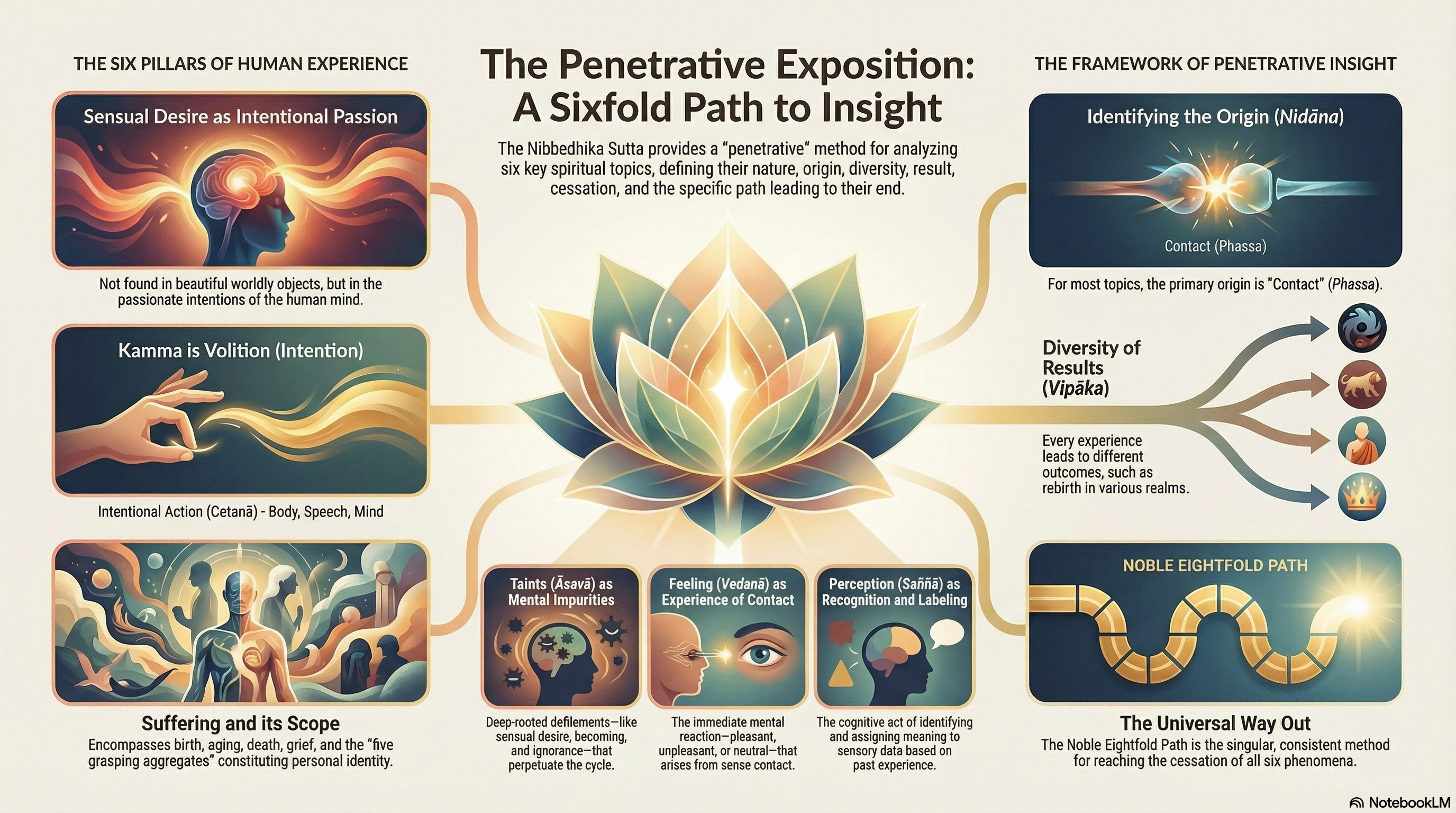 VISUAL SUMMARYSee this sutta in a pictureOpen the complete infographic for a visual overview before or after reading the full study.View infographic →
Six questions applied to every domain
Veditabba — What exactly is to be known?
Nidānasambhava — What condition gives rise to it?
Vemattatā — What are its different forms or varieties?
Vipāka — What result or outcome does it produce?
Nirodha — What does its cessation mean?
Nirodhagāminī paṭipadā — What practice leads to cessation?
Kāma • Vedanā • Saññā • Āsava • Kamma • Dukkha
Kāma — Not merely attractive objects: the source emphasizes saṅkapparāga, the passion built around the mind’s own intending and conception.
Vedanā — Three feeling tones, further differentiated as sāmisa and nirāmisa.
Saññā — Six perceptual fields; its result is vohāra—the way perception shapes expression and designation.
Āsava — Kāmāsava, bhavāsava and avijjāsava; their stated causal arising is avijjā.
Kamma — Cetanāhaṁ, bhikkhave, kammaṁ vadāmi—intention is called kamma, enacted through body, speech and mind.
Dukkha — Its origin is taṇhā; its result may be bewilderment or genuine search; its cessation is taṇhānirodha.
Nibbedhikapariyāya — a penetrative exposition of Dhamma
“Nibbedhikapariyāyaṁ vo, bhikkhave, dhammapariyāyaṁ desessāmi. Taṁ suṇātha, sādhukaṁ manasi karotha, bhāsissāmī”ti.
“Evaṁ, bhante”ti kho te bhikkhū bhagavato paccassosuṁ. Bhagavā etadavoca:
“Katamo ca so, bhikkhave, nibbedhikapariyāyo dhammapariyāyo?
Kāmā, bhikkhave, veditabbā, kāmānaṁ nidānasambhavo veditabbo, kāmānaṁ vemattatā veditabbā, kāmānaṁ vipāko veditabbo, kāmanirodho veditabbo, kāmanirodhagāminī paṭipadā veditabbā.
Variant: kāmanirodho → kāmānaṁ nirodho (mr) | kāmanirodhagāminī → kāmanirodhagāmini (pts1ed); kāmānaṁ nirodhagāminī (mr)
Vedanā, bhikkhave, veditabbā, vedanānaṁ nidānasambhavo veditabbo, vedanānaṁ vemattatā veditabbā, vedanānaṁ vipāko veditabbo, vedanānirodho veditabbo, vedanānirodhagāminī paṭipadā veditabbā.
Saññā, bhikkhave, veditabbā, saññānaṁ nidānasambhavo veditabbo, saññānaṁ vemattatā veditabbā, saññānaṁ vipāko veditabbo, saññānirodho veditabbo, saññānirodhagāminī paṭipadā veditabbā.
Āsavā, bhikkhave, veditabbā, āsavānaṁ nidānasambhavo veditabbo, āsavānaṁ vemattatā veditabbā, āsavānaṁ vipāko veditabbo, āsavanirodho veditabbo, āsavanirodhagāminī paṭipadā veditabbā.
Kammaṁ, bhikkhave, veditabbaṁ, kammānaṁ nidānasambhavo veditabbo, kammānaṁ vemattatā veditabbā, kammānaṁ vipāko veditabbo, kammanirodho veditabbo, kammanirodhagāminī paṭipadā veditabbā.
Dukkhaṁ, bhikkhave, veditabbaṁ, dukkhassa nidānasambhavo veditabbo, dukkhassa vemattatā veditabbā, dukkhassa vipāko veditabbo, dukkhanirodho veditabbo, dukkhanirodhagāminī paṭipadā veditabbā.”
“Bhikkhus, I will teach you a penetrative exposition of Dhamma. Listen and attend carefully; I will speak.”
“Yes, venerable sir,” the bhikkhus replied.
The Blessed One said:
“And what is this penetrative exposition of Dhamma?
Sensuality should be understood; the causal arising of sensuality should be understood; its diversity should be understood; its result should be understood; its cessation should be understood; and the path leading to its cessation should be understood.
Feeling should be understood in the same sixfold way.
Perception should be understood in the same sixfold way.
The āsavas should be understood in the same sixfold way.
Kamma should be understood in the same sixfold way.
Dukkha should be understood in the same sixfold way.”
Detailed explanation
Nibbedhika carries the sense of penetrating, piercing through, or breaking through to understanding. The discourse therefore teaches a method of analysis that refuses to stop at naming a phenomenon.
For all six topics the Buddha repeats the same investigative architecture. This is closely analogous to the Four Noble Truths, but here the structure is expanded to include diversity and result. The practitioner learns not only “what is this?” and “how does it cease?” but also “how does it vary?” and “what does it produce?”
The sixfold lens can be used as a practical template whenever a strong experience arises: identify it correctly, trace its condition, distinguish its type, observe its consequences, know what ending it would mean, and cultivate the Noble Eightfold Path rather than merely reacting to the surface experience.
All six investigations with Pāli, translation, explanation, practice table and example
Each domain below preserves the full supplied Pāli, translation, detailed explanation, sixfold practice investigation, textual variants and everyday/corporate example.
01Kāma — Sensuality
“‘Kāmā, bhikkhave, veditabbā, kāmānaṁ nidānasambhavo veditabbo, kāmānaṁ vemattatā veditabbā, kāmānaṁ vipāko veditabbo, kāmanirodho veditabbo, kāmanirodhagāminī paṭipadā veditabbā’ti, iti kho panetaṁ vuttaṁ. Kiñcetaṁ paṭicca vuttaṁ?
Pañcime, bhikkhave, kāmaguṇā— cakkhuviññeyyā rūpā iṭṭhā kantā manāpā piyarūpā kāmūpasaṁhitā rajanīyā, sotaviññeyyā saddā iṭṭhā kantā manāpā piyarūpā kāmūpasaṁhitā rajanīyā, ghānaviññeyyā gandhā iṭṭhā kantā manāpā piyarūpā kāmūpasaṁhitā rajanīyā, jivhāviññeyyā rasā iṭṭhā kantā manāpā piyarūpā kāmūpasaṁhitā rajanīyā, kāyaviññeyyā phoṭṭhabbā iṭṭhā kantā manāpā piyarūpā kāmūpasaṁhitā rajanīyā.
Api ca kho, bhikkhave, nete kāmā kāmaguṇā nāmete ariyassa vinaye vuccanti—
Variant: ca kho, bhikkhave, nete kāmā kāmaguṇā nāmete → te kāmaguṇā nāma nete kāmā (mr)
Saṅkapparāgo purisassa kāmo, Nete kāmā yāni citrāni loke; Variant: Nete → na te (sya-all) Saṅkapparāgo purisassa kāmo, Tiṭṭhanti citrāni tatheva loke; Athettha dhīrā vinayanti chandanti.
Katamo ca, bhikkhave, kāmānaṁ nidānasambhavo? Phasso, bhikkhave, kāmānaṁ nidānasambhavo.
Katamā ca, bhikkhave, kāmānaṁ vemattatā? Añño, bhikkhave, kāmo rūpesu, añño kāmo saddesu, añño kāmo gandhesu, añño kāmo rasesu, añño kāmo phoṭṭhabbesu. Ayaṁ vuccati, bhikkhave, kāmānaṁ vemattatā.
Katamo ca, bhikkhave, kāmānaṁ vipāko? Yaṁ kho, bhikkhave, kāmayamāno tajjaṁ tajjaṁ attabhāvaṁ abhinibbatteti puññabhāgiyaṁ vā apuññabhāgiyaṁ vā, ayaṁ vuccati, bhikkhave, kāmānaṁ vipāko.
Katamo ca, bhikkhave, kāmanirodho? Phassanirodho, bhikkhave, kāmanirodho.
Variant: Phassanirodho → phassanirodhā (sya-all)
Ayameva ariyo aṭṭhaṅgiko maggo kāmanirodhagāminī paṭipadā, seyyathidaṁ— sammādiṭṭhi, sammāsaṅkappo, sammāvācā, sammākammanto, sammāājīvo, sammāvāyāmo, sammāsati, sammāsamādhi.
Yato kho, bhikkhave, ariyasāvako evaṁ kāme pajānāti, evaṁ kāmānaṁ nidānasambhavaṁ pajānāti, evaṁ kāmānaṁ vemattataṁ pajānāti, evaṁ kāmānaṁ vipākaṁ pajānāti, evaṁ kāmanirodhaṁ pajānāti, evaṁ kāmanirodhagāminiṁ paṭipadaṁ pajānāti, so imaṁ nibbedhikaṁ brahmacariyaṁ pajānāti kāmanirodhaṁ.
Variant: Yato kho → yato ca kho (bahūsu)
Kāmā, bhikkhave, veditabbā, kāmānaṁ nidānasambhavo veditabbo, kāmānaṁ vemattatā veditabbā, kāmānaṁ vipāko veditabbo, kāmanirodho veditabbo, kāmanirodhagāminī paṭipadā veditabbāti, iti yaṁ taṁ vuttaṁ idametaṁ paṭicca vuttaṁ.”
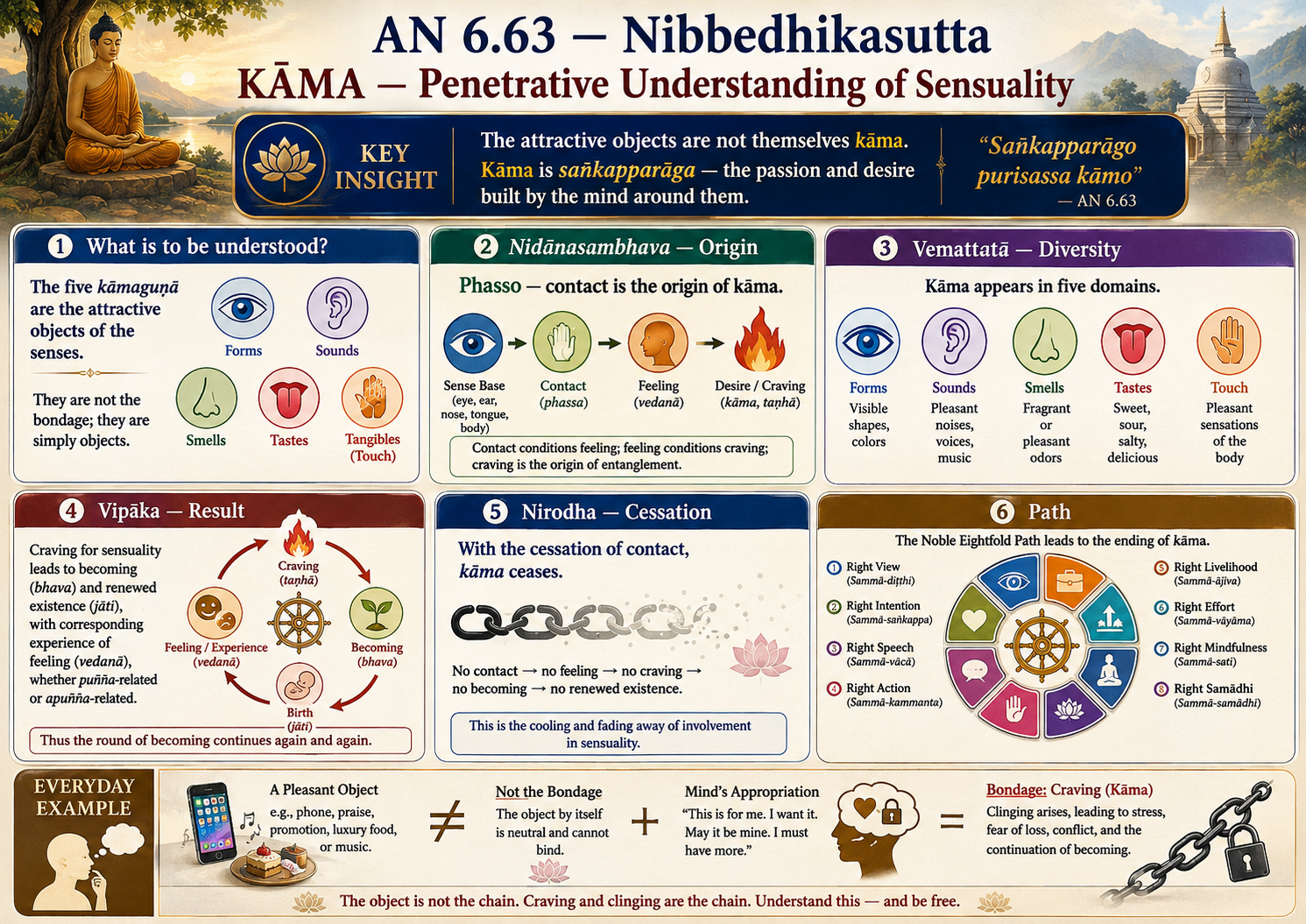
The Buddha first explains what was meant by saying that sensuality must be understood through its origin, diversity, result, cessation, and path.
There are five strings of sensual pleasure: forms known by the eye, sounds known by the ear, smells known by the nose, tastes known by the tongue, and tangible objects known by the body—when they are wished for, pleasing, agreeable, endearing, connected with sensuality, and provocative of passion.
But the Buddha immediately makes a crucial distinction: these are not themselves kāma. In the discipline of the noble ones they are called kāmaguṇā, “strings” or “strands” of sensual pleasure.
He then states:
“The passion for one’s own intentions/conceptions is a person’s sensuality. The beautiful things of the world are not themselves sensuality. The passion attached to one’s own intending is sensuality. The beautiful things remain in the world just as they are; the wise train away desire toward them.”
What gives rise to sensuality? Contact.
What is its diversity? There is sensuality regarding forms, sounds, smells, tastes, and tangible objects.
What is its result? One who desires sensuality produces a corresponding mode of existence, associated with merit or demerit.
What is its cessation? With the cessation of contact, sensuality ceases.
And the path leading to the cessation of sensuality is the Noble Eightfold Path: right view, right intention, right speech, right action, right livelihood, right effort, right mindfulness, and right samādhi.
When a noble disciple understands sensuality, its arising, diversity, result, cessation, and the path leading to cessation in this way, that disciple understands the penetrative holy life that culminates in the cessation of sensuality.
Detailed explanation
The famous verse is one of the most important corrections to a naïve understanding of sense restraint. The attractive object is not itself the bondage. The bondage is saṅkapparāga—the passion that the mind builds around its own intention, imagining, and appropriation.
This means the practice is not to hate beautiful sights, pleasant music, good food, fragrance, or comfortable touch. The training is to see how contact becomes the condition for a mental movement that says: “I want this; I need this; this will complete me.”
The phrase “the beautiful things remain just as they are” is especially important. Liberation is not achieved by destroying the world’s attractive features. The wise discipline chanda and rāga in relation to them.
Vipāka is described through the production of a corresponding attabhāva. The sutta thus connects sensual wanting not merely to a momentary feeling but to patterns of becoming and identity.
The path to cessation is not a single anti-sensuality technique; it is the whole Noble Eightfold Path.
Sixfold practice investigation
| What is kāma? | Look for the passion and appropriation generated around the sense object, not merely the object itself. |
|---|---|
| Cause | Identify the contact that triggered the mental movement. |
| Diversity | Which door is dominant—form, sound, smell, taste, or touch? |
| Result | What identity, behaviour, or becoming is this desire producing? |
| Cessation | Know the fading of the contact-conditioned process without feeding it. |
| Path | Return to right view, intention, speech, action, livelihood, effort, mindfulness, and samādhi. |
Everyday / corporate example
Corporate example: a new title, premium office, larger bonus, or prestige project is only the external kāmaguṇa. The binding element begins when the mind constructs: “This title proves my worth; I must have it; without it I am diminished.” The practice is to detect saṅkapparāga rather than blame the promotion itself.
Kāma infographic
Click infographic to enlarge ↗
02Vedanā — Feeling
“‘Vedanā, bhikkhave, veditabbā, vedanānaṁ nidānasambhavo veditabbo, vedanānaṁ vemattatā veditabbā, vedanānaṁ vipāko veditabbo, vedanānirodho veditabbo, vedanānirodhagāminī paṭipadā veditabbā’ti, iti kho panetaṁ vuttaṁ. Kiñcetaṁ paṭicca vuttaṁ?
Tisso imā, bhikkhave, vedanā— sukhā vedanā, dukkhā vedanā, adukkhamasukhā vedanā.
Katamo ca, bhikkhave, vedanānaṁ nidānasambhavo? Phasso, bhikkhave, vedanānaṁ nidānasambhavo.
Katamā ca, bhikkhave, vedanānaṁ vemattatā? Atthi, bhikkhave, sāmisā sukhā vedanā, atthi nirāmisā sukhā vedanā, atthi sāmisā dukkhā vedanā, atthi nirāmisā dukkhā vedanā, atthi sāmisā adukkhamasukhā vedanā, atthi nirāmisā adukkhamasukhā vedanā. Ayaṁ vuccati, bhikkhave, vedanānaṁ vemattatā.
Katamo ca, bhikkhave, vedanānaṁ vipāko? Yaṁ kho, bhikkhave, vediyamāno tajjaṁ tajjaṁ attabhāvaṁ abhinibbatteti puññabhāgiyaṁ vā apuññabhāgiyaṁ vā,
Variant: vediyamāno → vedayamāno (sya-all, km)
ayaṁ vuccati, bhikkhave, vedanānaṁ vipāko.
Katamo ca, bhikkhave, vedanānirodho? Phassanirodho, bhikkhave, vedanānirodho.
Variant: Phassanirodho → phassanirodhā (sya-all, km, mr)
Ayameva ariyo aṭṭhaṅgiko maggo vedanānirodhagāminī paṭipadā, seyyathidaṁ— sammādiṭṭhi, sammāsaṅkappo, sammāvācā, sammākammanto, sammāājīvo, sammāvāyāmo, sammāsati, sammāsamādhi.
Yato kho, bhikkhave, ariyasāvako evaṁ vedanaṁ pajānāti, evaṁ vedanānaṁ nidānasambhavaṁ pajānāti, evaṁ vedanānaṁ vemattataṁ pajānāti, evaṁ vedanānaṁ vipākaṁ pajānāti, evaṁ vedanānirodhaṁ pajānāti, evaṁ vedanānirodhagāminiṁ paṭipadaṁ pajānāti, so imaṁ nibbedhikaṁ brahmacariyaṁ pajānāti vedanānirodhaṁ.
Vedanā, bhikkhave, veditabbā, vedanānaṁ nidānasambhavo veditabbo, vedanānaṁ vemattatā veditabbā, vedanānaṁ vipāko veditabbo, vedanānirodho veditabbo, vedanānirodhagāminī paṭipadā veditabbāti, iti yaṁ taṁ vuttaṁ idametaṁ paṭicca vuttaṁ.”
There are three kinds of feeling: pleasant feeling, painful feeling, and neither-painful-nor-pleasant feeling.
What gives rise to feeling? Contact.
What is the diversity of feeling? There is worldly pleasant feeling and non-worldly pleasant feeling; worldly painful feeling and non-worldly painful feeling; worldly neutral feeling and non-worldly neutral feeling.
What is the result of feeling? While feeling, one may generate a corresponding mode of existence, associated with merit or demerit.
What is the cessation of feeling? With the cessation of contact, feeling ceases.
The path leading to the cessation of feeling is the Noble Eightfold Path: right view, right intention, right speech, right action, right livelihood, right effort, right mindfulness, and right samādhi.
When the noble disciple understands feeling through these six dimensions, the penetrative holy life culminating in the cessation of feeling is understood.
Detailed explanation
Vedanā here is not reduced to bodily sensation. The canonical division is affective tone: sukha, dukkha, and adukkhamasukha.
The important refinement is sāmisā versus nirāmisā. A pleasant feeling dependent on sensual or worldly acquisition differs from a pleasant feeling born of renunciation, Dhamma, or meditative development. Likewise, painful and neutral feeling can be worldly or non-worldly.
This prevents a simplistic practice rule such as “pleasant = bad, painful = good.” The practitioner asks what the feeling is dependent upon and what direction it supports.
The sutta again connects repeated feeling-conditioned reactions with the production of attabhāva—patterns of existence and identity.
The practical point is to know feeling early, before it automatically becomes craving, resistance, or indifference.
Sixfold practice investigation
| Know | Is the feeling pleasant, painful, or neutral? |
|---|---|
| Trace | What contact conditioned it? |
| Differentiate | Is it sāmisa—dependent on worldly bait—or nirāmisa—connected with renunciation/Dhamma? |
| Observe result | What behaviour or self-making follows when this feeling is indulged? |
| Know cessation | Notice the feeling changing and ending when its supporting contact is absent. |
| Develop path | Use the Eightfold Path so feeling is known without becoming bondage. |
Everyday / corporate example
Corporate example: praise from a senior leader produces pleasant vedanā. The key is not to deny the pleasantness, but to see whether it becomes sāmisa attachment—needing repeated validation—or whether the mind can receive it without constructing identity.

Vedanā infographic
Click infographic to enlarge ↗
03Saññā — Perception
“‘Saññā, bhikkhave, veditabbā, saññānaṁ nidānasambhavo veditabbo, saññānaṁ vemattatā veditabbā, saññānaṁ vipāko veditabbo, saññānirodho veditabbo, saññānirodhagāminī paṭipadā veditabbā’ti, iti kho panetaṁ vuttaṁ. Kiñcetaṁ paṭicca vuttaṁ?
Chayimā, bhikkhave, saññā— rūpasaññā, saddasaññā, gandhasaññā, rasasaññā, phoṭṭhabbasaññā, dhammasaññā.
Katamo ca, bhikkhave, saññānaṁ nidānasambhavo? Phasso, bhikkhave, saññānaṁ nidānasambhavo.
Katamā ca, bhikkhave, saññānaṁ vemattatā? Aññā, bhikkhave, saññā rūpesu, aññā saññā saddesu, aññā saññā gandhesu, aññā saññā rasesu, aññā saññā phoṭṭhabbesu, aññā saññā dhammesu.
Variant: bhikkhave, saññā rūpesu, aññā saññā saddesu → aññā bhikkhave rūpesu saññā aññā saddesu saññā (mr)
Ayaṁ vuccati, bhikkhave, saññānaṁ vemattatā.
Katamo ca, bhikkhave, saññānaṁ vipāko? Vohāravepakkaṁ, bhikkhave, saññaṁ vadāmi.
Variant: Vohāravepakkaṁ → vohāravepakkāhaṁ (bj, sya-all, pts1ed) | saññaṁ → saññā (sya-all, pts1ed)
Yathā yathā naṁ sañjānāti tathā tathā voharati, ‘evaṁ saññī ahosin’ti.
Variant: ahosinti → ahosīti (mr)
Ayaṁ vuccati, bhikkhave, saññānaṁ vipāko.
Katamo ca, bhikkhave, saññānirodho? Phassanirodho, bhikkhave, saññānirodho.
Variant: Phassanirodho → phassanirodhā (sya-all, mr)
Ayameva ariyo aṭṭhaṅgiko maggo saññānirodhagāminī paṭipadā, seyyathidaṁ— sammādiṭṭhi, sammāsaṅkappo, sammāvācā, sammākammanto, sammāājīvo, sammāvāyāmo, sammāsati, sammāsamādhi.
Yato kho, bhikkhave, ariyasāvako evaṁ saññaṁ pajānāti, evaṁ saññānaṁ nidānasambhavaṁ pajānāti, evaṁ saññānaṁ vemattataṁ pajānāti, evaṁ saññānaṁ vipākaṁ pajānāti, evaṁ saññānirodhaṁ pajānāti, evaṁ saññānirodhagāminiṁ paṭipadaṁ pajānāti, so imaṁ nibbedhikaṁ brahmacariyaṁ pajānāti saññānirodhaṁ.
Saññā, bhikkhave, veditabbā, saññānaṁ nidānasambhavo veditabbo, saññānaṁ vemattatā veditabbā, saññānaṁ vipāko veditabbo, saññānirodho veditabbo, saññānirodhagāminī paṭipadā veditabbāti. Iti yaṁ taṁ vuttaṁ idametaṁ paṭicca vuttaṁ.”
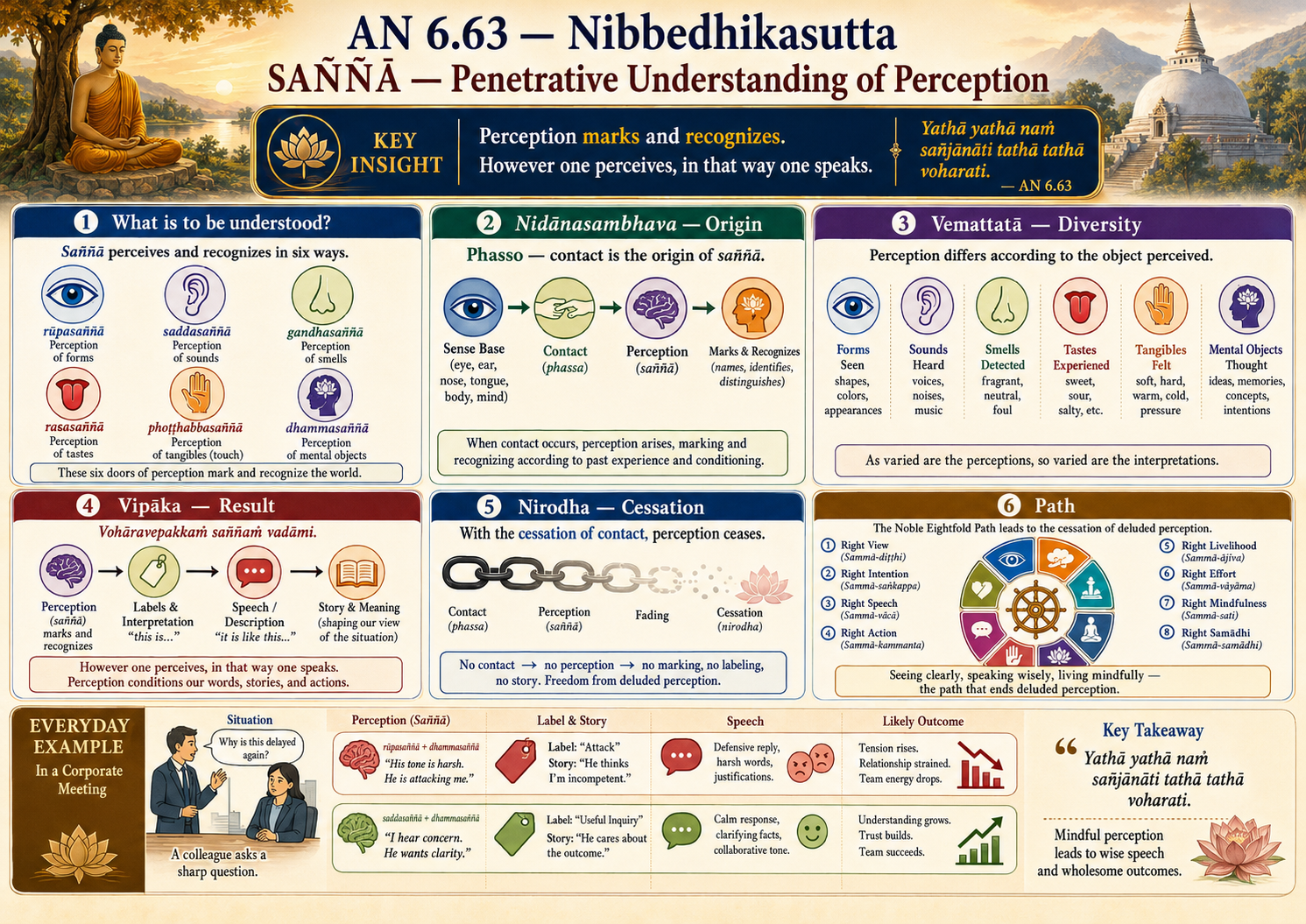
There are six kinds of perception: perception of forms, sounds, smells, tastes, tangible objects, and mental objects.
What gives rise to perception? Contact.
What is the diversity of perception? Perception differs according to whether its field is form, sound, smell, taste, touch, or mental object.
What is the result of perception? “I say that perception has expression or conventional designation as its result.” However one perceives something, in that way one speaks about it: “I perceived it in such a way.”
What is the cessation of perception? With the cessation of contact, perception ceases.
The Noble Eightfold Path—right view, right intention, right speech, right action, right livelihood, right effort, right mindfulness, and right samādhi—is the path leading to the cessation of perception.
When a noble disciple understands perception through these six dimensions, the penetrative holy life culminating in the cessation of perception is understood.
Detailed explanation
The statement vohāravepakkaṁ saññaṁ vadāmi is extremely important. Saññā does not remain private. It conditions the labels, descriptions, and language through which we communicate and construct a shared world.
Yathā yathā naṁ sañjānāti tathā tathā voharati—however one perceives, that is how one speaks about it.
This gives saññā enormous practical importance. Two people can encounter the same event and speak about it very differently because perception has selected and marked different features.
In practice, before arguing about the words, examine the saññā that produced the words. Has the mind marked the event as insult, threat, opportunity, failure, enemy, “mine,” or “unfair”? Speech then follows that perception.
Because contact is the origin, saññā is not an independent permanent faculty; it is conditioned and therefore trainable.
Sixfold practice investigation
| Identify | What has the mind marked or recognized? |
|---|---|
| Trace to contact | Through which door did this perceptual marking arise? |
| Check diversity | Visual, auditory, olfactory, gustatory, tactile, or mental perception? |
| Watch vohāra | How is this perception shaping the words and story that follow? |
| See cessation | When contact and attention change, does the perceptual label weaken? |
| Train path | Use right view and right mindfulness before converting perception into speech. |
Everyday / corporate example
Corporate example: one manager perceives a colleague’s question as “challenge to my authority,” while another perceives it as “useful scrutiny.” The same words produce different vohāra because the preceding saññā differs. Training saññā changes communication.
Saññā infographic
Click infographic to enlarge ↗
04Āsava — Inflows / Deep Defiling Currents
“‘Āsavā, bhikkhave, veditabbā, āsavānaṁ nidānasambhavo veditabbo, āsavānaṁ vemattatā veditabbā, āsavānaṁ vipāko veditabbo, āsavanirodho veditabbo, āsavanirodhagāminī paṭipadā veditabbā’ti, iti kho panetaṁ vuttaṁ. Kiñcetaṁ paṭicca vuttaṁ?
Tayome, bhikkhave, āsavā— kāmāsavo, bhavāsavo, avijjāsavo.
Katamo ca, bhikkhave, āsavānaṁ nidānasambhavo? Avijjā, bhikkhave, āsavānaṁ nidānasambhavo.
Katamā ca, bhikkhave, āsavānaṁ vemattatā? Atthi, bhikkhave, āsavā nirayagamanīyā, atthi āsavā tiracchānayonigamanīyā, atthi āsavā pettivisayagamanīyā, atthi āsavā manussalokagamanīyā, atthi āsavā devalokagamanīyā.
Variant: nirayagamanīyā → nirayagāminiyā (bj, mr); nirayagamaniyā (sya-all, pts1ed)
Ayaṁ vuccati, bhikkhave, āsavānaṁ vemattatā.
Katamo ca, bhikkhave, āsavānaṁ vipāko? Yaṁ kho, bhikkhave, avijjāgato tajjaṁ tajjaṁ attabhāvaṁ abhinibbatteti puññabhāgiyaṁ vā apuññabhāgiyaṁ vā, ayaṁ vuccati, bhikkhave, āsavānaṁ vipāko.
Katamo ca, bhikkhave, āsavanirodho? Avijjānirodho, bhikkhave, āsavanirodho.
Ayameva ariyo aṭṭhaṅgiko maggo āsavanirodhagāminī paṭipadā, seyyathidaṁ— sammādiṭṭhi, sammāsaṅkappo, sammāvācā, sammākammanto, sammāājīvo, sammāvāyāmo, sammāsati, sammāsamādhi.
Yato kho, bhikkhave, ariyasāvako evaṁ āsave pajānāti, evaṁ āsavānaṁ nidānasambhavaṁ pajānāti, evaṁ āsavānaṁ vemattataṁ pajānāti, evaṁ āsavānaṁ vipākaṁ pajānāti, evaṁ āsavānaṁ nirodhaṁ pajānāti, evaṁ āsavānaṁ nirodhagāminiṁ paṭipadaṁ pajānāti, so imaṁ nibbedhikaṁ brahmacariyaṁ pajānāti āsavanirodhaṁ.
Āsavā, bhikkhave, veditabbā, āsavānaṁ nidānasambhavo veditabbo, āsavānaṁ vemattatā veditabbā, āsavānaṁ vipāko veditabbo, āsavanirodho veditabbo, āsavanirodhagāminī paṭipadā veditabbāti. Iti yaṁ taṁ vuttaṁ idametaṁ paṭicca vuttaṁ.”
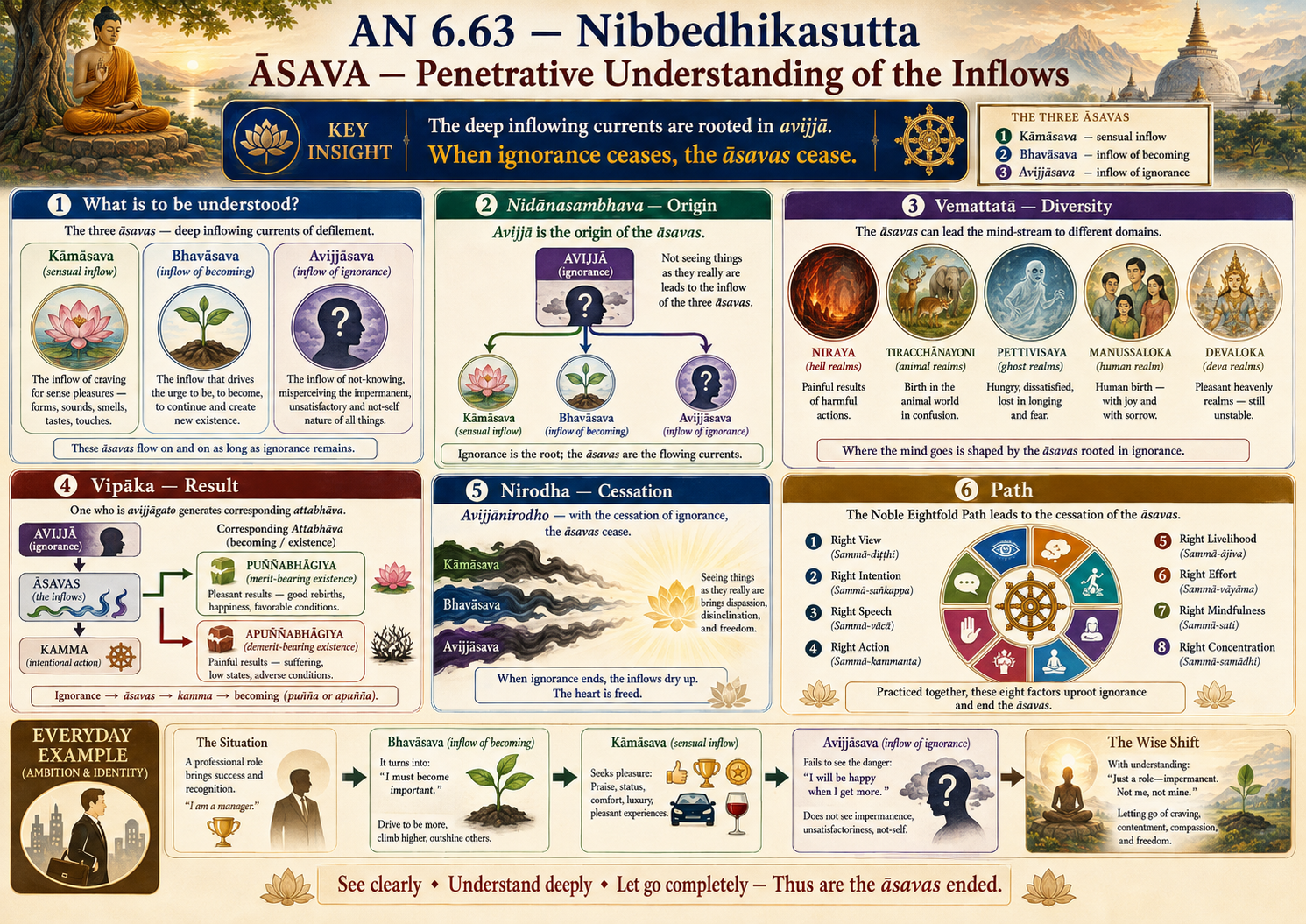
There are three āsavas: the āsava of sensuality, the āsava of becoming, and the āsava of ignorance.
What gives rise to the āsavas? Ignorance.
What is their diversity? There are āsavas leading toward hell, the animal realm, the realm of departed spirits, the human world, and the deva world.
What is their result? One immersed in ignorance generates a corresponding mode of existence, whether associated with merit or demerit.
What is the cessation of the āsavas? With the cessation of ignorance, the āsavas cease.
The path leading to their cessation is the Noble Eightfold Path: right view, right intention, right speech, right action, right livelihood, right effort, right mindfulness, and right samādhi.
When the noble disciple understands the āsavas in this sixfold penetrative way, the holy life culminating in their cessation is understood.
Detailed explanation
The sutta names three āsavas: kāmāsava, bhavāsava, and avijjāsava. These are deeper currents than a single passing thought. They are tendencies that keep flowing into and conditioning experience.
The stated causal origin is avijjā. This is important: ignorance is not merely lack of information. It is the fundamental not-knowing that allows sensuality and becoming to continue as compelling projects.
The diversity is described by the destinations toward which these currents can lead. Thus even refined becoming remains within conditioned existence.
The cessation formula is correspondingly deep: avijjānirodha is āsavanirodha. The task is not merely to manage symptoms but to end the ignorance that sustains the currents.
The Noble Eightfold Path is again presented as the complete solution.
Sixfold practice investigation
| Know the current | Is sensuality, becoming, or ignorance dominating? |
|---|---|
| Find the root | What is not being seen clearly? |
| Observe direction | What kind of existence or identity is this current constructing? |
| See vipāka | How does ignorance make wholesome/unwholesome becoming seem necessary? |
| Cessation | Work toward the ending of avijjā, not merely surface suppression. |
| Path | Develop the entire Noble Eightfold Path. |
Everyday / corporate example
Corporate example: ambition may begin as a practical goal but become bhavāsava when the mind is compelled to become “the top executive,” “the indispensable expert,” or “the respected leader.” The deeper issue is not the job role but ignorance-driven identity-becoming.
Āsava infographic
Click infographic to enlarge ↗
05Kamma — Intention in Action
“‘Kammaṁ, bhikkhave, veditabbaṁ, kammānaṁ nidānasambhavo veditabbo, kammānaṁ vemattatā veditabbā, kammānaṁ vipāko veditabbo, kammanirodho veditabbo, kammanirodhagāminī paṭipadā veditabbā’ti, iti kho panetaṁ vuttaṁ. Kiñcetaṁ paṭicca vuttaṁ?
Cetanāhaṁ, bhikkhave, kammaṁ vadāmi. Cetayitvā kammaṁ karoti— kāyena vācāya manasā.
Katamo ca, bhikkhave, kammānaṁ nidānasambhavo? Phasso, bhikkhave, kammānaṁ nidānasambhavo.
Katamā ca, bhikkhave, kammānaṁ vemattatā? Atthi, bhikkhave, kammaṁ nirayavedanīyaṁ, atthi kammaṁ tiracchānayonivedanīyaṁ, atthi kammaṁ pettivisayavedanīyaṁ, atthi kammaṁ manussalokavedanīyaṁ, atthi kammaṁ devalokavedanīyaṁ. Ayaṁ vuccati, bhikkhave, kammānaṁ vemattatā.
Katamo ca, bhikkhave, kammānaṁ vipāko? Tividhāhaṁ, bhikkhave, kammānaṁ vipākaṁ vadāmi—
Variant: Tividhāhaṁ → imāhaṁ (mr)
diṭṭheva dhamme, upapajje vā, apare vā pariyāye.
Variant: diṭṭheva → diṭṭhe vā (bj)
Ayaṁ vuccati, bhikkhave, kammānaṁ vipāko.
Katamo ca, bhikkhave, kammanirodho? Phassanirodho, bhikkhave, kammanirodho.
Variant: Phassanirodho → phassanirodhā (si, sya-all, mr)
Ayameva ariyo aṭṭhaṅgiko maggo kammanirodhagāminī paṭipadā, seyyathidaṁ— sammādiṭṭhi, sammāsaṅkappo, sammāvācā, sammākammanto, sammāājīvo, sammāvāyāmo, sammāsati, sammāsamādhi.
Yato kho, bhikkhave, ariyasāvako evaṁ kammaṁ pajānāti, evaṁ kammānaṁ nidānasambhavaṁ pajānāti, evaṁ kammānaṁ vemattataṁ pajānāti, evaṁ kammānaṁ vipākaṁ pajānāti, evaṁ kammanirodhaṁ pajānāti, evaṁ kammanirodhagāminiṁ paṭipadaṁ pajānāti, so imaṁ nibbedhikaṁ brahmacariyaṁ pajānāti kammanirodhaṁ.
Kammaṁ, bhikkhave, veditabbaṁ, kammānaṁ nidānasambhavo veditabbo, kammānaṁ vemattatā veditabbā, kammānaṁ vipāko veditabbo, kammanirodho veditabbo, kammanirodhagāminī paṭipadā veditabbāti, iti yaṁ taṁ vuttaṁ idametaṁ paṭicca vuttaṁ.”
“It is intention that I call kamma. Having intended, one performs kamma through body, speech, and mind.”
What gives rise to kamma? Contact.
What is the diversity of kamma? There is kamma to be experienced in hell, in the animal realm, in the realm of departed spirits, in the human world, and in the deva world.
What is the result of kamma? The Buddha says the result of kamma is of three kinds: experienced here and now, on a subsequent arising, or at a later occasion.
What is the cessation of kamma? With the cessation of contact, kamma ceases.
The path leading to the cessation of kamma is the Noble Eightfold Path: right view, right intention, right speech, right action, right livelihood, right effort, right mindfulness, and right samādhi.
When a noble disciple understands kamma through these six dimensions, the penetrative holy life culminating in the cessation of kamma is understood.
Detailed explanation
Cetanāhaṁ kammaṁ vadāmi is the central definition: intention is kamma.
The next sentence prevents a purely mental interpretation: after intending, kamma is enacted through body, speech, and mind.
This sharply focuses ethical training. The same outward action can have different karmic quality depending on intention, while intention that is repeatedly cultivated tends toward corresponding speech and action.
The sutta says phassa is the causal arising of kamma. Contact presents the situation in which intention takes shape. This links kamma directly to six-door practice: before bodily or verbal action there is a contact-conditioned opportunity in which cetanā can be known.
Vipāka is not always immediate. The sutta gives three temporal modes, reminding the practitioner not to conclude that an action has no consequence merely because no result is visible now.
Kammanirodha is ultimately tied to the ending of the contact-conditioned karmic process through the Noble Eightfold Path.
Sixfold practice investigation
| Pause at contact | Before reacting, recognize the event that has contacted the mind. |
|---|---|
| Know cetanā | What am I intending to produce through this response? |
| Check three doors | How will this intention become body, speech, or mind action? |
| Remember timing | Do not judge kamma only by immediate payoff. |
| Know cessation | Train so contact does not automatically become identity-driven intention. |
| Path | Use right intention, speech, action, livelihood, effort, mindfulness, and samādhi. |
Everyday / corporate example
Corporate example: two managers may deliver the same corrective feedback. One intends humiliation and domination; the other intends clarity and development. The words may partly overlap, but cetanā changes the ethical quality of the kamma.

Kamma infographic
Click infographic to enlarge ↗
06Dukkha — Suffering / Stress
“‘Dukkhaṁ, bhikkhave, veditabbaṁ, dukkhassa nidānasambhavo veditabbo, dukkhassa vemattatā veditabbā, dukkhassa vipāko veditabbo, dukkhanirodho veditabbo, dukkhanirodhagāminī paṭipadā veditabbā’ti, iti kho panetaṁ vuttaṁ. Kiñcetaṁ paṭicca vuttaṁ?
Jātipi dukkhā, jarāpi dukkhā, byādhipi dukkho, maraṇampi dukkhaṁ, sokaparidevadukkhadomanassupāyāsāpi dukkhā, yampicchaṁ na labhati tampi dukkhaṁ, saṅkhittena pañcupādānakkhandhā dukkhā.
Variant: byādhipi dukkho → vyādhipi dukkho (bj); byādhipi dukkhā (sya-all, mr); vyādhipi dukkhā (pts1ed) | pañcupādānakkhandhā → pañcupādānakkhandhāpi (mr)
Katamo ca, bhikkhave, dukkhassa nidānasambhavo? Taṇhā, bhikkhave, dukkhassa nidānasambhavo.
Katamā ca, bhikkhave, dukkhassa vemattatā? Atthi, bhikkhave, dukkhaṁ adhimattaṁ, atthi parittaṁ, atthi dandhavirāgi, atthi khippavirāgi. Ayaṁ vuccati, bhikkhave, dukkhassa vemattatā.
Katamo ca, bhikkhave, dukkhassa vipāko? Idha, bhikkhave, ekacco yena dukkhena abhibhūto pariyādinnacitto socati kilamati paridevati, urattāḷiṁ kandati, sammohaṁ āpajjati, yena vā pana dukkhena abhibhūto pariyādinnacitto bahiddhā pariyeṭṭhiṁ āpajjati:
Variant: pariyādinnacitto → pariyādiṇṇacitto (mr)
‘ko ekapadaṁ dvipadaṁ jānāti imassa dukkhassa nirodhāyā’ti?
Variant: ko → so na (mr) | jānāti → pajānāti (bj, sya-all, mr)
Sammohavepakkaṁ vāhaṁ, bhikkhave, dukkhaṁ vadāmi pariyeṭṭhivepakkaṁ vā. Ayaṁ vuccati, bhikkhave, dukkhassa vipāko.
Katamo ca, bhikkhave, dukkhanirodho? Taṇhānirodho, bhikkhave, dukkhanirodho.
Variant: Taṇhānirodho → taṇhānirodhā (si, sya-all, mr)
Ayameva ariyo aṭṭhaṅgiko maggo dukkhassa nirodhagāminī paṭipadā, seyyathidaṁ— sammādiṭṭhi, sammāsaṅkappo, sammāvācā, sammākammanto, sammāājīvo, sammāvāyāmo, sammāsati, sammāsamādhi.
Yato kho, bhikkhave, ariyasāvako evaṁ dukkhaṁ pajānāti, evaṁ dukkhassa nidānasambhavaṁ pajānāti, evaṁ dukkhassa vemattataṁ pajānāti, evaṁ dukkhassa vipākaṁ pajānāti, evaṁ dukkhanirodhaṁ pajānāti, evaṁ dukkhanirodhagāminiṁ paṭipadaṁ pajānāti, so imaṁ nibbedhikaṁ brahmacariyaṁ pajānāti dukkhanirodhaṁ.
Dukkhaṁ, bhikkhave, veditabbaṁ, dukkhassa nidānasambhavo veditabbo, dukkhassa vemattatā veditabbā, dukkhassa vipāko veditabbo, dukkhanirodho veditabbo, dukkhanirodhagāminī paṭipadā veditabbāti. Iti yaṁ taṁ vuttaṁ idametaṁ paṭicca vuttaṁ.”
Birth is suffering; aging is suffering; illness is suffering; death is suffering; sorrow, lamentation, pain, distress, and despair are suffering; not getting what one wants is suffering; in brief, the five clinging-aggregates are suffering.
What gives rise to suffering? Craving.
What is the diversity of suffering? Some suffering is intense, some slight; some fades slowly, some quickly.
What is the result of suffering? A person overwhelmed by suffering may grieve, become exhausted, lament, beat the breast, cry, and fall into confusion. Or, overwhelmed by suffering, a person may begin an outward search: “Who knows even one or two steps for the cessation of this suffering?”
The Buddha says that suffering may have either bewilderment or searching as its result.
What is the cessation of suffering? With the cessation of craving, suffering ceases.
The path leading to the cessation of suffering is the Noble Eightfold Path: right view, right intention, right speech, right action, right livelihood, right effort, right mindfulness, and right samādhi.
When a noble disciple understands suffering through these six dimensions, the penetrative holy life culminating in the cessation of suffering is understood.
Detailed explanation
The dukkha section gives the sixfold analysis its most existential application.
The definition culminates in pañcupādānakkhandhā dukkhā—the five clinging-aggregates are suffering. The issue is not merely external misfortune but appropriation of conditioned aggregates.
Taṇhā is named as nidānasambhava. The sutta therefore directs attention from the painful event to the craving that sustains the suffering-process.
The diversity of suffering is practical: some is overwhelming, some mild; some fades quickly, some lingers. Not every painful state behaves the same way.
The vipāka section is particularly insightful. Suffering can produce sammoha—bewilderment—or pariyeṭṭhi—search. The same suffering that disorients one person can become the catalyst for another to seek a path beyond suffering.
The Buddha’s teaching turns pariyeṭṭhi into penetrative understanding: do not merely search outside for relief; understand dukkha causally and develop the path to taṇhānirodha.
Sixfold practice investigation
| Name dukkha | What exactly is being suffered? |
|---|---|
| Trace craving | What am I demanding, resisting, or trying to preserve? |
| Assess diversity | Is this intense or slight, slowly fading or quickly fading? |
| Notice vipāka | Is suffering producing confusion or intelligent search? |
| Know cessation | What happens as taṇhā fades? |
| Develop path | Use the Noble Eightfold Path rather than endless external searching. |
Everyday / corporate example
Corporate example: after losing a senior role, one person becomes consumed by “I should still have that position” and spirals into confusion. Another recognizes the same pain as a reason to examine craving, identity, and livelihood. The suffering becomes pariyeṭṭhi—a genuine search for a deeper solution.
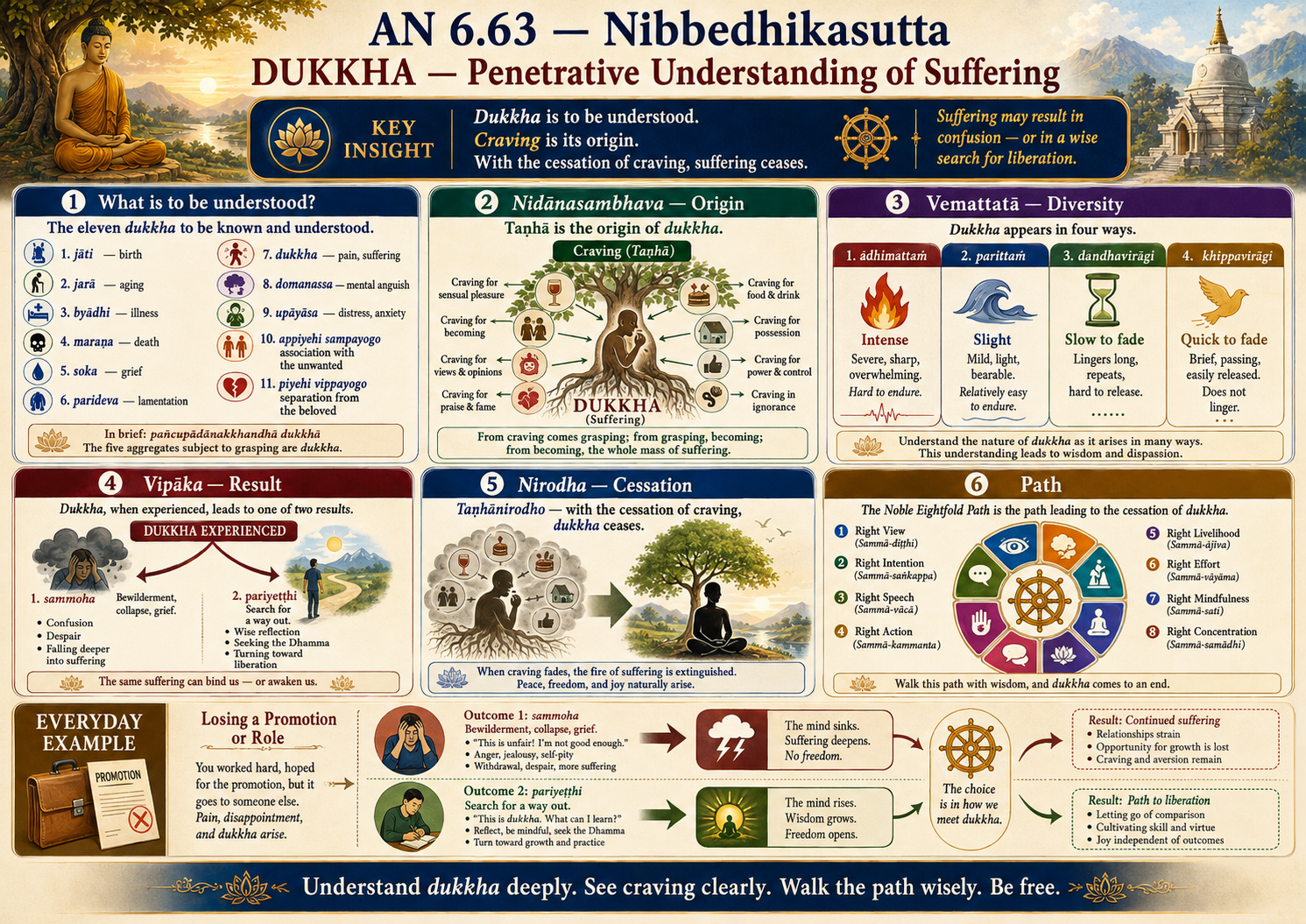
Dukkha infographic
Click infographic to enlarge ↗
Conditions, varieties, results and cessation
| Domain | Nidānasambhava | Vemattatā | Vipāka | Nirodha |
|---|---|---|---|---|
| Kāma | phassa | five sense domains | corresponding attabhāva | phassanirodha |
| Vedanā | phassa | 3 feelings × sāmisa/nirāmisa | corresponding attabhāva | phassanirodha |
| Saññā | phassa | six perception fields | vohāra / expression | phassanirodha |
| Āsava | avijjā | three āsavas / destinations | corresponding attabhāva | avijjānirodha |
| Kamma | phassa | kamma by destination | 3 timings of vipāka | phassanirodha |
| Dukkha | taṇhā | intense/slight; slow/quick fading | bewilderment or search | taṇhānirodha |
Penetration means understanding in relation to cessation
“Ayaṁ kho so, bhikkhave, nibbedhikapariyāyo dhammapariyāyo”ti.
“This, bhikkhus, is the penetrative exposition of Dhamma.”
Detailed explanation
The conclusion is deliberately short because the structure has already done the work.
Across six very different domains, the Buddha repeatedly teaches the same discipline of penetration:
veditabba → nidānasambhava → vemattatā → vipāka → nirodha → nirodhagāminī paṭipadā.
This can become a general practice framework. Rather than merely saying “I have desire,” “I have a painful feeling,” “this is my perception,” “this is my kamma,” or “I am suffering,” investigate the phenomenon through conditions and consequences.
The repeated appearance of the Noble Eightfold Path is decisive. Penetrative understanding is not complete until the phenomenon is understood in relation to cessation and the path that leads there.