
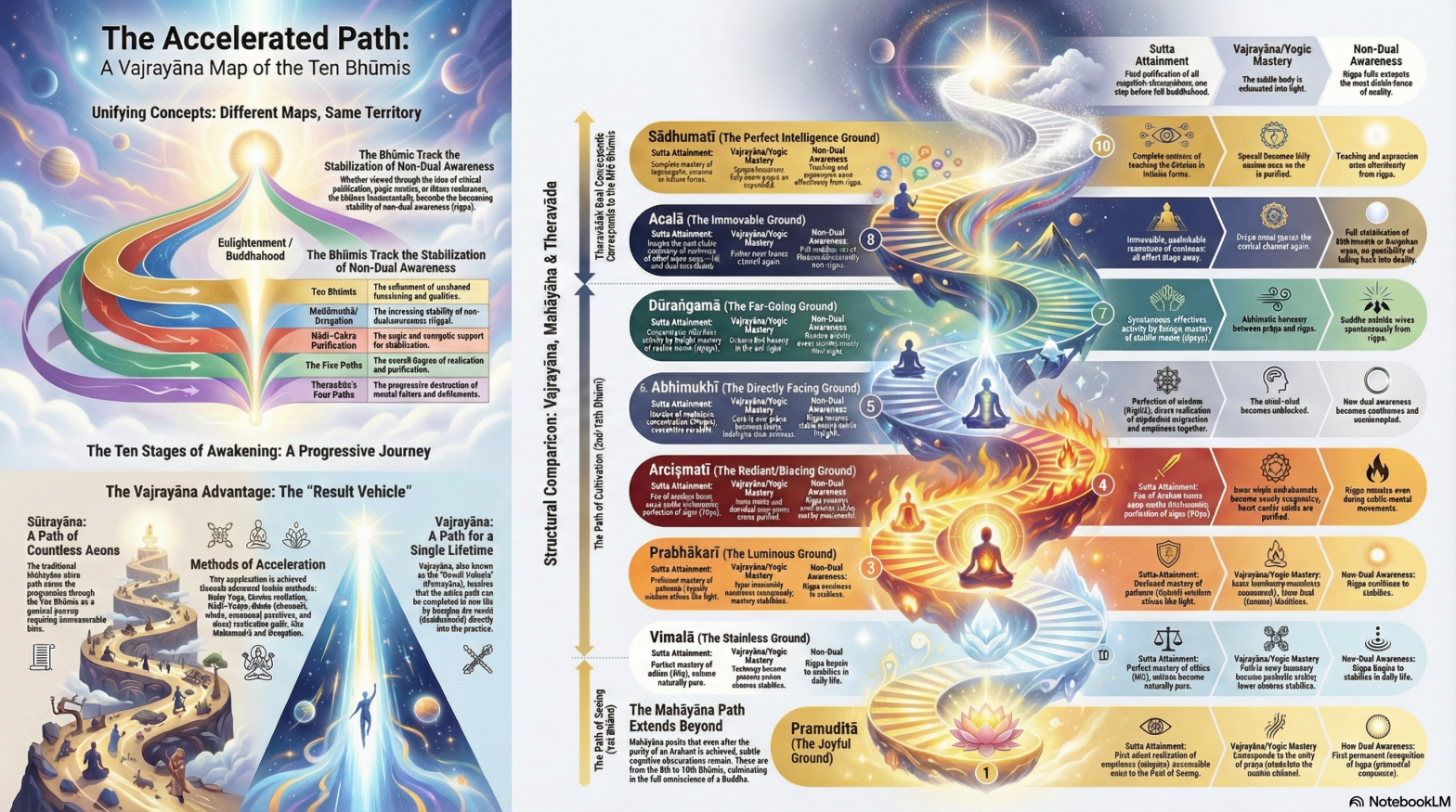
This essay portrays the ten Bodhisattva Bhūmis, which are the progressive stages of realization a Bodhisattva achieves on the path to Buddhahood, drawing primarily from the Vajrayāna Buddhist perspective.
It defines each of the ten stages, detailing their Key Attainments and results, such as the first direct realization of emptiness at the Pramuditā Bhūmi (Stage 1) and the purification of obscurations leading to the final stage, Dharmameghā Bhūmi (Stage 10).
This essay emphasizes Vajrayāna’s unique view that these stages, which traditionally span countless aeons, can be accelerated and traversed in a single lifetime through tantric practice. Finally, the essay provides a comprehensive master synthesis, mapping the Bhūmis across four different Buddhist frameworks: the Five Paths, Mahāmudrā/Dzogchen stability, the Theravāda Four Paths, and Vajrayāna’s specialized Nāḍī–Cakra purification.
Going into detail of this essay, one can see that progressive stabilization of non-dual awareness is unified by the understanding that the Bhūmis are not locations, but degrees of stabilization of realization. Whether viewed through the lens of Sūtra, Tantra, Dzogchen, or Theravāda, the path tracks the transformation of a fleeting initial realization into an effortless, continuous, and embodied state.
The following concepts illustrate this unifying progression:
The Transition from “Seeing” to “Cultivating”
Across all frameworks, stabilization begins with a decisive shift from intellectual understanding to direct perception, followed by a long period of habituation.
The Point of Entry (1st Bhūmi): This stage unifies the “Path of Seeing” (Darśana-mārga) with the “first direct realization of Śūnyatā”. In Mahāmudrā/Dzogchen terms, this is the “first permanent recognition of rigpa”. In yogic terms, this corresponds to the entry of prāṇa (inner wind) into the central channel.
The Process of Stabilization (Bhūmis 2–10): Once the initial realization occurs, the practitioner enters the “Path of Cultivation” (Bhāvanā-mārga). The goal here is not a new realization, but the “gradual destruction of subtle obscurations” that cloud the awareness already recognized.
The Collapse of Effort and Duality
A central metric for stabilization is the movement from effortful practice to spontaneous being.
Continuous Awareness (6th Bhūmi): A major milestone occurs at the “Directly Facing Ground,” where non-dual awareness becomes continuous. In Dzogchen, this is the point where rigpa remains uninterrupted.
Immovability (8th Bhūmi): This is the definitive turning point across frameworks. Known as the “Immovable Ground” (Acalā), it marks the cessation of all effort.
◦ In Dzogchen: Rigpa never collapses; realization is irreversible.
◦ In Tantra: Prāṇa never leaves the central channel.
◦ In Theravāda: This level roughly corresponds to the Arahant stage, where the “āsavas” (corruptions) are ended and rebirth ceases.
The Synchronization of Mind and Energy (Prāṇa)
This essay present a unified view where mental realization is intrinsically linked to energetic purification. The stabilization of awareness is mirrored by the stabilization of the subtle body.
Initial Stabilization: While the 1st Bhūmi marks the entry of prāṇa into the central channel, the 2nd through 5th Bhūmis involve stabilizing the chakras and inner winds (such as the heat/tummo at the 3rd Bhūmi and heart-center winds at the 4th).
Perfect Harmony: By the 7th Bhūmi, there is an automatic harmony between prāṇa and rigpa, and by the 9th, even speech-wind is fully purified. This illustrates that stable non-dual awareness is not just a mental state but a physiological transformation where the “inner winds and channels become deeply responsive to practice”.
The Exhaustion of Obscuration
The frameworks unify around what is being removed. Stabilization is effectively the progressive exhaustion of dualistic habits.
Gross vs. Subtle: The progression moves from destroying “identity-view” (1st Bhūmi) to overcoming subtle dualistic grasping (6th Bhūmi), and finally removing “subtle cognitive obscurations” that remain even after the emotional fetters are gone (8th–10th Bhūmi).
Theravāda vs. Mahāyāna Scope: While the Theravāda path concludes with the destruction of fetters (approx. 7th–8th Bhūmi), the Mahāyāna frameworks extend the stabilization process to include the purification of the subtlest cognitive blocks to omniscience, necessary for full Buddhahood.
Analogy: The Gyroscope
You can visualize the stabilization of non-dual awareness like a spinning gyroscope.
1st Bhūmi (Path of Seeing): The gyroscope is spun for the first time. It is upright (non-dual), but it wobbles significantly and requires constant external force (effort/practice) to keep from toppling over into gravity (duality/identity-view).
2nd–7th Bhūmis (Path of Cultivation): The spin increases in speed. The wobble decreases. The gyroscope can maintain its balance through minor disturbances, but it still relies on the momentum of applied energy (meditation and discipline).
8th Bhūmi (Immovable Ground): The gyroscope reaches “critical speed.” It is now so perfectly balanced and spinning so fast that it appears motionless. It is immovable; you could tilt the surface it stands on, and it would remain upright perfectly without any new effort. Its stability has become an inherent property of its motion, just as rigpa becomes the spontaneous, effortless nature of the mind.
Ten Bhūmis Mapped to the Five Paths (Pañcamārga) – The Five Paths are the foundational Mahāyāna framework into which the Bhūmis are inserted.
Pramuditā Bhūmi – “The Joyful Ground” – A person starts from not knowing to starting to know what is reality as in five aggregates. When he does that, following would be the key attainments provided that he has stood firm on the 5 precepts and having developed sufficient faith either as a saddhanusari or dhammanusari on the Buddha, Dhamma and Sangha.
Also the practitioner starts to attain Dāna-pāramitā – Perfection of giving and he starts to corresponds to the Path of Seeing: Direct, non-conceptual realization of śūnyatā / tathatā.
One becomes an Ārya Bodhisattva (noble being). The Bodhisattva sees: All dharmas as empty of inherent existence Yet does not fall into nihilism—compassion becomes deeper, not weaker.
Transformations: Irreversible shift: one can never fall back to ordinary ignorance.
Great joy arises from: Certainty of liberation and confidence in the path
Giving becomes: Less mixed with self-image, pride, or expectation and more fearless—giving body, possessions, teachings if needed
In terms of fetters: Comparable to stream-entry in early Buddhism and identity-view is shattered and faith in Dharma is unshakable.
Key Attainment:
First direct realization of Śūnyatā (emptiness)
Irreversible entry into the Path of Seeing (Darśanamārga)
Complete destruction of identity-view (sakkāya-diṭṭhi)
Result:
The Bodhisattva becomes an Ārya and cannot fall into lower realms again. Due to which there is spontaneous joy as improper view is gone.
Vajrayāna View:
Often corresponds to direct mind-nature realization and in highest tantras, can be reached in one life
Vimalā Bhūmi – “The Stainless Ground” – In this state, the ariya savaka either lay or a monk starts to make progress in removing the stain in the mind by following 5 or 8 precepts along with analyzing of forms, feelings, perceptions, preparations/violations and conscious experience including their dependent nature. As he starts that, the taints or dirt starts to erode away and below are the key attainments:
Transformations: All coarse ethical defilements are abandoned and even when acting in complex situations, motivation remains as in non-harming, based in compassion, guided by emptiness-wisdom. virtue is no longer effortful “self-control”; it becomes natural expression of understanding.
Subtle point: Ethics here is not just rule-keeping; it is: Speech, body, and livelihood completely aligned with insight and no hidden hypocrisy.
Key Attainment:
Complete purification of ethical defilements and perfect mastery of Śīla Pāramitā
Result:
No possibility of deliberate moral downfall and actions become naturally pure
Vajrayāna Note: This is where samaya (tantric vows) become perfectly stable
Prabhākarī Bhūmi – “The Luminous Ground” – In this state, the ariya savaka who is either a lay or a monk undergoes the practice of giving up and getting associated with anything that destroys his progress. In that way, there is always bliss experience due to which there is patience (Kṣānti) is getting fully established and his wisdom of nature of things gets established. His sati on breath is taking a great shape and is never agitated since he can watch the breath continiously noticing the changes that happen due to outside factors.
Key idea: Wisdom and compassion now begin to shine outward like light:
Others feel peace and clarity around this Bodhisattva.
Patience here is deep, patience with harm done to oneself, patience with the suffering of beings, and patience with the paradoxes and slowness of the path.
Transformations:
Anger/personal resentment become highly unlikely.
A very stable, gentle presence; the Bodhisattva:
Can hear criticism without defensiveness.
Can bear the sight of great suffering without collapsing into despair.
Why “luminous”?
Because the mind is less obscured:
The natural radiance (prabhā) of awareness is more evident.
Others are “illumined” by their presence and teaching.
Key Attainment:
Profound mastery of patience ( Pāramitā), wisdom shines like light and no anger can arise
Result: Radiance of wisdom naturally influences beings
Tantric Meaning: Inner luminosity begins to manifest consciously
Arciṣmatī Bhūmi – “The Radiant / Blazing Ground” – This is extremely blissful state to be in as the prana’s are getting calmed due to establishing of “indriya-samvara” or guarding of sense doors.
Key Attainment: Fire of wisdom burns away subtle defilements resulting in perfection of Vigor (Vīrya Pāramitā)
Result: Unstoppable energy for benefiting beings
Vajrayāna Insight: Here, inner winds and channels become deeply responsive to practice
Sudurjayā Bhūmi – “The Difficult-to-Conquer Ground” – This state provides a way to enter into jhānas be it rupa or arupa ones. This is difficult since there is not stable foundation before this accomplishment and when one gets into it, becomes a strong foundation.
Key idea: The Bodhisattva’s samādhi is unshakable and no “external Māra” or internal obscuration can overthrow this stability.
Transformations: Deep meditative absorption (dhyāna) becomes fully at the Bodhisattva’s disposal:
They can enter and emerge from profound samādhis at will.
They remain mindful and non-dual even in activity.
The mind is: Less distracted and less object-grasping, wide, open, and extremely stable.
Why “hard to conquer”? Because no lower motivation (ego, fame, pleasure, fear) can now derail the path.
The Bodhisattva cannot be seduced by: Samsāric pleasures and lesser attainments,Even personal nirvāṇa (śrāvaka-level liberation).
Key Attainment:
Mastery of Meditative Concentration (Dhyāna Pāramitā) and unshakable samādhi
Result: No Māra (mental obstacle) can overpower this Bodhisattva
Tantric Correspondence: Control over prāṇa (inner winds) becomes stable
Abhimukhī Bhūmi – “The Directly Facing Ground” – The ground here represents realizing dependent origination and voidness or suññata.
Key idea: The Bodhisattva’s activity becomes spontaneously skillful:
They know how to teach different beings in different ways,
Without contrivance, without long planning.
Transformations:
Compassion is no longer “trying to be kind”; it is: Instinctive, effortless, always appropriate to the receiver. They can appear in many forms, roles, even traditions, to help beings. “Going far” in what sense?
Their benefit extends far – to many beings, realms, and situations and their mind has gone far beyond: Egoic concern, Sectarian limits, fear of misunderstanding.
Key Attainment:
Direct realization of Dependent Origination + Emptiness together
Perfection of Prajñā (wisdom)
Result:
Dualistic grasping collapses drastically
Vajrayāna Meaning:
This is where non-dual awareness becomes continuous
Dūraṅgamā Bhūmi – “The Far-Going Ground” – In this stage, the bodhisatva has mastered being in awareness and also effortlessly engage in activities with all beings with compassion.
Key Attainment: Spontaneous, effortless activity for beings
Key idea: The Bodhisattva’s activity becomes spontaneously skillful and they know how to teach different beings in different ways without contrivance, without long planning.
Transformations: Compassion is no longer “trying to be kind”; it is: Instinctive, effortless, and always appropriate to the receiver. They can appear in many forms, roles, even traditions, to help beings.
“Going far” in what sense? Their benefit extends far – to many beings, realms, and situations. and their mind has gone far beyond egoic concern and various sectarian limits,
Fear of misunderstanding and mastery of skillful means (Upāya Pāramitā) has been established
Result: The Bodhisattva works for beings without conceptual effort
Tantric View: Buddha-activity becomes automatic and spontaneous
Acalā Bhūmi – “The Immovable Ground”
Literal meaning: acalā = unmoving, immovable and main pāramitā being sometimes linked with enhanced vīrya and aspiration, but more fundamentally to unshakable wisdom-compassion.
The key idea in this stage is that the Bodhisattva is now said to be irreversible vis-à-vis full Buddhahood. and no regression is possible.
Transformations: Nothing can shake their realization anymore as in Praise or blame, pleasure or pain, gain or loss and finally, life or death.
This is sometimes compared (by later commentators) to an arahant-level firmness in liberation, but with the bodhisattva vow fully operative.
Why “immovable”? because of no affliction, no wrong view and mind is liberated and illuminated all the time and no extreme situation that can bother.
Key Attainment: All effort drops away with perfect unshakable realization of suchness
Result: This is the turning point from practice to spontaneous Buddhahood
Vajrayāna Emphasis: Comparable to full stabilization of Mahāmudrā or Dzogchen rigpa
Sādhumatī Bhūmi – “The Perfect Intelligence Ground”
Key Attainment: Complete mastery of teaching, expression, and Dharma display and infinite forms of speech and instruction
Literal meaning: sādhu-matī = excellent, virtuous mind/intelligence with main pāramitā – Often tied to prajñā in its expressive side due to mastery of teaching, speech, doctrinal exposition.
Key idea: The Bodhisattva attains extraordinary mastery in expressing Dharma and any question asked can be answered in a way that guides the being correctly and they know how to untie knots of view.
Transformations: Dharma teaching becomes effortless, accurate and always adapted to the listener’s capacity. They are said to understand limitless approaches (yānas) and see all the seemingly different teachings as skillful means of one taste.
Why is this special? Because now the Bodhisattva is not just realized, but a perfect pedagogue – Able to transmit the Dharma in infinitely varied ways without distortion.
Result: The Bodhisattva becomes a perfect Dharma teacher
Tantric Meaning: Speech becomes fully mantra-pure
Dharmameghā Bhūmi – “The Cloud of Dharma
Main pāramitā: Culmination of all pāramitās which are sometimes specifically linked to prajñā and upāya as inseparable.
Key idea:The Bodhisattva’s realization is like a full cloud which rains Dharma evenly and spontaneously on all beings. There is no more self-conscious “I am helping”; help just radiates.
Transformations:
Final purification of subtle cognitive obscurations, ultra-subtle dualities (knower–known), activity becomes completely spontaneous, effortless and free from any trace of self-concern and one step before Buddhahood as Dharmameghā is often described as the last Bodhisattva stage while next moment is full Buddhahood (aśaikṣa) or no more training to be done as all qualities complete.
Key Attainment: Final purification of all cognitive obscurations and dharma rains effortlessly on all beings
Result:One step before full Buddhahood and entry into Vajradhara level which isSamyaksaṃbuddha
Summary view of the 10 bhumis
| Bhūmi | Name | Core Achievement |
|---|---|---|
| 1 | Pramuditā | First emptiness realization |
| 2 | Vimalā | Perfect ethics |
| 3 | Prabhākarī | Perfect patience |
| 4 | Arciṣmatī | Blazing energy |
| 5 | Sudurjayā | Unshakable samādhi |
| 6 | Abhimukhī | Non-dual wisdom |
| 7 | Dūraṅgamā | Spontaneous compassion |
| 8 | Acalā | Irreversible realization |
| 9 | Sādhumatī | Perfect teaching mastery |
| 10 | Dharmameghā | Final Bodhisattva stage |
| Five Paths (Skt.) | Name | Bhūmis Contained | What Happens |
|---|---|---|---|
| 1. Saṃbhāra-mārga | Path of Accumulation | Pre-Bhūmi | Merit, ethics, śamatha, bodhicitta |
| 2. Prayoga-mārga | Path of Preparation | Pre-Bhūmi | Vipassanā into emptiness (no direct seeing yet) |
| 3. Darśana-mārga | Path of Seeing | 1st Bhūmi only | First direct realization of śūnyatā |
| 4. Bhāvanā-mārga | Path of Cultivation | Bhūmis 2–10 | Gradual destruction of subtle obscurations |
| 5. Aśaikṣa-mārga | Path of No-More-Training | Buddhahood | Full omniscience |
Ten Bhūmis Mapped to Mahāmudrā & Dzogchen – Here the Bhūmis are not treated as cosmic levels, but as degrees of stabilization of non-dual awareness (rigpa).
| Bhūmi | Mahāmudrā / Dzogchen Meaning |
|---|---|
| Pre-Bhūmi | Recognition of rigpa is still unstable |
| 1st Bhūmi | First permanent recognition of rigpa |
| 2nd–3rd | Rigpa stabilizes in daily life |
| 4th–5th | Rigpa remains even during subtle mental movement |
| 6th | Non-dual awareness becomes uninterrupted |
| 7th | Activity arises spontaneously from rigpa |
| 8th | Rigpa never collapses (irreversible) |
| 9th | Teaching + expression arise effortlessly |
| 10th | Rigpa fully exhausts subtle duality |
| Buddhahood | Rigpa + compassion + omniscience inseparable |
The Physiological Mapping (Nāḍī, Prāṇa, and Chakra) in tabular form
| Bhūmi | Mental Attainment | Physiological/Tantric Correlate |
| 1st | Realization of Emptiness | Entry of prāṇa into the central channel |
| 3rd | Luminosity & Patience | Inner heat (tummo) stabilizes |
| 4th | Blazing Wisdom | Heart-center winds are purified |
| 8th | Effortlessness (Immovability) | Prāṇa never leaves the central channel |
| 9th | Perfect Teaching | Speech-wind becomes fully mantra-pure |
| 10th | Dharma Cloud | The subtle body is exhausted into light |
Ten Bhūmis vs Theravāda’s Four Paths – This is where false assumptions collapse. The mapping is exactly structural, but the vocabulary is different.
| Theravāda Path | Destroys | Mahāyāna Equivalent |
|---|---|---|
| Sotāpanna | Identity view, doubt, ritual clinging | 1st Bhūmi |
| Sakadāgāmī | Weakens greed & hate | Between 1st–2nd Bhūmi |
| Anāgāmī | Ends sense-desire & ill-will | Between 2nd–5th Bhūmi |
| Arahant | Ends all āsavas | ≈ 7th–8th Bhūmi level |
Ten Bhūmis Mapped to Nāḍī–Cakra Purification – This is Vajrayāna yogic language, NOT found in suttas, but widely used in tantra.
| Bhūmi | Primary Yogic Purification |
|---|---|
| Pre-Bhūmi | Gross nāḍī purification |
| 1st | Entry of prāṇa into central channel |
| 2nd | Lower chakras stabilize |
| 3rd | Heat (tummo) stabilizes |
| 4th | Heart-center winds purified |
| 5th | Stable inner stillness |
| 6th | Mind-wind unblocked |
| 7th | Automatic prāṇa-rigpa harmony |
| 8th | Prāṇa never leaves central channel |
| 9th | Speech-wind fully purified |
| 10th | Subtle body exhausted into light |
| Buddhahood | Prāṇa dissolves into Dharmakāya |
Conclusion:
| Framework | What It Really Tracks |
|---|---|
| Five Paths | Degree of realization + purification |
| Ten Bhūmis | Refinement of awakened functioning |
| Mahāmudrā/Dzogchen | Stability of non-dual rigpa |
| Theravāda Four Paths | Destruction of fetters & āsavas |
| Nāḍī–Cakra | Yogic support for stabilization |