
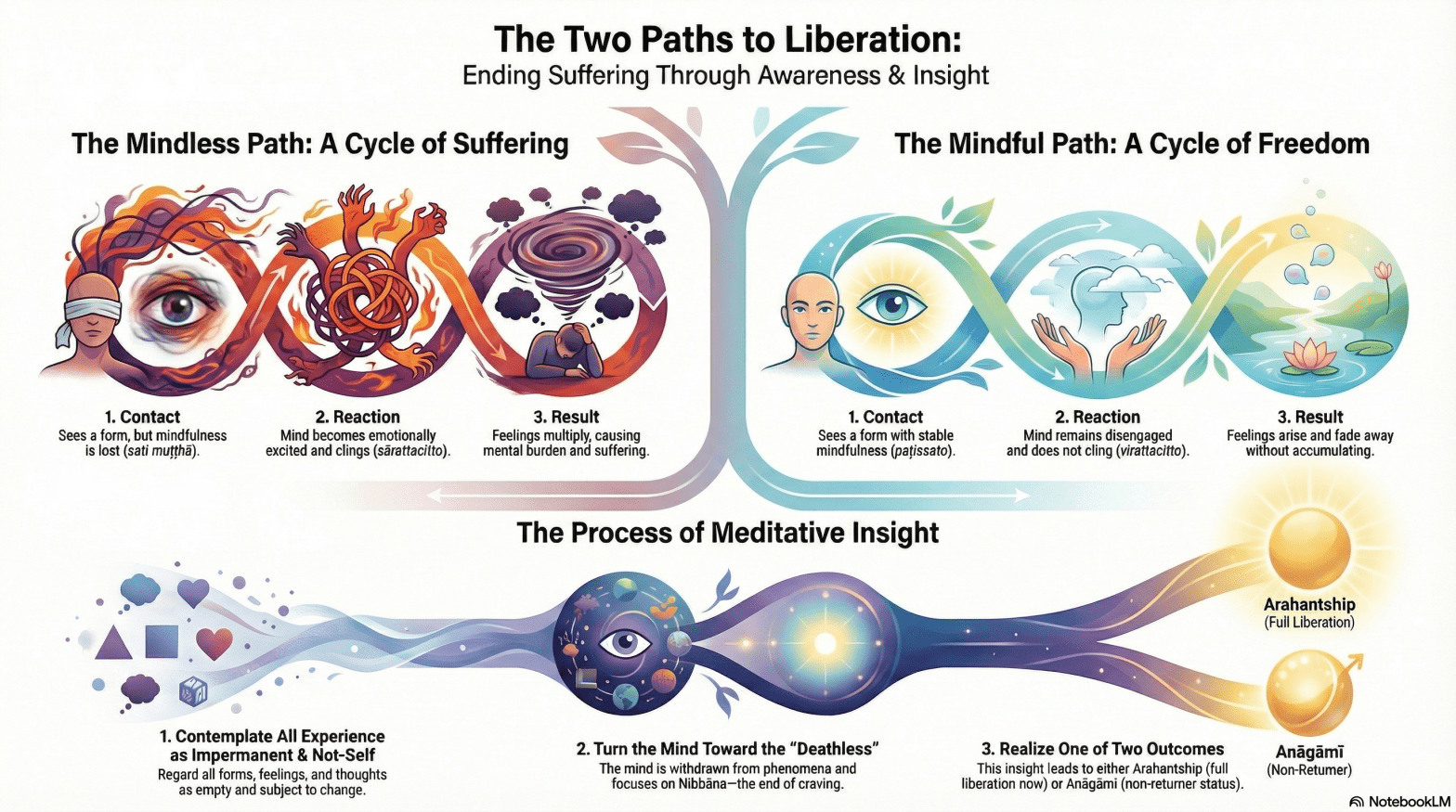
Let us take up two important sutta – SN 64 and SN35.95 relating to Mālukyaputta who became an Arahat after lot of discussions with Buddha on various subjects which helps us to understand on Anāgāmi stage to Arahat stage as well.
MN 64 – Mahāmālunkyasutta
The Buddha explains to Mahāmālukyaputta that liberation does not require leaving the jhānas or the world prematurely. Discusses how five lower fetters (orambhāgiyā saṁyojanā) are to be abandoned through jhāna and insight. Mahāmālukya asks deep questions about the types of arahants (cetovimutta vs paññāvimutta), which leads to the Buddha’s teaching on indriyavemattatā (diversity in spiritual faculties).
SN 35.95 – Mālukyaputta Sutta
Mālukyaputta approaches the Buddha, frustrated with sense-objects, asking for a brief instruction that would lead him to liberation. and Buddha gives the famous teaching:
“In the seen, there is only the seen. In the heard, only the heard…” this leads Mālukyaputta to insight and arahantship.
First, we take up on SN35.95 and later take up the bigger one representing on Anāgāmi in the later section.
Taṁ kiṁ maññasi, Mālukyaputta, ye te cakkhuviññeyyā rūpā adiṭṭhā adiṭṭhapubbā, na ca passasi, na ca te hoti passeyyanti—atthi te tattha chando vā rāgo vā pemaṁ vā”ti?
“No hetaṁ, bhante.”
“Ye te sotaviññeyyā saddā assutā assutapubbā, na ca suṇāsi, na ca te hoti suṇeyyanti—atthi te tattha chando vā rāgo vā pemaṁ vā”ti?
“No hetaṁ, bhante.”
“Ye te ghānaviññeyyā gandhā aghāyitā aghāyitapubbā, na ca ghāyasi, na ca te hoti ghāyeyyanti—atthi te tattha chando vā rāgo vā pemaṁ vā”ti?
“No hetaṁ, bhante.”
“Ye te jivhāviññeyyā rasā asāyitā asāyitapubbā, na ca sāyasi, na ca te hoti sāyeyyanti—atthi te tattha chando vā rāgo vā pemaṁ vā”ti?
“No hetaṁ, bhante.”
“Ye te kāyaviññeyyā phoṭṭhabbā asamphuṭṭhā asamphuṭṭhapubbā, na ca phusasi, na ca te hoti phuseyyanti—atthi te tattha chando vā rāgo vā pemaṁ vā”ti?
“No hetaṁ, bhante.”
“Ye te manoviññeyyā dhammā aviññātā aviññātapubbā, na ca vijānāsi, na ca te hoti vijāneyyanti—atthi te tattha chando vā rāgo vā pemaṁ vā”ti?
“No hetaṁ, bhante.”
“Ettha ca te, Mālukyaputta, diṭṭhasutamutaviññātabbesu dhammesu, diṭṭhe diṭṭhamattaṁ bhavissati, sute sutamattaṁ bhavissati, mute mutamattaṁ bhavissati, viññāte viññātamattaṁ bhavissati.
Yato kho te, Mālukyaputta, diṭṭhasutamutaviññātabbesu dhammesu diṭṭhe diṭṭhamattaṁ bhavissati, sute sutamattaṁ bhavissati, mute mutamattaṁ bhavissati, viññāte viññātamattaṁ bhavissati,
tato tvaṁ, Mālukyaputta, na tena; yato tvaṁ, Mālukyaputta, na tena; tato tvaṁ, Mālukyaputta, na tattha; yato tvaṁ, Mālukyaputta, na tattha; tato tvaṁ, Mālukyaputta, nevidha na huraṁ na ubhayamantarena.
Esevanto dukkhassā”ti.
🔸 I. Six Sense Bases and the Non-Experienced
Each paragraph explores a sense faculty (indriya) and its respective object consciousness (viññeyya), asking if there is desire for things never encountered.
🔠 Example (for eye and form):
“Do you, Mālukyaputta, have interest (chando), desire (rāgo), or infatuation (pema) for forms visible to the eye that you have never seen before, nor ever will?”
Answer: “No, Bhante.”
The same type of question is asked for the remaining senses and hence not explained here
🔍 Explanation:
Craving depends on contact (phassa).
If you never encountered a sense-object by way of interest, desire and infatuation, you can’t crave it. This points to the dependent nature of taṇhā (craving) — it requires prior contact and mental proliferation for it to be enjoyed or suffered. Thus, Buddha’s strategic tool is that — he shows non-arisen craving is the natural state before contact, thus hinting at nibbāna as the non-reactive mode.
🔸 II. Diṭṭhe Diṭṭhamattaṁ: Just the Seen in the Seen
“Ettha ca te, Mālukyaputta, diṭṭhasutamutaviññātabbesu dhammesu, diṭṭhe diṭṭhamattaṁ bhavissati…”
🔤 Word Breakdown:
diṭṭhe diṭṭhamattaṁ – in the seen, only the seen
sute sutamattaṁ – in the heard, only the heard
mute mutamattaṁ – in the sensed, only the sensed
viññāte viññātamattaṁ – in the known, only the known
🧠 Explanation:
The bare awareness model — pure mindfulness and should not construct or fabricate upon perception and hence no “this is mine,” “this is me,” or “I like this.”
This is the foundation of vipassanā practice and direct cognition without taṇhā.
🔸 III. Not by That – Not in That – Not Between
“Yato kho te… na tena… na tattha… nevidha na huraṁ na ubhayamantarena”
🔤 Word Breakdown:
na tena – not by that (not identified with that perception)
na tattha – not in that (not immersed in it)
nevidha, na huraṁ, na ubhayamantarena – neither here, nor there, nor in between
🧘 Explanation:
The practitioner has cut off identification with phenomena and there’s no longer a self-positioned in relation to objects leading to cessation of self-view (sakkāyadiṭṭhi).
The person transcends dualities of:
“I” vs “that”, subject vs object and here vs there. This is liberation through non-appropriation.
🔚 Conclusion:
“Esevanto dukkhassā”ti. – “This is the end of suffering.”
🔎 Explanation:
When cognition is bare, without craving or identification,
When there’s no becoming (bhava), no “I am” in relation to experience, Then dukkha ceases.
This teaching is not only a powerful description of insight meditation but also a direct pointer to arahantship.
| Stage | Description |
|---|---|
| Uncontacted object | No craving arises |
| Pure awareness (just seen/heard…) | Non-proliferation, satipaṭṭhāna mode |
| Not by that / not in that | Disidentification from perception |
| Neither here nor there | Transcendence of duality and location |
| End of dukkha | Nibbāna — cessation of clinging and becoming |
For this, Mālukyaputta recites a very nice gatha which has a very deeper connotation and let us take up that.
Rūpaṁ disvā sati muṭṭhā,
Piyaṁ nimittaṁ manasi karoto;
Sārattacitto vedeti,
Tañca ajjhosa tiṭṭhati.
Rūpaṁ disvā – Having seen a form (visible object),
sati muṭṭhā – mindfulness is lost,
Piyaṁ nimittaṁ manasi karoto – attending (manasi karoto) to a pleasing sign (piyaṁ nimittaṁ),
Sārattacitto vedeti – the mind, being emotionally excited or attracted (sārattacitto), experiences feeling (vedeti),
Tañca ajjhosa tiṭṭhati – and clings to that (tañca) firmly (ajjhosa tiṭṭhati = “grasps on”).
🔍 Explanation:
When a person sees a form, mindfulness (sati) is absent.
Attention is caught by attractive features (“piyaṁ nimittaṁ”) rather than reality as it is.
Sārattacitta means the mind is overwhelmed with passion or emotional resonance.
Clinging begins: tañca ajjhosa tiṭṭhati — this is upādāna.
🔁 This is the birth of taṇhā → upādāna → bhava, all in a moment.
Tassa vaḍḍhanti vedanā,
Anekā rūpasambhavā;
Abhijjhā ca vihesā ca,
Cittamassūpahaññati;
Evaṁ ācinato dukkhaṁ,
Ārā nibbāna vuccati.
Tassa vaḍḍhanti vedanā – For him, feelings increase
Anekā rūpasambhavā – Many, arising from forms.
Abhijjhā ca vihesā ca – Covetousness and irritation (ill will).
Cittamassūpahaññati – His mind is overwhelmed, crushed, battered.
Evaṁ ācinato dukkhaṁ – Thus, by practicing in this way, suffering is accumulated.
Ārā nibbāna vuccati – Nibbāna is said to be far away.
🔍 Explanation:
Once clinging is established, sensual feelings grow.
These give rise to:
Abhijjhā – obsessive desire
Vihesā – mental irritation or subtle aggression
The result: cittassa upahaññati – the mind becomes exhausted, injured, or disturbed.
Ācinato” comes from ācina = to accumulate through repetition. Living this way daily leads to accumulated dukkha because, one stays entangled in sense-reaction cycles, Nibbāna remains distant.
🔁 This shows the Pāli logic: perception → unwise attention → feeling → craving → mental agitation.
These stanzas form the first set: the defiled process based on cakkhu (eye) and rūpa (form). The same pattern will now be repeated for the other five senses (ear, nose, tongue, body, mind),
🔁 Summary for Ear & Sound
| Step | Description |
|---|---|
| Hearing a sound | Mindfulness is absent (sati muṭṭhā) |
| Latching onto pleasant sign | Manasi karoto piyaṁ nimittaṁ |
| Emotional reaction arises | Sārattacitto vedeti |
| Clinging forms | Ajjhosa tiṭṭhati |
| Feelings multiply | Vedanā increase due to repeated contact |
| Excess desire and aversion arise | Abhijjhā and vihesā |
| Mind afflicted | Cittam upahaññati |
| Nibbāna is distant | Ārā nibbāna |
🔁 Summary: Nose & Smell Sequence
| Step | Explanation |
|---|---|
| Contact with smell | One smells a fragrance (gandhaṁ ghatvā) |
| Loss of mindfulness | sati muṭṭhā – forgetfulness of true nature |
| Emotional identification | Mind attends to the attractive aspect (piyaṁ nimittaṁ) |
| Affective entanglement | Sārattacitta – stirred-up emotional mind |
| Clinging established | Clings to the experience (ajjhosa tiṭṭhati) |
| Feelings multiply | Anekā gandhasambhavā vedanā |
| Obsessive desire and aversion increase | Abhijjhā ca vihesā ca |
| Mental burden grows | Cittam upahaññati |
| Liberation is distant | Ārā nibbāna |
🔁 Summary Table: Tongue & Taste
| Step | Explanation |
|---|---|
| Contact with taste | Rasaṁ bhotvā |
| Loss of mindfulness | Sati muṭṭhā |
| Attention on pleasing sign | Piyaṁ nimittaṁ manasi karoto |
| Emotional entanglement | Sārattacitto vedeti |
| Clinging to flavor | Ajjhosa tiṭṭhati |
| Feelings proliferate | Anekā rasasambhavā vedanā |
| Obsessive desire and aversion arise | Abhijjhā ca vihesā ca |
| Mental disturbance increases | Cittam upahaññati |
| Distance from liberation | Ārā nibbāna |
🔁 Summary Table: Body & Touch
| Step | Explanation |
|---|---|
| Contact with tangible object | Phassaṁ phussa |
| Loss of mindfulness | Sati muṭṭhā |
| Attention on pleasing sign | Piyaṁ nimittaṁ manasi karoto |
| Emotional entanglement | Sārattacitto vedeti |
| Clinging to the touch | Ajjhosa tiṭṭhati |
| Feelings multiply | Anekā phassasambhavā vedanā |
| Obsessive desire and aversion arise | Abhijjhā ca vihesā ca |
| Mind becomes burdened | Cittam upahaññati |
| Liberation becomes distant | Ārā nibbāna |
🔁 Summary Table: Mind & Mental Objects
| Step | Explanation |
|---|---|
| Knowing a mental object | Dhammaṁ ñatvā |
| Mindfulness is lost | Sati muṭṭhā |
| Focus on pleasing quality | Piyaṁ nimittaṁ manasi karoto |
| Emotionally charged reaction | Sārattacitto vedeti |
| Clinging to thought | Ajjhosa tiṭṭhati |
| Feelings multiply | Anekā dhammasambhavā vedanā |
| Obsessive desire and aversion arise | Abhijjhā ca vihesā ca |
| Mind becomes burdened | Cittam upahaññati |
| Liberation is distant | Ārā nibbāna |
Na so rajjati rūpesu,
Rūpaṁ disvā paṭissato;
Virattacitto vedeti,
Tañca nājjhosa tiṭṭhati.
Na so rajjati rūpesu – He does not delight in visible forms,
Rūpaṁ disvā paṭissato – having seen a form with mindfulness,
Virattacitto vedeti – he experiences it with a mind disengaged,
Tañca nājjhosa tiṭṭhati – and does not cling to it.
🔍 Explanation
This stanza shows the opposite dynamic of the earlier “sati muṭṭhā” scenario.
The disciple sees a visual form (beautiful or ugly), but with mindfulness (paṭissato).
The mind is viratta – turned away from delight, not pulled in.
Feelings still occur (seeing always leads to vedanā), but they are not appropriated.
The absence of holding onto (anajjhosa) allows freedom in the very act of seeing.
Yathāssa passato rūpaṁ,
Sevato cāpi vedanaṁ;
Khīyati nopacīyati,
Evaṁ so caratī sato;
Evaṁ apacinato dukkhaṁ,
Santike nibbāna vuccati.
Yathāssa passato rūpaṁ – Just as he sees a form,
Sevato cāpi vedanaṁ – and experiences the feeling associated with it,
Khīyati nopacīyati – it fades away; it does not accumulate,
Evaṁ so caratī sato – thus he lives mindfully.
Evaṁ apacinato dukkhaṁ – By not accumulating suffering in this way,
Santike nibbāna vuccati – Nibbāna is said to be near.
🔍 Explanation
Sensory experience still arises, but it ends at the point of contact and the vedanā (feeling) does not become craving or aversion.
Khīyati = it fades out like a fire without fuel.
Nopacīyati = it does not build momentum into more becoming.
This is the essence of vipassanā insight: knowing impermanence in the moment of contact without fabrication.
Apacinato” literally means not gathering, not hoarding, or not cultivating the causes of suffering.
Just as in the previous half, dukkha was “ācinato” (accumulated), here it is apacinato — steadily deconstructed. This leads to nibbāna being “santike” — not far away, but close, accessible.
Summary Table: Vision With Mindfulness
| Step | Description |
|---|---|
| Sees form with mindfulness | Rūpaṁ disvā paṭissato |
| Mind disengaged from delight | Virattacitto vedeti |
| No clinging to form or feeling | Tañca nājjhosa tiṭṭhati |
| Feeling arises but fades out | Vedanā khīyati, nopacīyati |
| Lives mindfully, doesn’t accumulate | Evaṁ so caratī sato, apacinato dukkhaṁ |
| Nibbāna becomes near | Santike nibbāna vuccati |
We can now put the same with sound, taste, touch, smell and dhamma
🧘♂️ Culmination of the Six Sense Restraints
By cultivating:
Mindfulness (sati) at each sense door,
Dispassion (virāga) instead of craving or aversion,
Non-clinging (anajjhosa tiṭṭhati) to any feeling or object,…one does not accumulate suffering (dukkha), and thus, Nibbāna is near (santike nibbāna vuccati).
Let us now take up certain sections relating to Mahāmālukyasutta(MN64)
Buddha questions the bhikkhu’s on do they remember on how he has expounded on removal of five lower fetters. To that Mālukya answers on what five fetters are gone and to which Buddha gives simile of a child whose faculties are not developed also has these five fetters gone.
In that case, child and Anāgāmi would be same and nothing different. To this Ānanda requests Buddha to teach on how to understand in proper way to remove five fetters to be an ariya.
Then, he informs that a bhikkhu will enter into seven jhanas which has this common process:
So yadeva tattha hoti rūpagataṁ vedanāgataṁ saññāgataṁ saṅkhāragataṁ viññāṇagataṁ te dhamme aniccato dukkhato rogato gaṇḍato sallato aghato ābādhato parato palokato suññato anattato samanupassati.
| Pāli | Translation |
|---|---|
| So | He / That person (referring to a meditative practitioner) |
| yadeva | whatever indeed |
| tattha | therein / in that (likely referring to sense bases or phenomena) |
| hoti | exists / is |
| rūpagataṁ | that which pertains to form (rūpa) wherein the mind is moving towards rūpa |
| vedanāgataṁ | that which pertains to feeling (vedanā) wherein the mind is moving towards feelings |
| saññāgataṁ | that which pertains to perception (saññā) wherein the mind is moving towards perception |
| saṅkhāragataṁ | that which pertains to formations / volitional fabrications (saṅkhāra) wherein the mind is moving towards that |
| viññāṇagataṁ | that which pertains to consciousness (viññāṇa) herein the mind is moving towards conscious experience |
| te dhamme | those phenomena / those mental or experiential events |
| aniccato | as impermanent – arising and passing |
| dukkhato | as suffering or pain |
| rogato | as a disease |
| gaṇḍato | as a tumor or ulcer (internal affliction) |
| sallato | as a dart / splinter (pain-producing thing) |
| aghato | as a misfortune |
| ābādhato | as a sickness or affliction |
| parato | as alien / other / not mine |
| palokato | as decaying / breaking up / subject to disintegration |
| suññato | as empty (of self or essence) |
| anattato | as not-self |
| samanupassati | one contemplates / regards / perceives clearly |
So tehi dhammehi cittaṁ paṭivāpeti.
So tehi dhammehi cittaṁ paṭivāpetvā amatāya dhātuyā cittaṁ upasaṁharati: ‘etaṁ santaṁ etaṁ paṇītaṁ yadidaṁ sabbasaṅkhārasamatho sabbūpadhipaṭinissaggo taṇhākkhayo virāgo nirodho nibbānan’ti.
So tattha ṭhito āsavānaṁ khayaṁ pāpuṇāti;
No ce āsavānaṁ khayaṁ pāpuṇāti, teneva dhammarāgena tāya dhammanandiyā pañcannaṁ orambhāgiyānaṁ saṁyojanānaṁ parikkhayā opapātiko hoti, tattha parinibbāyī, anāvattidhammo tasmā lokā.
Ayampi kho, ānanda, maggo ayaṁ paṭipadā pañcannaṁ orambhāgiyānaṁ saṁyojanānaṁ pahānāya.
So tehi dhammehi cittaṁ paṭivāpeti.
So – He (the practitioner, meditator)
tehi dhammehi – by means of those dhammas (i.e., by contemplating the five aggregates and their characteristics as just mentioned: anicca, dukkha, etc.)
cittaṁ paṭivāpeti – he restrains or turns back the mind
paṭivāpeti = to ward off, check, protect the mind
🔍 Interpretation:
Having contemplated impermanence, suffering, not-self, etc., the meditator now withdraws the mind from external proliferation and settles it internally with clarity.
So tehi dhammehi cittaṁ paṭivāpetvā amatāya dhātuyā cittaṁ upasaṁharati:
paṭivāpetvā – having restrained / protected the mind
amatāya dhātuyā – toward the deathless element (nibbāna)
cittaṁ upasaṁharati – he gathers / collects / focuses the mind
🔍 Interpretation:
The mind, now free from craving, is directed toward the deathless — the unconditioned, nibbāna.
“Upasaṁharati” literally means drawing in the mind, leading it inward toward the unconditioned reality.
Etaṁ santaṁ etaṁ paṇītaṁ yadidaṁ…’
‘This is peaceful, this is sublime: namely…’
Now follows the meditative insight description of Nibbāna:
| Pāli Term | Translation |
|---|---|
| sabbasaṅkhārasamatho | stilling of all fabrications / preparations / choosing / volitions wrt to sight, sound, taste, touch, smell and thoughts |
| sabbūpadhipaṭinissaggo | relinquishment of all substrates / possessions with relation to five aggregates |
| taṇhākkhayo | diminishing of craving |
| virāgo | dispassion due to arising and passing away being seen or understood |
| nirodho | cessation in full |
| nibbānaṁ | extinguishment, liberation |
🔍 Interpretation:
This is a direct meditative realisation — seeing that peace is not in saṅkhāras, but in their letting go of it which is the peak of insight, leading to the final turning away from all conditioned existence.
So tattha ṭhito āsavānaṁ khayaṁ pāpuṇāti;
So tattha ṭhito – standing there (in that insight), established in that realisation
āsavānaṁ khayaṁ pāpuṇāti – attains the destruction of the āsavas (mental outflows: sensuality, becoming, ignorance, etc.)
🔍 Interpretation:
If the practitioner is fully established, this is the point of arahantship — complete liberation.
No ce āsavānaṁ khayaṁ pāpuṇāti…
But if he does not attain the destruction of the āsavas…Then follows the description of the non-returner (anāgāmī):
teneva dhammarāgena – due to that very passion for Dhamma (still a subtle fetter)
tāya dhammanandiyā – and delight in Dhamma
pañcannaṁ orambhāgiyānaṁ saṁyojanānaṁ parikkhayā – by the destruction of the five lower fetters
opapātiko hoti – he becomes one reborn spontaneously (in a pure abode)
tattha parinibbāyī – and attains final nibbāna there
anāvattidhammo tasmā lokā – not liable to return from that world
🔍 Interpretation:
This describes a practitioner who has removed the five lower fetters (identity view, doubt, attachment to rites, sensual desire, and ill-will) and thus is reborn in a Pure Abode (suddhāvāsa) — a non-returner — and will attain full liberation there.
Ayampi kho, ānanda, maggo ayaṁ paṭipadā pañcannaṁ orambhāgiyānaṁ saṁyojanānaṁ pahānāya.
Ayampi kho, ānanda – This too, Ānanda…
maggo ayaṁ paṭipadā – is a path, this practice
pañcannaṁ orambhāgiyānaṁ saṁyojanānaṁ pahānāya – for the removal of the five lower fetters
🔍 Interpretation:
This entire reflection and meditative process is one of the valid approaches leading to the destruction of the five lower fetters — thus culminating in non-returning or arahantship.
| Stage | Explanation |
|---|---|
| Paṭivāpeti cittaṁ | Restraining the mind from external proliferation |
| Upasaṁharati amatāya dhātuyā | Turning the mind inward toward Nibbāna |
| Etaṁ santaṁ… | Direct realisation of peaceful, sublime unconditioned liberation |
| Āsavakkhaya | Full enlightenment (arahantship) |
| No āsavakkhaya → Anāgāmī | If not fully liberated, becomes a non-returner in Pure Abodes |
| Maggo pañcannaṁ saṁyojanānaṁ | This is the path for removal of five lower fetters |
Puna caparaṁ, ānanda, bhikkhu sabbaso viññāṇañcāyatanaṁ samatikkamma ‘natthi kiñcī’ti ākiñcaññāyatanaṁ upasampajja viharati.
So yadeva tattha hoti vedanāgataṁ, saññāgataṁ, saṅkhāragataṁ, viññāṇagataṁ te dhamme aniccato, dukkhato, rogato, gaṇḍato, sallato, aghato, ābādhato, parato, palokato, suññato, anattato samanupassati.
So tehi dhammehi cittaṁ paṭivāpeti. So tehi dhammehi cittaṁ paṭivāpetvā amatāya dhātuyā cittaṁ upasaṁharati: ‘etaṁ santaṁ, etaṁ paṇītaṁ, yadidaṁ—sabbasaṅkhārasamatho, sabbūpadhipaṭinissaggo, taṇhākkhayo, virāgo, nirodho, nibbānan’ti.
So tattha ṭhito āsavānaṁ khayaṁ pāpuṇāti; no ce āsavānaṁ khayaṁ pāpuṇāti, teneva dhammarāgena, tāya dhammanandiyā, pañcannaṁ orambhāgiyānaṁ saṁyojanānaṁ parikkhayā, opapātiko hoti, tattha parinibbāyī, anāvattidhammo tasmā lokā.
Ayampi kho, ānanda, maggo ayaṁ paṭipadā pañcannaṁ orambhāgiyānaṁ saṁyojanānaṁ pahānāya.
“Again, Ānanda, a bhikkhu—having completely transcended the base of infinite consciousness (viññāṇañcāyatana), enters and abides in the base of nothingness (ākiñcaññāyatana), thinking, ‘There is nothing.’”
Puna caparaṁ – furthermore, again
sabbaso viññāṇañcāyatanaṁ samatikkamma – having completely gone beyond the dimension of infinite consciousness
‘natthi kiñcī’ti – “there is nothing” (mental perception of absence of object)
ākiñcaññāyatanaṁ upasampajja viharati – he enters and abides in the base of nothingness
🔍 This refers to the third formless jhāna in the series of arūpa-samāpatti. It is subtler than the infinite consciousness realm and signifies extreme withdrawal from phenomena.
🔹 So yadeva tattha hoti…
“Whatever there exists there—pertaining to feeling, perception, mental formations, and consciousness—he regards those phenomena as: impermanent, suffering, a disease, a boil, a dart, a calamity, a disease, alien, subject to decay, empty, and not-self.”
These are the five aggregates present even in formless attainment, albeit subtle:
Rupagatam – moving towards form-related
Vedanāgataṁ – moving towards feeling-related
Saññāgataṁ – moving towards perception-related
Saṅkhāragataṁ – moving towards volitional-related
Viññāṇagataṁ – moving towards consciousness-related
All these are now contemplated with twelve lenses listed above starting from impermanent, suffering etc.,
🔹 3. So tehi dhammehi cittaṁ paṭivāpeti…
“He turns the mind away from those phenomena…”
This is disengagement from even the most refined perception. The mind is gently turned from subtle mental phenomena towards something deeper.
🔹 4. …amatāya dhātuyā cittaṁ upasaṁharati…
“…and he collects his mind toward the deathless element…” That is, the mind is withdrawn into nibbāna — no longer fascinated by refined meditative states, but focused on the unconditioned.
🔹 5. ‘Etaṁ santaṁ etaṁ paṇītaṁ…’
“This is peaceful, this is sublime—namely: the stilling of all fabrications, the relinquishment of all possessions, the destruction of craving, dispassion, cessation, and nibbāna.”
These six qualities describe nibbāna in doctrinal terms:
sabbasaṅkhārasamatho – calming all volitioned activities
sabbūpadhipaṭinissaggo – renouncing all attachments and supports
taṇhākkhayo – destruction of craving
virāgo – dispassion
nirodho – cessation
nibbānaṁ – extinguishment
🔹 6. So tattha ṭhito āsavānaṁ khayaṁ pāpuṇāti…
“Established in that, he attains the destruction of the taints (āsavānaṁ khaya).”
If the insight is mature and complete, the meditator becomes an arahant here and now.
🔹 7. No ce āsavānaṁ khayaṁ pāpuṇāti…
“If he does not attain that, then—due to subtle clinging to Dhamma (dhammarāga) and delight in Dhamma (dhammanandi)—through destruction of the five lower fetters, he becomes spontaneously reborn (opapātiko), attains final nibbāna there, and does not return to this world.”
Dhammarāga & Dhammanandi – subtle attachments even to refined meditation
Five lower fetters removed → Anāgāmi
Opapātiko hoti – spontaneous birth in suddhāvāsa
Tattha parinibbāyī – final nibbāna there
Anāvattidhammo – no return to this world
🔹 8. Ayampi kho, ānanda…
“This too, Ānanda, is a path, a practice for the abandonment of the five lower fetters.”
This meditative stage—culminating in deep insight into formless states—is also valid for attaining liberation from identity view, doubt, attachment to rites, sensual desire, and ill-will.
| Stage | Explanation |
|---|---|
| Ākiñcaññāyatana Samāpatti | Absorption in “nothingness” — perception of “there is nothing” worth clinging to as self |
| Contemplation of Aggregates | Seeing subtle vedanā, saññā, etc., as anicca, dukkha, etc. |
| Mind Turned Toward Deathless | Insight overcomes fascination with samāpatti |
| Insight into Nibbāna Qualities | Realizes sabbasaṅkhārasamatho, virāgo, nirodho, etc. |
| Two Outcomes | Arahantship or Anāgāmī rebirth in Pure Abodes |
❖ The Question (by Ānanda)
Ānanda is asking the Buddha:
If the path and practice are the same, and they lead to the same result—the abandoning of the five lower fetters—then why are there different types of arahants?
Cetovimutta: One who is liberated through concentration (ceto = mind; vimutta = liberated)
Mastery of jhānas and arūpasamāpatti
Direct experience of liberation through deep samādhi which is often characterized by extensive meditative absorption
Paññāvimutta: One who is liberated through wisdom which lacks mastery of the formless jhānas.
Liberation arises through sharp insight and wisdom into the three characteristics (anicca, dukkha, anattā) Often uses vipassanā directly to reach liberation while the jhanas are established as secondary state.
So Ānanda is asking: Why this distinction?
❖ The Buddha’s Answer: Indriyavemattatā
Indriya – Spiritual faculties:
Saddhā (faith), Viriya (energy), Sati (mindfulness), Samādhi (concentration) and Paññā (wisdom)
Vemattatā – Difference, variation, diversity
Therefore, Indriyavemattatā means:
“Difference in the strength or dominance of spiritual faculties among individuals.”
The Buddha explains that even though the same path is being followed, the dominance or maturity of different faculties determines how the final liberation manifests.
🔷 Conclusion
Even though the path (magga) and the practice (paṭipadā) for abandoning the fetters is the same for all practitioners:
The mode of final realization differs depending on each person’s spiritual makeup (indriyavemattatā).
This upholds both the universality of the Dhamma and its adaptability to individual strengths.
In order to do this, one needs to develop “witness consciousness” which is also part of the mind, but that can have discernment.
Thus, in MN43, discussion between both the arahat’s say that wisdom has to be developed and conscious experiences of six senses has to be completely understood. This understanding happens through wisdom only.
When we can see that there is a witness to these six senses, the observer effect sets in which then stops the whole process of multiplication. This is what is termed as “anidassana viññāṇa” which can be translated as “unestablished / non-illustrative” consciousness where nothing of the six senses fall. It is like a screen on which all objects appear and disappear.