
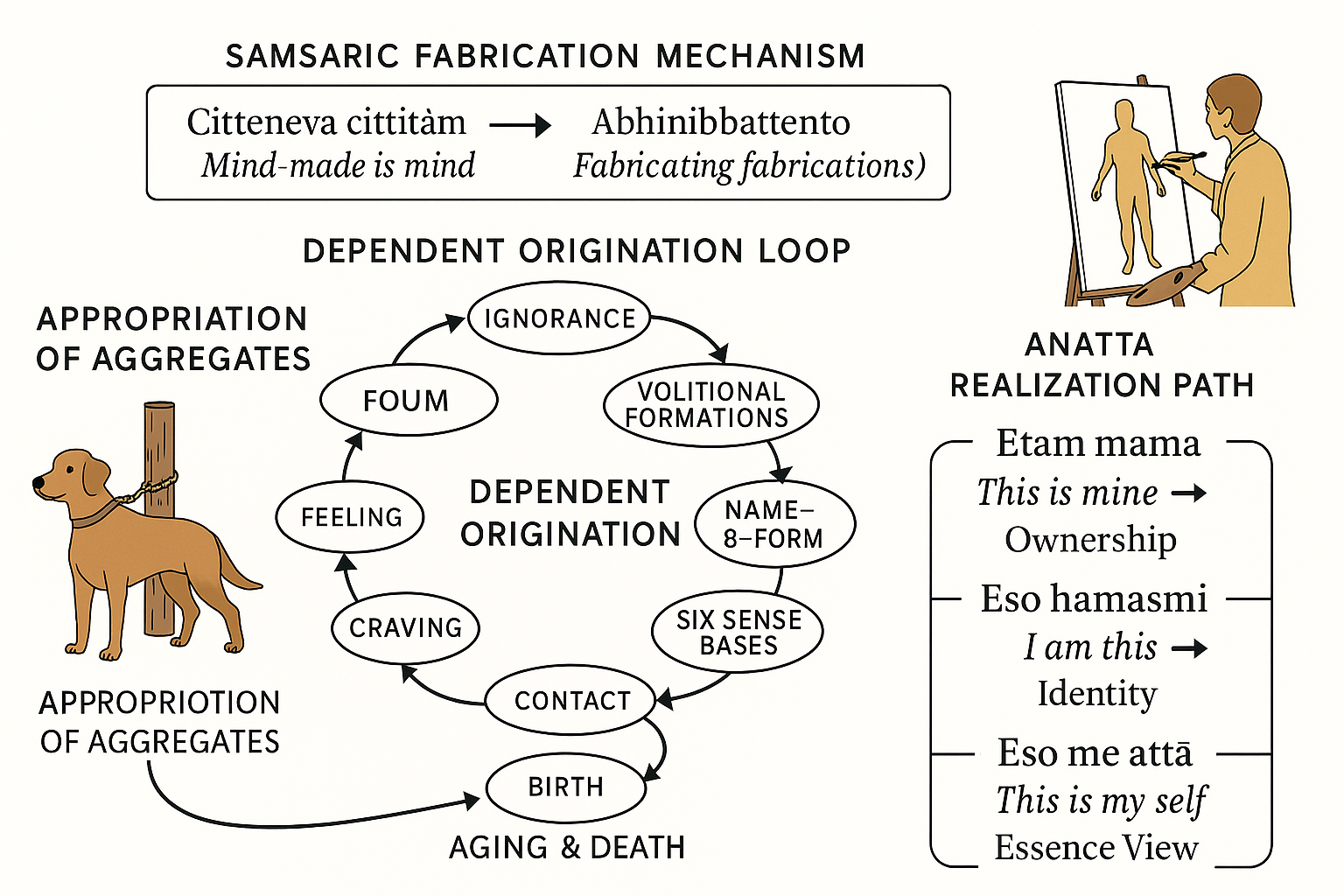
Let us take up an important sutta to understand about the citta or mind and how it is all mind-made either as human or animal or both. The sutta is Dutiyagaddulabaddhasutta
1️⃣
Sāvatthinidānaṁ.
“Anamataggoyaṁ, bhikkhave, saṁsāro. Pubbā koṭi na paññāyati avijjānīvaraṇānaṁ sattānaṁ taṇhāsaṁyojanānaṁ sandhāvataṁ saṁsarataṁ.”
At Sāvatthī.
“Bhikkhus, this samsāra (round of rebirth) is without discoverable beginning. A first point is not known of beings roaming and wandering hindered by ignorance and fettered by craving.”
Explanation:
Anamatagga = “without a known beginning” (ana + mata + agga = not known limit or beginning).
The problem of rebirth is rooted in two fundamental conditions:
avijjānīvaraṇānaṁ = “blocked by the hindrance of ignorance”
taṇhāsaṁyojanānaṁ = “fettered by craving”.
Samsāra is not just a series of lives but a cyclical continuity of ignorance and craving feeding each other. The Buddha is emphasizing here that this cyclic wandering has been going on from a beginningless past — this is meant to create a sense of urgency (saṁvega).
2️⃣
“Seyyathāpi, bhikkhave, sā gaddulabaddho daḷhe khīlevā thambhe vā upanibaddho. So gacchati cepi tameva khīlaṁ vā thambhaṁ vā upagacchati; tiṭṭhati cepi tameva khīlaṁ vā thambhaṁ vā upatiṭṭhati; nisīdati cepi tameva khīlaṁ vā thambhaṁ vā upanisīdati; nipajjati cepi tameva khīlaṁ vā thambhaṁ vā upanipajjati.”
“Suppose, bhikkhus, there is a dog tethered by a leash to a strong post or pillar. Whether it goes, stands, sits, or lies down, it remains tied to that same post or pillar.”
Explanation:
This is a simile to explain bondage to aggregates. and the dog represents the deluded being (puthujjana). The post or pillar represents the aggregates (khandhas) and the identification with them.
No matter what the being does—walking, standing, sitting, lying—it remains within the grasp of the khandhas as long as identification persists.
Gaddula-baddho (tied dog) is a powerful image of helplessness and circular wandering, showing how attachment keeps one bound to the aggregates.
3️⃣
“Evameva kho, bhikkhave, assutavā puthujjano rūpaṁ ‘etaṁ mama, eso hamasmi, eso me attā’ti samanupassati. Vedanaṁ … saññaṁ … saṅkhāre … viññāṇaṁ ‘etaṁ mama, eso hamasmi, eso me attā’ti samanupassati.”
“Just so, bhikkhus, the uninstructed ordinary person regards form as: ‘This is mine, I am this, this is my self.’ He similarly regards feeling… perception… formations… consciousness as: ‘This is mine, I am this, this is my self.’”
Explanation: The mechanism of bondage is identity view (sakkāyadiṭṭhi) and these are the three forms of self-view: etaṁ mama (“this is mine” — possessive appropriation), eso hamasmi (“this belongs to me” — identification), eso me attā (“this is my self” — essence view).
All five aggregates are wrongly appropriated through these three views.
The assutavā puthujjana (= uninstructed worldling) is caught in this trap, exactly like the dog tied to the post.
4️⃣
“So gacchati cepi ime pañcupādānakkhandhe upagacchati; tiṭṭhati cepi ime pañcupādānakkhandhe upatiṭṭhati; nisīdati cepi ime pañcupādānakkhandhe upanisīdati; nipajjati cepi ime pañcupādānakkhandhe upanipajjati.”
“Whether he goes, stands, sits, or lies down, he resorts to these five aggregates affected by clinging.”
Explanation:
This directly maps to the dog simile: wherever one goes in body, mind, or world, one is bound to the aggregates due to grasping.
Pañcupādānakkhandhe = “the five aggregates subject to clinging” (rupa, vedana, sañña, saṅkhāra, viññāṇa + upādāna). As long as clinging (upādāna) operates, even physical movements are ultimately moves within samsāra.
5️⃣
“Tasmātiha, bhikkhave, abhikkhaṇaṁ sakaṁ cittaṁ paccavekkhitabbaṁ: ‘dīgharattamidaṁ cittaṁ saṅkiliṭṭhaṁ rāgena dosena mohenā’ti. Cittasaṅkilesā, bhikkhave, sattā saṅkilissanti; cittavodānā sattā visujjhanti.”
“Therefore, bhikkhus, one should frequently reflect upon one’s own mind thus: ‘For a long time this mind has been defiled by lust, by hatred, and by delusion.’ Beings are defiled because of mental defilements; beings are purified because of mental purification.”
Explanation: This is the practice instruction: constant reflection (abhikkhaṇaṁ paccavekkhitabbaṁ) and root defilements (rāga, dosa, moha) are to be seen as the cause of mind’s contamination. Purification is purely dependent on cleaning the mind of these.
Cittavodānā (purity of mind) leads to liberation.
6️⃣
“Diṭṭhaṁ vo, bhikkhave, caraṇaṁ nāma cittaṁ”ti?
“Evaṁ, bhante”.
“Tampi kho, bhikkhave, caraṇaṁ nāma cittaṁ citteneva cittitaṁ. Tenapi kho, bhikkhave, caraṇena cittena cittaññeva cittataraṁ.”
“Have you seen, bhikkhus, that mind is called ‘wandering’?”
“Yes, Venerable Sir.”
“But even that mind called ‘wandering’ is itself made by mind. And by this wandering mind, the mind becomes yet more mind-made.”
Explanation: Caraṇaṁ = wandering, moving and mind itself is mind-made (citteneva cittitaṁ). The wandering is self-generating — craving leads to new formations, new intentions, new becoming. This is the deeper paṭiccasamuppāda at play: mind conditions more mind.
7️⃣
“Tasmātiha, bhikkhave, abhikkhaṇaṁ sakaṁ cittaṁ paccavekkhitabbaṁ: ‘dīgharattamidaṁ cittaṁ saṅkiliṭṭhaṁ rāgena dosena mohenā’ti. Cittasaṅkilesā, bhikkhave, sattā saṅkilissanti; cittavodānā sattā visujjhanti.”
“Therefore, bhikkhus, one should frequently reflect upon one’s own mind thus: ‘For a long time this mind has been defiled by lust, by hatred, and by delusion.’ Beings are defiled because of mental defilements; beings are purified because of mental purification.”
Explanation: This is a repetition for emphasis and sutta strongly insists on constant self-reflection (paccavekkhaṇa) as central practice for progress. All purification depends on removal of these root kilesas (defilements).
8️⃣
“Nāhaṁ, bhikkhave, aññaṁ ekanikāyampi samanupassāmi evaṁ cittaṁ yathayidaṁ, bhikkhave, tiracchānagatā pāṇā. tepi kho, bhikkhave, tiracchānagatā pāṇā citteneva cittitā, tehipi kho, bhikkhave, tiracchānagatehi pāṇehi cittaññeva cittataraṁ.”
“I do not see, bhikkhus, any other group of beings with a mind so powerful as that of animals (non-human beings). Yet even these animals are mind-made. And compared to them, the human mind is even more mind-made.”
Explanation: Even animals are mind-driven; mind governs their behavior and yet, in humans (tiracchānagatehi pāṇehi cittaññeva cittataraṁ), the mind is even more complex, more fabricated, more subtle. This points to the greater opportunity and greater danger in human existence.
9️⃣
“Tasmātiha, bhikkhave, abhikkhaṇaṁ sakaṁ cittaṁ paccavekkhitabbaṁ: ‘dīgharattamidaṁ cittaṁ saṅkiliṭṭhaṁ rāgena dosena mohenā’ti. Cittasaṅkilesā, bhikkhave, sattā saṅkilissanti; cittavodānā sattā visujjhanti.”
“Therefore, bhikkhus, one should frequently reflect upon one’s own mind thus: ‘For a long time this mind has been defiled by lust, by hatred, and by delusion.’ Beings are defiled because of mental defilements; beings are purified because of mental purification.”
Explanation: Third repetition of the same key instruction — Buddha emphasizes the practice is nothing but ongoing, vigilant, mindful observation of the mind and its defilements.
10️⃣
“Seyyathāpi, bhikkhave, rajako vā cittakārako vā rajanāya vā lākhāya vā haliddiyā vā nīliyā vā mañjiṭṭhāya vā suparimaṭṭhe phalake vā bhittiyā vā dussapaṭṭe vā itthirūpaṁ vā purisarūpaṁ vā abhinimmineyya sabbaṅgapaccaṅgiṁ;”
“Just as, bhikkhus, a dyer or a painter would create on a well-prepared board, wall, or cloth an image of a woman or man, complete in all its parts, using red, lac, turmeric, blue, or crimson pigments…”
Explanation: This is a second simile: mind as creator, fabricator (abhinimmineyya). wherein the painter represents mental volition and construction and the image represents the formations we fabricate — our self-view, worlds, perceptions. This is a powerful saṅkhāra simile — mind fabricates fabricated worlds like an artist painting forms on a blank canvas.
11️⃣
“Evameva kho, bhikkhave, assutavā puthujjano rūpaññeva abhinibbattento abhinibbatteti, vedanaññeva… saññaññeva … saṅkhāreyeva … viññāṇaññeva abhinibbattento abhinibbatteti.”
“Even so, bhikkhus, the uninstructed ordinary person fabricates form, fabricates feeling, fabricates perception, fabricates formations, fabricates consciousness.”
Explanation: Abhinibbattento = actively producing, generating, fabricating and the worldling is constantly recreating the aggregates, sustaining them by craving, clinging, and identification. These fabrications are not just passive processes — they are actively maintained, which is why saṅkhāra is one of the central terms in Dependent Origination.
12️⃣
“Taṁ kiṁ maññatha, bhikkhave, rūpaṁ niccaṁ vā aniccaṁ vā”ti?
“Aniccaṁ, bhante”.
“Vedanā … saññā … saṅkhārā … viññāṇaṁ …pe…”
“What do you think, bhikkhus: is form permanent or impermanent?”
“Impermanent, venerable sir.”
“And feeling… perception… formations… consciousness…?”
Explanation: The Buddha leads them through the standard contemplation of impermanence (anicca). and all five aggregates are declared impermanent.
13️⃣ (conclusion)
“Tasmātiha, bhikkhave … evaṁ passaṁ … nāparaṁ itthattāyāti pajānātī”ti.”
“Therefore, bhikkhus,… seeing thus,… he understands: ‘There is no more of this state of being (itthattā).’”
Explanation: Evaṁ passaṁ = seeing thus (in light of impermanence, non-self, dukkha).
Nāparaṁ itthattāya = no more of this becoming, existence, state of being.
This is the final realization leading to liberation: seeing the aggregates as not-self, impermanent, and not worth clinging to, ending all future existence.
Summary Chart:
| Section | Main Message |
|---|---|
| 1 | Beginningless samsāra due to ignorance and craving |
| 2-4 | Simile of dog tied to post — attachment to aggregates |
| 5-7 | Frequent reflection on mind’s defilements |
| 8-9 | Comparison with animal mind — human mind more fabricated |
| 10-11 | Simile of painter — mind creates aggregates like images |
| 12-13 | Impermanence contemplation leads to cessation |
1️⃣ Deep Doctrinal Analysis: Dependent Origination Connection
Key Sections from the Sutta:
“Abhinibbattento abhinibbatteti” (fabricating fabrications)
“Citteneva cittitaṁ” (mind is mind-made)
“Rūpaṁ vedanaṁ saññaṁ saṅkhārā viññāṇaṁ” (the five aggregates)
Mapping to Paṭiccasamuppāda:
| 12 Links | Correspondence in this Sutta |
|---|---|
| Avijjā (ignorance) | “avijjānīvaraṇānaṁ” (ignorance as the beginningless block) |
| Saṅkhārā (volitional formations) | “abhinibbattento abhinibbatteti” (constantly fabricating the aggregates) |
| Viññāṇa (consciousness) | “viññāṇaṁ ‘etaṁ mama…'” (consciousness appropriated as self) |
| Nāma-rūpa (name-form) | The aggregates are precisely the building blocks of nāma-rūpa |
| Phassa (contact) | Implied through the ongoing interaction with aggregates |
| Vedanā (feeling) | “vedanaṁ ‘etaṁ mama…'” (appropriation of feeling) |
| Taṇhā (craving) | “taṇhāsaṁyojanānaṁ” (craving as fetter) |
| Upādāna (clinging) | “pañcupādānakkhandhe” (aggregates subject to clinging) |
| Bhava (becoming) | The continued generation of existence via abhinibbatti (fabrication) |
| Jāti, Jarāmaraṇa | Continuation implied in the samsāric wandering |
👉 Core Point:
This sutta shows how the dependent origination chain is replayed at every moment via appropriation and fabrication of the aggregates, not merely once in a lifetime. The identity view leads to continuous fabrication.
2️⃣ Deep Doctrinal Analysis: Anatta (Not-Self Insight)
The Triple Conceit of Ownership:
etaṁ mama (“this is mine”) = ownership → leads to craving (taṇhā)
eso hamasmi (“I am this”) = identity → leads to self-image (māna)
eso me attā (“this is my self”) = essence view → leads to eternalist views (diṭṭhi)
The Reframing:
The Buddha here systematically dismantles each aspect of self-appropriation:
The aggregates are impermanent (anicca).
What is impermanent is unsatisfactory (dukkha).
What is dukkha is not suitable to be regarded as self (anattā).
When this is clearly seen, fabrication (abhinibbatti) ceases, and with it, suffering.
👉 Core Point:
The similes (dog tied to post; painter fabricating images) show how the “I-making” (ahaṅkāra) and “mine-making” (mamaṅkāra) generate continued becoming (bhava), keeping one bound in samsāra.
3️⃣ Deep Doctrinal Analysis: Sotāpatti (Stream-Entry Realization)
Sotāpanna insight fundamentally involves:
| Fetters Abandoned | Manifestation in This Sutta |
|---|---|
| Sakkāyadiṭṭhi (identity view) | The attachment to aggregates as “mine, I am this, my self” is broken |
| Vicikicchā (doubt) | The clarity on how samsāra operates through fabrication removes hesitation |
| Sīlabbataparāmāsa (attachment to rituals) | Understanding that mere mechanical rites cannot stop fabrication of aggregates |