A Structured Map of Paññā — Seventy-Three Knowledges
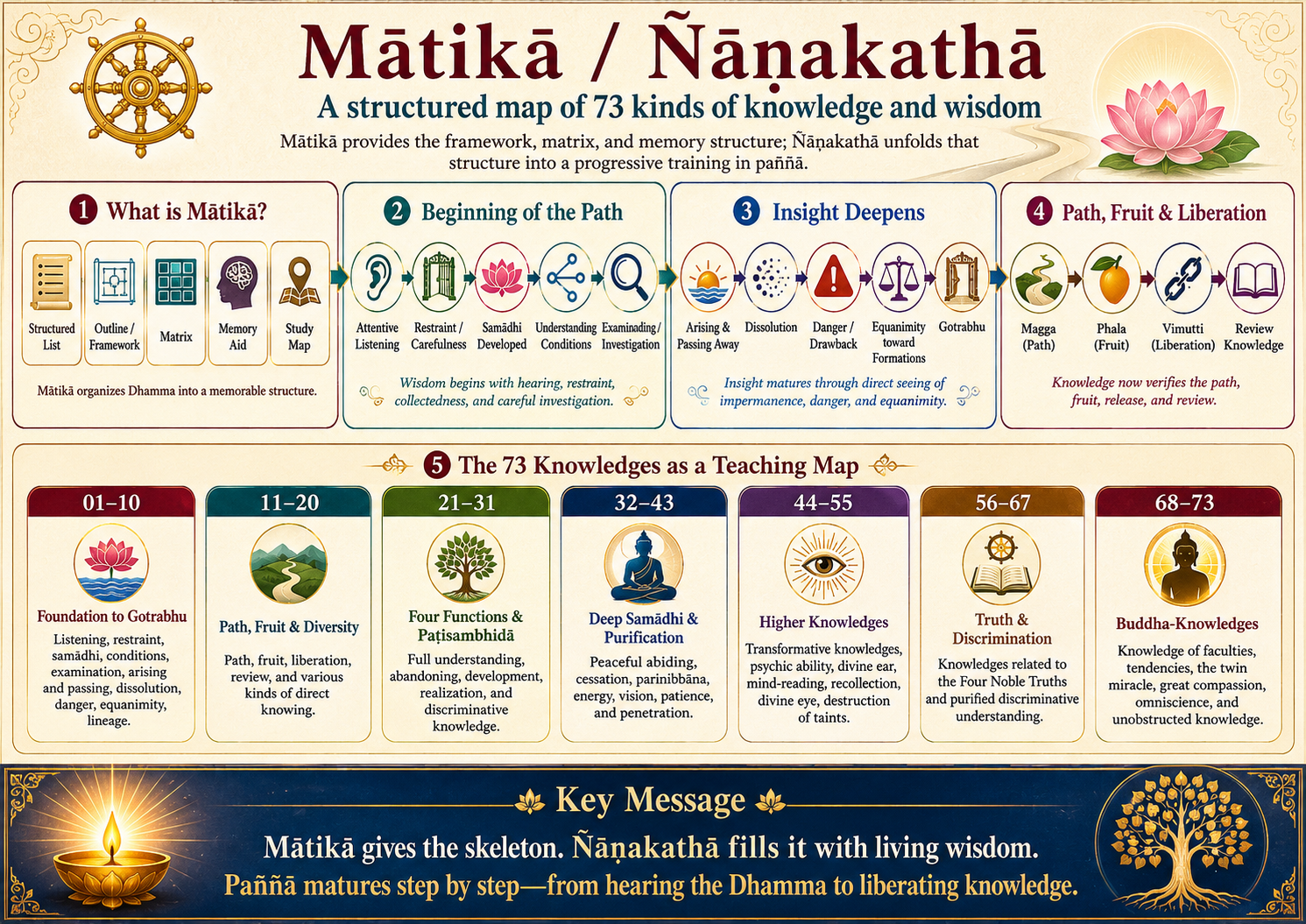 VISUAL SUMMARYSee this study in a pictureOpen the complete infographic for a visual overview before or after reading the full study.View infographic →
Mātikā gives the schedule; Ñāṇakathā unfolds the analytical field
Mātikā here is the schedule or matrix of seventy-three knowledges that opens the Ñāṇakathā, the Treatise on Knowledge, in the Mahāvagga of the Paṭisambhidāmagga. The detailed Ñāṇakathā then takes up these knowledges and analyzes them at length.
The opening is strikingly practical: attentive hearing, restraint, development of samādhi, ascertainment of conditions, comprehensive examination, arising-and-passing, dissolution, danger, equanimity toward formations, change of lineage, path, fruit, liberation, and review. But after this developmental core the mātikā changes mode several times. It classifies fields, functions of wisdom, paṭisambhidās, attainments, advanced liberative knowledges, higher knowledges, truth-knowledges, and finally Buddha-specific knowledges.
For that reason, the seventy-three should be studied as a structured map of paññā, not as a simplistic claim that every practitioner personally “reaches knowledge 73.” The mātikā itself says that sixty-seven are shared with disciples and that the final six are not.
The Paṭisambhidāmagga is traditionally associated with Venerable Sāriputta’s analytical style. On this page that traditional attribution is respected without turning it into an unsupported historical certainty.
How this rebuild works: each of the seventy-three items first appears in a corrected, concise reader. Under each range, the extensive detailed material from the uploaded page is also preserved in a cleaned source-reader accordion so that the large body of work is not lost.
Ten corrections that materially change how the page should be taught
0173 is not a universal attainment ladder
The old introduction says that by reaching the 73rd item the practitioner would have experienced all stages and states from worldling to arahant. The mātikā itself prevents that reading.
Imesaṁ tesattatiyā ñāṇānaṁ sattasaṭṭhi ñāṇāni sāvakasādhāraṇāni; cha ñāṇāni asādhāraṇāni sāvakehi.
Of the seventy-three knowledges, sixty-seven are shared with disciples; six—the final six—are not shared with disciples. Therefore items 68–73 cannot be a universal disciple-practice sequence.
02Traditional attribution to Sāriputta must be labelled as tradition
The Paṭisambhidāmagga is preserved in the Theravāda Khuddaka Nikāya and is traditionally associated with Venerable Sāriputta’s analytical style. It is better to say “traditionally attributed to Sāriputta” than to present modern historical authorship as established fact or call the canonical text simply “Sāriputta’s commentary.”
03The navigation ranges are editorial, not eight canonical subchapters
The eight ranges on this page exist to make a very large text usable. They reflect clear changes of subject matter, but the canonical mātikā itself is one numbered schedule of seventy-three knowledges.
04Pañca dhammakkhandhā is not the ordinary five aggregates
In the “five things to be realized” passage, pañca dhammakkhandhā means sīlakkhandha, samādhikkhandha, paññākkhandha, vimuttikkhandha, and vimuttiñāṇadassanakkhandha—virtue, samādhi, wisdom, liberation, and knowledge-and-vision of liberation. The old explanation incorrectly substituted rūpa, vedanā, saññā, saṅkhārā, and viññāṇa.
05Nava anupubbanirodhā has a precise meditative sequence
The nine successive cessations are not a vague progression in which “suffering and defilements gradually cease.” They correspond to what ceases at first jhāna, second jhāna, third jhāna, fourth jhāna, each formless attainment, and finally cessation of perception and feeling.
06Saṅkhata / asaṅkhata is not a distinction based on conceptualization
Saṅkhata means conditioned/constructed through conditions. Asaṅkhata means unconditioned; Nibbāna is the unconditioned in early Buddhist usage. The older explanation tying the distinction to whether “concepts are held” has been removed.
07Abhiññeyya is not derived as abhi + ñāṇa
Abhiññeyya carries the gerundive sense “to be directly known / fully known,” related to abhijānāti. The earlier derivation from a prefix “abhi” plus the noun “ñāṇa” was philologically too loose.
08Ānantarika samādhi, samasīsa and sallekha need technical translations
Item 32 is tied to purified non-distraction and path-level destruction of āsavas, not generic “unwavering concentration.” Item 36 uses the difficult technical expression samasīsa, which should not be reduced to ordinary “balance.” Item 37 sallekha is better understood as effacement or wearing away of defilements than as generic asceticism.
09Higher knowledges are not all prerequisites for liberation
Items 50–54 include iddhi, purified ear, mind-reading, recollection of past lives, and divine eye. These are specialized higher knowledges. Their presence in the common-to-disciples range means they are not Buddha-exclusive; it does not mean every disciple or every arahant must display all of them.
10Cittassa ekaggatā is rendered as unification / singleness in context
The source repeatedly analyzes samādhi through cittassa ekaggatā and avikkhepa. The rebuilt page avoids making “one-pointed concentration” the default English equivalent and instead uses collectedness, unification, singleness, and non-distraction according to context.
Eight editorial ranges for navigating the seventy-three knowledges
These eight ranges are an organizational aid for this website page. They are not being presented as eight canonical subdivisions of the mātikā.
| Range | Working group | Contents | How to read it |
|---|---|---|---|
| 01–14 | Developmental Core | Hearing → restraint → samādhi → conditionality → insight → gotrabhu → path → fruit → liberation → review. | This is the portion that most clearly reads as a developmental movement. Even here, it is better treated as a structured account of knowledges than as a self-certification ladder. |
| 15–19 | Diversity of Fields | Internal/external bases, conduct, planes, and dhamma-diversity. | The mode changes from progression to classification. These knowledges discriminate fields and domains; they are not simply ‘stages 15–19’ that everyone must pass through in order. |
| 20–24 | Five Functions of Wisdom | Direct knowing • full understanding • abandoning • development • realization. | These five show what paññā does. They map closely onto the practical tasks of the path and are especially useful for teaching. |
| 25–31 | Paṭisambhidā, Abidings & Attainments | Meaning • Dhamma • language • ready exposition • abidings • attainments. | Analytical competence becomes explicit. This cluster is especially valuable for teachers because it distinguishes meaning, principle, terminology, expression, and meditative attainments. |
| 32–43 | Advanced Liberative Knowledges | Path-samādhi, peaceful abiding, cessation attainment, parinibbāna, samasīsa, effacement, energy, purified vision, and penetration. | This range is technically difficult. It should not be flattened into generic meditation advice, nor presented as a simple universal ladder. |
| 44–55 | Vivaṭṭa & Higher Knowledges | Six turnings-away followed by iddhi, purified ear, mind-reading, past lives, divine eye, and destruction of āsavas. | The first six are a special analytical cluster; 50–55 move into higher knowledges. Supernormal knowledges are not prerequisites for every disciple’s liberation. |
| 56–67 | Truth & Purified Analytical Knowledge | Four Truths by function, four Truths as direct knowledges, then four purified paṭisambhidās. | This range returns the map to the core liberative structure: understand dukkha, abandon origin, realize cessation, develop the path, then articulate the Dhamma with purified discriminative knowledge. |
| 68–73 | Buddha-Only Knowledges | Faculties • dispositions • Twin Miracle • Great Compassion • omniscience • unobstructed knowledge. | The mātikā explicitly states that the last six are not shared with disciples. They must therefore be visually separated from the 67 disciple-common knowledges. |
Hearing → restraint → samādhi → conditionality → insight → gotrabhu → path → fruit → liberation → review.
This is the portion that most clearly reads as a developmental movement. Even here, it is better treated as a structured account of knowledges than as a self-certification ladder.
01 Wisdom in attentive listening is knowledge born of learning.
Sotāvadhāne paññā sutamaye ñāṇaṁ.
Wisdom in attentive listening is knowledge born of learning.
The list starts with hearing because paññā does not begin by inventing a private doctrine. One attends closely enough to know what is to be directly known, fully understood, abandoned, developed, and realized.
02 Wisdom in restraint after listening is knowledge born of virtue.
Sutvāna saṁvare paññā sīlamaye ñāṇaṁ
Wisdom in restraint after listening is knowledge born of virtue.
What is heard must alter conduct. Sīla here is restraint after hearing—not moral information stored in memory while behavior remains unchanged.
03 Wisdom in composing and unifying the mind after restraint is knowledge born of the development of samādhi.
Saṁvaritvā samādahane paññā samādhibhāvanāmaye ñāṇaṁ.
Wisdom in composing and unifying the mind after restraint is knowledge born of the development of samādhi.
The text itself analyzes samādhi through cittassa ekaggatā and avikkhepa. It is better understood here as collectedness, unification, and non-distraction than as a slogan of narrow one-pointed concentration.
04 Wisdom in ascertaining conditions is knowledge of the lawful standing or conditional order of phenomena.
Paccayapariggahe paññā dhammaṭṭhitiñāṇaṁ.
Wisdom in ascertaining conditions is knowledge of the lawful standing or conditional order of phenomena.
Paññā now turns toward conditions: what stands because what supports it? This is a decisive move from naming states to seeing conditional structure.
05 Wisdom in defining past, future, and present phenomena in summary is knowledge of comprehensive examination.
Atītānāgatapaccuppannānaṁ dhammānaṁ saṅkhipitvā vavatthāne paññā sammasane ñāṇaṁ.
Wisdom in defining past, future, and present phenomena in summary is knowledge of comprehensive examination.
Past, future, and present phenomena are gathered and examined under characteristics such as anicca, dukkha, and anattā. This is systematic comprehension rather than episodic observation.
06 Wisdom in contemplating change in present phenomena is knowledge of contemplation of arising and passing away.
Paccuppannānaṁ dhammānaṁ vipariṇāmānupassane paññā udayabbayānupassane ñāṇaṁ.
Wisdom in contemplating change in present phenomena is knowledge of contemplation of arising and passing away.
Attention becomes more immediate: currently arisen dhammas are observed in their change, arising, and passing.
07 Having reflected on the object, wisdom in contemplation of dissolution is insight knowledge.
Ārammaṇaṁ paṭisaṅkhā bhaṅgānupassane paññā vipassane ñāṇaṁ.
Having reflected on the object, wisdom in contemplation of dissolution is insight knowledge.
The emphasis moves from rise-and-fall to dissolution. The object is not stabilized into a thing; its breaking up is penetrated.
08 Wisdom when danger becomes manifest is knowledge of the drawback.
Bhayatupaṭṭhāne paññā ādīnave ñāṇaṁ.
Wisdom when danger becomes manifest is knowledge of the drawback.
When conditioned existence is clearly seen as vulnerable to dissolution, danger and drawback become apparent. Ādīnava is insight into liability, not pessimistic mood.
09 Wisdom established through desire for release and repeated reflection is knowledge of equanimity toward formations.
Muñcitukamyatāpaṭisaṅkhāsantiṭṭhanā paññā saṅkhārupekkhāsu ñāṇaṁ
Wisdom established through desire for release and repeated reflection is knowledge of equanimity toward formations.
The sequence gathers desire for release, repeated examination, and equanimity toward formations. Equanimity here is mature non-entanglement, not indifference.
10 Wisdom in emerging and turning away from the external is change-of-lineage knowledge.
Bahiddhā vuṭṭhānavivaṭṭane paññā gotrabhuñāṇaṁ.
Wisdom in emerging and turning away from the external is change-of-lineage knowledge.
Gotrabhu marks a change of lineage in the technical path context. It should not be used casually for every major meditation experience.
11 Wisdom in emerging and turning away from both sides is knowledge of the path.
Dubhato vuṭṭhānavivaṭṭane paññā magge ñāṇaṁ.
Wisdom in emerging and turning away from both sides is knowledge of the path.
Maggañāṇa concerns the supramundane path. The detailed section analyzes the four paths and the factors that emerge from opposing conditions.
12 Wisdom in the calming of the undertaking is knowledge of fruition.
Payogappaṭippassaddhi paññā phale ñāṇaṁ.
Wisdom in the calming of the undertaking is knowledge of fruition.
Phalañāṇa concerns fruition—the calming that follows the path’s work. Path and fruit must not be collapsed into the same event.
13 Wisdom in contemplating the severed round is knowledge of liberation.
Chinnavaṭumānupassane paññā vimuttiñāṇaṁ.
Wisdom in contemplating the severed round is knowledge of liberation.
Liberation knowledge reviews the mind released through the severing of the relevant defilements at each path level.
14 Wisdom in seeing the phenomena that arose at that time is knowledge of reviewing.
Tadā samudāgate dhamme passane paññā paccavekkhaṇe ñāṇaṁ.
Wisdom in seeing the phenomena that arose at that time is knowledge of reviewing.
Review knowledge examines what has arisen with path and fruit. Practice includes knowing what actually changed rather than merely assuming attainment.
SRC Open the full detailed source material for this range
The detailed material below is preserved from the uploaded document, but legacy visual clutter has been removed and major identified errors have been corrected. Where a passage is interpretive rather than the mātikā wording itself, it should be read as explanation rather than as part of the seventy-three-line schedule.
01 1.1.1. Sutamayañāṇaniddesa
Wisdom in attentive listening is knowledge based on hearing.
Nava dhammā sacchikātabbā— nava anupubbanirodhā.
Corrected explanation: These are the nine successive cessations: with first jhāna sensual perception ceases; with second jhāna vitakka-vicāra cease; with third jhāna pīti ceases; with fourth jhāna in-and-out breathing ceases; with the base of infinite space perception of form ceases; with infinite consciousness perception of infinite space ceases; with nothingness perception of infinite consciousness ceases; with neither-perception-nor-non-perception perception of nothingness ceases; and in the cessation of perception and feeling, perception and feeling cease.
02 1.1.2. Sīlamayañāṇaniddesa
Wisdom in restraint after hearing is knowledge based on moral conduct.
- 1
- 2
- 3
- 4
- 5
- 6
- 7
- 8
- 9
- 10
- 11
- 12
- 13
- 14
- 15
- 16
- 17
- 18
- 19
- 20
- 21
- 22
- 23
- 24
- 25
1. Kathaṁ sutvāna saṁvare paññā sīlamaye ñāṇaṁ?
Translation: How does wisdom based on hearing, related to restraint, manifest as knowledge associated with morality?
Explanation: This question asks how the wisdom gained through listening to teachings and practicing restraint transforms into knowledge related to moral conduct.
2. Pañca sīlāni— pariyantapārisuddhisīlaṁ, apariyantapārisuddhisīlaṁ, paripuṇṇapārisuddhisīlaṁ, aparāmaṭṭhapārisuddhisīlaṁ, paṭippassaddhipārisuddhisīlanti.
Translation: There are five kinds of pure morality—limited pure morality, unlimited pure morality, complete pure morality, unblemished pure morality, and calm pure morality.
Explanation: This line introduces the five types of pure morality that one can cultivate.
3. Tattha katamaṁ pariyantapārisuddhisīlaṁ? Anupasampannānaṁ pariyantasikkhāpadānaṁ— idaṁ pariyantapārisuddhisīlaṁ.
Translation: What is limited pure morality? The moral precepts for those not fully ordained—this is called limited pure morality.
Explanation: This describes the ethical conduct for lay practitioners who follow a limited set of precepts.
4. Katamaṁ apariyantapārisuddhisīlaṁ? Upasampannānaṁ apariyantasikkhāpadānaṁ— idaṁ apariyantapārisuddhisīlaṁ.
Translation: What is unlimited pure morality? The moral precepts for those who are fully ordained—this is called unlimited pure morality.
Explanation: This refers to the ethical conduct of fully ordained monks and nuns, who observe a more comprehensive set of precepts.
5. Katamaṁ paripuṇṇapārisuddhisīlaṁ? Puthujjanakalyāṇakānaṁ kusaladhamme yuttānaṁ sekkhapariyante paripūrakārīnaṁ kāye ca jīvite ca anapekkhānaṁ pariccattajīvitānaṁ— idaṁ paripuṇṇapārisuddhisīlaṁ.
Translation: What is complete pure morality? For laypeople and those practicing diligently in wholesome dhamma, filling the boundaries of the trainees, disregarding their bodies and lives, having relinquished their lives—this is called complete pure morality.
Explanation: This highlights the morality of dedicated lay practitioners and advanced trainees who practice diligently and are willing to sacrifice their own comfort and safety for their practice.
6. Katamaṁ aparāmaṭṭhapārisuddhisīlaṁ? Sattannaṁ sekkhānaṁ— idaṁ aparāmaṭṭhapārisuddhisīlaṁ.
Translation: What is unblemished pure morality? For the seven trainees—this is called unblemished pure morality.
Explanation: This refers to the morality of the seven types of noble trainees in Buddhism, who are on different stages of the path to enlightenment.
7. Katamaṁ paṭippassaddhipārisuddhisīlaṁ? Tathāgatasāvakānaṁ khīṇāsavānaṁ paccekabuddhānaṁ tathāgatānaṁ arahantānaṁ sammāsambuddhānaṁ— idaṁ paṭippassaddhipārisuddhisīlaṁ.
Translation: What is calm pure morality? For the disciples of the Tathāgata, the arahants with destroyed taints, solitary Buddhas, the Tathāgatas, the fully awakened Buddhas—this is called calm pure morality.
Explanation: This describes the morality of the highest beings in Buddhism—those who have achieved full enlightenment and live in complete purity and tranquility.
8. Atthi sīlaṁ pariyantaṁ, atthi sīlaṁ apariyantaṁ.
Translation: There is limited morality, and there is unlimited morality.
Explanation: This line introduces the concept of morality being either limited or unlimited.
9. Tattha katamaṁ taṁ sīlaṁ pariyantaṁ? Atthi sīlaṁ lābhapariyantaṁ, atthi sīlaṁ yasapariyantaṁ, atthi sīlaṁ ñātipariyantaṁ, atthi sīlaṁ aṅgapariyantaṁ, atthi sīlaṁ jīvitapariyantaṁ.
Translation: What is that limited morality? There is morality limited by gain, by fame, by relatives, by body parts, by life.
Explanation: This explains the different ways in which morality can be limited, such as by material gain, social status, familial obligations, physical health, or life itself.
10. Katamaṁ taṁ sīlaṁ lābhapariyantaṁ? Idhekacco lābhahetu lābhapaccayā lābhakāraṇā yathāsamādinnaṁ sikkhāpadaṁ vītikkamati— idaṁ taṁ sīlaṁ lābhapariyantaṁ.
Translation: What is that morality limited by gain? Here, someone breaks the precept they have undertaken for the sake of gain, due to gain, because of gain—this is that morality limited by gain.
Explanation: This describes a person who compromises their moral principles in pursuit of material gain.
11. Katamaṁ taṁ sīlaṁ yasapariyantaṁ? Idhekacco yasahetu yasapaccayā yasakāraṇā yathāsamādinnaṁ sikkhāpadaṁ vītikkamati— idaṁ taṁ sīlaṁ yasapariyantaṁ.
Translation: What is that morality limited by fame? Here, someone breaks the precept they have undertaken for the sake of fame, due to fame, because of fame—this is that morality limited by fame.
Explanation: This describes a person who compromises their moral principles in pursuit of fame or social status.
12. Katamaṁ taṁ sīlaṁ ñātipariyantaṁ? Idhekacco ñātihetu ñātipaccayā ñātikāraṇā yathāsamādinnaṁ sikkhāpadaṁ vītikkamati— idaṁ taṁ sīlaṁ ñātipariyantaṁ.
Translation: What is that morality limited by relatives? Here, someone breaks the precept they have undertaken for the sake of relatives, due to relatives, because of relatives—this is that morality limited by relatives.
Explanation: This describes a person who compromises their moral principles for the sake of family or relatives.
13. Katamaṁ taṁ sīlaṁ aṅgapariyantaṁ? Idhekacco aṅgahetu aṅgapaccayā aṅgakāraṇā yathāsamādinnaṁ sikkhāpadaṁ vītikkamati— idaṁ taṁ sīlaṁ aṅgapariyantaṁ.
Translation: What is that morality limited by body parts? Here, someone breaks the precept they have undertaken for the sake of body parts, due to body parts, because of body parts—this is that morality limited by body parts.
Explanation: This describes a person who compromises their moral principles for the sake of their physical health or bodily well-being.
14. Katamaṁ taṁ sīlaṁ jīvitapariyantaṁ? Idhekacco jīvitahetu jīvitapaccayā jīvitakāraṇā yathāsamādinnaṁ sikkhāpadaṁ vītikkamati— idaṁ taṁ sīlaṁ jīvitapariyantaṁ.
Translation: What is that morality limited by life? Here, someone breaks the precept they have undertaken for the sake of life, due to life, because of life—this is that morality limited by life.
Explanation: This describes a person who compromises their moral principles to preserve their life.
15. Evarūpāni sīlāni khaṇḍāni chiddāni sabalāni kammāsāni na bhujissāni na viññuppasatthāni parāmaṭṭhāni asamādhisaṁvattanikāni na avippaṭisāravatthukāni na pāmojjavatthukāni na pītivatthukāni na passaddhivatthukāni na sukhavatthukāni na samādhivatthukāni na yathābhūtañāṇadassanavatthukāni na ekantanibbidāya na virāgāya na nirodhāya na upasamāya na abhiññāya na sambodhāya na nibbānāya saṁvattanti— idaṁ taṁ sīlaṁ pariyantaṁ.
Translation: Such morality is broken, flawed, tainted, blemished, not complete, not praised by the wise, distracted, not conducive to concentration, not a basis for non-regret, not a cause for joy, not a cause for rapture, not a cause for tranquility, not a cause for happiness, not a cause for concentration, not a basis for insight into reality, not leading to dispassion, not leading to cessation, not leading to peace, not leading to higher knowledge, not leading to enlightenment, not leading to Nibbāna—this is that limited morality.
Explanation: This describes the negative consequences of having limited morality, indicating it does not lead to the ultimate goals of the Buddhist path.
16. Katamaṁ taṁ sīlaṁ apariyantaṁ? Atthi sīlaṁ na lābhapariyantaṁ, atthi sīlaṁ na yasapariyantaṁ, atthi sīlaṁ na ñātipariyantaṁ, atthi sīlaṁ na aṅgapariyantaṁ, atthi sīlaṁ na jīvitapariyantaṁ.
Translation: What is that unlimited morality? There is morality not limited by gain, not limited by fame, not limited by relatives, not limited by body parts, not limited by life. Explanation: This introduces the concept of unlimited morality, which is not compromised by various worldly concerns.
17. Katamaṁ taṁ sīlaṁ na lābhapariyantaṁ? Idhekacco lābhahetu lābhapaccayā lābhakāraṇā yathāsamādinnaṁ sikkhāpadaṁ vītikkamāya cittampi na uppādeti, kiṁ so vītikkamissati. Idaṁ taṁ sīlaṁ na lābhapariyantaṁ.
Translation: What is that morality not limited by gain? Here, someone does not even think of breaking the precept they have undertaken for the sake of gain, due to gain, because of gain—how could they break it? This is that morality not limited by gain.
Explanation: This describes a person whose moral principles are so strong that they are not even tempted to compromise them for material gain.
18. Katamaṁ taṁ sīlaṁ na yasapariyantaṁ? Idhekacco yasahetu yasapaccayā yasakāraṇā yathāsamādinnaṁ sikkhāpadaṁ vītikkamāya cittampi na uppādeti, kiṁ so vītikkamissati. Idaṁ taṁ sīlaṁ na yasapariyantaṁ.
Translation: What is that morality not limited by fame? Here, someone does not even think of breaking the precept they have undertaken for the sake of fame, due to fame, because of fame—how could they break it? This is that morality not limited by fame.
Explanation: This describes a person whose moral principles are so strong that they are not even tempted to compromise them for social status or fame.
19. Katamaṁ taṁ sīlaṁ na ñātipariyantaṁ? Idhekacco ñātihetu ñātipaccayā ñātikāraṇā yathāsamādinnaṁ sikkhāpadaṁ vītikkamāya cittampi na uppādeti, kiṁ so vītikkamissati. Idaṁ taṁ sīlaṁ na ñātipariyantaṁ.
Translation: What is that morality not limited by relatives? Here, someone does not even think of breaking the precept they have undertaken for the sake of relatives, due to relatives, because of relatives—how could they break it? This is that morality not limited by relatives.
Explanation: This describes a person whose moral principles are so strong that they are not even tempted to compromise them for the sake of family or relatives.
20. Katamaṁ taṁ sīlaṁ na aṅgapariyantaṁ? Idhekacco aṅgahetu aṅgapaccayā aṅgakāraṇā yathāsamādinnaṁ sikkhāpadaṁ vītikkamāya cittampi na uppādeti, kiṁ so vītikkamissati. Idaṁ taṁ sīlaṁ na aṅgapariyantaṁ.
Translation: What is that morality not limited by body parts? Here, someone does not even think of breaking the precept they have undertaken for the sake of body parts, due to body parts, because of body parts—how could they break it? This is that morality not limited by body parts.
Explanation: This describes a person whose moral principles are so strong that they are not even tempted to compromise them for their physical health or bodily well-being.
21. Katamaṁ taṁ sīlaṁ na jīvitapariyantaṁ? Idhekacco jīvitahetu jīvitapaccayā jīvitakāraṇā yathāsamādinnaṁ sikkhāpadaṁ vītikkamāya cittampi na uppādeti, kiṁ so vītikkamissati. Idaṁ taṁ sīlaṁ na jīvitapariyantaṁ.
Translation: What is that morality not limited by life? Here, someone does not even think of breaking the precept they have undertaken for the sake of life, due to life, because of life—how could they break it? This is that morality not limited by life.
Explanation: This describes a person whose moral principles are so strong that they are not even tempted to compromise them to preserve their life.
22. Evarūpāni sīlāni akhaṇḍāni acchiddāni asabalāni akammāsāni bhujissāni viññuppasatthāni aparāmaṭṭhāni samādhisaṁvattanikāni avippaṭisāravatthukāni pāmojjavatthukāni pītivatthukāni passaddhivatthukāni sukhavatthukāni samādhivatthukāni yathābhūtañāṇadassanavatthukāni ekantanibbidāya virāgāya nirodhāya upasamāya abhiññāya sambodhāya nibbānāya saṁvattanti— idaṁ taṁ sīlaṁ apariyantaṁ.
Translation: Such morality is unbroken, unflawed, untainted, unblemished, complete, praised by the wise, undistracted, conducive to concentration, a basis for non-regret, a cause for joy, a cause for rapture, a cause for tranquility, a cause for happiness, a cause for concentration, a basis for insight into reality, leading to dispassion, leading to cessation, leading to peace, leading to higher knowledge, leading to enlightenment, leading to Nibbāna—this is that unlimited morality.
Explanation: This describes the positive consequences of having unlimited morality, indicating it leads to the ultimate goals of the Buddhist path.
23. Kiṁ sīlaṁ? Kati sīlāni? Kiṁ samuṭṭhānaṁ sīlaṁ? Kati dhammasamodhānaṁ sīlaṁ?
Translation: What is morality? How many kinds of morality are there? What is the origin of morality? How many bases of morality are there?
Explanation: This introduces a series of questions about the nature, types, origin, and bases of morality.
24. Kiṁ sīlan ti cetanā sīlaṁ, cetasikaṁ sīlaṁ, saṁvaro sīlaṁ, avītikkamo sīlaṁ.
Translation: What is morality? Intention is morality, mental factors are morality, restraint is morality, non-transgression is morality.
Explanation: This defines morality in terms of intention, mental factors, restraint, and non-transgression.
25. Kati sīlānī ti tīṇi sīlāni— kusalasīlaṁ, akusalasīlaṁ, abyākatasīlaṁ.
Translation: How many kinds of morality are there? Three kinds of morality—wholesome morality, unwholesome morality, and neutral morality.
Explanation: This categorizes morality into three types: wholesome, unwholesome, and neutral.
- 26
- 27
- 28
- 29
- 30
- 31
- 32
- 33
- 34
- 35
- 36
- 37
- 38
- 39
- 40
- 41
- 42
- 43
- 44
- 45
- 46
- 47
- 48
- 49
- 50
- 51
- 52
- 53
- 54
- 55
- 56
- 57
26. Kiṁ samuṭṭhānaṁ sīlan ti kusalacittasamuṭṭhānaṁ kusalasīlaṁ, akusalacittasamuṭṭhānaṁ akusalasīlaṁ, abyākatacittasamuṭṭhānaṁ abyākatasīlaṁ.
Translation: What is the origin of morality? Wholesome morality originates from wholesome mind, unwholesome morality originates from unwholesome mind, neutral morality originates from neutral mind.
Explanation: This explains that the origin of morality is the quality of the mind from which it arises.
27. Kati dhammasamodhānaṁ sīlan ti saṁvarasamodhānaṁ sīlaṁ, avītikkamasamodhānaṁ sīlaṁ, tathābhāve jātacetanāsamodhānaṁ sīlaṁ.
Translation: How many bases of morality are there? Morality based on restraint, morality based on non-transgression, morality based on naturally arising intention.
Explanation: This describes the three bases of morality: restraint, non-transgression, and natural intention.
28. Pāṇātipātaṁ saṁvaraṭṭhena sīlaṁ, avītikkamaṭṭhena sīlaṁ.
Translation: Restraint from killing living beings is morality, non-transgression is morality.
Explanation: This describes morality in terms of restraining from killing and not transgressing this precept.
29. Adinnādānaṁ saṁvaraṭṭhena sīlaṁ, avītikkamaṭṭhena sīlaṁ.
Translation: Restraint from taking what is not given is morality, non-transgression is morality.
Explanation: This describes morality in terms of restraining from stealing and not transgressing this precept.
30. Kāmesumicchācāraṁ saṁvaraṭṭhena sīlaṁ, avītikkamaṭṭhena sīlaṁ. Translation: Restraint from sexual misconduct is morality, non-transgression is morality.
Explanation: This describes morality in terms of restraining from sexual misconduct and not transgressing this precept.
31. Musāvādaṁ saṁvaraṭṭhena sīlaṁ, avītikkamaṭṭhena sīlaṁ.
Translation: Restraint from false speech is morality, non-transgression is morality.
Explanation: This describes morality in terms of restraining from lying and not transgressing this precept.
32. Pisuṇaṁ vācaṁ saṁvaraṭṭhena sīlaṁ, avītikkamaṭṭhena sīlaṁ.
Translation: Restraint from divisive speech is morality, non-transgression is morality.
Explanation: This describes morality in terms of restraining from speech that causes division and not transgressing this precept.
33. Pharusaṁ vācaṁ saṁvaraṭṭhena sīlaṁ, avītikkamaṭṭhena sīlaṁ. Translation: Restraint from harsh speech is morality, non-transgression is morality.
Explanation: This describes morality in terms of restraining from harsh words and not transgressing this precept.
34. Samphappalāpaṁ saṁvaraṭṭhena sīlaṁ, avītikkamaṭṭhena sīlaṁ. Translation: Restraint from idle chatter is morality, non-transgression is morality.
Explanation: This describes morality in terms of restraining from meaningless talk and not transgressing this precept.
35. Abhijjhaṁ saṁvaraṭṭhena sīlaṁ, avītikkamaṭṭhena sīlaṁ.
Translation: Restraint from covetousness is morality, non-transgression is morality.
Explanation: This describes morality in terms of restraining from coveting others’ possessions and not transgressing this precept.
36. Byāpādaṁ saṁvaraṭṭhena sīlaṁ, avītikkamaṭṭhena sīlaṁ.
Translation: Restraint from ill-will is morality, non-transgression is morality. Explanation: This describes morality in terms of restraining from ill-will or hatred and not transgressing this precept.
37. Micchādiṭṭhiṁ saṁvaraṭṭhena sīlaṁ, avītikkamaṭṭhena sīlaṁ.
Translation: Restraint from wrong views is morality, non-transgression is morality.
Explanation: This describes morality in terms of restraining from holding wrong views and not transgressing this precept.
38. Nekkhammena kāmacchandaṁ saṁvaraṭṭhena sīlaṁ, avītikkamaṭṭhena sīlaṁ.
Translation: With renunciation, restraint from sensual desire is morality, non-transgression is morality.
Explanation: This describes morality in terms of restraining from sensual desires through renunciation and not transgressing this precept.
39. Abyāpādena byāpādaṁ saṁvaraṭṭhena sīlaṁ, avītikkamaṭṭhena sīlaṁ. Translation: With non-ill-will, restraint from ill-will is morality, non-transgression is morality.
Explanation: This describes morality in terms of restraining from ill-will through the practice of loving-kindness and not transgressing this precept.
40. Ālokasaññāya thinamiddhaṁ … avikkhepaṭṭhena uddhaccaṁ … dhammavavatthānena vicikicchaṁ … ñāṇena avijjaṁ … pāmojjena aratiṁ ….
Translation: With perception of light, restraint from sloth and torpor … with non-distraction, restraint from restlessness … with the discernment of dhamma, restraint from doubt … with knowledge, restraint from ignorance … with joy, restraint from discontent …
Explanation: This describes how different mental qualities and practices help in restraining various unwholesome states.
41. Paṭhamena jhānena nīvaraṇe … dutiyena jhānena vitakkavicārānaṁ … tatiyena jhānena pītiyā … catutthena jhānena sukhadukkhānaṁ … ākāsānañcāyatanasamāpattiyā rūpasaññaṁ paṭighasaññaṁ nānattasaññaṁ … viññāṇañcāyatanasamāpattiyā ākāsānañcāyatanasaññaṁ … ākiñcaññāyatanasamāpattiyā viññāṇañcāyatanasaññaṁ … nevasaññānāsaññāyatanasamāpattiyā ākiñcaññāyatanasaññaṁ.
Translation: With the first jhāna, restraint from the hindrances … with the second jhāna, restraint from initial and sustained thought … with the third jhāna, restraint from rapture … with the fourth jhāna, restraint from pleasure and pain … with the attainment of the base of infinite space, restraint from perception of form, perception of resistance, perception of diversity … with the attainment of the base of infinite consciousness, restraint from the perception of infinite space … with the attainment of the base of nothingness, restraint from the perception of infinite consciousness … with the attainment of the base of neither-perception-nor-non-perception, restraint from the perception of the base of nothingness.
Explanation: This describes how each meditative absorption (jhāna) helps in restraining different mental activities and perceptions.
42. Aniccānupassanāya niccasaññaṁ … dukkhānupassanāya sukhasaññaṁ … anattānupassanāya attasaññaṁ … nibbidānupassanāya nandiyā … virāgānupassanāya rāgassa … nirodhānupassanāya samudayassa … paṭinissaggānupassanāya ādānassa … khayānupassanāya ghanasaññaṁ … vayānupassanāya āyūhanassa … vipariṇāmānupassanāya dhuvasaññaṁ … animittānupassanāya nimittassa … appaṇihitānupassanāya paṇidhiyā … suññatānupassanāya abhinivesassa … adhipaññādhammavipassanāya sārāgābhinivesassa … yathābhūtañāṇadassanena sammohābhinivesassa … ādīnavānupassanāya ālayābhinivesassa … paṭisaṅkhānupassanāya appaṭisaṅkhaṁ … vivaṭṭanānupassanāya saññogābhinivesassa.
Translation: With contemplation of impermanence, restraint from perception of permanence … with contemplation of suffering, restraint from perception of pleasure … with contemplation of non-self, restraint from perception of self … with contemplation of disenchantment, restraint from delight … with contemplation of dispassion, restraint from lust … with contemplation of cessation, restraint from arising … with contemplation of relinquishment, restraint from grasping … with contemplation of destruction, restraint from perception of solidity … with contemplation of decay, restraint from accumulation … with contemplation of change, restraint from perception of constancy … with contemplation of the signless, restraint from perception of signs … with contemplation of the desireless, restraint from intention … with contemplation of the void, restraint from adherence … with advanced insight into dhamma, restraint from grasping … with direct knowledge of reality, restraint from delusion … with contemplation of danger, restraint from attachment … with contemplation of reflection, restraint from non-reflection … with contemplation of turning away, restraint from bondage.
Explanation: This describes how various contemplative practices and insights help in restraining different unwholesome perceptions and tendencies.
43. Sotāpattimaggena diṭṭhekaṭṭhānaṁ kilesānaṁ … sakadāgāmimaggena oḷārikānaṁ kilesānaṁ … anāgāmimaggena anusahagatānaṁ kilesānaṁ … arahattamaggena sabbakilesānaṁ pahānaṁ sīlaṁ, veramaṇī sīlaṁ, cetanā sīlaṁ, saṁvaro sīlaṁ, avītikkamo sīlaṁ.
Translation: With the path of stream-entry, restraint from wrong views … with the path of once-returning, restraint from coarse defilements … with the path of non-returning, restraint from subtle defilements … with the path of arahantship, restraint from all defilements, morality is restraint, morality is non-transgression.
Explanation: This describes how different stages of enlightenment lead to restraint from various defilements and how this restraint constitutes morality.
44. Pañca sīlāni— pāṇātipātassa pahānaṁ sīlaṁ, veramaṇī sīlaṁ, cetanā sīlaṁ, saṁvaro sīlaṁ, avītikkamo sīlaṁ.
Translation: The five precepts are—abandonment of killing, morality; abstaining from killing, morality; intention, morality; restraint, morality; non-transgression, morality.
Explanation: This reiterates the five precepts and defines them as aspects of morality through various perspectives.
45. Evarūpāni sīlāni cittassa avippaṭisārāya saṁvattanti, pāmojjāya saṁvattanti, pītiyā saṁvattanti, passaddhiyā saṁvattanti, somanassāya saṁvattanti, āsevanāya saṁvattanti, bhāvanāya saṁvattanti, bahulīkammāya saṁvattanti, alaṅkārāya saṁvattanti, parikkhārāya saṁvattanti, parivārāya saṁvattanti, pāripūriyā saṁvattanti, ekantanibbidāya virāgāya nirodhāya upasamāya abhiññāya sambodhāya nibbānāya saṁvattanti.
Translation: Such morality leads to non-regret of mind, leads to joy, leads to rapture, leads to tranquility, leads to happiness, leads to frequent practice, leads to development, leads to making abundant, leads to decoration, leads to equipment, leads to association, leads to fulfillment, leads to complete disenchantment, leads to dispassion, leads to cessation, leads to peace, leads to higher knowledge, leads to enlightenment, leads to Nibbāna.
Explanation: This describes the benefits and outcomes of practicing such morality, leading to various positive mental states and ultimately to enlightenment and Nibbāna.
46. Evarūpānaṁ sīlānaṁ saṁvarapārisuddhi adhisīlaṁ. Saṁvarapārisuddhiyā ṭhitaṁ cittaṁ avikkhepaṁ gacchati, avikkhepapārisuddhi adhicittaṁ. Saṁvarapārisuddhiṁ sammā passati, avikkhepapārisuddhiṁ sammā passati. Dassanapārisuddhi adhipaññā. Yo tattha saṁvaraṭṭho, ayaṁ adhisīlasikkhā. Yo tattha avikkhepaṭṭho, ayaṁ adhicittasikkhā. Yo tattha dassanaṭṭho, ayaṁ adhipaññāsikkhā.
Translation: For such morality, pure restraint is the higher virtue. With pure restraint, the mind becomes unwavering, and unwavering purity is higher mind. One sees pure restraint correctly, sees unwavering purity correctly. Insight purity is higher wisdom. He who is intent on restraint, this is the training in higher virtue. He who is intent on non-distraction, this is the training in higher mind. He who is intent on insight, this is the training in higher wisdom.
Explanation: This explains that pure restraint constitutes higher virtue, leading to an unwavering mind, which is higher mind. Correct understanding of restraint and non-distraction leads to higher wisdom. The training in higher virtue, mind, and wisdom involves being intent on restraint, non-distraction, and insight.
47. Imā tisso sikkhāyo āvajjanto sikkhati, jānanto sikkhati, passanto sikkhati, paccavekkhanto sikkhati, cittaṁ adhiṭṭhahanto sikkhati, saddhāya adhimuccanto sikkhati, vīriyaṁ paggaṇhanto sikkhati, satiṁ upaṭṭhapento sikkhati, cittaṁ samādahanto sikkhati, paññāya pajānanto sikkhati, abhiññeyyaṁ abhijānanto sikkhati, pariññeyyaṁ parijānanto sikkhati pahātabbaṁ pajahanto sikkhati, sacchikātabbaṁ sacchikaronto sikkhati, bhāvetabbaṁ bhāvento sikkhati.
Translation: Reflecting on these three trainings, one trains, knowing one trains, seeing one trains, reviewing one trains, determining the mind one trains, committing with faith one trains, applying effort one trains, establishing mindfulness one trains, concentrating the mind one trains, understanding with wisdom one trains, fully knowing the knowable one trains, comprehending the comprehensible one trains, abandoning the abandonable one trains, realizing the realizable one trains, developing the developable one trains.
Explanation: This describes the process of training in the three higher trainings: morality, concentration, and wisdom. It involves reflecting, knowing, seeing, reviewing, determining, committing with faith, applying effort, establishing mindfulness, concentrating the mind, understanding with wisdom, fully knowing, comprehending, abandoning, realizing, and developing.
48. Pañca sīlāni— adinnādānassa … kāmesumicchācārassa … musāvādassa … pisuṇāya vācāya … pharusāya vācāya … samphappalāpassa … abhijjhāya … byāpādassa … micchādiṭṭhiyā …
Translation: The five precepts are—abandonment of taking what is not given, morality; abandonment of sexual misconduct, morality; abandonment of false speech, morality; abandonment of divisive speech, morality; abandonment of harsh speech, morality; abandonment of idle chatter, morality; abandonment of covetousness, morality; abandonment of ill-will, morality; abandonment of wrong views, morality.
Explanation: This reiterates the five precepts and other moral guidelines, defining them as aspects of morality.
49. Nekkhammena kāmacchandassa … abyāpādena byāpādassa … ālokasaññāya thinamiddhassa … avikkhepena uddhaccassa … dhammavavatthānena vicikicchāya … ñāṇena avijjāya … pāmojjena aratiyā …
Translation: With renunciation, restraint from sensual desire; with non-ill-will, restraint from ill-will; with perception of light, restraint from sloth and torpor; with non-distraction, restraint from restlessness; with discernment of dhamma, restraint from doubt; with knowledge, restraint from ignorance; with joy, restraint from discontent.
Explanation: This describes how different mental qualities and practices help in restraining various unwholesome states.
50. Paṭhamena jhānena nīvaraṇānaṁ … dutiyena jhānena vitakkavicārānaṁ … tatiyena jhānena pītiyā … catutthena jhānena sukhadukkhānaṁ … ākāsānañcāyatanasamāpattiyā rūpasaññaṁ paṭighasaññaṁ nānattasaññaṁ … viññāṇañcāyatanasamāpattiyā ākāsānañcāyatanasaññaṁ … ākiñcaññāyatanasamāpattiyā viññāṇañcāyatanasaññaṁ … nevasaññānāsaññāyatanasamāpattiyā ākiñcaññāyatanasaññaṁ.
Translation: With the first jhāna, restraint from the hindrances; with the second jhāna, restraint from initial and sustained thought; with the third jhāna, restraint from rapture; with the fourth jhāna, restraint from pleasure and pain; with the attainment of the base of infinite space, restraint from perception of form, perception of resistance, perception of diversity; with the attainment of the base of infinite consciousness, restraint from the perception of infinite space; with the attainment of the base of nothingness, restraint from the perception of infinite consciousness; with the attainment of the base of neither-perception-nor-non-perception, restraint from the perception of the base of nothingness.
Explanation: This describes how each meditative absorption (jhāna) helps in restraining different mental activities and perceptions.
51. Aniccānupassanāya niccasaññaṁ … dukkhānupassanāya sukhasaññaṁ … anattānupassanāya attasaññaṁ … nibbidānupassanāya nandiyā … virāgānupassanāya rāgassa … nirodhānupassanāya samudayassa … paṭinissaggānupassanāya ādānassa … khayānupassanāya ghanasaññaṁ … vayānupassanāya āyūhanassa … vipariṇāmānupassanāya dhuvasaññaṁ … animittānupassanāya nimittassa … appaṇihitānupassanāya paṇidhiyā … suññatānupassanāya abhinivesassa … adhipaññādhammavipassanāya sārāgābhinivesassa … yathābhūtañāṇadassanena sammohābhinivesassa … ādīnavānupassanāya ālayābhinivesassa … paṭisaṅkhānupassanāya appaṭisaṅkhaṁ … vivaṭṭanānupassanāya saññogābhinivesassa.
Translation: With contemplation of impermanence, restraint from perception of permanence; with contemplation of suffering, restraint from perception of pleasure; with contemplation of non-self, restraint from perception of self; with contemplation of disenchantment, restraint from delight; with contemplation of dispassion, restraint from lust; with contemplation of cessation, restraint from arising; with contemplation of relinquishment, restraint from grasping; with contemplation of destruction, restraint from perception of solidity; with contemplation of decay, restraint from striving/accumulation ; with contemplation of change, restraint from perception of constancy; with contemplation of the signless, restraint from perception of signs; with contemplation of the desireless, restraint from intention; with contemplation of the void, restraint from adherence; with advanced insight into dhamma, restraint from grasping; with direct knowledge of reality, restraint from delusion; with contemplation of danger, restraint from attachment; with contemplation of reflection, restraint from non-reflection; with contemplation of turning away, restraint from bondage.
Explanation: This describes how various contemplative practices and insights help in restraining different unwholesome perceptions and tendencies.
52. Sotāpattimaggena diṭṭhekaṭṭhānaṁ kilesānaṁ … sakadāgāmimaggena oḷārikānaṁ kilesānaṁ … anāgāmimaggena anusahagatānaṁ kilesānaṁ … arahattamaggena sabbakilesānaṁ pahānaṁ sīlaṁ, veramaṇī sīlaṁ, cetanā sīlaṁ, saṁvaro sīlaṁ, avītikkamo sīlaṁ.
Translation: With the path of stream-entry, restraint from wrong views; with the path of once-returning, restraint from coarse defilements; with the path of non-returning, restraint from subtle defilements; with the path of arahantship, restraint from all defilements, morality is restraint, morality is non-transgression.
Explanation: This describes how different stages of enlightenment lead to restraint from various defilements and how this restraint constitutes morality.
53. Pañca sīlāni— pāṇātipātassa pahānaṁ sīlaṁ, veramaṇī sīlaṁ, cetanā sīlaṁ, saṁvaro sīlaṁ, avītikkamo sīlaṁ.
Translation: The five precepts are—abandonment of killing, morality; abstaining from killing, morality; intention, morality; restraint, morality; non-transgression, morality.
Explanation: This reiterates the five precepts and defines them as aspects of morality through various perspectives.
54. Evarūpāni sīlāni cittassa avippaṭisārāya saṁvattanti, pāmojjāya saṁvattanti, pītiyā saṁvattanti, passaddhiyā saṁvattanti, somanassāya saṁvattanti, āsevanāya saṁvattanti, bhāvanāya saṁvattanti, bahulīkammāya saṁvattanti, alaṅkārāya saṁvattanti, parikkhārāya saṁvattanti, parivārāya saṁvattanti, pāripūriyā saṁvattanti, ekantanibbidāya virāgāya nirodhāya upasamāya abhiññāya sambodhāya nibbānāya saṁvattanti.
Translation: Such morality leads to non-regret of mind, leads to joy, leads to rapture, leads to tranquility, leads to happiness, leads to frequent practice, leads to development, leads to making abundant, leads to decoration, leads to equipment, leads to association, leads to fulfillment, leads to complete disenchantment, leads to dispassion, leads to cessation, leads to peace, leads to higher knowledge, leads to enlightenment, leads to Nibbāna.
Explanation: This describes the benefits and outcomes of practicing such morality, leading to various positive mental states and ultimately to enlightenment and Nibbāna.
55. Evarūpānaṁ sīlānaṁ saṁvarapārisuddhi adhisīlaṁ. Saṁvarapārisuddhiyā ṭhitaṁ cittaṁ na vikkhepaṁ gacchati, avikkhepapārisuddhi adhicittaṁ. Saṁvarapārisuddhiṁ sammā passati, avikkhepapārisuddhiṁ sammā passati. Dassanapārisuddhi adhipaññā. Yo tattha saṁvaraṭṭho, ayaṁ adhisīlasikkhā. Yo tattha avikkhepaṭṭho, ayaṁ adhicittasikkhā. Yo tattha dassanaṭṭho, ayaṁ adhipaññāsikkhā.
Translation: For such morality, pure restraint is the higher virtue. With pure restraint, the mind becomes unwavering, and unwavering purity is higher mind. One sees pure restraint correctly, sees unwavering purity correctly. Insight purity is higher wisdom. He who is intent on restraint, this is the training in higher virtue. He who is intent on non-distraction, this is the training in higher mind. He who is intent on insight, this is the training in higher wisdom.
Explanation: This explains that pure restraint constitutes higher virtue, leading to an unwavering mind, which is higher mind. Correct understanding of restraint and non-distraction leads to higher wisdom. The training in higher virtue, mind, and wisdom involves being intent on restraint, non-distraction, and insight.
56. Imā tisso sikkhāyo āvajjanto sikkhati, jānanto sikkhati, passanto sikkhati, paccavekkhanto sikkhati, cittaṁ adhiṭṭhahanto sikkhati, saddhāya adhimuccanto sikkhati, vīriyaṁ paggaṇhanto sikkhati, satiṁ upaṭṭhapento sikkhati, cittaṁ samādahanto sikkhati, paññāya pajānanto sikkhati, abhiññeyyaṁ abhijānanto sikkhati, pariññeyyaṁ parijānanto sikkhati pahātabbaṁ pajahanto sikkhati, sacchikātabbaṁ sacchikaronto sikkhati, bhāvetabbaṁ bhāvento sikkhati.
Translation: Reflecting on these three trainings, one trains, knowing one trains, seeing one trains, reviewing one trains, determining the mind one trains, committing with faith one trains, applying effort one trains, establishing mindfulness one trains, concentrating the mind one trains, understanding with wisdom one trains, fully knowing the knowable one trains, comprehending the comprehensible one trains, abandoning the abandonable one trains, realizing the realizable one trains, developing the developable one trains.
Explanation: This describes the process of training in the three higher trainings: morality, concentration, and wisdom. It involves reflecting, knowing, seeing, reviewing, determining, committing with faith, applying effort, establishing mindfulness, concentrating the mind, understanding with wisdom, fully knowing, comprehending, abandoning, realizing, and developing.
57. Taṁ ñātaṭṭhena ñāṇaṁ pajānanaṭṭhena paññā. Tena vuccati— “sutvāna saṁvare paññā sīlamaye ñāṇaṁ”.
Translation: Knowledge is in the sense of knowing, wisdom is in the sense of understanding. Therefore it is said—“wisdom related to restraint manifests as knowledge associated with morality.”
Explanation: This final line clarifies that knowledge and wisdom are closely related, with wisdom manifesting as knowledge through understanding and practice. Thus, wisdom related to restraint leads to moral knowledge.
Sīlamayañāṇaniddeso dutiyo.
03 1.1.3. Samādhibhāvanāmayañāṇaniddesa
Collectedness and non-distraction after restraint — knowledge born of samādhi development.
Kathaṁ saṁvaritvā samādahane paññā samādhibhāvanāmaye ñāṇaṁ?
Translation: How is the wisdom of concentration development (samādhibhāvanāmaye ñāṇaṁ) achieved through restraint and composure?
- One
- Two
- Three
- Four
- Five
- Six
- Seven
- Eight
- Nine
- Ten
- Conclusion
Eko samādhi— cittassa ekaggatā.
Translation: One type of concentration (samādhi) is the unification of the mind (cittassa ekaggatā).
Explanation: This refers to the unification of the mind, a state where the mind is fully focused and unified.
Dve samādhī— lokiyo samādhi, lokuttaro samādhi.
Translation: There are two types of concentration—mundane concentration (lokiyo samādhi) and supramundane concentration (lokuttaro samādhi).
Explanation: Mundane concentration pertains to ordinary states of focused attention, while supramundane concentration refers to higher, transcendent states associated with enlightenment.
Tayo samādhī— savitakkasavicāro samādhi, avitakkavicāramatto samādhi, avitakkaavicāro samādhi.
Translation: There are three types of concentration—with initial and sustained thought (savitakkasavicāro samādhi), without initial but with sustained thought (avitakkavicāramatto samādhi), and without initial and sustained thought (avitakkaavicāro samādhi).
Explanation: These types of concentration correspond to different levels of jhāna (meditative absorption), where the mind becomes progressively more refined and focused.
Cattāro samādhī— hānabhāgiyo samādhi, ṭhitibhāgiyo samādhi, visesabhāgiyo samādhi, nibbedhabhāgiyo samādhi.
Translation: There are four types of concentration—leading to decline (hānabhāgiyo samādhi), leading to stability (ṭhitibhāgiyo samādhi), leading to distinction (visesabhāgiyo samādhi), and leading to penetration (nibbedhabhāgiyo samādhi).
Explanation: These types describe the effects of concentration on one’s spiritual progress, ranging from regression to achieving deep insight.
Pañca samādhī— pītipharaṇatā, sukhapharaṇatā, cetopharaṇatā, ālokapharaṇatā, paccavekkhaṇānimittaṁ.
Translation: There are five types of concentration—suffused with rapture (pītipharaṇatā), suffused with happiness (sukhapharaṇatā), suffused with mental clarity (cetopharaṇatā), suffused with light (āloka pharaṇatā), and reflective in nature (paccavekkhaṇānimittaṁ).
Explanation: These types describe the qualities that dominate one’s mind during deep concentration, such as rapture, happiness, mental clarity, light, and reflective insight.
Cha samādhī— buddhānussativasena cittassa ekaggatā avikkhepo samādhi, dhammānussativasena cittassa ekaggatā avikkhepo samādhi, saṅghānussativasena cittassa ekaggatā avikkhepo samādhi, sīlānussativasena cittassa ekaggatā avikkhepo samādhi, cāgānussativasena cittassa ekaggatā avikkhepo samādhi, devatānussativasena cittassa ekaggatā avikkhepo samādhi.
Translation: There are six types of concentration—unification of the mind and non-distraction through recollection of the Buddha, Dhamma, Sangha, morality, generosity, and deities.
Explanation: These types of concentration are achieved by reflecting on the qualities of the Buddha, Dhamma, Sangha, one’s moral conduct, acts of generosity, and the qualities of deities, leading to a unified and undistracted mind.
Satta samādhī— samādhikusalatā, samādhissa samāpattikusalatā, samādhissa ṭhitikusalatā, samādhissa vuṭṭhānakusalatā, samādhissa kallatākusalatā, samādhissa gocarakusalatā, samādhissa abhinīhārakusalatā.
Translation: There are seven types of concentration—skill in concentration, skill in attaining concentration, skill in maintaining concentration, skill in emerging from concentration, skill in making concentration fit, skill in extending concentration, skill in applying concentration.
Explanation: These types refer to various aspects of mastering concentration, from attaining it, maintaining it, emerging from it, making it effective, extending its application, and skillfully applying it.
Aṭṭha samādhī— pathavīkasiṇavasena cittassa ekaggatā avikkhepo samādhi, āpokasiṇavasena …pe… tejokasiṇavasena … vāyokasiṇavasena … nīlakasiṇavasena … pītakasiṇavasena … lohitakasiṇavasena … odātakasiṇavasena cittassa ekaggatā avikkhepo samādhi.
Translation: There are eight types of concentration—unification of the mind and non-distraction through the earth, water, fire, air, blue, yellow, red, and white kasiṇas (meditation objects).
Explanation: These types of concentration are achieved by focusing on different meditation objects (kasiṇas) representing elements and colors, leading to a unified and undistracted mind.
Nava samādhī— rūpāvacaro samādhi atthi hīno, atthi majjho, atthi paṇīto; arūpāvacaro samādhi atthi hīno, atthi majjho, atthi paṇīto; suññato samādhi, animitto samādhi, appaṇihito samādhi.
Translation: There are nine types of concentration—material concentration (rūpāvacaro samādhi) that is inferior, moderate, and superior; immaterial concentration (arūpāvacaro samādhi) that is inferior, moderate, and superior; emptiness concentration (suññato samādhi), signless concentration (animitto samādhi), desireless concentration (appaṇihito samādhi).
Explanation: These types describe different levels and qualities of concentration, including material and immaterial jhānas and specific meditative focuses on emptiness, signlessness, and desirelessness.
Dasa samādhī— uddhumātakasaññāvasena cittassa ekaggatā avikkhepo samādhi, vinīlakasaññāvasena … vipubbakasaññāvasena … vicchiddakasaññāvasena … vikkhāyitakasaññāvasena … vikkhittakasaññāvasena … hatavikkhittakasaññāvasena … lohitakasaññāvasena … puḷavakasaññāvasena … aṭṭhikasaññāvasena cittassa ekaggatā avikkhepo samādhi.
Translation: There are ten types of concentration—unification of the mind and non-distraction through perceptions of a bloated corpse, blue-black corpse, festering corpse, dismembered corpse, gnawed corpse, scattered corpse, hacked and scattered corpse, blood-stained corpse, worm-infested corpse, and skeleton.
Explanation: These types of concentration are achieved by contemplating various stages of a decaying corpse, leading to a unified and undistracted mind.
Ime pañcapaññāsa samādhī.
Translation: These are the fifty types of concentration.
Explanation: This summarizes the various types of concentration discussed above, totaling fifty.
Api ca pañcavīsati samādhissa samādhiṭṭhā— pariggahaṭṭhena samādhi, parivāraṭṭhena samādhi, paripūraṭṭhena samādhi, ekaggaṭṭhena samādhi, avikkhepaṭṭhena samādhi, avisāraṭṭhena samādhi, anāvilaṭṭhena samādhi, aniñjanaṭṭhena samādhi, vimuttaṭṭhena samādhi, ekattupaṭṭhānavasena cittassa ṭhitattā samādhi, samaṁ esatīti samādhi, visamaṁ nesatīti samādhi, samaṁ esitattā samādhi, visamaṁ nesitattā samādhi, samaṁ ādiyatīti samādhi, visamaṁ nādiyatīti samādhi, samaṁ ādinnattā samādhi, visamaṁ anādinnattā samādhi, samaṁ paṭipajjatīti samādhi, visamaṁ nappaṭipajjatīti samādhi, samaṁ paṭipannattā samādhi, visamaṁ nappaṭipannattā samādhi, samaṁ jhāyatīti samādhi, visamaṁ jhāpetīti samādhi, samaṁ jhātattā samādhi, visamaṁ jhāpitattā samādhi, samo ca hito ca sukho cāti samādhi.
Translation: Additionally, there are twenty-five aspects of concentration—concentration by grasping, concentration by accompaniment, concentration by fulfillment, concentration by unification, concentration by non-distraction, concentration by non-expansiveness, concentration by non-turbulence, concentration by non-flickering, concentration by freedom, concentration by stability of mind through establishment of oneness, concentration that sees equally, concentration that does not see unequally, concentration by equal seeing, concentration by unequal seeing, concentration that takes equally, concentration that does not take unequally, concentration by equal taking, concentration by unequal taking, concentration that practices equally, concentration that does not practice unequally, concentration by equal practicing, concentration by unequal practicing, concentration that meditates equally, concentration that does not meditate unequally, concentration by equal meditating, concentration by unequal meditating, concentration that is equal, beneficial, and happy.
Explanation: This describes different ways concentration can be understood and developed, focusing on various qualities and aspects of concentration practice.
Taṁ ñātaṭṭhena ñāṇaṁ, pajānanaṭṭhena paññā. Tena vuccati— “saṁvaritvā samādahane paññā samādhibhāvanāmaye ñāṇaṁ”.
Translation: Knowledge is in the sense of knowing, wisdom is in the sense of understanding. Therefore it is said—“wisdom related to concentration development manifests as knowledge associated with composure.”
Explanation: This final line clarifies that knowledge and wisdom are closely related, with wisdom manifesting as knowledge through understanding and practice of concentration development.
Samādhibhāvanāmayañāṇaniddeso tatiyo.
04 1.1.4. Dhammaṭṭhitiñāṇaniddesa
Wisdom in understanding conditions is knowledge of the stability of phenomena.
Kathaṁ paccayapariggahe paññā dhammaṭṭhitiñāṇaṁ?
Translation: How is the wisdom of discerning conditions (paccayapariggahe paññā) and the knowledge of the stability of phenomena (dhammaṭṭhitiñāṇaṁ) achieved?
- 1
- 2
- 3
- 4
- 5
- 6
- 7
- 8
- 9
- 10
- 11
- 12
- 13
- 14
- 15
- 16
- 17
- 18
- 19
- 20
- 21
- 22
- 23
- 24
- 25
- 26
- Conclusion
Avijjā saṅkhārānaṁ uppādaṭṭhiti ca pavattaṭṭhiti ca nimittaṭṭhiti ca āyūhanaṭṭhiti ca saññogaṭṭhiti ca palibodhaṭṭhiti ca samudayaṭṭhiti ca hetuṭṭhiti ca paccayaṭṭhiti ca.
Translation: Ignorance (avijjā) is the cause (paccayo) for formations (saṅkhārā) in nine ways: as arising (uppādaṭṭhiti), continuation (pavattaṭṭhiti), indication (nimittaṭṭhiti), accumulation (āyūhanaṭṭhiti), conjunction (saññogaṭṭhiti), obstruction (palibodhaṭṭhiti), origination (samudayaṭṭhiti), cause (hetuṭṭhiti), and condition (paccayaṭṭhiti).
Explanation: This describes the various aspects through which ignorance conditions formations or preparations
Imehi navahākārehi avijjā paccayo, saṅkhārā paccayasamuppannā. Ubhopete dhammā paccayasamuppannāti— paccayapariggahe paññā dhammaṭṭhitiñāṇaṁ.
Translation: Through these nine aspects, ignorance is the condition, and formations arise dependent on conditions. Both these phenomena arise dependent on conditions—thus, the wisdom of discerning conditions and the knowledge of the stability of phenomena are achieved.
Explanation: This emphasizes understanding how ignorance conditions formations through these nine aspects and recognizing that both are dependent on conditions.
Atītampi addhānaṁ … anāgatampi addhānaṁ avijjā saṅkhārānaṁ uppādaṭṭhiti ca pavattaṭṭhiti ca nimittaṭṭhiti ca āyūhanaṭṭhiti ca saññogaṭṭhiti ca palibodhaṭṭhiti ca samudayaṭṭhiti ca hetuṭṭhiti ca paccayaṭṭhiti ca.
Translation: In the past and in the future, ignorance conditions formations as arising, continuation, indication, accumulation, conjunction, obstruction, origination, cause, and condition.
Explanation: This extends the analysis of ignorance conditioning formations to past and future contexts.
Imehi navahākārehi avijjā paccayo, saṅkhārā paccayasamuppannā. Ubhopete dhammā paccayasamuppannāti— paccayapariggahe paññā dhammaṭṭhitiñāṇaṁ.
Translation: Through these nine aspects, ignorance is the condition, and formations arise dependent on conditions. Both these phenomena arise dependent on conditions—thus, the wisdom of discerning conditions and the knowledge of the stability of phenomena are achieved.
Explanation: This repeats the emphasis on the conditional nature of ignorance and formations, highlighting the importance of understanding these dependencies.
Saṅkhārā viññāṇassa …pe… viññāṇaṁ nāmarūpassa … nāmarūpaṁ saḷāyatanassa … saḷāyatanaṁ phassassa … phasso vedanāya … vedanā taṇhāya … taṇhā upādānassa … upādānaṁ bhavassa … bhavo jātiyā … jāti jarāmaraṇassa uppādaṭṭhiti ca pavattaṭṭhiti ca nimittaṭṭhiti ca āyūhanaṭṭhiti ca saññogaṭṭhiti ca palibodhaṭṭhiti ca samudayaṭṭhiti ca hetuṭṭhiti ca paccayaṭṭhiti ca.
Translation: Formations condition consciousness; consciousness conditions name-and-form; name-and-form condition the six sense bases; the six sense bases condition contact; contact conditions feeling; feeling conditions craving; craving conditions clinging; clinging conditions becoming; becoming conditions birth; birth conditions aging-and-death as arising, continuation, indication, accumulation, conjunction, obstruction, origination, cause, and condition.
Explanation: This describes the chain of dependent origination (paṭiccasamuppāda) and how each link in the chain is conditioned in these nine ways.
Imehi navahākārehi jāti paccayo, jarāmaraṇaṁ paccayasamuppannaṁ. Ubhopete dhammā paccayasamuppannāti— paccayapariggahe paññā dhammaṭṭhitiñāṇaṁ.
Translation: Through these nine aspects, birth is the condition, and aging-and-death arise dependent on conditions. Both these phenomena arise dependent on conditions—thus, the wisdom of discerning conditions and the knowledge of the stability of phenomena are achieved.
Explanation: This reiterates that understanding how birth conditions aging-and-death through these nine aspects leads to wisdom and knowledge of the stability of phenomena.
Atītampi addhānaṁ … anāgatampi addhānaṁ jāti jarāmaraṇassa uppādaṭṭhiti ca pavattaṭṭhiti ca nimittaṭṭhiti ca āyūhanaṭṭhiti ca saññogaṭṭhiti ca palibodhaṭṭhiti ca samudayaṭṭhiti ca hetuṭṭhiti ca paccayaṭṭhiti ca.
Translation: In the past and in the future, birth conditions aging-and-death as arising, continuation, indication, accumulation, conjunction, obstruction, origination, cause, and condition.
Explanation: This extends the analysis of birth conditioning aging-and-death to past and future contexts.
Imehi navahākārehi jāti paccayo, jarāmaraṇaṁ paccayasamuppannaṁ. Ubhopete dhammā paccayasamuppannāti— paccayapariggahe paññā dhammaṭṭhitiñāṇaṁ.
Translation: Through these nine aspects, birth is the condition, and aging-and-death arise dependent on conditions. Both these phenomena arise dependent on conditions—thus, the wisdom of discerning conditions and the knowledge of the stability of phenomena are achieved.
Explanation: This repeats the emphasis on the conditional nature of birth and aging-and-death, highlighting the importance of understanding these dependencies.
Avijjā hetu, saṅkhārā hetusamuppannā. Ubhopete dhammā hetusamuppannāti— paccayapariggahe paññā dhammaṭṭhitiñāṇaṁ.
Translation: Ignorance is the cause, formations arise dependent on the cause. Both these phenomena arise dependent on the cause—thus, the wisdom of discerning conditions and the knowledge of the stability of phenomena are achieved.
Explanation: This emphasizes the role of ignorance as the primary cause in the chain of dependent origination and the arising of formations.
Atītampi addhānaṁ … anāgatampi addhānaṁ avijjā hetu, saṅkhārā hetusamuppannā. Ubhopete dhammā hetusamuppannāti— paccayapariggahe paññā dhammaṭṭhitiñāṇaṁ.
Translation: In the past and in the future, ignorance is the cause, formations arise dependent on the cause. Both these phenomena arise dependent on the cause—thus, the wisdom of discerning conditions and the knowledge of the stability of phenomena are achieved.
Explanation: This extends the analysis of ignorance conditioning formations to past and future contexts.
Saṅkhārā hetu, viññāṇaṁ hetusamuppannaṁ …pe… viññāṇaṁ hetu, nāmarūpaṁ hetusamuppannaṁ … nāmarūpaṁ hetu, saḷāyatanaṁ hetusamuppannaṁ … saḷāyatanaṁ hetu, phasso hetusamuppanno … phasso hetu, vedanā hetusamuppannā … vedanā hetu, taṇhā hetusamuppannā … taṇhā hetu, upādānaṁ hetusamuppannaṁ … upādānaṁ hetu, bhavo hetusamuppanno … bhavo hetu, jāti hetusamuppannā … jāti hetu, jarāmaraṇaṁ hetusamuppannaṁ.
Translation: Formations are the cause, consciousness arises dependent on the cause; consciousness is the cause, name-and-form arise dependent on the cause; name-and-form is the cause, the six sense bases arise dependent on the cause; the six sense bases are the cause, contact arises dependent on the cause; contact is the cause, feeling arises dependent on the cause; feeling is the cause, craving arises dependent on the cause; craving is the cause, clinging arises dependent on the cause; clinging is the cause, becoming arises dependent on the cause; becoming is the cause, birth arises dependent on the cause; birth is the cause, aging-and-death arise dependent on the cause.
Explanation: This describes the chain of dependent origination and how each link in the chain arises dependent on the preceding cause.
Ubhopete dhammā hetusamuppannāti— paccayapariggahe paññā dhammaṭṭhitiñāṇaṁ.
Translation: Both these phenomena arise dependent on the cause—thus, the wisdom of discerning conditions and the knowledge of the stability of phenomena are achieved.
Explanation: This emphasizes that understanding the causal nature of these phenomena leads to wisdom and knowledge of their stability.
Atītampi addhānaṁ … anāgatampi addhānaṁ jāti hetu, jarāmaraṇaṁ hetusamuppannaṁ. Ubhopete dhammā hetusamuppannāti— paccayapariggahe paññā dhammaṭṭhitiñāṇaṁ.
Translation: In the past and in the future, birth is the cause, aging-and-death arise dependent on the cause. Both these phenomena arise dependent on the cause—thus, the wisdom of discerning conditions and the knowledge of the stability of phenomena are achieved.
Explanation: This extends the analysis of birth conditioning aging-and-death to past and future contexts.
Avijjā paṭiccā, saṅkhārā paṭiccasamuppannā. Ubhopete dhammā paṭiccasamuppannāti— paccayapariggahe paññā dhammaṭṭhitiñāṇaṁ.
Translation: Ignorance as a condition, formations arise dependent on conditions. Both these phenomena arise dependent on conditions—thus, the wisdom of discerning conditions and the knowledge of the stability of phenomena are achieved.
Explanation: This emphasizes the role of ignorance as the primary condition in the chain of dependent origination and the arising of formations.
Atītampi addhānaṁ … anāgatampi addhānaṁ avijjā paṭiccā, saṅkhārā paṭiccasamuppannā. Ubhopete dhammā paṭiccasamuppannāti— paccayapariggahe paññā dhammaṭṭhitiñāṇaṁ.
Translation: In the past and in the future, ignorance as a condition, formations arise dependent on conditions. Both these phenomena arise dependent on conditions—thus, the wisdom of discerning conditions and the knowledge of the stability of phenomena are achieved.
Explanation: This extends the analysis of ignorance conditioning formations to past and future contexts.
Saṅkhārā paṭiccā, viññāṇaṁ paṭiccasamuppannaṁ …pe… viññāṇaṁ paṭiccaṁ, nāmarūpaṁ paṭiccasamuppannaṁ … nāmarūpaṁ paṭiccaṁ, saḷāyatanaṁ paṭiccasamuppannaṁ … saḷāyatanaṁ paṭiccaṁ, phasso paṭiccasamuppanno … phasso paṭicco, vedanā paṭiccasamuppannā … vedanā paṭiccā, taṇhā paṭiccasamuppannā … taṇhā paṭiccā, upādānaṁ paṭiccasamuppannaṁ … upādānaṁ paṭiccaṁ, bhavo paṭiccasamuppanno … bhavo paṭicco, jāti paṭiccasamuppannā … jāti paṭiccā, jarāmaraṇaṁ paṭiccasamuppannaṁ.
Translation: Formations as a condition, consciousness arises dependent on conditions; consciousness as a condition, name-and-form arise dependent on conditions; name-and-form as a condition, the six sense bases arise dependent on conditions; the six sense bases as a condition, contact arises dependent on conditions; contact as a condition, feeling arises dependent on conditions; feeling as a condition, craving arises dependent on conditions; craving as a condition, clinging arises dependent on conditions; clinging as a condition, becoming arises dependent on conditions; becoming as a condition, birth arises dependent on conditions; birth as a condition, aging-and-death arise dependent on conditions.
Explanation: This describes the chain of dependent origination and how each link in the chain arises dependent on the preceding condition.
Ubhopete dhammā paṭiccasamuppannāti— paccayapariggahe paññā dhammaṭṭhitiñāṇaṁ.
Translation: Both these phenomena arise dependent on conditions—thus, the wisdom of discerning conditions and the knowledge of the stability of phenomena are achieved.
Explanation: This emphasizes that understanding the conditional nature of these phenomena leads to wisdom and knowledge of their stability.
Atītampi addhānaṁ … anāgatampi addhānaṁ jāti paṭiccā, jarāmaraṇaṁ paṭiccasamuppannaṁ. Ubhopete dhammā paṭiccasamuppannāti— paccayapariggahe paññā dhammaṭṭhitiñāṇaṁ.
Translation: In the past and in the future, birth as a condition, aging-and-death arise dependent on conditions. Both these phenomena arise dependent on conditions—thus, the wisdom of discerning conditions and the knowledge of the stability of phenomena are achieved.
Explanation: This extends the analysis of birth conditioning aging-and-death to past and future contexts.
Avijjā paccayo, saṅkhārā paccayasamuppannā. Ubhopete dhammā paccayasamuppannāti— paccayapariggahe paññā dhammaṭṭhitiñāṇaṁ. Translation: Ignorance is the condition, formations arise dependent on conditions. Both these phenomena arise dependent on conditions—thus, the wisdom of discerning conditions and the knowledge of the stability of phenomena are achieved.
Explanation: This emphasizes the role of ignorance as the primary condition in the chain of dependent origination and the arising of formations.
Atītampi addhānaṁ … anāgatampi addhānaṁ avijjā paccayo, saṅkhārā paccayasamuppannā. Ubhopete dhammā paccayasamuppannāti— paccayapariggahe paññā dhammaṭṭhitiñāṇaṁ.
Translation: In the past and in the future, ignorance is the condition, formations arise dependent on conditions. Both these phenomena arise dependent on conditions—thus, the wisdom of discerning conditions and the knowledge of the stability of phenomena are achieved.
Explanation: This extends the analysis of ignorance conditioning formations to past and future contexts.
Saṅkhārā paccayā, viññāṇaṁ paccayasamuppannaṁ …pe… viññāṇaṁ paccayo, nāmarūpaṁ paccayasamuppannaṁ … nāmarūpaṁ paccayo, saḷāyatanaṁ paccayasamuppannaṁ … saḷāyatanaṁ paccayo, phasso paccayasamuppanno … phasso paccayo, vedanā paccayasamuppannā … vedanā paccayo, taṇhā paccayasamuppannā … taṇhā paccayo, upādānaṁ paccayasamuppannaṁ … upādānaṁ paccayo, bhavo paccayasamuppanno … bhavo paccayo, jāti paccayasamuppannā … jāti paccayo, jarāmaraṇaṁ paccayasamuppannaṁ.
Translation: Formations as a condition, consciousness arises dependent on conditions; consciousness as a condition, name-and-form arise dependent on conditions; name-and-form as a condition, the six sense bases arise dependent on conditions; the six sense bases as a condition, contact arises dependent on conditions; contact as a condition, feeling arises dependent on conditions; feeling as a condition, craving arises dependent on conditions; craving as a condition, clinging arises dependent on conditions; clinging as a condition, becoming arises dependent on conditions; becoming as a condition, birth arises dependent on conditions; birth as a condition, aging-and-death arise dependent on conditions.
Explanation: This describes the chain of dependent origination and how each link in the chain arises dependent on the preceding condition.
Ubhopete dhammā paccayasamuppannāti— paccayapariggahe paññā dhammaṭṭhitiñāṇaṁ.
Translation: Both these phenomena arise dependent on conditions—thus, the wisdom of discerning conditions and the knowledge of the stability of phenomena are achieved.
Explanation: This emphasizes that understanding the conditional nature of these phenomena leads to wisdom and knowledge of their stability.
Atītampi addhānaṁ … anāgatampi addhānaṁ jāti paccayo, jarāmaraṇaṁ paccayasamuppannaṁ. Ubhopete dhammā paccayasamuppannāti— paccayapariggahe paññā dhammaṭṭhitiñāṇaṁ.
Translation: In the past and in the future, birth as a condition, aging-and-death arise dependent on conditions. Both these phenomena arise dependent on conditions—thus, the wisdom of discerning conditions and the knowledge of the stability of phenomena are achieved.
Explanation: This extends the analysis of birth conditioning aging-and-death to past and future contexts.
Purimakammabhavasmiṁ moho avijjā, āyūhanā saṅkhārā, nikanti taṇhā, upagamanaṁ upādānaṁ, cetanā bhavo. Ime pañca dhammā purimakammabhavasmiṁ idha paṭisandhiyā paccayā.
Translation: In the previous existence, delusion is ignorance, volitional activities are formations, desire is craving, attachment is clinging, intention is becoming. These five phenomena are conditions for rebirth here.
Explanation: This highlights the five primary factors from the previous life that condition rebirth in the present life.
Idha paṭisandhi viññāṇaṁ, okkanti nāmarūpaṁ, pasādo āyatanaṁ, phuṭṭho phasso, vedayitaṁ vedanā. Ime pañca dhammā idhupapattibhavasmiṁ purekatassa kammassa paccayā.
Translation: In this rebirth, consciousness is the rebirth-linking consciousness, descent is name-and-form, development is the sense bases, contact is contact, and feeling is feeling. These five phenomena are conditions for existence in this life, dependent on past actions.
Explanation: This explains how the factors conditioned by past actions manifest in the present life.
Idha paripakkattā āyatanānaṁ moho avijjā, āyūhanā saṅkhārā, nikanti taṇhā upagamanaṁ upādānaṁ, cetanā bhavo. Ime pañca dhammā idha kammabhavasmiṁ āyatiṁ paṭisandhiyā paccayā.
Translation: In this life, due to the maturity of the sense bases, delusion is ignorance, volitional activities are formations, desire is craving, attachment is clinging, intention is becoming. These five phenomena are conditions for future rebirth.
Explanation: This describes how the maturation of factors in this life conditions future rebirth.
Āyatiṁ paṭisandhi viññāṇaṁ, okkanti nāmarūpaṁ, pasādo āyatanaṁ, phuṭṭho phasso, vedayitaṁ vedanā. Ime pañca dhammā āyatiṁ upapattibhavasmiṁ idha katassa kammassa paccayā.
Translation: In the future, rebirth-linking consciousness is consciousness, descent is name-and-form, development is the sense bases, contact is contact, and feeling is feeling. These five phenomena are conditions for future existence, dependent on actions done here.
Explanation: This explains how the factors conditioned by actions in this life will manifest in future rebirth.
Itime catusaṅkhepe tayo addhe tisandhiṁ vīsatiyā ākārehi paṭiccasamuppādaṁ jānāti passati aññāti paṭivijjhati. Taṁ ñātaṭṭhena ñāṇaṁ, pajānanaṭṭhena paññā. Tena vuccati— “paccayapariggahe paññā dhammaṭṭhitiñāṇaṁ”.
Translation: In summary, these are the three periods (past, present, future) with twenty ways of dependent origination, understood, seen, known, and penetrated. This is knowledge in the sense of knowing, wisdom in the sense of understanding. Therefore, it is said—“the wisdom of discerning conditions and the knowledge of the stability of phenomena.”
Explanation: This concludes by summarizing the understanding of dependent origination across three periods and twenty aspects, highlighting the development of wisdom through this understanding.
Dhammaṭṭhitiñāṇaniddeso catuttho.
05 1.1.5. Sammasanañāṇaniddesa
Wisdom in summarizing and defining past, future, and present phenomena is knowledge in thorough examination.
Kathaṁ atītānāgatapaccuppannānaṁ dhammānaṁ saṅkhipitvā vavatthāne paññā sammasane ñāṇaṁ?
Translation: How is the wisdom of insight into summarizing and defining past, future, and present phenomena (atītānāgatapaccuppannānaṁ dhammānaṁ saṅkhipitvā vavatthāne paññā sammasane ñāṇaṁ) achieved?
- 1st section
- 2nd section
- 3rd section
Yaṁ kiñci rūpaṁ atītānāgatapaccuppannaṁ ajjhattaṁ vā bahiddhā vā oḷārikaṁ vā sukhumaṁ vā hīnaṁ vā paṇītaṁ vā yaṁ dūre santike vā, sabbaṁ rūpaṁ aniccato vavattheti ekaṁ sammasanaṁ, dukkhato vavattheti ekaṁ sammasanaṁ, anattato vavattheti ekaṁ sammasanaṁ.
Translation: Any form, whether past, future, or present, internal or external, gross or subtle, inferior or superior, near or far, all forms are examined as impermanent (aniccato), as suffering (dukkhato), and as non-self (anattato).
Explanation: This describes how all forms, regardless of their characteristics, are understood through three key insights: impermanence, suffering, and non-self.
Yā kāci vedanā …pe… yā kāci saññā … ye keci saṅkhārā … yaṁ kiñci viññāṇaṁ atītānāgatapaccuppannaṁ ajjhattaṁ vā bahiddhā vā oḷārikaṁ vā sukhumaṁ vā hīnaṁ vā paṇītaṁ vā yaṁ dūre santike vā, sabbaṁ viññāṇaṁ aniccato vavattheti ekaṁ sammasanaṁ, dukkhato vavattheti ekaṁ sammasanaṁ, anattato vavattheti ekaṁ sammasanaṁ.
Translation: Any feeling, perception, formations, or consciousness, whether past, future, or present, internal or external, gross or subtle, inferior or superior, near or far, all consciousness is examined as impermanent, as suffering, and as non-self.
Explanation: This applies the same three insights (impermanence, suffering, non-self) to all aspects of existence, including feelings, perceptions, mental formations, and consciousness.
Cakkhuṁ …pe… jarāmaraṇaṁ atītānāgatapaccuppannaṁ aniccato vavattheti ekaṁ sammasanaṁ, dukkhato vavattheti ekaṁ sammasanaṁ, anattato vavattheti ekaṁ sammasanaṁ.
Translation: The eye, and so on, up to aging-and-death, whether past, future, or present, are examined as impermanent, as suffering, and as non-self.
Explanation: This extends the three insights to all physical and mental phenomena, including the six sense bases and the process of aging and death.
Rūpaṁ atītānāgatapaccuppannaṁ aniccaṁ khayaṭṭhena, dukkhaṁ bhayaṭṭhena anattā asārakaṭṭhenāti saṅkhipitvā vavatthāne paññā sammasane ñāṇaṁ. Vedanā …pe… saññā …pe… saṅkhārā …pe… viññāṇaṁ …pe… cakkhu …pe… jarāmaraṇaṁ atītānāgatapaccuppannaṁ aniccaṁ khayaṭṭhena, dukkhaṁ bhayaṭṭhena, anattā asārakaṭṭhenāti saṅkhipitvā vavatthāne paññā sammasane ñāṇaṁ.
Translation: Form, whether past, future, or present, is impermanent in terms of decay, suffering in terms of danger, and non-self in terms of insubstantiality. This summarizes and defines the wisdom of insight. Feelings, perceptions, formations, consciousness, the eye, and aging-and-death are similarly understood.
Explanation: This passage reiterates the application of the three insights to all aspects of existence, emphasizing their impermanent, suffering, and non-self nature.
Rūpaṁ atītānāgatapaccuppannaṁ aniccaṁ saṅkhataṁ paṭiccasamuppannaṁ khayadhammaṁ vayadhammaṁ virāgadhammaṁ nirodhadhammanti saṅkhipitvā vavatthāne paññā sammasane ñāṇaṁ. Vedanā …pe… saññā … saṅkhārā … viññāṇaṁ … cakkhu …pe… jarāmaraṇaṁ atītānāgatapaccuppannaṁ aniccaṁ saṅkhataṁ paṭiccasamuppannaṁ khayadhammaṁ vayadhammaṁ virāgadhammaṁ nirodhadhammanti saṅkhipitvā vavatthāne paññā sammasane ñāṇaṁ.
Translation: Form, whether past, future, or present, is impermanent, conditioned, dependently arisen, subject to decay, subject to vanishing, subject to fading, and subject to cessation. This summarizes and defines the wisdom of insight. Feelings, perceptions, formations, consciousness, the eye, and aging-and-death are similarly understood.
Explanation: This expands the understanding of impermanence by including concepts of conditioned phenomena, dependent origination, and the process of decay and cessation.
Jātipaccayā jarāmaraṇaṁ, asati jātiyā natthi jarāmaraṇanti saṅkhipitvā vavatthāne paññā sammasane ñāṇaṁ.
Translation: Aging-and-death are dependent on birth; without birth, there is no aging-and-death. This summarizes and defines the wisdom of insight.
Explanation: This passage highlights the dependent relationship between birth and aging-and-death, emphasizing the principle of dependent origination.
Atītampi addhānaṁ … anāgatampi addhānaṁ jātipaccayā jarāmaraṇaṁ, asati jātiyā natthi jarāmaraṇanti saṅkhipitvā vavatthāne paññā sammasane ñāṇaṁ. Translation: In the past and in the future, aging-and-death are dependent on birth; without birth, there is no aging-and-death. This summarizes and defines the wisdom of insight.
Explanation: This extends the understanding of the dependent relationship between birth and aging-and-death to past and future contexts.
Bhavapaccayā jāti, asati …pe… upādānapaccayā bhavo, asati …pe… taṇhāpaccayā upādānaṁ, asati …pe… vedanāpaccayā taṇhā, asati …pe… phassapaccayā vedanā, asati …pe… saḷāyatanapaccayā phasso, asati …pe… nāmarūpapaccayā saḷāyatanaṁ, asati …pe… viññāṇapaccayā nāmarūpaṁ, asati …pe… saṅkhārapaccayā viññāṇaṁ, asati …pe… avijjāpaccayā saṅkhārā, asati avijjāya natthi saṅkhārāti saṅkhipitvā vavatthāne paññā sammasane ñāṇaṁ.
Translation: Birth is dependent on becoming; without becoming, there is no birth. Clinging is dependent on craving; without craving, there is no clinging. Craving is dependent on feeling; without feeling, there is no craving. Feeling is dependent on contact; without contact, there is no feeling. Contact is dependent on the six sense bases; without the six sense bases, there is no contact. The six sense bases are dependent on name-and-form; without name-and-form, there are no six sense bases. Name-and-form are dependent on consciousness; without consciousness, there is no name-and-form. Consciousness is dependent on formations; without formations, there is no consciousness. Formations are dependent on ignorance; without ignorance, there are no formations. This summarizes and defines the wisdom of insight.
Explanation: This passage describes the chain of dependent origination, emphasizing the conditional relationships between each link in the chain.
Atītampi addhānaṁ … anāgatampi addhānaṁ avijjāpaccayā saṅkhārā, asati avijjāya natthi saṅkhārāti saṅkhipitvā vavatthāne paññā sammasane ñāṇaṁ.
Translation: In the past and in the future, formations are dependent on ignorance; without ignorance, there are no formations. This summarizes and defines the wisdom of insight.
Explanation: This extends the understanding of the dependent relationship between ignorance and formations to past and future contexts.
Taṁ ñātaṭṭhena ñāṇaṁ, pajānanaṭṭhena paññā. Tena vuccati— “atītānāgatapaccuppannānaṁ dhammānaṁ saṅkhipitvā vavatthāne paññā sammasane ñāṇaṁ”.
Translation: This is knowledge in the sense of knowing, wisdom in the sense of understanding. Therefore, it is said—“the wisdom of insight into summarizing and defining past, future, and present phenomena.”
Explanation: This concluding statement emphasizes that the understanding of dependent origination across past, present, and future phenomena leads to the development of wisdom and insight.
Sammasanañāṇaniddeso pañcamo.
06 1.1.6. Udayabbayañāṇaniddesa
Wisdom in observing the impermanence of present phenomena is knowledge in seeing arising and passing away.
Kathaṁ paccuppannānaṁ dhammānaṁ vipariṇāmānupassane paññā udayabbayānupassane ñāṇaṁ?
Translation: How is the wisdom of insight into the arising and passing away (udayabbayānupassane) of present phenomena (paccuppannānaṁ dhammānaṁ vipariṇāmānupassane) achieved?
- 1st section
- 2nd section
- 3rd section
Jātaṁ rūpaṁ paccuppannaṁ, tassa nibbattilakkhaṇaṁ udayo, vipariṇāmalakkhaṇaṁ vayo, anupassanā ñāṇaṁ.
Translation: A present form has arisen, its characteristic of arising is udayo, its characteristic of change is vayo, and observing this is the knowledge of insight. Explanation: This line explains that the understanding of a present form involves recognizing its arising (udayo) and its changing or passing away (vayo). Insight is gained through observing these characteristics.
Jātā vedanā … jātā saññā … jātā saṅkhārā … jātaṁ viññāṇaṁ … jātaṁ cakkhu …pe… jāto bhavo paccuppanno, tassa nibbattilakkhaṇaṁ udayo, vipariṇāmalakkhaṇaṁ vayo, anupassanā ñāṇaṁ.
Translation: Present feelings have arisen, present perceptions have arisen, present mental formations have arisen, present consciousness has arisen, present eye … present becoming has arisen, its characteristic of arising is udayo, its characteristic of change is vayo, and observing this is the knowledge of insight.
Explanation: This passage extends the previous explanation to other aggregates (feelings, perceptions, mental formations, consciousness, and becoming), indicating that insight is achieved by recognizing their arising and passing away.
Pañcannaṁ khandhānaṁ udayaṁ passanto kati lakkhaṇāni passati, vayaṁ passanto kati lakkhaṇāni passati, udayabbayaṁ passanto kati lakkhaṇāni passati?
Translation: Seeing the arising of the five aggregates, how many characteristics does one see? Seeing the passing away, how many characteristics does one see? Seeing both arising and passing away, how many characteristics does one see?
Explanation: This asks about the number of characteristics observed in the processes of arising, passing away, and both arising and passing away of the five aggregates.
Pañcannaṁ khandhānaṁ udayaṁ passanto pañcavīsati lakkhaṇāni passati, vayaṁ passanto pañcavīsati lakkhaṇāni passati; udayabbayaṁ passanto paññāsa lakkhaṇāni passati.
Translation: Seeing the arising of the five aggregates, one sees twenty-five characteristics; seeing the passing away, one sees twenty-five characteristics; seeing both arising and passing away, one sees fifty characteristics.
Explanation: This states the specific number of characteristics observed in each of these processes for the five aggregates.
Rūpakkhandhassa udayaṁ passanto kati lakkhaṇāni passati, vayaṁ passanto kati lakkhaṇāni passati, udayabbayaṁ passanto kati lakkhaṇāni passati?
Translation: Seeing the arising of the form aggregate, how many characteristics does one see? Seeing the passing away, how many characteristics does one see? Seeing both arising and passing away, how many characteristics does one see?
Explanation: This asks specifically about the form aggregate and the number of characteristics seen in its arising, passing away, and both.
Rūpakkhandhassa udayaṁ passanto pañca lakkhaṇāni passati, vayaṁ passanto pañca lakkhaṇāni passati; udayabbayaṁ passanto dasa lakkhaṇāni passati.
Translation: Seeing the arising of the form aggregate, one sees five characteristics; seeing the passing away, one sees five characteristics; seeing both arising and passing away, one sees ten characteristics.
Explanation: This provides the specific number of characteristics for the form aggregate.
Vedanākkhandhassa …pe… saññākkhandhassa …pe… saṅkhārakkhandhassa …pe… viññāṇakkhandhassa udayaṁ passanto kati lakkhaṇāni passati, vayaṁ passanto kati lakkhaṇāni passati, udayabbayaṁ passanto kati lakkhaṇāni passati?
Translation: Seeing the arising of the feeling aggregate … the perception aggregate … the formation aggregate … the consciousness aggregate, how many characteristics does one see? Seeing the passing away, how many characteristics does one see? Seeing both arising and passing away, how many characteristics does one see?
Explanation: This repeats the question for each of the other four aggregates.
Rūpakkhandhassa udayaṁ passanto katamāni pañca lakkhaṇāni passati? Avijjāsamudayā rūpasamudayoti— paccayasamudayaṭṭhena rūpakkhandhassa udayaṁ passati.
Translation: Seeing the arising of the form aggregate, what five characteristics does one see? With the arising of ignorance, there is the arising of form—seeing the arising of the form aggregate due to the arising of its conditions.
Explanation: This identifies the specific characteristics observed in the arising of the form aggregate, highlighting the role of conditions such as ignorance.
Taṇhāsamudayā rūpasamudayoti— paccayasamudayaṭṭhena rūpakkhandhassa udayaṁ passati.
Kammasamudayā rūpasamudayoti— paccayasamudayaṭṭhena rūpakkhandhassa udayaṁ passati.
Āhārasamudayā rūpasamudayoti— paccayasamudayaṭṭhena rūpakkhandhassa udayaṁ passati.
Nibbattilakkhaṇaṁ passantopi rūpakkhandhassa udayaṁ passati.
Translation: With the arising of craving, there is the arising of form; with the arising of karma, there is the arising of form; with the arising of food, there is the arising of form. Seeing the characteristic of arising, there is the arising of the form aggregate.
Explanation: These passages describe how various conditions (craving, karma, food and showing up) contribute to the arising of the form aggregate.
Rūpakkhandhassa udayaṁ passanto imāni pañca lakkhaṇāni passati.
Translation: Seeing the arising of the form aggregate, one sees these five characteristics.
Explanation: This summarizes the five characteristics seen in the arising of the form aggregate.
Vayaṁ passanto katamāni pañca lakkhaṇāni passati?
Translation: Seeing the passing away of the form aggregate, what five characteristics does one see?
Explanation: This asks about the specific characteristics observed in the passing away of the form aggregate.
Avijjānirodhā rūpanirodhoti— paccayanirodhaṭṭhena rūpakkhandhassa vayaṁ passati.
Translation: With the cessation of ignorance, there is the cessation of form—seeing the passing away of the form aggregate due to the cessation of its conditions.
Explanation: This identifies the specific characteristics observed in the passing away of the form aggregate, highlighting the role of conditions such as the cessation of ignorance.
Taṇhānirodhā rūpanirodhoti— paccayanirodhaṭṭhena rūpakkhandhassa vayaṁ passati.
Kammanirodhā rūpanirodhoti— paccayanirodhaṭṭhena rūpakkhandhassa vayaṁ passati.
Āhāranirodhā rūpanirodhoti— paccayanirodhaṭṭhena rūpakkhandhassa vayaṁ passati.
Vipariṇāmalakkhaṇaṁ passantopi rūpakkhandhassa vayaṁ passati.
Translation: With the cessation of craving, there is the cessation of form; with the cessation of karma, there is the cessation of form; with the cessation of food, there is the cessation of form. Seeing the characteristic of change, there is the passing away of the form aggregate.
Explanation: These passages describe how various conditions (craving, karma, food) contribute to the cessation of the form aggregate.
Rūpakkhandhassa vayaṁ passanto imāni pañca lakkhaṇāni passati.
Translation: Seeing the passing away of the form aggregate, one sees these five characteristics.
Explanation: This summarizes the five characteristics seen in the passing away of the form aggregate.
Udayabbayaṁ passanto imāni dasa lakkhaṇāni passati.
Translation: Seeing both arising and passing away, one sees these ten characteristics.
Explanation: This summarizes the ten characteristics seen in the process of both arising and passing away.
Vedanākkhandhassa udayaṁ passanto katamāni pañca lakkhaṇāni passati?
Translation: Seeing the arising of the feeling aggregate, what five characteristics does one see?
Explanation: This asks about the specific characteristics observed in the arising of the feeling aggregate.
Avijjāsamudayā vedanāsamudayoti— paccayasamudayaṭṭhena vedanākkhandhassa udayaṁ passati.
Translation: With the arising of ignorance, there is the arising of feeling—seeing the arising of the feeling aggregate due to the arising of its conditions.
Explanation: This identifies the specific characteristics observed in the arising of the feeling aggregate, highlighting the role of conditions such as ignorance.
Taṇhāsamudayā vedanāsamudayoti— paccayasamudayaṭṭhena vedanākkhandhassa udayaṁ passati.
Kammasamudayā vedanāsamudayoti— paccayasamudayaṭṭhena vedanākkhandhassa udayaṁ passati.
Phassasamudayā vedanāsamudayoti— paccayasamudayaṭṭhena vedanākkhandhassa udayaṁ passati.
Nibbattilakkhaṇaṁ passantopi vedanākkhandhassa udayaṁ passati.
Translation: With the arising of craving, there is the arising of feeling; with the arising of karma, there is the arising of feeling; with the arising of contact, there is the arising of feeling. Seeing the characteristic of showing up, there is the arising of the feeling aggregate.
Explanation: These passages describe how various conditions (craving, karma, contact) contribute to the arising of the feeling aggregate.
Vedanākkhandhassa udayaṁ passanto imāni pañca lakkhaṇāni passati.
Translation: Seeing the arising of the feeling aggregate, one sees these five characteristics.
Explanation: This summarizes the five characteristics seen in the arising of the feeling aggregate.
Vayaṁ passanto katamāni pañca lakkhaṇāni passati?
Translation: Seeing the passing away of the feeling aggregate, what five characteristics does one see?
Explanation: This asks about the specific characteristics observed in the passing away of the feeling aggregate.
Avijjānirodhā vedanānirodhoti— paccayanirodhaṭṭhena vedanākkhandhassa vayaṁ passati.
Translation: With the cessation of ignorance, there is the cessation of feeling—seeing the passing away of the feeling aggregate due to the cessation of its conditions.
Explanation: This identifies the specific characteristics observed in the passing away of the feeling aggregate, highlighting the role of conditions such as the cessation of ignorance.
Taṇhānirodhā vedanānirodhoti— paccayanirodhaṭṭhena vedanākkhandhassa vayaṁ passati. Kammanirodhā vedanānirodhoti— paccayanirodhaṭṭhena vedanākkhandhassa vayaṁ passati. Phassanirodhā vedanānirodhoti— paccayanirodhaṭṭhena vedanākkhandhassa vayaṁ passati. Vipariṇāmalakkhaṇaṁ passantopi vedanākkhandhassa vayaṁ passati.
Translation: With the cessation of craving, there is the cessation of feeling; with the cessation of karma, there is the cessation of feeling; with the cessation of contact, there is the cessation of feeling. Seeing the characteristic of change, there is the passing away of the feeling aggregate.
Explanation: These passages describe how various conditions (craving, karma, contact) contribute to the cessation of the feeling aggregate.
Vedanākkhandhassa vayaṁ passanto imāni pañca lakkhaṇāni passati.
Translation: Seeing the passing away of the feeling aggregate, one sees these five characteristics.
Explanation: This summarizes the five characteristics seen in the passing away of the feeling aggregate.
Udayabbayaṁ passanto imāni dasa lakkhaṇāni passati.
Translation: Seeing both arising and passing away, one sees these ten characteristics.
Explanation: This summarizes the ten characteristics seen in the process of both arising and passing away.
Saññākkhandhassa …pe… saṅkhārakkhandhassa …pe… viññāṇakkhandhassa udayaṁ passanto katamāni pañca lakkhaṇāni passati?
Translation: Seeing the arising of the perception aggregate … the formation aggregate … the consciousness aggregate, what five characteristics does one see?
Explanation: This repeats the question for each of the other three aggregates.
Avijjāsamudayā viññāṇasamudayoti— paccayasamudayaṭṭhena viññāṇakkhandhassa udayaṁ passati.
Translation: With the arising of ignorance, there is the arising of consciousness—seeing the arising of the consciousness aggregate due to the arising of its conditions.
Explanation: This identifies the specific characteristics observed in the arising of the consciousness aggregate, highlighting the role of conditions such as ignorance.
Taṇhāsamudayā viññāṇasamudayoti— paccayasamudayaṭṭhena viññāṇakkhandhassa udayaṁ passati.
Kammasamudayā viññāṇasamudayoti— paccayasamudayaṭṭhena viññāṇakkhandhassa udayaṁ passati.
Nāmarūpasamudayā viññāṇasamudayoti— paccayasamudayaṭṭhena viññāṇakkhandhassa udayaṁ passati.
Nibbattilakkhaṇaṁ passantopi viññāṇakkhandhassa udayaṁ passati.
Translation: With the arising of craving, there is the arising of consciousness; with the arising of karma, there is the arising of consciousness; with the arising of name-and-form, there is the arising of consciousness. Seeing the characteristic of arising, there is the arising of the consciousness aggregate.
Explanation: These passages describe how various conditions (craving, karma, name-and-form) contribute to the arising of the consciousness aggregate.
Viññāṇakkhandhassa udayaṁ passanto imāni pañca lakkhaṇāni passati.
Translation: Seeing the arising of the consciousness aggregate, one sees these five characteristics.
Explanation: This summarizes the five characteristics seen in the arising of the consciousness aggregate.
Vayaṁ passanto katamāni pañca lakkhaṇāni passati?
Translation: Seeing the passing away of the consciousness aggregate, what five characteristics does one see?
Explanation: This asks about the specific characteristics observed in the passing away of the consciousness aggregate.
Avijjānirodhā viññāṇanirodhoti— paccayanirodhaṭṭhena viññāṇakkhandhassa vayaṁ passati.
Translation: With the cessation of ignorance, there is the cessation of consciousness—seeing the passing away of the consciousness aggregate due to the cessation of its conditions.
Explanation: This identifies the specific characteristics observed in the passing away of the consciousness aggregate, highlighting the role of conditions such as the cessation of ignorance.
Taṇhānirodhā viññāṇanirodhoti— paccayanirodhaṭṭhena viññāṇakkhandhassa vayaṁ passati. Kammanirodhā viññāṇanirodhoti— paccayanirodhaṭṭhena viññāṇakkhandhassa vayaṁ passati. Nāmarūpanirodhā viññāṇanirodhoti— paccayanirodhaṭṭhena viññāṇakkhandhassa vayaṁ passati. Vipariṇāmalakkhaṇaṁ passantopi viññāṇakkhandhassa vayaṁ passati.
Translation: With the cessation of craving, there is the cessation of consciousness; with the cessation of karma, there is the cessation of consciousness; with the cessation of name-and-form, there is the cessation of consciousness. Seeing the characteristic of change, there is the passing away of the consciousness aggregate.
Explanation: These passages describe how various conditions (craving, karma, name-and-form) contribute to the cessation of the consciousness aggregate.
Viññāṇakkhandhassa vayaṁ passanto imāni pañca lakkhaṇāni passati.
Translation: Seeing the passing away of the consciousness aggregate, one sees these five characteristics.
Explanation: This summarizes the five characteristics seen in the passing away of the consciousness aggregate.
Udayabbayaṁ passanto imāni dasa lakkhaṇāni passati.
Translation: Seeing both arising and passing away, one sees these ten characteristics.
Explanation: This summarizes the ten characteristics seen in the process of both arising and passing away.
Pañcannaṁ khandhānaṁ udayaṁ passanto imāni pañcavīsati lakkhaṇāni passati, vayaṁ passanto imāni pañcavīsati lakkhaṇāni passati, udayabbayaṁ passanto imāni paññāsa lakkhaṇāni passati.
Translation: Seeing the arising of the five aggregates, one sees twenty-five characteristics; seeing the passing away, one sees twenty-five characteristics; seeing both arising and passing away, one sees fifty characteristics.
Explanation: This provides the specific number of characteristics observed in each of these processes for the five aggregates.
Taṁ ñātaṭṭhena ñāṇaṁ, pajānanaṭṭhena paññā. Tena vuccati— “paccuppannānaṁ dhammānaṁ vipariṇāmānupassane paññā udayabbayānupassane ñāṇaṁ”.
Translation: That which is known as knowledge is understood as wisdom. Therefore, it is said—”the wisdom of insight into the arising and passing away of present phenomena.”
Explanation: This final line clarifies that the knowledge gained through observing the arising and passing away of present phenomena is considered wisdom.
Udayabbayañāṇaniddeso chaṭṭho.
07 1.1.7. Bhaṅgānupassanāñāṇaniddesa
Wisdom in contemplating dissolution through reflection on objects is insight knowledge.
Kathaṁ ārammaṇaṁ paṭisaṅkhā bhaṅgānupassane paññā vipassane ñāṇaṁ?
Translation: How does wisdom of insight (vipassana) arise through considering the object and observing dissolution?
Explanation: This introduces the question of how insight arises through contemplation of objects and their dissolution.
- 1st section
- 2nd section
Rūpārammaṇatā cittaṁ uppajjitvā bhijjati. Taṁ ārammaṇaṁ paṭisaṅkhā tassa cittassa bhaṅgaṁ anupassati.
Translation: When a consciousness with a form object arises, it dissolves. Considering that object, one observes the dissolution of that consciousness.
Explanation: This explains that consciousness arises with an object (e.g., a visual form) and then dissolves. Insight is developed by observing this process.
Anupassatī ti, kathaṁ anupassati? Aniccato anupassati, no niccato. Dukkhato anupassati, no sukhato. Anattato anupassati, no attato. Nibbindati, no nandati, virajjati, no rajjati. Nirodheti, no samudeti. Paṭinissajjati, no ādiyati.
Translation: How does one observe? One observes as impermanent, not permanent; as suffering, not happiness; as non-self, not self. One becomes disenchanted, not delighted; dispassionate, not attached. One leads to cessation, not arising. One relinquishes, not clings.
Explanation: This elaborates on the manner of observation: seeing phenomena as impermanent, unsatisfactory, and non-self, leading to dispassion, disenchantment, cessation, and relinquishment.
Aniccato anupassanto niccasaññaṁ pajahati. Dukkhato anupassanto sukhasaññaṁ pajahati. Anattato anupassanto attasaññaṁ pajahati. Nibbindanto nandiṁ pajahati. Virajjanto rāgaṁ pajahati. Nirodhento samudayaṁ pajahati. Paṭinissajjanto ādānaṁ pajahati.
Translation: Observing as impermanent, one abandons the perception of permanence. Observing as suffering, one abandons the perception of happiness. Observing as non-self, one abandons the perception of self. Becoming disenchanted, one abandons delight. Becoming dispassionate, one abandons passion. Leading to cessation, one abandons arising. Relinquishing, one abandons clinging.
Explanation: This highlights the results of proper observation: abandoning incorrect perceptions (permanence, happiness, self), delight, passion, arising, and clinging.
Vedanārammaṇatā …pe… saññārammaṇatā … saṅkhārārammaṇatā … viññāṇārammaṇatā … cakkhu …pe… jarāmaraṇārammaṇatā cittaṁ uppajjitvā bhijjati. Taṁ ārammaṇaṁ paṭisaṅkhā tassa cittassa bhaṅgaṁ anupassati.
Translation: When a consciousness with feeling as the object … with perception as the object … with formations as the object … with consciousness as the object … with eye … with aging-and-death as the object arises, it dissolves. Considering that object, one observes the dissolution of that consciousness.
Explanation: This extends the previous explanation to different objects of consciousness (feeling, perception, formations, consciousness, the eye, aging-and-death), observing their arising and dissolution.
Anupassatīti, kathaṁ anupassati? Aniccato anupassati, no niccato. Dukkhato anupassati, no sukhato. Anattato anupassati, no attato. Nibbindati, no nandati. Virajjati, no rajjati. Nirodheti, no samudeti. Paṭinissajjati, no ādiyati.
Translation: How does one observe? One observes as impermanent, not permanent; as suffering, not happiness; as non-self, not self. One becomes disenchanted, not delighted. One becomes dispassionate, not attached. One leads to cessation, not arising. One relinquishes, not clings.
Explanation: Reiterates the manner of observation for these various objects.
Aniccato anupassanto niccasaññaṁ pajahati. Dukkhato anupassanto sukhasaññaṁ pajahati. Anattato anupassanto attasaññaṁ pajahati. Nibbindanto nandiṁ pajahati. Virajjanto rāgaṁ pajahati. Nirodhento samudayaṁ pajahati. Paṭinissajjanto ādānaṁ pajahati.
Translation: Observing as impermanent, one abandons the perception of permanence. Observing as suffering, one abandons the perception of happiness. Observing as non-self, one abandons the perception of self. Becoming disenchanted, one abandons delight. Becoming dispassionate, one abandons passion. Leading to cessation, one abandons arising. Relinquishing, one abandons clinging.
Explanation: Repeats the results of proper observation for these various objects.
Vatthusaṅkamanā ceva, paññāya ca vivaṭṭanā; Āvajjanā balañceva, paṭisaṅkhā vipassanā. Ārammaṇaanvayena, ubho ekavavatthanā; Nirodhe adhimuttatā, vayalakkhaṇavipassanā.
Translation: Transition of the base and expansion by wisdom; attention and strength, contemplation and insight. Through the connection with the object, both stabilize as one; determination in cessation, insight into the characteristic of dissolution.
Explanation: Describes the process and factors involved in insight, emphasizing the role of wisdom, contemplation, and observation of cessation and dissolution.
Ārammaṇañca paṭisaṅkhā, bhaṅgañca anupassati; Suññato ca upaṭṭhānaṁ, adhipaññā vipassanā.
Translation: Contemplating the object and observing dissolution; establishing in emptiness, higher wisdom in insight.
Explanation: Emphasizes contemplating objects and observing their dissolution, leading to the establishment in the perception of emptiness and higher wisdom.
Kusalo tīsu anupassanāsu, Catasso ca vipassanāsu; Tayo upaṭṭhāne kusalatā, Nānādiṭṭhīsu na kampatīti.
Translation: Skilled in three kinds of observation, four kinds of insight; skilled in three kinds of establishment, not shaken by various views.
Explanation: Highlights the importance of skill in different types of observation, insight, and establishment, leading to stability in the face of various views.
Taṁ ñātaṭṭhena ñāṇaṁ, pajānanaṭṭhena paññā. Tena vuccati— “ārammaṇaṁ paṭisaṅkhā bhaṅgānupassane paññā vipassane ñāṇaṁ”.
Translation: That which is known as knowledge is understood as wisdom. Therefore, it is said—”the wisdom of insight through contemplating the object and observing dissolution.”
Explanation: Clarifies that the knowledge gained through contemplating objects and observing their dissolution is considered wisdom.
Bhaṅgānupassanāñāṇaniddeso sattamo.
09 1.1.9. Saṅkhārupekkhāñāṇaniddesa
Wisdom in reflecting on the desire for release is knowledge in equanimity towards formations.
Kathaṁ muñcitukamyatāpaṭisaṅkhāsantiṭṭhanā paññā saṅkhārupekkhāsu ñāṇaṁ?
Translation: How does wisdom (paññā) based on the desire for release (muñcitukamyatā), reflection (paṭisaṅkhā), and tranquility (santiṭṭhanā) lead to knowledge of equanimity towards formations (saṅkhārupekkhā)?
Explanation: This question explores how the development of wisdom, which is grounded in a desire for liberation, reflective understanding, and inner tranquility, results in the ability to maintain equanimity towards all conditioned phenomena.
- 1st section
- 2nd section
- 3rd section
Uppādaṁ muñcitukamyatāpaṭisaṅkhāsantiṭṭhanā paññā saṅkhārupekkhāsu ñāṇaṁ, pavattaṁ muñcitukamyatāpaṭisaṅkhāsantiṭṭhanā paññā saṅkhārupekkhāsu ñāṇaṁ, nimittaṁ muñcitukamyatā …pe… āyūhanaṁ muñcitukamyatā … paṭisandhiṁ muñcitukamyatā … gatiṁ muñcitukamyatā … nibbattiṁ muñcitukamyatā … upapattiṁ muñcitukamyatā … jātiṁ muñcitukamyatā … jaraṁ muñcitukamyatā … byādhiṁ muñcitukamyatā … maraṇaṁ muñcitukamyatā … sokaṁ muñcitukamyatā … paridevaṁ muñcitukamyatā …pe… upāyāsaṁ muñcitukamyatāpaṭisaṅkhāsantiṭṭhanā paññā saṅkhārupekkhāsu ñāṇaṁ.
Translation: Arising, continuation, signs, formations, rebirth-linking, destiny, existence, birth, aging, illness, death, sorrow, lamentation, and despair—wisdom based on the desire for release, reflection, and tranquility leads to knowledge of equanimity towards formations.
Explanation: This passage outlines how different aspects and stages of existence, from birth to death and the associated emotional states, are seen with equanimity when one possesses wisdom grounded in the desire for release, reflection, and tranquility.
Uppādo dukkhanti— muñcitukamyatāpaṭisaṅkhāsantiṭṭhanā paññā saṅkhārupekkhāsu ñāṇaṁ. Pavattaṁ dukkhanti— muñcitukamyatāpaṭisaṅkhāsantiṭṭhanā paññā saṅkhārupekkhāsu ñāṇaṁ …pe… upāyāso dukkhanti— muñcitukamyatāpaṭisaṅkhāsantiṭṭhanā paññā saṅkhārupekkhāsu ñāṇaṁ.
Translation: Arising is suffering—wisdom based on the desire for release, reflection, and tranquility leads to knowledge of equanimity towards formations. Continuation is suffering—wisdom based on the desire for release, reflection, and tranquility leads to knowledge of equanimity towards formations… despair is suffering—wisdom based on the desire for release, reflection, and tranquility leads to knowledge of equanimity towards formations.
Explanation: This segment identifies various aspects of existence (arising, continuation, and despair) as forms of suffering, indicating that the wisdom based on the desire for release, reflection, and tranquility leads to equanimity towards these conditions.
Uppādo bhayanti— muñcitukamyatāpaṭisaṅkhāsantiṭṭhanā paññā saṅkhārupekkhāsu ñāṇaṁ. Pavattaṁ bhayanti— muñcitukamyatāpaṭisaṅkhāsantiṭṭhanā paññā saṅkhārupekkhāsu ñāṇaṁ …pe… upāyāso bhayanti— muñcitukamyatāpaṭisaṅkhāsantiṭṭhanā paññā saṅkhārupekkhāsu ñāṇaṁ.
Translation: Arising is fear—wisdom based on the desire for release, reflection, and tranquility leads to knowledge of equanimity towards formations. Continuation is fear—wisdom based on the desire for release, reflection, and tranquility leads to knowledge of equanimity towards formations… despair is fear—wisdom based on the desire for release, reflection, and tranquility leads to knowledge of equanimity towards formations.
Explanation: Here, the text suggests that aspects of existence like arising, continuation, and despair are sources of fear, and wisdom grounded in the desire for release, reflection, and tranquility brings about equanimity towards these fears.
Uppādo sāmisanti— muñcitukamyatāpaṭisaṅkhāsantiṭṭhanā paññā saṅkhārupekkhāsu ñāṇaṁ. Pavattaṁ sāmisanti— muñcitukamyatāpaṭisaṅkhāsantiṭṭhanā paññā saṅkhārupekkhāsu ñāṇaṁ …pe… upāyāso sāmisanti— muñcitukamyatāpaṭisaṅkhāsantiṭṭhanā paññā saṅkhārupekkhāsu ñāṇaṁ.
Translation: Arising is with substance—wisdom based on the desire for release, reflection, and tranquility leads to knowledge of equanimity towards formations. Continuation is with substance—wisdom based on the desire for release, reflection, and tranquility leads to knowledge of equanimity towards formations… despair is with substance—wisdom based on the desire for release, reflection, and tranquility leads to knowledge of equanimity towards formations.
Explanation: This part highlights that arising, continuation, and despair involve attachment to substance, and wisdom based on the desire for release, reflection, and tranquility results in equanimity towards these attachments.
Uppādo saṅkhārāti— muñcitukamyatāpaṭisaṅkhāsantiṭṭhanā paññā saṅkhārupekkhāsu ñāṇaṁ. Pavattaṁ saṅkhārāti— muñcitukamyatāpaṭisaṅkhāsantiṭṭhanā paññā saṅkhārupekkhāsu ñāṇaṁ …pe… upāyāso saṅkhārāti— muñcitukamyatāpaṭisaṅkhāsantiṭṭhanā paññā saṅkhārupekkhāsu ñāṇaṁ.
Translation: Arising is formations—wisdom based on the desire for release, reflection, and tranquility leads to knowledge of equanimity towards formations. Continuation is formations—wisdom based on the desire for release, reflection, and tranquility leads to knowledge of equanimity towards formations… despair is formations—wisdom based on the desire for release, reflection, and tranquility leads to knowledge of equanimity towards formations.
Explanation: Recognizing that arising, continuation, and despair are conditioned formations, this wisdom leads to equanimity towards these formations.
Uppādo saṅkhārā, te saṅkhāre ajjhupekkhatīti— saṅkhārupekkhā. Ye ca saṅkhārā yā ca upekkhā ubhopete saṅkhārā, te saṅkhāre ajjhupekkhatīti— saṅkhārupekkhā. Pavattaṁ saṅkhārā …pe… nimittaṁ saṅkhārā … āyūhanā saṅkhārā … paṭisandhi saṅkhārā … gati saṅkhārā … nibbatti saṅkhārā … upapatti saṅkhārā … jāti saṅkhārā … jarā saṅkhārā … byādhi saṅkhārā … maraṇaṁ saṅkhārā … soko saṅkhārā … paridevo saṅkhārā …pe… upāyāso saṅkhārā, te saṅkhāre ajjhupekkhatīti— saṅkhārupekkhā. Ye ca saṅkhārā yā ca upekkhā ubhopete saṅkhārā, te saṅkhāre ajjhupekkhatīti— saṅkhārupekkhā.
Translation: Arising is formations, and one views these formations with equanimity—this is equanimity towards formations. Formations and equanimity are both formations, and one views these formations with equanimity—this is equanimity towards formations. Continuation is formations… signs are formations… formations are formations… rebirth-linking is formations… destiny is formations… existence is formations… birth is formations… aging is formations… illness is formations… death is formations… sorrow is formations… lamentation is formations… despair is formations, and one views these formations with equanimity—this is equanimity towards formations. Formations and equanimity are both formations, and one views these formations with equanimity—this is equanimity towards formations.
Explanation: This passage highlights how all aspects and stages of existence are viewed with equanimity when one recognizes them as conditioned formations.
Katihākārehi saṅkhārupekkhāya cittassa abhinīhāro hoti? Aṭṭhahākārehi saṅkhārupekkhāya cittassa abhinīhāro hoti. Puthujjanassa katihākārehi saṅkhārupekkhāya cittassa abhinīhāro hoti? Sekkhassa katihākārehi saṅkhārupekkhāya cittassa abhinīhāro hoti? Vītarāgassa katihākārehi saṅkhārupekkhāya cittassa abhinīhāro hoti?
Translation: How many ways does equanimity towards formations arise in the mind? Equanimity towards formations arises in the mind in eight ways. By how many ways does equanimity towards formations arise in the mind of an ordinary person? By how many ways does equanimity towards formations arise in the mind of a trainee? By how many ways does equanimity towards formations arise in the mind of one free from passion?
Explanation: This section inquires about the various ways equanimity towards formations arises in different types of individuals.
Puthujjanassa dvīhākārehi saṅkhārupekkhāya cittassa abhinīhāro hoti. Sekkhassa tīhākārehi saṅkhārupekkhāya cittassa abhinīhāro hoti. Vītarāgassa tīhākārehi saṅkhārupekkhāya cittassa abhinīhāro hoti.
Translation: Equanimity towards formations arises in the mind of an ordinary person in two ways. Equanimity towards formations arises in the mind of a trainee in three ways. Equanimity towards formations arises in the mind of one free from passion in three ways.
Explanation: The text explains that equanimity towards formations arises in two ways for ordinary persons, and in three ways for both trainees and those free from passion.
Puthujjanassa katamehi dvīhākārehi saṅkhārupekkhāya cittassa abhinīhāro hoti? Puthujjano saṅkhārupekkhaṁ abhinandati vā vipassati vā. Puthujjanassa imehi dvīhākārehi saṅkhārupekkhāya cittassa abhinīhāro hoti.
Translation: By which two ways does equanimity towards formations arise in the mind of an ordinary person? An ordinary person either delights in or observes equanimity towards formations. These are the two ways in which equanimity towards formations arises in the mind of an ordinary person.
Explanation: For ordinary persons, equanimity towards formations arises through delighting in them or through observing them.
Sekkhassa katamehi tīhākārehi saṅkhārupekkhāya cittassa abhinīhāro hoti? Sekkho saṅkhārupekkhaṁ abhinandati vā vipassati vā paṭisaṅkhāya vā phalasamāpattiṁ samāpajjati. Sekkhassa imehi tīhākārehi saṅkhārupekkhāya cittassa abhinīhāro hoti.
Translation: By which three ways does equanimity towards formations arise in the mind of a trainee? A trainee either delights in, observes, or reflects upon equanimity towards formations, or attains the fruition attainment. These are the three ways in which equanimity towards formations arises in the mind of a trainee.
Explanation: Trainees develop equanimity towards formations through delighting in them, observing them, reflecting upon them, or attaining the fruition attainment.
Vītarāgassa katamehi tīhākārehi saṅkhārupekkhāya cittassa abhinīhāro hoti? Vītarāgo saṅkhārupekkhaṁ vipassati vā paṭisaṅkhāya vā phalasamāpattiṁ samāpajjati, tadajjhupekkhitvā suññatavihārena vā animittavihārena vā appaṇihitavihārena vā viharati. Vītarāgassa imehi tīhākārehi saṅkhārupekkhāya cittassa abhinīhāro hoti.
Translation: By which three ways does equanimity towards formations arise in the mind of one free from passion? One free from passion either observes, reflects upon, or attains the fruition attainment, and then dwells in the state of equanimity, or in the dwellings of emptiness, signlessness, or desirelessness. These are the three ways in which equanimity towards formations arises in the mind of one free from passion.
Explanation: Those free from passion develop equanimity towards formations through observing them, reflecting upon them, attaining the fruition attainment, or dwelling in the states of emptiness, signlessness, or desirelessness.
Kathaṁ puthujjanassa ca sekkhassa ca saṅkhārupekkhāya cittassa abhinīhāro ekattaṁ hoti? Puthujjanassa saṅkhārupekkhaṁ abhinandato cittaṁ kilissati, bhāvanāya paripantho hoti, paṭivedhassa antarāyo hoti, āyatiṁ paṭisandhiyā paccayo hoti. Sekkhassapi saṅkhārupekkhaṁ abhinandato cittaṁ kilissati, bhāvanāya paripantho hoti, uttaripaṭivedhassa antarāyo hoti, āyatiṁ paṭisandhiyā paccayo hoti. Evaṁ puthujjanassa ca sekkhassa ca saṅkhārupekkhāya cittassa abhinīhāro ekattaṁ hoti abhinandaṭṭhena.
Translation: When an ordinary person delights in equanimity towards formations, the mind becomes defiled, it obstructs development, hinders realization, and becomes a condition for future rebirth. Similarly, when a trainee delights in equanimity towards formations, the mind becomes defiled, it obstructs development, hinders higher realization, and becomes a condition for future rebirth. Thus, the arising of equanimity towards formations in the minds of an ordinary person and a trainee is similar in terms of delighting in it.
Explanation: Both ordinary persons and trainees can have their minds defiled and obstructed if they delight in equanimity towards formations, leading to future rebirth.
Kathaṁ puthujjanassa ca sekkhassa ca vītarāgassa ca saṅkhārupekkhāya cittassa abhinīhāro ekattaṁ hoti? Puthujjano saṅkhārupekkhaṁ aniccatopi dukkhatopi anattatopi vipassati. Sekkhopi saṅkhārupekkhaṁ aniccatopi dukkhatopi anattatopi vipassati. Vītarāgopi saṅkhārupekkhaṁ aniccatopi dukkhatopi anattatopi vipassati. Evaṁ puthujjanassa ca sekkhassa ca vītarāgassa ca saṅkhārupekkhāya cittassa abhinīhāro ekattaṁ hoti anupassanaṭṭhena.
Translation: How is the arising of equanimity towards formations in the mind of an ordinary person, a trainee, and one free from passion similar? An ordinary person observes equanimity towards formations through the perception of impermanence, suffering, and non-self. A trainee observes equanimity towards formations through the perception of impermanence, suffering, and non-self. One free from passion observes equanimity towards formations through the perception of impermanence, suffering, and non-self. Thus, the arising of equanimity towards formations in the minds of an ordinary person, a trainee, and one free from passion is similar in terms of observing these perceptions.
Explanation: Equanimity towards formations arises in all three types of individuals through the observation of impermanence, suffering, and non-self.
Kathaṁ puthujjanassa ca sekkhassa ca vītarāgassa ca saṅkhārupekkhāya cittassa abhinīhāro nānattaṁ hoti? Puthujjanassa saṅkhārupekkhā kusalā hoti. Sekkhassapi saṅkhārupekkhā kusalā hoti. Vītarāgassa saṅkhārupekkhā abyākatā hoti. Evaṁ puthujjanassa ca sekkhassa ca vītarāgassa ca saṅkhārupekkhāya cittassa abhinīhāro nānattaṁ hoti kusalābyākataṭṭhena.
Translation: How is the arising of equanimity towards formations in the mind of an ordinary person, a trainee, and one free from passion different? For an ordinary person, equanimity towards formations is wholesome. For a trainee, equanimity towards formations is wholesome. For one free from passion, equanimity towards formations is indeterminate. Thus, the arising of equanimity towards formations in the minds of an ordinary person, a trainee, and one free from passion is different in terms of being wholesome or indeterminate.
Explanation: The nature of equanimity towards formations varies: it is wholesome for ordinary persons and trainees, but indeterminate for those free from passion.
Kathaṁ puthujjanassa ca sekkhassa ca vītarāgassa ca saṅkhārupekkhāya cittassa abhinīhāro nānattaṁ hoti? Puthujjanassa saṅkhārupekkhā kiñcikāle suviditā hoti, kiñcikāle na suviditā hoti. Sekkhassapi saṅkhārupekkhā kiñcikāle suviditā hoti, kiñcikāle na suviditā hoti. Vītarāgassa saṅkhārupekkhā accantaṁ suviditā hoti. Evaṁ puthujjanassa ca sekkhassa ca vītarāgassa ca saṅkhārupekkhāya cittassa abhinīhāro nānattaṁ hoti viditaṭṭhena ca aviditaṭṭhena ca.
Translation: How is the arising of equanimity towards formations in the mind of an ordinary person, a trainee, and one free from passion different? For an ordinary person, equanimity towards formations is sometimes well-understood, sometimes not well-understood. For a trainee, equanimity towards formations is sometimes well-understood, sometimes not well-understood. For one free from passion, equanimity towards formations is always well-understood. Thus, the arising of equanimity towards formations in the minds of an ordinary person, a trainee, and one free from passion is different in terms of being well-understood or not well-understood.
Explanation: The understanding of equanimity towards formations can be inconsistent for ordinary persons and trainees, but it is consistently well-understood for those free from passion.
Kathaṁ puthujjanassa ca sekkhassa ca vītarāgassa ca saṅkhārupekkhāya cittassa abhinīhāro nānattaṁ hoti? Puthujjano saṅkhārupekkhaṁ atittattā vipassati. Sekkhopi saṅkhārupekkhaṁ atittattā vipassati. Vītarāgo saṅkhārupekkhaṁ tittattā vipassati. Evaṁ puthujjanassa ca sekkhassa ca vītarāgassa ca saṅkhārupekkhāya cittassa abhinīhāro nānattaṁ hoti tittaṭṭhena ca atittaṭṭhena ca.
Translation: How is the arising of equanimity towards formations in the mind of an ordinary person, a trainee, and one free from passion different? An ordinary person observes equanimity towards formations out of dissatisfaction. A trainee observes equanimity towards formations out of dissatisfaction. One free from passion observes equanimity towards formations out of satisfaction. Thus, the arising of equanimity towards formations in the minds of an ordinary person, a trainee, and one free from passion is different in terms of satisfaction and dissatisfaction.
Explanation: Equanimity towards formations is motivated by dissatisfaction for ordinary persons and trainees, but by satisfaction for those free from passion.
Kathaṁ puthujjanassa ca sekkhassa ca vītarāgassa ca saṅkhārupekkhāya cittassa abhinīhāro nānattaṁ hoti? Puthujjano saṅkhārupekkhaṁ tiṇṇaṁ saññojanānaṁ pahānāya sotāpattimaggaṁ paṭilābhatthāya vipassati. Sekkho saṅkhārupekkhaṁ tiṇṇaṁ saññojanānaṁ pahīnattā uttaripaṭilābhatthāya vipassati. Vītarāgo saṅkhārupekkhaṁ sabbakilesānaṁ pahīnattā diṭṭhadhammasukhavihāratthāya vipassati. Evaṁ puthujjanassa ca sekkhassa ca vītarāgassa ca saṅkhārupekkhāya cittassa abhinīhāro nānattaṁ hoti pahīnaṭṭhena ca appahīnaṭṭhena ca.
Translation: How is the arising of equanimity towards formations in the mind of an ordinary person, a trainee, and one free from passion different? An ordinary person observes equanimity towards formations for the attainment of the path of stream-entry by abandoning the three fetters. A trainee observes equanimity towards formations for the higher attainment by having abandoned the three fetters. One free from passion observes equanimity towards formations for dwelling in the bliss of present liberation, having abandoned all defilements. Thus, the arising of equanimity towards formations in the minds of an ordinary person, a trainee, and one free from passion is different in terms of what has been abandoned and what has not.
Explanation: The motivations for observing equanimity towards formations differ: ordinary persons seek stream-entry by abandoning fetters, trainees seek higher attainments, and those free from passion dwell in present liberation.
Kathaṁ sekkhassa ca vītarāgassa ca saṅkhārupekkhāya cittassa abhinīhāro nānattaṁ hoti? Sekkho saṅkhārupekkhaṁ abhinandati vā vipassati vā paṭisaṅkhāya vā phalasamāpattiṁ samāpajjati. Vītarāgo saṅkhārupekkhaṁ vipassati vā paṭisaṅkhāya vā phalasamāpattiṁ samāpajjati, tadajjhupekkhitvā suññatavihārena vā animittavihārena vā appaṇihitavihārena vā viharati. Evaṁ sekkhassa ca vītarāgassa ca saṅkhārupekkhāya cittassa abhinīhāro nānattaṁ hoti vihārasamāpattaṭṭhena.
Translation: How is the arising of equanimity towards formations in the mind of a trainee and one free from passion different? A trainee either delights in, observes, reflects upon equanimity towards formations, or attains the fruition attainment. One free from passion observes, reflects upon equanimity towards formations, or attains the fruition attainment and then dwells in the state of equanimity, or in the dwellings of emptiness, signlessness, or desirelessness. Thus, the arising of equanimity towards formations in the minds of a trainee and one free from passion is different in terms of the mode of dwelling.
Explanation: The practice of equanimity towards formations varies: trainees might delight in or observe it, while those free from passion dwell in deeper states of liberation.
Kati saṅkhārupekkhā samathavasena uppajjanti? Kati saṅkhārupekkhā vipassanāvasena uppajjanti? Aṭṭha saṅkhārupekkhā sama thavasena uppajjanti. Dasa saṅkhārupekkhā vipassanāvasena uppajjanti.
Translation: How many equanimity towards formations arise through tranquility (samatha) and how many through insight (vipassanā)? Eight arise through tranquility. Ten arise through insight.
Explanation: There are eight types of equanimity towards formations arising from tranquility practices and ten from insight practices.
Katamā aṭṭha saṅkhārupekkhā samathavasena uppajjanti? Paṭhamaṁ jhānaṁ paṭilābhatthāya nīvaraṇe paṭisaṅkhāsantiṭṭhanā paññā saṅkhārupekkhāsu ñāṇaṁ. Dutiyaṁ jhānaṁ paṭilābhatthāya vitakkavicāre paṭisaṅkhāsantiṭṭhanā paññā saṅkhārupekkhāsu ñāṇaṁ. Tatiyaṁ jhānaṁ paṭilābhatthāya pītiṁ paṭisaṅkhāsantiṭṭhanā paññā saṅkhārupekkhāsu ñāṇaṁ. Catutthaṁ jhānaṁ paṭilābhatthāya sukhadukkhe paṭisaṅkhāsantiṭṭhanā paññā saṅkhārupekkhāsu ñāṇaṁ. Ākāsānañcāyatanasamāpattiṁ paṭilābhatthāya rūpasaññaṁ paṭighasaññaṁ nānattasaññaṁ paṭisaṅkhāsantiṭṭhanā paññā saṅkhārupekkhāsu ñāṇaṁ. Viññāṇañcāyatanasamāpattiṁ paṭilābhatthāya ākāsānañcāyatanasaññaṁ paṭisaṅkhāsantiṭṭhanā paññā saṅkhārupekkhāsu ñāṇaṁ. Ākiñcaññāyatanasamāpattiṁ paṭilābhatthāya viññāṇañcāyatanasaññaṁ paṭisaṅkhāsantiṭṭhanā paññā saṅkhārupekkhāsu ñāṇaṁ. Nevasaññānāsaññāyatanasamāpattiṁ paṭilābhatthāya ākiñcaññāyatanasaññaṁ paṭisaṅkhāsantiṭṭhanā paññā saṅkhārupekkhāsu ñāṇaṁ. Imā aṭṭha saṅkhārupekkhā samathavasena uppajjanti.
Translation: What are the eight equanimity towards formations that arise through tranquility? For attaining the first jhāna, equanimity towards formations arises from reflecting on the hindrances. For attaining the second jhāna, it arises from reflecting on initial and sustained thought. For attaining the third jhāna, it arises from reflecting on joy. For attaining the fourth jhāna, it arises from reflecting on pleasure and pain. For attaining the base of infinite space, it arises from reflecting on the perception of form, resistance, and diversity. For attaining the base of infinite consciousness, it arises from reflecting on the perception of infinite space. For attaining the base of nothingness, it arises from reflecting on the perception of infinite consciousness. For attaining the base of neither-perception-nor-non-perception, it arises from reflecting on the perception of nothingness. These are the eight equanimity towards formations that arise through tranquility.
Explanation: The text details how equanimity towards formations arises through various levels of jhānic and meditative attainments, each requiring specific reflections.
Katamā dasa saṅkhārupekkhā vipassanāvasena uppajjanti? Sotāpattimaggaṁ paṭilābhatthāya uppādaṁ pavattaṁ nimittaṁ āyūhanaṁ paṭisandhiṁ gatiṁ nibbattiṁ upapattiṁ jātiṁ jaraṁ byādhiṁ maraṇaṁ sokaṁ paridevaṁ upāyāsaṁ paṭisaṅkhāsantiṭṭhanā paññā saṅkhārupekkhāsu ñāṇaṁ. Sotāpattiphalasamāpattatthāya uppādaṁ pavattaṁ nimittaṁ āyūhanaṁ paṭisandhiṁ paṭisaṅkhā santiṭṭhanā paññā saṅkhārupekkhāsu ñāṇaṁ. Sakadāgāmimaggaṁ paṭilābhatthāya …pe… sakadāgāmiphalasamāpattatthāya … anāgāmimaggaṁ paṭilābhatthāya …pe… anāgāmiphalasamāpattatthāya … arahattamaggaṁ paṭilābhatthāya uppādaṁ pavattaṁ nimittaṁ āyūhanaṁ paṭisandhiṁ gatiṁ nibbattiṁ upapattiṁ jātiṁ jaraṁ byādhiṁ maraṇaṁ sokaṁ paridevaṁ upāyāsaṁ paṭisaṅkhāsantiṭṭhanā paññā saṅkhārupekkhāsu ñāṇaṁ. Arahattaphalasamāpattatthāya …pe… suññatavihārasamāpattatthāya …pe… animittavihārasamāpattatthāya uppādaṁ pavattaṁ nimittaṁ āyūhanaṁ paṭisandhiṁ … paṭisaṅkhāsantiṭṭhanā paññā saṅkhārupekkhāsu ñāṇaṁ. Imā dasa saṅkhārupekkhā vipassanāvasena uppajjanti.
Translation: What are the ten equanimity towards formations that arise through insight? For attaining the path of stream-entry, equanimity towards formations arises from reflecting on arising, continuation, signs, formations, rebirth-linking, destiny, existence, birth, aging, illness, death, sorrow, lamentation, and despair. For attaining the fruition of stream-entry, equanimity towards formations arises from reflecting on arising, continuation, signs, formations, rebirth-linking. For attaining the path of once-returning… for attaining the fruition of once-returning… for attaining the path of non-returning… for attaining the fruition of non-returning… for attaining the path of arahantship, equanimity towards formations arises from reflecting on arising, continuation, signs, formations, rebirth-linking, destiny, existence, birth, aging, illness, death, sorrow, lamentation, and despair. For attaining the fruition of arahantship… for attaining the dwelling in emptiness… for attaining the dwelling in signlessness… for attaining the dwelling in desirelessness, equanimity towards formations arises from reflecting on arising, continuation, signs, formations, rebirth-linking. These are the ten equanimity towards formations that arise through insight.
Explanation: The text lists how equanimity towards formations arises through insight at various stages of the path, from stream-entry to arahantship, each associated with specific reflections and realizations.
Kati saṅkhārupekkhā kusalā, kati akusalā, kati abyākatā? Pannarasa saṅkhārupekkhā kusalā, tisso saṅkhārupekkhā abyākatā. Natthi saṅkhārupekkhā akusalā.
Translation: How many equanimity towards formations are wholesome, unwholesome, and indeterminate? Fifteen equanimity towards formations are wholesome, three are indeterminate. There are no unwholesome equanimity towards formations.
Explanation: The passage categorizes equanimity towards formations as primarily wholesome, with a few being indeterminate, and none being unwholesome.
Paṭisaṅkhāsantiṭṭhanā paññā, Aṭṭha cittassa gocarā; Puthujjanassa dve honti, Tayo sekkhassa gocarā; Tayo ca vītarāgassa, Yehi cittaṁ vivaṭṭati.
Translation: Wisdom based on reflection and tranquility is the domain of eight types of mind. For an ordinary person, there are two domains. For a trainee, there are three domains. For one free from passion, there are three domains through which the mind turns away.
Explanation: This segment outlines the different domains of mind associated with wisdom based on reflection and tranquility for ordinary persons, trainees, and those free from passion.
Aṭṭha samādhissa paccayā, dasa ñāṇassa gocarā; Aṭṭhārasa saṅkhārupekkhā, tiṇṇaṁ vimokkhāna paccayā.
Translation: Eight are conditions for concentration, ten are domains of knowledge; eighteen are equanimity towards formations, and conditions for the three liberations.
Explanation: The text identifies the number of conditions and domains related to concentration, knowledge, equanimity towards formations, and the three types of liberation.
Ime aṭṭhārasākārā, Paññā yassa pariccitā; Kusalo saṅkhārupekkhāsu, Nānādiṭṭhīsu na kampatīti.
Translation: These eighteen aspects are well understood by wisdom. One skilled in equanimity towards formations does not waver in various views.
Explanation: This passage emphasizes that understanding these eighteen aspects through wisdom ensures steadiness and non-wavering in various views.
Taṁ ñātaṭṭhena ñāṇaṁ, pajānanaṭṭhena paññā. Tena vuccati— “muñcitukamyatāpaṭisaṅkhāsantiṭṭhanā paññā saṅkhārupekkhāsu ñāṇaṁ”.
Translation: This is knowledge in terms of recognition, and wisdom in terms of understanding. Therefore, it is said—”wisdom based on the desire for release, reflection, and tranquility leads to knowledge of equanimity towards formations.”
Explanation: The final segment defines the relationship between knowledge, wisdom, and equanimity towards formations, concluding that wisdom based on the desire for release, reflection, and tranquility results in equanimity towards all conditioned phenomena.
Saṅkhārupekkhāñāṇaniddeso navamo
10 1.1.10. Gotrabhuñāṇaniddesa
Wisdom in emerging externally is knowledge of the lineage.
Kathaṁ bahiddhā vuṭṭhānavivaṭṭane paññā gotrabhuñāṇaṁ?
How is the wisdom of the knowledge of the change of lineage (gotrabhuñāṇa) in the external realization of emergence?
- 1st section
- 2nd section
Uppādaṁ abhibhuyyatīti— gotrabhu. Overcoming the arising—this is gotrabhu.
Pavattaṁ abhibhuyyatīti— gotrabhu. Overcoming the continuity—this is gotrabhu.
Nimittaṁ abhibhuyyatīti— gotrabhu. Overcoming the sign—this is gotrabhu.
Āyūhanaṁ abhibhuyyatīti— gotrabhu. Overcoming the accumulation—this is gotrabhu.
Paṭisandhiṁ abhibhuyyatīti— gotrabhu. Overcoming the linking—this is gotrabhu.
Gatiṁ abhibhuyyatīti— gotrabhu. Overcoming the destination—this is gotrabhu.
Nibbattiṁ abhibhuyyatīti— gotrabhu. Overcoming the production—this is gotrabhu.
Upapattiṁ abhibhuyyatīti— gotrabhu. Overcoming the rebirth—this is gotrabhu.
Jātiṁ abhibhuyyatīti— gotrabhu. Overcoming the birth—this is gotrabhu.
Jaraṁ abhibhuyyatīti— gotrabhu. Overcoming aging—this is gotrabhu.
Byādhiṁ abhibhuyyatīti— gotrabhu. Overcoming illness—this is gotrabhu.
Maraṇaṁ abhibhuyyatīti— gotrabhu. Overcoming death—this is gotrabhu.
Sokaṁ abhibhuyyatīti— gotrabhu. Overcoming sorrow—this is gotrabhu.
Paridevaṁ abhibhuyyatīti— gotrabhu. Overcoming lamentation—this is gotrabhu.
Upāyāsaṁ abhibhuyyatīti— gotrabhu. Overcoming distress—this is gotrabhu.
Bahiddhā saṅkhāranimittaṁ abhibhuyyatīti— gotrabhu. Overcoming the external sign of formations—this is gotrabhu.
Anuppādaṁ pakkhandatīti— gotrabhu. Entering non-arising—this is gotrabhu.
Appavattaṁ pakkhandatīti— gotrabhu. Entering non-continuity—this is gotrabhu.
…pe… nirodhaṁ nibbānaṁ pakkhandatīti— gotrabhu. Entering cessation and nibbāna—this is gotrabhu.
Uppādaṁ abhibhuyyitvā anuppādaṁ pakkhandatīti— gotrabhu. Overcoming arising and entering non-arising—this is gotrabhu.
Pavattaṁ abhibhuyyitvā appavattaṁ pakkhandatīti— gotrabhu. Overcoming continuity and entering non-continuity—this is gotrabhu.
Nimittaṁ abhibhuyyitvā animittaṁ pakkhandatīti— gotrabhu. Overcoming signs and entering signlessness—this is gotrabhu.
…pe… bahiddhā saṅkhāranimittaṁ abhibhuyyitvā nirodhaṁ nibbānaṁ pakkhandatīti— gotrabhu. Overcoming external signs of formations and entering cessation and nibbāna—this is gotrabhu.
Uppādā vuṭṭhātīti— gotrabhu. Emerging from arising—this is gotrabhu.
Pavattā vuṭṭhātīti— gotrabhu. Emerging from continuity—this is gotrabhu.
Nimittā vuṭṭhātīti— gotrabhu. Emerging from signs—this is gotrabhu.
Āyūhanā vuṭṭhātīti— gotrabhu. Emerging from accumulations—this is gotrabhu.
Paṭisandhiyā vuṭṭhātīti— gotrabhu. Emerging from linking—this is gotrabhu.
Gatiyā vuṭṭhātīti— gotrabhu. Emerging from destination—this is gotrabhu.
Nibbattiyā vuṭṭhātīti— gotrabhu. Emerging from production—this is gotrabhu.
Upapattiyā vuṭṭhātīti— gotrabhu. Emerging from rebirth—this is gotrabhu.
Jātiyā vuṭṭhātīti— gotrabhu. Emerging from birth—this is gotrabhu.
Jarāya vuṭṭhātīti— gotrabhu. Emerging from aging—this is gotrabhu.
Byādhimhā vuṭṭhātīti— gotrabhu. Emerging from illness—this is gotrabhu.
Maraṇā vuṭṭhātīti— gotrabhu. Emerging from death—this is gotrabhu.
Sokā vuṭṭhātīti— gotrabhu. Emerging from sorrow—this is gotrabhu.
Paridevā vuṭṭhātīti— gotrabhu. Emerging from lamentation—this is gotrabhu.
Upāyāsā vuṭṭhātīti— gotrabhu. Emerging from distress—this is gotrabhu.
Bahiddhā saṅkhāranimittā vuṭṭhātīti— gotrabhu. Emerging from external signs of formations—this is gotrabhu.
Anuppādaṁ pakkhandatīti— gotrabhu. Entering non-arising—this is gotrabhu.
Appavattaṁ pakkhandatīti— gotrabhu. Entering non-continuity—this is gotrabhu.
…pe… nirodhaṁ nibbānaṁ pakkhandatīti— gotrabhu. Entering cessation and nibbāna—this is gotrabhu.
Uppādā vuṭṭhahitvā anuppādaṁ pakkhandatīti— gotrabhu. Overcoming arising and entering non-arising—this is gotrabhu.
Pavattā vuṭṭhahitvā appavattaṁ pakkhandatīti— gotrabhu. Overcoming continuity and entering non-continuity—this is gotrabhu.
Nimittā vuṭṭhahitvā animittaṁ pakkhandatīti— gotrabhu. Overcoming signs and entering signlessness—this is gotrabhu.
Āyūhanā vuṭṭhahitvā anāyūhanaṁ pakkhandatīti— gotrabhu. Overcoming accumulations and entering non-accumulation—this is gotrabhu.
Paṭisandhiyā vuṭṭhahitvā appaṭisandhiṁ pakkhandatīti— gotrabhu. Overcoming linking and entering non-linking—this is gotrabhu.
Gatiyā vuṭṭhahitvā agatiṁ pakkhandatīti— gotrabhu. Overcoming destination and entering non-destination—this is gotrabhu.
Nibbattiyā vuṭṭhahitvā anibbattiṁ pakkhandatīti— gotrabhu. Overcoming production and entering non-production—this is gotrabhu.
Upapattiyā vuṭṭhahitvā anupapattiṁ pakkhandatīti— gotrabhu. Overcoming rebirth and entering non-rebirth—this is gotrabhu.
Jātiyā vuṭṭhahitvā ajātiṁ pakkhandatīti— gotrabhu. Overcoming birth and entering non-birth—this is gotrabhu.
Jarāya vuṭṭhahitvā ajaraṁ pakkhandatīti— gotrabhu. Overcoming aging and entering non-aging—this is gotrabhu.
Byādhimhā vuṭṭhahitvā abyādhiṁ pakkhandatīti— gotrabhu. Overcoming illness and entering non-illness—this is gotrabhu.
Maraṇā vuṭṭhahitvā amataṁ pakkhandatīti— gotrabhu. Overcoming death and entering deathlessness—this is gotrabhu.
Sokā vuṭṭhahitvā asokaṁ pakkhandatīti— gotrabhu. Overcoming sorrow and entering non-sorrow—this is gotrabhu.
Paridevā vuṭṭhahitvā aparidevaṁ pakkhandatīti— gotrabhu. Overcoming lamentation and entering non-lamentation—this is gotrabhu.
Upāyāsā vuṭṭhahitvā anupāyāsaṁ pakkhandatīti— gotrabhu. Overcoming distress and entering non-distress—this is gotrabhu.
Bahiddhā saṅkhāranimittā vuṭṭhahitvā nirodhaṁ nibbānaṁ pakkhandatīti— gotrabhu. Overcoming external signs of formations and entering cessation and nibbāna—this is gotrabhu.
Uppādā vivaṭṭatīti— gotrabhu. Turning away from arising—this is gotrabhu.
Pavattā vivaṭṭatīti— gotrabhu. Turning away from continuity—this is gotrabhu.
…pe… bahiddhā saṅkhāranimittā vivaṭṭatīti— gotrabhu. Turning away from external signs of formations—this is gotrabhu.
Anuppādaṁ pakkhandatīti— gotrabhu. Entering non-arising—this is gotrabhu.
Appavattaṁ pakkhandatīti— gotrabhu. Entering non-continuity—this is gotrabhu.
…pe… nirodhaṁ nibbānaṁ pakkhandatīti— gotrabhu. Entering cessation and nibbāna—this is gotrabhu.
Uppādā vivaṭṭitvā anuppādaṁ pakkhandatīti— gotrabhu. Turning away from arising and entering non-arising—this is gotrabhu.
Pavattā vivaṭṭitvā appavattaṁ pakkhandatīti— gotrabhu. Turning away from continuity and entering non-continuity—this is gotrabhu.
…pe… bahiddhā saṅkhāranimittā vivaṭṭitvā nirodhaṁ nibbānaṁ pakkhandatīti— gotrabhu. Turning away from external signs of formations and entering cessation and nibbāna—this is gotrabhu.
Kati gotrabhū dhammā samathavasena uppajjanti? Kati gotrabhū dhammā vipassanāvasena uppajjanti? How many gotrabhu states arise through tranquility and how many through insight?
Aṭṭha gotrabhū dhammā samathavasena uppajjanti. Eight gotrabhu states arise through tranquility.
Dasa gotrabhū dhammā vipassanāvasena uppajjanti. Ten gotrabhu states arise through insight.
Katame aṭṭha gotrabhū dhammā samathavasena uppajjanti? Which are the eight gotrabhu states that arise through tranquility?
Paṭhamaṁ jhānaṁ paṭilābhatthāya nīvaraṇe abhibhuyyatīti— gotrabhu. For attaining the first jhāna, overcoming the hindrances—this is gotrabhu.
Dutiyaṁ jhānaṁ paṭilābhatthāya vitakkavicāre abhibhuyyatīti— gotrabhu. For attaining the second jhāna, overcoming initial and sustained thought—this is gotrabhu.
Tatiyaṁ jhānaṁ paṭilābhatthāya pītiṁ abhibhuyyatīti— gotrabhu. For attaining the third jhāna, overcoming joy—this is gotrabhu.
Catutthaṁ jhānaṁ paṭilābhatthāya sukhadukkhe abhibhuyyatīti— gotrabhu. For attaining the fourth jhāna, overcoming pleasure and pain—this is gotrabhu.
Ākāsānañcāyatanasamāpattiṁ paṭilābhatthāya rūpasaññaṁ paṭighasaññaṁ nānattasaññaṁ abhibhuyyatīti— gotrabhu. For attaining the base of infinite space, overcoming the perceptions of form, resistance, and diversity—this is gotrabhu.
Viññāṇañcāyatanasamāpattiṁ paṭilābhatthāya ākāsānañcāyatanasaññaṁ abhibhuyyatīti— gotrabhu. For attaining the base of infinite consciousness, overcoming the perception of infinite space—this is gotrabhu.
Ākiñcaññāyatanasamāpattiṁ paṭilābhatthāya viññāṇañcāyatanasaññaṁ abhibhuyyatīti— gotrabhu. For attaining the base of nothingness, overcoming the perception of infinite consciousness—this is gotrabhu.
Nevasaññānāsaññāyatanasamāpattiṁ paṭilābhatthāya ākiñcaññāyatanasaññaṁ abhibhuyyatīti— gotrabhu. For attaining the base of neither-perception-nor-non-perception, overcoming the perception of nothingness—this is gotrabhu.
Ime aṭṭha gotrabhū dhammā samathavasena uppajjanti. These are the eight gotrabhu states that arise through tranquility.
Katame dasa gotrabhū dhammā vipassanāvasena uppajjanti? Which are the ten gotrabhu states that arise through insight?
Sotāpattimaggaṁ paṭilābhatthāya uppādaṁ pavattaṁ nimittaṁ āyūhanaṁ paṭisandhiṁ gatiṁ nibbattiṁ upapattiṁ jātiṁ jaraṁ byādhiṁ maraṇaṁ sokaṁ paridevaṁ upāyāsaṁ bahiddhā saṅkhāranimittaṁ abhibhuyyatīti— gotrabhu. For attaining the path of stream-entry, overcoming arising, continuity, signs, formations, linking, destination, production, rebirth, birth, aging, illness, death, sorrow, lamentation, distress, and external signs of formations—this is gotrabhu.
Sotāpattiphalasamāpattatthāya uppādaṁ pavattaṁ nimittaṁ āyūhanaṁ paṭisandhiṁ abhibhuyyatīti— gotrabhu. For attaining the fruition of stream-entry, overcoming arising, continuity, signs, formations, and linking—this is gotrabhu.
Sakadāgāmimaggaṁ paṭilābhatthāya …pe… sakadāgāmiphalasamāpattatthāya … anāgāmimaggaṁ paṭilābhatthāya … anāgāmiphalasamāpattatthāya … arahattamaggaṁ paṭilābhatthāya uppādaṁ pavattaṁ nimittaṁ āyūhanaṁ paṭisandhiṁ gatiṁ nibbattiṁ upapattiṁ jātiṁ jaraṁ byādhiṁ maraṇaṁ sokaṁ paridevaṁ upāyāsaṁ bahiddhā saṅkhāranimittaṁ abhibhuyyatīti— gotrabhu. For attaining the paths and fruits of once-returning, non-returning, and arahantship, overcoming arising, continuity, signs, formations, linking, destination, production, rebirth, birth, aging, illness, death, sorrow, lamentation, distress, and external signs of formations—this is gotrabhu.
Arahattaphalasamāpattatthāya … suññatavihārasamāpattatthāya … animittavihārasamāpattatthāya uppādaṁ pavattaṁ nimittaṁ āyūhanaṁ paṭisandhiṁ abhibhuyyatīti— gotrabhu. For attaining the fruition of arahantship, the dwelling in emptiness, the dwelling in signlessness, overcoming arising, continuity, signs, formations, and linking—this is gotrabhu.
Ime dasa gotrabhū dhammā vipassanāvasena uppajjanti. These are the ten gotrabhu states that arise through insight.
Kati gotrabhū dhammā kusalā, kati akusalā, kati abyākatā? How many gotrabhu states are wholesome, unwholesome, and indeterminate?
Pannarasa gotrabhū dhammā kusalā, tayo gotrabhū dhammā abyākatā. Natthi gotrabhu dhammā akusalāti. Fifteen gotrabhu states are wholesome, three are indeterminate. There are no unwholesome gotrabhu states.
Sāmisañca nirāmisaṁ, Paṇihitañca appaṇihitaṁ; Saññuttañca visaññuttaṁ, Vuṭṭhitañca avuṭṭhitaṁ. Both with and without defilements, with and without aspiration, with and without attachment, emerging and non-emerging.
Aṭṭha samādhissa paccayā, dasa ñāṇassa gocarā; Aṭṭhārasa gotrabhū dhammā, tiṇṇaṁ vimokkhāna paccayā. Eight are conditions for concentration, ten are domains of knowledge; eighteen are gotrabhu states, and conditions for the three liberations.
Ime aṭṭhārasākārā, Paññā yassa pariccitā; Kusalo vivaṭṭe vuṭṭhāne, Nānādiṭṭhīsu na kampatīti. These eighteen aspects are well understood by wisdom. One skilled in the realization of emergence does not waver in various views.
Taṁ ñātaṭṭhena ñāṇaṁ, pajānanaṭṭhena paññā. Tena vuccati— “bahiddhā vuṭṭhānavivaṭṭane paññā gotrabhuñāṇaṁ”. This is knowledge in terms of recognition, and wisdom in terms of understanding. Therefore, it is called “the wisdom of the knowledge of the change of lineage in the external realization of emergence.”
Gotrabhuñāṇaniddeso dasamo
11 1.1.11. Maggañāṇaniddesa
Wisdom in emerging on both sides is knowledge of the path.
How is the knowledge of the path (magga ñāṇa) the wisdom in emerging from both (dubhato vuṭṭhāna-vivaṭṭane paññā)?
- Sotāpanna
- Sakadāgāmi
- Anāgāmi
- Arahat
- Conclusion
Sotāpatti-magga (Path of Stream-Entry)
Sotāpatti-maggakkhaṇe dassanaṭṭhena sammādiṭṭhi micchādiṭṭhiyā vuṭṭhāti, tadanuvattakakilesehi ca khandhehi ca vuṭṭhāti, bahiddhā ca sabbanimittehi vuṭṭhāti. Tena vuccati— “dubhato vuṭṭhānavivaṭṭane paññā magge ñāṇaṁ”.
At the moment of the path of stream-entry, right view (sammādiṭṭhi) emerges from wrong view (micchādiṭṭhi), from the defilements and aggregates that follow it, and from all external signs. Therefore, it is called “the wisdom of the knowledge of the path in emerging from both.”
Abhiniropanaṭṭhena sammāsaṅkappo micchāsaṅkappā vuṭṭhāti, tadanuvattakakilesehi ca khandhehi ca vuṭṭhāti, bahiddhā ca sabbanimittehi vuṭṭhāti. Tena vuccati— “dubhato vuṭṭhānavivaṭṭane paññā magge ñāṇaṁ”.
Right intention (sammāsaṅkappa) emerges from wrong intention (micchāsaṅkappa), from the defilements and aggregates that follow it, and from all external signs.
Pariggahaṭṭhena sammāvācā micchāvācāya vuṭṭhāti, tadanuvattakakilesehi ca khandhehi ca vuṭṭhāti, bahiddhā ca sabbanimittehi vuṭṭhāti. Tena vuccati— “dubhato vuṭṭhānavivaṭṭane paññā magge ñāṇaṁ”.
Right speech (sammāvācā) emerges from wrong speech (micchāvācā), from the defilements and aggregates that follow it, and from all external signs.
Samuṭṭhānaṭṭhena sammākammanto micchākammantā vuṭṭhāti, tadanuvattakakilesehi ca khandhehi ca vuṭṭhāti, bahiddhā ca sabbanimittehi vuṭṭhāti. Tena vuccati— “dubhato vuṭṭhānavivaṭṭane paññā magge ñāṇaṁ”.
Right action (sammākammanto) emerges from wrong action (micchākammanta), from the defilements and aggregates that follow it, and from all external signs.
Vodānaṭṭhena sammāājīvo micchāājīvā vuṭṭhāti, tadanuvattakakilesehi ca khandhehi ca vuṭṭhāti, bahiddhā ca sabbanimittehi vuṭṭhāti. Tena vuccati— “dubhato vuṭṭhānavivaṭṭane paññā magge ñāṇaṁ”.
Right livelihood (sammāājīvo) emerges from wrong livelihood (micchāājīva), from the defilements and aggregates that follow it, and from all external signs.
Paggahaṭṭhena sammāvāyāmo micchāvāyāmā vuṭṭhāti, tadanuvattakakilesehi ca khandhehi ca vuṭṭhāti, bahiddhā ca sabbanimittehi vuṭṭhāti. Tena vuccati— “dubhato vuṭṭhānavivaṭṭane paññā magge ñāṇaṁ”.
Right effort (sammāvāyāmo) emerges from wrong effort (micchāvāyāma), from the defilements and aggregates that follow it, and from all external signs.
Upaṭṭhānaṭṭhena sammāsati micchāsatiyā vuṭṭhāti, tadanuvattakakilesehi ca khandhehi ca vuṭṭhāti, bahiddhā ca sabbanimittehi vuṭṭhāti. Tena vuccati— “dubhato vuṭṭhānavivaṭṭane paññā magge ñāṇaṁ”.
Right mindfulness (sammāsati) emerges from wrong mindfulness (micchāsati), from the defilements and aggregates that follow it, and from all external signs.
Avikkhepaṭṭhena sammāsamādhi micchāsamādhito vuṭṭhāti, tadanuvattakakilesehi ca khandhehi ca vuṭṭhāti, bahiddhā ca sabbanimittehi vuṭṭhāti. Tena vuccati— “dubhato vuṭṭhānavivaṭṭane paññā magge ñāṇaṁ”.
Right concentration (sammāsamādhi) emerges from wrong concentration (micchāsamādhi), from the defilements and aggregates that follow it, and from all external signs.
Sakadāgāmi-magga (Path of Once-Returning)
Sakadāgāmimaggakkhaṇe dassanaṭṭhena sammādiṭṭhi …pe… avikkhepaṭṭhena sammāsamādhi oḷārikā kāmarāgasaññojanā paṭighasaññojanā oḷārikā kāmarāgānusayā paṭighānusayā vuṭṭhāti, tadanuvattakakilesehi ca khandhehi ca vuṭṭhāti, bahiddhā ca sabbanimittehi vuṭṭhāti. Tena vuccati— “dubhato vuṭṭhānavivaṭṭane paññā magge ñāṇaṁ”.
At the moment of the path of once-returning, right view, etc., emerge from coarse fetters of sensual desire and ill will, from the defilements and aggregates that follow them, and from all external signs.
Anāgāmi-magga (Path of Non-Returning)
Anāgāmimaggakkhaṇe dassanaṭṭhena sammādiṭṭhi …pe… avikkhepaṭṭhena sammāsamādhi anusahagatā kāmarāgasaññojanā paṭighasaññojanā anusahagatā kāmarāgānusayā paṭighānusayā vuṭṭhāti, tadanuvattakakilesehi ca khandhehi ca vuṭṭhāti, bahiddhā ca sabbanimittehi vuṭṭhāti. Tena vuccati— “dubhato vuṭṭhānavivaṭṭane paññā magge ñāṇaṁ”.
At the moment of the path of non-returning, right view, etc., emerge from subtle fetters of sensual desire and ill will, from the defilements and aggregates that follow them, and from all external signs.
Arahant-magga (Path of Arahantship)
Arahattamaggakkhaṇe dassanaṭṭhena sammādiṭṭhi …pe… avikkhepaṭṭhena sammāsamādhi rūparāgā arūparāgā mānā uddhaccā avijjāya mānānusayā bhavarāgānusayā avijjānusayā vuṭṭhāti, tadanuvattakakilesehi ca khandhehi ca vuṭṭhāti, bahiddhā ca sabbanimittehi vuṭṭhāti. Tena vuccati— “dubhato vuṭṭhānavivaṭṭane paññā magge ñāṇaṁ”.
At the moment of the path of arahantship, right view, etc., emerge from the fetters of attachment to form, attachment to formlessness, conceit, restlessness, and ignorance, from the defilements and aggregates that follow them, and from all external signs.
Summary
Ajātaṁ jhāpeti jātena, jhānaṁ tena pavuccati; Jhānavimokkhe kusalatā, nānādiṭṭhīsu na kampati.
Unborn burns what is born, therefore it is called jhāna. The skillfulness in jhāna and liberation does not waver in various views.
Samādahitvā yathā ce vipassati, Vipassamāno tathā ce samādahe; Vipassanā ca samatho tadā ahu, Samānabhāgā yuganaddhā vattare.
One who has stabilized concentration sees insightfully, and one who sees insightfully stabilizes concentration. Thus, insight and tranquility are practiced together.
Dukkhā saṅkhārā sukho, nirodho iti dassanaṁ; Dubhato vuṭṭhitā paññā, phasseti amataṁ padaṁ.
Formations are suffering, cessation is happiness—thus the understanding. Wisdom that emerges from both sides touches the deathless state.
Vimokkhacariyaṁ jānāti, Nānattekattakovido; Dvinnaṁ ñāṇānaṁ kusalatā, Nānādiṭṭhīsu na kampatīti.
Knows the practice of liberation, skilled in non-duality and unity. The skillfulness in the two knowledges does not waver in various views.
Conclusion
Taṁ ñātaṭṭhena ñāṇaṁ, pajānanaṭṭhena paññā. Tena vuccati— “dubhato vuṭṭhānavivaṭṭane paññā magge ñāṇaṁ”.
That is called knowledge in the sense of knowing, wisdom in the sense of understanding. Therefore, it is called “the wisdom of the knowledge of the path in emerging from both.”
Maggañāṇaniddeso ekādasamo.
12 1.1.12. Phalañāṇaniddesa
Wisdom in calming efforts is knowledge of the fruit.
How is the wisdom of the knowledge in the fruition (phala ñāṇa) characterized by the calming of effort (payogappaṭippassaddhi)?
- Sotāpanna
- Sakadāgāmi
- Anāgāmi
- Arahat
- Conclusion
Explanation and Translation:
Sotāpatti-magga (Path of Stream-Entry)
Sotāpattimaggakkhaṇe dassanaṭṭhena sammādiṭṭhi micchādiṭṭhiyā vuṭṭhāti, tadanuvattakakilesehi ca khandhehi ca vuṭṭhāti, bahiddhā ca sabbanimittehi vuṭṭhāti. Taṁpayogappaṭippassaddhattā uppajjati sammādiṭṭhi. Maggassetaṁ phalaṁ.
At the moment of the path of stream-entry, right view (sammādiṭṭhi) emerges from wrong view (micchādiṭṭhi), from the defilements and aggregates that follow it, and from all external signs. Because of the calming of effort, right view arises. This is the fruit of the path.
Abhiniropanaṭṭhena sammāsaṅkappo micchāsaṅkappā vuṭṭhāti tadanuvattakakilesehi ca khandhehi ca vuṭṭhāti, bahiddhā ca sabbanimittehi vuṭṭhāti. Taṁpayogappaṭippassaddhattā uppajjati sammāsaṅkappo. Maggassetaṁ phalaṁ.
Right intention (sammāsaṅkappa) emerges from wrong intention (micchāsaṅkappa), from the defilements and aggregates that follow it, and from all external signs. Because of the calming of effort, right intention arises. This is the fruit of the path.
Pariggahaṭṭhena sammāvācā micchāvācāya vuṭṭhāti, tadanuvattakakilesehi ca khandhehi ca vuṭṭhāti, bahiddhā ca sabbanimittehi vuṭṭhāti. Taṁpayogappaṭippassaddhattā uppajjati sammāvācā. Maggassetaṁ phalaṁ.
Right speech (sammāvācā) emerges from wrong speech (micchāvācā), from the defilements and aggregates that follow it, and from all external signs. Because of the calming of effort, right speech arises. This is the fruit of the path.
Samuṭṭhānaṭṭhena sammākammanto micchākammantā vuṭṭhāti, tadanuvattakakilesehi ca khandhehi ca vuṭṭhāti, bahiddhā ca sabbanimittehi vuṭṭhāti. Taṁpayogappaṭippassaddhattā uppajjati sammākammanto. Maggassetaṁ phalaṁ.
Right action (sammākammanto) emerges from wrong action (micchākammanta), from the defilements and aggregates that follow it, and from all external signs. Because of the calming of effort, right action arises. This is the fruit of the path.
Vodānaṭṭhena sammāājīvo micchāājīvā vuṭṭhāti, tadanuvattakakilesehi ca khandhehi ca vuṭṭhāti, bahiddhā ca sabbanimittehi vuṭṭhāti. Taṁpayogappaṭippassaddhattā uppajjati sammāājīvo. Maggassetaṁ phalaṁ.
Right livelihood (sammāājīvo) emerges from wrong livelihood (micchāājīva), from the defilements and aggregates that follow it, and from all external signs. Because of the calming of effort, right livelihood arises. This is the fruit of the path.
Paggahaṭṭhena sammāvāyāmo micchāvāyāmā vuṭṭhāti, tadanuvattakakilesehi ca khandhehi ca vuṭṭhāti, bahiddhā ca sabbanimittehi vuṭṭhāti. Taṁpayogappaṭippassaddhattā uppajjati sammāvāyāmo. Maggassetaṁ phalaṁ.
Right effort (sammāvāyāmo) emerges from wrong effort (micchāvāyāma), from the defilements and aggregates that follow it, and from all external signs. Because of the calming of effort, right effort arises. This is the fruit of the path.
Upaṭṭhānaṭṭhena sammāsati micchāsatiyā vuṭṭhāti, tadanuvattakakilesehi ca khandhehi ca vuṭṭhāti, bahiddhā ca sabbanimittehi vuṭṭhāti. Taṁpayogappaṭippassaddhattā uppajjati sammāsati. Maggassetaṁ phalaṁ.
Right mindfulness (sammāsati) emerges from wrong mindfulness (micchāsati), from the defilements and aggregates that follow it, and from all external signs. Because of the calming of effort, right mindfulness arises. This is the fruit of the path.
Avikkhepaṭṭhena sammāsamādhi micchāsamādhito vuṭṭhāti, tadanuvattakakilesehi ca khandhehi ca vuṭṭhāti, bahiddhā ca sabbanimittehi vuṭṭhāti. Taṁpayogappaṭippassaddhattā uppajjati sammāsamādhi. Maggassetaṁ phalaṁ.
Right concentration (sammāsamādhi) emerges from wrong concentration (micchāsamādhi), from the defilements and aggregates that follow it, and from all external signs. Because of the calming of effort, right concentration arises. This is the fruit of the path.
Sakadāgāmi-magga (Path of Once-Returning)
Sakadāgāmimaggakkhaṇe dassanaṭṭhena sammādiṭṭhi …pe… avikkhepaṭṭhena sammāsamādhi oḷārikā kāmarāgasaññojanā paṭighasaññojanā oḷārikā kāmarāgānusayā paṭighānusayā vuṭṭhāti, tadanuvattakakilesehi ca khandhehi ca vuṭṭhāti, bahiddhā ca sabbanimittehi vuṭṭhāti. Taṁpayogappaṭippassaddhattā uppajjati sammāsamādhi. Maggassetaṁ phalaṁ.
At the moment of the path of once-returning, right view, etc., emerge from the coarse fetters of sensual desire and ill will, from the defilements and aggregates that follow them, and from all external signs. Because of the calming of effort, right concentration arises. This is the fruit of the path.
Anāgāmi-magga (Path of Non-Returning)
Anāgāmimaggakkhaṇe dassanaṭṭhena sammādiṭṭhi …pe… avikkhepaṭṭhena sammāsamādhi anusahagatā kāmarāgasaññojanā paṭighasaññojanā anusahagatā kāmarāgānusayā paṭighānusayā vuṭṭhāti, tadanuvattakakilesehi ca khandhehi ca vuṭṭhāti, bahiddhā ca sabbanimittehi vuṭṭhāti. Taṁpayogappaṭippassaddhattā uppajjati sammāsamādhi. Maggassetaṁ phalaṁ.
At the moment of the path of non-returning, right view, etc., emerge from the subtle fetters of sensual desire and ill will, from the defilements and aggregates that follow them, and from all external signs. Because of the calming of effort, right concentration arises. This is the fruit of the path.
Arahattamaggakkhaṇe dassanaṭṭhena sammādiṭṭhi …pe… avikkhepaṭṭhena sammāsamādhi rūparāgā arūparāgā mānā uddhaccā avijjāya mānānusayā bhavarāgānusayā avijjānusayā vuṭṭhāti, tadanuvattakakilesehi ca khandhehi ca vuṭṭhāti, bahiddhā ca sabbanimittehi vuṭṭhāti. Taṁpayogappaṭippassaddhattā uppajjati sammāsamādhi. Maggassetaṁ phalaṁ.
At the moment of the path of arahantship, right view, etc., emerge from the fetters of attachment to form, attachment to formlessness, conceit, restlessness, and ignorance, from the defilements and aggregates that follow them, and from all external signs. Because of the calming of effort, right concentration arises. This is the fruit of the path.
Summary
Taṁ ñātaṭṭhena ñāṇaṁ, pajānanaṭṭhena paññā. Tena vuccati— “payogappaṭippassaddhipaññā phale ñāṇaṁ”.
This is called knowledge in the sense of knowing, wisdom in the sense of understanding. Therefore, it is called “the wisdom of the knowledge in the fruition characterized by the calming of effort.”
Phalañāṇaniddeso dvādasamo
13 1.1.13. Vimuttiñāṇaniddesa
Wisdom in contemplating the destruction of impediments is knowledge of liberation.
How is the wisdom of liberation knowledge (vimuttiñāṇa) characterized by observing the cutting off of fetters (chinnavaṭumānupassane paññā)?
- Sotāpanna
- Sakadāgāmi
- Anāgāmi
- Arahat
- Conclusion
Sotāpatti-magga (Path of Stream-Entry):
Sotāpattimaggena sakkāyadiṭṭhi, vicikicchā, sīlabbataparāmāso, diṭṭhānusayo, vicikicchānusayo attano cittassa upakkilesā sammā samucchinnā honti.
With the path of stream-entry, the defilements of self-view (sakkāyadiṭṭhi), doubt (vicikicchā), attachment to rites and rituals (sīlabbataparāmāso), the underlying tendency of views (diṭṭhānusayo), and the underlying tendency of doubt (vicikicchānusayo) are completely cut off from one’s mind.
Imehi pañcahi upakkilesehi sapariyuṭṭhānehi cittaṁ vimuttaṁ hoti suvimuttaṁ.
From these five defilements, which are together with their accompanying defilements, the mind is liberated, well-liberated.
Taṁvimutti ñātaṭṭhena ñāṇaṁ, pajānanaṭṭhena paññā. Tena vuccati— “chinnavaṭumānupassane paññā vimuttiñāṇaṁ”.
This liberation is called knowledge in the sense of knowing (ñātaṭṭhena ñāṇaṁ), wisdom in the sense of understanding (pajānanaṭṭhena paññā). Therefore, it is called “the wisdom of liberation knowledge in observing the cutting off of fetters.”
Sakadāgāmi-magga (Path of Once-Returning):
Sakadāgāmimaggena oḷārikaṁ kāmarāgasaññojanaṁ, paṭighasaññojanaṁ, oḷāriko kāmarāgānusayo, paṭighānusayo— attano cittassa upakkilesā sammā samucchinnā honti.
With the path of once-returning, the coarse fetters of sensual desire (kāmarāgasaññojana) and ill will (paṭighasaññojana), and the underlying tendencies of coarse sensual desire (kāmarāgānusayo) and ill will (paṭighānusayo) are completely cut off from one’s mind.
Imehi catūhi upakkilesehi sapariyuṭṭhānehi cittaṁ vimuttaṁ hoti suvimuttaṁ.
From these four defilements, which are together with their accompanying defilements, the mind is liberated, well-liberated.
Taṁvimutti ñātaṭṭhena ñāṇaṁ, pajānanaṭṭhena paññā. Tena vuccati— “chinnavaṭumānupassane paññā vimuttiñāṇaṁ”.
This liberation is called knowledge in the sense of knowing (ñātaṭṭhena ñāṇaṁ), wisdom in the sense of understanding (pajānanaṭṭhena paññā). Therefore, it is called “the wisdom of liberation knowledge in observing the cutting off of fetters.”
Anāgāmi-magga (Path of Non-Returning):
Anāgāmimaggena anusahagataṁ kāmarāgasaññojanaṁ, paṭighasaññojanaṁ, anusahagato kāmarāgānusayo, paṭighānusayo— attano cittassa upakkilesā sammā samucchinnā honti.
With the path of non-returning, the subtle fetters of sensual desire (kāmarāgasaññojana) and ill will (paṭighasaññojana), and the underlying tendencies of subtle sensual desire (kāmarāgānusayo) and ill will (paṭighānusayo) are completely cut off from one’s mind.
Imehi catūhi upakkilesehi sapariyuṭṭhānehi cittaṁ vimuttaṁ hoti suvimuttaṁ.
From these four defilements, which are together with their accompanying defilements, the mind is liberated, well-liberated.
Taṁvimutti ñātaṭṭhena ñāṇaṁ, pajānanaṭṭhena paññā. Tena vuccati— “chinnavaṭumānupassane paññā vimuttiñāṇaṁ”.
This liberation is called knowledge in the sense of knowing (ñātaṭṭhena ñāṇaṁ), wisdom in the sense of understanding (pajānanaṭṭhena paññā). Therefore, it is called “the wisdom of liberation knowledge in observing the cutting off of fetters.”
Arahattamagga (Path of Arahantship):
Arahattamaggena rūparāgo, arūparāgo, māno, uddhaccaṁ, avijjā, mānānusayo, bhavarāgānusayo, avijjānusayo— attano cittassa upakkilesā sammā samucchinnā honti.
With the path of arahantship, the defilements of attachment to form (rūparāgo), attachment to formlessness (arūparāgo), conceit (māno), restlessness (uddhaccaṁ), ignorance (avijjā), the underlying tendencies of conceit (mānānusayo), attachment to existence (bhavarāgānusayo), and ignorance (avijjānusayo) are completely cut off from one’s mind.
Imehi aṭṭhahi upakkilesehi sapariyuṭṭhānehi cittaṁ vimuttaṁ hoti suvimuttaṁ.
From these eight defilements, which are together with their accompanying defilements, the mind is liberated, well-liberated.
Taṁvimutti ñātaṭṭhena ñāṇaṁ, pajānanaṭṭhena paññā. Tena vuccati— “chinnavaṭumānupassane paññā vimuttiñāṇaṁ”.
This liberation is called knowledge in the sense of knowing (ñātaṭṭhena ñāṇaṁ), wisdom in the sense of understanding (pajānanaṭṭhena paññā). Therefore, it is called “the wisdom of liberation knowledge in observing the cutting off of fetters.”
Summary:
Taṁ ñātaṭṭhena ñāṇaṁ, pajānanaṭṭhena paññā. Tena vuccati— “chinnavaṭumānupassane paññā vimuttiñāṇaṁ”.
This is called knowledge in the sense of knowing (ñātaṭṭhena ñāṇaṁ), wisdom in the sense of understanding (pajānanaṭṭhena paññā). Therefore, it is called “the wisdom of liberation knowledge in observing the cutting off of fetters.”
Vimuttiñāṇaniddeso terasamo
14 1.1.14 Paccavekkhaṇañāṇaniddesa
Wisdom in reflecting on phenomena that have arisen is knowledge in review.
Kathaṁ tadā samudāgate dhamme passane paññā paccavekkhaṇe ñāṇaṁ? Variant: paccavekkhaṇe paccavekkhane (bj)
How does wisdom arise in observation and knowledge in reflection when phenomena have arisen?
- Sotāpanna
- Sakadāgāmi to Arahat
- Conclusion
Sotāpattimaggakkhaṇe dassanaṭṭhena sammādiṭṭhi tadā samudāgatā.
At the moment of the path of stream-entry, right view arises in terms of seeing.
Abhiniropanaṭṭhena sammāsaṅkappo tadā samudāgato.
Right intention arises in terms of application.
Pariggahaṭṭhena sammāvācā tadā samudāgatā.
Right speech arises in terms of grasping.
Samuṭṭhānaṭṭhena sammākammanto tadā samudāgato.
Right action arises in terms of arising.
Vodānaṭṭhena sammāājīvo tadā samudāgato.
Right livelihood arises in terms of purification.
Paggahaṭṭhena sammāvāyāmo tadā samudāgato.
Right effort arises in terms of application.
Upaṭṭhānaṭṭhena sammāsati tadā samudāgatā.
Right mindfulness arises in terms of establishment.
Avikkhepaṭṭhena sammāsamādhi tadā samudāgato.
Right concentration arises in terms of non-distraction.
Kathaṁ tadā samudāgate dhamme passane paññā paccavekkhaṇe ñāṇaṁ?
How does wisdom arise in the observation and reflection of phenomena that have arisen?
Sotāpattimaggakkhaṇe dassanaṭṭhena sammādiṭṭhi tadā samudāgatā.
At the moment of the path of stream-entry, right view arises in terms of seeing.
Abhiniropanaṭṭhena sammāsaṅkappo tadā samudāgato.
Right intention arises in terms of application.
Pariggahaṭṭhena sammāvācā tadā samudāgatā.
Right speech arises in terms of grasping.
Samuṭṭhānaṭṭhena sammākammanto tadā samudāgato.
Right action arises in terms of arising.
Vodānaṭṭhena sammāājīvo tadā samudāgato.
Right livelihood arises in terms of purification.
Paggahaṭṭhena sammāvāyāmo tadā samudāgato.
Right effort arises in terms of application.
Upaṭṭhānaṭṭhena sammāsati tadā samudāgatā.
Right mindfulness arises in terms of establishment.
Avikkhepaṭṭhena sammāsamādhi tadā samudāgato.
Right concentration arises in terms of non-distraction.
Upaṭṭhānaṭṭhena satisambojjhaṅgo tadā samudāgato.
The factor of enlightenment, mindfulness, arises in terms of establishment.
Pavicayaṭṭhena dhammavicayasambojjhaṅgo tadā samudāgato.
The factor of enlightenment, investigation of phenomena, arises in terms of analysis.
Paggahaṭṭhena vīriyasambojjhaṅgo tadā samudāgato.
The factor of enlightenment, energy, arises in terms of effort.
Pharaṇaṭṭhena pītisambojjhaṅgo tadā samudāgato.
The factor of enlightenment, rapture, arises in terms of suffusing.
Upasamaṭṭhena passaddhisambojjhaṅgo tadā samudāgato.
The factor of enlightenment, tranquility, arises in terms of calming.
Avikkhepaṭṭhena samādhisambojjhaṅgo tadā samudāgato.
The factor of enlightenment, concentration, arises in terms of non-distraction.
Paṭisaṅkhānaṭṭhena upekkhāsambojjhaṅgo tadā samudāgato.
The factor of enlightenment, equanimity, arises in terms of reflection.
Assaddhiye akampiyaṭṭhena saddhābalaṁ tadā samudāgataṁ.
The power of faith arises in terms of unwaveringness in the face of faithlessness.
Kosajje akampiyaṭṭhena vīriyabalaṁ tadā samudāgataṁ.
The power of energy arises in terms of unwaveringness in the face of laziness.
Pamāde akampiyaṭṭhena satibalaṁ tadā samudāgataṁ.
The power of mindfulness arises in terms of unwaveringness in the face of heedlessness.
Uddhacce akampiyaṭṭhena samādhibalaṁ tadā samudāgataṁ.
The power of concentration arises in terms of unwaveringness in the face of restlessness.
Avijjāya akampiyaṭṭhena paññābalaṁ tadā samudāgataṁ.
The power of wisdom arises in terms of unwaveringness in the face of ignorance.
Adhimokkhaṭṭhena saddhindriyaṁ tadā samudāgataṁ.
The faculty of faith arises in terms of decision.
Paggahaṭṭhena vīriyindriyaṁ tadā samudāgataṁ.
The faculty of energy arises in terms of application.
Upaṭṭhānaṭṭhena satindriyaṁ tadā samudāgataṁ.
The faculty of mindfulness arises in terms of establishment.
Avikkhepaṭṭhena samādhindriyaṁ tadā samudāgataṁ.
The faculty of concentration arises in terms of non-distraction.
Dassanaṭṭhena paññindriyaṁ tadā samudāgataṁ.
The faculty of wisdom arises in terms of seeing.
Ādhipateyyaṭṭhena indriyā tadā samudāgatā.
The faculties arise in terms of predominance.
Akampiyaṭṭhena balā tadā samudāgatā.
The powers arise in terms of unwaveringness.
Niyyānaṭṭhena sambojjhaṅgā tadā samudāgatā.
The factors of enlightenment arise in terms of leading out.
Hetuṭṭhena maggo tadā samudāgato.
The path arises in terms of cause.
Upaṭṭhānaṭṭhena satipaṭṭhānā tadā samudāgatā.
The foundations of mindfulness arise in terms of establishment.
Padahanaṭṭhena sammappadhānā tadā samudāgatā.
The right efforts arise in terms of striving.
Ijjhanaṭṭhena iddhipādā tadā samudāgatā.
The bases of spiritual power arise in terms of accomplishment.
Tathaṭṭhena saccā tadā samudāgatā.
The truths arise in terms of reality.
Avikkhepaṭṭhena samatho tadā samudāgato.
Tranquility arises in terms of non-distraction.
Anupassanaṭṭhena vipassanā tadā samudāgatā.
Insight arises in terms of observation.
Ekarasaṭṭhena samathavipassanā tadā samudāgatā.
Tranquility and insight arise in terms of single taste.
Anativattanaṭṭhena yuganaddhaṁ tadā samudāgataṁ.
The coupling of tranquility and insight arises in terms of non-transgression.
Saṁvaraṭṭhena sīlavisuddhi tadā samudāgatā.
Purification of virtue arises in terms of restraint.
Avikkhepaṭṭhena cittavisuddhi tadā samudāgatā.
Purification of mind arises in terms of non-distraction.
Dassanaṭṭhena diṭṭhivisuddhi tadā samudāgatā.
Purification of view arises in terms of seeing.
Vimuttaṭṭhena vimokkho tadā samudāgato.
Liberation arises in terms of freedom.
Paṭivedhaṭṭhena vijjā tadā samudāgatā.
Knowledge arises in terms of penetration.
Pariccāgaṭṭhena vimutti tadā samudāgatā.
Freedom arises in terms of relinquishment.
Samucchedaṭṭhena khaye ñāṇaṁ tadā samudāgataṁ.
Knowledge arises in terms of destruction.
Chando mūlaṭṭhena tadā samudāgato.
Desire arises in terms of root.
Manasikāro samuṭṭhānaṭṭhena tadā samudāgato.
Attention arises in terms of foundation.
Phasso samodhānaṭṭhena tadā samudāgato.
Contact arises in terms of meeting.
Vedanā samosaraṇaṭṭhena tadā samudāgatā.
Feeling arises in terms of converging.
Samādhi pamukhaṭṭhena tadā samudāgato.
Concentration arises in terms of head or leading.
Sati ādhipateyyaṭṭhena tadā samudāgatā.
Mindfulness arises in terms of predominance.
Paññā taduttaraṭṭhena tadā samudāgatā.
Wisdom arises in terms of surpassing.
Vimutti sāraṭṭhena tadā samudāgatā.
Liberation arises in terms of essence.
Amatogadhaṁ nibbānaṁ pariyosānaṭṭhena tadā samudāgataṁ.
Nibbāna, the deathless, arises in terms of extinguishment.
Vuṭṭhahitvā paccavekkhati, ime dhammā tadā samudāgatā.
Having arisen, one reflects, “These phenomena have arisen.”
Sotāpattiphalakkhaṇe dassanaṭṭhena sammādiṭṭhi tadā samudāgatā.
At the moment of the fruit of stream-entry, right view arises in terms of seeing.
Abhiniropanaṭṭhena sammāsaṅkappo tadā samudāgato …pe… paṭippassaddhaṭṭhena anuppāde ñāṇaṁ tadā samudāgataṁ.
Right intention arises in terms of application … knowledge of non-arising arises in terms of calming.
Chando mūlaṭṭhena tadā samudāgato.
Desire or interest arises in terms of root.
Manasikāro samuṭṭhānaṭṭhena tadā samudāgato.
Attention arises in terms of foundation.
Phasso samodhānaṭṭhena tadā samudāgato.
Contact arises in terms of meeting.
Vedanā samosaraṇaṭṭhena tadā samudāgatā.
Feeling arises in terms of converging.
Samādhi pamukhaṭṭhena tadā samudāgato.
Concentration arises in terms of head.
Sati ādhipateyyaṭṭhena tadā samudāgatā.
Mindfulness arises in terms of predominance.
Paññā taduttaraṭṭhena tadā samudāgatā.
Wisdom arises in terms of surpassing.
Vimutti sāraṭṭhena tadā samudāgatā.
Liberation arises in terms of essence.
Amatogadhaṁ nibbānaṁ pariyosānaṭṭhena tadā samudāgataṁ.
Nibbāna, the deathless, arises in terms of conclusion.
Vuṭṭhahitvā paccavekkhati, ime dhammā tadā samudāgatā.
Having arisen, one reflects, “These phenomena have arisen.”
Sakadāgāmimaggakkhaṇe …pe… sakadāgāmiphalakkhaṇe …pe… anāgāmimaggakkhaṇe …pe… anāgāmiphalakkhaṇe …pe… arahattamaggakkhaṇe dassanaṭṭhena sammādiṭṭhi tadā samudāgatā …pe… samucchedaṭṭhena khaye ñāṇaṁ tadā samudāgataṁ.
At the moment of the path of once-returning … at the moment of the fruit of once-returning … at the moment of the path of non-returning … at the moment of the fruit of non-returning … at the moment of the path of arahantship, right view arises in terms of seeing … knowledge of destruction arises in terms of cutting off.
Chando mūlaṭṭhena tadā samudāgato.
Desire arises in terms of root.
Amatogadhaṁ nibbānaṁ pariyosānaṭṭhena tadā samudāgataṁ.
Nibbāna, the deathless, arises in terms of extinguishment.
Vuṭṭhahitvā paccavekkhati, ime dhammā tadā samudāgatā.
Having arisen, one reflects, “These phenomena have arisen.”
Arahattaphalakkhaṇe dassanaṭṭhena sammādiṭṭhi tadā samudāgatā …pe… paṭippassaddhaṭṭhena anuppāde ñāṇaṁ tadā samudāgataṁ.
At the moment of the fruit of arahantship, right view arises in terms of seeing … knowledge of non-arising arises in terms of calming.
Chando mūlaṭṭhena tadā samudāgato.
Desire arises in terms of root.
Amatogadhaṁ nibbānaṁ pariyosānaṭṭhena tadā samudāgataṁ.
Nibbāna, the deathless, arises in terms of conclusion.
Vuṭṭhahitvā paccavekkhati, ime dhammā tadā samudāgatā.
Having arisen, one reflects, “These phenomena have arisen.”
Taṁ ñātaṭṭhena ñāṇaṁ, pajānanaṭṭhena paññā. Tena vuccati— “tadā samudāgate dhamme passane paññā paccavekkhaṇe ñāṇaṁ”.
That which is known as knowledge, in terms of recognition, is called wisdom in terms of understanding. Therefore, it is said, “When phenomena have arisen, wisdom arises in observation and knowledge arises in reflection.”
Paccavekkhaṇañāṇaniddeso cuddasamo
Internal/external bases, conduct, planes, and dhamma-diversity.
The mode changes from progression to classification. These knowledges discriminate fields and domains; they are not simply ‘stages 15–19’ that everyone must pass through in order.
15 Wisdom in defining the internal is knowledge of the diversity of bases or internal fields.
Ajjhattavavatthāne paññā vatthunānatte ñāṇaṁ.
Wisdom in defining the internal is knowledge of the diversity of bases or internal fields.
The text begins a new analytical range. This is not simply the next meditation ‘stage’; it classifies diversity in internal bases or fields.
16 Wisdom in defining the external is knowledge of the diversity of ranges or external fields.
Bahiddhāvavatthāne paññā gocaranānatte ñāṇaṁ
Wisdom in defining the external is knowledge of the diversity of ranges or external fields.
The corresponding external ranges or fields are distinguished. This expands analytical knowledge beyond the earlier insight sequence.
17 Wisdom in defining modes of conduct is knowledge of the diversity of conduct.
Cariyāvavatthāne paññā cariyānānatte ñāṇaṁ.
Wisdom in defining modes of conduct is knowledge of the diversity of conduct.
Different modes of conduct are known as different rather than forced into one model.
18 Wisdom in defining the four dhammas is knowledge of the diversity of planes.
Catudhammavavatthāne paññā bhūminānatte ñāṇaṁ.
Wisdom in defining the four dhammas is knowledge of the diversity of planes.
The text analyzes four planes: sensual, form, formless, and the unincluded/supramundane plane. This is taxonomy, not a claim that the practitioner sequentially takes rebirth in all four.
19 Wisdom in defining the nine dhammas is knowledge of the diversity of dhammas.
Navadhammavavatthāne paññā dhammanānatte ñāṇaṁ.
Wisdom in defining the nine dhammas is knowledge of the diversity of dhammas.
Nine dhamma-diversities are analyzed. Again, the mode is discriminative knowledge, not a simple ladder.
SRC Open the full detailed source material for this range
The detailed material below is preserved from the uploaded document, but legacy visual clutter has been removed and major identified errors have been corrected. Where a passage is interpretive rather than the mātikā wording itself, it should be read as explanation rather than as part of the seventy-three-line schedule.
15 1.1.15. Vatthunānattañāṇaniddesa
Wisdom in internal establishment is knowledge of the diversity of objects.
Kathaṁ tadā samudāgate dhamme passane paññā paccavekkhaṇe ñāṇaṁ?
How does wisdom arise in the observation and reflection of phenomena that have arisen?
- Sotāpanna
- Sakadāgāmi to Arahat
- Conclusion
Sotāpattimaggakkhaṇe dassanaṭṭhena sammādiṭṭhi tadā samudāgatā.
At the moment of the path of stream-entry, right view arises in terms of seeing.
Abhiniropanaṭṭhena sammāsaṅkappo tadā samudāgato.
Right intention arises in terms of application.
Pariggahaṭṭhena sammāvācā tadā samudāgatā.
Right speech arises in terms of grasping.
Samuṭṭhānaṭṭhena sammākammanto tadā samudāgato.
Right action arises in terms of arising.
Vodānaṭṭhena sammāājīvo tadā samudāgato.
Right livelihood arises in terms of purification.
Paggahaṭṭhena sammāvāyāmo tadā samudāgato.
Right effort arises in terms of application.
Upaṭṭhānaṭṭhena sammāsati tadā samudāgatā.
Right mindfulness arises in terms of establishment.
Avikkhepaṭṭhena sammāsamādhi tadā samudāgato.
Right concentration arises in terms of non-distraction.
Upaṭṭhānaṭṭhena satisambojjhaṅgo tadā samudāgato.
The factor of enlightenment, mindfulness, arises in terms of establishment.
Pavicayaṭṭhena dhammavicayasambojjhaṅgo tadā samudāgato.
The factor of enlightenment, investigation of phenomena, arises in terms of analysis.
Paggahaṭṭhena vīriyasambojjhaṅgo tadā samudāgato.
The factor of enlightenment, energy, arises in terms of effort.
Pharaṇaṭṭhena pītisambojjhaṅgo tadā samudāgato.
The factor of enlightenment, rapture, arises in terms of suffusing.
Upasamaṭṭhena passaddhisambojjhaṅgo tadā samudāgato.
The factor of enlightenment, tranquility, arises in terms of calming.
Avikkhepaṭṭhena samādhisambojjhaṅgo tadā samudāgato.
The factor of enlightenment, concentration, arises in terms of non-distraction.
Paṭisaṅkhānaṭṭhena upekkhāsambojjhaṅgo tadā samudāgato.
The factor of enlightenment, equanimity, arises in terms of reflection.
Assaddhiye akampiyaṭṭhena saddhābalaṁ tadā samudāgataṁ.
The power of faith arises in terms of unwaveringness in the face of faithlessness.
Kosajje akampiyaṭṭhena vīriyabalaṁ tadā samudāgataṁ.
The power of energy arises in terms of unwaveringness in the face of laziness.
Pamāde akampiyaṭṭhena satibalaṁ tadā samudāgataṁ.
The power of mindfulness arises in terms of unwaveringness in the face of heedlessness.
Uddhacce akampiyaṭṭhena samādhibalaṁ tadā samudāgataṁ.
The power of concentration arises in terms of unwaveringness in the face of restlessness.
Avijjāya akampiyaṭṭhena paññābalaṁ tadā samudāgataṁ.
The power of wisdom arises in terms of unwaveringness in the face of ignorance.
Adhimokkhaṭṭhena saddhindriyaṁ tadā samudāgataṁ.
The faculty of faith arises in terms of decision.
Paggahaṭṭhena vīriyindriyaṁ tadā samudāgataṁ.
The faculty of energy arises in terms of application.
Upaṭṭhānaṭṭhena satindriyaṁ tadā samudāgataṁ.
The faculty of mindfulness arises in terms of establishment.
Avikkhepaṭṭhena samādhindriyaṁ tadā samudāgataṁ.
The faculty of concentration arises in terms of non-distraction.
Dassanaṭṭhena paññindriyaṁ tadā samudāgataṁ.
The faculty of wisdom arises in terms of seeing.
Ādhipateyyaṭṭhena indriyā tadā samudāgatā.
The faculties arise in terms of predominance.
Akampiyaṭṭhena balā tadā samudāgatā.
The powers arise in terms of unwaveringness.
Niyyānaṭṭhena sambojjhaṅgā tadā samudāgatā.
The factors of enlightenment arise in terms of leading out.
Hetuṭṭhena maggo tadā samudāgato.
The path arises in terms of cause.
Upaṭṭhānaṭṭhena satipaṭṭhānā tadā samudāgatā.
The foundations of mindfulness arise in terms of establishment.
Padahanaṭṭhena sammappadhānā tadā samudāgatā.
The right efforts arise in terms of striving.
Ijjhanaṭṭhena iddhipādā tadā samudāgatā.
The bases of spiritual power arise in terms of accomplishment.
Tathaṭṭhena saccā tadā samudāgatā.
The truths arise in terms of reality.
Avikkhepaṭṭhena samatho tadā samudāgato.
Tranquility arises in terms of non-distraction.
Anupassanaṭṭhena vipassanā tadā samudāgatā.
Insight arises in terms of observation.
Ekarasaṭṭhena samathavipassanā tadā samudāgatā.
Tranquility and insight arise in terms of single taste.
Anativattanaṭṭhena yuganaddhaṁ tadā samudāgataṁ.
The coupling of tranquility and insight arises in terms of non-transgression.
Saṁvaraṭṭhena sīlavisuddhi tadā samudāgatā.
Purification of virtue arises in terms of restraint.
Avikkhepaṭṭhena cittavisuddhi tadā samudāgatā.
Purification of mind arises in terms of non-distraction.
Dassanaṭṭhena diṭṭhivisuddhi tadā samudāgatā.
Purification of view arises in terms of seeing.
Vimuttaṭṭhena vimokkho tadā samudāgato.
Liberation arises in terms of freedom.
Paṭivedhaṭṭhena vijjā tadā samudāgatā.
Knowledge arises in terms of penetration.
Pariccāgaṭṭhena vimutti tadā samudāgatā.
Freedom arises in terms of relinquishment.
Samucchedaṭṭhena khaye ñāṇaṁ tadā samudāgataṁ.
Knowledge arises in terms of destruction.
Chando mūlaṭṭhena tadā samudāgato.
Desire arises in terms of root.
Manasikāro samuṭṭhānaṭṭhena tadā samudāgato.
Attention arises in terms of foundation.
Phasso samodhānaṭṭhena tadā samudāgato.
Contact arises in terms of meeting.
Vedanā samosaraṇaṭṭhena tadā samudāgatā.
Feeling arises in terms of converging.
Samādhi pamukhaṭṭhena tadā samudāgato.
Concentration arises in terms of head.
Sati ādhipateyyaṭṭhena tadā samudāgatā.
Mindfulness arises in terms of predominance.
Paññā taduttaraṭṭhena tadā samudāgatā.
Wisdom arises in terms of surpassing.
Vimutti sāraṭṭhena tadā samudāgatā.
Liberation arises in terms of essence.
Amatogadhaṁ nibbānaṁ pariyosānaṭṭhena tadā samudāgataṁ.
Nibbāna, the deathless, arises in terms of conclusion.
Vuṭṭhahitvā paccavekkhati, ime dhammā tadā samudāgatā.
Having arisen, one reflects, “These phenomena have arisen.”
Sotāpattiphalakkhaṇe dassanaṭṭhena sammādiṭṭhi tadā samudāgatā.
At the moment of the fruit of stream-entry, right view arises in terms of seeing.
Abhiniropanaṭṭhena sammāsaṅkappo tadā samudāgato …pe… paṭippassaddhaṭṭhena anuppāde ñāṇaṁ tadā samudāgataṁ.
Right intention arises in terms of application … knowledge of non-arising arises in terms of calming.
Chando mūlaṭṭhena tadā samudāgato.
Desire arises in terms of root.
Manasikāro samuṭṭhānaṭṭhena tadā samudāgato.
Attention arises in terms of foundation.
Phasso samodhānaṭṭhena tadā samudāgato.
Contact arises in terms of meeting.
Vedanā samosaraṇaṭṭhena tadā samudāgatā.
Feeling arises in terms of converging.
Samādhi pamukhaṭṭhena tadā samudāgato.
Concentration arises in terms of head.
Sati ādhipateyyaṭṭhena tadā samudāgatā.
Mindfulness arises in terms of predominance.
Paññā taduttaraṭṭhena tadā samudāgatā.
Wisdom arises in terms of surpassing.
Vimutti sāraṭṭhena tadā samudāgatā.
Liberation arises in terms of essence.
Amatogadhaṁ nibbānaṁ pariyosānaṭṭhena tadā samudāgataṁ.
Nibbāna, the deathless, arises in terms of conclusion.
Vuṭṭhahitvā paccavekkhati, ime dhammā tadā samudāgatā.
Having arisen, one reflects, “These phenomena have arisen.”
Sakadāgāmimaggakkhaṇe …pe… sakadāgāmiphalakkhaṇe …pe… anāgāmimaggakkhaṇe …pe… anāgāmiphalakkhaṇe …pe… arahattamaggakkhaṇe dassanaṭṭhena sammādiṭṭhi tadā samudāgatā …pe… samucchedaṭṭhena khaye ñāṇaṁ tadā samudāgataṁ.
At the moment of the path of once-returning … at the moment of the fruit of once-returning … at the moment of the path of non-returning … at the moment of the fruit of non-returning … at the moment of the path of arahantship, right view arises in terms of seeing … knowledge of destruction arises in terms of cutting off.
Chando mūlaṭṭhena tadā samudāgato.
Desire arises in terms of root.
Amatogadhaṁ nibbānaṁ pariyosānaṭṭhena tadā samudāgataṁ.
Nibbāna, the deathless, arises in terms of conclusion.
Vuṭṭhahitvā paccavekkhati, ime dhammā tadā samudāgatā.
Having arisen, one reflects, “These phenomena have arisen.”
Arahattaphalakkhaṇe dassanaṭṭhena sammādiṭṭhi tadā samudāgatā …pe… paṭippassaddhaṭṭhena anuppāde ñāṇaṁ tadā samudāgataṁ.
At the moment of the fruit of arahantship, right view arises in terms of seeing … knowledge of non-arising arises in terms of calming.
Chando mūlaṭṭhena tadā samudāgato.
Desire arises in terms of root.
Amatogadhaṁ nibbānaṁ pariyosānaṭṭhena tadā samudāgataṁ.
Nibbāna, the deathless, arises in terms of conclusion.
Vuṭṭhahitvā paccavekkhati, ime dhammā tadā samudāgatā.
Having arisen, one reflects, “These phenomena have arisen.”
Taṁ ñātaṭṭhena ñāṇaṁ, pajānanaṭṭhena paññā. Tena vuccati— “tadā samudāgate dhamme passane paññā paccavekkhaṇe ñāṇaṁ”.
That which is known as knowledge, in terms of recognition, is called wisdom in terms of understanding. Therefore, it is said, “When phenomena have arisen, wisdom arises in observation and knowledge arises in reflection.”
Vatthunānattañāṇaniddeso pannarasamo.
16 1.1.16. Gocaranānattañāṇaniddesa
Wisdom in external establishment is knowledge of the diversity of fields.
Kathaṁ bahiddhā vavatthāne paññā gocaranānatte ñāṇaṁ?
How does wisdom arise in distinguishing external objects and the diversity of their fields?
Kathaṁ bahiddhā dhamme vavattheti?
How does one distinguish external phenomena?
- Rupe
- Sadde
- Gandhe
- Rase
- phoṭṭhabbe
- dhamme
- Conclusion
Rūpe bahiddhā vavattheti, sadde bahiddhā vavattheti, gandhe bahiddhā vavattheti, rase bahiddhā vavattheti, phoṭṭhabbe bahiddhā vavattheti, dhamme bahiddhā vavattheti.
One distinguishes forms externally, sounds externally, smells externally, tastes externally, tangibles externally, and mental objects externally.
Kathaṁ rūpe bahiddhā vavattheti?
How does one distinguish forms externally?
Rūpā avijjāsambhūtāti vavattheti, rūpā taṇhāsambhūtāti vavattheti, rūpā kammasambhūtāti vavattheti, rūpā āhārasambhūtāti vavattheti, rūpā catunnaṁ mahābhūtānaṁ upādāyāti vavattheti, rūpā uppannāti vavattheti, rūpā samudāgatāti vavattheti. Rūpā ahutvā sambhūtā, hutvā na bhavissantīti vavattheti. One distinguishes forms as arising from ignorance, arising from craving, arising from karma, arising from nutriment, arising from the four great elements, arisen, and originated. One distinguishes forms as having not existed before, coming into existence, and not existing in the future.
Rūpe antavantato vavattheti, rūpā addhuvā asassatā vipariṇāmadhammāti vavattheti. One distinguishes forms as limited, impermanent, unstable, subject to change.
Rūpā aniccā saṅkhatā paṭiccasamuppannā khayadhammā vayadhammā virāgadhammā nirodhadhammāti vavattheti.
One distinguishes forms as impermanent, conditioned, arising from causes, subject to decay, subject to passing away, subject to fading away, subject to cessation.
Rūpe aniccato vavattheti, no niccato; dukkhato vavattheti, no sukhato; anattato vavattheti, no attato; nibbindati, no nandati; virajjati, no rajjati; nirodheti, no samudeti; paṭinissajjati, no ādiyati.
One distinguishes forms as impermanent, not permanent; as suffering, not pleasurable; as not-self, not self; becomes disenchanted, not delighted; becomes dispassionate, not passionate; ceases, not arises; relinquishes, not grasps.
Aniccato vavatthento niccasaññaṁ pajahati, dukkhato vavatthento sukhasaññaṁ pajahati, anattato vavatthento attasaññaṁ pajahati, nibbindanto nandiṁ pajahati, virajjanto rāgaṁ pajahati, nirodhento samudayaṁ pajahati, paṭinissajjanto ādānaṁ pajahati. Evaṁ rūpe bahiddhā vavattheti.
Distinguishing forms as impermanent, one abandons the perception of permanence; distinguishing forms as suffering, one abandons the perception of pleasure; distinguishing forms as not-self, one abandons the perception of self; becoming disenchanted, one abandons delight; becoming dispassionate, one abandons passion; ceasing, one abandons arising; relinquishing, one abandons grasping. Thus one distinguishes forms externally.
Kathaṁ sadde bahiddhā vavattheti?
How does one distinguish sounds externally?
Saddā (…) catunnaṁ mahābhūtānaṁ upādāyāti vavattheti, saddā uppannāti vavattheti, saddā samudāgatāti vavattheti. Variant: (…) (avijjāsambhūtāti vavattheti …pe… saddā) (si, sya-all, csp1ed); (avijjāsambhūtāti vavattheti …pe… ) (pts-vp-pli1).
Sounds arise from the four great elements, sounds arise, sounds originate. (Alternatively: sounds arise from ignorance…sounds.)
Saddā ahutvā sambhūtā, hutvā na bhavissantīti vavattheti.
Sounds arise from not having existed before, coming into existence, and not existing in the future.
Sadde antavantato vavattheti, saddā addhuvā asassatā vipariṇāmadhammāti vavattheti, saddā aniccā saṅkhatā paṭiccasamuppannā khayadhammā vayadhammā virāgadhammā nirodhadhammāti vavattheti.
One distinguishes sounds as limited, impermanent, unstable, subject to change, as impermanent, conditioned, arising from causes, subject to decay, subject to passing away, subject to fading away, subject to cessation.
Sadde aniccato vavattheti, no niccato …pe… evaṁ sadde bahiddhā vavattheti.
One distinguishes sounds as impermanent, not permanent… thus one distinguishes sounds externally.
Kathaṁ gandhe bahiddhā vavattheti?
How does one distinguish smells externally?
Gandhā avijjāsambhūtāti vavattheti, gandhā taṇhāsambhūtāti vavattheti …pe… evaṁ gandhe bahiddhā vavattheti.
Smells arise from ignorance, smells arise from craving… thus one distinguishes smells externally.
Kathaṁ rase bahiddhā vavattheti?
How does one distinguish tastes externally?
Rasā avijjāsambhūtāti vavattheti, rasā taṇhāsambhūtāti vavattheti …pe… evaṁ rase bahiddhā vavattheti.
Tastes arise from ignorance, tastes arise from craving… thus one distinguishes tastes externally.
Kathaṁ phoṭṭhabbe bahiddhā vavattheti?
How does one distinguish tangibles externally?
Phoṭṭhabbā avijjāsambhūtāti vavattheti, phoṭṭhabbā taṇhāsambhūtāti vavattheti, phoṭṭhabbā kammasambhūtāti vavattheti, phoṭṭhabbā āhārasambhūtāti vavattheti, phoṭṭhabbā uppannāti vavattheti. Phoṭṭhabbā samudāgatāti vavattheti …pe… evaṁ phoṭṭhabbe bahiddhā vavattheti.
Tangibles arise from ignorance, tangibles arise from craving, tangibles arise from karma, tangibles arise from nutriment, tangibles arise, tangibles originate… thus one distinguishes tangibles externally.
Kathaṁ dhamme bahiddhā vavattheti?
How does one distinguish mental objects externally?
Dhammā avijjāsambhūtāti vavattheti, dhammā taṇhāsambhūtāti vavattheti, dhammā kammasambhūtāti vavattheti, dhammā āhārasambhūtāti vavattheti, dhammā uppannāti vavattheti, dhammā samudāgatāti vavattheti. Dhammā ahutvā sambhūtā, hutvā na bhavissantīti vavattheti.
Mental objects arise from ignorance, mental objects arise from craving, mental objects arise from karma, mental objects arise from nutriment, mental objects arise, mental objects originate. Mental objects arise from not having existed before, coming into existence, and not existing in the future.
Dhamme antavantato vavattheti, dhammā addhuvā asassatā vipariṇāmadhammāti vavattheti, dhammā aniccā saṅkhatā paṭiccasamuppannā khayadhammā vayadhammā virāgadhammā nirodhadhammāti vavattheti.
One distinguishes mental objects as limited, impermanent, unstable, subject to change, as impermanent, conditioned, arising from causes, subject to decay, subject to passing away, subject to fading away, subject to cessation.
Dhamme aniccato vavattheti, no niccato; dukkhato vavattheti, no sukhato; anattato vavattheti, no attato; nibbindati, no nandati; virajjati, no rajjati; nirodheti, no samudeti; paṭinissajjati, no ādiyati …pe…
One distinguishes mental objects as impermanent, not permanent; as suffering, not pleasurable; as not-self, not self; becomes disenchanted, not delighted; becomes dispassionate, not passionate; ceases, not arises; relinquishes, not grasps…
aniccato vavatthento niccasaññaṁ pajahati, dukkhato vavatthento sukhasaññaṁ pajahati, anattato vavatthento attasaññaṁ pajahati, nibbindanto nandiṁ pajahati, virajjanto rāgaṁ pajahati, nirodhento samudayaṁ pajahati, paṭinissajjanto ādānaṁ pajahati. Evaṁ dhamme bahiddhā vavattheti.
Distinguishing mental objects as impermanent, one abandons the perception of permanence; distinguishing mental objects as suffering, one abandons the perception of pleasure; distinguishing mental objects as not-self, one abandons the perception of self; becoming disenchanted, one abandons delight; becoming dispassionate, one abandons passion; ceasing, one abandons arising; relinquishing, one abandons grasping. Thus one distinguishes mental objects externally.
Taṁ ñātaṭṭhena ñāṇaṁ, pajānanaṭṭhena paññā. Tena vuccati— “bahiddhā vavatthāne paññā gocaranānatte ñāṇaṁ”.
That which is known as knowledge in terms of recognition, is called wisdom in terms of understanding. Therefore, it is said, “In distinguishing externally, wisdom arises in the diversity of their fields and knowledge arises in understanding.”
Gocaranānattañāṇaniddeso soḷasamo.
17 1.1.17. Cariyānānattañāṇaniddesa
Wisdom in establishing conduct is knowledge of the diversity of conduct.
Kathaṁ cariyāvavatthāne paññā cariyānānatte ñāṇaṁ?
How does wisdom arise in distinguishing the nature of conduct and the diversity of actions?
Cariyā ti tisso cariyāyo— viññāṇacariyā, aññāṇacariyā, ñāṇacariyā.
There are three types of conduct—conduct associated with consciousness, conduct associated with ignorance, and conduct associated with knowledge.
- viññāṇacariyā
- aññāṇacariyā,
- ñāṇacariyā
Katamā viññāṇacariyā?
What is conduct associated with consciousness?
Dassanatthāya āvajjanakiriyābyākatā viññāṇacariyā rūpesu, dassanaṭṭho cakkhuviññāṇaṁ viññāṇacariyā rūpesu, diṭṭhattā abhiniropanā vipākamanodhātu viññāṇacariyā rūpesu, abhiniropitattā vipākamanoviññāṇadhātu viññāṇacariyā rūpesu.
Conduct associated with consciousness for seeing arises in forms through acts of attention, the seeing consciousness (eye-consciousness) is conduct associated with forms, the resultant mind element associated with vision is conduct associated with forms, and the resultant mind-consciousness element associated with vision is conduct associated with forms.
Savanatthāya āvajjanakiriyābyākatā viññāṇacariyā saddesu, savanattho sotaviññāṇaṁ viññāṇacariyā saddesu, sutattā abhiniropanā vipākamanodhātu viññāṇacariyā saddesu, abhiniropitattā vipākamanoviññāṇadhātu viññāṇacariyā saddesu.
Conduct associated with consciousness for hearing arises in sounds through acts of attention, the hearing consciousness (ear-consciousness) is conduct associated with sounds, the resultant mind element associated with hearing is conduct associated with sounds, and the resultant mind-consciousness element associated with hearing is conduct associated with sounds.
Ghāyanatthāya āvajjanakiriyābyākatā viññāṇacariyā gandhesu, ghāyanaṭṭho ghānaviññāṇaṁ viññāṇacariyā gandhesu, ghāyitattā abhiniropanā vipākamanodhātu viññāṇacariyā gandhesu, abhiniropitattā vipākamanoviññāṇadhātu viññāṇacariyā gandhesu.
Conduct associated with consciousness for smelling arises in smells through acts of attention, the smelling consciousness (nose-consciousness) is conduct associated with smells, the resultant mind element associated with smelling is conduct associated with smells, and the resultant mind-consciousness element associated with smelling is conduct associated with smells.
Sāyanatthāya āvajjanakiriyābyākatā viññāṇacariyā rasesu, sāyanaṭṭho jivhāviññāṇaṁ viññāṇacariyā rasesu, sāyitattā abhiniropanā vipākamanodhātu viññāṇacariyā rasesu, abhiniropitattā vipākamanoviññāṇadhātu viññāṇacariyā rasesu.
Conduct associated with consciousness for tasting arises in tastes through acts of attention, the tasting consciousness (tongue-consciousness) is conduct associated with tastes, the resultant mind element associated with tasting is conduct associated with tastes, and the resultant mind-consciousness element associated with tasting is conduct associated with tastes.
Phusanatthāya āvajjanakiriyābyākatā viññāṇacariyā phoṭṭhabbesu, phusanaṭṭho kāyaviññāṇaṁ viññāṇacariyā phoṭṭhabbesu, phuṭṭhattā abhiniropanā vipākamanodhātu viññāṇacariyā phoṭṭhabbesu, abhiniropitattā vipākamanoviññāṇadhātu viññāṇacariyā phoṭṭhabbesu.
Conduct associated with consciousness for touching arises in tangibles through acts of attention, the touching consciousness (body-consciousness) is conduct associated with tangibles, the resultant mind element associated with touching is conduct associated with tangibles, and the resultant mind-consciousness element associated with touching is conduct associated with tangibles.
Vijānanatthāya āvajjanakiriyābyākatā viññāṇacariyā dhammesu, vijānanaṭṭho manoviññāṇaṁ viññāṇacariyā dhammesu.
Conduct associated with consciousness for knowing arises in mental objects through acts of attention, the knowing consciousness (mind-consciousness) is conduct associated with mental objects.
Viññāṇacariyā ti kenaṭṭhena viññāṇacariyā? Nīrāgā caratīti— viññāṇacariyā. Niddosā caratīti— viññāṇacariyā. Nimmohā caratīti— viññāṇacariyā. Nimmānā caratīti— viññāṇacariyā. Niddiṭṭhi caratīti— viññāṇacariyā niuddhaccā caratīti— viññāṇacariyā. Nibbicikicchā caratīti— viññāṇacariyā. Nānusayā caratīti— viññāṇacariyā. Rāgavippayuttā caratīti— viññāṇacariyā. Dosavippayuttā caratīti— viññāṇacariyā. Mohavippayuttā caratīti— viññāṇacariyā. Mānavippayuttā caratīti— viññāṇacariyā. Diṭṭhivippayuttā caratīti— viññāṇacariyā. Uddhaccavippayuttā caratīti— viññāṇacariyā. Vicikicchāvippayuttā caratīti— viññāṇacariyā. Anusayavippayuttā caratīti— viññāṇacariyā. Kusalehi kammehi sampayuttā caratīti— viññāṇacariyā. Akusalehi kammehi vippayuttā caratīti— viññāṇacariyā. Sāvajjehi kammehi vippayuttā caratīti— viññāṇacariyā. Anavajjehi kammehi sampayuttā caratīti— viññāṇacariyā. Kaṇhehi kammehi vippayuttā caratīti— viññāṇacariyā. Sukkehi kammehi sampayuttā caratīti— viññāṇacariyā. Sukhudrayehi kammehi sampayuttā caratīti— viññāṇacariyā. Dukkhudrayehi kammehi vippayuttā caratīti— viññāṇacariyā. Sukhavipākehi kammehi sampayuttā caratīti— viññāṇacariyā. Dukkhavipākehi kammehi vippayuttā caratīti— viññāṇacariyā. Viññāte caratīti— viññāṇacariyā. Viññāṇassa evarūpā cariyā hotīti— viññāṇacariyā. Pakatiparisuddhamidaṁ cittaṁ nikkilesaṭṭhenāti— viññāṇacariyā. Ayaṁ viññāṇacariyā.
What is the meaning of conduct associated with consciousness? Conduct associated with consciousness is moving without attachment, without aversion, without delusion, without conceit, without wrong views, without restlessness, without doubt, without underlying tendencies, detached from lust, detached from aversion, detached from delusion, detached from conceit, detached from wrong views, detached from restlessness, detached from doubt, detached from underlying tendencies, associated with wholesome actions, detached from unwholesome actions, detached from blameworthy actions, associated with blameless actions, detached from dark actions, associated with bright actions, associated with actions leading to happiness, detached from actions leading to suffering, associated with actions resulting in happiness, detached from actions resulting in suffering. Conduct associated with consciousness is understood as such because it is free from defilements. This is conduct associated with consciousness.
Katamā aññāṇacariyā? What is conduct associated with ignorance?
Manāpiyesu rūpesu rāgassa javanatthāya āvajjanakiriyābyākatā viññāṇacariyā; rāgassa javanā aññāṇacariyā. Amanāpiyesu rūpesu dosassa javanatthāya āvajjanakiriyābyākatā viññāṇacariyā; dosassa javanā aññāṇacariyā. Tadubhayena asamapekkhanasmiṁ vatthusmiṁ mohassa javanatthāya āvajjanakiriyābyākatā viññāṇacariyā; mohassa javanā aññāṇacariyā. Vinibandhassa mānassa javanatthāya āvajjanakiriyābyākatā viññāṇacariyā; mānassa javanā aññāṇacariyā. Parāmaṭṭhāya diṭṭhiyā javanatthāya āvajjanakiriyābyākatā viññāṇacariyā; diṭṭhiyā javanā aññāṇacariyā. Vikkhepagatassa uddhaccassa javanatthāya āvajjanakiriyābyākatā viññāṇacariyā; uddhaccassa javanā aññāṇacariyā. Aniṭṭhaṅgatāya vicikicchāya javanatthāya āvajjanakiriyābyākatā viññāṇacariyā; vicikicchāya javanā aññāṇacariyā. Thāmagatassa anusayassa javanatthāya āvajjanakiriyābyākatā viññāṇacariyā; anusayassa javanā aññāṇacariyā.
Conduct associated with ignorance is the intention for lust towards pleasing forms; the intention for lust is conduct associated with ignorance. Conduct associated with ignorance is the intention for aversion towards displeasing forms; the intention for aversion is conduct associated with ignorance. Conduct associated with ignorance is the intention for delusion towards both pleasing and displeasing forms; the intention for delusion is conduct associated with ignorance. Conduct associated with ignorance is the intention for conceit towards comparison; the intention for conceit is conduct associated with ignorance. Conduct associated with ignorance is the intention for wrong views towards firm attachment; the intention for wrong views is conduct associated with ignorance. Conduct associated with ignorance is the intention for restlessness towards distraction; the intention for restlessness is conduct associated with ignorance. Conduct associated with ignorance is the intention for doubt towards uncertainty; the intention for doubt is conduct associated with ignorance. Conduct associated with ignorance is the intention for underlying tendencies towards persistence; the intention for underlying tendencies is conduct associated with ignorance.
Manāpiyesu saddesu …pe… manāpiyesu gandhesu …pe… manāpiyesu rasesu …pe… manāpiyesu phoṭṭhabbesu …pe… manāpiyesu dhammesu rāgassa javanatthāya āvajjanakiriyābyākatā viññāṇacariyā; rāgassa javanā aññāṇacariyā. Amanāpiyesu dhammesu dosassa javanatthāya āvajjanakiriyābyākatā viññāṇacariyā; dosassa javanā aññāṇacariyā. Tadubhayena asamapekkhanasmiṁ vatthusmiṁ mohassa javanatthāya āvajjanakiriyābyākatā viññāṇacariyā; mohassa javanā aññāṇacariyā. Vinibandhassa mānassa javanatthāya āvajjanakiriyābyākatā viññāṇacariyā; mānassa javanā aññāṇacariyā. Parāmaṭṭhāya diṭṭhiyā javanatthāya āvajjanakiriyābyākatā viññāṇacariyā; diṭṭhiyā javanā aññāṇacariyā. Vikkhepagatassa uddhaccassa javanatthāya āvajjanakiriyābyākatā viññāṇacariyā; uddhaccassa javanā aññāṇacariyā; aniṭṭhaṅgatāya vicikicchāya javanatthāya āvajjanakiriyābyākatā viññāṇacariyā; vicikicchāya javanā aññāṇacariyā. Thāmagatassa anusayassa javanatthāya āvajjanakiriyābyākatā viññāṇacariyā; anusayassa javanā aññāṇacariyā.
Conduct associated with ignorance is the intention for lust towards pleasing sounds, smells, tastes, touches, and mental objects; the intention for lust is conduct associated with ignorance. Conduct associated with ignorance is the intention for aversion towards displeasing mental objects; the intention for aversion is conduct associated with ignorance. Conduct associated with ignorance is the intention for delusion towards both pleasing and displeasing forms; the intention for delusion is conduct associated with ignorance. Conduct associated with ignorance is the intention for conceit towards comparison; the intention for conceit is conduct associated with ignorance. Conduct associated with ignorance is the intention for wrong views towards firm attachment; the intention for wrong views is conduct associated with ignorance. Conduct associated with ignorance is the intention for restlessness towards distraction; the intention for restlessness is conduct associated with ignorance. Conduct associated with ignorance is the intention for doubt towards uncertainty; the intention for doubt is conduct associated with ignorance. Conduct associated with ignorance is the intention for underlying tendencies towards persistence; the intention for underlying tendencies is conduct associated with ignorance.
Aññāṇacariyā ti kenaṭṭhena aññāṇacariyā? Sarāgā caratīti— aññāṇacariyā. Sadosā caratīti— aññāṇacariyā. Samohā caratīti— aññāṇacariyā. Samānā caratīti— aññāṇacariyā. Sadiṭṭhi caratīti— aññāṇacariyā. Sauddhaccā caratīti— aññāṇacariyā. Savicikicchā caratīti— aññāṇacariyā. Sānusayā caratīti— aññāṇacariyā. Rāgasampayuttā caratīti— aññāṇacariyā. Dosasampayuttā caratīti— aññāṇacariyā. Mohasampayuttā caratīti— aññāṇacariyā. Mānasampayuttā caratīti— aññāṇacariyā. Diṭṭhisampayuttā caratīti— aññāṇacariyā. Uddhaccasampayuttā caratīti— aññāṇacariyā. Vicikicchāsampayuttā caratīti— aññāṇacariyā. Anusayasampayuttā caratīti— aññāṇacariyā. Kusalehi kammehi vippayuttā caratīti— aññāṇacariyā. Akusalehi kammehi sampayuttā caratīti— aññāṇacariyā. Sāvajjehi kammehi sampayuttā caratīti— aññāṇacariyā. Anavajjehi kammehi vippayuttā caratīti— aññāṇacariyā. Kaṇhehi kammehi sampayuttā caratīti— aññāṇacariyā. Sukkehi kammehi vippayuttā caratīti— aññāṇacariyā. Sukhudrayehi kammehi vippayuttā caratīti— aññāṇacariyā. Dukkhudrayehi kammehi sampayuttā caratīti— aññāṇacariyā. Sukhavipākehi kammehi vippayuttā caratīti— aññāṇacariyā. Dukkhavipākehi kammehi sampayuttā caratīti— aññāṇacariyā. Aññāte caratīti— aññāṇacariyā. Aññāṇassa evarūpā cariyā hotīti— aññāṇacariyā. Ayaṁ aññāṇacariyā.
What is the meaning of conduct associated with ignorance? Conduct associated with ignorance is moving with attachment, with aversion, with delusion, with conceit, with wrong views, with restlessness, with doubt, with underlying tendencies, associated with lust, associated with aversion, associated with delusion, associated with conceit, associated with wrong views, associated with restlessness, associated with doubt, associated with underlying tendencies, detached from wholesome actions, associated with unwholesome actions, associated with blameworthy actions, detached from blameless actions, associated with dark actions, detached from bright actions, detached from actions leading to happiness, associated with actions leading to suffering, detached from actions resulting in happiness, associated with actions resulting in suffering. Conduct associated with ignorance is understood as such because it is connected with defilements. This is conduct associated with ignorance.
Katamā ñāṇacariyā? What is conduct associated with knowledge?
Aniccānupassanatthāya āvajjanakiriyābyākatā viññāṇacariyā; aniccānupassanā ñāṇacariyā. Dukkhānupassanatthāya āvajjanakiriyābyākatā viññāṇacariyā; dukkhānupassanā ñāṇacariyā. Anattānupassanatthāya āvajjanakiriyābyākatā viññāṇacariyā; anattānupassanā ñāṇacariyā. Nibbidānupassanatthāya …pe… virāgānupassanatthāya … nirodhānupassanatthāya … paṭinissaggānupassanatthāya … khayānupassanatthāya … vayānupassanatthāya … vipariṇāmānupassanatthāya … animittānupassanatthāya … appaṇihitānupassanatthāya … suññatānupassanatthāya … adhipaññādhammānupassanatthāya … yathābhūtañāṇadassanatthāya … ādīnavānupassanatthāya … paṭisaṅkhānupassanatthāya āvajjanakiriyābyākatā viññāṇacariyā; paṭisaṅkhānupassanā ñāṇacariyā. Vivaṭṭanānupassanā ñāṇacariyā. Sotāpattimaggo ñāṇacariyā. Sotāpattiphalasamāpatti ñāṇacariyā. Sakadāgāmimaggo ñāṇacariyā. Sakadāgāmiphalasamāpatti ñāṇacariyā. Anāgāmimaggo ñāṇacariyā. Anāgāmiphalasamāpatti ñāṇacariyā. Arahattamaggo ñāṇacariyā. Arahattaphalasamāpatti ñāṇacariyā.
Conduct associated with knowledge is the attention for the contemplation of impermanence; the contemplation of impermanence is conduct associated with knowledge. Conduct associated with knowledge is the attention for the contemplation of suffering; the contemplation of suffering is conduct associated with knowledge. Conduct associated with knowledge is the attention for the contemplation of non-self; the contemplation of non-self is conduct associated with knowledge. Conduct associated with knowledge is the attention for the contemplation of dispassion; the contemplation of dispassion is conduct associated with knowledge. Conduct associated with knowledge is the attention for the contemplation of fading away; the contemplation of fading away is conduct associated with knowledge. Conduct associated with knowledge is the attention for the contemplation of cessation; the contemplation of cessation is conduct associated with knowledge. Conduct associated with knowledge is the attention for the contemplation of relinquishment; the contemplation of relinquishment is conduct associated with knowledge. Conduct associated with knowledge is the attention for the contemplation of destruction; the contemplation of destruction is conduct associated with knowledge. Conduct associated with knowledge is the attention for the contemplation of decay; the contemplation of decay is conduct associated with knowledge. Conduct associated with knowledge is the attention for the contemplation of transformation; the contemplation of transformation is conduct associated with knowledge. Conduct associated with knowledge is the attention for the contemplation of the signless; the contemplation of the signless is conduct associated with knowledge. Conduct associated with knowledge is the attention for the contemplation of the desireless; the contemplation of the desireless is conduct associated with knowledge. Conduct associated with knowledge is the attention for the contemplation of emptiness; the contemplation of emptiness is conduct associated with knowledge. Conduct associated with knowledge is the attention for the contemplation of the superior knowledge; the contemplation of the superior knowledge is conduct associated with knowledge. Conduct associated with knowledge is the attention for the contemplation of the true nature of things; the contemplation of the true nature of things is conduct associated with knowledge. Conduct associated with knowledge is the attention for the contemplation of danger; the contemplation of danger is conduct associated with knowledge. Conduct associated with knowledge is the attention for the contemplation of reflection; the contemplation of reflection is conduct associated with knowledge. Conduct associated with knowledge is the contemplation of turning away; the contemplation of turning away is conduct associated with knowledge. The path of stream-entry is conduct associated with knowledge. The fruition of stream-entry is conduct associated with knowledge. The path of once-return is conduct associated with knowledge. The fruition of once-return is conduct associated with knowledge. The path of non-return is conduct associated with knowledge. The fruition of non-return is conduct associated with knowledge. The path of arahantship is conduct associated with knowledge. The fruition of arahantship is conduct associated with knowledge.
Ñāṇacariyā ti kenaṭṭhena ñāṇacariyā? Nīrāgā caratīti— ñāṇacariyā. Niddosā caratīti— ñāṇacariyā …pe… nānusayā caratīti— ñāṇacariyā. Rāgavippayuttā caratīti— ñāṇacariyā. Dosavippayuttā caratīti— ñāṇacariyā. Mohavippayuttā caratīti— ñāṇacariyā. Mānavippayuttā …pe… diṭṭhivippayuttā … uddhaccavippayuttā … vicikicchāvippayuttā … anusayavippayuttā … kusalehi kammehi sampayuttā … akusalehi kammehi vippayuttā … sāvajjehi kammehi vippayuttā … anavajjehi kammehi sampayuttā … kaṇhehi kammehi vippayuttā … sukkehi kammehi sampayuttā … sukhudrayehi kammehi sampayuttā … dukkhudrayehi kammehi vippayuttā … sukhavipākehi kammehi sampayuttā caratīti— ñāṇacariyā. Dukkhavipākehi kammehi vippayuttā caratīti— ñāṇacariyā. Ñāte caratīti— ñāṇacariyā. Ñāṇassa evarūpā cariyā hotīti— ñāṇacariyā. Ayaṁ ñāṇacariyā. Aññā viññāṇacariyā, aññā aññāṇacariyā, aññā ñāṇacariyāti. Taṁ ñātaṭṭhena ñāṇaṁ, pajānanaṭṭhena paññā. Tena vuccati— “cariyāvavatthāne paññā cariyānānatte ñāṇaṁ”.
What is the meaning of conduct associated with knowledge? Conduct associated with knowledge is moving without attachment, without aversion, without delusion, without conceit, without wrong views, without restlessness, without doubt, without underlying tendencies, detached from lust, detached from aversion, detached from delusion, detached from conceit, detached from wrong views, detached from restlessness, detached from doubt, detached from underlying tendencies, associated with wholesome actions, detached from unwholesome actions, detached from blameworthy actions, associated with blameless actions, detached from dark actions, associated with bright actions, associated with actions leading to happiness, detached from actions leading to suffering, associated with actions resulting in happiness, detached from actions resulting in suffering. Conduct associated with knowledge is understood as such because it is free from defilements. This is conduct associated with knowledge.
There is conduct associated with consciousness, conduct associated with ignorance, and conduct associated with knowledge. That is known by the meaning of knowing, and wisdom by the meaning of understanding. Therefore it is said— “in distinguishing the nature of conduct, wisdom arises with the knowledge of the diversity of actions.”
Cariyānānattañāṇaniddeso sattarasamo.
18 1.1.18. Bhūminānattañāṇaniddesa
Wisdom in establishing the four phenomena is knowledge of the diversity of grounds.
Kathaṁ catudhammavavatthāne paññā bhūminānatte ñāṇaṁ?
How is there wisdom in distinguishing the four realms, with knowledge of the diversity of realms?
Catasso bhūmiyo— kāmāvacarā bhūmi, rūpāvacarā bhūmi, arūpāvacarā bhūmi, apariyāpannā bhūmi.
There are four realms: the realm of sensual desire, the realm of form, the formless realm, and the realm beyond.
- kāmāvacarā bhūmi
- rūpāvacarā bhūmi
- arūpāvacarā bhūmi
- apariyāpannā bhūmi
- Conclusion
Katamā kāmāvacarā bhūmi? What is the realm of sensual desire?
Heṭṭhato avīcinirayaṁ pariyantaṁ karitvā uparito paranimmitavasavattī deve antokaritvā yaṁ etasmiṁ antare etthāvacarā ettha pariyāpannā khandhadhātuāyatanā rūpaṁ vedanā saññā saṅkhārā viññāṇaṁ— ayaṁ kāmāvacarā bhūmi.
From below, bounded by the Avīci hell, and above, bounded by the Paranimmitavasavattī gods, within these limits, the aggregates, elements, and sense bases found within this range, such as form, feeling, perception, formations, and consciousness—this is the realm of sensual desire.
Katamā rūpāvacarā bhūmi? What is the realm of form?
Heṭṭhato brahmalokaṁ pariyantaṁ karitvā uparito akaniṭṭhe deve antokaritvā yaṁ etasmiṁ antare etthāvacarā ettha pariyāpannā samāpannassa vā upapannassa vā diṭṭhadhammasukhavihārissa vā cittacetasikā dhammā— ayaṁ rūpāvacarā bhūmi.
From below, bounded by the Brahma world, and above, bounded by the Akaniṭṭha gods, within these limits, the mental and associated states of those who have attained, are reborn, or dwell happily in the present—this is the realm of form.
Katamā arūpāvacarā bhūmi? What is the formless realm?
Heṭṭhato ākāsānañcāyatanūpage deve pariyantaṁ karitvā uparito nevasaññānāsaññāyatanūpage deve antokaritvā yaṁ etasmiṁ antare etthāvacarā ettha pariyāpannā samāpannassa vā upapannassa vā diṭṭhadhammasukhavihārissa vā cittacetasikā dhammā— ayaṁ arūpāvacarā bhūmi.
From below, bounded by the gods of the sphere of infinite space, and above, bounded by the gods of the sphere of neither perception nor non-perception, within these limits, the mental and associated states of those who have attained, are reborn, or dwell happily in the present—this is the formless realm.
Katamā apariyāpannā bhūmi? What is the realm beyond?
Apariyāpannā maggā ca maggaphalāni ca asaṅkhatā ca dhātu— ayaṁ apariyāpannā bhūmi. Imā catasso bhūmiyo.
The realm beyond includes the paths and fruits of the paths and the unconditioned element—this is the realm beyond. These are the four realms.
Aparāpi catasso bhūmiyo cattāro satipaṭṭhānā cattāro sammappadhānā, cattāro iddhipādā, cattāri jhānāni, catasso appamaññāyo, catasso arūpasamāpattiyo, catasso paṭisambhidā, catasso paṭipadā, cattāri ārammaṇāni, cattāro ariyavaṁsā, cattāri saṅgahavatthūni, cattāri cakkāni, cattāri dhammapadāni— imā catasso bhūmiyo.
There are also four other realms: the four foundations of mindfulness, the four right efforts, the four bases of power, the four jhānas, the four immeasurables, the four formless attainments, the four analytical knowledges, the four paths, the four objects of meditation, the four noble lineages, the four means of sustaining a community, the four wheels of dhamma, the four paths of dhamma—these are the four other realms.
Taṁ ñātaṭṭhena ñāṇaṁ, pajānanaṭṭhena paññā. Tena vuccati— “catudhammavavatthāne paññā bhūminānatte ñāṇaṁ”.
That is known by the meaning of knowing, and wisdom by the meaning of understanding. Therefore, it is said: “In distinguishing the four dhammas, wisdom arises with knowledge of the diversity of realms.”
Bhūminānattañāṇaniddeso aṭṭhārasamo.
19 1.1.19. Dhammanānattañāṇaniddesa
Wisdom in establishing the nine phenomena is knowledge of the diversity of phenomena.
Kathaṁ navadhammavavatthāne paññā dhammanānatte ñāṇaṁ?
How is there wisdom in distinguishing the nine dhammas, with knowledge of the diversity of dhammas?
Kathaṁ dhamme vavattheti? How does one distinguish dhammas?
- kāmāvacarā dhamma
- rūpāvacarā dhamma
- arūpāvacarā dhamma
- apariyāpannā dhamma
- Conclusion
Kāmāvacare dhamme kusalato vavattheti, akusalato vavattheti, abyākatato vavattheti. Rūpāvacare dhamme kusalato vavattheti, abyākatato vavattheti. Arūpāvacare dhamme kusalato vavattheti, abyākatato vavattheti. Apariyāpanne dhamme kusalato vavattheti, abyākatato vavattheti.
In the realm of sensual desire, one distinguishes dhammas as wholesome, unwholesome, or indeterminate. In the realm of form, one distinguishes dhammas as wholesome or indeterminate. In the formless realm, one distinguishes dhammas as wholesome or indeterminate. In the realm beyond, one distinguishes dhammas as wholesome or indeterminate.
Kathaṁ kāmāvacare dhamme kusalato vavattheti, akusalato vavattheti, abyākatato vavattheti?
How does one distinguish dhammas in the realm of sensual desire as wholesome, unwholesome, or indeterminate?
Dasa kusalakammapathe kusalato vavattheti, dasa akusalakammapathe akusalato vavattheti, rūpañca vipākañca kiriyañca abyākatato vavattheti— evaṁ kāmāvacare dhamme kusalato vavattheti, akusalato vavattheti, abyākatato vavattheti.
One distinguishes the ten wholesome courses of action as wholesome, the ten unwholesome courses of action as unwholesome, and form, resultant, and functional states as indeterminate—thus, one distinguishes dhammas in the realm of sensual desire as wholesome, unwholesome, or indeterminate.
Kathaṁ rūpāvacare dhamme kusalato vavattheti, abyākatato vavattheti?
How does one distinguish dhammas in the realm of form as wholesome or indeterminate?
Idhaṭṭhassa cattāri jhānāni kusalato vavattheti, tatrūpapannassa cattāri jhānāni abyākatato vavattheti— evaṁ rūpāvacare dhamme kusalato vavattheti, abyākatato vavattheti.
For one who is in this world, one distinguishes the four jhānas as wholesome, and for one who is reborn there, one distinguishes the four jhānas as indeterminate—thus, one distinguishes dhammas in the realm of form as wholesome or indeterminate.
Kathaṁ arūpāvacare dhamme kusalato vavattheti, abyākatato vavattheti?
How does one distinguish dhammas in the formless realm as wholesome or indeterminate?
Idhaṭṭhassa catasso arūpāvacarasamāpattiyo kusalato vavattheti, tatrūpapannassa catasso arūpāvacarasamāpattiyo abyākatato vavattheti— evaṁ arūpāvacare dhamme kusalato vavattheti, abyākatato vavattheti.
For one who is in this world, one distinguishes the four formless attainments as wholesome, and for one who is reborn there, one distinguishes the four formless attainments as indeterminate—thus, one distinguishes dhammas in the formless realm as wholesome or indeterminate.
Kathaṁ apariyāpanne dhamme kusalato vavattheti, abyākatato vavattheti?
How does one distinguish dhammas in the realm beyond as wholesome or indeterminate?
Cattāro ariyamagge kusalato vavattheti, cattāri ca sāmaññaphalāni nibbānañca abyākatato vavattheti— evaṁ apariyāpanne dhamme kusalato vavattheti, abyākatato vavattheti. Evaṁ dhamme vavattheti.
One distinguishes the four noble paths as wholesome and the four fruits of the paths and Nibbāna as indeterminate—thus, one distinguishes dhammas in the realm beyond as wholesome or indeterminate. Thus, one distinguishes dhammas.
Nava pāmojjamūlakā dhammā. There are nine dhammas rooted in joy.
Aniccato manasikaroto pāmojjaṁ jāyati, pamuditassa pīti jāyati, pītimanassa kāyo passambhati, passaddhakāyo sukhaṁ vedeti, sukhino cittaṁ samādhiyati.
By contemplating impermanence, joy arises, and for one who is joyful, rapture arises. With a rapturous mind, the body becomes tranquil. With a tranquil body, one experiences happiness, and a happy mind becomes concentrated.
Samāhite citte yathābhūtaṁ pajānāti passati. Yathābhūtaṁ jānaṁ passaṁ nibbindati, nibbindaṁ virajjati, virāgā vimuccati.
With a concentrated mind, one understands and sees things as they really are. Knowing and seeing things as they are, one becomes disenchanted. Through disenchantment, one becomes dispassionate, and through dispassion, one is liberated.
Dukkhato manasikaroto pāmojjaṁ jāyati …pe… anattato manasikaroto pāmojjaṁ jāyati …pe… By contemplating suffering, joy arises… By contemplating non-self, joy arises…
Rūpaṁ aniccato manasikaroto pāmojjaṁ jāyati …pe… rūpaṁ dukkhato manasikaroto …pe… vedanaṁ … saññaṁ … saṅkhāre … viññāṇaṁ … cakkhuṁ …pe… jarāmaraṇaṁ aniccato manasikaroto pāmojjaṁ jāyati …pe… jarāmaraṇaṁ dukkhato manasikaroto pāmojjaṁ jāyati …pe… jarāmaraṇaṁ anattato manasikaroto pāmojjaṁ jāyati, pamuditassa pīti jāyati, pītimanassa kāyo passambhati, passaddhakāyo sukhaṁ vedeti, sukhino cittaṁ samādhiyati.
By contemplating the impermanence of form, joy arises… By contemplating the suffering of form… By contemplating the impermanence of feeling, perception, formations, consciousness, the eye… By contemplating the impermanence of aging and death, joy arises… By contemplating the suffering of aging and death, joy arises… By contemplating the non-self of aging and death, joy arises. For one who is joyful, rapture arises. With a rapturous mind, the body becomes tranquil. With a tranquil body, one experiences happiness, and a happy mind becomes concentrated.
Samāhite citte yathābhūtaṁ pajānāti passati. Yathābhūtaṁ jānaṁ passaṁ nibbindati, nibbindaṁ virajjati, virāgā vimuccati. Ime nava pāmojjamūlakā dhammā.
With a concentrated mind, one understands and sees things as they really are. Knowing and seeing things as they are, one becomes disenchanted. Through disenchantment, one becomes dispassionate, and through dispassion, one is liberated. These are the nine dhammas rooted in joy.
Nava yoniso manasikāramūlakā dhammā. There are nine dhammas rooted in wise attention.
Aniccato yoniso manasikaroto pāmojjaṁ jāyati, pamuditassa pīti jāyati, pītimanassa kāyo passambhati, passaddhakāyo sukhaṁ vedeti, sukhino cittaṁ samādhiyati.
By wisely contemplating impermanence, joy arises, and for one who is joyful, rapture arises. With a rapturous mind, the body becomes tranquil. With a tranquil body, one experiences happiness, and a happy mind becomes concentrated.
Samāhitena cittena “idaṁ dukkhan”ti yathābhūtaṁ pajānāti, “ayaṁ dukkhasamudayo”ti yathābhūtaṁ pajānāti, “ayaṁ dukkhanirodho”ti yathābhūtaṁ pajānāti, “ayaṁ dukkhanirodhagāminī paṭipadā”ti yathābhūtaṁ pajānāti.
With a concentrated mind, one understands as it really is: “This is suffering,” “This is the origin of suffering,” “This is the cessation of suffering,” “This is the path leading to the cessation of suffering.”
Dukkhato yoniso manasikaroto pāmojjaṁ jāyati, pamuditassa pīti jāyati, pītimanassa kāyo passambhati, passaddhakāyo sukhaṁ vedeti, sukhino cittaṁ samādhiyati.
By wisely contemplating suffering, joy arises. For one who is joyful, rapture arises. With a rapturous mind, the body becomes tranquil. With a tranquil body, one experiences happiness, and a happy mind becomes concentrated.
Samāhitena cittena “idaṁ dukkhan”ti yathābhūtaṁ pajānāti, “ayaṁ dukkhasamudayo”ti yathābhūtaṁ pajānāti, “ayaṁ dukkhanirodho”ti yathābhūtaṁ pajānāti, “ayaṁ dukkhanirodhagāminī paṭipadā”ti yathābhūtaṁ pajānāti.
With a concentrated mind, one understands as it really is: “This is suffering,” “This is the origin of suffering,” “This is the cessation of suffering,” “This is the path leading to the cessation of suffering.”
Anattato yoniso manasikaroto pāmojjaṁ jāyati …pe…. By wisely contemplating non-self, joy arises…
Rūpaṁ aniccato yoniso manasikaroto pāmojjaṁ jāyati …pe… rūpaṁ dukkhato yoniso manasikaroto pāmojjaṁ jāyati …pe… rūpaṁ anattato yoniso manasikaroto pāmojjaṁ jāyati …pe… vedanaṁ … saññaṁ … saṅkhāre … viññāṇaṁ … cakkhuṁ …pe… jarāmaraṇaṁ aniccato yoniso manasikaroto pāmojjaṁ jāyati …pe… jarāmaraṇaṁ dukkhato yoniso manasikaroto pāmojjaṁ jāyati …pe… jarāmaraṇaṁ anattato yoniso manasikaroto pāmojjaṁ jāyati, pamuditassa pīti jāyati, pītimanassa kāyo passambhati, passaddhakāyo sukhaṁ vedeti, sukhino cittaṁ samādhiyati.
By wisely contemplating the impermanence of form, joy arises… By wisely contemplating the suffering of form… By wisely contemplating the non-self of form… By wisely contemplating the impermanence of feeling, perception, formations, consciousness, the eye… By wisely contemplating the impermanence of aging and death, joy arises… By wisely contemplating the suffering of aging and death, joy arises… By wisely contemplating the non-self of aging and death, joy arises. For one who is joyful, rapture arises. With a rapturous mind, the body becomes tranquil. With a tranquil body, one experiences happiness, and a happy mind becomes concentrated.
Samāhitena cittena “idaṁ dukkhan”ti yathābhūtaṁ pajānāti, “ayaṁ dukkhasamudayo”ti yathābhūtaṁ pajānāti, “ayaṁ dukkhanirodho”ti yathābhūtaṁ pajānāti, “ayaṁ dukkhanirodhagāminī paṭipadā”ti yathābhūtaṁ pajānāti. Ime nava yoniso manasikāramūlakā dhammā.
With a concentrated mind, one understands as it really is: “This is suffering,” “This is the origin of suffering,” “This is the cessation of suffering,” “This is the path leading to the cessation of suffering.” These are the nine dhammas rooted in wise attention.
Nava nānattā— dhātunānattaṁ paṭicca uppajjati phassanānattaṁ, phassanānattaṁ paṭicca uppajjati vedanānānattaṁ, vedanānānattaṁ paṭicca uppajjati saññānānattaṁ, saññānānattaṁ paṭicca uppajjati saṅkappanānattaṁ, saṅkappanānattaṁ paṭicca uppajjati chandanānattaṁ, chandanānattaṁ paṭicca uppajjati pariḷāhanānattaṁ, pariḷāhanānattaṁ paṭicca uppajjati pariyesanānānattaṁ, pariyesanānānattaṁ paṭicca uppajjati lābhanānattaṁ— ime nava nānattā.
There are nine diversities: Due to the diversity of elements, there arises the diversity of contact; due to the diversity of contact, there arises the diversity of feeling; due to the diversity of feeling, there arises the diversity of perception; due to the diversity of perception, there arises the diversity of intention; due to the diversity of intention, there arises the diversity of desire; due to the diversity of desire, there arises the diversity of passion; due to the diversity of passion, there arises the diversity of seeking; due to the diversity of seeking, there arises the diversity of acquisition—these are the nine diversities.
Taṁ ñātaṭṭhena ñāṇaṁ, pajānanaṭṭhena paññā. Tena vuccati— “navadhammavavatthāne paññā dhammanānatte ñāṇaṁ”.
That is known by the meaning of knowing, and wisdom by the meaning of understanding. Therefore, it is said: “In distinguishing the nine dhammas, wisdom arises with knowledge of the diversity of dhammas.”
Dhammanānattañāṇaniddeso ekūnavīsatimo.
Direct knowing • full understanding • abandoning • development • realization.
These five show what paññā does. They map closely onto the practical tasks of the path and are especially useful for teaching.
20 Wisdom as direct knowing is knowledge in the sense of what is known.
Abhiññāpaññā ñātaṭṭhe ñāṇaṁ.
Wisdom as direct knowing is knowledge in the sense of what is known.
Abhiññā is one mode of paññā: directly knowing what is to be known.
21 Wisdom as full understanding is knowledge in the sense of examination and assessment.
Pariññāpaññā tīraṇaṭṭhe ñāṇaṁ.
Wisdom as full understanding is knowledge in the sense of examination and assessment.
Pariññā adds thorough assessment or full understanding. Knowing that something exists is not the same as penetrating it thoroughly.
22 Wisdom in abandoning is knowledge in the sense of relinquishment.
Pahāne paññā pariccāgaṭṭhe ñāṇaṁ.
Wisdom in abandoning is knowledge in the sense of relinquishment.
Pahāna gives paññā its abandoning function: what is understood as harmful is relinquished.
23 Wisdom in development is knowledge in the sense of one taste or unified function.
Bhāvanāpaññā ekarasaṭṭhe ñāṇaṁ.
Wisdom in development is knowledge in the sense of one taste or unified function.
Bhāvanā gives paññā its developmental function: what belongs to the path is cultivated and brought to maturity.
24 Wisdom in realization is knowledge in the sense of directly touching or realizing.
Sacchikiriyāpaññā phassanaṭṭhe ñāṇaṁ.
Wisdom in realization is knowledge in the sense of directly touching or realizing.
Sacchikiriyā gives paññā its realization function: what is to be realized is directly touched, not merely believed.
SRC Open the full detailed source material for this range
The detailed material below is preserved from the uploaded document, but legacy visual clutter has been removed and major identified errors have been corrected. Where a passage is interpretive rather than the mātikā wording itself, it should be read as explanation rather than as part of the seventy-three-line schedule.
20–24 1.1.20–24 Ñāṇapañcakaniddesa
Wisdom in direct knowledge is knowledge in the known. • Wisdom in thorough understanding is knowledge in assessment. • Wisdom in abandoning is knowledge in relinquishment. • +2 more
Kathaṁ abhiññāpaññā ñātaṭṭhe ñāṇaṁ, pariññāpaññā tīraṇaṭṭhe ñāṇaṁ, pahāne paññā pariccāgaṭṭhe ñāṇaṁ, bhāvanā paññā ekarasaṭṭhe ñāṇaṁ, sacchikiriyāpaññā phassanaṭṭhe ñāṇaṁ?
How is wisdom in higher knowledge (abhiññāpaññā) knowledge in the sense of knowing, wisdom in full understanding (pariññāpaññā) knowledge in the sense of discernment, wisdom in abandoning (pahāna) knowledge in the sense of relinquishment, wisdom in development (bhāvanāpaññā) knowledge in the sense of cultivation, and wisdom in realization (sacchikiriyāpaññā) knowledge in the sense of contact?
Ye ye dhammā abhiññātā honti, te te dhammā ñātā honti.
Whichever dhammas are fully known through direct knowledge, those dhammas are considered known.
Ye ye dhammā pariññātā honti, te te dhammā tīritā honti.
Whichever dhammas are fully understood, those dhammas are considered discerned.
Ye ye dhammā pahīnā honti, te te dhammā pariccattā honti.
Whichever dhammas are abandoned, those dhammas are considered relinquished.
Ye ye dhammā bhāvitā honti, te te dhammā ekarasā honti.
Whichever dhammas are developed, those dhammas are considered unified in essence.
Ye ye dhammā sacchikatā honti, te te dhammā phassitā honti.
Whichever dhammas are realized, those dhammas are considered contacted.
Taṁ ñātaṭṭhena ñāṇaṁ, pajānanaṭṭhena paññā. Tena vuccati— “abhiññā paññā ñātaṭṭhe ñāṇaṁ, pariññā paññā tīraṇaṭṭhe ñāṇaṁ, pahāne paññā pariccāgaṭṭhe ñāṇaṁ, bhāvanā paññā ekarasaṭṭhe ñāṇaṁ, sacchikiriyā paññā phassanaṭṭhe ñāṇaṁ”.
That is known by the meaning of knowing, and wisdom by the meaning of understanding. Therefore, it is said: “Wisdom in higher knowledge is knowledge in the sense of knowing, wisdom in full understanding is knowledge in the sense of discernment, wisdom in abandoning is knowledge in the sense of relinquishment, wisdom in development is knowledge in the sense of cultivation, and wisdom in realization is knowledge in the sense of contact.”
Ñāṇapañcakaniddeso catuvīsatimo.
Meaning • Dhamma • language • ready exposition • abidings • attainments.
Analytical competence becomes explicit. This cluster is especially valuable for teachers because it distinguishes meaning, principle, terminology, expression, and meditative attainments.
25 Wisdom regarding diversity of meanings is knowledge of the discrimination of meaning.
Atthanānatte paññā atthapaṭisambhide ñāṇaṁ.
Wisdom regarding diversity of meanings is knowledge of the discrimination of meaning.
Atthapaṭisambhidā distinguishes meanings and results. It asks what a teaching signifies and points toward.
26 Wisdom regarding diversity of dhammas is knowledge of the discrimination of Dhamma.
Dhammanānatte paññā dhammapaṭisambhide ñāṇaṁ.
Wisdom regarding diversity of dhammas is knowledge of the discrimination of Dhamma.
Dhammapaṭisambhidā distinguishes dhammas, principles, reasons, causes, and formulations. It should not be reduced to language alone.
27 Wisdom regarding diversity of linguistic expression is knowledge of the discrimination of language.
Niruttinānatte paññā niruttipaṭisambhide ñāṇaṁ
Wisdom regarding diversity of linguistic expression is knowledge of the discrimination of language.
Niruttipaṭisambhidā concerns linguistic expression and terminology. Etymology may help, but canonical usage and grammar are primary.
28 Wisdom regarding diversity of responsive expression is knowledge of the discrimination of ready exposition.
Paṭibhānanānatte paññā paṭibhānapaṭisambhide ñāṇaṁ.
Wisdom regarding diversity of responsive expression is knowledge of the discrimination of ready exposition.
Paṭibhānapaṭisambhidā concerns ready, discriminating expression—the ability to bring the analysis together appropriately and clearly.
29 Wisdom regarding diversity of abidings is knowledge of abiding.
Vihāranānatte paññā vihāraṭṭhe ñāṇaṁ.
Wisdom regarding diversity of abidings is knowledge of abiding.
Vihāra knowledge distinguishes modes of abiding. ‘Abiding’ can include meditative and liberative dwellings, not merely physical residence.
30 Wisdom regarding diversity of attainments is knowledge of attainment.
Samāpattinānatte paññā samāpattaṭṭhe ñāṇaṁ.
Wisdom regarding diversity of attainments is knowledge of attainment.
Samāpatti knowledge distinguishes attainments. This is specialized mastery, not a checklist every practitioner must claim.
31 Wisdom regarding diversity of abidings and attainments is knowledge of abiding-and-attainment.
Vihārasamāpattinānatte paññā vihārasamāpattaṭṭhe ñāṇaṁ.
Wisdom regarding diversity of abidings and attainments is knowledge of abiding-and-attainment.
This combines the previous two analytical fields: how abidings and attainments differ and interrelate.
SRC Open the full detailed source material for this range
The detailed material below is preserved from the uploaded document, but legacy visual clutter has been removed and major identified errors have been corrected. Where a passage is interpretive rather than the mātikā wording itself, it should be read as explanation rather than as part of the seventy-three-line schedule.
25–28 1.1.25–28 Paṭisambhidāñāṇaniddesa
Wisdom in the diversity of meanings is knowledge in discrimination of meaning. • Wisdom in the diversity of phenomena is knowledge in discrimination of phenomena. • Wisdom in the diversity of language is knowledge in discrimination of language. • +1 more
Kathaṁ atthanānatte paññā atthapaṭisambhide ñāṇaṁ, dhammanānatte paññā dhammapaṭisambhide ñāṇaṁ, niruttinānatte paññā niruttipaṭisambhide ñāṇaṁ, paṭibhānanānatte paññā paṭibhānapaṭisambhide ñāṇaṁ?
How is wisdom in the diversity of meanings knowledge in the analytical knowledge of meaning, wisdom in the diversity of phenomena knowledge in the analytical knowledge of phenomena, wisdom in the diversity of language knowledge in the analytical knowledge of language, and wisdom in the diversity of eloquence knowledge in the analytical knowledge of eloquence?
- atthanānatte paññā
- dhammanānatte paññā
- niruttinānatte paññā
- paṭibhānapaṭisambhide ñāṇaṁ
- Conclusion
Adhimokkhaṭṭho attho, paggahaṭṭho attho, upaṭṭhānaṭṭho attho, avikkhepaṭṭho attho, dassanaṭṭho attho. Añño adhimokkhaṭṭho attho, añño paggahaṭṭho attho, añño upaṭṭhānaṭṭho attho, añño avikkhepaṭṭho attho, añño dassanaṭṭho attho.
Determination is a meaning, exertion is a meaning, establishment is a meaning, non-distraction is a meaning, seeing is a meaning. One meaning is determination, another meaning is exertion, another meaning is establishment, another meaning is non-distraction, another meaning is seeing.
Yena ñāṇena ime nānā atthā ñātā, teneva ñāṇena ime nānā atthā paṭividitāti. Tena vuccati “atthanānatte paññā atthapaṭisambhide ñāṇaṁ”.
By the knowledge through which these various meanings are known, by that very knowledge these various meanings are understood. Therefore, it is said: “Wisdom in the diversity of meanings is knowledge in the analytical knowledge of meaning.”
Assaddhiye akampiyaṭṭho attho. Kosajje akampiyaṭṭho attho. Pamāde akampiyaṭṭho attho. Uddhacce akampiyaṭṭho attho. Avijjāya akampiyaṭṭho attho. Añño assaddhiye akampiyaṭṭho attho, añño kosajje akampiyaṭṭho attho, añño pamāde akampiyaṭṭho attho, añño uddhacce akampiyaṭṭho attho, añño avijjāya akampiyaṭṭho attho.
In faithlessness, immovability is a meaning. In sloth, immovability is a meaning. In heedlessness, immovability is a meaning. In restlessness, immovability is a meaning. In ignorance, immovability is a meaning. One meaning of immovability in faithlessness, another meaning of immovability in sloth, another meaning of immovability in heedlessness, another meaning of immovability in restlessness, another meaning of immovability in ignorance.
Yena ñāṇena ime nānā atthā ñātā, teneva ñāṇena ime nānā atthā paṭividitāti. Tena vuccati— “atthanānatte paññā atthapaṭisambhide ñāṇaṁ”.
By the knowledge through which these various meanings are known, by that very knowledge these various meanings are understood. Therefore, it is said: “Wisdom in the diversity of meanings is knowledge in the analytical knowledge of meaning.”
Upaṭṭhānaṭṭho attho, pavicayaṭṭho attho, paggahaṭṭho attho, pharaṇaṭṭho attho, upasamaṭṭho attho, avikkhepaṭṭho attho, paṭisaṅkhānaṭṭho attho. Añño upaṭṭhānaṭṭho attho, añño pavicayaṭṭho attho, añño paggahaṭṭho attho, añño pharaṇaṭṭho attho, añño upasamaṭṭho attho, añño avikkhepaṭṭho attho, añño paṭisaṅkhānaṭṭho attho.
Establishment is a meaning, investigation is a meaning, exertion is a meaning, permeation is a meaning, tranquility is a meaning, non-distraction is a meaning, consideration is a meaning. One meaning is establishment, another meaning is investigation, another meaning is exertion, another meaning is permeation, another meaning is tranquility, another meaning is non-distraction, another meaning is consideration.
Yena ñāṇena ime nānā atthā ñātā, teneva ñāṇena ime nānā atthā paṭividitāti. Tena vuccati— “atthanānatte paññā atthapaṭisambhide ñāṇaṁ”.
By the knowledge through which these various meanings are known, by that very knowledge these various meanings are understood. Therefore, it is said: “Wisdom in the diversity of meanings is knowledge in the analytical knowledge of meaning.”
Dassanaṭṭho attho, abhiniropanaṭṭho attho, pariggahaṭṭho attho, samuṭṭhānaṭṭho attho, vodānaṭṭho attho, paggahaṭṭho attho, upaṭṭhānaṭṭho attho, avikkhepaṭṭho attho. Añño dassanaṭṭho attho, añño abhiniropanaṭṭho attho, añño pariggahaṭṭho attho, añño samuṭṭhānaṭṭho attho, añño vodānaṭṭho attho, añño paggahaṭṭho attho, añño upaṭṭhānaṭṭho attho, añño avikkhepaṭṭho attho.
Seeing is a meaning, determination is a meaning, acquisition is a meaning, arising is a meaning, purification is a meaning, exertion is a meaning, establishment is a meaning, non-distraction is a meaning. One meaning is seeing, another meaning is determination, another meaning is acquisition, another meaning is arising, another meaning is purification, another meaning is exertion, another meaning is establishment, another meaning is non-distraction.
Yena ñāṇena ime nānā atthā ñātā, teneva ñāṇena ime nānā atthā paṭividitāti. Tena vuccati— “atthanānatte paññā atthapaṭisambhide ñāṇaṁ”.
By the knowledge through which these various meanings are known, by that very knowledge these various meanings are understood. Therefore, it is said: “Wisdom in the diversity of meanings is knowledge in the analytical knowledge of meaning.”
Saddhindriyaṁ dhammo, vīriyindriyaṁ dhammo, satindriyaṁ dhammo, samādhindriyaṁ dhammo, paññindriyaṁ dhammo. Añño saddhindriyaṁ dhammo, añño vīriyindriyaṁ dhammo, añño satindriyaṁ dhammo, añño samādhindriyaṁ dhammo, añño paññindriyaṁ dhammo.
The faculty of faith is a phenomenon, the faculty of energy is a phenomenon, the faculty of mindfulness is a phenomenon, the faculty of concentration is a phenomenon, the faculty of wisdom is a phenomenon. One phenomenon is the faculty of faith, another phenomenon is the faculty of energy, another phenomenon is the faculty of mindfulness, another phenomenon is the faculty of concentration, another phenomenon is the faculty of wisdom.
Yena ñāṇena ime nānā dhammā ñātā, teneva ñāṇena ime nānā dhammā paṭividitāti. Tena vuccati— “dhammanānatte paññā dhammapaṭisambhide ñāṇaṁ”.
By the knowledge through which these various phenomena are known, by that very knowledge these various phenomena are understood. Therefore, it is said: “Wisdom in the diversity of phenomena is knowledge in the analytical knowledge of phenomena.”
Saddhābalaṁ dhammo, vīriyabalaṁ dhammo, satibalaṁ dhammo, samādhibalaṁ dhammo, paññābalaṁ dhammo. Añño saddhābalaṁ dhammo, añño vīriyabalaṁ dhammo, añño satibalaṁ dhammo, añño samādhibalaṁ dhammo, añño paññābalaṁ dhammo.
The power of faith is a phenomenon, the power of energy is a phenomenon, the power of mindfulness is a phenomenon, the power of concentration is a phenomenon, the power of wisdom is a phenomenon. One phenomenon is the power of faith, another phenomenon is the power of energy, another phenomenon is the power of mindfulness, another phenomenon is the power of concentration, another phenomenon is the power of wisdom.
Yena ñāṇena ime nānā dhammā ñātā, teneva ñāṇena ime nānā dhammā paṭividitāti. Tena vuccati— “dhammanānatte paññā dhammapaṭisambhide ñāṇaṁ”.
By the knowledge through which these various phenomena are known, by that very knowledge these various phenomena are understood. Therefore, it is said: “Wisdom in the diversity of phenomena is knowledge in the analytical knowledge of phenomena.”
Satisambojjhaṅgo dhammo, dhammavicayasambojjhaṅgo dhammo, vīriyasambojjhaṅgo dhammo, pītisambojjhaṅgo dhammo, passaddhisambojjhaṅgo dhammo, samādhisambojjhaṅgo dhammo, upekkhāsambojjhaṅgo dhammo. Añño satisambojjhaṅgo dhammo, añño dhammavicayasambojjhaṅgo dhammo, añño vīriyasambojjhaṅgo dhammo, añño pītisambojjhaṅgo dhammo, añño passaddhisambojjhaṅgo dhammo, añño samādhisambojjhaṅgo dhammo, añño upekkhāsambojjhaṅgo dhammo.
Mindfulness as a factor of enlightenment is a phenomenon, investigation of phenomena as a factor of enlightenment is a phenomenon, energy as a factor of enlightenment is a phenomenon, rapture as a factor of enlightenment is a phenomenon, tranquility as a factor of enlightenment is a phenomenon, concentration as a factor of enlightenment is a phenomenon, equanimity as a factor of enlightenment is a phenomenon. One phenomenon is mindfulness as a factor of enlightenment, another phenomenon is investigation of phenomena as a factor of enlightenment, another phenomenon is energy as a factor of enlightenment, another phenomenon is rapture as a factor of enlightenment, another phenomenon is tranquility as a factor of enlightenment, another phenomenon is concentration as a factor of enlightenment, another phenomenon is equanimity as a factor of enlightenment.
Yena ñāṇena ime nānā dhammā ñātā, teneva ñāṇena ime nānā dhammā paṭividitāti. Tena vuccati— “dhammanānatte paññā dhammapaṭisambhide ñāṇaṁ”.
By the knowledge through which these various phenomena are known, by that very knowledge these various phenomena are understood. Therefore, it is said: “Wisdom in the diversity of phenomena is knowledge in the analytical knowledge of phenomena.”
Sammādiṭṭhi dhammo, sammāsaṅkappo dhammo, sammāvācā dhammo, sammākammanto dhammo, sammāājīvo dhammo, sammāvāyāmo dhammo, sammāsati dhammo, sammāsamādhi dhammo. Añño sammādiṭṭhi dhammo, añño sammāsaṅkappo dhammo, añño sammāvācā dhammo, añño sammākammanto dhammo, añño sammāājīvo dhammo, añño sammāvāyāmo dhammo, añño sammāsati dhammo, añño sammāsamādhi dhammo.
Right view is a phenomenon, right intention is a phenomenon, right speech is a phenomenon, right action is a phenomenon, right livelihood is a phenomenon, right effort is a phenomenon, right mindfulness is a phenomenon, right concentration is a phenomenon. One phenomenon is right view, another phenomenon is right intention, another phenomenon is right speech, another phenomenon is right action, another phenomenon is right livelihood, another phenomenon is right effort, another phenomenon is right mindfulness, another phenomenon is right concentration.
Yena ñāṇena ime nānā dhammā ñātā, teneva ñāṇena ime nānā dhammā paṭividitāti. Tena vuccati— “dhammanānatte paññā dhammapaṭisambhide ñāṇaṁ”.
By the knowledge through which these various phenomena are known, by that very knowledge these various phenomena are understood. Therefore, it is said: “Wisdom in the diversity of phenomena is knowledge in the analytical knowledge of phenomena.”
Pañca dhamme sandassetuṁ byañjananiruttābhilāpā, pañca atthe sandassetuṁ byañjananiruttābhilāpā. Aññā dhammaniruttiyo, aññā atthaniruttiyo.
Five expressions to illustrate phenomena, five expressions to illustrate meanings. One set of expressions for phenomena, another set of expressions for meanings.
Detailed exposition of the FIVE attha or meanings
Nītattha: When the Buddha speaks of “dukkha” (suffering), the nītattha is the suffering experienced in daily life, such as physical pain and emotional distress.
Neyyattha: When the Buddha discusses “anicca” (impermanence), the neyyattha involves understanding that all conditioned phenomena are transient and constantly changing.
Paññattattha: The term “sangha” (community) has a paññattattha meaning as the community of monks, nuns, and lay followers who practice the Dhamma.
Pabhassarattha: The teaching on “sunyata” (emptiness) has a pabhassarattha meaning, illuminating the profound insight into the lack of inherent self in all phenomena.
Paramatthattha: The concept of “nirvana” (liberation) is best understood in its paramatthattha sense, as the ultimate cessation of suffering and realization of ultimate reality.
Yena ñāṇena imā nānā niruttiyo ñātā, teneva ñāṇena imā nānā niruttiyo paṭividitāti. Tena vuccati— “niruttinānatte paññā niruttipaṭisambhide ñāṇaṁ”.
By the knowledge through which these various expressions are known, by that very knowledge these various expressions are understood. Therefore, it is said: “Wisdom in the diversity of language is knowledge in the analytical knowledge of language.”
Pañca dhamme sandassetuṁ byañjananiruttābhilāpā, pañca atthe sandassetuṁ byañjananiruttābhilāpā. Aññā dhammaniruttiyo, aññā atthaniruttiyo.
Five expressions to illustrate phenomena, five expressions to illustrate meanings. Different expressions for phenomena, different expressions for meanings.
Yena ñāṇena imā nānā niruttiyo ñātā, teneva ñāṇena imā nānā niruttiyo paṭividitāti. Tena vuccati— “niruttinānatte paññā niruttipaṭisambhide ñāṇaṁ”.
By the knowledge through which these various expressions are known, by that very knowledge these various expressions are understood. Therefore, it is said: “Wisdom in the diversity of language is knowledge in the analytical knowledge of language.”
Satta dhamme sandassetuṁ byañjananiruttābhilāpā, satta atthe sandassetuṁ byañjananiruttābhilāpā. Aññā dhammaniruttiyo, aññā atthaniruttiyo.
Seven expressions to illustrate phenomena, seven expressions to illustrate meanings. Different expressions for phenomena, different expressions for meanings.
Yena ñāṇena imā nānā niruttiyo ñātā, teneva ñāṇena imā nānā niruttiyo paṭividitāti. Tena vuccati— “niruttinānatte paññā niruttipaṭisambhide ñāṇaṁ”.
By the knowledge through which these various expressions are known, by that very knowledge these various expressions are understood. Therefore, it is said: “Wisdom in the diversity of language is knowledge in the analytical knowledge of language.”
Deeper exposition of SEVEN attha or meanings
Nītattha: When the Buddha speaks of “dukkha” (suffering), the nītattha is the suffering experienced in daily life, such as physical pain and emotional distress.
Neyyattha: When the Buddha discusses “anicca” (impermanence), the neyyattha involves understanding that all conditioned phenomena are transient and constantly changing.
Paññattattha: The term “sangha” (community) has a paññattattha meaning as the community of monks, nuns, and lay followers who practice the Dhamma.
Pabhassarattha: The teaching on “sunyata” (emptiness) has a pabhassarattha meaning, illuminating the profound insight into the lack of inherent self in all phenomena.
Paramatthattha: The concept of “nirvana” (liberation) is best understood in its paramatthattha sense, as the ultimate cessation of suffering and realization of ultimate reality.
Sammuti-attha: The term “self” has a sammuti-attha meaning as it is commonly used to refer to an individual’s identity in everyday language.
Ariyapariyesanā-attha: The quest for enlightenment or the noble search (ariyapariyesanā) has a specific attha meaning in the context of striving for the highest spiritual goals.
Aṭṭha dhamme sandassetuṁ byañjananiruttābhilāpā, aṭṭha atthe sandassetuṁ byañjananiruttābhilāpā. Aññā dhammaniruttiyo, aññā atthaniruttiyo.
Eight expressions to illustrate phenomena, eight expressions to illustrate meanings. Different expressions for phenomena, different expressions for meanings.
Yena ñāṇena imā nānā niruttiyo ñātā, teneva ñāṇena imā nānā niruttiyo paṭividitāti. Tena vuccati— “niruttinānatte paññā niruttipaṭisambhide ñāṇaṁ”.
By the knowledge through which these various expressions are known, by that very knowledge these various expressions are understood. Therefore, it is said: “Wisdom in the diversity of language is knowledge in the analytical knowledge of language.”
Pañcasu dhammesu ñāṇāni, pañcasu atthesu ñāṇāni, dasasu niruttīsu ñāṇāni. Aññāni dhammesu ñāṇāni, aññāni atthesu ñāṇāni, aññāni niruttīsu ñāṇāni.
Five knowledges in phenomena, five knowledges in meanings, ten knowledges in expressions. Different knowledges in phenomena, different knowledges in meanings, different knowledges in expressions.
Yena ñāṇena ime nānā ñāṇā ñātā, teneva ñāṇena ime nānā ñāṇā paṭividitāti. Tena vuccati— “paṭibhānanānatte paññā paṭibhānapaṭisambhide ñāṇaṁ”.
By the knowledge through which these various knowledges are known, by that very knowledge these various knowledges are understood. Therefore, it is said: “Wisdom in the diversity of eloquence is knowledge in the analytical knowledge of eloquence.”
Pañcasu dhammesu ñāṇāni, pañcasu atthesu ñāṇāni, dasasu niruttīsu ñāṇāni. Aññāni dhammesu ñāṇāni, aññāni atthesu ñāṇāni, aññāni niruttīsu ñāṇāni.
Five knowledges in phenomena, five knowledges in meanings, ten knowledges in expressions. Different knowledges in phenomena, different knowledges in meanings, different knowledges in expressions.
Yena ñāṇena ime nānā ñāṇā ñātā, teneva ñāṇena ime nānā ñāṇā paṭividitāti. Tena vuccati— “paṭibhānanānatte paññā paṭibhānapaṭisambhide ñāṇaṁ”.
By the knowledge through which these various knowledges are known, by that very knowledge these various knowledges are understood. Therefore, it is said: “Wisdom in the diversity of eloquence is knowledge in the analytical knowledge of eloquence.”
Sattasu dhammesu ñāṇāni, sattasu atthesu ñāṇāni, cuddasasu niruttīsu ñāṇāni. Aññāni dhammesu ñāṇāni, aññāni atthesu ñāṇāni, aññāni niruttīsu ñāṇāni.
Seven knowledges in phenomena, seven knowledges in meanings, fourteen knowledges in expressions. Different knowledges in phenomena, different knowledges in meanings, different knowledges in expressions.
Yena ñāṇena ime nānā ñāṇā ñātā, teneva ñāṇena ime nānā ñāṇā paṭividitāti. Tena vuccati— “paṭibhānanānatte paññā paṭibhānapaṭisambhide ñāṇaṁ”.
By the knowledge through which these various knowledges are known, by that very knowledge these various knowledges are understood. Therefore, it is said: “Wisdom in the diversity of eloquence is knowledge in the analytical knowledge of eloquence.”
Aṭṭhasu dhammesu ñāṇāni, aṭṭhasu atthesu ñāṇāni soḷasasu niruttīsu ñāṇāni. Aññāni dhammesu ñāṇāni, aññāni atthesu ñāṇāni, aññāni niruttīsu ñāṇāni.
Eight knowledges in phenomena, eight knowledges in meanings, sixteen knowledges in expressions. Different knowledges in phenomena, different knowledges in meanings, different knowledges in expressions.
Yena ñāṇena ime nānā ñāṇā ñātā, teneva ñāṇena ime nānā ñāṇā paṭividitāti. Tena vuccati— “paṭibhānanānatte paññā paṭibhānapaṭisambhide ñāṇaṁ”.
By the knowledge through which these various knowledges are known, by that very knowledge these various knowledges are understood. Therefore, it is said: “Wisdom in the diversity of eloquence is knowledge in the analytical knowledge of eloquence.”
Taṁ ñātaṭṭhena ñāṇaṁ, pajānanaṭṭhena paññā. Tena vuccati— “atthanānatte paññā atthapaṭisambhide ñāṇaṁ. Dhammanānatte paññā dhammapaṭisambhide ñāṇaṁ. Niruttinānatte paññā niruttipaṭisambhide ñāṇaṁ. Paṭibhānanānatte paññā paṭibhānapaṭisambhide ñāṇaṁ”.
That is knowledge in terms of knowing, and wisdom in terms of understanding. Therefore, it is said: “Wisdom in the diversity of meanings is knowledge in the analytical knowledge of meaning. Wisdom in the diversity of phenomena is knowledge in the analytical knowledge of phenomena. Wisdom in the diversity of language is knowledge in the analytical knowledge of language. Wisdom in the diversity of eloquence is knowledge in the analytical knowledge of eloquence.”
Paṭisambhidāñāṇaniddeso aṭṭhavīsatimo.
29–31 1.1.29–31 Ñāṇattayaniddesa
Wisdom in the diversity of abodes is knowledge in the nature of abodes. • Wisdom in the diversity of attainments is knowledge in the nature of attainments. • Wisdom in the diversity of abodes and attainments is knowledge in their nature.
Kathaṁ vihāranānatte paññā vihāraṭṭhe ñāṇaṁ, samāpattinānatte paññā samāpattaṭṭhe ñāṇaṁ, vihārasamāpattinānatte paññā vihārasamāpattaṭṭhe ñāṇaṁ?
How is there knowledge of the diversity of dwelling (vihāra) with wisdom in the domain of dwelling, knowledge of the diversity of attainment (samāpatti) with wisdom in the domain of attainment, and knowledge of the diversity of dwelling-attainment (vihārasamāpatti) with wisdom in the domain of dwelling-attainment?
- Section 1
- Section 2
- Conclusion
Nimittaṁ bhayato sampassamāno animitte adhimuttattā phussa phussa vayaṁ passati— animitto vihāro.
Seeing the sign (nimitta) as fearsome, one repeatedly sees cessation due to determination towards the signless—this is the signless dwelling.
Paṇidhiṁ bhayato sampassamāno appaṇihite adhimuttattā phussa phussa vayaṁ passati— appaṇihito vihāro.
Seeing the aspiration (paṇidhi) as fearsome, one repeatedly sees cessation due to determination towards the undirected—this is the undirected dwelling.
Abhinivesaṁ bhayato sampassamāno suññate adhimuttattā phussa phussa vayaṁ passati— suññato vihāro.
Seeing the adherence (abhinivesa) as fearsome, one repeatedly sees cessation due to determination towards the void—this is the void dwelling.
Nimittaṁ bhayato sampassamāno animitte adhimuttattā pavattaṁ ajjhupekkhitvā nirodhaṁ nibbānaṁ animittaṁ āvajjitvā samāpajjati— animittā samāpatti.
Seeing the sign (nimitta) as fearsome, due to determination towards the signless, after observing the ongoing, one attains cessation and Nibbāna by focusing on the signless—this is the signless attainment.
Paṇidhiṁ bhayato sampassamāno appaṇihite adhimuttattā pavattaṁ ajjhupekkhitvā nirodhaṁ nibbānaṁ appaṇihitaṁ āvajjitvā samāpajjati— appaṇihitā samāpatti.
Seeing the aspiration (paṇidhi) as fearsome, due to determination towards the undirected, after observing the ongoing, one attains cessation and Nibbāna by focusing on the undirected—this is the undirected attainment.
Abhinivesaṁ bhayato sampassamāno suññate adhimuttattā pavattaṁ ajjhupekkhitvā nirodhaṁ nibbānaṁ suññataṁ āvajjitvā samāpajjati— suññatā samāpatti.
Seeing the adherence (abhinivesa) as fearsome, due to determination towards the void, after observing the ongoing, one attains cessation and Nibbāna by focusing on the void—this is the void attainment.
Nimittaṁ bhayato sampassamāno animitte adhimuttattā phussa phussa vayaṁ passati, pavattaṁ ajjhupekkhitvā nirodhaṁ nibbānaṁ animittaṁ āvajjitvā samāpajjati— animittavihārasamāpatti.
Seeing the sign (nimitta) as fearsome, due to determination towards the signless, one repeatedly sees cessation, after observing the ongoing, one attains cessation and Nibbāna by focusing on the signless—this is the signless dwelling-attainment.
Paṇidhiṁ bhayato sampassamāno appaṇihite adhimuttattā phussa phussa vayaṁ passati, pavattaṁ ajjhupekkhitvā nirodhaṁ nibbānaṁ appaṇihitaṁ āvajjitvā samāpajjati— appaṇihitavihārasamāpatti.
Seeing the aspiration (paṇidhi) as fearsome, due to determination towards the undirected, one repeatedly sees cessation, after observing the ongoing, one attains cessation and Nibbāna by focusing on the undirected—this is the undirected dwelling-attainment.
Abhinivesaṁ bhayato sampassamāno suññate adhimuttattā phussa phussa vayaṁ passati, pavattaṁ ajjhupekkhitvā nirodhaṁ nibbānaṁ suññataṁ āvajjitvā samāpajjati— suññatavihārasamāpatti.
Seeing the adherence (abhinivesa) as fearsome, due to determination towards the void, one repeatedly sees cessation, after observing the ongoing, one attains cessation and Nibbāna by focusing on the void—this is the void dwelling-attainment.
Rūpanimittaṁ bhayato sampassamāno animitte adhimuttattā phussa phussa vayaṁ passati— animitto vihāro.
Seeing the form-sign (rūpanimitta) as fearsome, one repeatedly sees cessation due to determination towards the signless—this is the signless dwelling.
Rūpapaṇidhiṁ bhayato sampassamāno appaṇihite adhimuttattā phussa phussa vayaṁ passati— appaṇihito vihāro.
Seeing the form-aspiration (rūpapaṇidhi) as fearsome, one repeatedly sees cessation due to determination towards the undirected—this is the undirected dwelling.
Rūpābhinivesaṁ bhayato sampassamāno suññate adhimuttattā phussa phussa vayaṁ passati— suññato vihāro.
Seeing the form-adherence (rūpābhinivesa) as fearsome, one repeatedly sees cessation due to determination towards the void—this is the void dwelling.
Rūpanimittaṁ bhayato sampassamāno animitte adhimuttattā pavattaṁ ajjhupekkhitvā nirodhaṁ nibbānaṁ animittaṁ āvajjitvā samāpajjati— animittā samāpatti.
Seeing the form-sign (rūpanimitta) as fearsome, due to determination towards the signless, after observing the ongoing, one attains cessation and Nibbāna by focusing on the signless—this is the signless attainment.
Rūpapaṇidhiṁ bhayato sampassamāno appaṇihite adhimuttattā pavattaṁ ajjhupekkhitvā nirodhaṁ nibbānaṁ appaṇihitaṁ āvajjitvā samāpajjati— appaṇihitā samāpatti.
Seeing the form-aspiration (rūpapaṇidhi) as fearsome, due to determination towards the undirected, after observing the ongoing, one attains cessation and Nibbāna by focusing on the undirected—this is the undirected attainment.
Rūpābhinivesaṁ bhayato sampassamāno suññate adhimuttattā pavattaṁ ajjhupekkhitvā nirodhaṁ nibbānaṁ suññataṁ āvajjitvā samāpajjati— suññatā samāpatti.
Seeing the form-adherence (rūpābhinivesa) as fearsome, due to determination towards the void, after observing the ongoing, one attains cessation and Nibbāna by focusing on the void—this is the void attainment.
Rūpanimittaṁ bhayato sampassamāno animitte adhimuttattā phussa phussa vayaṁ passati, pavattaṁ ajjhupekkhitvā nirodhaṁ nibbānaṁ animittaṁ āvajjitvā samāpajjati— animittavihārasamāpatti.
Seeing the form-sign (rūpanimitta) as fearsome, due to determination towards the signless, one repeatedly sees cessation, after observing the ongoing, one attains cessation and Nibbāna by focusing on the signless—this is the signless dwelling-attainment.
Rūpapaṇidhiṁ bhayato sampassamāno appaṇihite adhimuttattā phussa phussa vayaṁ passati, pavattaṁ ajjhupekkhitvā nirodhaṁ nibbānaṁ appaṇihitaṁ āvajjitvā samāpajjati— appaṇihitavihārasamāpatti.
Seeing the form-aspiration (rūpapaṇidhi) as fearsome, due to determination towards the undirected, one repeatedly sees cessation, after observing the ongoing, one attains cessation and Nibbāna by focusing on the undirected—this is the undirected dwelling-attainment.
Rūpābhinivesaṁ bhayato sampassamāno suññate adhimuttattā phussa phussa vayaṁ passati, pavattaṁ ajjhupekkhitvā nirodhaṁ nibbānaṁ suññataṁ āvajjitvā samāpajjati— suññatavihārasamāpatti.
Seeing the form-adherence (rūpābhinivesa) as fearsome, due to determination towards the void, one repeatedly sees cessation, after observing the ongoing, one attains cessation and Nibbāna by focusing on the void—this is the void dwelling-attainment.
Vedanānimittaṁ …pe… saññānimittaṁ … saṅkhāranimittaṁ … viññāṇanimittaṁ … cakkhunimittaṁ …pe… jarāmaraṇanimittaṁ bhayato sampassamāno animitte adhimuttattā phussa phussa vayaṁ passati— animitto vihāro.
Seeing the sign of feeling (vedanānimitta) as fearsome…the sign of perception…the sign of formations…the sign of consciousness…the sign of the eye…the sign of aging and death, one repeatedly sees cessation due to determination towards the signless—this is the signless dwelling.
Jarāmaraṇapaṇidhiṁ bhayato sampassamāno appaṇihite adhimuttattā phussa phussa vayaṁ passati— appaṇihito vihāro.
Seeing the aspiration of aging and death as fearsome, one repeatedly sees cessation due to determination towards the undirected—this is the undirected dwelling.
Jarāmaraṇābhinivesaṁ bhayato sampassamāno suññate adhimuttattā phussa phussa vayaṁ passati— suññato vihāro.
Seeing the adherence of aging and death as fearsome, one repeatedly sees cessation due to determination towards the void—this is the void dwelling.
Jarāmaraṇanimittaṁ bhayato sampassamāno animitte adhimuttattā pavattaṁ ajjhupekkhitvā nirodhaṁ nibbānaṁ animittaṁ āvajjitvā samāpajjati— animittā samāpatti.
Seeing the sign of aging and death as fearsome, due to determination towards the signless, after observing the ongoing, one attains cessation and Nibbāna by focusing on the signless—this is the signless attainment.
Jarāmaraṇapaṇidhiṁ bhayato sampassamāno appaṇihite adhimuttattā pavattaṁ ajjhupekkhitvā nirodhaṁ nibbānaṁ appaṇihitaṁ āvajjitvā samāpajjati— appaṇihitā samāpatti.
Seeing the aspiration of aging and death as fearsome, due to determination towards the undirected, after observing the ongoing, one attains cessation and Nibbāna by focusing on the undirected—this is the undirected attainment.
Jarāmaraṇābhinivesaṁ bhayato sampassamāno suññate adhimuttattā pavattaṁ ajjhupekkhitvā nirodhaṁ nibbānaṁ suññataṁ āvajjitvā samāpajjati— suññatā samāpatti.
Seeing the adherence of aging and death as fearsome, due to determination towards the void, after observing the ongoing, one attains cessation and Nibbāna by focusing on the void—this is the void attainment.
Jarāmaraṇanimittaṁ bhayato sampassamāno animitte adhimuttattā phussa phussa vayaṁ passati, pavattaṁ ajjhupekkhitvā nirodhaṁ nibbānaṁ animittaṁ āvajjitvā samāpajjati— animittavihārasamāpatti.
Seeing the sign of aging and death as fearsome, due to determination towards the signless, one repeatedly sees cessation, after observing the ongoing, one attains cessation and Nibbāna by focusing on the signless—this is the signless dwelling-attainment.
Jarāmaraṇapaṇidhiṁ bhayato sampassamāno appaṇihite adhimuttattā phussa phussa vayaṁ passati, pavattaṁ ajjhupekkhitvā nirodhaṁ nibbānaṁ appaṇihitaṁ āvajjitvā samāpajjati— appaṇihitavihārasamāpatti.
Seeing the aspiration of aging and death as fearsome, due to determination towards the undirected, one repeatedly sees cessation, after observing the ongoing, one attains cessation and Nibbāna by focusing on the undirected—this is the undirected dwelling-attainment.
Jarāmaraṇābhinivesaṁ bhayato sampassamāno suññate adhimuttattā phussa phussa vayaṁ passati, pavattaṁ ajjhupekkhitvā nirodhaṁ nibbānaṁ suññataṁ āvajjitvā samāpajjati— suññatavihārasamāpatti.
Seeing the adherence of aging and death as fearsome, due to determination towards the void, one repeatedly sees cessation, after observing the ongoing, one attains cessation and Nibbāna by focusing on the void—this is the void dwelling-attainment.
Añño animitto vihāro, añño appaṇihito vihāro, añño suññato vihāro.
One type is the signless dwelling, another is the undirected dwelling, and another is the void dwelling.
Aññā animittā samāpatti, aññā appaṇihitā samāpatti, aññā suññatā samāpatti.
One type is the signless attainment, another is the undirected attainment, and another is the void attainment.
Aññā animittā vihārasamāpatti, aññā appaṇihitā vihārasamāpatti, aññā suññatā vihārasamāpatti.
One type is the signless dwelling-attainment, another is the undirected dwelling-attainment, and another is the void dwelling-attainment.
Taṁ ñātaṭṭhena ñāṇaṁ, pajānanaṭṭhena paññā.
That is knowledge in terms of knowing, and wisdom in terms of understanding.
Tena vuccati— “vihāranānatte paññā vihāraṭṭhe ñāṇaṁ, samāpattinānatte paññā samāpattaṭṭhe ñāṇaṁ, vihārasamāpattinānatte paññā vihārasamāpattaṭṭhe ñāṇaṁ”.
Therefore, it is said: “Wisdom in the diversity of dwelling is knowledge in the domain of dwelling, wisdom in the diversity of attainment is knowledge in the domain of attainment, and wisdom in the diversity of dwelling-attainment is knowledge in the domain of dwelling-attainment.”
Ñāṇattayaniddeso ekatiṁsatimo.
Path-samādhi, peaceful abiding, cessation attainment, parinibbāna, samasīsa, effacement, energy, purified vision, and penetration.
This range is technically difficult. It should not be flattened into generic meditation advice, nor presented as a simple universal ladder.
32 Wisdom in cutting off the āsavas through purified non-distraction is knowledge associated with ānantarika samādhi.
Avikkhepaparisuddhattā āsavasamucchede paññā ānantarikasamādhimhi ñāṇaṁ.
Wisdom in cutting off the āsavas through purified non-distraction is knowledge associated with ānantarika samādhi.
This is not generic ‘unwavering concentration.’ The detailed text connects purified non-distraction with the cutting off of āsavas at the four paths. Later commentary identifies ānantarika samādhi here with path-samādhi because fruition follows without an interval.
33 Wisdom marked by predominance of vision, attainment of peaceful abiding, and sublime inclination is knowledge of conflict-free abiding.
Dassanādhipateyyaṁ santo ca vihārādhigamo paṇītādhimuttatā paññā araṇavihāre ñāṇaṁ.
Wisdom marked by predominance of vision, attainment of peaceful abiding, and sublime inclination is knowledge of conflict-free abiding.
Araṇa-vihāra means an abiding free from conflict or affliction. The detailed exposition moves through jhānas and formless attainments as progressive removals of disturbance.
34 Wisdom as mastery through the two powers, calming of the three formations, sixteen modes of knowledge-conduct, and nine modes of samādhi-conduct is knowledge of the attainment of cessation.
Dvīhi balehi samannāgatattā tayo ca saṅkhārānaṁ paṭippassaddhiyā soḷasahi ñāṇacariyāhi navahi samādhicariyāhi vasibhāvatā paññā nirodhasamāpattiyā ñāṇaṁ.
Wisdom as mastery through the two powers, calming of the three formations, sixteen modes of knowledge-conduct, and nine modes of samādhi-conduct is knowledge of the attainment of cessation.
Nirodhasamāpatti is a highly specialized attainment requiring mastery of samatha and vipassanā and the calming of formations. It is not an ordinary mindfulness exercise or universal milestone.
35 Wisdom in bringing the process to completion for one fully aware is knowledge concerning parinibbāna.
Sampajānassa pavattapariyādāne paññā parinibbāne ñāṇaṁ.
Wisdom in bringing the process to completion for one fully aware is knowledge concerning parinibbāna.
Parinibbānañāṇa belongs to a very advanced liberative context. It should not be presented as simply ‘the next meditation state’ after cessation attainment.
36 Wisdom in right cutting off, cessation, and non-appearance of dhammas is knowledge of samasīsa—the specialized ‘equal-headed’ or coincident culmination.
Sabbadhammānaṁ sammā samucchede nirodhe ca anupaṭṭhānatā paññā samasīsaṭṭhe ñāṇaṁ.
Wisdom in right cutting off, cessation, and non-appearance of dhammas is knowledge of samasīsa—the specialized ‘equal-headed’ or coincident culmination.
Samasīsa is a difficult technical expression. The older subtitle ‘knowledge in balance’ was too casual. The text analyzes sama and sīsa in a specialized way; later traditions associate it with a coincident culmination.
37 Wisdom in exhausting the force of manifold unwholesome qualities is knowledge in the sense of sallekha, effacement.
Puthunānattatejapariyādāne paññā sallekhaṭṭhe ñāṇaṁ.
Wisdom in exhausting the force of manifold unwholesome qualities is knowledge in the sense of sallekha, effacement.
Sallekha is better rendered as effacement or wearing away of defilements than generic ‘ascetic practice.’ The detailed section contrasts unwholesome states with their effacing counterparts.
38 Wisdom in being unshrinking, resolute, and sustaining effort is knowledge of arousing energy.
Asallīnattapahitattapaggahaṭṭhe paññā vīriyārambhe ñāṇaṁ.
Wisdom in being unshrinking, resolute, and sustaining effort is knowledge of arousing energy.
Vīriyārambha is the arousing and sustaining of energy without shrinking back.
39 Wisdom in illuminating diverse dhammas is knowledge in showing their meaning.
Nānādhammappakāsanatā paññā atthasandassane ñāṇaṁ.
Wisdom in illuminating diverse dhammas is knowledge in showing their meaning.
Understanding becomes communicable: diverse dhammas are illuminated so their meaning can be shown.
40 Wisdom penetrating unity and diversity in all dhammas is knowledge of purification of vision.
Sabbadhammānaṁ ekasaṅgahatānānattekattapaṭivedhe paññā dassanavisuddhiñāṇaṁ.
Wisdom penetrating unity and diversity in all dhammas is knowledge of purification of vision.
Purification of vision penetrates both diversity and unity without reducing phenomena to an imagined permanent essence.
41 Wisdom through understanding is knowledge of khanti—patience or acceptance.
Viditattā paññā khantiñāṇaṁ.
Wisdom through understanding is knowledge of khanti—patience or acceptance.
Khanti here is grounded in knowing. Patience is not blind endurance but stability supported by understanding.
42 Wisdom through direct contact or experience is knowledge of thorough penetration.
Phuṭṭhattā paññā pariyogāhaṇe ñāṇaṁ.
Wisdom through direct contact or experience is knowledge of thorough penetration.
Pariyogāhaṇa indicates penetrating, entering into, or thoroughly comprehending what has been directly contacted.
43 Wisdom in bringing things together is knowledge of a partial or delimited abiding.
Samodahane paññā padesavihāre ñāṇaṁ.
Wisdom in bringing things together is knowledge of a partial or delimited abiding.
Padesavihāra analyzes delimited modes of experience and feeling conditioned by the arising and calming of different factors.
SRC Open the full detailed source material for this range
The detailed material below is preserved from the uploaded document, but legacy visual clutter has been removed and major identified errors have been corrected. Where a passage is interpretive rather than the mātikā wording itself, it should be read as explanation rather than as part of the seventy-three-line schedule.
32 1.1.32. Ānantarikasamādhiñāṇaniddesa
Purified non-distraction and cutting off the āsavas — knowledge associated with ānantarika samādhi.
Advanced technical range: this material should be read in its specific path, fruition, attainment, and liberative context rather than translated into generic meditation instructions.
Kathaṁ avikkhepaparisuddhattā āsavasamucchede paññā ānantarikasamādhimhi ñāṇaṁ?
How is there knowledge through wisdom in the immediate concentration (ānantarika samādhi) due to the purity of non-distraction in the destruction of influxes (āsava)?
- avikkhepaparisuddhattā
- āsavasamucchede
- Conclusion
Nekkhammavasena cittassa ekaggatā avikkhepo samādhi.
Through the state of renunciation, the unification and non-distraction of the mind is concentration.
Tassa samādhissa vasena uppajjati ñāṇaṁ.
Through the power of that concentration, knowledge arises.
Tena ñāṇena āsavā khīyanti.
Through that knowledge, the influxes are destroyed.
Iti paṭhamaṁ samatho, pacchā ñāṇaṁ.
Thus, first tranquility (samatha), then knowledge.
Tena ñāṇena āsavānaṁ khayo hoti.
Through that knowledge, there is the destruction of influxes.
Tena vuccati— “avikkhepaparisuddhattā āsavasamucchede paññā ānantarikasamādhimhi ñāṇaṁ”.
Therefore, it is said: “Wisdom in the purity of non-distraction in the destruction of influxes is knowledge in the immediate concentration.”
Āsavā ti katame te āsavā? Kāmāsavo, bhavāsavo, diṭṭhāsavo, avijjāsavo.
What are the influxes? The influx of sensuality (kāmāsava), the influx of becoming (bhavāsava), the influx of views (diṭṭhāsava), and the influx of ignorance (avijjāsava).
Katthete āsavā khīyanti?
How are these influxes destroyed?
Sotāpattimaggena anavaseso diṭṭhāsavo khīyati, apāyagamanīyo kāmāsavo khīyati, apāyagamanīyo bhavāsavo khīyati, apāyagamanīyo avijjāsavo khīyati.
With the path of stream-entry (sotāpatti), the influx of views is completely destroyed, and the influxes leading to the lower realms (sensuality, becoming, and ignorance) are destroyed.
Etthete āsavā khīyanti. Sakadāgāmimaggena oḷāriko kāmāsavo khīyati, tadekaṭṭho bhavāsavo khīyati, tadekaṭṭho avijjāsavo khīyati.
With the path of once-returning (sakadāgāmi), the coarse influx of sensuality is destroyed, along with some part of the influxes of becoming and ignorance.
Etthete āsavā khīyanti. Anāgāmimaggena anavaseso kāmāsavo khīyati, tadekaṭṭho bhavāsavo khīyati, tadekaṭṭho avijjāsavo khīyati.
With the path of non-returning (anāgāmi), the influx of sensuality is completely destroyed, along with some part of the influxes of becoming and ignorance.
Etthete āsavā khīyanti. Arahattamaggena anavaseso bhavāsavo khīyati, anavaseso avijjāsavo khīyati.
With the path of arahantship (arahatta), the influxes of becoming and ignorance are completely destroyed.
Etthete āsavā khīyanti.
Thus, these influxes are destroyed.
Abyāpādavasena …pe… ālokasaññāvasena … avikkhepavasena … dhammavavatthānavasena … ñāṇavasena … pāmojjavasena … paṭhamajjhānavasena … dutiyajjhānavasena … tatiyajjhānavasena … catutthajjhānavasena … ākāsānañcāyatanasamāpattivasena … viññāṇañcāyatanasamāpattivasena … ākiñcaññāyatanasamāpattivasena … nevasaññānāsaññāyatanasamāpattivasena … pathavīkasiṇavasena … āpokasiṇavasena … tejokasiṇavasena … vāyokasiṇavasena … nīlakasiṇavasena … pītakasiṇavasena … lohitakasiṇavasena … odātakasiṇavasena … ākāsakasiṇavasena … viññāṇakasiṇavasena … buddhānussativasena … dhammānussativasena … saṅghānussativasena … sīlānussativasena … cāgānussativasena … devatānussativasena … ānāpānassativasena … maraṇassativasena … kāyagatāsativasena … upasamānussativasena … uddhumātakasaññāvasena … vinīlakasaññāvasena … vipubbakasaññāvasena … vicchiddakasaññāvasena … vikkhāyitakasaññāvasena … vikkhittakasaññāvasena … hatavikkhittakasaññāvasena … lohitakasaññāvasena … puḷavakasaññāvasena … aṭṭhikasaññāvasena.
Through the perception of non-ill-will…through the perception of light…through non-distraction…through distinguishing phenomena…through knowledge…through joy…through the first jhāna…through the second jhāna…through the third jhāna…through the fourth jhāna…through the attainment of the base of infinite space…through the attainment of the base of infinite consciousness…through the attainment of the base of nothingness…through the attainment of the base of neither-perception-nor-non-perception…through the earth kasiṇa…through the water kasiṇa…through the fire kasiṇa…through the air kasiṇa…through the blue kasiṇa…through the yellow kasiṇa…through the red kasiṇa…through the white kasiṇa…through the space kasiṇa…through the consciousness kasiṇa…through the recollection of the Buddha…through the recollection of the Dhamma…through the recollection of the Saṅgha…through the recollection of virtue…through the recollection of generosity…through the recollection of deities…through mindfulness of breathing…through mindfulness of death…through mindfulness of the body…through the recollection of peace…through the perception of a bloated corpse…through the perception of a livid corpse…through the perception of a festering corpse…through the perception of a dismembered corpse…through the perception of a gnawed corpse…through the perception of a scattered corpse…through the perception of a mutilated corpse…through the perception of a blood-stained corpse…through the perception of a worm-infested corpse…through the perception of bones.
Dīghaṁ assāsavasena …pe… dīghaṁ passāsavasena … rassaṁ assāsavasena … rassaṁ passāsavasena … sabbakāyapaṭisaṁvedī assāsavasena … sabbakāyapaṭisaṁvedī passāsavasena … passambhayaṁ kāyasaṅkhāraṁ assāsavasena … passambhayaṁ kāyasaṅkhāraṁ passāsavasena … pītipaṭisaṁvedī assāsavasena … pītipaṭisaṁvedī passāsavasena … sukhapaṭisaṁvedī assāsavasena … sukhapaṭisaṁvedī passāsavasena … cittasaṅkhārapaṭisaṁvedī assāsavasena … cittasaṅkhārapaṭisaṁvedī passāsavasena … passambhayaṁ cittasaṅkhāraṁ assāsavasena … passambhayaṁ cittasaṅkhāraṁ passāsavasena … cittapaṭisaṁvedī assāsavasena … cittapaṭisaṁvedī passāsavasena … abhippamodayaṁ cittaṁ assāsavasena … abhippamodayaṁ cittaṁ passāsavasena … samādahaṁ cittaṁ …pe… vimocayaṁ cittaṁ … aniccānupassī … virāgānupassī … nirodhānupassī … paṭinissaggānupassī assāsavasena … paṭinissaggānupassī passāsavasena cittassa ekaggatā avikkhepo samādhi.
By breathing in long…breathing out long…breathing in short…breathing out short…experiencing the whole body while breathing in…experiencing the whole body while breathing out…calming the bodily formations while breathing in…calming the bodily formations while breathing out…experiencing rapture while breathing in…experiencing rapture while breathing out…experiencing pleasure while breathing in…experiencing pleasure while breathing out…experiencing mental formations while breathing in…experiencing mental formations while breathing out…calming mental formations while breathing in…calming mental formations while breathing out…experiencing the mind while breathing in…experiencing the mind while breathing out…gladdening the mind while breathing in…gladdening the mind while breathing out…concentrating the mind…liberating the mind…contemplating impermanence…contemplating dispassion…contemplating cessation…contemplating relinquishment while breathing in…contemplating relinquishment while breathing out—the unification and non-distraction of the mind is concentration.
Tassa samādhissa vasena uppajjati ñāṇaṁ, tena ñāṇena āsavā khīyanti.
Through the power of that concentration, knowledge arises, and through that knowledge, the influxes are destroyed.
Iti paṭhamaṁ samatho, pacchā ñāṇaṁ. Tena ñāṇena āsavānaṁ khayo hoti.
Thus, first tranquility, then knowledge. Through that knowledge, the influxes are destroyed.
Tena vuccati— “avikkhepaparisuddhattā āsavasamucchede paññā ānantarikasamādhimhi ñāṇaṁ”.
Therefore, it is said: “Wisdom in the purity of non-distraction in the destruction of influxes is knowledge in the immediate concentration.”
Āsavā ti katame te āsavā? Kāmāsavo, bhavāsavo, diṭṭhāsavo, avijjāsavo.
What are the influxes? The influx of sensuality, the influx of becoming, the influx of views, and the influx of ignorance.
Katthete āsavā khīyanti?
How are these influxes destroyed?
Sotāpattimaggena anavaseso diṭṭhāsavo khīyati, apāyagamanīyo kāmāsavo khīyati, apāyagamanīyo bhavāsavo khīyati, apāyagamanīyo avijjāsavo khīyati.
With the path of stream-entry, the influx of views is completely destroyed, and the influxes leading to the lower realms (sensuality, becoming, and ignorance) are destroyed.
Etthete āsavā khīyanti. Sakadāgāmimaggena oḷāriko kāmāsavo khīyati, tadekaṭṭho bhavāsavo khīyati, tadekaṭṭho avijjāsavo khīyati.
With the path of once-returning, the coarse influx of sensuality is destroyed, along with some part of the influxes of becoming and ignorance.
Etthete āsavā khīyanti. Anāgāmimaggena anavaseso kāmāsavo khīyati, tadekaṭṭho bhavāsavo khīyati, tadekaṭṭho avijjāsavo khīyati.
With the path of non-returning, the influx of sensuality is completely destroyed, along with some part of the influxes of becoming and ignorance.
Etthete āsavā khīyanti. Arahattamaggena anavaseso bhavāsavo khīyati, anavaseso avijjāsavo khīyati.
With the path of arahantship, the influxes of becoming and ignorance are completely destroyed.
Etthete āsavā khīyanti.
Thus, these influxes are destroyed.
Taṁ ñātaṭṭhena ñāṇaṁ, pajānanaṭṭhena paññā.
That is knowledge in terms of knowing, and wisdom in terms of understanding.
Tena vuccati— “avikkhepaparisuddhattā āsavasamucchede paññā ānantarikasamādhimhi ñāṇaṁ”.
Therefore, it is said: “Wisdom in the purity of non-distraction in the destruction of influxes is knowledge in the immediate concentration.”
Ānantarikasamādhiñāṇaniddeso dvattiṁsatimo.
34 1.1.34. Nirodhasamāpattiñāṇaniddesa
Wisdom in the mastery of two powers, the calming of three formations, and the sixteen and ninefold contemplations is knowledge in the attainment of cessation.
Advanced technical range: this material should be read in its specific path, fruition, attainment, and liberative context rather than translated into generic meditation instructions.
Kathaṁ dvīhi balehi samannāgatattā tayo ca saṅkhārānaṁ paṭippassaddhiyā soḷasahi ñāṇacariyāhi navahi samādhicariyāhi vasibhāvatā paññā nirodhasamāpattiyā ñāṇaṁ? How is there knowledge through wisdom in the attainment of cessation, characterized by mastery, due to the possession of two strengths, the calming of three formations, sixteen kinds of wisdom practices, and nine kinds of concentration practices?
Dvīhi balehī ti dve balāni— samathabalaṁ, vipassanābalaṁ. Two strengths mean the two powers: the power of calm and the power of insight.
Katamaṁ samathabalaṁ? Nekkhammavasena cittassekaggatā avikkhepo samathabalaṁ. Abyāpādavasena cittassekaggatā avikkhepo samathabalaṁ. Ālokasaññāvasena cittassekaggatā avikkhepo samathabalaṁ. Avikkhepavasena cittassekaggatā avikkhepo samathabalaṁ …pe… paṭinissaggānupassī assāsavasena cittassekaggatā avikkhepo samathabalaṁ. Paṭinissaggānupassī passāsavasena cittassekaggatā avikkhepo samathabalaṁ. What is the power of calm? Concentration and undistractedness of the mind through renunciation is the power of calm. Concentration and undistractedness of the mind through non-ill will is the power of calm. Concentration and undistractedness of the mind through the perception of light is the power of calm. Concentration and undistractedness of the mind through undistractedness itself is the power of calm… Contemplating relinquishment with the in-breath is the power of calm. Contemplating relinquishment with the out-breath is the power of calm.
Samathabalan ti kenaṭṭhena samathabalaṁ? Paṭhamena jhānena nīvaraṇe na kampatīti— samathabalaṁ. Dutiyena jhānena vitakkavicāre na kampatīti— samathabalaṁ. Tatiyena jhānena pītiyā na kampatīti— samathabalaṁ. Catutthena jhānena sukhadukkhe na kampatīti— samathabalaṁ. Ākāsānañcāyatanasamāpattiyā rūpasaññāya paṭighasaññāya nānattasaññāya na kampatīti— samathabalaṁ. Viññāṇañcāyatanasamāpattiyā ākāsānañcāyatanasaññāya na kampatīti— samathabalaṁ. Ākiñcaññāyatanasamāpattiyā viññāṇañcāyatanasaññāya na kampatīti— samathabalaṁ. Nevasaññānāsaññāyatanasamāpattiyā ākiñcaññāyatanasaññāya na kampatīti— samathabalaṁ. Uddhacce ca uddhaccasahagatakilese ca khandhe ca na kampati na calati na vedhatīti— samathabalaṁ. Idaṁ samathabalaṁ. Why is it called the power of calm? Because it does not shake with hindrances in the first jhāna, it is the power of calm. Because it does not shake with initial and sustained thought in the second jhāna, it is the power of calm. Because it does not shake with rapture in the third jhāna, it is the power of calm. Because it does not shake with pleasure and pain in the fourth jhāna, it is the power of calm. Because it does not shake with the perception of forms, the perception of resistance, and various perceptions in the attainment of the base of infinite space, it is the power of calm. Because it does not shake with the perception of infinite space in the attainment of the base of infinite consciousness, it is the power of calm. Because it does not shake with the perception of infinite consciousness in the attainment of the base of nothingness, it is the power of calm. Because it does not shake with the perception of nothingness in the attainment of the base of neither-perception-nor-non-perception, it is the power of calm. Because it does not shake with restlessness and the mental formations associated with restlessness, it is the power of calm. This is the power of calm.
Katamaṁ vipassanābalaṁ? Aniccānupassanā vipassanābalaṁ. Dukkhānupassanā vipassanābalaṁ. Anattānupassanā vipassanābalaṁ. Nibbidānupassanā vipassanābalaṁ. Virāgānupassanā vipassanābalaṁ. Nirodhānupassanā vipassanābalaṁ. Paṭinissaggānupassanā vipassanābalaṁ. Rūpe aniccānupassanā vipassanābalaṁ …pe… rūpe paṭinissaggānupassanā vipassanābalaṁ. Vedanāya …pe… saññāya … saṅkhāresu … viññāṇe … cakkhusmiṁ …pe… jarāmaraṇe aniccānupassanā vipassanābalaṁ …pe… jarāmaraṇe paṭinissaggānupassanā vipassanābalaṁ. What is the power of insight? Contemplation of impermanence is the power of insight. Contemplation of suffering is the power of insight. Contemplation of non-self is the power of insight. Contemplation of disenchantment is the power of insight. Contemplation of dispassion is the power of insight. Contemplation of cessation is the power of insight. Contemplation of relinquishment is the power of insight. Contemplation of impermanence in forms is the power of insight… Contemplation of relinquishment in forms is the power of insight. Contemplation of impermanence in feelings, perceptions, formations, consciousness, the eye, etc., up to contemplation of impermanence in aging and death is the power of insight… Contemplation of relinquishment in aging and death is the power of insight.
Vipassanābalan ti kenaṭṭhena vipassanābalaṁ? Aniccānupassanāya niccasaññāya na kampatīti— vipassanābalaṁ. Dukkhānupassanāya sukhasaññāya na kampatīti— vipassanābalaṁ. Anattānupassanāya attasaññāya na kampatīti— vipassanābalaṁ. Nibbidānupassanāya nandiyā na kampatīti— vipassanābalaṁ. Virāgānupassanāya rāge na kampatīti— vipassanābalaṁ. Nirodhānupassanāya samudaye na kampatīti— vipassanābalaṁ. Paṭinissaggānupassanāya ādāne na kampatīti— vipassanābalaṁ. Avijjāya ca avijjā sahagatakilese ca khandhe ca na kampati na calati na vedhatīti— vipassanābalaṁ. Idaṁ vipassanābalaṁ. Why is it called the power of insight? Because it does not shake with the perception of permanence when contemplating impermanence, it is the power of insight. Because it does not shake with the perception of pleasure when contemplating suffering, it is the power of insight. Because it does not shake with the perception of self when contemplating non-self, it is the power of insight. Because it does not shake with delight when contemplating disenchantment, it is the power of insight. Because it does not shake with passion when contemplating dispassion, it is the power of insight. Because it does not shake with arising when contemplating cessation, it is the power of insight. Because it does not shake with attachment when contemplating relinquishment, it is the power of insight. Because it does not shake with ignorance and the mental formations associated with ignorance, it is the power of insight. This is the power of insight.
Tayo ca saṅkhārānaṁ paṭippassaddhiyā ti katamesaṁ tiṇṇannaṁ saṅkhārānaṁ paṭippassaddhiyā? Dutiyaṁ jhānaṁ samāpannassa vitakkavicārā vacīsaṅkhārā paṭippassaddhā honti. Catutthaṁ jhānaṁ samāpannassa assāsapassāsā kāyasaṅkhārā paṭippassaddhā honti. Saññāvedayitanirodhaṁ samāpannassa saññā ca vedanā ca cittasaṅkhārā paṭippassaddhā honti. Imesaṁ tiṇṇannaṁ saṅkhārānaṁ paṭippassaddhiyā. What is meant by the calming of three formations? For one who has attained the second jhāna, initial and sustained thought (verbal formations) are calmed. For one who has attained the fourth jhāna, in-and-out breathing (bodily formations) are calmed. For one who has attained the cessation of perception and feeling, perception and feeling (mental formations) are calmed. These are the three formations that are calmed.
Soḷasahi ñāṇacariyāhī ti katamāhi soḷasahi ñāṇacariyāhi? Aniccānupassanā ñāṇacariyā, dukkhānupassanā ñāṇacariyā, anattānupassanā ñāṇacariyā, nibbidānupassanā ñāṇacariyā, virāgānupassanā ñāṇacariyā, nirodhānupassanā ñāṇacariyā, paṭinissaggānupassanā ñāṇacariyā, vivaṭṭanānupassanā ñāṇacariyā, sotāpattimaggo ñāṇacariyā, sotāpattiphalasamāpatti ñāṇacariyā, sakadāgāmimaggo ñāṇacariyā, sakadāgāmiphalasamāpatti ñāṇacariyā, anāgāmimaggo ñāṇacariyā, anāgāmiphalasamāpatti ñāṇacariyā, arahattamaggo ñāṇacariyā, arahattaphalasamāpatti ñāṇacariyā— imāhi soḷasahi ñāṇacariyāhi. What are the sixteen kinds of wisdom practices? Contemplation of impermanence, contemplation of suffering, contemplation of non-self, contemplation of disenchantment, contemplation of dispassion, contemplation of cessation, contemplation of relinquishment, contemplation of turning away, the path of stream-entry, the fruition of stream-entry, the path of once-returning, the fruition of once-returning, the path of non-returning, the fruition of non-returning, the path of arahantship, and the fruition of arahantship— these are the sixteen kinds of wisdom practices.
Navahi samādhicariyāhī ti katamāhi navahi samādhicariyāhi? Paṭhamaṁ jhānaṁ samādhicariyā, dutiyaṁ jhānaṁ samādhicariyā, tatiyaṁ jhānaṁ samādhicariyā, catutthaṁ jhānaṁ samādhicariyā, ākāsānañcāyatanasamāpatti …pe… viññāṇañcāyatanasamāpatti … ākiñcaññāyatanasamāpatti … nevasaññānāsaññāyatanasamāpatti samādhicariyā. Paṭhamaṁ jhānaṁ paṭilābhatthāya vitakko ca vicāro ca pīti ca sukhañca cittekaggatā ca …pe… nevasaññānāsaññāyatanasamāpattiṁ paṭilābhatthāya vitakko ca vicāro ca pīti ca sukhañca cittekaggatā ca— imāhi navahi samādhicariyāhi. What are the nine kinds of concentration practices? The first jhāna, the second jhāna, the third jhāna, the fourth jhāna, the attainment of the base of infinite space, the attainment of the base of infinite consciousness, the attainment of the base of nothingness, the attainment of the base of neither-perception-nor-non-perception, the attainment of cessation of perception and feeling— these are the nine kinds of concentration practices. For the attainment of the first jhāna: initial thought, sustained thought, rapture, pleasure, and unification of mind… For the attainment of the base of neither-perception-nor-non-perception: initial thought, sustained thought, rapture, pleasure, and unification of mind— these are the nine kinds of concentration practices.
Vasī ti pañca vasiyo. Āvajjanavasī, samāpajjanavasī, adhiṭṭhānavasī, vuṭṭhānavasī, paccavekkhaṇāvasī. Mastery means five masteries: mastery in adverting, mastery in entering, mastery in resolving, mastery in emerging, mastery in reviewing.
Paṭhamaṁ jhānaṁ yatthicchakaṁ yadicchakaṁ yāvaticchakaṁ āvajjati; āvajjanāya dandhāyitattaṁ natthīti— āvajjanavasī. Paṭhamaṁ jhānaṁ yatthicchakaṁ yadicchakaṁ yāvaticchakaṁ samāpajjati; samāpajjanāya dandhāyitattaṁ natthīti— samāpajjanavasī. Paṭhamaṁ jhānaṁ yatthicchakaṁ yadicchakaṁ yāvaticchakaṁ adhiṭṭhāti; adhiṭṭhāne dandhāyitattaṁ natthīti— adhiṭṭhānavasī. Paṭhamaṁ jhānaṁ yatthicchakaṁ yadicchakaṁ yāvaticchakaṁ vuṭṭhāti; vuṭṭhāne dandhāyitattaṁ natthīti— vuṭṭhānavasī. Paṭhamaṁ jhānaṁ yatthicchakaṁ yadicchakaṁ yāvaticchakaṁ paccavekkhati; paccavekkhaṇāya dandhāyitattaṁ natthīti— paccavekkhaṇāvasī. For the first jhāna, one adverts to it whenever, wherever, and for however long one wishes; there is no difficulty in adverting— this is mastery in adverting. One attains the first jhāna whenever, wherever, and for however long one wishes; there is no difficulty in attaining— this is mastery in attaining. One resolves the first jhāna whenever, wherever, and for however long one wishes; there is no difficulty in resolving— this is mastery in resolving. One emerges from the first jhāna whenever, wherever, and for however long one wishes; there is no difficulty in emerging— this is mastery in emerging. One reviews the first jhāna whenever, wherever, and for however long one wishes; there is no difficulty in reviewing— this is mastery in reviewing.
Dutiyaṁ jhānaṁ …pe… nevasaññānāsaññāyatanasamāpattiṁ yatthicchakaṁ yadicchakaṁ yāvaticchakaṁ āvajjati; āvajjanāya dandhāyitattaṁ natthīti— āvajjanavasī. Nevasaññānāsaññāyatanasamāpattiṁ yatthicchakaṁ yadicchakaṁ yāvaticchakaṁ samāpajjati …pe… adhiṭṭhāti … vuṭṭhāti … paccavekkhati; paccavekkhaṇāya dandhāyitattaṁ natthīti— paccavekkhaṇāvasī. Imā pañca vasiyo. For the second jhāna, etc., up to the attainment of the base of neither-perception-nor-non-perception, one adverts to it whenever, wherever, and for however long one wishes; there is no difficulty in adverting— this is mastery in adverting. One attains the base of neither-perception-nor-non-perception whenever, wherever, and for however long one wishes; there is no difficulty in attaining… One resolves… One emerges… One reviews; there is no difficulty in reviewing— this is mastery in reviewing. These are the five masteries.
Taṁ ñātaṭṭhena ñāṇaṁ, pajānanaṭṭhena paññā. That is knowledge in terms of knowing, and wisdom in terms of understanding.
Tena vuccati— “dvīhi balehi samannāgatattā tayo ca saṅkhārānaṁ paṭippassaddhiyā soḷasahi ñāṇacariyāhi navahi samādhicariyāhi vasībhāvatā paññā nirodhasamāpattiyā ñāṇaṁ”. Therefore, it is said: “Because of the possession of two strengths, the calming of three formations, sixteen kinds of wisdom practices, and nine kinds of concentration practices, wisdom as mastery is knowledge in the attainment of cessation.”
Nirodhasamāpattiñāṇaniddeso catuttiṁsatimo.
35 1.1.35. Parinibbānañāṇaniddesa
Wisdom in full awareness is knowledge in complete extinguishment.
Advanced technical range: this material should be read in its specific path, fruition, attainment, and liberative context rather than translated into generic meditation instructions.
Kathaṁ sampajānassa pavattapariyādāne paññā parinibbāne ñāṇaṁ? How is there knowledge through wisdom in final Nibbāna in the complete cessation of activity for one who is fully aware?
Idha sampajāno nekkhammena kāmacchandassa pavattaṁ pariyādiyati, abyāpādena byāpādassa pavattaṁ pariyādiyati, ālokasaññāya thinamiddhassa pavattaṁ pariyādiyati, avikkhepena uddhaccassa pavattaṁ pariyādiyati, dhammavavatthānena vicikicchāya …pe… ñāṇena avijjāya … pāmojjena aratiyā … paṭhamena jhānena nīvaraṇānaṁ pavattaṁ pariyādiyati …pe… arahattamaggena sabbakilesānaṁ pavattaṁ pariyādiyati. Here, one who is fully aware, through renunciation, brings the activity of sensual desire to cessation; through non-ill will, brings the activity of ill will to cessation; through the perception of light, brings the activity of sloth and torpor to cessation; through undistractedness, brings the activity of restlessness to cessation; through the discrimination of phenomena, brings the activity of doubt to cessation… through knowledge, brings the activity of ignorance to cessation… through joy, brings the activity of discontent to cessation… through the first jhāna, brings the activity of hindrances to cessation… through the path of arahantship, brings the activity of all defilements to cessation.
Atha vā pana sampajānassa anupādisesāya nibbānadhātuyā parinibbāyantassa idañceva cakkhupavattaṁ pariyādiyati, aññañca cakkhupavattaṁ na uppajjati. Alternatively, for one who is fully aware and attaining final Nibbāna in the element of Nibbāna without residue, the current activity of the eye ceases, and no new activity of the eye arises.
Idañceva sotapavattaṁ …pe… ghānapavattaṁ … jivhāpavattaṁ … kāyapavattaṁ … manopavattaṁ pariyādiyati, aññañca manopavattaṁ na uppajjati. Similarly, the current activity of the ear ceases… the current activity of the nose ceases… the current activity of the tongue ceases… the current activity of the body ceases… the current activity of the mind ceases, and no new activity of the mind arises.
Idaṁ sampajānassa pavattapariyādāne paññā parinibbāne ñāṇaṁ. This is the knowledge through wisdom in the final Nibbāna for one who is fully aware in the complete cessation of activity.
Taṁ ñātaṭṭhena ñāṇaṁ, pajānanaṭṭhena paññā. That is knowledge in terms of knowing, and wisdom in terms of understanding.
Tena vuccati— “sampajānassa pavattapariyādāne paññā parinibbāne ñāṇaṁ”. Therefore, it is said: “For one who is fully aware, knowledge through wisdom in the complete cessation of activity is the knowledge in final Nibbāna.”
Parinibbānañāṇaniddeso pañcatiṁsatimo.
36 1.1.36. Samasīsaṭṭhañāṇaniddesa
A specialized knowledge of samasīsa (‘equal-headed’ / coincident culmination); not ordinary ‘balance’.
Advanced technical range: this material should be read in its specific path, fruition, attainment, and liberative context rather than translated into generic meditation instructions.
Kathaṁ sabbadhammānaṁ sammā samucchede nirodhe ca anupaṭṭhānatā paññā samasīsaṭṭhe ñāṇaṁ? How is there knowledge through wisdom in the comprehensive termination and cessation of all phenomena, in the absence of further arising, and in the supreme and balanced state?
Sabbadhammānan ti— pañcakkhandhā, dvādasāyatanāni, aṭṭhārasa dhātuyo, kusalā dhammā, akusalā dhammā, abyākatā dhammā, kāmāvacarā dhammā, rūpāvacarā dhammā, arūpāvacarā dhammā, apariyāpannā dhammā. By all phenomena: the five aggregates, the twelve sense bases, the eighteen elements, wholesome phenomena, unwholesome phenomena, indeterminate phenomena, sensual sphere phenomena, form sphere phenomena, formless sphere phenomena, and transcendental phenomena.
Sammā samucchede ti nekkhammena kāmacchandaṁ sammā samucchindati. Abyāpādena byāpādaṁ sammā samucchindati. Ālokasaññāya thinamiddhaṁ sammā samucchindati. Avikkhepena uddhaccaṁ sammā samucchindati. Dhammavavatthānena vicikicchaṁ sammā samucchindati. Ñāṇena avijjaṁ sammā samucchindati. Pāmojjena aratiṁ sammā samucchindati. Paṭhamena jhānena nīvaraṇe sammā samucchindati …pe… arahattamaggena sabbakilese sammā samucchindati. By comprehensive termination: sensual desire is rightly terminated by renunciation. Ill will is rightly terminated by non-ill will. Sloth and torpor are rightly terminated by the perception of light. Restlessness is rightly terminated by undistractedness. Doubt is rightly terminated by the discrimination of phenomena. Ignorance is rightly terminated by knowledge. Discontent is rightly terminated by joy. Hindrances are rightly terminated by the first jhāna… All defilements are rightly terminated by the path of arahantship.
Nirodhe ti nekkhammena kāmacchandaṁ nirodheti. Abyāpādena byāpādaṁ nirodheti. Ālokasaññāya thinamiddhaṁ nirodheti. Avikkhepena uddhaccaṁ nirodheti. Dhammavavatthānena vicikicchaṁ nirodheti. Ñāṇena avijjaṁ nirodheti. Pāmojjena aratiṁ nirodheti. Paṭhamena jhānena nīvaraṇe nirodheti …pe… arahattamaggena sabbakilese nirodheti. By cessation: sensual desire ceases by renunciation. Ill will ceases by non-ill will. Sloth and torpor cease by the perception of light. Restlessness ceases by undistractedness. Doubt ceases by the discrimination of phenomena. Ignorance ceases by knowledge. Discontent ceases by joy. Hindrances cease by the first jhāna… All defilements cease by the path of arahantship.
Anupaṭṭhānatā ti nekkhammaṁ paṭiladdhassa kāmacchando na upaṭṭhāti. Abyāpādaṁ paṭiladdhassa byāpādo na upaṭṭhāti. Ālokasaññaṁ paṭiladdhassa thinamiddhaṁ na upaṭṭhāti. Avikkhepaṁ paṭiladdhassa uddhaccaṁ na upaṭṭhāti. Dhammavavatthānaṁ paṭiladdhassa vicikicchā na upaṭṭhāti. Ñāṇaṁ paṭiladdhassa avijjā na upaṭṭhāti. Pāmojjaṁ paṭiladdhassa arati na upaṭṭhāti. Paṭhamaṁ jhānaṁ paṭiladdhassa nīvaraṇā na upaṭṭhahanti …pe… arahattamaggaṁ paṭiladdhassa sabbakilesā na upaṭṭhahanti. By the absence of further arising: for one who has attained renunciation, sensual desire does not arise. For one who has attained non-ill will, ill will does not arise. For one who has attained the perception of light, sloth and torpor do not arise. For one who has attained undistractedness, restlessness does not arise. For one who has attained the discrimination of phenomena, doubt does not arise. For one who has attained knowledge, ignorance does not arise. For one who has attained joy, discontent does not arise. For one who has attained the first jhāna, hindrances do not arise… For one who has attained the path of arahantship, all defilements do not arise.
Saman ti kāmacchandassa pahīnattā nekkhammaṁ samaṁ. Byāpādassa pahīnattā abyāpādo samaṁ. Thinamiddhassa pahīnattā ālokasaññā samaṁ. Uddhaccassa pahīnattā avikkhepo samaṁ. Vicikicchāya pahīnattā dhammavavatthānaṁ samaṁ. Avijjāya pahīnattā ñāṇaṁ samaṁ. Aratiyā pahīnattā pāmojjaṁ samaṁ. Nīvaraṇānaṁ pahīnattā paṭhamaṁ jhānaṁ samaṁ …pe… sabbakilesānaṁ pahīnattā arahattamaggo samaṁ. By balance: renunciation is balanced due to the elimination of sensual desire. Non-ill will is balanced due to the elimination of ill will. The perception of light is balanced due to the elimination of sloth and torpor. Undistractedness is balanced due to the elimination of restlessness. The discrimination of phenomena is balanced due to the elimination of doubt. Knowledge is balanced due to the elimination of ignorance. Joy is balanced due to the elimination of discontent. The first jhāna is balanced due to the elimination of hindrances… The path of arahantship is balanced due to the elimination of all defilements.
Sīsan ti terasa sīsāni— palibodhasīsañca taṇhā, vinibandhanasīsañca māno, parāmāsasīsañca diṭṭhi, vikkhepasīsañca uddhaccaṁ, saṅkilesasīsañca avijjā, adhimokkhasīsañca saddhā, paggahasīsañca vīriyaṁ, upaṭṭhānasīsañca sati, avikkhepasīsañca samādhi, dassanasīsañca paññā, pavattasīsañca jīvitindriyaṁ, gocarasīsañca vimokkho, saṅkhārasīsañca nirodho. By the supreme and balanced state: the thirteen heads are— obstruction head craving, binding head conceit, attachment head views, distraction head restlessness, defilement head ignorance, determination head faith, energy head effort, presence head mindfulness, undistractedness head concentration, vision head wisdom, sustenance head life faculty, domain head liberation, formation head cessation.
Taṁ ñātaṭṭhena ñāṇaṁ, pajānanaṭṭhena paññā. That is knowledge in terms of knowing, and wisdom in terms of understanding.
Tena vuccati— “sabbadhammānaṁ sammā samucchede nirodhe ca anupaṭṭhānatā paññā samasīsaṭṭhe ñāṇaṁ”. Therefore, it is said: “In the comprehensive termination and cessation of all phenomena, and in the absence of further arising, wisdom through balance is the supreme and balanced state of knowledge.”
Samasīsaṭṭhañāṇaniddeso chattiṁsatimo.
37 1.1.37. Sallekhaṭṭhañāṇaniddesa
Knowledge in the sense of sallekha — effacement or wearing away of defilements.
Kathaṁ puthunānattatejapariyādāne paññā sallekhaṭṭhe ñāṇaṁ?
How is there knowledge through wisdom in the comprehensive overcoming of the diverse and numerous defilements and the cultivation of the practice of effacement?
Puthū ti— rāgo puthu, doso puthu, moho puthu, kodho …pe… upanāho … makkho … paḷāso … issā … macchariyaṁ … māyā … sāṭheyyaṁ … thambho … sārambho … māno … atimāno … mado … pamādo … sabbe kilesā … sabbe duccaritā … sabbe abhisaṅkhārā … sabbe bhavagāmikammā.
By numerous and diverse: lust is numerous, hatred is numerous, delusion is numerous, anger …pe… malice … hypocrisy … obstinacy … envy … miserliness … deceit … fraud … obstinacy … rivalry … conceit … excessive conceit … intoxication … negligence … all defilements … all misconduct … all volitional formations … all karma leading to rebirth.
Nānattekattan ti kāmacchando nānattaṁ, nekkhammaṁ ekattaṁ. Byāpādo nānattaṁ, abyāpādo ekattaṁ. Thinamiddhaṁ nānattaṁ, ālokasaññā ekattaṁ. Uddhaccaṁ nānattaṁ, avikkhepo ekattaṁ. Vicikicchā nānattaṁ, dhammavavatthānaṁ ekattaṁ. Avijjā nānattaṁ, ñāṇaṁ ekattaṁ. Arati nānattaṁ, pāmojjaṁ ekattaṁ. Nīvaraṇā nānattaṁ, paṭhamaṁ jhānaṁ ekattaṁ …pe… sabbe kilesā nānattaṁ, arahattamaggo ekattaṁ.
By diverse and singular: sensual desire is diverse, renunciation is singular. Ill will is diverse, non-ill will is singular. Sloth and torpor are diverse, the perception of light is singular. Restlessness is diverse, undistractedness is singular. Doubt is diverse, the discrimination of phenomena is singular. Ignorance is diverse, knowledge is singular. Discontent is diverse, joy is singular. Hindrances are diverse, the first jhāna is singular …pe… all defilements are diverse, the path of arahantship is singular.
Tejo ti pañca tejā— caraṇatejo, guṇatejo, paññātejo, puññatejo, dhammatejo. Caraṇatejena tejitattā dussīlyatejaṁ pariyādiyati. Guṇatejena tejitattā aguṇatejaṁ pariyādiyati. Paññātejena tejitattā duppaññatejaṁ pariyādiyati. Puññatejena tejitattā apuññatejaṁ pariyādiyati. Dhammatejena tejitattā adhammatejaṁ pariyādiyati.
By energy: the five energies are— the energy of conduct, the energy of virtue, the energy of wisdom, the energy of merit, the energy of the Dhamma. By the energy of conduct, the energy of misconduct is overcome. By the energy of virtue, the energy of non-virtue is overcome. By the energy of wisdom, the energy of ignorance is overcome. By the energy of merit, the energy of demerit is overcome. By the energy of the Dhamma, the energy of non-Dhamma is overcome.
Sallekho ti kāmacchando asallekho, nekkhammaṁ sallekho. Byāpādo asallekho, abyāpādo sallekho. Thinamiddhaṁ asallekho, ālokasaññā sallekho. Uddhaccaṁ asallekho, avikkhepo sallekho. Vicikicchā asallekho, dhammavavatthānaṁ sallekho. Avijjā asallekho, ñāṇaṁ sallekho. Arati asallekho, pāmojjaṁ sallekho. Nīvaraṇā asallekho, paṭhamaṁ jhānaṁ sallekho …pe… sabbakilesā asallekho, arahattamaggo sallekho.
By effacement: sensual desire is not effacement, renunciation is effacement. Ill will is not effacement, non-ill will is effacement. Sloth and torpor are not effacement, the perception of light is effacement. Restlessness is not effacement, undistractedness is effacement. Doubt is not effacement, the discrimination of phenomena is effacement. Ignorance is not effacement, knowledge is effacement. Discontent is not effacement, joy is effacement. Hindrances are not effacement, the first jhāna is effacement …pe… all defilements are not effacement, the path of arahantship is effacement.
Taṁ ñātaṭṭhena ñāṇaṁ, pajānanaṭṭhena paññā.
That is knowledge in terms of knowing, and wisdom in terms of understanding.
Tena vuccati— “puthunānattatejapariyādāne paññā sallekhaṭṭhe ñāṇaṁ”.
Therefore, it is said: “In the comprehensive overcoming of the diverse and numerous defilements and the cultivation of the practice of effacement, wisdom is the knowledge in the state of effacement.”
Sallekhaṭṭhañāṇaniddeso sattatiṁsatimo.
38 1.1.38 Vīriyārambhañāṇaniddesa
Wisdom in unwavering effort is knowledge in the arousal of energy.
Kathaṁ asallīnattapahitattapaggahaṭṭhe paññā vīriyārambhe ñāṇaṁ?
How is there knowledge of effort (vīriyārambhe) through discernment in terms of non-sluggishness, striving, and endeavor (asallīnattapahitattapaggahaṭṭhe)?
Anuppannānaṁ pāpakānaṁ akusalānaṁ dhammānaṁ anuppādāya asallīnattapahitattapaggahaṭṭhe paññā vīriyārambhe ñāṇaṁ.
Discernment of effort in terms of non-sluggishness, striving, and endeavor is the knowledge that prevents the arising of unarisen evil and unwholesome states.
Uppannānaṁ pāpakānaṁ akusalānaṁ dhammānaṁ pahānāya asallīnattapahitattapaggahaṭṭhe paññā vīriyārambhe ñāṇaṁ.
Discernment of effort in terms of non-sluggishness, striving, and endeavor is the knowledge that abandons arisen evil and unwholesome states.
Anuppannānaṁ kusalānaṁ dhammānaṁ uppādāya asallīnattapahitattapaggahaṭṭhe paññā vīriyārambhe ñāṇaṁ.
Discernment of effort in terms of non-sluggishness, striving, and endeavor is the knowledge that brings about the arising of unarisen wholesome states.
Uppannānaṁ kusalānaṁ dhammānaṁ ṭhitiyā asammosāya bhiyyobhāvāya vepullāya bhāvanāya pāripūriyā asallīnattapahitattapaggahaṭṭhe paññā vīriyārambhe ñāṇaṁ.
Discernment of effort in terms of non-sluggishness, striving, and endeavor is the knowledge that sustains, preserves, increases, develops, and perfects arisen wholesome states.
Anuppannassa kāmacchandassa anuppādāya asallīnattapahitattapaggahaṭṭhe paññā vīriyārambhe ñāṇaṁ.
Discernment of effort in terms of non-sluggishness, striving, and endeavor is the knowledge that prevents the arising of unarisen sensual desire.
Uppannassa kāmacchandassa pahānāya asallīnattapahitattapaggahaṭṭhe paññā vīriyārambhe ñāṇaṁ.
Discernment of effort in terms of non-sluggishness, striving, and endeavor is the knowledge that abandons arisen sensual desire.
Anuppannassa nekkhammassa uppādāya asallīnattapahitattapaggahaṭṭhe paññā vīriyārambhe ñāṇaṁ.
Discernment of effort in terms of non-sluggishness, striving, and endeavor is the knowledge that brings about the arising of unarisen renunciation.
Uppannassa nekkhammassa ṭhitiyā asammosāya bhiyyobhāvāya vepullāya bhāvanāya pāripūriyā asallīnattapahitattapaggahaṭṭhe paññā vīriyārambhe ñāṇaṁ.
Discernment of effort in terms of non-sluggishness, striving, and endeavor is the knowledge that sustains, preserves, increases, develops, and perfects arisen renunciation.
Anuppannānaṁ sabbakilesānaṁ anuppādāya asallīnattapahitattapaggahaṭṭhe paññā vīriyārambhe ñāṇaṁ.
Discernment of effort in terms of non-sluggishness, striving, and endeavor is the knowledge that prevents the arising of unarisen defilements.
Uppannānaṁ sabbakilesānaṁ pahānāya asallīnattapahitattapaggahaṭṭhe paññā vīriyārambhe ñāṇaṁ.
Discernment of effort in terms of non-sluggishness, striving, and endeavor is the knowledge that abandons arisen defilements.
Anuppannassa arahattamaggassa uppādāya asallīnattapahitattapaggahaṭṭhe paññā vīriyārambhe ñāṇaṁ.
Discernment of effort in terms of non-sluggishness, striving, and endeavor is the knowledge that brings about the arising of the unarisen path of Arahantship.
Uppannassa arahattamaggassa ṭhitiyā asammosāya bhiyyobhāvāya vepullāya bhāvanāya pāripūriyā asallīnattapahitattapaggahaṭṭhe paññā vīriyārambhe ñāṇaṁ.
Discernment of effort in terms of non-sluggishness, striving, and endeavor is the knowledge that sustains, preserves, increases, develops, and perfects arisen Arahantship path.
Taṁ ñātaṭṭhena ñāṇaṁ, pajānanaṭṭhena paññā.
That is knowledge in terms of what is known, discernment in terms of what is understood.
Tena vuccati— “asallīnattapahitattapaggahaṭṭhe paññā vīriyārambhe ñāṇaṁ”.
Therefore it is said: “Discernment in terms of non-sluggishness, striving, and endeavor is knowledge in the effort (vīriyārambhe).”
Vīriyārambhañāṇaniddeso aṭṭhatiṁsatimo.
39 1.1.39. Atthasandassanañāṇaniddesa
Wisdom in the clear exposition of various phenomena is knowledge in pointing out the meaning.
Kathaṁ nānādhammappakāsanatā paññā atthasandassane ñāṇaṁ?
How does the illumination of various dhammas with wisdom lead to knowledge in explaining the meaning?
Nānādhammā ti pañcakkhandhā, dvādasāyatanāni, aṭṭhārasa dhātuyo, kusalā dhammā, akusalā dhammā, abyākatā dhammā, kāmāvacarā dhammā, rūpāvacarā dhammā, arūpāvacarā dhammā, apariyāpannā dhammā.
Various dhammas: the five aggregates, the twelve sense bases, the eighteen elements, wholesome dhammas, unwholesome dhammas, indeterminate dhammas, sensual-sphere dhammas, form-sphere dhammas, formless-sphere dhammas, and unconditioned dhammas.
Pakāsanatā ti rūpaṁ aniccato pakāseti, rūpaṁ dukkhato pakāseti, rūpaṁ anattato pakāseti. Vedanaṁ …pe… saññaṁ … saṅkhāre … viññāṇaṁ … cakkhuṁ …pe… jarāmaraṇaṁ aniccato pakāseti, jarāmaraṇaṁ dukkhato pakāseti, jarāmaraṇaṁ anattato pakāseti.
Illumination: It illuminates form as impermanent, form as suffering, form as non-self. Feeling … perception … formations … consciousness … eye … old age and death as impermanent, old age and death as suffering, old age and death as non-self.
Atthasandassane ti kāmacchandaṁ pajahanto nekkhammatthaṁ sandasseti. Byāpādaṁ pajahanto abyāpādatthaṁ sandasseti. Thinamiddhaṁ pajahanto ālokasaññatthaṁ sandasseti. Uddhaccaṁ pajahanto avikkhepatthaṁ sandasseti. Vicikicchaṁ pajahanto dhammavavatthānatthaṁ sandasseti. Avijjaṁ pajahanto ñāṇatthaṁ sandasseti. Aratiṁ pajahanto pāmojjatthaṁ sandasseti. Nīvaraṇe pajahanto paṭhamajjhānatthaṁ sandasseti …pe… sabbakilese pajahanto arahattamaggatthaṁ sandasseti.
In explaining the meaning: Abandoning sensual desire, it shows the meaning of renunciation. Abandoning ill will, it shows the meaning of non-ill will. Abandoning sloth and torpor, it shows the meaning of perception of light. Abandoning restlessness, it shows the meaning of non-distraction. Abandoning doubt, it shows the meaning of discrimination of dhamma. Abandoning ignorance, it shows the meaning of knowledge. Abandoning discontent, it shows the meaning of delight. Abandoning hindrances, it shows the meaning of the first jhāna … abandoning all defilements, it shows the meaning of the path to arahantship.
Taṁ ñātaṭṭhena ñāṇaṁ, pajānanaṭṭhena paññā. Tena vuccati— “nānādhammappakāsanatā paññā atthasandassane ñāṇaṁ”.
That is knowledge in the sense of understanding, wisdom in the sense of discerning. Therefore, it is said— “The illumination of various dhammas with wisdom leads to knowledge in explaining the meaning.”
Atthasandassanañāṇaniddeso navatiṁsatimo.
41 1.1.41. Khantiñāṇaniddesa
Wisdom in understanding is knowledge in patience.
Kathaṁ viditattā paññā khantiñāṇaṁ?
How is wisdom (paññā) the knowledge of forbearance (khantiñāṇaṁ) from understanding (viditattā)?
Rūpaṁ aniccato viditaṁ, rūpaṁ dukkhato viditaṁ, rūpaṁ anattato viditaṁ.
Form (rūpaṁ) is understood (viditaṁ) as impermanent (aniccato), form (rūpaṁ) is understood (viditaṁ) as suffering (dukkhato), form (rūpaṁ) is understood (viditaṁ) as non-self (anattato).
Yaṁ yaṁ viditaṁ taṁ taṁ khamatīti— viditattā paññā khantiñāṇaṁ.
Whatever is understood (yaṁ yaṁ viditaṁ), that is endured (taṁ taṁ khamatīti)— therefore, wisdom (paññā) is the knowledge of forbearance (khantiñāṇaṁ) from understanding (viditattā).
Vedanā …pe… saññā … saṅkhārā … viññāṇaṁ … cakkhu …pe… jarāmaraṇaṁ aniccato viditaṁ, jarāmaraṇaṁ dukkhato viditaṁ, jarāmaraṇaṁ anattato viditaṁ.
Feeling (vedanā), … perception (saññā), … mental formations (saṅkhārā), … consciousness (viññāṇaṁ), … the eye (cakkhu), … aging and death (jarāmaraṇaṁ) are understood (viditaṁ) as impermanent (aniccato), aging and death (jarāmaraṇaṁ) are understood (viditaṁ) as suffering (dukkhato), aging and death (jarāmaraṇaṁ) are understood (viditaṁ) as non-self (anattato).
Yaṁ yaṁ viditaṁ taṁ taṁ khamatīti— viditattā paññā khantiñāṇaṁ.
Whatever is understood (yaṁ yaṁ viditaṁ), that is endured (taṁ taṁ khamatīti)— therefore, wisdom (paññā) is the knowledge of forbearance (khantiñāṇaṁ) from understanding (viditattā).
Taṁ ñātaṭṭhena ñāṇaṁ, pajānanaṭṭhena paññā. Tena vuccati— “viditattā paññā khantiñāṇaṁ”.
That knowledge (ñāṇa) is by the nature of knowing (ñātaṭṭhena), and wisdom (paññā) is by the nature of understanding (pajānanaṭṭhena). Therefore it is said (tena vuccati)— “from understanding (viditattā), wisdom (paññā) is the knowledge of forbearance (khantiñāṇaṁ)”.
Khantiñāṇaniddeso ekacattālīsamo.
42 1.1.42 Pariyogāhaṇañāṇaniddesa
Wisdom in being touched is knowledge in grasping fully.
Kathaṁ phuṭṭhattā paññā pariyogāhaṇe ñāṇaṁ?
How is wisdom (paññā) the knowledge of comprehension (pariyogāhaṇe ñāṇaṁ) from being touched (phuṭṭhattā)?
Rūpaṁ aniccato phusati, rūpaṁ dukkhato phusati, rūpaṁ anattato phusati.
Form (rūpaṁ) is touched (phusati) as impermanent (aniccato), form (rūpaṁ) is touched (phusati) as suffering (dukkhato), form (rūpaṁ) is touched (phusati) as non-self (anattato).
Yaṁ yaṁ phusati taṁ taṁ pariyogahatīti— phuṭṭhattā paññā pariyogāhaṇe ñāṇaṁ.
Whatever is touched (yaṁ yaṁ phusati), that is comprehended (taṁ taṁ pariyogahatīti)— therefore, wisdom (paññā) is the knowledge of comprehension (pariyogāhaṇe ñāṇaṁ) from being touched (phuṭṭhattā).
Vedanaṁ …pe… saññaṁ … saṅkhāre … viññāṇaṁ … cakkhuṁ …pe… jarāmaraṇaṁ aniccato phusati, dukkhato phusati, anattato phusati.
Feeling (vedanā), … perception (saññā), … mental formations (saṅkhāre), … consciousness (viññāṇaṁ), … the eye (cakkhuṁ), … aging and death (jarāmaraṇaṁ) are touched (phusati) as impermanent (aniccato), aging and death (jarāmaraṇaṁ) are touched (phusati) as suffering (dukkhato), aging and death (jarāmaraṇaṁ) are touched (phusati) as non-self (anattato).
Yaṁ yaṁ phusati taṁ taṁ pariyogahatīti— phuṭṭhattā paññā pariyogāhaṇe ñāṇaṁ.
Whatever is touched (yaṁ yaṁ phusati), that is comprehended (taṁ taṁ pariyogahatīti)— therefore, wisdom (paññā) is the knowledge of comprehension (pariyogāhaṇe ñāṇaṁ) from being touched (phuṭṭhattā).
Taṁ ñātaṭṭhena ñāṇaṁ, pajānanaṭṭhena paññā. Tena vuccati— “phuṭṭhattā paññā pariyogāhaṇe ñāṇaṁ”.
That knowledge (ñāṇa) is by the nature of knowing (ñātaṭṭhena), and wisdom (paññā) is by the nature of understanding (pajānanaṭṭhena). Therefore it is said (tena vuccati)— “from being touched (phuṭṭhattā), wisdom (paññā) is the knowledge of comprehension (pariyogāhaṇe ñāṇaṁ)”.
43 1.1.43. Padesavihārañāṇaniddesa
Wisdom in integration is knowledge in partial abiding.
Kathaṁ samodahane paññā padesavihāre ñāṇaṁ?
How is wisdom (paññā) the knowledge of particular application (padesavihāre ñāṇaṁ) in the combining (samodahane)?
Micchādiṭṭhipaccayāpi vedayitaṁ, micchādiṭṭhivūpasamapaccayāpi vedayitaṁ.
Through wrong view (micchādiṭṭhipaccayāpi), it is felt (vedayitaṁ); through the cessation of wrong view (micchādiṭṭhivūpasamapaccayāpi), it is felt (vedayitaṁ).
Sammādiṭṭhipaccayāpi vedayitaṁ, sammādiṭṭhivūpasamapaccayāpi vedayitaṁ.
Through right view (sammādiṭṭhipaccayāpi), it is felt (vedayitaṁ); through the cessation of right view (sammādiṭṭhivūpasamapaccayāpi), it is felt (vedayitaṁ).
Micchāsaṅkappapaccayāpi vedayitaṁ, micchāsaṅkappavūpasamapaccayāpi vedayitaṁ.
Through wrong intention (micchāsaṅkappapaccayāpi), it is felt (vedayitaṁ); through the cessation of wrong intention (micchāsaṅkappavūpasamapaccayāpi), it is felt (vedayitaṁ).
Sammāsaṅkappapaccayāpi vedayitaṁ, sammāsaṅkappavūpasamapaccayāpi vedayitaṁ …pe…
Through right intention (sammāsaṅkappapaccayāpi), it is felt (vedayitaṁ); through the cessation of right intention (sammāsaṅkappavūpasamapaccayāpi), it is felt (vedayitaṁ …pe…)
Micchāvimuttipaccayāpi vedayitaṁ, micchāvimuttivūpasamapaccayāpi vedayitaṁ.
Through wrong liberation (micchāvimuttipaccayāpi), it is felt (vedayitaṁ); through the cessation of wrong liberation (micchāvimuttivūpasamapaccayāpi), it is felt (vedayitaṁ).
Sammāvimuttipaccayāpi vedayitaṁ, sammāvimuttivūpasamapaccayāpi vedayitaṁ.
Through right liberation (sammāvimuttipaccayāpi), it is felt (vedayitaṁ); through the cessation of right liberation (sammāvimuttivūpasamapaccayāpi), it is felt (vedayitaṁ).
Chandapaccayāpi vedayitaṁ, chandavūpasamapaccayāpi vedayitaṁ.
Through desire (chandapaccayāpi), it is felt (vedayitaṁ); through the cessation of desire (chandavūpasamapaccayāpi), it is felt (vedayitaṁ).
Vitakkapaccayāpi vedayitaṁ, vitakkavūpasamapaccayāpi vedayitaṁ.
Through thought (vitakkapaccayāpi), it is felt (vedayitaṁ); through the cessation of thought (vitakkavūpasamapaccayāpi), it is felt (vedayitaṁ).
Saññāpaccayāpi vedayitaṁ, saññāvūpasamapaccayāpi vedayitaṁ.
Through perception (saññāpaccayāpi), it is felt (vedayitaṁ); through the cessation of perception (saññāvūpasamapaccayāpi), it is felt (vedayitaṁ).
Chando ca avūpasanto hoti, vitakko ca avūpasanto hoti, saññā ca avūpasantā hoti, tappaccayāpi vedayitaṁ.
Desire (chando ca) is unceased (avūpasanto hoti), thought (vitakko ca) is unceased (avūpasanto hoti), perception (saññā ca) is unceased (avūpasantā hoti), through that (tappaccayāpi) it is felt (vedayitaṁ).
Chando ca vūpasanto hoti, vitakko ca avūpasanto hoti, saññā ca avūpasantā hoti, tappaccayāpi vedayitaṁ.
Desire (chando ca) is ceased (vūpasanto hoti), thought (vitakko ca) is unceased (avūpasanto hoti), perception (saññā ca) is unceased (avūpasantā hoti), through that (tappaccayāpi) it is felt (vedayitaṁ).
Chando ca vūpasanto hoti, vitakko ca vūpasanto hoti, saññā ca avūpasantā hoti, tappaccayāpi vedayitaṁ.
Desire (chando ca) is ceased (vūpasanto hoti), thought (vitakko ca) is ceased (vūpasanto hoti), perception (saññā ca) is unceased (avūpasantā hoti), through that (tappaccayāpi) it is felt (vedayitaṁ).
Chando ca vūpasanto hoti, vitakko ca vūpasanto hoti, saññā ca vūpasantā hoti, tappaccayāpi vedayitaṁ.
Desire (chando ca) is ceased (vūpasanto hoti), thought (vitakko ca) is ceased (vūpasanto hoti), perception (saññā ca) is ceased (vūpasantā hoti), through that (tappaccayāpi) it is felt (vedayitaṁ).
Appattassa pattiyā atthi āyavaṁ, tasmimpi ṭhāne anuppatte tappaccayāpi vedayitaṁ.
For the unattained (appattassa) attainment (pattiyā), there is striving (atthi āyavaṁ); in that state (tasmimpi ṭhāne) not yet attained (anuppatte), through that (tappaccayāpi) it is felt (vedayitaṁ).
Taṁ ñātaṭṭhena ñāṇaṁ, pajānanaṭṭhena paññā. Tena vuccati— “samodahane paññā padesavihāre ñāṇaṁ”.
That knowledge (ñāṇa) is by the nature of knowing (ñātaṭṭhena), and wisdom (paññā) is by the nature of understanding (pajānanaṭṭhena). Therefore it is said (tena vuccati)— “in the combining (samodahane), wisdom (paññā) is the knowledge of particular application (padesavihāre ñāṇaṁ)”.
Padesavihārañāṇaniddeso tecattālīsamo.
Six turnings-away followed by iddhi, purified ear, mind-reading, past lives, divine eye, and destruction of āsavas.
The first six are a special analytical cluster; 50–55 move into higher knowledges. Supernormal knowledges are not prerequisites for every disciple’s liberation.
44 Wisdom through mastery is knowledge of turning away through perception.
Adhipatattā paññā saññāvivaṭṭe ñāṇaṁ
Wisdom through mastery is knowledge of turning away through perception.
The first of six vivaṭṭa knowledges: turning away associated with perception. ‘Turning away’ is safer than treating vivaṭṭa simply as ‘unfolding.’
45 Wisdom regarding diversity is knowledge of turning away through mind.
Nānatte paññā cetovivaṭṭe ñāṇaṁ.
Wisdom regarding diversity is knowledge of turning away through mind.
Turning away is analyzed through the diversity of mind. These six knowledges are an analytical cluster, not six new worldling-to-arahant stages.
46 Wisdom through determination is knowledge of turning away through consciousness.
Adhiṭṭhāne paññā cittavivaṭṭe ñāṇaṁ.
Wisdom through determination is knowledge of turning away through consciousness.
Determination and consciousness are examined as a mode of turning away.
47 Wisdom in emptiness is knowledge of turning away through knowledge.
Suññate paññā ñāṇavivaṭṭe ñāṇaṁ.
Wisdom in emptiness is knowledge of turning away through knowledge.
Emptiness is related to the turning away of knowledge.
48 Wisdom in relinquishment is knowledge of turning away through liberation.
Vosagge paññā vimokkhavivaṭṭe ñāṇaṁ.
Wisdom in relinquishment is knowledge of turning away through liberation.
Relinquishment is related to the turning away of liberation.
49 Wisdom in suchness or actuality is knowledge of turning away through truth.
Tathaṭṭhe paññā saccavivaṭṭe ñāṇaṁ.
Wisdom in suchness or actuality is knowledge of turning away through truth.
Suchness/actuality is related to the turning away of truth.
50 Wisdom in the successful determination of body and mind, with perceptions of ease and lightness, is knowledge of kinds of supernormal power.
Kāyampi cittampi ekavavatthānatā sukhasaññañca lahusaññañca adhiṭṭhānavasena ijjhanaṭṭhe paññā iddhividhe ñāṇaṁ.
Wisdom in the successful determination of body and mind, with perceptions of ease and lightness, is knowledge of kinds of supernormal power.
The text now enters higher knowledges. Iddhi is a specialized supernormal knowledge and must not be treated as necessary for liberation.
51 Wisdom in penetrating signs of diverse and unified sounds is knowledge of purification of the ear element.
Vitakkavipphāravasena nānattekattasaddanimittānaṁ pariyogāhaṇe paññā sotadhātuvisuddhiñāṇaṁ.
Wisdom in penetrating signs of diverse and unified sounds is knowledge of purification of the ear element.
Purification of the ear element concerns extraordinary auditory knowledge. It is among the 67 knowledges shareable with disciples, but ‘shareable’ does not mean attained by every disciple.
52 Wisdom in penetrating diverse and unified courses of consciousness is knowledge of reading the minds of others.
Tiṇṇannaṁ cittānaṁ vipphārattā indriyānaṁ pasādavasena nānattekattaviññāṇacariyā pariyogāhaṇe paññā cetopariyañāṇaṁ.
Wisdom in penetrating diverse and unified courses of consciousness is knowledge of reading the minds of others.
Cetopariya is direct knowledge of the mental states of others, not ordinary intuition or psychological guessing.
53 Wisdom in penetrating conditioned processes and diverse courses of kamma is knowledge of recollection of past abodes.
Paccayappavattānaṁ dhammānaṁ nānattekattakammavipphāravasena pariyogāhaṇe paññā pubbenivāsānussatiñāṇaṁ.
Wisdom in penetrating conditioned processes and diverse courses of kamma is knowledge of recollection of past abodes.
Pubbenivāsānussati concerns recollection of previous abodes/lives. Memory-like imagery in meditation should not automatically be labelled this knowledge.
54 Wisdom through illumination in seeing diverse and unified signs of form is knowledge of the divine eye.
Obhāsavasena nānattekattarūpanimittānaṁ dassanaṭṭhe paññā dibbacakkhuñāṇaṁ.
Wisdom through illumination in seeing diverse and unified signs of form is knowledge of the divine eye.
Dibbacakkhu is the divine-eye knowledge, a specialized higher knowledge associated with purified vision of beings and forms.
55 Wisdom through mastery of the three faculties in sixty-four modes is knowledge of destruction of the āsavas.
Catusaṭṭhiyā ākārehi tiṇṇannaṁ indriyānaṁ vasibhāvatā paññā āsavānaṁ khaye ñāṇaṁ.
Wisdom through mastery of the three faculties in sixty-four modes is knowledge of destruction of the āsavas.
Āsavakkhaya is the liberative higher knowledge: destruction of the influxes/taints. Unlike the preceding supernormal abilities, this is directly tied to complete liberation.
SRC Open the full detailed source material for this range
The detailed material below is preserved from the uploaded document, but legacy visual clutter has been removed and major identified errors have been corrected. Where a passage is interpretive rather than the mātikā wording itself, it should be read as explanation rather than as part of the seventy-three-line schedule.
44–49 1.1.44–49 Chavivaṭṭañāṇaniddesa
Wisdom in mastery is knowledge in the unfolding of perception. • Wisdom in diversity is knowledge in the unfolding of the mind. • Wisdom in determination is knowledge in the unfolding of consciousness. • +3 more
Kathaṁ adhipatattā paññā saññāvivaṭṭe ñāṇaṁ?
How is wisdom (paññā) the knowledge of the disentanglement of perception (saññāvivaṭṭe ñāṇaṁ) through dominance (adhipatattā)?
Nekkhammādhipatattā paññā kāmacchandato saññāya vivaṭṭatīti— adhipatattā paññā saññāvivaṭṭe ñāṇaṁ.
Through the dominance of renunciation (nekkhammādhipatattā), wisdom (paññā) disentangles perception (saññāya vivaṭṭatīti) from sense-desire (kāmacchandato)— thus, through dominance (adhipatattā), wisdom (paññā) is the knowledge of the disentanglement of perception (saññāvivaṭṭe ñāṇaṁ).
Abyāpādādhipatattā paññā byāpādato saññāya vivaṭṭatīti— adhipatattā paññā saññāvivaṭṭe ñāṇaṁ.
Through the dominance of non-ill-will (abyāpādādhipatattā), wisdom (paññā) disentangles perception (saññāya vivaṭṭatīti) from ill-will (byāpādato)— thus, through dominance (adhipatattā), wisdom (paññā) is the knowledge of the disentanglement of perception (saññāvivaṭṭe ñāṇaṁ).
Ālokasaññādhipatattā paññā thinamiddhato saññāya vivaṭṭatīti— adhipatattā paññā saññāvivaṭṭe ñāṇaṁ.
Through the dominance of perception of light (ālokasaññādhipatattā), wisdom (paññā) disentangles perception (saññāya vivaṭṭatīti) from sloth and torpor (thinamiddhato)— thus, through dominance (adhipatattā), wisdom (paññā) is the knowledge of the disentanglement of perception (saññāvivaṭṭe ñāṇaṁ).
Avikkhepādhipatattā paññā uddhaccato saññāya vivaṭṭatīti— adhipatattā paññā saññāvivaṭṭe ñāṇaṁ.
Through the dominance of non-distraction (avikkhepādhipatattā), wisdom (paññā) disentangles perception (saññāya vivaṭṭatīti) from restlessness (uddhaccato)— thus, through dominance (adhipatattā), wisdom (paññā) is the knowledge of the disentanglement of perception (saññāvivaṭṭe ñāṇaṁ).
Dhammavavatthānādhipatattā paññā vicikicchāya saññāya vivaṭṭatīti— adhipatattā paññā saññāvivaṭṭe ñāṇaṁ.
Through the dominance of discerning phenomena (dhammavavatthānādhipatattā), wisdom (paññā) disentangles perception (saññāya vivaṭṭatīti) from doubt (vicikicchāya)— thus, through dominance (adhipatattā), wisdom (paññā) is the knowledge of the disentanglement of perception (saññāvivaṭṭe ñāṇaṁ).
Ñāṇādhipatattā paññā avijjāya saññāya vivaṭṭatīti— adhipatattā paññā saññāvivaṭṭe ñāṇaṁ.
Through the dominance of knowledge (ñāṇādhipatattā), wisdom (paññā) disentangles perception (saññāya vivaṭṭatīti) from ignorance (avijjāya)— thus, through dominance (adhipatattā), wisdom (paññā) is the knowledge of the disentanglement of perception (saññāvivaṭṭe ñāṇaṁ).
Pāmojjādhipatattā paññā aratiyā saññāya vivaṭṭatīti— adhipatattā paññā saññāvivaṭṭe ñāṇaṁ.
Through the dominance of joy (pāmojjādhipatattā), wisdom (paññā) disentangles perception (saññāya vivaṭṭatīti) from discontent (aratiyā)— thus, through dominance (adhipatattā), wisdom (paññā) is the knowledge of the disentanglement of perception (saññāvivaṭṭe ñāṇaṁ).
Paṭhamajjhānādhipatattā paññā nīvaraṇehi saññāya vivaṭṭatīti— adhipatattā paññā saññāvivaṭṭe ñāṇaṁ …pe…
Through the dominance of the first jhāna (paṭhamajjhānādhipatattā), wisdom (paññā) disentangles perception (saññāya vivaṭṭatīti) from the hindrances (nīvaraṇehi)— thus, through dominance (adhipatattā), wisdom (paññā) is the knowledge of the disentanglement of perception (saññāvivaṭṭe ñāṇaṁ) …pe…
Arahattamaggādhipatattā paññā sabbakilesehi saññāya vivaṭṭatīti— adhipatattā paññā saññāvivaṭṭe ñāṇaṁ.
Through the dominance of the path to arahantship (arahattamaggādhipatattā), wisdom (paññā) disentangles perception (saññāya vivaṭṭatīti) from all defilements (sabbakilesehi)— thus, through dominance (adhipatattā), wisdom (paññā) is the knowledge of the disentanglement of perception (saññāvivaṭṭe ñāṇaṁ).
Taṁ ñātaṭṭhena ñāṇaṁ, pajānanaṭṭhena paññā. Tena vuccati— “adhipatattā paññā saññāvivaṭṭe ñāṇaṁ”.
That knowledge (ñāṇa) is by the nature of knowing (ñātaṭṭhena), and wisdom (paññā) is by the nature of understanding (pajānanaṭṭhena). Therefore it is said (tena vuccati)— “through dominance (adhipatattā), wisdom (paññā) is the knowledge of the disentanglement of perception (saññāvivaṭṭe ñāṇaṁ)”.
Kathaṁ nānatte paññā cetovivaṭṭe ñāṇaṁ?
How is wisdom (paññā) the knowledge of the disentanglement of the mind (cetovivaṭṭe ñāṇaṁ) in diversity (nānatte)?
Kāmacchando nānattaṁ, nekkhammaṁ ekattaṁ.
Sense-desire (kāmacchando) is diverse (nānattaṁ), renunciation (nekkhammaṁ) is unified (ekattaṁ).
Nekkhammekattaṁ cetayato kāmacchandato cittaṁ vivaṭṭatīti— nānatte paññā cetovivaṭṭe ñāṇaṁ.
With the intention of renunciation (nekkhammaṁ cetayato), the mind (cittaṁ) disentangles (vivaṭṭatīti) from sense-desire (kāmacchandato)— thus, in diversity (nānatte), wisdom (paññā) is the knowledge of the disentanglement of the mind (cetovivaṭṭe ñāṇaṁ).
Byāpādo nānattaṁ, abyāpādo ekattaṁ.
Ill-will (byāpādo) is diverse (nānattaṁ), non-ill-will (abyāpādo) is unified (ekattaṁ).
Abyāpādekattaṁ cetayato byāpādato cittaṁ vivaṭṭatīti— nānatte paññā cetovivaṭṭe ñāṇaṁ.
With the intention of non-ill-will (abyāpādekattaṁ cetayato), the mind (cittaṁ) disentangles (vivaṭṭatīti) from ill-will (byāpādato)— thus, in diversity (nānatte), wisdom (paññā) is the knowledge of the disentanglement of the mind (cetovivaṭṭe ñāṇaṁ).
Thinamiddhaṁ nānattaṁ, ālokasaññā ekattaṁ.
Sloth and torpor (thinamiddhaṁ) are diverse (nānattaṁ), perception of light (ālokasaññā) is unified (ekattaṁ).
Ālokasaññekattaṁ cetayato thinamiddhato cittaṁ vivaṭṭatīti— nānatte paññā cetovivaṭṭe ñāṇaṁ.
With the intention of the perception of light (ālokasaññekattaṁ cetayato), the mind (cittaṁ) disentangles (vivaṭṭatīti) from sloth and torpor (thinamiddhato)— thus, in diversity (nānatte), wisdom (paññā) is the knowledge of the disentanglement of the mind (cetovivaṭṭe ñāṇaṁ). …pe…
Sabbakilesā nānattaṁ, arahattamaggo ekattaṁ.
All defilements (sabbakilesā) are diverse (nānattaṁ), the path to arahantship (arahattamaggo) is unified (ekattaṁ).
Arahattamaggekattaṁ cetayato sabbakilesehi cittaṁ vivaṭṭatīti— nānatte paññā cetovivaṭṭe ñāṇaṁ.
With the intention of the path to arahantship (arahattamaggekattaṁ cetayato), the mind (cittaṁ) disentangles (vivaṭṭatīti) from all defilements (sabbakilesehi)— thus, in diversity (nānatte), wisdom (paññā) is the knowledge of the disentanglement of the mind (cetovivaṭṭe ñāṇaṁ).
Taṁ ñātaṭṭhena ñāṇaṁ, pajānanaṭṭhena paññā. Tena vuccati— “nānatte paññā cetovivaṭṭe ñāṇaṁ”.
That knowledge (ñāṇa) is by the nature of knowing (ñātaṭṭhena), and wisdom (paññā) is by the nature of understanding (pajānanaṭṭhena). Therefore it is said (tena vuccati)— “in diversity (nānatte), wisdom (paññā) is the knowledge of the disentanglement of the mind (cetovivaṭṭe ñāṇaṁ)”.
Kathaṁ adhiṭṭhāne paññā cittavivaṭṭe ñāṇaṁ?
How is wisdom (paññā) the knowledge of the disentanglement of the mind (cittavivaṭṭe ñāṇaṁ) in determination (adhiṭṭhāne)?
Kāmacchandaṁ pajahanto nekkhammavasena cittaṁ adhiṭṭhātīti— adhiṭṭhāne paññā cittavivaṭṭe ñāṇaṁ.
Abandoning sense-desire (kāmacchandaṁ pajahanto), the mind (cittaṁ) is determined (adhiṭṭhātīti) by means of renunciation (nekkhammavasena)— thus, in determination (adhiṭṭhāne), wisdom (paññā) is the knowledge of the disentanglement of the mind (cittavivaṭṭe ñāṇaṁ).
Byāpādaṁ pajahanto abyāpādavasena cittaṁ adhiṭṭhātīti— adhiṭṭhāne paññā cittavivaṭṭe ñāṇaṁ.
Abandoning ill-will (byāpādaṁ pajahanto), the mind (cittaṁ) is determined (adhiṭṭhātīti) by means of non-ill-will (abyāpādavasena)— thus, in determination (adhiṭṭhāne), wisdom (paññā) is the knowledge of the disentanglement of the mind (cittavivaṭṭe ñāṇaṁ).
Thinamiddhaṁ pajahanto ālokasaññāvasena cittaṁ adhiṭṭhātīti— adhiṭṭhāne paññā cittavivaṭṭe ñāṇaṁ …pe…
Abandoning sloth and torpor (thinamiddhaṁ pajahanto), the mind (cittaṁ) is determined (adhiṭṭhātīti) by means of the perception of light (ālokasaññāvasena)— thus, in determination (adhiṭṭhāne), wisdom (paññā) is the knowledge of the disentanglement of the mind (cittavivaṭṭe ñāṇaṁ) …pe…
Sabbakilese pajahanto arahattamaggavasena cittaṁ adhiṭṭhātīti— adhiṭṭhāne paññā cittavivaṭṭe ñāṇaṁ.
Abandoning all defilements (sabbakilese pajahanto), the mind (cittaṁ) is determined (adhiṭṭhātīti) by means of the path to arahantship (arahattamaggavasena)— thus, in determination (adhiṭṭhāne), wisdom (paññā) is the knowledge of the disentanglement of the mind (cittavivaṭṭe ñāṇaṁ).
Taṁ ñātaṭṭhena ñāṇaṁ, pajānanaṭṭhena paññā. Tena vuccati— “adhiṭṭhāne paññā cittavivaṭṭe ñāṇaṁ”.
That knowledge (ñāṇa) is by the nature of knowing (ñātaṭṭhena), and wisdom (paññā) is by the nature of understanding (pajānanaṭṭhena). Therefore it is said (tena vuccati)— “in determination (adhiṭṭhāne), wisdom (paññā) is the knowledge of the disentanglement of the mind (cittavivaṭṭe ñāṇaṁ)”.
Kathaṁ suññate paññā ñāṇavivaṭṭe ñāṇaṁ?
How is wisdom (paññā) the knowledge of the disentanglement of knowledge (ñāṇavivaṭṭe ñāṇaṁ) in emptiness (suññate)?
“Cakkhu suññaṁ attena vā attaniyena vā niccena vā dhuvena vā sassatena vā avipariṇāmadhammena vā”ti yathābhūtaṁ jānato passato cakkhābhinivesato ñāṇaṁ vivaṭṭatīti— suññate paññā ñāṇavivaṭṭe ñāṇaṁ.
“The eye (cakkhu) is empty (suññaṁ) of self (attena vā) or what belongs to self (attaniyena vā), of permanence (niccena vā), of stability (dhuvena vā), of eternality (sassatena vā), of unchanging nature (avipariṇāmadhammena vā)”— knowing and seeing thus as it really is (yathābhūtaṁ jānato passato), knowledge (ñāṇaṁ) disentangles (vivaṭṭatīti) from adherence to the eye (cakkhābhinivesato)— thus, in emptiness (suññate), wisdom (paññā) is the knowledge of the disentanglement of knowledge (ñāṇavivaṭṭe ñāṇaṁ).
“Sotaṁ suññaṁ …pe… ghānaṁ suññaṁ … jivhā suññā … kāyo suñño … mano suñño attena vā attaniyena vā niccena vā dhuvena vā sassatena vā avipariṇāmadhammena vā”ti yathābhūtaṁ jānato passato manābhinivesato ñāṇaṁ vivaṭṭatīti— suññate paññā ñāṇavivaṭṭe ñāṇaṁ.
“The ear (sotaṁ) is empty (suññaṁ), … the nose (ghānaṁ) is empty (suññaṁ), … the tongue (jivhā) is empty (suññā), … the body (kāyo) is empty (suñño), … the mind (mano) is empty (suñño) of self (attena vā) or what belongs to self (attaniyena vā), of permanence (niccena vā), of stability (dhuvena vā), of eternality (sassatena vā), of unchanging nature (avipariṇāmadhammena vā)”— knowing and seeing thus as it really is (yathābhūtaṁ jānato passato), knowledge (ñāṇaṁ) disentangles (vivaṭṭatīti) from adherence to the mind (manābhinivesato)— thus, in emptiness (suññate), wisdom (paññā) is the knowledge of the disentanglement of knowledge (ñāṇavivaṭṭe ñāṇaṁ).
Taṁ ñātaṭṭhena ñāṇaṁ, pajānanaṭṭhena paññā. Tena vuccati— “suññate paññā ñāṇavivaṭṭe ñāṇaṁ”.
That knowledge (ñāṇa) is by the nature of knowing (ñātaṭṭhena), and wisdom (paññā) is by the nature of understanding (pajānanaṭṭhena). Therefore it is said (tena vuccati)— “in emptiness (suññate), wisdom (paññā) is the knowledge of the disentanglement of knowledge (ñāṇavivaṭṭe ñāṇaṁ)”.
Kathaṁ vosagge paññā vimokkhavivaṭṭe ñāṇaṁ?
How is wisdom (paññā) the knowledge of the disentanglement of liberation (vimokkhavivaṭṭe ñāṇaṁ) in relinquishment (vosagge)?
Nekkhammena kāmacchandaṁ vosajjatīti— vosagge paññā vimokkhavivaṭṭe ñāṇaṁ.
Through renunciation (nekkhammena), sense-desire (kāmacchandaṁ) is relinquished (vosajjatīti)— thus, in relinquishment (vosagge), wisdom (paññā) is the knowledge of the disentanglement of liberation (vimokkhavivaṭṭe ñāṇaṁ).
Abyāpādena byāpādaṁ vosajjatīti— vosagge paññā vimokkhavivaṭṭe ñāṇaṁ.
Through non-ill-will (abyāpādena), ill-will (byāpādaṁ) is relinquished (vosajjatīti)— thus, in relinquishment (vosagge), wisdom (paññā) is the knowledge of the disentanglement of liberation (vimokkhavivaṭṭe ñāṇaṁ).
Ālokasaññāya thinamiddhaṁ vosajjatīti— vosagge paññā vimokkhavivaṭṭe ñāṇaṁ.
Through the perception of light (ālokasaññāya), sloth and torpor (thinamiddhaṁ) are relinquished (vosajjatīti)— thus, in relinquishment (vosagge), wisdom (paññā) is the knowledge of the disentanglement of liberation (vimokkhavivaṭṭe ñāṇaṁ).
Avikkhepena uddhaccaṁ vosajjatīti— vosagge paññā vimokkhavivaṭṭe ñāṇaṁ.
Through non-distraction (avikkhepena), restlessness (uddhaccaṁ) is relinquished (vosajjatīti)— thus, in relinquishment (vosagge), wisdom (paññā) is the knowledge of the disentanglement of liberation (vimokkhavivaṭṭe ñāṇaṁ).
Dhammavavatthānena vicikicchaṁ vosajjatīti— vosagge paññā vimokkhavivaṭṭe ñāṇaṁ.
Through discerning phenomena (dhammavavatthānena), doubt (vicikicchaṁ) is relinquished (vosajjatīti)— thus, in relinquishment (vosagge), wisdom (paññā) is the knowledge of the disentanglement of liberation (vimokkhavivaṭṭe ñāṇaṁ).
Arahattamaggena sabbakilese vosajjatīti— vosagge paññā vimokkhavivaṭṭe ñāṇaṁ.
Through the path to arahantship (arahattamaggena), all defilements (sabbakilese) are relinquished (vosajjatīti)— thus, in relinquishment (vosagge), wisdom (paññā) is the knowledge of the disentanglement of liberation (vimokkhavivaṭṭe ñāṇaṁ).
Taṁ ñātaṭṭhena ñāṇaṁ, pajānanaṭṭhena paññā. Tena vuccati— “vosagge paññā vimokkhavivaṭṭe ñāṇaṁ”.
That knowledge (ñāṇa) is by the nature of knowing (ñātaṭṭhena), and wisdom (paññā) is by the nature of understanding (pajānanaṭṭhena). Therefore it is said (tena vuccati)— “in relinquishment (vosagge), wisdom (paññā) is the knowledge of the disentanglement of liberation (vimokkhavivaṭṭe ñāṇaṁ)”.
Kathaṁ tathaṭṭhe paññā saccavivaṭṭe ñāṇaṁ?
How is wisdom (paññā) the knowledge of the disentanglement of truth (saccavivaṭṭe ñāṇaṁ) in the true state (tathaṭṭhe)?
Dukkhassa pīḷanaṭṭhaṁ saṅkhataṭṭhaṁ santāpaṭṭhaṁ vipariṇāmaṭṭhaṁ parijānanto vivaṭṭatīti— tathaṭṭhe paññā saccavivaṭṭe ñāṇaṁ.
Suffering (dukkhassa) is known (parijānanto) as oppression (pīḷanaṭṭhaṁ), as conditioned (saṅkhataṭṭhaṁ), as burning (santāpaṭṭhaṁ), as change (vipariṇāmaṭṭhaṁ), thus it disentangles (vivaṭṭatīti)— thus, in the true state (tathaṭṭhe), wisdom (paññā) is the knowledge of the disentanglement of truth (saccavivaṭṭe ñāṇaṁ).
Samudayassa āyūhanaṭṭhaṁ nidānaṭṭhaṁ saññogaṭṭhaṁ palibodhaṭṭhaṁ pajahanto vivaṭṭatīti— tathaṭṭhe paññā saccavivaṭṭe ñāṇaṁ.
The origin (samudayassa) is abandoned (pajahanto) as accumulation (āyūhanaṭṭhaṁ), as cause (nidānaṭṭhaṁ), as bondage (saññogaṭṭhaṁ), as obstruction (palibodhaṭṭhaṁ), thus it disentangles (vivaṭṭatīti)— thus, in the true state (tathaṭṭhe), wisdom (paññā) is the knowledge of the disentanglement of truth (saccavivaṭṭe ñāṇaṁ).
Nirodhassa nissaraṇaṭṭhaṁ vivekaṭṭhaṁ asaṅkhataṭṭhaṁ amataṭṭhaṁ sacchikaronto vivaṭṭatīti— tathaṭṭhe paññā saccavivaṭṭe ñāṇaṁ.
Cessation (nirodhassa) is realized (sacchikaronto) as escape (nissaraṇaṭṭhaṁ), as seclusion (vivekaṭṭhaṁ), as unconditioned (asaṅkhataṭṭhaṁ), as deathless (amataṭṭhaṁ), thus it disentangles (vivaṭṭatīti)— thus, in the true state (tathaṭṭhe), wisdom (paññā) is the knowledge of the disentanglement of truth (saccavivaṭṭe ñāṇaṁ).
Maggassa niyyānaṭṭhaṁ hetuṭṭhaṁ dassanaṭṭhaṁ ādhipateyyaṭṭhaṁ bhāvento vivaṭṭatīti— tathaṭṭhe paññā saccavivaṭṭe ñāṇaṁ.
The path (maggassa) is developed (bhāvento) as the way out (niyyānaṭṭhaṁ), as cause (hetuṭṭhaṁ), as vision (dassanaṭṭhaṁ), as mastery (ādhipateyyaṭṭhaṁ), thus it disentangles (vivaṭṭatīti)— thus, in the true state (tathaṭṭhe), wisdom (paññā) is the knowledge of the disentanglement of truth (saccavivaṭṭe ñāṇaṁ).
Saññāvivaṭṭo, cetovivaṭṭo, cittavivaṭṭo, ñāṇavivaṭṭo, vimokkhavivaṭṭo, saccavivaṭṭo.
Disentanglement of perception (saññāvivaṭṭo), disentanglement of the mind (cetovivaṭṭo), disentanglement of consciousness (cittavivaṭṭo), disentanglement of knowledge (ñāṇavivaṭṭo), disentanglement of liberation (vimokkhavivaṭṭo), disentanglement of truth (saccavivaṭṭo).
Sañjānanto vivaṭṭatīti— saññāvivaṭṭo.
Perceiving (sañjānanto) thus it disentangles (vivaṭṭatīti)— thus, it is the disentanglement of perception (saññāvivaṭṭo).
Cetayanto vivaṭṭatīti— cetovivaṭṭo.
Intending (cetayanto) thus it disentangles (vivaṭṭatīti)— thus, it is the disentanglement of the mind (cetovivaṭṭo).
Vijānanto vivaṭṭatīti— cittavivaṭṭo.
Knowing (vijānanto) thus it disentangles (vivaṭṭatīti)— thus, it is the disentanglement of consciousness (cittavivaṭṭo).
Ñāṇaṁ karonto vivaṭṭatīti— ñāṇavivaṭṭo.
Creating knowledge (ñāṇaṁ karonto) thus it disentangles (vivaṭṭatīti)— thus, it is the disentanglement of knowledge (ñāṇavivaṭṭo).
Vosajjanto vivaṭṭatīti— vimokkhavivaṭṭo.
Relinquishing (vosajjanto) thus it disentangles (vivaṭṭatīti)— thus, it is the disentanglement of liberation (vimokkhavivaṭṭo).
Tathaṭṭhe vivaṭṭatīti— saccavivaṭṭo.
In the true state (tathaṭṭhe) thus it disentangles (vivaṭṭatīti)— thus, it is the disentanglement of truth (saccavivaṭṭo).
Yattha saññāvivaṭṭo, tattha cetovivaṭṭo.
Where there is the disentanglement of perception (saññāvivaṭṭo), there is the disentanglement of the mind (cetovivaṭṭo).
Yattha cetovivaṭṭo, tattha saññāvivaṭṭo.
Where there is the disentanglement of the mind (cetovivaṭṭo), there is the disentanglement of perception (saññāvivaṭṭo).
Yattha saññāvivaṭṭo cetovivaṭṭo, tattha cittavivaṭṭo.
Where there is the disentanglement of perception (saññāvivaṭṭo) and the disentanglement of the mind (cetovivaṭṭo), there is the disentanglement of consciousness (cittavivaṭṭo).
Yattha cittavivaṭṭo, tattha saññāvivaṭṭo cetovivaṭṭo.
Where there is the disentanglement of consciousness (cittavivaṭṭo), there is the disentanglement of perception (saññāvivaṭṭo) and the disentanglement of the mind (cetovivaṭṭo).
Yattha saññāvivaṭṭo cetovivaṭṭo cittavivaṭṭo, tattha ñāṇavivaṭṭo.
Where there is the disentanglement of perception (saññāvivaṭṭo), the disentanglement of the mind (cetovivaṭṭo), and the disentanglement of consciousness (cittavivaṭṭo), there is the disentanglement of knowledge (ñāṇavivaṭṭo).
Yattha ñāṇavivaṭṭo, tattha saññāvivaṭṭo cetovivaṭṭo cittavivaṭṭo.
Where there is the disentanglement of knowledge (ñāṇavivaṭṭo), there is the disentanglement of perception (saññāvivaṭṭo), the disentanglement of the mind (cetovivaṭṭo), and the disentanglement of consciousness (cittavivaṭṭo).
Yattha saññāvivaṭṭo cetovivaṭṭo cittavivaṭṭo ñāṇavivaṭṭo, tattha vimokkhavivaṭṭo.
Where there is the disentanglement of perception (saññāvivaṭṭo), the disentanglement of the mind (cetovivaṭṭo), the disentanglement of consciousness (cittavivaṭṭo), and the disentanglement of knowledge (ñāṇavivaṭṭo), there is the disentanglement of liberation (vimokkhavivaṭṭo).
Yattha vimokkhavivaṭṭo, tattha saññāvivaṭṭo cetovivaṭṭo cittavivaṭṭo ñāṇavivaṭṭo.
Where there is the disentanglement of liberation (vimokkhavivaṭṭo), there is the disentanglement of perception (saññāvivaṭṭo), the disentanglement of the mind (cetovivaṭṭo), the disentanglement of consciousness (cittavivaṭṭo), and the disentanglement of knowledge (ñāṇavivaṭṭo).
Yattha saññāvivaṭṭo cetovivaṭṭo cittavivaṭṭo ñāṇavivaṭṭo vimokkhavivaṭṭo, tattha saccavivaṭṭo.
Where there is the disentanglement of perception (saññāvivaṭṭo), the disentanglement of the mind (cetovivaṭṭo), the disentanglement of consciousness (cittavivaṭṭo), the disentanglement of knowledge (ñāṇavivaṭṭo), and the disentanglement of liberation (vimokkhavivaṭṭo), there is the disentanglement of truth (saccavivaṭṭo).
Yattha saccavivaṭṭo, tattha saññāvivaṭṭo cetovivaṭṭo cittavivaṭṭo ñāṇavivaṭṭo vimokkhavivaṭṭo.
Where there is the disentanglement of truth (saccavivaṭṭo), there is the disentanglement of perception (saññāvivaṭṭo), the disentanglement of the mind (cetovivaṭṭo), the disentanglement of consciousness (cittavivaṭṭo), the disentanglement of knowledge (ñāṇavivaṭṭo), and the disentanglement of liberation (vimokkhavivaṭṭo).
Taṁ ñātaṭṭhena ñāṇaṁ, pajānanaṭṭhena paññā. Tena vuccati— “tathaṭṭhe paññā saccavivaṭṭe ñāṇaṁ”.
That knowledge (ñāṇa) is by the nature of knowing (ñātaṭṭhena), and wisdom (paññā) is by the nature of understanding (pajānanaṭṭhena). Therefore it is said (tena vuccati)— “in the true state (tathaṭṭhe), wisdom (paññā) is the knowledge of the disentanglement of truth (saccavivaṭṭe ñāṇaṁ)”.
Chavivaṭṭañāṇaniddeso navacattālīsamo.
50 1.1.50. Iddhividhañāṇaniddesa
Wisdom in unifying body and mind, pleasant and light perception, is knowledge in the accomplishment of supernormal powers.
Higher-knowledge range: these are specialized knowledges. Their presence in the mātikā does not make every supernormal ability a requirement for liberation.
Kathaṁ kāyampi cittampi ekavavatthānatā sukhasaññañca lahusaññañca adhiṭṭhānavasena ijjhanaṭṭhe paññā iddhividhe ñāṇaṁ?
How is wisdom (paññā) the knowledge of spiritual power (iddhividhe ñāṇaṁ) in achieving (ijjhanaṭṭhe) through the determination (adhiṭṭhānavasena) of the unification (ekavavatthānatā) of body (kāya) and mind (citta), and of the perception of ease (sukhasaññā) and lightness (lahusaññā)?
Idha bhikkhu chandasamādhipadhānasaṅkhārasamannāgataṁ iddhipādaṁ bhāveti, vīriyasamādhipadhānasaṅkhārasamannāgataṁ iddhipādaṁ bhāveti, cittasamādhipadhānasaṅkhārasamannāgataṁ iddhipādaṁ bhāveti, vīmaṁsāsamādhipadhānasaṅkhārasamannāgataṁ iddhipādaṁ bhāveti.
Here, a monk (bhikkhu) develops the basis of spiritual power (iddhipādaṁ) endowed with the concentration (samādhi) due to desire (chandasamādhipadhānasaṅkhārasamannāgataṁ), the concentration due to energy (vīriyasamādhipadhānasaṅkhārasamannāgataṁ), the concentration due to mind (cittasamādhipadhānasaṅkhārasamannāgataṁ), and the concentration due to investigation (vīmaṁsāsamādhipadhānasaṅkhārasamannāgataṁ).
So imesu catūsu iddhipādesu cittaṁ paribhāveti paridameti, muduṁ karoti kammaniyaṁ.
He, in these four bases of spiritual power (catūsu iddhipādesu), trains (paribhāveti) and refines (paridameti) the mind (cittaṁ), making it soft (muduṁ karoti) and workable (kammaniyaṁ).
So imesu catūsu iddhipādesu cittaṁ paribhāvetvā paridametvā muduṁ karitvā kammaniyaṁ kāyampi citte samodahati, cittampi kāye samodahati, kāyavasena cittaṁ pariṇāmeti, cittavasena kāyaṁ pariṇāmeti, kāyavasena cittaṁ adhiṭṭhāti, cittavasena kāyaṁ adhiṭṭhāti; kāyavasena cittaṁ pariṇāmetvā cittavasena kāyaṁ pariṇāmetvā kāyavasena cittaṁ adhiṭṭhahitvā cittavasena kāyaṁ adhiṭṭhahitvā sukhasaññañca lahusaññañca kāye okkamitvā viharati.
He, having trained (paribhāvetvā) and refined (paridametvā) the mind (cittaṁ), making it soft (muduṁ karitvā) and workable (kammaniyaṁ), unifies (samodahati) body (kāya) with mind (citta), and mind (citta) with body (kāya); directs (pariṇāmeti) the mind (citta) by means of the body (kāyavasena) and the body (kāya) by means of the mind (cittavasena); determines (adhiṭṭhāti) the mind (citta) by means of the body (kāyavasena) and the body (kāya) by means of the mind (cittavasena); having unified (samodahati) the mind (citta) with the body (kāya) and the body (kāya) with the mind (citta), he dwells (viharati) by perceiving (okkamitvā) ease (sukhasaññā) and lightness (lahusaññā) in the body (kāye).
So tathābhāvitena cittena parisuddhena pariyodātena iddhividhañāṇāya cittaṁ abhinīharati abhininnāmeti.
He, with the mind (cittena) thus developed (tathābhāvitena), pure (parisuddhena) and bright (pariyodātena), directs (abhinīharati) and inclines (abhininnāmeti) the mind (cittaṁ) towards the knowledge of spiritual power (iddhividhañāṇāya).
So anekavihitaṁ iddhividhaṁ paccanubhoti.
He experiences (paccanubhoti) various kinds (anekavihitaṁ) of spiritual power (iddhividhaṁ).
Ekopi hutvā bahudhā hoti, bahudhāpi hutvā eko hoti; āvibhāvaṁ tirobhāvaṁ; tirokuṭṭaṁ tiropākāraṁ tiropabbataṁ asajjamāno gacchati, seyyathāpi ākāse; pathaviyāpi ummujjanimujjaṁ karoti, seyyathāpi udake; udakepi abhijjamāne gacchati, seyyathāpi pathaviyaṁ; ākāsepi pallaṅkena kamati, seyyathāpi pakkhī sakuṇo; imepi candimasūriye evaṁmahiddhike evaṁmahānubhāve pāṇinā parāmasati parimajjati; yāva brahmalokāpi kāyena vasaṁ vatteti.
He becomes one (ekopi) and many (bahudhā) as he wishes; he appears (āvibhāvaṁ) and disappears (tirobhaṁ); he passes through walls (tirokuṭṭaṁ), enclosures (tiropākāraṁ), and mountains (tiropabbataṁ) unhindered (asajjamāno), as if through space (seyyathāpi ākāse); he walks on water (udakepi abhijjamāne gacchati) as if on land (seyyathāpi pathaviyaṁ); he dives in and out of the earth (pathaviyāpi ummujjanimujjaṁ karoti) as if in water (seyyathāpi udake); he flies cross-legged through the air (ākāsepi pallaṅkena kamati) like a bird (seyyathāpi pakkhī sakuṇo); he touches (parāmasati) and strokes (parimajjati) the sun and moon (candimasūriye) with his hand (pāṇinā), so powerful and mighty (evaṁmahiddhike evaṁmahānubhāve); and he exercises mastery over the body (kāyena vasaṁ vatteti) as far as the Brahma world (yāva brahmalokāpi).
Taṁ ñātaṭṭhena ñāṇaṁ, pajānanaṭṭhena paññā. Tena vuccati— “kāyampi cittampi ekavavatthānatā sukhasaññañca lahusaññañca adhiṭṭhānavasena ijjhanaṭṭhe paññā iddhividhe ñāṇaṁ”.
That knowledge (ñāṇa) is by the nature of knowing (ñātaṭṭhena), and wisdom (paññā) is by the nature of understanding (pajānanaṭṭhena). Therefore it is said (tena vuccati)— “through the determination (adhiṭṭhānavasena) of the unification (ekavavatthānatā) of body (kāya) and mind (citta), and of the perception of ease (sukhasaññā) and lightness (lahusaññā), wisdom (paññā) is the knowledge of spiritual power (iddhividhe ñāṇaṁ) in achieving (ijjhanaṭṭhe)”.
Iddhividhañāṇaniddeso paññāsamo.
51 1.1.51. Sotadhātuvisuddhiñāṇaniddesa
Wisdom in the extension of thoughts is knowledge in the purification of the ear element through comprehending various sounds.
Higher-knowledge range: these are specialized knowledges. Their presence in the mātikā does not make every supernormal ability a requirement for liberation.
Kathaṁ vitakkavipphāravasena nānattekattasaddanimittānaṁ pariyogāhaṇe paññā sotadhātuvisuddhiñāṇaṁ?
How is wisdom (paññā) the knowledge of the purification of the auditory element (sotadhātuvisuddhiñāṇaṁ) in the comprehension (pariyogāhaṇe) of the diversity and unity of sound signs (nānattekattasaddanimittānaṁ) through the expansion of thought (vitakkavipphāravasena)?
Idha bhikkhu chandasamādhi …pe… vīriyasamādhi … cittasamādhi … vīmaṁsāsamādhipadhānasaṅkhārasamannāgataṁ iddhipādaṁ bhāveti.
Here, a monk (bhikkhu) develops the basis of spiritual power (iddhipādaṁ) endowed with the concentration (samādhi) due to desire (chandasamādhi) …pe… concentration due to energy (vīriyasamādhi) … concentration due to mind (cittasamādhi) … concentration due to investigation (vīmaṁsāsamādhipadhānasaṅkhārasamannāgataṁ).
So imesu catūsu iddhipādesu cittaṁ paribhāveti paridameti, muduṁ karoti kammaniyaṁ.
He, in these four bases of spiritual power (catūsu iddhipādesu), trains (paribhāveti) and refines (paridameti) the mind (cittaṁ), making it soft (muduṁ karoti) and workable (kammaniyaṁ).
So imesu catūsu iddhipādesu cittaṁ paribhāvetvā paridametvā, muduṁ karitvā kammaniyaṁ dūrepi saddānaṁ saddanimittaṁ manasi karoti, santikepi saddānaṁ saddanimittaṁ manasi karoti, oḷārikānampi saddānaṁ saddanimittaṁ manasi karoti, sukhumānampi saddānaṁ saddanimittaṁ manasi karoti, saṇhasaṇhānampi saddānaṁ saddanimittaṁ manasi karoti, puratthimāyapi disāya saddānaṁ saddanimittaṁ manasi karoti, pacchimāyapi disāya saddānaṁ saddanimittaṁ manasi karoti, uttarāyapi disāya saddānaṁ saddanimittaṁ manasi karoti, dakkhiṇāyapi disāya saddānaṁ saddanimittaṁ manasi karoti, puratthimāyapi anudisāya saddānaṁ saddanimittaṁ manasi karoti, pacchimāyapi anudisāya saddānaṁ saddanimittaṁ manasi karoti, uttarāyapi anudisāya saddānaṁ saddanimittaṁ manasi karoti, dakkhiṇāyapi anudisāya saddānaṁ saddanimittaṁ manasi karoti, heṭṭhimāyapi disāya saddānaṁ saddanimittaṁ manasi karoti, uparimāyapi disāya saddānaṁ saddanimittaṁ manasi karoti.
He, having trained (paribhāvetvā) and refined (paridametvā) the mind (cittaṁ), making it soft (muduṁ karitvā) and workable (kammaniyaṁ), focuses the mind (manasi karoti) on sound signs (saddanimittaṁ) at a distance (dūrepi) and nearby (santikepi), on coarse sounds (oḷārikānampi) and subtle sounds (sukhumānampi), on very fine sounds (saṇhasaṇhānampi), on sound signs in the eastern direction (puratthimāyapi disāya), in the western direction (pacchimāyapi disāya), in the northern direction (uttarāyapi disāya), in the southern direction (dakkhiṇāyapi disāya), in the intermediate directions (puratthimāyapi anudisāya, pacchimāyapi anudisāya, uttarāyapi anudisāya, dakkhiṇāyapi anudisāya), below (heṭṭhimāyapi disāya), and above (uparimāyapi disāya).
So tathābhāvitena cittena parisuddhena pariyodātena sotadhātuvisuddhiñāṇāya cittaṁ abhinīharati abhininnāmeti.
He, with the mind (cittena) thus developed (tathābhāvitena), pure (parisuddhena) and bright (pariyodātena), directs (abhinīharati) and inclines (abhininnāmeti) the mind (cittaṁ) towards the knowledge of the purification of the auditory element (sotadhātuvisuddhiñāṇāya).
So dibbāya sotadhātuyā visuddhāya atikkantamānusikāya ubho sadde suṇāti— dibbe ca mānuse ca ye dūre santike ca.
He hears (suṇāti) both kinds of sounds (ubho sadde)— divine (dibbe ca) and human (mānuse ca), those near (santike ca) and those far (dūre ca), with the purified divine ear element (dibbāya sotadhātuyā visuddhāya) that surpasses human (atikkantamānusikāya).
Taṁ ñātaṭṭhena ñāṇaṁ, pajānanaṭṭhena paññā. Tena vuccati— “vitakkavipphāravasena nānattekattasaddanimittānaṁ pariyogāhaṇe paññā sotadhātuvisuddhiñāṇaṁ”.
That knowledge (ñāṇa) is by the nature of knowing (ñātaṭṭhena), and wisdom (paññā) is by the nature of understanding (pajānanaṭṭhena). Therefore it is said (tena vuccati)— “through the expansion of thought (vitakkavipphāravasena) in the comprehension (pariyogāhaṇe) of the diversity and unity of sound signs (nānattekattasaddanimittānaṁ), wisdom (paññā) is the knowledge of the purification of the auditory element (sotadhātuvisuddhiñāṇaṁ)”.
Sotadhātuvisuddhiñāṇaniddeso ekapaññāsamo.
52 1.1.52. Cetopariyañāṇaniddesa
Wisdom in the extension of the three minds is knowledge in comprehending the diversity and unity of consciousness through the purification of faculties.
Higher-knowledge range: these are specialized knowledges. Their presence in the mātikā does not make every supernormal ability a requirement for liberation.
Kathaṁ tiṇṇaṁ cittānaṁ vipphārattā indriyānaṁ pasādavasena nānattekattaviññāṇacariyāpariyogāhaṇe paññā cetopariyañāṇaṁ?
How is wisdom (paññā) the knowledge of understanding the variety and unity of consciousness behaviors (nānattekattaviññāṇacariyāpariyogāhaṇe) through the expansion of the three minds (tiṇṇaṁ cittānaṁ vipphārattā) and the purification of the faculties (indriyānaṁ pasādavasena), resulting in the knowledge of others’ minds (cetopariyañāṇaṁ)?
Idha bhikkhu chandasamādhipadhānasaṅkhārasamannāgataṁ iddhipādaṁ bhāveti, vīriyasamādhi …pe… cittasamādhi …pe… vīmaṁsāsamādhipadhānasaṅkhārasamannāgataṁ iddhipādaṁ bhāveti.
Here, a monk (bhikkhu) develops the basis of spiritual power (iddhipādaṁ) endowed with the concentration (samādhi) due to desire (chandasamādhi), concentration due to energy (vīriyasamādhi), concentration due to mind (cittasamādhi), and concentration due to investigation (vīmaṁsāsamādhipadhānasaṅkhārasamannāgataṁ).
So imesu catūsu iddhipādesu cittaṁ paribhāveti paridameti, muduṁ karoti kammaniyaṁ.
He, in these four bases of spiritual power (catūsu iddhipādesu), trains (paribhāveti) and refines (paridameti) the mind (cittaṁ), making it soft (muduṁ karoti) and workable (kammaniyaṁ).
So imesu catūsu iddhipādesu cittaṁ paribhāvetvā paridametvā, muduṁ karitvā kammaniyaṁ evaṁ pajānāti— “idaṁ rūpaṁ somanassindriyasamuṭṭhitaṁ, idaṁ rūpaṁ domanassindriyasamuṭṭhitaṁ, idaṁ rūpaṁ upekkhindriyasamuṭṭhitan”ti.
He, having trained (paribhāvetvā) and refined (paridametvā) the mind (cittaṁ), making it soft (muduṁ karitvā) and workable (kammaniyaṁ), understands (evaṁ pajānāti)— “this form (idaṁ rūpaṁ) is accompanied by pleasant feeling (somanassindriyasamuṭṭhitaṁ), this form (idaṁ rūpaṁ) is accompanied by unpleasant feeling (domanassindriyasamuṭṭhitaṁ), this form (idaṁ rūpaṁ) is accompanied by neutral feeling (upekkhindriyasamuṭṭhitan)”.
So tathābhāvitena cittena parisuddhena pariyodātena cetopariyañāṇāya cittaṁ abhinīharati abhininnāmeti.
He, with the mind (cittena) thus developed (tathābhāvitena), pure (parisuddhena) and bright (pariyodātena), directs (abhinīharati) and inclines (abhininnāmeti) the mind (cittaṁ) towards the knowledge of understanding others’ minds (cetopariyañāṇāya).
So parasattānaṁ parapuggalānaṁ cetasā ceto paricca pajānāti— sarāgaṁ vā cittaṁ “sarāgaṁ cittan”ti pajānāti, vītarāgaṁ vā cittaṁ “vītarāgaṁ cittan”ti pajānāti, sadosaṁ vā cittaṁ …pe… vītadosaṁ vā cittaṁ … samohaṁ vā cittaṁ … vītamohaṁ vā cittaṁ … saṅkhittaṁ vā cittaṁ … vikkhittaṁ vā cittaṁ … mahaggataṁ vā cittaṁ … amahaggataṁ vā cittaṁ … sauttaraṁ vā cittaṁ … anuttaraṁ vā cittaṁ … samāhitaṁ vā cittaṁ … asamāhitaṁ vā cittaṁ … vimuttaṁ vā cittaṁ … avimuttaṁ vā cittaṁ “avimuttaṁ cittan”ti pajānāti.
He understands (pajānāti) the minds (cittaṁ) of other beings (parasattānaṁ) and other individuals (parapuggalānaṁ) by means of his own mind (cetasā ceto paricca)— a mind with passion (sarāgaṁ vā cittaṁ), “a mind with passion” (sarāgaṁ cittan”ti pajānāti); a mind without passion (vītarāgaṁ vā cittaṁ), “a mind without passion” (vītarāgaṁ cittan”ti pajānāti); a mind with aversion (sadosaṁ vā cittaṁ), a mind without aversion (vītadosaṁ vā cittaṁ); a mind with delusion (samohaṁ vā cittaṁ), a mind without delusion (vītamohaṁ vā cittaṁ); a contracted mind (saṅkhittaṁ vā cittaṁ), a distracted mind (vikkhittaṁ vā cittaṁ); an exalted mind (mahaggataṁ vā cittaṁ), an unexalted mind (amahaggataṁ vā cittaṁ); a surpassed mind (sauttaraṁ vā cittaṁ), an unsurpassed mind (anuttaraṁ vā cittaṁ); a concentrated mind (samāhitaṁ vā cittaṁ), an unconcentrated mind (asamāhitaṁ vā cittaṁ); a liberated mind (vimuttaṁ vā cittaṁ), an unliberated mind (avimuttaṁ vā cittaṁ), “an unliberated mind” (avimuttaṁ cittan”ti pajānāti).
Taṁ ñātaṭṭhena ñāṇaṁ, pajānanaṭṭhena paññā. Tena vuccati— “tiṇṇaṁ cittānaṁ vipphārattā indriyānaṁ pasādavasena nānattekattaviññāṇacariyāpariyogāhaṇe paññā cetopariyañāṇaṁ”.
That knowledge (ñāṇa) is by the nature of knowing (ñātaṭṭhena), and wisdom (paññā) is by the nature of understanding (pajānanaṭṭhena). Therefore it is said (tena vuccati)— “through the expansion of the three minds (tiṇṇaṁ cittānaṁ vipphārattā) and the purification of the faculties (indriyānaṁ pasādavasena), wisdom (paññā) is the knowledge of understanding the variety and unity of consciousness behaviors (nānattekattaviññāṇacariyāpariyogāhaṇe), resulting in the knowledge of others’ minds (cetopariyañāṇaṁ)”.
Cetopariyañāṇaniddeso dvepaññāsamo.
53 1.1.53. Pubbenivāsānussatiñāṇaniddesa
Wisdom in the functioning of conditions is knowledge in the recollection of past lives through comprehending diverse actions.
Higher-knowledge range: these are specialized knowledges. Their presence in the mātikā does not make every supernormal ability a requirement for liberation.
Kathaṁ paccayapavattānaṁ dhammānaṁ nānattekattakammavipphāravasena pariyogāhaṇe paññā pubbenivāsānussatiñāṇaṁ?
How is wisdom (paññā) the knowledge of the recollection of past lives (pubbenivāsānussatiñāṇaṁ) in the comprehension (pariyogāhaṇe) of the diversity and unity of phenomena (nānattekattakammavipphāravasena) driven by conditions (paccayapavattānaṁ dhammānaṁ)?
Idha bhikkhu chandasamādhi …pe… muduṁ karitvā kammaniyaṁ evaṁ pajānāti— “imasmiṁ sati idaṁ hoti, imassuppādā idaṁ uppajjati, yadidaṁ— avijjāpaccayā saṅkhārā, saṅkhārapaccayā viññāṇaṁ, viññāṇapaccayā nāmarūpaṁ, nāmarūpapaccayā saḷāyatanaṁ, saḷāyatanapaccayā phasso, phassapaccayā vedanā, vedanāpaccayā taṇhā, taṇhāpaccayā upādānaṁ, upādānapaccayā bhavo, bhavapaccayā jāti, jātipaccayā jarāmaraṇaṁ sokaparidevadukkhadomanassupāyāsā sambhavanti; evametassa kevalassa dukkhakkhandhassa samudayo hoti”.
Here, a monk (bhikkhu) develops the basis of spiritual power (iddhipādaṁ) endowed with concentration (samādhi) due to desire (chandasamādhi), energy (vīriyasamādhi), mind (cittasamādhi), and investigation (vīmaṁsāsamādhi), making the mind (cittaṁ) soft (muduṁ karitvā) and workable (kammaniyaṁ). He understands (evaṁ pajānāti)— “When this exists, that comes to be; with the arising of this, that arises. That is to say, with ignorance (avijjā) as condition, volitional formations (saṅkhārā); with volitional formations as condition, consciousness (viññāṇaṁ); with consciousness as condition, name-and-form (nāmarūpaṁ); with name-and-form as condition, the six sense bases (saḷāyatanaṁ); with the six sense bases as condition, contact (phasso); with contact as condition, feeling (vedanā); with feeling as condition, craving (taṇhā); with craving as condition, clinging (upādānaṁ); with clinging as condition, existence (bhavo); with existence as condition, birth (jāti); with birth as condition, aging and death (jarāmaraṇaṁ), sorrow (soka), lamentation (parideva), pain (dukkha), displeasure (domanassa), and despair (upāyāsā) come to be. Such is the origin of this whole mass of suffering (dukkhakkhandhassa samudayo hoti)”.
So tathābhāvitena cittena parisuddhena pariyodātena pubbenivāsānussatiñāṇāya cittaṁ abhinīharati abhininnāmeti.
He, with the mind (cittena) thus developed (tathābhāvitena), pure (parisuddhena) and bright (pariyodātena), directs (abhinīharati) and inclines (abhininnāmeti) the mind (cittaṁ) towards the knowledge of the recollection of past lives (pubbenivāsānussatiñāṇāya).
So anekavihitaṁ pubbenivāsaṁ anussarati, seyyathidaṁ— ekampi jātiṁ dvepi jātiyo tissopi jātiyo catassopi jātiyo pañcapi jātiyo dasapi jātiyo vīsampi jātiyo tiṁsampi jātiyo cattālīsampi jātiyo paññāsampi jātiyo, jātisatampi jātisahassampi jātisatasahassampi, anekepi saṁvaṭṭakappe anekepi vivaṭṭakappe anekepi saṁvaṭṭavivaṭṭakappe— “amutrāsiṁ evaṁnāmo evaṅgotto evaṁvaṇṇo evamāhāro evaṁsukhadukkhappaṭisaṁvedī evamāyupariyanto, so tato cuto amutra udapādiṁ; tatrāpāsiṁ evaṁnāmo evaṅgotto evaṁvaṇṇo evamāhāro evaṁsukhadukkhappaṭisaṁvedī evamāyupariyanto, so tato cuto idhūpapanno”ti. Iti sākāraṁ sauddesaṁ anekavihitaṁ pubbenivāsaṁ anussarati.
He recollects (anussarati) his manifold past lives (anekavihitaṁ pubbenivāsaṁ), that is to say, one birth (ekampi jātiṁ), two births (dvepi jātiyo), three births (tissopi jātiyo), four births (catassopi jātiyo), five births (pañcapi jātiyo), ten births (dasapi jātiyo), twenty births (vīsampi jātiyo), thirty births (tiṁsampi jātiyo), forty births (cattālīsampi jātiyo), fifty births (paññāsampi jātiyo), a hundred births (jātisatampi), a thousand births (jātisahassampi), a hundred thousand births (jātisatasahassampi), many aeons of world contraction (anekepi saṁvaṭṭakappe), many aeons of world expansion (anekepi vivaṭṭakappe), many aeons of both world contraction and expansion (anekepi saṁvaṭṭavivaṭṭakappe)— “There I was named such, of such a clan, of such an appearance, such was my food, such was my experience of pleasure and pain, and such was my life span. Passing away from there, I reappeared elsewhere. There too I was named such, of such a clan, of such an appearance, such was my food, such was my experience of pleasure and pain, and such was my life span. Passing away from there, I reappeared here.” Thus he recollects his manifold past lives in their modes and details (iti sākāraṁ sauddesaṁ anekavihitaṁ pubbenivāsaṁ anussarati).
Taṁ ñātaṭṭhena ñāṇaṁ, pajānanaṭṭhena paññā. Tena vuccati— “paccayapavattānaṁ dhammānaṁ nānattekattakammavipphāravasena pariyogāhaṇe paññā pubbenivāsānussatiñāṇaṁ”.
That knowledge (ñāṇa) is by the nature of knowing (ñātaṭṭhena), and wisdom (paññā) is by the nature of understanding (pajānanaṭṭhena). Therefore it is said (tena vuccati)— “through the comprehension (pariyogāhaṇe) of the diversity and unity of phenomena (nānattekattakammavipphāravasena) driven by conditions (paccayapavattānaṁ dhammānaṁ), wisdom (paññā) is the knowledge of the recollection of past lives (pubbenivāsānussatiñāṇaṁ)”.
Pubbenivāsānussatiñāṇaniddeso tepaññāsamo.
54 1.1.54. Dibbacakkhuñāṇaniddesa
Wisdom in light is knowledge in the divine eye through seeing diverse forms.
Higher-knowledge range: these are specialized knowledges. Their presence in the mātikā does not make every supernormal ability a requirement for liberation.
Kathaṁ obhāsavasena nānattekattarūpanimittānaṁ dassanaṭṭhe paññā dibbacakkhuñāṇaṁ?
How is wisdom (paññā) the knowledge of the divine eye (dibbacakkhuñāṇaṁ) in the seeing (dassanaṭṭhe) of the diversity and unity of forms and signs (nānattekattarūpanimittānaṁ) through radiance (obhāsavasena)?
Idha bhikkhu chandasamādhipadhānasaṅkhārasamannāgataṁ iddhipādaṁ bhāveti, vīriyasamādhi …pe… cittasamādhi …pe… vīmaṁsāsamādhipadhānasaṅkhārasamannāgataṁ iddhipādaṁ bhāveti.
Here, a monk (bhikkhu) develops the basis of spiritual power (iddhipādaṁ) endowed with concentration (samādhi) due to desire (chandasamādhi), concentration due to energy (vīriyasamādhi), concentration due to mind (cittasamādhi), and concentration due to investigation (vīmaṁsāsamādhipadhānasaṅkhārasamannāgataṁ).
So imesu catūsu iddhipādesu cittaṁ paribhāveti paridameti, muduṁ karoti kammaniyaṁ.
He, in these four bases of spiritual power (catūsu iddhipādesu), trains (paribhāveti) and refines (paridameti) the mind (cittaṁ), making it soft (muduṁ karoti) and workable (kammaniyaṁ).
So imesu catūsu iddhipādesu cittaṁ paribhāvetvā paridametvā, muduṁ karitvā kammaniyaṁ ālokasaññaṁ manasi karoti, divāsaññaṁ adhiṭṭhāti— “yathā divā tathā rattiṁ, yathā rattiṁ tathā divā”. Iti vivaṭena cetasā apariyonaddhena sappabhāsaṁ cittaṁ bhāveti.
He, having trained (paribhāvetvā) and refined (paridametvā) the mind (cittaṁ), making it soft (muduṁ karitvā) and workable (kammaniyaṁ), focuses on the perception of light (ālokasaññaṁ manasi karoti) and determines to perceive the same by day as by night (divāsaññaṁ adhiṭṭhāti)— “as by day, so by night; as by night, so by day.” Thus, with an open and unobstructed mind (vivaṭena cetasā apariyonaddhena), he develops the mind (cittaṁ bhāveti) which is luminous (sappabhāsaṁ).
So tathābhāvitena cittena parisuddhena pariyodātena sattānaṁ cutūpapātañāṇāya cittaṁ abhinīharati abhininnāmeti.
He, with the mind (cittena) thus developed (tathābhāvitena), pure (parisuddhena) and bright (pariyodātena), directs (abhinīharati) and inclines (abhininnāmeti) the mind (cittaṁ) towards the knowledge of the passing away and reappearing of beings (sattānaṁ cutūpapātañāṇāya).
So dibbena cakkhunā visuddhena atikkantamānusakena, satte passati cavamāne upapajjamāne hīne paṇīte suvaṇṇe dubbaṇṇe sugate duggate yathākammūpage satte pajānāti— “ime vata bhonto sattā kāyaduccaritena samannāgatā, vacīduccaritena samannāgatā, manoduccaritena samannāgatā, ariyānaṁ upavādakā, micchādiṭṭhikā, micchādiṭṭhikammasamādānā; te kāyassa bhedā paraṁ maraṇā apāyaṁ duggatiṁ vinipātaṁ nirayaṁ upapannā. Ime vā pana bhonto sattā kāyasucaritena samannāgatā, vacīsucaritena samannāgatā, manosucaritena samannāgatā ariyānaṁ anupavādakā, sammādiṭṭhikā sammādiṭṭhikammasamādānā; te kāyassa bhedā paraṁ maraṇā sugatiṁ saggaṁ lokaṁ upapannā”ti.
He, with the divine eye (dibbena cakkhunā), purified (visuddhena) and surpassing the human (atikkantamānusakena), sees beings (satte passati) passing away (cavamāne) and reappearing (upapajjamāne), inferior (hīne) and superior (paṇīte), beautiful (suvaṇṇe) and ugly (dubbaṇṇe), in good destinations (sugate) and bad destinations (duggate), and understands how beings fare according to their actions (yathākammūpage satte pajānāti)— “These beings (ime vata bhonto sattā) are endowed with bad conduct of body (kāyaduccaritena samannāgatā), speech (vacīduccaritena samannāgatā), and mind (manoduccaritena samannāgatā); they slander the noble ones (ariyānaṁ upavādakā), hold wrong views (micchādiṭṭhikā), and undertake actions based on wrong views (micchādiṭṭhikammasamādānā); on the dissolution of the body (kāyassa bhedā), after death (paraṁ maraṇā), they reappear in a state of deprivation (apāyaṁ), in a bad destination (duggatiṁ), in perdition (vinipātaṁ), in hell (nirayaṁ upapannā). But these beings (ime vā pana bhonto sattā) are endowed with good conduct of body (kāyasucaritena samannāgatā), speech (vacīsucaritena samannāgatā), and mind (manosucaritena samannāgatā); they do not slander the noble ones (ariyānaṁ anupavādakā), hold right views (sammādiṭṭhikā), and undertake actions based on right views (sammādiṭṭhikammasamādānā); on the dissolution of the body (kāyassa bhedā), after death (paraṁ maraṇā), they reappear in a good destination (sugatiṁ), in a heavenly world (saggaṁ lokaṁ upapannā).”
Iti dibbena cakkhunā visuddhena atikkantamānusakena satte passati cavamāne upapajjamāne hīne paṇīte suvaṇṇe dubbaṇṇe, sugate duggate yathākammūpage satte pajānāti.
Thus, with the divine eye (dibbena cakkhunā), purified (visuddhena) and surpassing the human (atikkantamānusakena), he sees beings (satte passati) passing away (cavamāne) and reappearing (upapajjamāne), inferior (hīne) and superior (paṇīte), beautiful (suvaṇṇe) and ugly (dubbaṇṇe), in good destinations (sugate) and bad destinations (duggate), and understands how beings fare according to their actions (yathākammūpage satte pajānāti).
Taṁ ñātaṭṭhena ñāṇaṁ, pajānanaṭṭhena paññā. Tena vuccati— “obhāsavasena nānattekattarūpanimittānaṁ dassanaṭṭhe paññā dibbacakkhuñāṇaṁ”.
That knowledge (ñāṇa) is by the nature of knowing (ñātaṭṭhena), and wisdom (paññā) is by the nature of understanding (pajānanaṭṭhena). Therefore it is said (tena vuccati)— “through radiance (obhāsavasena) in the seeing (dassanaṭṭhe) of the diversity and unity of forms and signs (nānattekattarūpanimittānaṁ), wisdom (paññā) is the knowledge of the divine eye (dibbacakkhuñāṇaṁ)”.
Dibbacakkhuñāṇaniddeso catupaññāsamo.
55 1.1.55. Āsavakkhayañāṇaniddesa
Wisdom in the sixty-four modes is knowledge in the mastery of the three faculties and the destruction of taints.
Higher-knowledge range: these are specialized knowledges. Their presence in the mātikā does not make every supernormal ability a requirement for liberation.
Kathaṁ catusaṭṭhiyā ākārehi tiṇṇannaṁ indriyānaṁ vasibhāvatā paññā āsavānaṁ khaye ñāṇaṁ?
How is wisdom (paññā) the knowledge of the destruction of the taints (āsavānaṁ khaye ñāṇaṁ) in the mastery (vasibhāvatā) of the three faculties (tiṇṇannaṁ indriyānaṁ) through sixty-four modes (catusaṭṭhiyā ākārehi)?
Katamesaṁ tiṇṇannaṁ indriyānaṁ? Which three faculties (tiṇṇannaṁ indriyānaṁ)?
Anaññātaññassāmītindriyassa, aññindriyassa, aññātāvindriyassa.
The faculty of one who has not yet attained knowledge (anaññātaññassāmītindriyassa),
the faculty of one who has attained knowledge (aññindriyassa),
the faculty of one who has fully attained knowledge (aññātāvindriyassa).
Anaññātaññassāmītindriyaṁ kati ṭhānāni gacchati, aññindriyaṁ kati ṭhānāni gacchati, aññātāvindriyaṁ kati ṭhānāni gacchati?
How many stages does the faculty of one who has not yet attained knowledge (anaññātaññassāmītindriyaṁ) go through? How many stages does the faculty of one who has attained knowledge (aññindriyaṁ) go through? How many stages does the faculty of one who has fully attained knowledge (aññātāvindriyaṁ) go through?
Anaññātaññassāmītindriyaṁ ekaṁ ṭhānaṁ gacchati— sotāpattimaggaṁ.
The faculty of one who has not yet attained knowledge (anaññātaññassāmītindriyaṁ) goes through one stage (ekaṁ ṭhānaṁ gacchati)— the path of stream-entry (sotāpattimaggaṁ).
Aññindriyaṁ cha ṭhānāni gacchati— sotāpattiphalaṁ, sakadāgāmimaggaṁ, sakadāgāmiphalaṁ, anāgāmimaggaṁ, anāgāmiphalaṁ, arahattamaggaṁ.
The faculty of one who has attained knowledge (aññindriyaṁ) goes through six stages (cha ṭhānāni gacchati)— the fruition of stream-entry (sotāpattiphalaṁ), the path of once-returning (sakadāgāmimaggaṁ), the fruition of once-returning (sakadāgāmiphalaṁ), the path of non-returning (anāgāmimaggaṁ), the fruition of non-returning (anāgāmiphalaṁ), the path of arahantship (arahattamaggaṁ).
Aññātāvindriyaṁ ekaṁ ṭhānaṁ gacchati— arahattaphalaṁ.
The faculty of one who has fully attained knowledge (aññātāvindriyaṁ) goes through one stage (ekaṁ ṭhānaṁ gacchati)— the fruition of arahantship (arahattaphalaṁ).
Sotāpattimaggakkhaṇe anaññātaññassāmītindriyassa saddhindriyaṁ adhimokkhaparivāraṁ hoti, vīriyindriyaṁ paggahaparivāraṁ hoti, satindriyaṁ upaṭṭhānaparivāraṁ hoti, samādhindriyaṁ avikkhepaparivāraṁ hoti, paññindriyaṁ dassanaparivāraṁ hoti, manindriyaṁ vijānanaparivāraṁ hoti, somanassindriyaṁ abhisandanaparivāraṁ hoti, jīvitindriyaṁ pavattasantatādhipateyyaparivāraṁ hoti.
At the moment of the path of stream-entry (sotāpattimaggakkhaṇe), the faculty of one who has not yet attained knowledge (anaññātaññassāmītindriyassa) has the faculty of faith (saddhindriyaṁ) surrounded by resolution (adhimokkhaparivāraṁ), the faculty of energy (vīriyindriyaṁ) surrounded by exertion (paggahaparivāraṁ), the faculty of mindfulness (satindriyaṁ) surrounded by presence (upaṭṭhānaparivāraṁ), the faculty of concentration (samādhindriyaṁ) surrounded by non-distraction (avikkhepaparivāraṁ), the faculty of wisdom (paññindriyaṁ) surrounded by vision (dassanaparivāraṁ), the faculty of mind (manindriyaṁ) surrounded by knowing (vijānanaparivāraṁ), the faculty of joy (somanassindriyaṁ) surrounded by abundance (abhisandanaparivāraṁ), the faculty of life (jīvitindriyaṁ) surrounded by dominance in the continuity of occurrence (pavattasantatādhipateyyaparivāraṁ).
Sotāpattimaggakkhaṇe jātā dhammā ṭhapetvā cittasamuṭṭhānaṁ rūpaṁ sabbeva kusalā honti, sabbeva anāsavā honti, sabbeva niyyānikā honti, sabbeva apacayagāmino honti, sabbeva lokuttarā honti, sabbeva nibbānārammaṇā honti.
At the moment of the path of stream-entry (sotāpattimaggakkhaṇe), the arisen phenomena (jātā dhammā) excluding materiality originated by mind (ṭhapetvā cittasamuṭṭhānaṁ rūpaṁ) are all wholesome (sabbeva kusalā honti), are all free from taints (sabbeva anāsavā honti), are all leading to liberation (sabbeva niyyānikā honti), are all diminishing (sabbeva apacayagāmino honti), are all supramundane (sabbeva lokuttarā honti), are all with nibbāna as their object (sabbeva nibbānārammaṇā honti).
Sotāpattimaggakkhaṇe anaññātaññassāmītindriyassa imāni aṭṭhindriyāni sahajātaparivārā honti, aññamaññaparivārā honti, nissayaparivārā honti, sampayuttaparivārā honti, sahagatā honti, sahajātā honti, saṁsaṭṭhā honti, sampayuttā honti.
At the moment of the path of stream-entry (sotāpattimaggakkhaṇe), these eight faculties (imāni aṭṭhindriyāni) of one who has not yet attained knowledge (anaññātaññassāmītindriyassa) are accompanied by their concomitants (sahajātaparivārā honti), are accompanied by each other (aññamaññaparivārā honti), are accompanied by their bases (nissayaparivārā honti), are accompanied by their associated factors (sampayuttaparivārā honti), are accompanied by each other (sahagatā honti), are born together (sahajātā honti), are mixed together (saṁsaṭṭhā honti), are associated together (sampayuttā honti).
Teva tassa ākārā ceva honti parivārā ca.
Those are their modes (ākārā) and their accompaniments (parivārā).
Sotāpattiphalakkhaṇe aññindriyassa saddhindriyaṁ adhimokkhaparivāraṁ hoti, vīriyindriyaṁ paggahaparivāraṁ hoti, satindriyaṁ upaṭṭhānaparivāraṁ hoti, samādhindriyaṁ avikkhepaparivāraṁ hoti, paññindriyaṁ dassanaparivāraṁ hoti, manindriyaṁ vijānanaparivāraṁ hoti, somanassindriyaṁ abhisandanaparivāraṁ hoti, jīvitindriyaṁ pavattasantatādhipateyyaparivāraṁ hoti.
At the moment of the fruition of stream-entry (sotāpattiphalakkhaṇe), the faculty of one who has attained knowledge (aññindriyassa) has the faculty of faith (saddhindriyaṁ) surrounded by resolution (adhimokkhaparivāraṁ), the faculty of energy (vīriyindriyaṁ) surrounded by exertion (paggahaparivāraṁ), the faculty of mindfulness (satindriyaṁ) surrounded by presence (upaṭṭhānaparivāraṁ), the faculty of concentration (samādhindriyaṁ) surrounded by non-distraction (avikkhepaparivāraṁ), the faculty of wisdom (paññindriyaṁ) surrounded by vision (dassanaparivāraṁ), the faculty of mind (manindriyaṁ) surrounded by knowing (vijānanaparivāraṁ), the faculty of joy (somanassindriyaṁ) surrounded by abundance (abhisandanaparivāraṁ), the faculty of life (jīvitindriyaṁ) surrounded by dominance in the continuity of occurrence (pavattasantatādhipateyyaparivāraṁ).
Sotāpattiphalakkhaṇe jātā dhammā sabbeva abyākatā honti, ṭhapetvā cittasamuṭṭhānaṁ rūpaṁ sabbeva anāsavā honti, sabbeva lokuttarā honti, sabbeva nibbānārammaṇā honti.
At the moment of the fruition of stream-entry (sotāpattiphalakkhaṇe), the arisen phenomena (jātā dhammā) are all undeclared (sabbeva abyākatā honti), excluding materiality originated by mind (ṭhapetvā cittasamuṭṭhānaṁ rūpaṁ), all are free from taints (sabbeva anāsavā honti), all are supramundane (sabbeva lokuttarā honti), all have nibbāna as their object (sabbeva nibbānārammaṇā honti).
Sotāpattiphalakkhaṇe aññindriyassa imāni aṭṭhindriyāni sahajātaparivārā honti, aññamaññaparivārā honti, nissayaparivārā honti, sampayuttaparivārā honti, sahagatā honti, sahajātā honti, saṁsaṭṭhā honti, sampayuttā honti.
At the moment of the fruition of stream-entry (sotāpattiphalakkhaṇe), these eight faculties (imāni aṭṭhindriyāni) of one who has attained knowledge (aññindriyassa) are accompanied by their concomitants (sahajātaparivārā honti), are accompanied by each other (aññamaññaparivārā honti), are accompanied by their bases (nissayaparivārā honti), are accompanied by their associated factors (sampayuttaparivārā honti), are accompanied by each other (sahagatā honti), are born together (sahajātā honti), are mixed together (saṁsaṭṭhā honti), are associated together (sampayuttā honti).
Teva tassa ākārā ceva honti parivārā ca.
Those are their modes (ākārā) and their accompaniments (parivārā).
Sakadāgāmimaggakkhaṇe …pe… sakadāgāmiphalakkhaṇe …pe… anāgāmimaggakkhaṇe …pe… anāgāmiphalakkhaṇe …pe… arahattamaggakkhaṇe aññindriyassa saddhindriyaṁ adhimokkhaparivāraṁ hoti …pe… jīvitindriyaṁ pavattasantatādhipateyyaparivāraṁ hoti.
At the moment of the path of once-returning (sakadāgāmimaggakkhaṇe) …pe… at the moment of the fruition of once-returning (sakadāgāmiphalakkhaṇe) …pe… at the moment of the path of non-returning (anāgāmimaggakkhaṇe) …pe… at the moment of the fruition of non-returning (anāgāmiphalakkhaṇe) …pe… at the moment of the path of arahantship (arahattamaggakkhaṇe), the faculty of one who has attained knowledge (aññindriyassa) has the faculty of faith (saddhindriyaṁ) surrounded by resolution (adhimokkhaparivāraṁ) …pe… the faculty of life (jīvitindriyaṁ) surrounded by dominance in the continuity of occurrence (pavattasantatādhipateyyaparivāraṁ).
Arahattamaggakkhaṇe jātā dhammā ṭhapetvā cittasamuṭṭhānaṁ rūpaṁ sabbeva kusalā honti, sabbeva anāsavā honti, sabbeva niyyānikā honti, sabbeva apacayagāmino honti, sabbeva lokuttarā honti, sabbeva nibbānārammaṇā honti.
At the moment of the path of arahantship (arahattamaggakkhaṇe), the arisen phenomena (jātā dhammā) excluding materiality originated by mind (ṭhapetvā cittasamuṭṭhānaṁ rūpaṁ) are all wholesome (sabbeva kusalā honti), are all free from taints (sabbeva anāsavā honti), are all leading to liberation (sabbeva niyyānikā honti), are all diminishing (sabbeva apacayagāmino honti), are all supramundane (sabbeva lokuttarā honti), are all with nibbāna as their object (sabbeva nibbānārammaṇā honti).
Arahattamaggakkhaṇe aññindriyassa imāni aṭṭhindriyāni sahajātaparivārā honti, aññamaññaparivārā honti, nissayaparivārā honti, sampayuttaparivārā honti, sahagatā honti, sahajātā honti, saṁsaṭṭhā honti, sampayuttā honti.
At the moment of the path of arahantship (arahattamaggakkhaṇe), these eight faculties (imāni aṭṭhindriyāni) of one who has attained knowledge (aññindriyassa) are accompanied by their concomitants (sahajātaparivārā honti), are accompanied by each other (aññamaññaparivārā honti), are accompanied by their bases (nissayaparivārā honti), are accompanied by their associated factors (sampayuttaparivārā honti), are accompanied by each other (sahagatā honti), are born together (sahajātā honti), are mixed together (saṁsaṭṭhā honti), are associated together (sampayuttā honti).
Teva tassa ākārā ceva honti parivārā ca. Those are their modes (ākārā) and their accompaniments (parivārā).
Arahattaphalakkhaṇe aññātāvindriyassa saddhindriyaṁ adhimokkhaparivāraṁ hoti, vīriyindriyaṁ paggahaparivāraṁ hoti, satindriyaṁ upaṭṭhānaparivāraṁ hoti, samādhindriyaṁ avikkhepaparivāraṁ hoti, paññindriyaṁ dassanaparivāraṁ hoti, manindriyaṁ vijānanaparivāraṁ hoti, somanassindriyaṁ abhisandanaparivāraṁ hoti, jīvitindriyaṁ pavattasantatādhipateyyaparivāraṁ hoti.
At the moment of the fruition of arahantship (arahattaphalakkhaṇe), the faculty of one who has fully attained knowledge (aññātāvindriyassa) has the faculty of faith (saddhindriyaṁ) surrounded by resolution (adhimokkhaparivāraṁ), the faculty of energy (vīriyindriyaṁ) surrounded by exertion (paggahaparivāraṁ), the faculty of mindfulness (satindriyaṁ) surrounded by presence (upaṭṭhānaparivāraṁ), the faculty of concentration (samādhindriyaṁ) surrounded by non-distraction (avikkhepaparivāraṁ), the faculty of wisdom (paññindriyaṁ) surrounded by vision (dassanaparivāraṁ), the faculty of mind (manindriyaṁ) surrounded by knowing (vijānanaparivāraṁ), the faculty of joy (somanassindriyaṁ) surrounded by abundance (abhisandanaparivāraṁ), the faculty of life (jīvitindriyaṁ) surrounded by dominance in the continuity of occurrence (pavattasantatādhipateyyaparivāraṁ).
Arahattaphalakkhaṇe jātā dhammā sabbeva abyākatā honti, ṭhapetvā cittasamuṭṭhānaṁ rūpaṁ sabbeva anāsavā honti, sabbeva lokuttarā honti, sabbeva nibbānārammaṇā honti.
At the moment of the fruition of arahantship (arahattaphalakkhaṇe), the arisen phenomena (jātā dhammā) are all undeclared (sabbeva abyākatā honti), excluding materiality originated by mind (ṭhapetvā cittasamuṭṭhānaṁ rūpaṁ), all are free from taints (sabbeva anāsavā honti), all are supramundane (sabbeva lokuttarā honti), all have nibbāna as their object (sabbeva nibbānārammaṇā honti).
Arahattaphalakkhaṇe aññātāvindriyassa imāni aṭṭhindriyāni sahajātaparivārā honti, aññamaññaparivārā honti, nissayaparivārā honti, sampayuttaparivārā honti, sahagatā honti, sahajātā honti, saṁsaṭṭhā honti, sampayuttā honti.
At the moment of the fruition of arahantship (arahattaphalakkhaṇe), these eight faculties (imāni aṭṭhindriyāni) of one who has fully attained knowledge (aññātāvindriyassa) are accompanied by their concomitants (sahajātaparivārā honti), are accompanied by each other (aññamaññaparivārā honti), are accompanied by their bases (nissayaparivārā honti), are accompanied by their associated factors (sampayuttaparivārā honti), are accompanied by each other (sahagatā honti), are born together (sahajātā honti), are mixed together (saṁsaṭṭhā honti), are associated together (sampayuttā honti).
Teva tassa ākārā ceva honti parivārā ca. Those are their modes (ākārā) and their accompaniments (parivārā).
Iti imāni aṭṭhaṭṭhakāni catusaṭṭhi honti. Thus these eight characteristics (aṭṭhaṭṭhakāni) are sixty-four (catusaṭṭhi honti).
Āsavā ti katame te āsavā? What are the taints (āsavā)?
Kāmāsavo, bhavāsavo, diṭṭhāsavo, avijjāsavo. The taint of sensual desire (kāmāsavo), the taint of being (bhavāsavo), the taint of views (diṭṭhāsavo), the taint of ignorance (avijjāsavo).
Katthete āsavā khīyanti? Where are these taints destroyed (katthete āsavā khīyanti)?
Sotāpattimaggena anavaseso diṭṭhāsavo khīyati, apāyagamanīyo kāmāsavo khīyati, apāyagamanīyo bhavāsavo khīyati, apāyagamanīyo avijjāsavo khīyati. Etthete āsavā khīyanti.
Through the path of stream-entry (sotāpattimaggena), the taint of views (diṭṭhāsavo) is completely destroyed (anavaseso khīyati), the taint of sensual desire leading to lower realms (apāyagamanīyo kāmāsavo), the taint of being leading to lower realms (apāyagamanīyo bhavāsavo), and the taint of ignorance leading to lower realms (apāyagamanīyo avijjāsavo) are destroyed (khīyati). Thus these taints are destroyed (etthete āsavā khīyanti).
Sakadāgāmimaggena oḷāriko kāmāsavo khīyati, tadekaṭṭho bhavāsavo khīyati, tadekaṭṭho avijjāsavo khīyati. Etthete āsavā khīyanti.
Through the path of once-returning (sakadāgāmimaggena), the coarse taint of sensual desire (oḷāriko kāmāsavo) is destroyed (khīyati), and the taint of being (bhavāsavo) and the taint of ignorance (avijjāsavo) are partially destroyed (tadekaṭṭho khīyati). Thus these taints are destroyed (etthete āsavā khīyanti).
Anāgāmimaggena anavaseso kāmāsavo khīyati, tadekaṭṭho bhavāsavo khīyati, tadekaṭṭho avijjāsavo khīyati. Etthete āsavā khīyanti.
Through the path of non-returning (anāgāmimaggena), the taint of sensual desire (kāmāsavo) is completely destroyed (anavaseso khīyati), and the taint of being (bhavāsavo) and the taint of ignorance (avijjāsavo) are partially destroyed (tadekaṭṭho khīyati). Thus these taints are destroyed (etthete āsavā khīyanti).
Arahattamaggena anavaseso bhavāsavo khīyati, anavaseso avijjāsavo khīyati. Etthete āsavā khīyanti.
Through the path of arahantship (arahattamaggena), the taint of being (bhavāsavo) is completely destroyed (anavaseso khīyati), and the taint of ignorance (avijjāsavo) is completely destroyed (anavaseso khīyati). Thus these taints are destroyed (etthete āsavā khīyanti).
Taṁ ñātaṭṭhena ñāṇaṁ, pajānanaṭṭhena paññā. Tena vuccati— “catusaṭṭhiyā ākārehi tiṇṇannaṁ indriyānaṁ vasibhāvatā paññā āsavānaṁ khaye ñāṇaṁ”.
That knowledge (ñāṇa) is by the nature of knowing (ñātaṭṭhena), and wisdom (paññā) is by the nature of understanding (pajānanaṭṭhena). Therefore it is said (tena vuccati)— “through sixty-four modes (catusaṭṭhiyā ākārehi) in the mastery (vasibhāvatā) of the three faculties (tiṇṇannaṁ indriyānaṁ), wisdom (paññā) is the knowledge of the destruction of the taints (āsavānaṁ khaye ñāṇaṁ)”.
Āsavakkhayañāṇaniddeso pañcapaññāsamo.
Four Truths by function, four Truths as direct knowledges, then four purified paṭisambhidās.
This range returns the map to the core liberative structure: understand dukkha, abandon origin, realize cessation, develop the path, then articulate the Dhamma with purified discriminative knowledge.
56 Wisdom whose function is full understanding is knowledge of dukkha.
Pariññaṭṭhe paññā dukkhe ñāṇaṁ.
Wisdom whose function is full understanding is knowledge of dukkha.
The Four Noble Truths are now presented according to their distinct task. Dukkha is to be fully understood.
57 Wisdom whose function is abandoning is knowledge of the origin of dukkha.
Pahānaṭṭhe paññā samudaye ñāṇaṁ.
Wisdom whose function is abandoning is knowledge of the origin of dukkha.
The origin is not merely to be described; it is to be abandoned.
58 Wisdom whose function is realization is knowledge of the cessation of dukkha.
Sacchikiriyaṭṭhe paññā nirodhe ñāṇaṁ.
Wisdom whose function is realization is knowledge of the cessation of dukkha.
Cessation is not merely to be inferred; it is to be realized.
59 Wisdom whose function is development is knowledge of the path.
Bhāvanaṭṭhe paññā magge ñāṇaṁ.
Wisdom whose function is development is knowledge of the path.
The path is not merely to be admired; it is to be developed.
60 Knowledge of dukkha.
Dukkhe ñāṇaṁ.
Knowledge of dukkha.
A second fourfold truth set states knowledge of dukkha directly.
61 Knowledge of the origin of dukkha.
Dukkhasamudaye ñāṇaṁ.
Knowledge of the origin of dukkha.
Direct knowledge of the arising/origin of dukkha.
62 Knowledge of the cessation of dukkha.
Dukkhanirodhe ñāṇaṁ.
Knowledge of the cessation of dukkha.
Direct knowledge of the cessation of dukkha.
63 Knowledge of the practice leading to the cessation of dukkha.
Dukkhanirodhagāminiyā paṭipadāya ñāṇaṁ.
Knowledge of the practice leading to the cessation of dukkha.
Direct knowledge of the practice leading to cessation.
64 Knowledge of the discrimination of meaning.
Atthapaṭisambhide ñāṇaṁ.
Knowledge of the discrimination of meaning.
The four paṭisambhidās appear again in purified form. This repetition is part of the architecture and should not be mistaken for accidental duplication.
65 Knowledge of the discrimination of Dhamma.
Dhammapaṭisambhide ñāṇaṁ.
Knowledge of the discrimination of Dhamma.
Purified discrimination of Dhamma.
66 Knowledge of the discrimination of language.
Niruttipaṭisambhide ñāṇaṁ
Knowledge of the discrimination of language.
Purified discrimination of language.
67 Knowledge of the discrimination of ready expression.
Paṭibhānapaṭisambhide ñāṇaṁ.
Knowledge of the discrimination of ready expression.
Purified discrimination of ready expression.
SRC Open the full detailed source material for this range
The detailed material below is preserved from the uploaded document, but legacy visual clutter has been removed and major identified errors have been corrected. Where a passage is interpretive rather than the mātikā wording itself, it should be read as explanation rather than as part of the seventy-three-line schedule.
56–63 1.1.56–63 Saccañāṇacatukkadvayaniddesa
Wisdom in thorough understanding is knowledge in suffering. • Wisdom in abandoning is knowledge in the origin of suffering. • Wisdom in realization is knowledge in the cessation of suffering. • +5 more
Kathaṁ pariññaṭṭhe paññā dukkhe ñāṇaṁ, pahānaṭṭhe paññā samudaye ñāṇaṁ, sacchikiriyaṭṭhe paññā nirodhe ñāṇaṁ, bhāvanaṭṭhe paññā magge ñāṇaṁ?
How is wisdom (paññā) the knowledge of suffering (dukkhe ñāṇaṁ) in the aspect of full understanding (pariññaṭṭhe), the knowledge of the origin of suffering (samudaye ñāṇaṁ) in the aspect of abandonment (pahānaṭṭhe), the knowledge of the cessation of suffering (nirodhe ñāṇaṁ) in the aspect of realization (sacchikiriyaṭṭhe), and the knowledge of the path (magge ñāṇaṁ) in the aspect of development (bhāvanaṭṭhe)?
Dukkhassa pīḷanaṭṭho saṅkhataṭṭho santāpaṭṭho vipariṇāmaṭṭho pariññātaṭṭho; samudayassa āyūhanaṭṭho nidānaṭṭho saññogaṭṭho palibodhaṭṭho pahānaṭṭho; nirodhassa nissaraṇaṭṭho vivekaṭṭho asaṅkhataṭṭho amataṭṭho sacchikiriyaṭṭho; maggassa niyyānaṭṭho hetuṭṭho dassanaṭṭho ādhipateyyaṭṭho bhāvanaṭṭho.
Suffering (dukkha) is understood (pariññātaṭṭho) as affliction (pīḷanaṭṭho), compounded (saṅkhataṭṭho), burning (santāpaṭṭho), and subject to change (vipariṇāmaṭṭho);
the origin of suffering (samudaya) is understood (pahānaṭṭho) as accumulation (āyūhanaṭṭho), cause (nidānaṭṭho), conjunction (saññogaṭṭho), and obstruction (palibodhaṭṭho);
the cessation of suffering (nirodha) is realized (sacchikiriyaṭṭho) as release (nissaraṇaṭṭho), seclusion (vivekaṭṭho), unconditioned (asaṅkhataṭṭho), and deathless (amataṭṭho);
the path (magga) is developed (bhāvanaṭṭho) as leading out (niyyānaṭṭho), cause (hetuṭṭho), vision (dassanaṭṭho), and dominance (ādhipateyyaṭṭho).
Taṁ ñātaṭṭhena ñāṇaṁ, pajānanaṭṭhena paññā. Tena vuccati— “pariññaṭṭhe paññā dukkhe ñāṇaṁ, pahānaṭṭhe paññā samudaye ñāṇaṁ, sacchikiriyaṭṭhe paññā nirodhe ñāṇaṁ, bhāvanaṭṭhe paññā magge ñāṇaṁ”.
That knowledge (ñāṇa) is by the nature of knowing (ñātaṭṭhena), and wisdom (paññā) is by the nature of understanding (pajānanaṭṭhena). Therefore it is said (tena vuccati)— “wisdom (paññā) is the knowledge of suffering (dukkhe ñāṇaṁ) in the aspect of full understanding (pariññaṭṭhe), the knowledge of the origin of suffering (samudaye ñāṇaṁ) in the aspect of abandonment (pahānaṭṭhe), the knowledge of the cessation of suffering (nirodhe ñāṇaṁ) in the aspect of realization (sacchikiriyaṭṭhe), and the knowledge of the path (magge ñāṇaṁ) in the aspect of development (bhāvanaṭṭhe)”.
Kathaṁ dukkhe ñāṇaṁ, dukkhasamudaye ñāṇaṁ, dukkhanirodhe ñāṇaṁ, dukkhanirodhagāminiyā paṭipadāya ñāṇaṁ?
How is there knowledge (ñāṇaṁ) of suffering (dukkhe), of the origin of suffering (dukkhasamudaye), of the cessation of suffering (dukkhanirodhe), and of the path leading to the cessation of suffering (dukkhanirodhagāminiyā paṭipadāya)?
Maggasamaṅgissa ñāṇaṁ dukkhepetaṁ ñāṇaṁ, dukkhasamudayepetaṁ ñāṇaṁ, dukkhanirodhepetaṁ ñāṇaṁ, dukkhanirodhagāminiyā paṭipadāyapetaṁ ñāṇaṁ.
For one who is endowed with the path (maggasamaṅgissa), there is knowledge (ñāṇaṁ) of suffering (dukkhepetaṁ ñāṇaṁ), of the origin of suffering (dukkhasamudayepetaṁ ñāṇaṁ), of the cessation of suffering (dukkhanirodhepetaṁ ñāṇaṁ), and of the path leading to the cessation of suffering (dukkhanirodhagāminiyā paṭipadāyapetaṁ ñāṇaṁ).
Tattha katamaṁ dukkhe ñāṇaṁ? What is the knowledge (ñāṇaṁ) of suffering (dukkhe)?
Dukkhaṁ ārabbha yā uppajjati paññā pajānanā vicayo pavicayo dhammavicayo sallakkhaṇā upalakkhaṇā paccupalakkhaṇā paṇḍiccaṁ kosallaṁ nepuññaṁ vebhabyā cintā upaparikkhā bhūri medhā pariṇāyikā vipassanā sampajaññaṁ patodo paññā paññindriyaṁ paññābalaṁ paññāsatthaṁ paññāpāsādo paññāāloko paññāobhāso paññāpajjoto paññāratanaṁ amoho dhammavicayo sammādiṭṭhi— idaṁ vuccati dukkhe ñāṇaṁ.
Regarding suffering (dukkha), the wisdom (paññā) that arises (uppajjati) is understanding (pajānanā), investigation (vicayo), thorough investigation (pavicayo), examination of phenomena (dhammavicayo), discerning (sallakkhaṇā), marking (upalakkhaṇā), noting (paccupalakkhaṇā), intelligence (paṇḍiccaṁ), skill (kosallaṁ), proficiency (nepuññaṁ), discrimination (vebhabyā), reflection (cintā), analysis (upaparikkhā), abundance (bhūri), wisdom (medhā), guidance (pariṇāyikā), insight (vipassanā), clear comprehension (sampajaññaṁ), spur (patodo), wisdom (paññā), faculty of wisdom (paññindriyaṁ), power of wisdom (paññābalaṁ), weapon of wisdom (paññāsatthaṁ), joy of wisdom (paññāpāsādo), light of wisdom (paññāāloko), radiance of wisdom (paññāobhāso), brilliance of wisdom (paññāpajjoto), gem of wisdom (paññāratanaṁ), non-delusion (amoho), examination of phenomena (dhammavicayo), and right view (sammādiṭṭhi)— this is called the knowledge of suffering (dukkhe ñāṇaṁ).
Dukkhasamudayaṁ ārabbha …pe… dukkhanirodhaṁ ārabbha …pe… dukkhanirodhagāminiṁ paṭipadaṁ ārabbha yā uppajjati paññā pajānanā …pe… amoho dhammavicayo sammādiṭṭhi— idaṁ vuccati dukkhanirodhagāminiyā paṭipadāya ñāṇaṁ.
Regarding the origin of suffering (dukkhasamudayaṁ) …pe… regarding the cessation of suffering (dukkhanirodhaṁ) …pe… regarding the path leading to the cessation of suffering (dukkhanirodhagāminiṁ paṭipadaṁ), the wisdom (paññā) that arises (uppajjati) is understanding (pajānanā) …pe… non-delusion (amoho), examination of phenomena (dhammavicayo), and right view (sammādiṭṭhi)— this is called the knowledge of the path leading to the cessation of suffering (dukkhanirodhagāminiyā paṭipadāya ñāṇaṁ).
Taṁ ñātaṭṭhena ñāṇaṁ, pajānanaṭṭhena paññā. Tena vuccati— “dukkhe ñāṇaṁ, dukkhasamudaye ñāṇaṁ, dukkhanirodhe ñāṇaṁ, dukkhanirodhagāminiyā paṭipadāya ñāṇaṁ”.
That knowledge (ñāṇa) is by the nature of knowing (ñātaṭṭhena), and wisdom (paññā) is by the nature of understanding (pajānanaṭṭhena). Therefore it is said (tena vuccati)— “knowledge of suffering (dukkhe ñāṇaṁ), knowledge of the origin of suffering (dukkhasamudaye ñāṇaṁ), knowledge of the cessation of suffering (dukkhanirodhe ñāṇaṁ), and knowledge of the path leading to the cessation of suffering (dukkhanirodhagāminiyā paṭipadāya ñāṇaṁ)”.
Saccañāṇacatukkadvayaniddeso tesaṭṭhimo.
64–67 1.1.64–67 Suddhikapaṭisambhidāñāṇaniddesa
Knowledge in the discrimination of meaning. • Knowledge in the discrimination of phenomena. • Knowledge in the discrimination of language. • +1 more
Kathaṁ atthapaṭisambhide ñāṇaṁ, dhammapaṭisambhide ñāṇaṁ, niruttipaṭisambhide ñāṇaṁ, paṭibhānapaṭisambhide ñāṇaṁ?
How is the knowledge of analysis of meaning (atthapaṭisambhide ñāṇaṁ), the knowledge of analysis of phenomena (dhammapaṭisambhide ñāṇaṁ), the knowledge of analysis of language (niruttipaṭisambhide ñāṇaṁ), and the knowledge of analysis of eloquence (paṭibhānapaṭisambhide ñāṇaṁ)?
Atthesu ñāṇaṁ atthapaṭisambhidā, dhammesu ñāṇaṁ dhammapaṭisambhidā, niruttīsu ñāṇaṁ niruttipaṭisambhidā, paṭibhānesu ñāṇaṁ paṭibhānapaṭisambhidā.
Knowledge in meanings (atthesu ñāṇaṁ) is analysis of meaning (atthapaṭisambhidā), knowledge in phenomena (dhammesu ñāṇaṁ) is analysis of phenomena (dhammapaṭisambhidā), knowledge in language (niruttīsu ñāṇaṁ) is analysis of language (niruttipaṭisambhidā), knowledge in eloquence (paṭibhānesu ñāṇaṁ) is analysis of eloquence (paṭibhānapaṭisambhidā).
Atthanānatte paññā atthapaṭisambhide ñāṇaṁ, dhammanānatte paññā dhammapaṭisambhide ñāṇaṁ, niruttinānatte paññā niruttipaṭisambhide ñāṇaṁ, paṭibhānanānatte paññā paṭibhānapaṭisambhide ñāṇaṁ.
Wisdom in the variety of meanings (atthanānatte paññā) is the knowledge of analysis of meaning (atthapaṭisambhide ñāṇaṁ), wisdom in the variety of phenomena (dhammanānatte paññā) is the knowledge of analysis of phenomena (dhammapaṭisambhide ñāṇaṁ), wisdom in the variety of language (niruttinānatte paññā) is the knowledge of analysis of language (niruttipaṭisambhide ñāṇaṁ), wisdom in the variety of eloquence (paṭibhānanānatte paññā) is the knowledge of analysis of eloquence (paṭibhānapaṭisambhide ñāṇaṁ).
Atthavavatthāne paññā atthapaṭisambhide ñāṇaṁ, dhammavavatthāne paññā dhammapaṭisambhide ñāṇaṁ, niruttivavatthāne paññā niruttipaṭisambhide ñāṇaṁ, paṭibhānavavatthāne paññā paṭibhānapaṭisambhide ñāṇaṁ.
Wisdom in the delineation of meanings (atthavavatthāne paññā) is the knowledge of analysis of meaning (atthapaṭisambhide ñāṇaṁ), wisdom in the delineation of phenomena (dhammavavatthāne paññā) is the knowledge of analysis of phenomena (dhammapaṭisambhide ñāṇaṁ), wisdom in the delineation of language (niruttivavatthāne paññā) is the knowledge of analysis of language (niruttipaṭisambhide ñāṇaṁ), wisdom in the delineation of eloquence (paṭibhānavavatthāne paññā) is the knowledge of analysis of eloquence (paṭibhānapaṭisambhide ñāṇaṁ).
Atthasallakkhaṇe paññā atthapaṭisambhide ñāṇaṁ, dhammasallakkhaṇe paññā dhammapaṭisambhide ñāṇaṁ, niruttisallakkhaṇe paññā niruttipaṭisambhide ñāṇaṁ, paṭibhānasallakkhaṇe paññā paṭibhānapaṭisambhide ñāṇaṁ.
Wisdom in the observation of meanings (atthasallakkhaṇe paññā) is the knowledge of analysis of meaning (atthapaṭisambhide ñāṇaṁ), wisdom in the observation of phenomena (dhammasallakkhaṇe paññā) is the knowledge of analysis of phenomena (dhammapaṭisambhide ñāṇaṁ), wisdom in the observation of language (niruttisallakkhaṇe paññā) is the knowledge of analysis of language (niruttipaṭisambhide ñāṇaṁ), wisdom in the observation of eloquence (paṭibhānasallakkhaṇe paññā) is the knowledge of analysis of eloquence (paṭibhānapaṭisambhide ñāṇaṁ).
Atthūpalakkhaṇe paññā atthapaṭisambhide ñāṇaṁ, dhammūpalakkhaṇe paññā dhammapaṭisambhide ñāṇaṁ, niruttūpalakkhaṇe paññā niruttipaṭisambhide ñāṇaṁ, paṭibhānūpalakkhaṇe paññā paṭibhānapaṭisambhide ñāṇaṁ.
Wisdom in the marking of meanings (atthūpalakkhaṇe paññā) is the knowledge of analysis of meaning (atthapaṭisambhide ñāṇaṁ), wisdom in the marking of phenomena (dhammūpalakkhaṇe paññā) is the knowledge of analysis of phenomena (dhammapaṭisambhide ñāṇaṁ), wisdom in the marking of language (niruttūpalakkhaṇe paññā) is the knowledge of analysis of language (niruttipaṭisambhide ñāṇaṁ), wisdom in the marking of eloquence (paṭibhānūpalakkhaṇe paññā) is the knowledge of analysis of eloquence (paṭibhānapaṭisambhide ñāṇaṁ).
Atthappabhede paññā atthapaṭisambhide ñāṇaṁ, dhammappabhede paññā dhammapaṭisambhide ñāṇaṁ, niruttippabhede paññā niruttipaṭisambhide ñāṇaṁ, paṭibhānappabhede paññā paṭibhānapaṭisambhide ñāṇaṁ.
Wisdom in the analysis of meanings (atthappabhede paññā) is the knowledge of analysis of meaning (atthapaṭisambhide ñāṇaṁ), wisdom in the analysis of phenomena (dhammappabhede paññā) is the knowledge of analysis of phenomena (dhammapaṭisambhide ñāṇaṁ), wisdom in the analysis of language (niruttippabhede paññā) is the knowledge of analysis of language (niruttipaṭisambhide ñāṇaṁ), wisdom in the analysis of eloquence (paṭibhānappabhede paññā) is the knowledge of analysis of eloquence (paṭibhānapaṭisambhide ñāṇaṁ).
Atthappabhāvane paññā atthapaṭisambhide ñāṇaṁ, dhammappabhāvane paññā dhammapaṭisambhide ñāṇaṁ, niruttippabhāvane paññā niruttipaṭisambhide ñāṇaṁ, paṭibhānappabhāvane paññā paṭibhānapaṭisambhide ñāṇaṁ.
Wisdom in the development of meanings (atthappabhāvane paññā) is the knowledge of analysis of meaning (atthapaṭisambhide ñāṇaṁ), wisdom in the development of phenomena (dhammappabhāvane paññā) is the knowledge of analysis of phenomena (dhammapaṭisambhide ñāṇaṁ), wisdom in the development of language (niruttippabhāvane paññā) is the knowledge of analysis of language (niruttipaṭisambhide ñāṇaṁ), wisdom in the development of eloquence (paṭibhānappabhāvane paññā) is the knowledge of analysis of eloquence (paṭibhānapaṭisambhide ñāṇaṁ).
Atthajotane paññā atthapaṭisambhide ñāṇaṁ, dhammajotane paññā dhammapaṭisambhide ñāṇaṁ, niruttijotane paññā niruttipaṭisambhide ñāṇaṁ, paṭibhānajotane paññā paṭibhānapaṭisambhide ñāṇaṁ.
Wisdom in the illumination of meanings (atthajotane paññā) is the knowledge of analysis of meaning (atthapaṭisambhide ñāṇaṁ), wisdom in the illumination of phenomena (dhammajotane paññā) is the knowledge of analysis of phenomena (dhammapaṭisambhide ñāṇaṁ), wisdom in the illumination of language (niruttijotane paññā) is the knowledge of analysis of language (niruttipaṭisambhide ñāṇaṁ), wisdom in the illumination of eloquence (paṭibhānajotane paññā) is the knowledge of analysis of eloquence (paṭibhānapaṭisambhide ñāṇaṁ).
Atthavirocane paññā atthapaṭisambhide ñāṇaṁ, dhammavirocane paññā dhammapaṭisambhide ñāṇaṁ, niruttivirocane paññā niruttipaṭisambhide ñāṇaṁ, paṭibhānavirocane paññā paṭibhānapaṭisambhide ñāṇaṁ.
Wisdom in the clarification of meanings (atthavirocane paññā) is the knowledge of analysis of meaning (atthapaṭisambhide ñāṇaṁ), wisdom in the clarification of phenomena (dhammavirocane paññā) is the knowledge of analysis of phenomena (dhammapaṭisambhide ñāṇaṁ), wisdom in the clarification of language (niruttivirocane paññā) is the knowledge of analysis of language (niruttipaṭisambhide ñāṇaṁ), wisdom in the clarification of eloquence (paṭibhānavirocane paññā) is the knowledge of analysis of eloquence (paṭibhānapaṭisambhide ñāṇaṁ).
Atthappakāsane paññā atthapaṭisambhide ñāṇaṁ, dhammappakāsane paññā dhammapaṭisambhide ñāṇaṁ, niruttippakāsane paññā niruttipaṭisambhide ñāṇaṁ, paṭibhānappakāsane paññā paṭibhānapaṭisambhide ñāṇaṁ.
Wisdom in the exposition of meanings (atthappakāsane paññā) is the knowledge of analysis of meaning (atthapaṭisambhide ñāṇaṁ), wisdom in the exposition of phenomena (dhammappakāsane paññā) is the knowledge of analysis of phenomena (dhammapaṭisambhide ñāṇaṁ), wisdom in the exposition of language (niruttippakāsane paññā) is the knowledge of analysis of language (niruttipaṭisambhide ñāṇaṁ), wisdom in the exposition of eloquence (paṭibhānappakāsane paññā) is the knowledge of analysis of eloquence (paṭibhānapaṭisambhide ñāṇaṁ).
Taṁ ñātaṭṭhena ñāṇaṁ, pajānanaṭṭhena paññā. Tena vuccati— “atthapaṭisambhide ñāṇaṁ, dhammapaṭisambhide ñāṇaṁ, niruttipaṭisambhide ñāṇaṁ, paṭibhānapaṭisambhide ñāṇaṁ”.
That knowledge (ñāṇa) is by the nature of knowing (ñātaṭṭhena), and wisdom (paññā) is by the nature of understanding (pajānanaṭṭhena). Therefore it is said (tena vuccati)— “the knowledge of analysis of meaning (atthapaṭisambhide ñāṇaṁ), the knowledge of analysis of phenomena (dhammapaṭisambhide ñāṇaṁ), the knowledge of analysis of language (niruttipaṭisambhide ñāṇaṁ), and the knowledge of analysis of eloquence (paṭibhānapaṭisambhide ñāṇaṁ)”.
Suddhikapaṭisambhidāñāṇaniddeso sattasaṭṭhimo.
Faculties • dispositions • Twin Miracle • Great Compassion • omniscience • unobstructed knowledge.
The mātikā explicitly states that the last six are not shared with disciples. They must therefore be visually separated from the 67 disciple-common knowledges.
68 Knowledge of the relative maturity and capacity of the faculties of beings.
Indriyaparopariyattañāṇaṁ.
Knowledge of the relative maturity and capacity of the faculties of beings.
The mātikā itself says the last six knowledges are not shared with disciples. This knowledge concerns the Buddha’s capacity to know the relative maturity of beings’ faculties.
69 Knowledge of the dispositions and underlying tendencies of beings.
Sattānaṁ āsayānusaye ñāṇaṁ.
Knowledge of the dispositions and underlying tendencies of beings.
Buddha-only in this seventy-threefold scheme: knowledge of beings’ dispositions and latent tendencies.
70 Knowledge of the Twin Miracle.
Yamakapāṭihīre ñāṇaṁ.
Knowledge of the Twin Miracle.
Buddha-only: the Twin Miracle. The detailed text explicitly describes it as not shared with disciples.
71 Knowledge associated with the attainment of Great Compassion.
Mahākaruṇāsamāpattiyā ñāṇaṁ.
Knowledge associated with the attainment of Great Compassion.
Buddha-only: Great Compassion as a distinctive Buddha-knowledge.
72 Omniscient knowledge.
Sabbaññutaññāṇaṁ.
Omniscient knowledge.
Buddha-only: omniscient knowledge. The detailed section repeatedly pairs it with unobstructed knowledge.
73 Unobstructed knowledge.
Anāvaraṇañāṇaṁ.
Unobstructed knowledge.
Buddha-only: unobstructed knowledge. This is the culmination of the mātikā, not a goal that every disciple is expected to attain.
SRC Open the full detailed source material for this range
The detailed material below is preserved from the uploaded document, but legacy visual clutter has been removed and major identified errors have been corrected. Where a passage is interpretive rather than the mātikā wording itself, it should be read as explanation rather than as part of the seventy-three-line schedule.
68 1.1.68. Indriyaparopariyattañāṇaniddesa
Knowledge in the higher knowledge of faculties.
Buddha-only range: the mātikā itself states that the last six knowledges are asādhāraṇāni sāvakehi—not shared with disciples. They must not be presented as stages every practitioner attains.
Katamaṁ tathāgatassa indriyaparopariyattañāṇaṁ?
What is the Tathāgata’s knowledge of the mastery over the faculties of others (indriyaparopariyattañāṇaṁ)?
Idha tathāgato satte passati apparajakkhe mahārajakkhe tikkhindriye mudindriye svākāre dvākāre suviññāpaye duviññāpaye appekacce paralokavajjabhayadassāvino appekacce na paralokavajjabhayadassāvino.
Here the Tathāgata sees beings with little dust in their eyes (apparajakkhe), with much dust in their eyes (mahārajakkhe), with sharp faculties (tikkhindriye), with dull faculties (mudindriye), who are easy to instruct (svākāre), who are difficult to instruct (dvākāre), who are easy to discern (suviññāpaye), who are difficult to discern (duviññāpaye), some who see danger in the other world (appekacce paralokavajjabhayadassāvino), some who do not see danger in the other world (appekacce na paralokavajjabhayadassāvino).
Apparajakkhe mahārajakkhe ti saddho puggalo apparajakkho, assaddho puggalo mahārajakkho.
With little dust in their eyes (apparajakkhe), with much dust in their eyes (mahārajakkhe): a faithful person (saddho puggalo) has little dust in their eyes (apparajakkho), an unfaithful person (assaddho puggalo) has much dust in their eyes (mahārajakkho).
Āraddhavīriyo puggalo apparajakkho, kusīto puggalo mahārajakkho.
An energetic person (āraddhavīriyo puggalo) has little dust in their eyes (apparajakkho), a lazy person (kusīto puggalo) has much dust in their eyes (mahārajakkho).
Upaṭṭhitassati puggalo apparajakkho, muṭṭhassati puggalo mahārajakkho.
A mindful person (upaṭṭhitassati puggalo) has little dust in their eyes (apparajakkho), an unmindful person (muṭṭhassati puggalo) has much dust in their eyes (mahārajakkho).
Samāhito puggalo apparajakkho, asamāhito puggalo mahārajakkho.
A concentrated person (samāhito puggalo) has little dust in their eyes (apparajakkho), an unconcentrated person (asamāhito puggalo) has much dust in their eyes (mahārajakkho).
Paññavā puggalo apparajakkho, duppañño puggalo mahārajakkho.
A wise person (paññavā puggalo) has little dust in their eyes (apparajakkho), an unwise person (duppañño puggalo) has much dust in their eyes (mahārajakkho).
Tikkhindriye mudindriye ti saddho puggalo tikkhindriyo, assaddho puggalo mudindriyo.
With sharp faculties (tikkhindriye), with dull faculties (mudindriye): a faithful person (saddho puggalo) has sharp faculties (tikkhindriyo), an unfaithful person (assaddho puggalo) has dull faculties (mudindriyo).
Āraddhavīriyo puggalo tikkhindriyo, kusīto puggalo mudindriyo.
An energetic person (āraddhavīriyo puggalo) has sharp faculties (tikkhindriyo), a lazy person (kusīto puggalo) has dull faculties (mudindriyo).
Upaṭṭhitassati puggalo tikkhindriyo, muṭṭhassati puggalo mudindriyo.
A mindful person (upaṭṭhitassati puggalo) has sharp faculties (tikkhindriyo), an unmindful person (muṭṭhassati puggalo) has dull faculties (mudindriyo).
Samāhito puggalo tikkhindriyo, asamāhito puggalo mudindriyo.
A concentrated person (samāhito puggalo) has sharp faculties (tikkhindriyo), an unconcentrated person (asamāhito puggalo) has dull faculties (mudindriyo).
Paññavā puggalo tikkhindriyo, duppañño puggalo mudindriyo.
A wise person (paññavā puggalo) has sharp faculties (tikkhindriyo), an unwise person (duppañño puggalo) has dull faculties (mudindriyo).
Svākāre dvākāre ti saddho puggalo svākāro, assaddho puggalo dvākāro.
Easy to instruct (svākāre), difficult to instruct (dvākāre): a faithful person (saddho puggalo) is easy to instruct (svākāro), an unfaithful person (assaddho puggalo) is difficult to instruct (dvākāro).
Āraddhavīriyo puggalo svākāro, kusīto puggalo dvākāro.
An energetic person (āraddhavīriyo puggalo) is easy to instruct (svākāro), a lazy person (kusīto puggalo) is difficult to instruct (dvākāro).
Upaṭṭhitassati puggalo svākāro, muṭṭhassati puggalo dvākāro.
A mindful person (upaṭṭhitassati puggalo) is easy to instruct (svākāro), an unmindful person (muṭṭhassati puggalo) is difficult to instruct (dvākāro).
Samāhito puggalo svākāro, asamāhito puggalo dvākāro.
A concentrated person (samāhito puggalo) is easy to instruct (svākāro), an unconcentrated person (asamāhito puggalo) is difficult to instruct (dvākāro).
Paññavā puggalo svākāro, duppañño puggalo dvākāro.
A wise person (paññavā puggalo) is easy to instruct (svākāro), an unwise person (duppañño puggalo) is difficult to instruct (dvākāro).
Suviññāpaye duviññāpaye ti saddho puggalo suviññāpayo, assaddho puggalo duviññāpayo.
Easy to discern (suviññāpaye), difficult to discern (duviññāpaye): a faithful person (saddho puggalo) is easy to discern (suviññāpayo), an unfaithful person (assaddho puggalo) is difficult to discern (duviññāpayo).
Āraddhavīriyo puggalo suviññāpayo, kusīto puggalo duviññāpayo.
An energetic person (āraddhavīriyo puggalo) is easy to discern (suviññāpayo), a lazy person (kusīto puggalo) is difficult to discern (duviññāpayo).
Upaṭṭhitassati puggalo suviññāpayo, muṭṭhassati puggalo duviññāpayo.
A mindful person (upaṭṭhitassati puggalo) is easy to discern (suviññāpayo), an unmindful person (muṭṭhassati puggalo) is difficult to discern (duviññāpayo).
Samāhito puggalo suviññāpayo, asamāhito puggalo duviññāpayo.
A concentrated person (samāhito puggalo) is easy to discern (suviññāpayo), an unconcentrated person (asamāhito puggalo) is difficult to discern (duviññāpayo).
Paññavā puggalo suviññāpayo, duppañño puggalo duviññāpayo.
A wise person (paññavā puggalo) is easy to discern (suviññāpayo), an unwise person (duppañño puggalo) is difficult to discern (duviññāpayo).
Appekacce paralokavajjabhayadassāvino, appekacce na paralokavajjabhayadassāvino ti saddho puggalo paralokavajjabhayadassāvī, assaddho puggalo na paralokavajjabhayadassāvī.
Some see danger in the other world (appekacce paralokavajjabhayadassāvino), some do not see danger in the other world (appekacce na paralokavajjabhayadassāvino): a faithful person (saddho puggalo) sees danger in the other world (paralokavajjabhayadassāvī), an unfaithful person (assaddho puggalo) does not see danger in the other world (na paralokavajjabhayadassāvī).
Āraddhavīriyo puggalo paralokavajjabhayadassāvī, kusīto puggalo na paralokavajjabhayadassāvī.
An energetic person (āraddhavīriyo puggalo) sees danger in the other world (paralokavajjabhayadassāvī), a lazy person (kusīto puggalo) does not see danger in the other world (na paralokavajjabhayadassāvī).
Upaṭṭhitassati puggalo paralokavajjabhayadassāvī, muṭṭhassati puggalo na paralokavajjabhayadassāvī.
A mindful person (upaṭṭhitassati puggalo) sees danger in the other world (paralokavajjabhayadassāvī), an unmindful person (muṭṭhassati puggalo) does not see danger in the other world (na paralokavajjabhayadassāvī).
Samāhito puggalo paralokavajjabhayadassāvī, asamāhito puggalo na paralokavajjabhayadassāvī.
A concentrated person (samāhito puggalo) sees danger in the other world (paralokavajjabhayadassāvī), an unconcentrated person (asamāhito puggalo) does not see danger in the other world (na paralokavajjabhayadassāvī).
Paññavā puggalo paralokavajjabhayadassāvī, duppañño puggalo na paralokavajjabhayadassāvī.
A wise person (paññavā puggalo) sees danger in the other world (paralokavajjabhayadassāvī), an unwise person (duppañño puggalo) does not see danger in the other world (na paralokavajjabhayadassāvī).
Loko ti— khandhaloko, dhātuloko, āyatanaloko, vipattibhavaloko, vipattisambhavaloko, sampattibhavaloko, sampattisambhavaloko.
World (loko): the world of aggregates (khandhaloko), the world of elements (dhātuloko), the world of sense bases (āyatanaloko), the world of misfortune existence (vipattibhavaloko), the world of the cause of misfortune (vipattisambhavaloko), the world of fortunate existence (sampattibhavaloko), the world of the cause of fortune (sampattisambhavaloko).
Eko loko— sabbe sattā āhāraṭṭhitikā.
One world (eko loko): all beings are sustained by food (sabbe sattā āhāraṭṭhitikā).
Dve lokā— nāmañca, rūpañca.
Two worlds (dve lokā): name and form (nāmañca, rūpañca).
Tayo lokā— tisso vedanā.
Three worlds (tayo lokā): three feelings (tisso vedanā).
Cattāro lokā— cattāro āhārā.
Four worlds (cattāro lokā): four types of food (cattāro āhārā).
Pañca lokā— pañcupādānakkhandhā.
Five worlds (pañca lokā): five aggregates of clinging (pañcupādānakkhandhā).
Cha lokā— cha ajjhattikāni āyatanāni.
Six worlds (cha lokā): six internal sense bases (cha ajjhattikāni āyatanāni).
Satta lokā— satta viññāṇaṭṭhitiyo*.
Seven worlds (satta lokā): seven stations of consciousness (satta viññāṇaṭṭhitiyo).
Aṭṭha lokā— aṭṭha lokadhammā.
Eight worlds (aṭṭha lokā): eight worldly conditions (aṭṭha lokadhammā).
Nava lokā— nava sattāvāsā.
Nine worlds (nava lokā): nine abodes of beings (nava sattāvāsā).
Dasa lokā— dasāyatanāni.
Ten worlds (dasa lokā): ten sense bases (dasāyatanāni).
Dvādasa lokā— dvādasāyatanāni.
Twelve worlds (dvādasa lokā): twelve sense bases (dvādasāyatanāni).
Aṭṭhārasa lokā— aṭṭhārasa dhātuyo.
Eighteen worlds (aṭṭhārasa lokā): eighteen elements (aṭṭhārasa dhātuyo).
*The term satta viññāṇaṭṭhitiyo refers to the seven stations of consciousness or seven planes of existence based on the nature and function of consciousness. These stations are described in the Pali Canon and are understood as various levels or realms in which consciousness can manifest. Below is a detailed explanation of the seven stations of consciousness:
1. Diverse Beings with Diverse Perceptions (nānatta-saññino sattā)
These are beings with different kinds of perceptions. This category includes beings in the kāmāvacara (sensual desire realm) and the lower planes of rūpāvacara (form realm). Beings here have diverse sensory experiences and perceptions, such as humans, animals, and some deities. Their consciousness is characterized by a variety of mental activities and sensory inputs.
2. Beings with Unitary Perceptions (ekatta-saññino sattā)
These are beings with unified perceptions. This category includes beings in the higher planes of the rūpāvacara realm. Their perceptions are more refined and unified, such as the deities in the Brahma worlds. Their consciousness is less distracted by sensory inputs compared to beings in the sensual desire realm.
3. Beings with Infinite Space as Perception (ākiñcañña-saññino sattā)
These are beings who dwell in the perception of infinite space. This category includes beings in the first plane of the arūpāvacara (formless realm), specifically the Ākāsānañcāyatana (sphere of infinite space). Their consciousness is absorbed in the boundless space, free from physical form.
4. Beings with Infinite Consciousness as Perception (viññāṇa-saññino sattā)
These are beings who dwell in the perception of infinite consciousness. This category includes beings in the second plane of the arūpāvacara realm, specifically the Viññāṇañcāyatana (sphere of infinite consciousness). Their consciousness perceives the boundless continuity of consciousness itself.
5. Beings with Nothingness as Perception (ākiñcañña-saññino sattā)
These are beings who dwell in the perception of nothingness. This category includes beings in the third plane of the arūpāvacara realm, specifically the Ākiñcaññāyatana (sphere of nothingness). Their consciousness is absorbed in the perception of the absence of anything substantial or existing.
6. Beings with Neither Perception nor Non-Perception (nevasaññānāsaññino sattā)
These are beings who dwell in the state of neither perception nor non-perception. This category includes beings in the fourth plane of the arūpāvacara realm, specifically the Nevasaññānāsaññāyatana (sphere of neither perception nor non-perception). Their consciousness is extremely subtle, to the point where it cannot be distinctly categorized as perception or non-perception.
7. Beings with Perception of the Base of Infinite Space (ākāsānañcāyatana-saññino sattā)
This is a more refined level, including beings who dwell in the perception of the base of infinite space within the formless realms, but specifically focusing on those who have achieved mastery over this perception. Their consciousness is highly refined and absorbed in the vast expanse of infinite space.
Summary
The seven stations of consciousness represent progressively subtler levels of perception and existence, moving from the coarse sensory experiences of the sensual realm to the highly refined and abstract perceptions of the formless realms. Understanding these stations helps in comprehending the diversity of consciousness and the potential for developing increasingly subtle and refined states of mind through meditative practices.
Vajjan ti sabbe kilesā vajjā, sabbe duccaritā vajjā, sabbe abhisaṅkhārā vajjā, sabbe bhavagāmikammā vajjā.
Vajjan (fault): all defilements (kilesā) are faults (vajjā), all misconduct (duccaritā) is a fault (vajjā), all formations (abhisaṅkhārā) are faults (vajjā), all actions leading to rebirth (bhavagāmikammā) are faults (vajjā).
Iti imasmiñca loke imasmiñca vajje tibbā bhayasaññā paccupaṭṭhitā hoti, seyyathāpi ukkhittāsike vadhake.
Thus, in this world (imasmiñca loke) and in these faults (imasmiñca vajje), a keen perception of fear (tibbā bhayasaññā) arises (paccupaṭṭhitā hoti), just as in the presence of an executioner with raised sword (seyyathāpi ukkhittāsike vadhake).
Imehi paññāsāya ākārehi imāni pañcindriyāni jānāti passati aññāti paṭivijjhati— idaṁ tathāgatassa indriyaparopariyattañāṇaṁ.
Through these fifty modes (imehi paññāsāya ākārehi), the Tathāgata knows, sees, understands, and penetrates these five faculties (pañcindriyāni jānāti passati aññāti paṭivijjhati)— this is the Tathāgata’s knowledge of the mastery over the faculties of others (tathāgatassa indriyaparopariyattañāṇaṁ).
Indriyaparopariyattañāṇaniddeso aṭṭhasaṭṭhimo.
69 1.1.69. Āsayānusayañāṇaniddesa
Knowledge in the tendencies and dispositions of beings.
Buddha-only range: the mātikā itself states that the last six knowledges are asādhāraṇāni sāvakehi—not shared with disciples. They must not be presented as stages every practitioner attains.
Katamaṁ tathāgatassa sattānaṁ āsayānusaye ñāṇaṁ?
What is the Tathāgata’s knowledge of the tendencies and inclinations of beings (sattānaṁ āsayānusaye ñāṇaṁ)?
Idha tathāgato sattānaṁ āsayaṁ jānāti, anusayaṁ jānāti, caritaṁ jānāti, adhimuttiṁ jānāti, bhabbābhabbe satte pajānāti.
Here the Tathāgata knows the tendencies (āsayaṁ jānāti), knows the underlying tendencies (anusayaṁ jānāti), knows the conduct (caritaṁ jānāti), knows the inclinations (adhimuttiṁ jānāti), and knows who are capable (bhabbā) and incapable (abhabbā) among beings (satte pajānāti).
Katamo sattānaṁ āsayo? What is the tendency (āsayo) of beings?
“Sassato loko”ti vā, “asassato loko”ti vā, “antavā loko”ti vā, “anantavā loko”ti vā, “taṁ jīvaṁ taṁ sarīran”ti vā, “aññaṁ jīvaṁ aññaṁ sarīran”ti vā, “hoti tathāgato paraṁ maraṇā”ti vā, “na hoti tathāgato paraṁ maraṇā”ti vā, “hoti ca na ca hoti tathāgato paraṁ maraṇā”ti vā, “neva hoti na na hoti tathāgato paraṁ maraṇā”ti vā.
“The world is eternal (sassato loko)” or “The world is not eternal (asassato loko)” or “The world is finite (antavā loko)” or “The world is infinite (anantavā loko)” or “The soul and the body are the same (taṁ jīvaṁ taṁ sarīran)” or “The soul and the body are different (aññaṁ jīvaṁ aññaṁ sarīran)” or “The Tathāgata exists after death (hoti tathāgato paraṁ maraṇā)” or “The Tathāgata does not exist after death (na hoti tathāgato paraṁ maraṇā)” or “The Tathāgata both exists and does not exist after death (hoti ca na ca hoti tathāgato paraṁ maraṇā)” or “The Tathāgata neither exists nor does not exist after death (neva hoti na na hoti tathāgato paraṁ maraṇā)”.
Iti bhavadiṭṭhisannissitā vā sattā honti vibhavadiṭṭhisannissitā vā.
Thus, beings are inclined towards views of existence (bhavadiṭṭhisannissitā) or towards views of non-existence (vibhavadiṭṭhisannissitā).
Ete vā pana ubho ante anupagamma idappaccayatāpaṭiccasamuppannesu dhammesu anulomikā khanti paṭiladdhā hoti, yathābhūtaṁ vā ñāṇaṁ.
Or, without adhering to either of these extremes, they attain conforming acceptance (anulomikā khanti paṭiladdhā) in the phenomena arising from specific conditionality (idappaccayatāpaṭiccasamuppannesu dhammesu) or true knowledge (yathābhūtaṁ ñāṇaṁ).
Kāmaṁ sevantaññeva jānāti— “ayaṁ puggalo kāmagaruko kāmāsayo kāmādhimutto”ti.
He knows just by observing one devoted to sensual pleasures (kāmaṁ sevantaññeva): “This person is inclined towards sensual pleasures (kāmagaruko), has a tendency towards sensual pleasures (kāmāsayo), is inclined towards sensual pleasures (kāmādhimutto)”.
Nekkhammaṁ sevantaññeva jānāti— “ayaṁ puggalo nekkhammagaruko nekkhammāsayo nekkhammādhimutto”ti.
He knows just by observing one devoted to renunciation (nekkhammaṁ sevantaññeva): “This person is inclined towards renunciation (nekkhammagaruko), has a tendency towards renunciation (nekkhammāsayo), is inclined towards renunciation (nekkhammādhimutto)”.
Byāpādaṁ sevantaññeva jānāti— “ayaṁ puggalo byāpādagaruko byāpādāsayo byāpādādhimutto”ti.
He knows just by observing one devoted to ill-will (byāpādaṁ sevantaññeva): “This person is inclined towards ill-will (byāpādagaruko), has a tendency towards ill-will (byāpādāsayo), is inclined towards ill-will (byāpādādhimutto)”.
Abyāpādaṁ sevantaññeva jānāti— “ayaṁ puggalo abyāpādagaruko abyāpādāsayo abyāpādādhimutto”ti.
He knows just by observing one devoted to non-ill-will (abyāpādaṁ sevantaññeva): “This person is inclined towards non-ill-will (abyāpādagaruko), has a tendency towards non-ill-will (abyāpādāsayo), is inclined towards non-ill-will (abyāpādādhimutto)”.
Thinamiddhaṁ sevantaññeva jānāti— “ayaṁ puggalo thinamiddhagaruko thinamiddhāsayo thinamiddhādhimutto”ti.
He knows just by observing one devoted to sloth and torpor (thinamiddhaṁ sevantaññeva): “This person is inclined towards sloth and torpor (thinamiddhagaruko), has a tendency towards sloth and torpor (thinamiddhāsayo), is inclined towards sloth and torpor (thinamiddhādhimutto)”.
Ālokasaññaṁ sevantaññeva jānāti— “ayaṁ puggalo ālokasaññāgaruko ālokasaññāsayo ālokasaññādhimutto”ti.
He knows just by observing one devoted to the perception of light (ālokasaññaṁ sevantaññeva): “This person is inclined towards the perception of light (ālokasaññāgaruko), has a tendency towards the perception of light (ālokasaññāsayo), is inclined towards the perception of light (ālokasaññādhimutto)”.
Ayaṁ sattānaṁ āsayo. This is the tendency of beings (sattānaṁ āsayo).
Katamo ca sattānaṁ anusayo? What is the underlying tendency (anusayo) of beings?
Sattānusayā— kāmarāgānusayo, paṭighānusayo, mānānusayo, diṭṭhānusayo, vicikicchānusayo, bhavarāgānusayo, avijjānusayo.
The underlying tendencies of beings (sattānusayā) are: sensual desire (kāmarāgānusayo), ill-will (paṭighānusayo), conceit (mānānusayo), views (diṭṭhānusayo), doubt (vicikicchānusayo), desire for existence (bhavarāgānusayo), and ignorance (avijjānusayo).
Yaṁ loke piyarūpaṁ sātarūpaṁ, ettha sattānaṁ kāmarāgānusayo anuseti.
Whatever in the world is pleasing and delightful (yaṁ loke piyarūpaṁ sātarūpaṁ), in that, the underlying tendency of sensual desire (kāmarāgānusayo) lies dormant (anuseti) in beings.
Yaṁ loke appiyarūpaṁ asātarūpaṁ, ettha sattānaṁ paṭighānusayo anuseti.
Whatever in the world is unpleasing and undesirable (yaṁ loke appiyarūpaṁ asātarūpaṁ), in that, the underlying tendency of ill-will (paṭighānusayo) lies dormant (anuseti) in beings.
Iti imesu dvīsu dhammesu avijjā anupatitā, tadekaṭṭho māno ca diṭṭhi ca vicikicchā ca daṭṭhabbā.
Thus, in these two phenomena (imesu dvīsu dhammesu), ignorance (avijjā) is present, and likewise, conceit (māno), views (diṭṭhi), and doubt (vicikicchā) are to be seen (daṭṭhabbā).
Ayaṁ sattānaṁ anusayo. This is the underlying tendency of beings (sattānaṁ anusayo).
Katamañca sattānaṁ caritaṁ? What is the conduct (caritaṁ) of beings?
Puññābhisaṅkhāro apuññābhisaṅkhāro āneñjābhisaṅkhāro parittabhūmako vā mahābhūmako vā.
Meritorious formations (puññābhisaṅkhāro), demeritorious formations (apuññābhisaṅkhāro), and imperturbable formations (āneñjābhisaṅkhāro) pertain to either a limited realm (parittabhūmako) or a vast realm (mahābhūmako).
Idaṁ sattānaṁ caritaṁ. This is the conduct of beings (sattānaṁ caritaṁ).
Katamā ca sattānaṁ adhimutti? What is the inclination (adhimutti) of beings?
Santi sattā hīnādhimuttikā, santi sattā paṇītādhimuttikā.
There are beings with inferior inclinations (hīnādhimuttikā), and there are beings with superior inclinations (paṇītādhimuttikā).
Hīnādhimuttikā sattā hīnādhimuttike satte sevanti bhajanti payirupāsanti.
Beings with inferior inclinations (hīnādhimuttikā sattā) associate with (sevanti), seek out (bhajanti), and attend to (payirupāsanti) other beings with inferior inclinations (hīnādhimuttike satte).
Paṇītādhimuttikā sattā paṇītādhimuttike satte sevanti bhajanti payirupāsanti.
Beings with superior inclinations (paṇītādhimuttikā sattā) associate with (sevanti), seek out (bhajanti), and attend to (payirupāsanti) other beings with superior inclinations (paṇītādhimuttike satte).
Atītampi addhānaṁ hīnādhimuttikā sattā hīnādhimuttike satte seviṁsu bhajiṁsu payirupāsiṁsu; paṇītādhimuttikā sattā paṇītādhimuttike satte seviṁsu bhajiṁsu payirupāsiṁsu.
In the past (atītampi addhānaṁ), beings with inferior inclinations (hīnādhimuttikā sattā) associated with, sought out, and attended to other beings with inferior inclinations (hīnādhimuttike satte); beings with superior inclinations (paṇītādhimuttikā sattā) associated with, sought out, and attended to other beings with superior inclinations (paṇītādhimuttike satte).
Anāgatampi addhānaṁ hīnādhimuttikā sattā hīnādhimuttike satte sevissanti bhajissanti payirupāsissanti; paṇītādhimuttikā sattā paṇītādhimuttike satte sevissanti bhajissanti payirupāsissanti.
In the future (anāgatampi addhānaṁ), beings with inferior inclinations (hīnādhimuttikā sattā) will associate with, seek out, and attend to other beings with inferior inclinations (hīnādhimuttike satte); beings with superior inclinations (paṇītādhimuttikā sattā) will associate with, seek out, and attend to other beings with superior inclinations (paṇītādhimuttike satte).
Ayaṁ sattānaṁ adhimutti. This is the inclination of beings (sattānaṁ adhimutti).
Katame sattā abhabbā? What are the incapable (abhabbā) beings?
Ye te sattā kammāvaraṇena samannāgatā, kilesāvaraṇena samannāgatā, vipākāvaraṇena samannāgatā, assaddhā acchandikā duppaññā, abhabbā niyāmaṁ okkamituṁ kusalesu dhammesu sammattaṁ— ime te sattā abhabbā.
Those beings who are obstructed by their actions (kammāvaraṇena samannāgatā), obstructed by their defilements (kilesāvaraṇena samannāgatā), obstructed by their results (vipākāvaraṇena samannāgatā), who are unfaithful (assaddhā), lacking desire (acchandikā), and unwise (duppaññā), they are incapable (abhabbā) of entering the path (niyāmaṁ okkamituṁ) of the noble (kusalesu dhammesu) qualities (sammattaṁ)— these beings (ime te sattā) are incapable (abhabbā).
Katame sattā bhabbā? What are the capable (bhabbā) beings?
Ye te sattā na kammāvaraṇena samannāgatā, na kilesāvaraṇena samannāgatā, na vipākāvaraṇena samannāgatā, saddhā chandikā paññavanto, bhabbā niyāmaṁ okkamituṁ kusalesu dhammesu sammattaṁ— ime te sattā bhabbā.
Those beings who are not obstructed by their actions (na kammāvaraṇena samannāgatā), not obstructed by their defilements (na kilesāvaraṇena samannāgatā), not obstructed by their results (na vipākāvaraṇena samannāgatā), who are faithful (saddhā), desirous (chandikā), and wise (paññavanto), they are capable (bhabbā) of entering the path (niyāmaṁ okkamituṁ) of the noble (kusalesu dhammesu) qualities (sammattaṁ)— these beings (ime te sattā) are capable (bhabbā).
Idaṁ tathāgatassa sattānaṁ āsayānusaye ñāṇaṁ.
This is the Tathāgata’s knowledge of the tendencies and inclinations of beings (tathāgatassa sattānaṁ āsayānusaye ñāṇaṁ).
Āsayānusayañāṇaniddeso navasaṭṭhimo.
70 1.1.70. Yamakapāṭihīrañāṇaniddesa
Knowledge in the twin miracle.
Buddha-only range: the mātikā itself states that the last six knowledges are asādhāraṇāni sāvakehi—not shared with disciples. They must not be presented as stages every practitioner attains.
Katamaṁ tathāgatassa yamakapāṭihīre ñāṇaṁ?
What is the knowledge of the Tathāgata’s twin miracle?
Idha tathāgato yamakapāṭihīraṁ karoti asādhāraṇaṁ sāvakehi.
Here, the Tathāgata performs the twin miracle, which is not shared with his disciples.
Uparimakāyato aggikkhandho pavattati, heṭṭhimakāyato udakadhārā pavattati; heṭṭhimakāyato aggikkhandho pavattati, uparimakāyato udakadhārā pavattati; puratthimakāyato aggikkhandho pavattati, pacchimakāyato udakadhārā pavattati; pacchimakāyato aggikkhandho pavattati, puratthimakāyato udakadhārā pavattati; dakkhiṇaakkhito aggikkhandho pavattati, vāmaakkhito udakadhārā pavattati; vāmaakkhito aggikkhandho pavattati, dakkhiṇaakkhito udakadhārā pavattati; dakkhiṇakaṇṇasotato aggikkhandho pavattati, vāmakaṇṇasotato udakadhārā pavattati; vāmakaṇṇasotato aggikkhandho pavattati, dakkhiṇakaṇṇasotato udakadhārā pavattati; dakkhiṇanāsikāsotato aggikkhandho pavattati, vāmanāsikāsotato udakadhārā pavattati; vāmanāsikāsotato aggikkhandho pavattati, dakkhiṇanāsikāsotato udakadhārā pavattati; dakkhiṇaaṁsakūṭato aggikkhandho pavattati, vāmaaṁsakūṭato udakadhārā pavattati; vāmaaṁsakūṭato aggikkhandho pavattati, dakkhiṇaaṁsakūṭato udakadhārā pavattati; dakkhiṇahatthato aggikkhandho pavattati, vāmahatthato udakadhārā pavattati; vāmahatthato aggikkhandho pavattati, dakkhiṇahatthato udakadhārā pavattati; dakkhiṇapassato aggikkhandho pavattati, vāmapassato udakadhārā pavattati; vāmapassato aggikkhandho pavattati, dakkhiṇapassato udakadhārā pavattati; dakkhiṇapādato aggikkhandho pavattati, vāmapādato udakadhārā pavattati; vāmapādato aggikkhandho pavattati, dakkhiṇapādato udakadhārā pavattati; aṅgulaṅgulehi aggikkhandho pavattati, aṅgulantarikāhi udakadhārā pavattati; aṅgulantarikāhi aggikkhandho pavattati, aṅgulaṅgulehi udakadhārā pavattati; ekekalomato aggikkhandho pavattati, ekekalomato udakadhārā pavattati; lomakūpato lomakūpato aggikkhandho pavattati, lomakūpato lomakūpato udakadhārā pavattati.
From the upper part of his body, flames arise, and from the lower part of his body, a stream of water flows; from the lower part of his body, flames arise, and from the upper part of his body, a stream of water flows; from the front part of his body, flames arise, and from the back part of his body, a stream of water flows; from the back part of his body, flames arise, and from the front part of his body, a stream of water flows; from his right eye, flames arise, and from his left eye, a stream of water flows; from his left eye, flames arise, and from his right eye, a stream of water flows; from his right ear, flames arise, and from his left ear, a stream of water flows; from his left ear, flames arise, and from his right ear, a stream of water flows; from his right nostril, flames arise, and from his left nostril, a stream of water flows; from his left nostril, flames arise, and from his right nostril, a stream of water flows; from his right shoulder, flames arise, and from his left shoulder, a stream of water flows; from his left shoulder, flames arise, and from his right shoulder, a stream of water flows; from his right hand, flames arise, and from his left hand, a stream of water flows; from his left hand, flames arise, and from his right hand, a stream of water flows; from his right side, flames arise, and from his left side, a stream of water flows; from his left side, flames arise, and from his right side, a stream of water flows; from his right foot, flames arise, and from his left foot, a stream of water flows; from his left foot, flames arise, and from his right foot, a stream of water flows; from his fingers, flames arise, and from between his fingers, a stream of water flows; from between his fingers, flames arise, and from his fingers, a stream of water flows; from each hair, flames arise, and from each hair, a stream of water flows; from each hair follicle, flames arise, and from each hair follicle, a stream of water flows.
Channaṁ vaṇṇānaṁ— nīlānaṁ, pītakānaṁ, lohitakānaṁ, odātānaṁ, mañjiṭṭhānaṁ, pabhassarānaṁ bhagavā caṅkamati, nimmito tiṭṭhati vā nisīdati vā seyyaṁ vā kappeti. Variant: mañjiṭṭhānaṁ mañjeṭṭhānaṁ (sya-all, pts-vp-pli1, mr) Bhagavā tiṭṭhati, nimmito caṅkamati vā nisīdati vā seyyaṁ vā kappeti. Bhagavā nisīdati, nimmito caṅkamati vā tiṭṭhati vā seyyaṁ vā kappeti. Bhagavā seyyaṁ kappeti, nimmito caṅkamati vā tiṭṭhati vā nisīdati vā. Nimmito caṅkamati, bhagavā tiṭṭhati vā nisīdati vā seyyaṁ vā kappeti. Nimmito tiṭṭhati, bhagavā caṅkamati vā nisīdati vā seyyaṁ vā kappeti. Nimmito nisīdati, bhagavā caṅkamati vā tiṭṭhati vā seyyaṁ vā kappeti. Nimmito seyyaṁ kappeti, bhagavā caṅkamati vā tiṭṭhati vā nisīdati vā.
Of six colors—blue, yellow, red, white, crimson, and shining— the Blessed One walks, while his created form stands or sits or lies down. The Blessed One stands, while his created form walks or sits or lies down. The Blessed One sits, while his created form walks or stands or lies down. The Blessed One lies down, while his created form walks or stands or sits. The created form walks, while the Blessed One stands or sits or lies down. The created form stands, while the Blessed One walks or sits or lies down. The created form sits, while the Blessed One walks or stands or lies down. The created form lies down, while the Blessed One walks or stands or sits.
Idaṁ tathāgatassa yamakapāṭihīre ñāṇaṁ.
This is the knowledge of the Tathāgata’s twin miracle.
Yamakapāṭihīrañāṇaniddeso sattatimo.
71 1.1.71. Mahākaruṇāñāṇaniddesa
Knowledge in the attainment of great compassion.
Buddha-only range: the mātikā itself states that the last six knowledges are asādhāraṇāni sāvakehi—not shared with disciples. They must not be presented as stages every practitioner attains.
Katamaṁ tathāgatassa mahākaruṇāsamāpattiyā ñāṇaṁ?
What is the knowledge of the Tathāgata’s attainment of great compassion?
Bahukehi ākārehi passantānaṁ buddhānaṁ bhagavantānaṁ sattesu mahākaruṇā okkamati.
In many ways, when seeing beings, the Buddhas, the Blessed Ones, are filled with great compassion.
Āditto lokasannivāsoti— passantānaṁ buddhānaṁ bhagavantānaṁ sattesu mahākaruṇā okkamati.
“The world is burning”—seeing this, the Buddhas, the Blessed Ones, are filled with great compassion for beings.
Uyyutto lokasannivāsoti— passantānaṁ buddhānaṁ bhagavantānaṁ sattesu mahākaruṇā okkamati.
“The world is oppressed”—seeing this, the Buddhas, the Blessed Ones, are filled with great compassion for beings.
Payāto lokasannivāsoti— passantānaṁ buddhānaṁ bhagavantānaṁ sattesu mahākaruṇā okkamati.
“The world is on the move”—seeing this, the Buddhas, the Blessed Ones, are filled with great compassion for beings.
Kummaggappaṭipanno lokasannivāsoti— passantānaṁ buddhānaṁ bhagavantānaṁ sattesu mahākaruṇā okkamati.
“The world is on the wrong path”—seeing this, the Buddhas, the Blessed Ones, are filled with great compassion for beings.
Upanīyati loko addhuvoti— passantānaṁ buddhānaṁ bhagavantānaṁ sattesu mahākaruṇā okkamati.
“The world is being led to instability”—seeing this, the Buddhas, the Blessed Ones, are filled with great compassion for beings.
Atāṇo loko anabhissaroti— passantānaṁ buddhānaṁ bhagavantānaṁ sattesu mahākaruṇā okkamati.
“The world is unprotected and helpless”—seeing this, the Buddhas, the Blessed Ones, are filled with great compassion for beings.
Assako loko, sabbaṁ pahāya gamanīyanti— passantānaṁ buddhānaṁ bhagavantānaṁ sattesu mahākaruṇā okkamati.
“The world is without ownership, destined to leave everything behind”—seeing this, the Buddhas, the Blessed Ones, are filled with great compassion for beings.
Ūno loko atitto taṇhādāsoti— passantānaṁ buddhānaṁ bhagavantānaṁ sattesu mahākaruṇā okkamati.
“The world is deficient, unsatisfied, and a slave to craving”—seeing this, the Buddhas, the Blessed Ones, are filled with great compassion for beings.
Atāyano lokasannivāsoti— passantānaṁ …pe… aleṇo lokasannivāsoti— passantānaṁ …pe… asaraṇo lokasannivāsoti— passantānaṁ …pe… asaraṇībhūto lokasannivāsoti— passantānaṁ …pe….
“The world is full of suffering”—seeing this, the Buddhas, the Blessed Ones, are filled with great compassion for beings.
Uddhato loko avūpasantoti— passantānaṁ …pe… sasallo lokasannivāso, viddho puthusallehi; tassa natthañño koci sallānaṁ uddhatā, aññatra mayāti— passantānaṁ …pe… avijjandhakārāvaraṇo lokasannivāso aṇḍabhūto kilesapañjarapakkhitto; tassa natthañño koci ālokaṁ dassetā, aññatra mayāti— passantānaṁ …pe… avijjāgato lokasannivāso aṇḍabhūto pariyonaddho tantākulakajāto kulāgaṇḍikajāto muñjapabbajabhūto apāyaṁ duggatiṁ vinipātaṁ saṁsāraṁ nātivattatīti— passantānaṁ …pe… avijjāvisadosasaṁlitto lokasannivāso kilesakalalībhūtoti— passantānaṁ …pe… rāgadosamohajaṭājaṭito lokasannivāso; tassa natthañño koci jaṭaṁ vijaṭetā, aññatra mayāti— passantānaṁ …pe….
“The world is agitated and restless”—seeing this, the Buddhas, the Blessed Ones, are filled with great compassion for beings.
Taṇhāsaṅghāṭapaṭimukko lokasannivāsoti— passantānaṁ …pe… taṇhājālena otthaṭo lokasannivāsoti— passantānaṁ …pe… taṇhāsotena vuyhati lokasannivāsoti— passantānaṁ …pe… taṇhāsaññojanena saññutto lokasannivāsoti— passantānaṁ …pe… taṇhānusayena anusaṭo lokasannivāsoti— passantānaṁ …pe… taṇhāsantāpena santappati lokasannivāsoti— passantānaṁ …pe… taṇhāpariḷāhena pariḍayhati lokasannivāsoti— passantānaṁ …pe….
“The world is bound by craving”—seeing this, the Buddhas, the Blessed Ones, are filled with great compassion for beings.
Diṭṭhisaṅghāṭapaṭimukko lokasannivāsoti— passantānaṁ …pe… diṭṭhijālena otthaṭo lokasannivāsoti— passantānaṁ …pe… diṭṭhisotena vuyhati lokasannivāsoti— passantānaṁ …pe… diṭṭhisaññojanena saññutto lokasannivāsoti— passantānaṁ …pe… diṭṭhānusayena anusaṭo lokasannivāsoti— passantānaṁ …pe… diṭṭhisantāpena santappati lokasannivāsoti— passantānaṁ …pe… diṭṭhipariḷāhena pariḍayhati lokasannivāsoti— passantānaṁ …pe….
“The world is entangled in wrong views”—seeing this, the Buddhas, the Blessed Ones, are filled with great compassion for beings.
Jātiyā anugato lokasannivāsoti— passantānaṁ …pe… jarāya anusaṭo lokasannivāsoti— passantānaṁ …pe… byādhinā abhibhūto lokasannivāsoti— passantānaṁ …pe… maraṇena abbhāhato lokasannivāsoti— passantānaṁ …pe… dukkhe patiṭṭhito lokasannivāsoti— passantānaṁ …pe….
“The world is afflicted by birth”—seeing this, the Buddhas, the Blessed Ones, are filled with great compassion for beings.
Taṇhāya uḍḍito lokasannivāsoti— passantānaṁ …pe… jarāpākāraparikkhitto lokasannivāsoti— passantānaṁ …pe… maccupāsena parikkhitto lokasannivāsoti— passantānaṁ …pe… mahābandhanabaddho lokasannivāso— rāgabandhanena dosabandhanena mohabandhanena mānabandhanena diṭṭhibandhanena kilesabandhanena duccaritabandhanena; tassa natthañño koci bandhanaṁ mocetā, aññatra mayāti— passantānaṁ …pe… mahāsambādhappaṭipanno lokasannivāso; tassa natthañño koci okāsaṁ dassetā, aññatra mayāti— passantānaṁ …pe… mahāpalibodhena palibuddho lokasannivāso; tassa natthañño koci palibodhaṁ chetā, aññatra mayāti— passantānaṁ …pe… mahāpapāte patito lokasannivāso; tassa natthañño koci papātā uddhatā, aññatra mayāti— passantānaṁ …pe… mahākantārappaṭipanno lokasannivāso; tassa natthañño koci kantāraṁ tāretā, aññatra mayāti— passantānaṁ …pe… mahāsaṁsārappaṭipanno lokasannivāso; tassa natthañño koci saṁsārā mocetā, aññatra mayāti— passantānaṁ …pe… mahāvidugge samparivattati lokasannivāso; tassa natthañño koci viduggā uddhatā, aññatra mayāti— passantānaṁ …pe… mahāpalipe palipanno lokasannivāso; tassa natthañño koci palipā uddhatā, aññatra mayāti— passantānaṁ …pe….
“The world is bound by the great bond of craving”—seeing this, the Buddhas, the Blessed Ones, are filled with great compassion for beings.
Abbhāhato lokasannivāsoti— passantānaṁ …pe… āditto lokasannivāso— rāgagginā dosagginā mohagginā jātiyā jarāya maraṇena sokehi paridevehi dukkhehi domanassehi upāyāsehi; tassa natthañño koci nibbāpetā, aññatra mayāti— passantānaṁ …pe… unnītako lokasannivāso haññati niccamatāṇo pattadaṇḍo takkaroti— passantānaṁ …pe… vajjabandhanabaddho lokasannivāso āghātanapaccupaṭṭhito; tassa natthañño koci bandhanaṁ mocetā, aññatra mayāti— passantānaṁ …pe… anātho lokasannivāso paramakāruññappatto; tassa natthañño koci tāyetā, aññatra mayāti— passantānaṁ …pe… dukkhābhitunno lokasannivāso cirarattaṁ pīḷitoti— passantānaṁ …pe… gadhito lokasannivāso niccaṁ pipāsitoti— passantānaṁ …pe….
“The world is struck down and bound by sorrow”—seeing this, the Buddhas, the Blessed Ones, are filled with great compassion for beings.
Andho lokasannivāso acakkhukoti— passantānaṁ …pe… hatanetto lokasannivāso apariṇāyakoti— passantānaṁ …pe… vipathapakkhando lokasannivāso añjasāparaddho; tassa natthañño koci ariyapathaṁ ānetā, aññatra mayāti— passantānaṁ …pe… mahoghapakkhando lokasannivāso; tassa natthañño koci oghā uddhatā, aññatra mayāti— passantānaṁ …pe….
“The world is blind and without vision”—seeing this, the Buddhas, the Blessed Ones, are filled with great compassion for beings.
Dvīhi diṭṭhigatehi pariyuṭṭhito lokasannivāsoti— passantānaṁ …pe… tīhi duccaritehi vippaṭipanno lokasannivāsoti— passantānaṁ …pe… catūhi yogehi yutto lokasannivāso catuyogayojitoti— passantānaṁ …pe… catūhi ganthehi ganthito lokasannivāsoti— passantānaṁ …pe… catūhi upādānehi upādīyati lokasannivāsoti— passantānaṁ …pe… pañcagatisamāruḷho lokasannivāsoti— passantānaṁ …pe… pañcahi kāmaguṇehi rajjati lokasannivāsoti— passantānaṁ …pe… pañcahi nīvaraṇehi otthaṭo lokasannivāsoti— passantānaṁ …pe… chahi vivādamūlehi vivadati lokasannivāsoti— passantānaṁ …pe… chahi taṇhākāyehi rajjati lokasannivāsoti— passantānaṁ …pe… chahi diṭṭhigatehi pariyuṭṭhito lokasannivāsoti— passantānaṁ …pe… sattahi anusayehi anusaṭo lokasannivāsoti— passantānaṁ …pe… sattahi saññojanehi saññutto lokasannivāsoti— passantānaṁ …pe… sattahi mānehi unnato lokasannivāsoti— passantānaṁ …pe… aṭṭhahi lokadhammehi samparivattati lokasannivāsoti— passantānaṁ …pe… aṭṭhahi micchattehi niyyāto lokasannivāsoti— passantānaṁ …pe… aṭṭhahi purisadosehi dussati lokasannivāsoti— passantānaṁ …pe… navahi āghātavatthūhi āghātito lokasannivāsoti— passantānaṁ …pe… navavidhamānehi unnato lokasannivāsoti— passantānaṁ …pe… navahi taṇhāmūlakehi dhammehi rajjati lokasannivāsoti— passantānaṁ …pe… dasahi kilesavatthūhi kilissati lokasannivāsoti— passantānaṁ …pe… dasahi āghātavatthūhi āghātito lokasannivāsoti— passantānaṁ …pe… dasahi akusalakammapathehi samannāgato lokasannivāsoti— passantānaṁ …pe… dasahi saññojanehi saññutto lokasannivāsoti— passantānaṁ …pe… dasahi micchattehi niyyāto lokasannivāsoti— passantānaṁ …pe… dasavatthukāya micchādiṭṭhiyā samannāgato lokasannivāsoti— passantānaṁ …pe… dasavatthukāya antaggāhikāya diṭṭhiyā samannāgato lokasannivāsoti— passantānaṁ …pe… aṭṭhasatataṇhāpapañcasatehi papañcito lokasannivāsoti— passantānaṁ buddhānaṁ bhagavantānaṁ sattesu mahākaruṇā okkamati.
“The world is overwhelmed by the various kinds of wrong views, by misconduct in three ways, by the four bonds, by the four entanglements, by the four attachments, by the five realms of rebirth, by the five strands of sensual pleasure, by the five hindrances, by the six roots of contention, by the six bodies of craving, by the six wrong views, by the seven latent tendencies, by the seven fetters, by the seven kinds of pride, by the eight worldly conditions, by the eight wrong practices, by the eight defilements, by the nine causes of hatred, by the nine wrong practices, by the nine kinds of craving, by the ten bases of defilement, by the ten causes of hatred, by the ten unwholesome courses of action, by the ten fetters, by the ten wrong practices, by the ten bases of wrong view, by the ten bases of dogmatic belief, by the various kinds of craving, and by the sixty-two kinds of wrong views”—seeing this, the Buddhas, the Blessed Ones, are filled with great compassion for beings.
Ahañcamhi tiṇṇo, loko ca atiṇṇo ahañcamhi mutto, loko ca amutto; ahañcamhi danto, loko ca adanto; ahañcamhi santo, loko ca asanto; ahañcamhi assattho, loko ca anassattho; ahañcamhi parinibbuto, loko ca aparinibbuto; pahomi khvāhaṁ tiṇṇo tāretuṁ, mutto mocetuṁ, danto dametuṁ, santo sametuṁ, assattho assāsetuṁ, parinibbuto pare ca parinibbāpetunti— passantānaṁ buddhānaṁ bhagavantānaṁ sattesu mahākaruṇā okkamati.
“I have crossed over, but the world has not crossed over; I am liberated, but the world is not liberated; I am disciplined, but the world is undisciplined; I am calm, but the world is not calm; I am without attachment, but the world is attached; I am fully extinguished, but the world is not extinguished. I am capable of helping others cross over, liberating others, disciplining others, calming others, leading others to dispassion, and fully extinguishing others”—seeing this, the Buddhas, the Blessed Ones, are filled with great compassion for beings.
Idaṁ tathāgatassa mahākaruṇāsamāpattiyā ñāṇaṁ.
This is the knowledge of the Tathāgata’s attainment of great compassion.
Explanation: This passage illustrates the Buddha’s profound compassion (mahākaruṇā) for all sentient beings. The repeated phrases emphasize how the Buddha perceives the suffering, delusion, and bondage of beings in various ways
Mahākaruṇāñāṇaniddeso ekasattatimo.
The passage ends by highlighting the Buddha’s unique capacity to understand and alleviate these sufferings, emphasizing his compassion and commitment to helping beings achieve liberation.
72–73 1.1.72–73 Sabbaññutañāṇaniddesa
72–73. Omniscient knowledge and unobstructed knowledge — Buddha-only in the seventy-threefold mātikā.
Buddha-only range: the mātikā itself states that the last six knowledges are asādhāraṇāni sāvakehi—not shared with disciples. They must not be presented as stages every practitioner attains.
Katamaṁ tathāgatassa sabbaññutaññāṇaṁ?
What is the knowledge of the Tathāgata’s omniscience?
Sabbaṁ saṅkhatamasaṅkhataṁ anavasesaṁ jānātīti— sabbaññutaññāṇaṁ.
The knowledge of the Tathāgata’s omniscience is knowing all conditioned and unconditioned things without exception.
Tattha āvaraṇaṁ natthīti— anāvaraṇañāṇaṁ.
There is no obstruction in this knowledge—thus it is called unobstructed knowledge.
Atītaṁ sabbaṁ jānātīti— sabbaññutaññāṇaṁ.
The knowledge of the Tathāgata’s omniscience is knowing all things past.
Tattha āvaraṇaṁ natthīti— anāvaraṇañāṇaṁ.
There is no obstruction in this knowledge—thus it is called unobstructed knowledge.
Anāgataṁ sabbaṁ jānātīti— sabbaññutaññāṇaṁ.
The knowledge of the Tathāgata’s omniscience is knowing all things future.
Tattha āvaraṇaṁ natthīti— anāvaraṇañāṇaṁ.
There is no obstruction in this knowledge—thus it is called unobstructed knowledge.
Paccuppannaṁ sabbaṁ jānātīti— sabbaññutaññāṇaṁ.
The knowledge of the Tathāgata’s omniscience is knowing all things present.
Tattha āvaraṇaṁ natthīti— anāvaraṇañāṇaṁ.
There is no obstruction in this knowledge—thus it is called unobstructed knowledge.
Cakkhu ceva rūpā ca, evaṁ taṁ sabbaṁ jānātīti— sabbaññutaññāṇaṁ.
The knowledge of the Tathāgata’s omniscience is knowing the eye and forms, and so on.
Tattha āvaraṇaṁ natthīti— anāvaraṇañāṇaṁ.
There is no obstruction in this knowledge—thus it is called unobstructed knowledge.
Sotañceva saddā ca …pe… ghānañceva gandhā ca … jivhā ceva rasā ca … kāyo ceva phoṭṭhabbā ca … mano ceva dhammā ca, evaṁ taṁ sabbaṁ jānātīti— sabbaññutaññāṇaṁ.
The knowledge of the Tathāgata’s omniscience is knowing the ear and sounds, the nose and smells, the tongue and tastes, the body and tangibles, the mind and mental objects.
Tattha āvaraṇaṁ natthīti— anāvaraṇañāṇaṁ.
There is no obstruction in this knowledge—thus it is called unobstructed knowledge.
Yāvatā aniccaṭṭhaṁ dukkhaṭṭhaṁ anattaṭṭhaṁ, taṁ sabbaṁ jānātīti— sabbaññutaññāṇaṁ.
The knowledge of the Tathāgata’s omniscience is knowing the impermanent, the suffering, and the non-self nature of all things.
Tattha āvaraṇaṁ natthīti— anāvaraṇañāṇaṁ.
There is no obstruction in this knowledge—thus it is called unobstructed knowledge.
Yāvatā rūpassa aniccaṭṭhaṁ dukkhaṭṭhaṁ anattaṭṭhaṁ, taṁ sabbaṁ jānātīti— sabbaññutaññāṇaṁ.
The knowledge of the Tathāgata’s omniscience is knowing the impermanent, the suffering, and the non-self nature of form.
Tattha āvaraṇaṁ natthīti— anāvaraṇañāṇaṁ.
There is no obstruction in this knowledge—thus it is called unobstructed knowledge.
Yāvatā vedanāya …pe… yāvatā saññāya …pe… yāvatā saṅkhārānaṁ …pe… yāvatā viññāṇassa …pe… yāvatā cakkhussa …pe… jarāmaraṇassa aniccaṭṭhaṁ dukkhaṭṭhaṁ anattaṭṭhaṁ, taṁ sabbaṁ jānātīti— sabbaññutaññāṇaṁ.
The knowledge of the Tathāgata’s omniscience is knowing the impermanent, the suffering, and the non-self nature of feeling, perception, mental formations, consciousness, the eye, and aging and death.
Tattha āvaraṇaṁ natthīti— anāvaraṇañāṇaṁ.
There is no obstruction in this knowledge—thus it is called unobstructed knowledge.
Yāvatā abhiññāya abhiññaṭṭhaṁ, taṁ sabbaṁ jānātīti— sabbaññutaññāṇaṁ.
The knowledge of the Tathāgata’s omniscience is knowing all the aspects of higher knowledge.
Tattha āvaraṇaṁ natthīti— anāvaraṇañāṇaṁ.
There is no obstruction in this knowledge—thus it is called unobstructed knowledge.
Yāvatā pariññāya pariññaṭṭhaṁ …pe… yāvatā pahānassa pahānaṭṭhaṁ …pe… yāvatā bhāvanāya bhāvanaṭṭhaṁ …pe… yāvatā sacchikiriyāya sacchikiriyaṭṭhaṁ, taṁ sabbaṁ jānātīti— sabbaññutaññāṇaṁ.
The knowledge of the Tathāgata’s omniscience is knowing all aspects of full understanding, abandonment, development, and realization.
Tattha āvaraṇaṁ natthīti— anāvaraṇañāṇaṁ.
There is no obstruction in this knowledge—thus it is called unobstructed knowledge.
Yāvatā khandhānaṁ khandhaṭṭhaṁ, taṁ sabbaṁ jānātīti— sabbaññutaññāṇaṁ.
The knowledge of the Tathāgata’s omniscience is knowing all aspects of the aggregates.
Tattha āvaraṇaṁ natthīti— anāvaraṇañāṇaṁ.
There is no obstruction in this knowledge—thus it is called unobstructed knowledge.
Yāvatā dhātūnaṁ dhātuṭṭhaṁ …pe… yāvatā āyatanānaṁ āyatanaṭṭhaṁ …pe… yāvatā saṅkhatānaṁ saṅkhataṭṭhaṁ …pe… yāvatā asaṅkhatassa asaṅkhataṭṭhaṁ, taṁ sabbaṁ jānātīti— sabbaññutaññāṇaṁ.
The knowledge of the Tathāgata’s omniscience is knowing all aspects of the elements, the sense bases, the conditioned, and the unconditioned.
Tattha āvaraṇaṁ natthīti— anāvaraṇañāṇaṁ.
There is no obstruction in this knowledge—thus it is called unobstructed knowledge. Yāvatā kusale dhamme, sabbaṁ jānātīti— sabbaññutaññāṇaṁ.
The knowledge of the Tathāgata’s omniscience is knowing all aspects of wholesome phenomena.
Tattha āvaraṇaṁ natthīti— anāvaraṇañāṇaṁ.
There is no obstruction in this knowledge—thus it is called unobstructed knowledge.
Yāvatā akusale dhamme …pe… yāvatā abyākate dhamme … yāvatā kāmāvacare dhamme … yāvatā rūpāvacare dhamme … yāvatā arūpāvacare dhamme … yāvatā apariyāpanne dhamme, sabbaṁ jānātīti— sabbaññutaññāṇaṁ.
The knowledge of the Tathāgata’s omniscience is knowing all aspects of unwholesome phenomena, indeterminate phenomena, phenomena in the sensual realm, phenomena in the form realm, phenomena in the formless realm, and phenomena not included in these categories.
Tattha āvaraṇaṁ natthīti— anāvaraṇañāṇaṁ.
There is no obstruction in this knowledge—thus it is called unobstructed knowledge.
Yāvatā dukkhassa dukkhaṭṭhaṁ, taṁ sabbaṁ jānātīti— sabbaññutaññāṇaṁ.
The knowledge of the Tathāgata’s omniscience is knowing all aspects of suffering.
Tattha āvaraṇaṁ natthīti— anāvaraṇañāṇaṁ.
There is no obstruction in this knowledge—thus it is called unobstructed knowledge.
Yāvatā samudayassa samudayaṭṭhaṁ …pe… yāvatā nirodhassa nirodhaṭṭhaṁ …pe… yāvatā maggassa maggaṭṭhaṁ, taṁ sabbaṁ jānātīti— sabbaññutaññāṇaṁ.
The knowledge of the Tathāgata’s omniscience is knowing all aspects of the origin of suffering, the cessation of suffering, and the path leading to the cessation of suffering.
Tattha āvaraṇaṁ natthīti— anāvaraṇañāṇaṁ.
There is no obstruction in this knowledge—thus it is called unobstructed knowledge.
Yāvatā atthapaṭisambhidāya atthapaṭisambhidaṭṭhaṁ, taṁ sabbaṁ jānātīti— sabbaññutaññāṇaṁ.
The knowledge of the Tathāgata’s omniscience is knowing all aspects of the discrimination of meanings.
Tattha āvaraṇaṁ natthīti— anāvaraṇañāṇaṁ.
There is no obstruction in this knowledge—thus it is called unobstructed knowledge.
Yāvatā dhammapaṭisambhidāya dhammapaṭisambhidaṭṭhaṁ …pe… yāvatā niruttipaṭisambhidāya niruttipaṭisambhidaṭṭhaṁ …pe… yāvatā paṭibhānapaṭisambhidāya paṭibhānapaṭisambhidaṭṭhaṁ, taṁ sabbaṁ jānātīti— sabbaññutaññāṇaṁ.
The knowledge of the Tathāgata’s omniscience is knowing all aspects of the discrimination of phenomena, the discrimination of language, and the discrimination of eloquence.
Tattha āvaraṇaṁ natthīti— anāvaraṇañāṇaṁ.
There is no obstruction in this knowledge—thus it is called unobstructed knowledge.
Yāvatā indriyaparopariyattañāṇaṁ, taṁ sabbaṁ jānātīti— sabbaññutaññāṇaṁ.
The knowledge of the Tathāgata’s omniscience is knowing all aspects of the understanding of faculties.
Tattha āvaraṇaṁ natthīti— anāvaraṇañāṇaṁ.
There is no obstruction in this knowledge—thus it is called unobstructed knowledge.
Yāvatā sattānaṁ āsayānusaye ñāṇaṁ …pe… yāvatā yamakapāṭihīre ñāṇaṁ …pe… yāvatā mahākaruṇāsamāpattiyā ñāṇaṁ, taṁ sabbaṁ jānātīti— sabbaññutaññāṇaṁ.
The knowledge of the Tathāgata’s omniscience is knowing all aspects of beings’ inclinations and tendencies, the knowledge of the twin miracle, and the knowledge of the attainment of great compassion.
Tattha āvaraṇaṁ natthīti— anāvaraṇañāṇaṁ.
There is no obstruction in this knowledge—thus it is called unobstructed knowledge.
Yāvatā sadevakassa lokassa samārakassa sabrahmakassa sassamaṇabrāhmaṇiyā pajāya sadevamanussāya diṭṭhaṁ sutaṁ mutaṁ viññātaṁ pattaṁ pariyesitaṁ anuvicaritaṁ manasā, taṁ sabbaṁ jānātīti— sabbaññutaññāṇaṁ.
The knowledge of the Tathāgata’s omniscience is knowing all things seen, heard, sensed, known, attained, sought, and considered by the mind in the world with its gods, Maras, Brahmas, recluses and brahmins, and gods and humans.
Tattha āvaraṇaṁ natthīti— anāvaraṇañāṇaṁ.
There is no obstruction in this knowledge—thus it is called unobstructed knowledge.
Na tassa addiṭṭhamidhatthi kiñci, Atho aviññātamajānitabbaṁ; Sabbaṁ abhiññāsi yadatthi neyyaṁ, Tathāgato tena samantacakkhūti.
There is nothing that he has not seen here, nor anything unknown that he should know; He has known everything that needs to be known, Therefore, the Tathāgata is called the all-seeing one.
Samantacakkhū ti kenaṭṭhena samantacakkhu?
Why is the Tathāgata called “Samantacakkhu” (the All-seeing One)?
Cuddasa buddhañāṇāni.
There are fourteen kinds of Buddha knowledge.
Imāni cuddasa buddhañāṇāni.
These are the fourteen kinds of Buddha knowledge.
Imesaṁ cuddasannaṁ buddhañāṇānaṁ aṭṭha ñāṇāni sāvakasādhāraṇāni; cha ñāṇāni asādhāraṇāni sāvakehi.
Among these fourteen kinds of Buddha knowledge, eight are shared with the disciples, while six are unique to the Buddha.
Yāvatā dukkhassa dukkhaṭṭho, sabbo ñāto; aññāto dukkhaṭṭho natthīti— sabbaññutaññāṇaṁ.
The knowledge of omniscience means knowing all aspects of suffering. There is no aspect of suffering that is unknown.
Tattha āvaraṇaṁ natthīti— anāvaraṇañāṇaṁ.
There is no obstruction in this knowledge—thus it is called unobstructed knowledge.
Yāvatā dukkhassa dukkhaṭṭho, sabbo ñāto, sabbo diṭṭho, sabbo vidito, sabbo sacchikato, sabbo phassito paññāya; aphassito paññāya dukkhaṭṭho natthīti— sabbaññutaññāṇaṁ.
The knowledge of omniscience means knowing, seeing, understanding, realizing, and comprehending with wisdom all aspects of suffering. There is no aspect of suffering that is not comprehended.
Tattha āvaraṇaṁ natthīti— anāvaraṇañāṇaṁ.
There is no obstruction in this knowledge—thus it is called unobstructed knowledge.
Yāvatā samudayassa samudayaṭṭho … yāvatā nirodhassa nirodhaṭṭho … yāvatā maggassa maggaṭṭho …pe… yāvatā atthapaṭisambhidāya atthapaṭisambhidaṭṭho … yāvatā dhammapaṭisambhidāya dhammapaṭisambhidaṭṭho … yāvatā niruttipaṭisambhidāya niruttipaṭisambhidaṭṭho … yāvatā paṭibhānapaṭisambhidāya paṭibhānapaṭisambhidaṭṭho, sabbo ñāto, sabbo diṭṭho, sabbo vidito, sabbo sacchikato, sabbo phassito paññāya; aphassito paññāya paṭibhānapaṭisambhidaṭṭho natthīti— sabbaññutaññāṇaṁ.
The knowledge of omniscience means knowing, seeing, understanding, realizing, and comprehending with wisdom all aspects of the origin of suffering, the cessation of suffering, the path leading to the cessation of suffering, the discrimination of meanings, the discrimination of phenomena, the discrimination of language, and the discrimination of eloquence. There is no aspect of these that is not comprehended.
Tattha āvaraṇaṁ natthīti— anāvaraṇañāṇaṁ.
There is no obstruction in this knowledge—thus it is called unobstructed knowledge.
Yāvatā indriyaparopariyattañāṇaṁ … yāvatā sattānaṁ āsayānusaye ñāṇaṁ … yāvatā yamakapāṭihīre ñāṇaṁ … yāvatā mahākaruṇāsamāpattiyā ñāṇaṁ; sabbaṁ ñātaṁ, sabbaṁ diṭṭhaṁ, sabbaṁ viditaṁ, sabbaṁ sacchikataṁ, sabbaṁ phassitaṁ paññāya; aphassitaṁ paññāya mahākaruṇāsamāpattiyā ñāṇaṁ natthīti— sabbaññutaññāṇaṁ.
The knowledge of omniscience means knowing, seeing, understanding, realizing, and comprehending with wisdom all aspects of the understanding of faculties, the inclinations and tendencies of beings, the twin miracle, and the attainment of great compassion. There is no aspect of these that is not comprehended.
Tattha āvaraṇaṁ natthīti— anāvaraṇañāṇaṁ.
There is no obstruction in this knowledge—thus it is called unobstructed knowledge.
Yāvatā sadevakassa lokassa samārakassa sabrahmakassa sassamaṇabrāhmaṇiyā pajāya sadevamanussāya diṭṭhaṁ sutaṁ mutaṁ viññātaṁ pattaṁ pariyesitaṁ anuvicaritaṁ manasā, sabbaṁ ñātaṁ, sabbaṁ diṭṭhaṁ, sabbaṁ viditaṁ, sabbaṁ sacchikataṁ, sabbaṁ phassitaṁ paññāya; aphassitaṁ paññāya natthīti— sabbaññutaññāṇaṁ.
The knowledge of omniscience means knowing, seeing, understanding, realizing, and comprehending with wisdom all things seen, heard, sensed, known, attained, sought, and considered by the mind in the world with its gods, Maras, Brahmas, recluses and brahmins, and gods and humans. There is no aspect of these that is not comprehended.
Tattha āvaraṇaṁ natthīti— anāvaraṇañāṇaṁ.
There is no obstruction in this knowledge—thus it is called unobstructed knowledge.
Na tassa addiṭṭhamidhatthi kiñci, Atho aviññātamajānitabbaṁ; Sabbaṁ abhiññāsi yadatthi neyyaṁ, Tathāgato tena samantacakkhūti.
There is nothing that he has not seen here, nor anything unknown that he should know; He has known everything that needs to be known, Therefore, the Tathāgata is called the all-seeing one.
Explanation: This passage explains the concept of samantacakkhu (the All-seeing One) and elaborates on the fourteen kinds of knowledge (buddhañāṇāni) possessed by the Buddha. The key points include:
The Buddha is called samantacakkhu (the All-seeing One) because he has seen, known, and comprehended everything that needs to be known without any obstruction, making his insight complete and perfect.
Ñāṇakathā niṭṭhitā.
Continue the source study through clear descriptive links
01Depth of Dhamma — sutta and Dhamma source lookup
The former SuttaCentral links in the uploaded material have been removed. Use Depth of Dhamma to locate the referenced suttas by number or title.
02Jhānavibhaṅga study on Dhamma Essence
The source material already points to the existing Jhānavibhaṅga study for the nine successive abidings and cessations.
Open the Jhānavibhaṅga study on Dhamma Essence